
README
nnU-Net
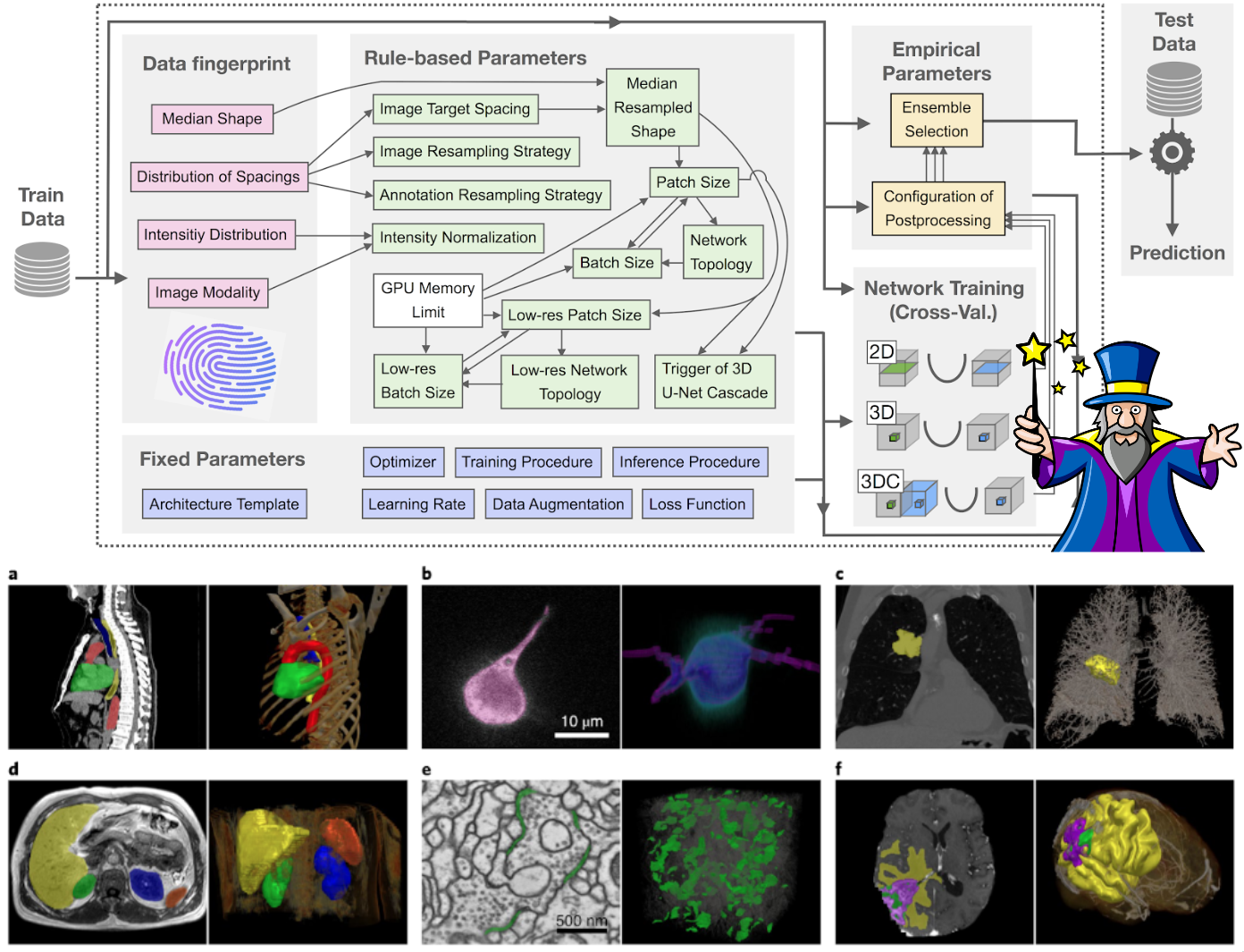
nnU-Net is a semantic segmentation framework that automatically adapts its pipeline to a dataset. It analyzes the training data, creates a dataset fingerprint, configures suitable U-Net variants, and provides an end-to-end workflow from preprocessing to training, model selection, and inference.
It is primarily designed for supervised biomedical image segmentation, but it also works well as a strong baseline and development framework for researchers working on new segmentation methods.
If you are looking for nnU-Net v1, use the v1 branch. If you are migrating from v1, start with the TLDR migration guide.
Start Here
- First-time setup: Installation and setup
- First run on your own data: Getting Started
- Task-oriented docs: How-to Guides
- Formats, commands, and configuration details: Reference
- Concepts and rationale: Explanation
Quick Install
Install PyTorch for your hardware first, then install nnU-Net:
pip install nnunetv2
For the full setup, including nnUNet_raw, nnUNet_preprocessed, and nnUNet_results, see Installation and setup.
Documentation
Start with the documentation home.
Useful entry points:
- New users: Getting Started
- Dataset preparation: Prepare a dataset
- Training workflow: Train models
- Inference workflow: Run inference
- Recommended residual encoder presets: Residual Encoder Presets in nnU-Net
- Finetuning from nnssl self-supervised checkpoints: Finetune from nnssl checkpoints
- Contributing: CONTRIBUTING.md
Scope
nnU-Net is built for supervised semantic segmentation. It supports 2D and 3D data, arbitrary channel definitions, multiple image formats, and dataset-specific adaptation of preprocessing and network configuration.
It performs particularly well in training-from-scratch settings such as biomedical datasets, challenge datasets, and non-standard imaging problems where off-the-shelf natural-image pretrained models are often a poor fit.
For a concise overview of the design, see How nnU-Net works.
Citation
Please cite the following paper when using nnU-Net:
Isensee, F., Jaeger, P. F., Kohl, S. A., Petersen, J., & Maier-Hein, K. H. (2021).
nnU-Net: a self-configuring method for deep learning-based biomedical image segmentation.
Nature Methods, 18(2), 203-211.
Additional recent work on residual encoder presets and benchmarking:
Project Notes
- nnU-Net v2 is a complete reimplementation of the original nnU-Net with improved code structure and extensibility.
- Not every dataset creates every configuration. For example, the cascade is only generated when the dataset characteristics justify it.
- Detailed historical changes are summarized in What is different in v2?.
Acknowledgements

nnU-Net is developed and maintained by the Applied Computer Vision Lab (ACVL) of Helmholtz Imaging and the Division of Medical Image Computing at the German Cancer Research Center (DKFZ).
Contributors
(top 30 of 99)


Similar repos


Languages
Python
98.9%
Shell
1.1%
README
nnU-Net
nnU-Net is a semantic segmentation framework that automatically adapts its pipeline to a dataset. It analyzes the training data, creates a dataset fingerprint, configures suitable U-Net variants, and provides an end-to-end workflow from preprocessing to training, model selection, and inference.
It is primarily designed for supervised biomedical image segmentation, but it also works well as a strong baseline and development framework for researchers working on new segmentation methods.
If you are looking for nnU-Net v1, use the v1 branch. If you are migrating from v1, start with the TLDR migration guide.
Start Here
- First-time setup: Installation and setup
- First run on your own data: Getting Started
- Task-oriented docs: How-to Guides
- Formats, commands, and configuration details: Reference
- Concepts and rationale: Explanation
Quick Install
Install PyTorch for your hardware first, then install nnU-Net:
pip install nnunetv2
For the full setup, including nnUNet_raw, nnUNet_preprocessed, and nnUNet_results, see Installation and setup.
Documentation
Start with the documentation home.
Useful entry points:
- New users: Getting Started
- Dataset preparation: Prepare a dataset
- Training workflow: Train models
- Inference workflow: Run inference
- Recommended residual encoder presets: Residual Encoder Presets in nnU-Net
- Finetuning from nnssl self-supervised checkpoints: Finetune from nnssl checkpoints
- Contributing: CONTRIBUTING.md
Scope
nnU-Net is built for supervised semantic segmentation. It supports 2D and 3D data, arbitrary channel definitions, multiple image formats, and dataset-specific adaptation of preprocessing and network configuration.
It performs particularly well in training-from-scratch settings such as biomedical datasets, challenge datasets, and non-standard imaging problems where off-the-shelf natural-image pretrained models are often a poor fit.
For a concise overview of the design, see How nnU-Net works.
Citation
Please cite the following paper when using nnU-Net:
Isensee, F., Jaeger, P. F., Kohl, S. A., Petersen, J., & Maier-Hein, K. H. (2021).
nnU-Net: a self-configuring method for deep learning-based biomedical image segmentation.
Nature Methods, 18(2), 203-211.
Additional recent work on residual encoder presets and benchmarking:
Project Notes
- nnU-Net v2 is a complete reimplementation of the original nnU-Net with improved code structure and extensibility.
- Not every dataset creates every configuration. For example, the cascade is only generated when the dataset characteristics justify it.
- Detailed historical changes are summarized in What is different in v2?.
Acknowledgements
nnU-Net is developed and maintained by the Applied Computer Vision Lab (ACVL) of Helmholtz Imaging and the Division of Medical Image Computing at the German Cancer Research Center (DKFZ).
Similar repos
Contributors
(top 30 of 99)
Languages
Python
98.9%
Shell
1.1%