Exploring Fairness in Long-Term Prediction of Type 2 Diabetes Microvascular Complications (AIM-FM workshop @ NeurIPS 24)
Jupyter Notebook
0
17 commits
updated Dec 4, 2024
This repository contains the code for the workshop paper Exploring Fairness in Long-Term Prediction of Type 2 Diabetes Microvascular Complications presented at the '24 NeurIPS workshop AIM-FM: Advancements In Medical Foundation Models: Explainability, Robustness, Security, and Beyond
Foundation models are increasingly being used and applied to a variety of data sources, including structured electronic healthcare records (EHR) for disease risk prediction. It is currently not clear how these may be perpetuating existing biases known in the data or how this may vary over time.
In this paper we leveraged large scale EHR data to explore the performance of pre-trained clinical language models on disease prediction tasks over different time windows. We predicted the risk of microvascular complications (nephropathy, neuropathy and retinopathy) in individuals living with Type 2 Diabetes over 6-, 12-, 36- and 60-month risk prediction windows and measured differences across sensitivity, specificity and demographic parity.
We demonstrated that models have statistically significant gaps in performance across different demographic groups, such as ethnic group, sex and level of deprivation. The performance gaps were particularly pronounced for ethnic minority groups, and those with missing or unknown ethnicity status. There was also indications that ethnic group bias may decrease over time, with longer prediction windows, such 36- or 60-months showing fewer statistically significant gaps than shorter time windows.
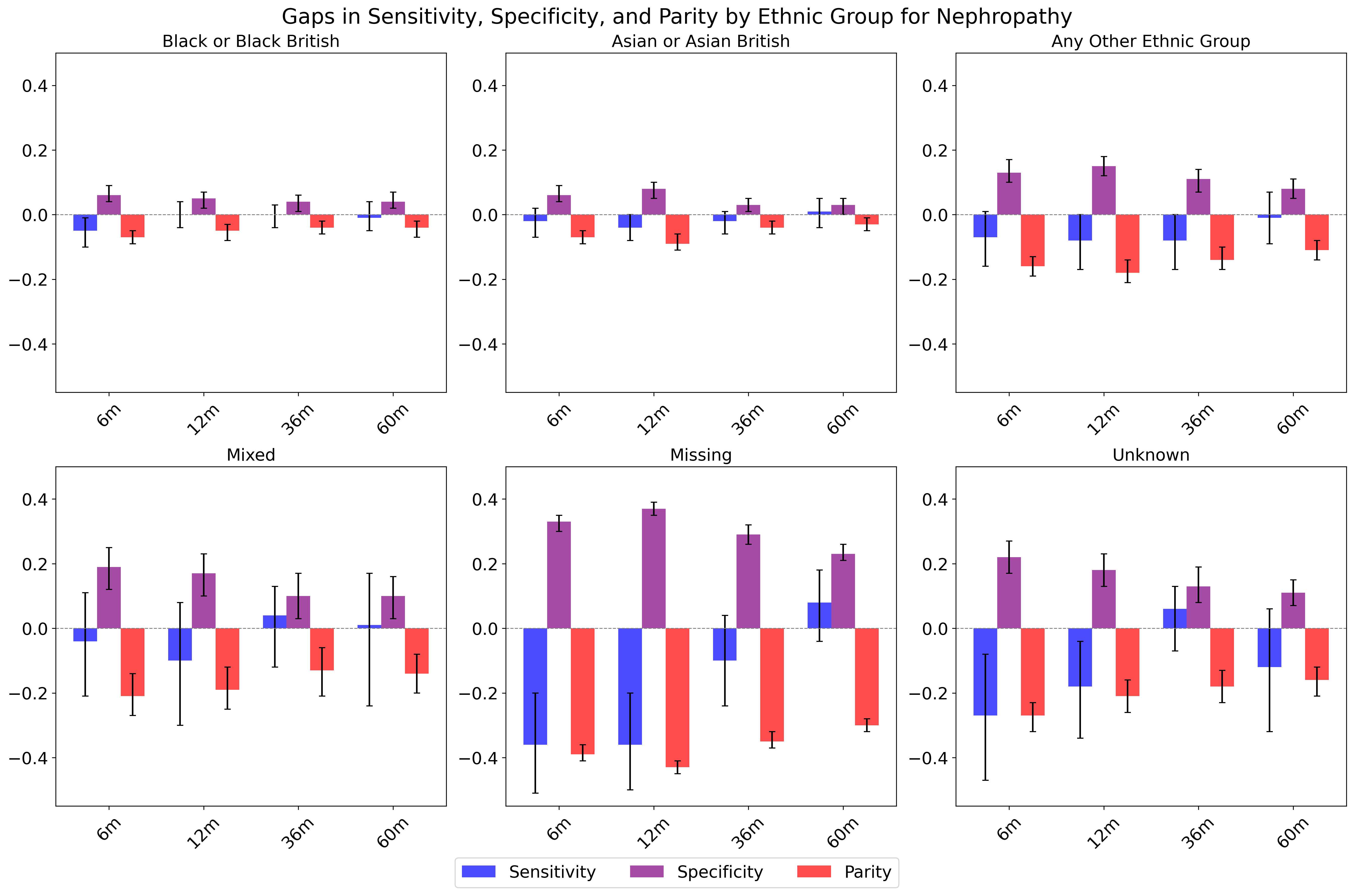 Gaps in performance on sensitivity, specificity and demographic parity on nephropathy task
fine_tune_model.py: contains code to fine tune pre-trained clinical language models
fairness-gap.py: calculates the gaps in performance and conducts bootstrapping
graphs.ipynb: builds the graph you see above
token_length.py: explore differences in token length at different prediction windows (spoiler, the majority of EHR text is truncated when using the standard 512 truncation)
Exploring Fairness in Long-Term Prediction of Type 2 Diabetes Microvascular Complications (AIM-FM workshop @ NeurIPS 24)
Jupyter Notebook
0
17 commits
updated Dec 4, 2024
This repository contains the code for the workshop paper Exploring Fairness in Long-Term Prediction of Type 2 Diabetes Microvascular Complications presented at the '24 NeurIPS workshop AIM-FM: Advancements In Medical Foundation Models: Explainability, Robustness, Security, and Beyond
Foundation models are increasingly being used and applied to a variety of data sources, including structured electronic healthcare records (EHR) for disease risk prediction. It is currently not clear how these may be perpetuating existing biases known in the data or how this may vary over time.
In this paper we leveraged large scale EHR data to explore the performance of pre-trained clinical language models on disease prediction tasks over different time windows. We predicted the risk of microvascular complications (nephropathy, neuropathy and retinopathy) in individuals living with Type 2 Diabetes over 6-, 12-, 36- and 60-month risk prediction windows and measured differences across sensitivity, specificity and demographic parity.
We demonstrated that models have statistically significant gaps in performance across different demographic groups, such as ethnic group, sex and level of deprivation. The performance gaps were particularly pronounced for ethnic minority groups, and those with missing or unknown ethnicity status. There was also indications that ethnic group bias may decrease over time, with longer prediction windows, such 36- or 60-months showing fewer statistically significant gaps than shorter time windows.
Gaps in performance on sensitivity, specificity and demographic parity on nephropathy task
fine_tune_model.py: contains code to fine tune pre-trained clinical language models
fairness-gap.py: calculates the gaps in performance and conducts bootstrapping
graphs.ipynb: builds the graph you see above
token_length.py: explore differences in token length at different prediction windows (spoiler, the majority of EHR text is truncated when using the standard 512 truncation)