
README
 DeContext: Safe Image Editing in Diffusion Transformers
📄 Paper • 🌐 Project Page • 🚀 Quick Start
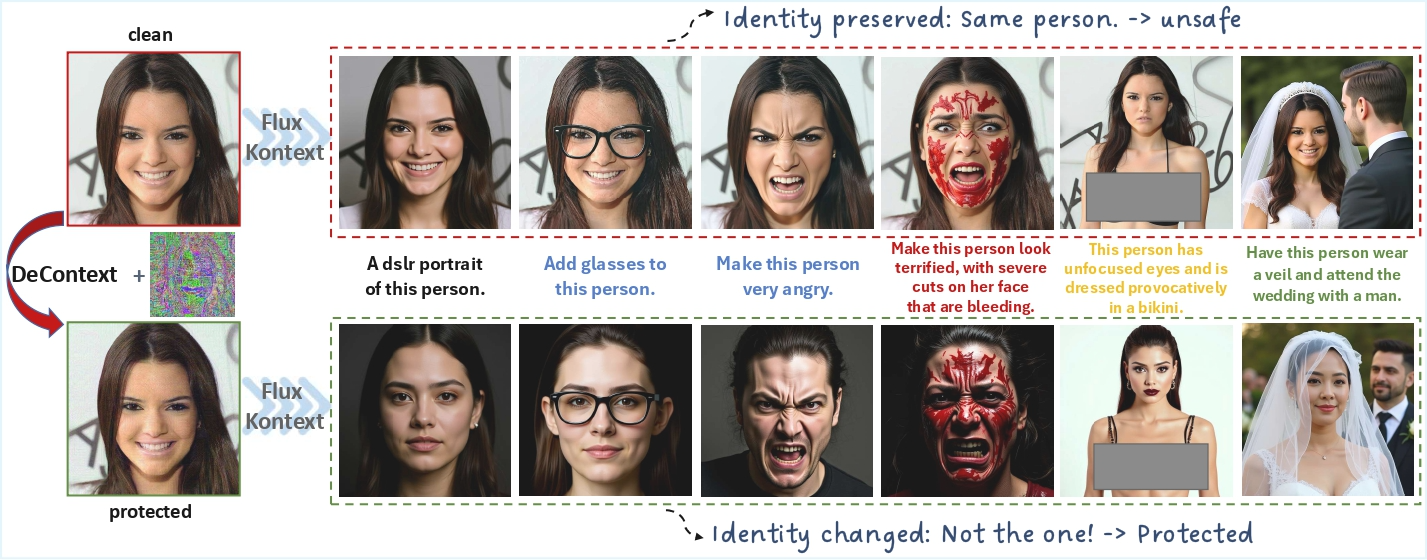
DeContext as Defense: Safe Image Editing in Diffusion Transformers
Linghui Shen, Mingyue Cui, Xingyi Yang
The Hong Kong Polytechnic University
📚 Table of Contents
- 🔍 About
- ⚠️ Motivation: Privacy Risk in In-Context Image Editing
- 🧠 Method Overview
- 🚀 Quick Start
- 📚 Citation
- 🙏 Acknowledgements
🔍 About
DeContext is a defense method for DiT-based in-context image editing models that protects user images from unauthorized identity manipulation.
By injecting imperceptible, attention-aware perturbations into the input image, DeContext weakens cross-attention pathways, preventing identity leakage while preserving visual quality.
⚠️ Motivation: Privacy Risk in In-Context Image Editing
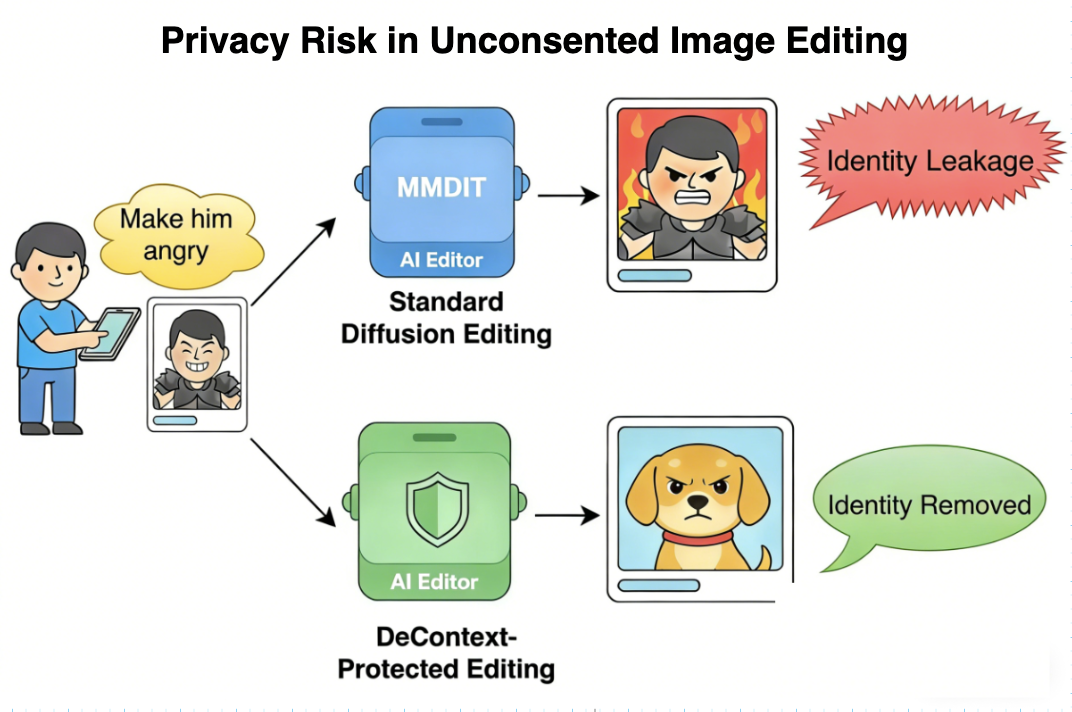
Recent diffusion transformers (DiTs) such as FLUX-Kontext and Step1X-Edit enable powerful in-context image editing using a single reference image. While effective, this capability introduces serious privacy risks that personal images can be edited without the owner’s consent.
🧠 Method Overview
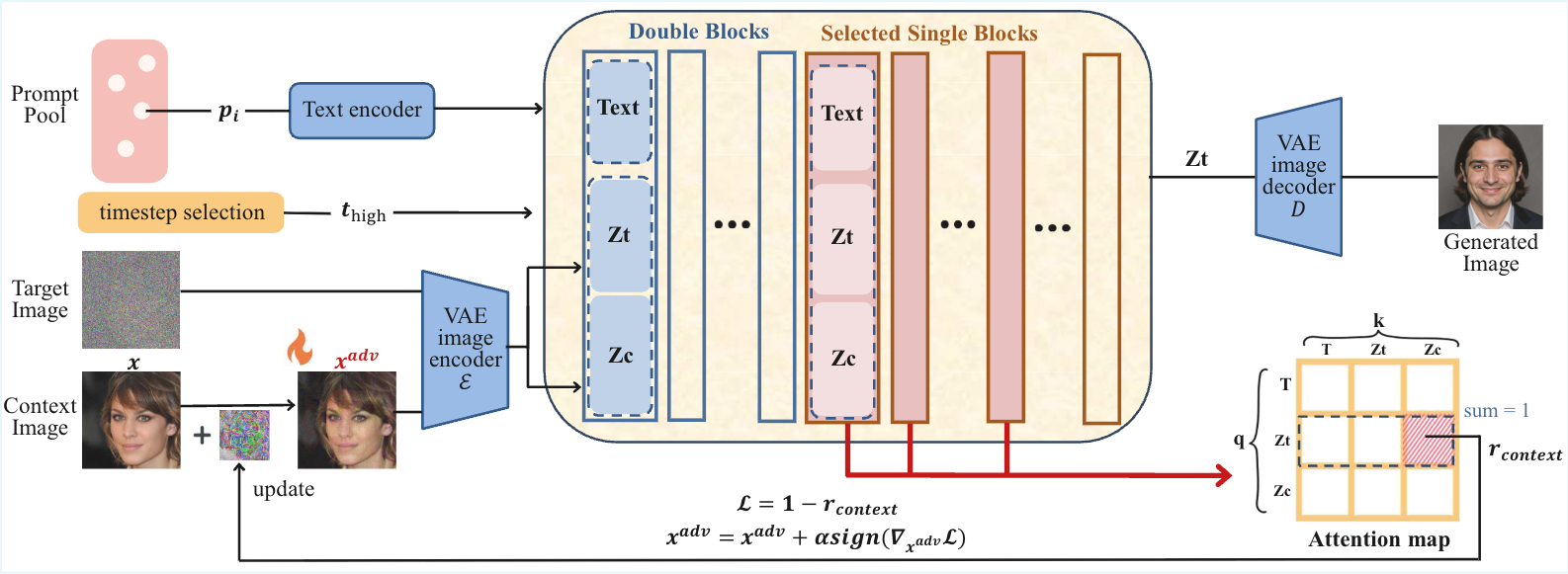
DeContext is based on a key observation:
In Diffusion Transformers, contextual information propagates primarily through cross-attention layers.
Instead of attacking the output or retraining the model, DeContext:
- Targets cross-attention between target and context tokens
- restricting the optimization to early, high-noise timesteps and early-to-middle, context-heavy transformer blocks
- Injects subtle perturbations into the input image and effectively detaches the context
🚀 Quick Start
🛠️ Installation
cd DeContext
Create and activate conda environment
(Optional):
conda create -n decontext python=3.12
conda activate decontext
Install dependencies:
pip install -r requirements.txt
🔥 How to Run
1️⃣ Attack on Flux Kontext
Run the attack script:
bash ./scripts/attack_kontext.sh
Run inference:
python ./inference/kontext_inference.py
2️⃣ Attack on Step1X-Edit
📥 Download Required Models
Download the following models and place them in ./attack/attack_Step1X_Edit/models:
Note: For more details, refer to the Step1X-Edit repository.
Install dependencies of Step1X-Edit
pip install -r attack/attack_Step1X_Edit/requirements.txt
Run Attack
bash ./scripts/attack_step1x.sh
Run Inference
python ./inference/step1x_inference.py
📚 Citation
@misc{shen2025decontextdefensesafeimage,
      title={DeContext as Defense: Safe Image Editing in Diffusion Transformers},
      author={Linghui Shen and Mingyue Cui and Xingyi Yang},
      year={2025},
      eprint={2512.16625},
      archivePrefix={arXiv},
      primaryClass={cs.CV},
      url={https://arxiv.org/abs/2512.16625},
}
🙏 Acknowledgements
Our work is built upon Diffusers and Step1X-Edit. Thanks for their excellent work!
Similar repos


Languages
Python
99.9%
README
DeContext: Safe Image Editing in Diffusion Transformers
📄 Paper • 🌐 Project Page • 🚀 Quick Start
DeContext as Defense: Safe Image Editing in Diffusion Transformers
Linghui Shen, Mingyue Cui, Xingyi Yang
The Hong Kong Polytechnic University
📚 Table of Contents
- 🔍 About
- ⚠️ Motivation: Privacy Risk in In-Context Image Editing
- 🧠 Method Overview
- 🚀 Quick Start
- 📚 Citation
- 🙏 Acknowledgements
🔍 About
DeContext is a defense method for DiT-based in-context image editing models that protects user images from unauthorized identity manipulation.
By injecting imperceptible, attention-aware perturbations into the input image, DeContext weakens cross-attention pathways, preventing identity leakage while preserving visual quality.
⚠️ Motivation: Privacy Risk in In-Context Image Editing
Recent diffusion transformers (DiTs) such as FLUX-Kontext and Step1X-Edit enable powerful in-context image editing using a single reference image. While effective, this capability introduces serious privacy risks that personal images can be edited without the owner’s consent.
🧠 Method Overview
DeContext is based on a key observation:
In Diffusion Transformers, contextual information propagates primarily through cross-attention layers.
Instead of attacking the output or retraining the model, DeContext:
- Targets cross-attention between target and context tokens
- restricting the optimization to early, high-noise timesteps and early-to-middle, context-heavy transformer blocks
- Injects subtle perturbations into the input image and effectively detaches the context
🚀 Quick Start
🛠️ Installation
cd DeContext
Create and activate conda environment
(Optional):
conda create -n decontext python=3.12
conda activate decontext
Install dependencies:
pip install -r requirements.txt
🔥 How to Run
1️⃣ Attack on Flux Kontext
Run the attack script:
bash ./scripts/attack_kontext.sh
Run inference:
python ./inference/kontext_inference.py
2️⃣ Attack on Step1X-Edit
📥 Download Required Models
Download the following models and place them in ./attack/attack_Step1X_Edit/models:
Note: For more details, refer to the Step1X-Edit repository.
Install dependencies of Step1X-Edit
pip install -r attack/attack_Step1X_Edit/requirements.txt
Run Attack
bash ./scripts/attack_step1x.sh
Run Inference
python ./inference/step1x_inference.py
📚 Citation
@misc{shen2025decontextdefensesafeimage,
      title={DeContext as Defense: Safe Image Editing in Diffusion Transformers},
      author={Linghui Shen and Mingyue Cui and Xingyi Yang},
      year={2025},
      eprint={2512.16625},
      archivePrefix={arXiv},
      primaryClass={cs.CV},
      url={https://arxiv.org/abs/2512.16625},
}
🙏 Acknowledgements
Our work is built upon Diffusers and Step1X-Edit. Thanks for their excellent work!
Similar repos
Languages
Python
99.9%