
Local Realtime/Live Speech Transcription; Rust Implementation of Voxtral-Realtime-4B
Rust
8
34 commits
updated Mar 23, 2026
README
Voicet
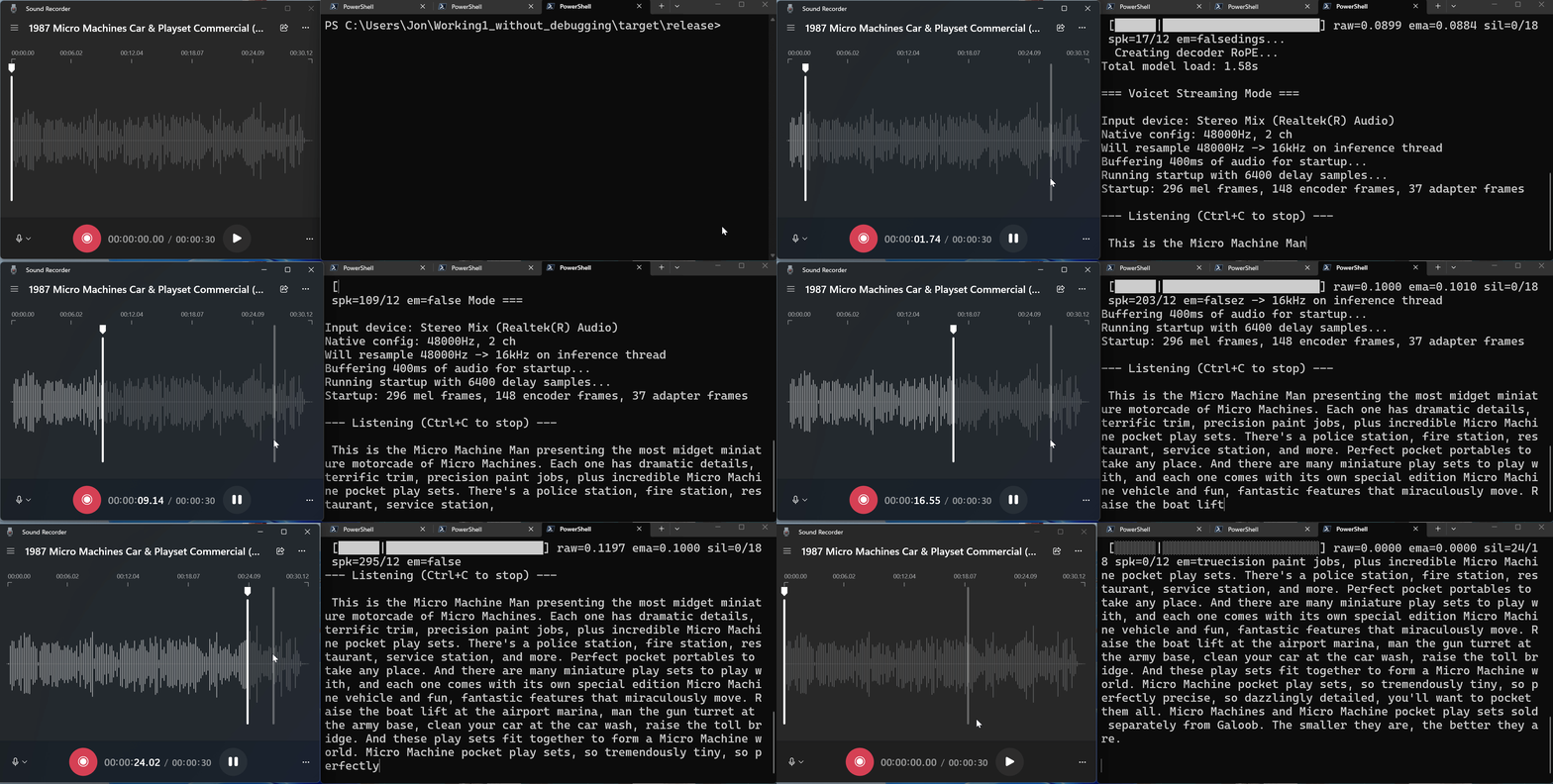
Ultrafast, ultra efficient Real-time (live) speech-to-text on your GPU. No cloud, no Python, no API keys. Words appear as you speak them inside your app of choice, hotkey optional.
Support for RTX 3000 series and up (>11gb VRAM); DGX Spark [untested]. Windows/Linux
I found it to be slightly faster than speechmatics (probably because it's local) and just as accurate.
Voxtral Mini 4B Realtime is a relatively large model for speech to text, but in return it gets you insanely low latency and high accuracy. So I built this app on top of it to optimize the best I could.
Result: <3s cold load time, only 51w power consumption on an RTX 5080.
Automatic paragraph breaks on speech pauses (configurable)
Features
Lightweight tray icon and UI (right click to pause transcription, right click to open settings) [ all settings are available in the UI, saved to settings.ini]
Fastest implementation of Voxtral Mini 4B Realtime in CUDA on the web. 5x realtime on RTX 5080.
Type mode [--type] supports dictation directly into your text editor (Word, Claude Code). Just speak and words appear.
Automatic paragraph breaks via silence detection (configurable)
Offline transcription mode with enhanced accuracy of wav files
Hotkey mode in case you want to pause the model while not in use, keeps model preloaded and primed on GPU
Why Rust instead of Python?
The official HuggingFace pipeline works, but it carries a lot of weight:
| Voicet (Rust) | HF Transformers (Python) | |
|---|---|---|
| Runtime | Single 35 MB binary | Python + PyTorch + Transformers (~5 GB installed) |
| Cold Startup | 2.5s (mmap weights directly) | 14.4s (Python imports +weight loading) |
| Throughput (RTX 5080) | 63 tok/s (5x real-time) | 24.5 tok/s (2.1x real-time) |
| Realtime Power Consumption (RTX 5080) | 51W | 110W |
| Streaming | Native — causal architecture, incremental mel/encoder/decoder | Requires custom pipeline code |
| Dependencies | Just CUDA runtime | Python ecosystem, pip, conda, venv |
| Deployment | one binary + Mistral model | Reproduce Python environment |
Performance comes from:
- Flash Attention v2 — fused CUDA kernels for both encoder (32 layers) and decoder (26 layers)
- Fused RMSNorm — single CUDA kernel replaces 7 ops, saves ~530 kernel launches per token
- Precomputed Ada-RMSNorm conditioning — 26 per-layer scale tensors computed once, not every forward pass
- Cached lm_head transpose — avoids transposing 800 MB every token
- BF16 throughout — matches PyTorch default, half the memory of FP32
Other features: Resumable requests. Processes audio pipeline in parallel with gpu compute, eliminating gpu compute latency
Quick start
Prerequisites
- NVIDIA GPU with CUDA support (tested on RTX 5080)
- CUDA Toolkit installed (Linux only - included for Windows release)
- Model weights: download Voxtral-Mini-4B-Realtime into the voicet.exe directory. You only need consolidated.safetensors and tekken.json
Build
cargo build --release
Run
Live streaming — speak into your mic:
./target/release/voicet
Type Mode — speak into your mic, words are typed into your document
./target/release/voicet --type
Offline transcription — transcribe a WAV file:
./target/release/voicet path/to/audio.wav
WAV files are automatically resampled to 16 kHz mono if needed.
How it works
16 kHz audio
  → Mel spectrogram (128 bins, 10ms frames)
    → Conv stem (stride-2 downsample)
      → 32-layer causal encoder (sliding window attention, 750 frames)
        → Adapter (4:1 downsample)
          → 26-layer decoder (GQA, Ada-RMSNorm delay conditioning)
            → Token output every 80ms
The model is causal — each frame only sees past context, never the future. This is what makes real-time streaming possible. (Whisper, by contrast, is bidirectional and needs the full audio before it can transcribe.)
The streaming pipeline buffers 320ms of audio for startup, then processes incrementally: 8 mel frames accumulate, run through the conv stem, encoder chunk, adapter, and decoder to emit one token every 80ms.
See ARCHITECTURE.md for full details.
Configuration
| CLI flag | Default | Effect |
|---|---|---|
--delay | 4 (320ms) | Accuracy vs latency. Higher = more lookahead. Auto-set to 20 in offline mode. |
--silence-threshold | 0.006 | RMS energy below which audio counts as silence. |
--silence-flush | delay+14 | Consecutive silent chunks before paragraph break. |
--min-speech | 12 (960ms) | Minimum speech duration before silence detection activates. |
--rms-ema | 0.3 | EMA smoothing factor for speech detection. |
--hotkey | none | Global hotkey to toggle recording (F1-F12, ScrollLock, Pause). |
--type | off | Type transcribed words directly into the focused app. |
--model-dir | . | Directory containing model files. |
--device | 0 | CUDA device index. |
Dependencies
Built on candle, a minimal ML framework for Rust. A vendored fork of candle-flash-attn is included in candle-fork/ that compiles only the CUDA kernels this model needs (BF16, head_dim 64/128), reducing binary size from 190 MB to 35 MB. Builds work fully offline.
License
MIT
Contributors

34 commits
Similar repos


Languages
Rust
76.7%
Metal
6.7%
C++
6.7%
Cuda
5.0%
Python
2.6%
HTML
1.8%
Local Realtime/Live Speech Transcription; Rust Implementation of Voxtral-Realtime-4B
Rust
8
34 commits
updated Mar 23, 2026
README
Voicet
Ultrafast, ultra efficient Real-time (live) speech-to-text on your GPU. No cloud, no Python, no API keys. Words appear as you speak them inside your app of choice, hotkey optional.
Support for RTX 3000 series and up (>11gb VRAM); DGX Spark [untested]. Windows/Linux
I found it to be slightly faster than speechmatics (probably because it's local) and just as accurate.
Voxtral Mini 4B Realtime is a relatively large model for speech to text, but in return it gets you insanely low latency and high accuracy. So I built this app on top of it to optimize the best I could.
Result: <3s cold load time, only 51w power consumption on an RTX 5080.
Automatic paragraph breaks on speech pauses (configurable)
Features
Lightweight tray icon and UI (right click to pause transcription, right click to open settings) [ all settings are available in the UI, saved to settings.ini]
Fastest implementation of Voxtral Mini 4B Realtime in CUDA on the web. 5x realtime on RTX 5080.
Type mode [--type] supports dictation directly into your text editor (Word, Claude Code). Just speak and words appear.
Automatic paragraph breaks via silence detection (configurable)
Offline transcription mode with enhanced accuracy of wav files
Hotkey mode in case you want to pause the model while not in use, keeps model preloaded and primed on GPU
Why Rust instead of Python?
The official HuggingFace pipeline works, but it carries a lot of weight:
| Voicet (Rust) | HF Transformers (Python) | |
|---|---|---|
| Runtime | Single 35 MB binary | Python + PyTorch + Transformers (~5 GB installed) |
| Cold Startup | 2.5s (mmap weights directly) | 14.4s (Python imports +weight loading) |
| Throughput (RTX 5080) | 63 tok/s (5x real-time) | 24.5 tok/s (2.1x real-time) |
| Realtime Power Consumption (RTX 5080) | 51W | 110W |
| Streaming | Native — causal architecture, incremental mel/encoder/decoder | Requires custom pipeline code |
| Dependencies | Just CUDA runtime | Python ecosystem, pip, conda, venv |
| Deployment | one binary + Mistral model | Reproduce Python environment |
Performance comes from:
- Flash Attention v2 — fused CUDA kernels for both encoder (32 layers) and decoder (26 layers)
- Fused RMSNorm — single CUDA kernel replaces 7 ops, saves ~530 kernel launches per token
- Precomputed Ada-RMSNorm conditioning — 26 per-layer scale tensors computed once, not every forward pass
- Cached lm_head transpose — avoids transposing 800 MB every token
- BF16 throughout — matches PyTorch default, half the memory of FP32
Other features: Resumable requests. Processes audio pipeline in parallel with gpu compute, eliminating gpu compute latency
Quick start
Prerequisites
- NVIDIA GPU with CUDA support (tested on RTX 5080)
- CUDA Toolkit installed (Linux only - included for Windows release)
- Model weights: download Voxtral-Mini-4B-Realtime into the voicet.exe directory. You only need consolidated.safetensors and tekken.json
Build
cargo build --release
Run
Live streaming — speak into your mic:
./target/release/voicet
Type Mode — speak into your mic, words are typed into your document
./target/release/voicet --type
Offline transcription — transcribe a WAV file:
./target/release/voicet path/to/audio.wav
WAV files are automatically resampled to 16 kHz mono if needed.
How it works
16 kHz audio
  → Mel spectrogram (128 bins, 10ms frames)
    → Conv stem (stride-2 downsample)
      → 32-layer causal encoder (sliding window attention, 750 frames)
        → Adapter (4:1 downsample)
          → 26-layer decoder (GQA, Ada-RMSNorm delay conditioning)
            → Token output every 80ms
The model is causal — each frame only sees past context, never the future. This is what makes real-time streaming possible. (Whisper, by contrast, is bidirectional and needs the full audio before it can transcribe.)
The streaming pipeline buffers 320ms of audio for startup, then processes incrementally: 8 mel frames accumulate, run through the conv stem, encoder chunk, adapter, and decoder to emit one token every 80ms.
See ARCHITECTURE.md for full details.
Configuration
| CLI flag | Default | Effect |
|---|---|---|
--delay | 4 (320ms) | Accuracy vs latency. Higher = more lookahead. Auto-set to 20 in offline mode. |
--silence-threshold | 0.006 | RMS energy below which audio counts as silence. |
--silence-flush | delay+14 | Consecutive silent chunks before paragraph break. |
--min-speech | 12 (960ms) | Minimum speech duration before silence detection activates. |
--rms-ema | 0.3 | EMA smoothing factor for speech detection. |
--hotkey | none | Global hotkey to toggle recording (F1-F12, ScrollLock, Pause). |
--type | off | Type transcribed words directly into the focused app. |
--model-dir | . | Directory containing model files. |
--device | 0 | CUDA device index. |
Dependencies
Built on candle, a minimal ML framework for Rust. A vendored fork of candle-flash-attn is included in candle-fork/ that compiles only the CUDA kernels this model needs (BF16, head_dim 64/128), reducing binary size from 190 MB to 35 MB. Builds work fully offline.
License
MIT
Similar repos
Contributors
34 commits
Languages
Rust
76.7%
Metal
6.7%
C++
6.7%
Cuda
5.0%
Python
2.6%
HTML
1.8%