
FastSLM: Hierarchical Temporal Abstraction for Efficient Long-Form Speech Adaptation
Python
1
134 commits
updated Sep 2, 2026
README
🚀 FastSLM: Hierarchical Temporal Abstraction for Efficient Long-Form Speech Adaptation


🎉 Accepted at EMNLP 2026 Findings
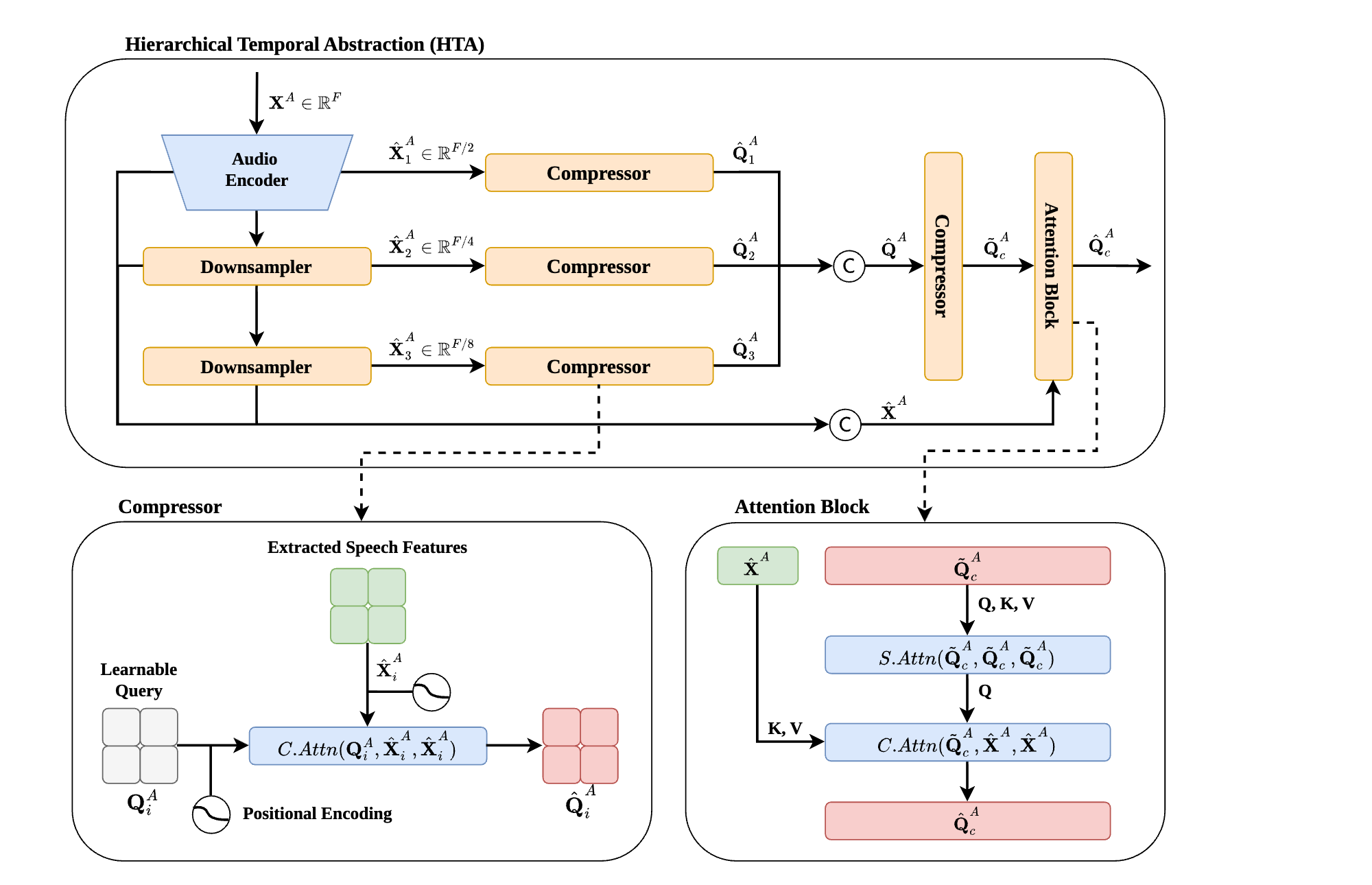
FastSLM is a token-efficient Speech-Language Model (SLM) for long-form speech understanding. It introduces the Hierarchical Temporal Abstractor (HTA), which progressively compresses speech representations to only 1.67 tokens/sec while preserving linguistic information.
🌟 Features
- 🔊 Hierarchical Temporal Abstractor (HTA): Progressively compresses high-frame-rate speech features while preserving both local acoustic details and global semantic context.
- ⚡ Three-stage Training Pipeline: Uses accessible ASR corpora for speech adaptation, followed by multi-task instruction tuning.
- 🧠 LLM Adaptation: Adapts pre-trained LLMs to the speech modality.
📊 Experimental Results
FastSLM achieves a strong balance between speech understanding performance and computational efficiency while using only 1.67 speech tokens/sec.
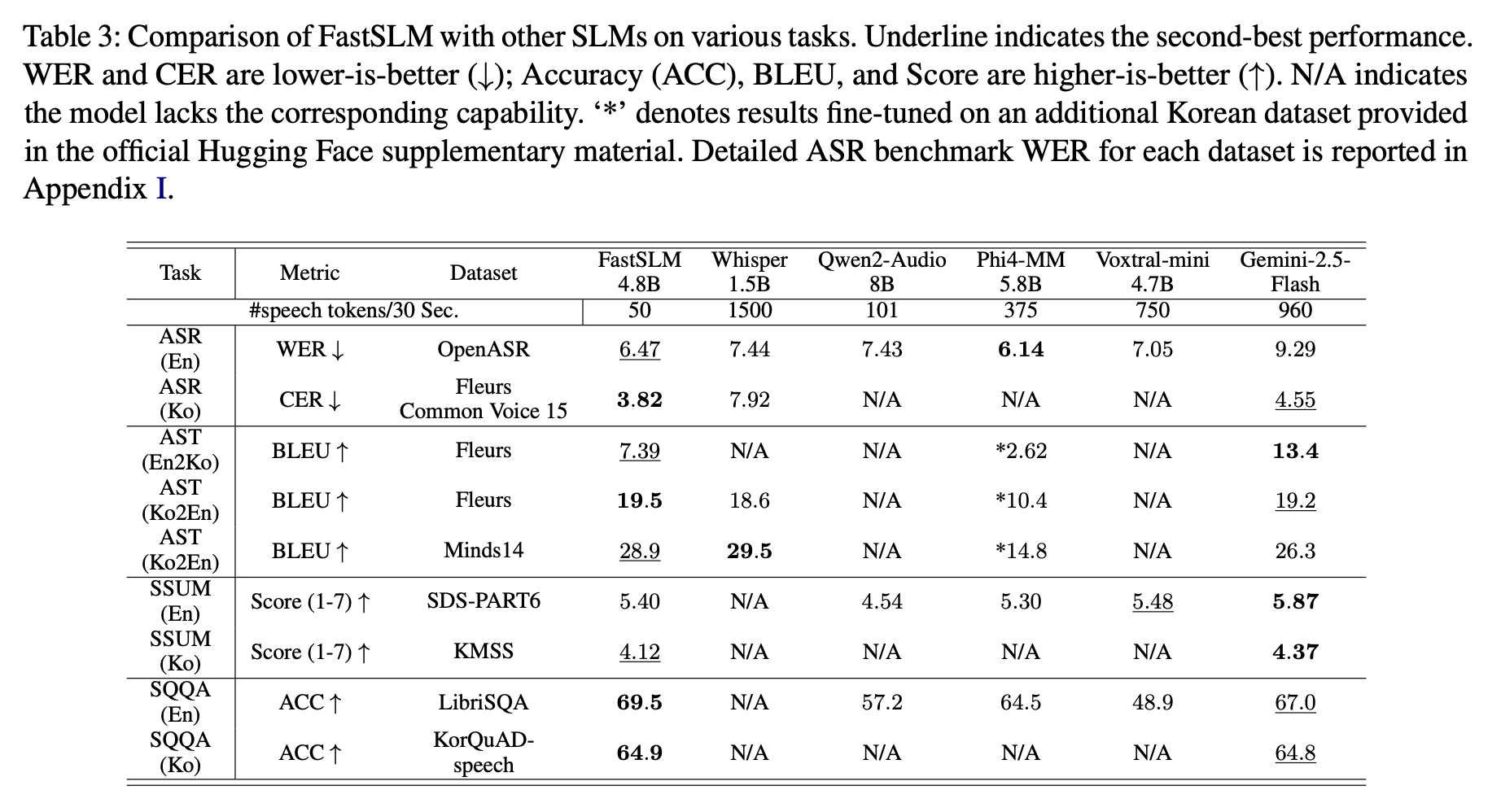
These results show that FastSLM maintains competitive performance across diverse speech-language tasks despite its highly compressed speech representation.
Long-form Scalability
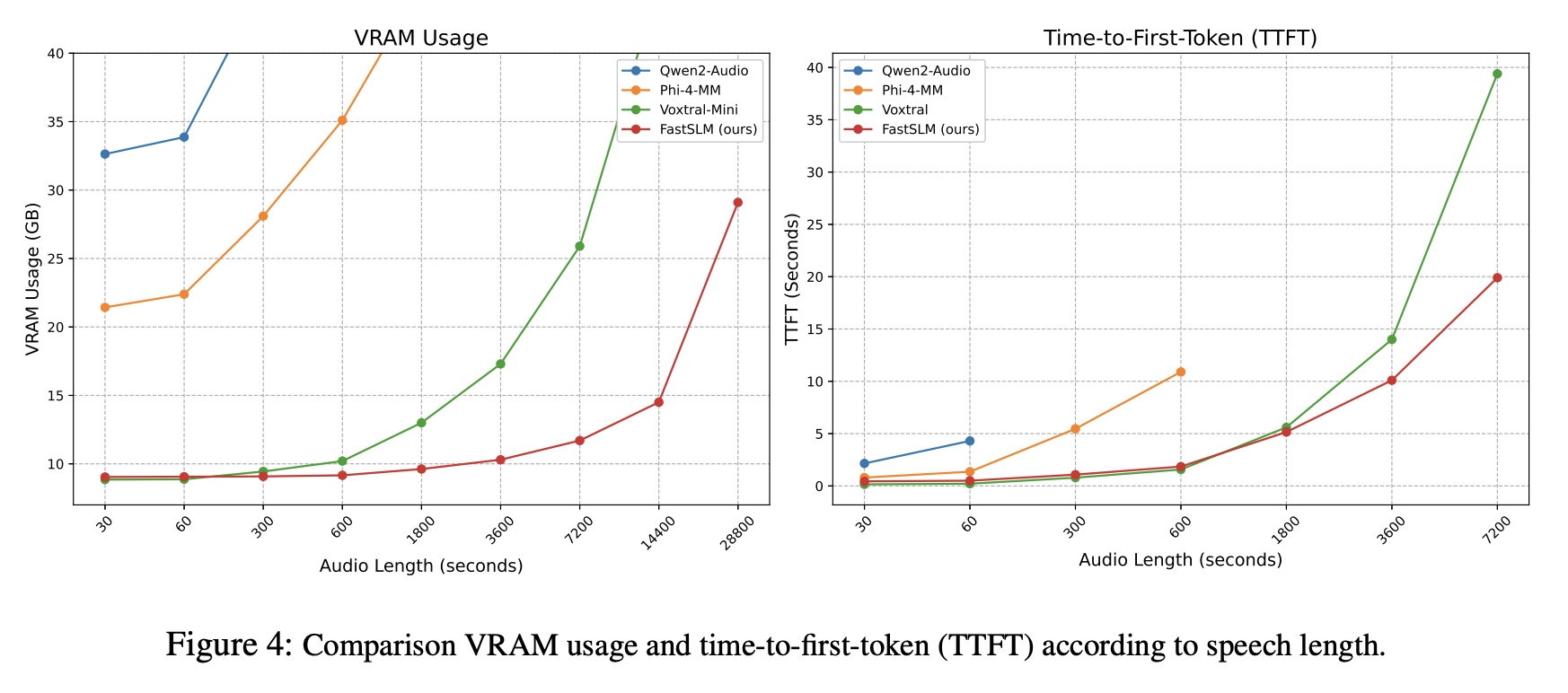
FastSLM is designed for efficient long-context speech processing. In our long-form scalability experiments, FastSLM exhibits near-linear memory growth and can process speech inputs of up to 8 hours using less than 30 GB of GPU memory on a 40 GB A100 GPU.
🔍 Hierarchical Attention Visualization
To analyze how HTA processes long-form speech, we visualize the cross-attention distributions across its hierarchical stages.
As speech duration increases, the attention distribution progressively shifts toward deeper abstraction stages. Early stages primarily preserve fine-grained local acoustic information, while deeper stages increasingly capture broader temporal and semantic context.
This behavior illustrates how HTA gradually transforms dense frame-level speech representations into compact higher-level representations instead of performing aggressive compression in a single step.
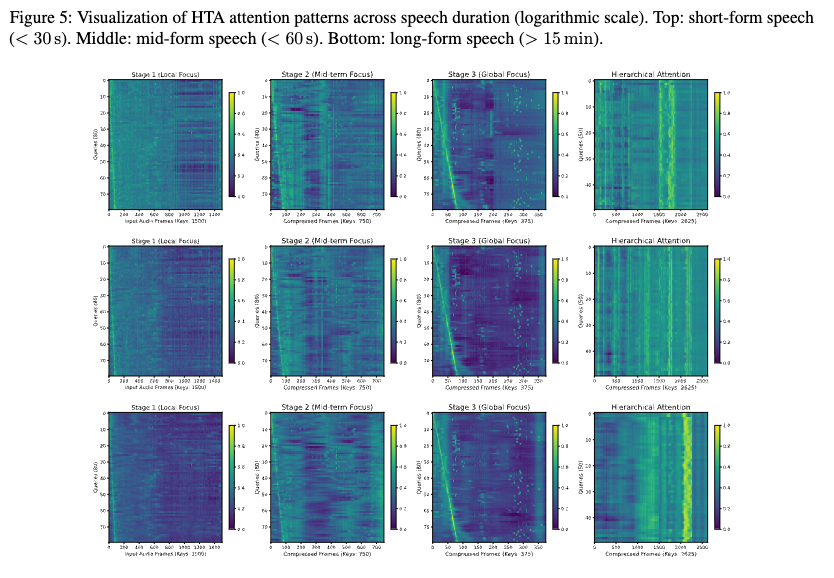
Interpretation: HTA progressively reallocates attention across hierarchical levels as the input duration increases, supporting multi-scale temporal abstraction for long-form speech.
⚙️ Installation
- System Requirements
To process audio files, you need to install
ffmpegon your system.
sudo apt update
sudo apt install ffmpeg
git clone https://github.com/Lee-junseok1025/FastSLM
cd FastSLM
pip install -r requirements.txt
📥 PyTorch Model
- Model weights available here
🤗 Hugging Face Models
import torch
import torchaudio
from models.model import FastSLM

model = FastSLM(
    embed_dim=2560, # LLM hidden size
    speech_dim=1280, # Audio Encoder hidden size
    lora=True, # LoRA activate
    lora_r=16, # LoRA Rank
    lora_a=64, # LoRA alpha
    compression_size=50, # Audio token length
).cuda()

checkpoint = torch.load("your_path/Stage3_FastSLM.pt")
model.load_state_dict(check_point)
🎤 Sample Inference
# 1. Load audio
wav_path = "sample_audio/English_audio.wav"
wav,sample_rate  = librosa.load(wav_path)

# 2. Resample to 16 kHz (required by FastSLM)
if sample_rate != 16000:
    audio = librosa.resample(wav,orig_sr=sample_rate,target_sr=16000)
else:
    audio = wav
audio_tensor = torch.tensor((audio,),dtype=torch.float32).cuda()
# 3. Prepare the prompt
# Task Token exists 4 task
# Automatic Speech Recognition: <|ASR|>
# Automatic Speech Translation: <|AST|>
# Speech Summarization: <|SSUM|>
# Spoken Query-based Question Answering: <|SQQA|>
TASK_TOKEN = "<|ASR|>"
AUDIO_TOKEN = "<|audio_bos|><|AUDIO|><|audio_eos|>"
user_prompt = f"{TASK_TOKEN}{AUDIO_TOKEN}\nTranscribe the audio clip into text."

prompt = [{"role": "user", "content": user_prompt}]
input_ids = tokenizer.apply_chat_template(
    prompt,
    add_generation_prompt=True,
    tokenize=True,
    return_tensors='pt'
).to(model.device)

# 5. Perform inference
model.eval()
with torch.no_grad():
    with torch.cuda.amp.autocast(dtype=torch.bfloat16):
        output = model.generate(
            input_ids=token,
            audio=audio_tensor
        )

# 7. Print the transcription result
print("Generated output:", output[0])
⚡ GPU Requirements
FastSLM inference requires a GPU with sufficient memory.
| Task | Recommended GPU | Minimum VRAM |
|---|---|---|
| Inference | NVIDIA A100 / H100 | ≈11 GB |
💡 Mixed Precision (
bfloat16) is recommended to reduce memory usage.
📖 Citation
If you find FastSLM useful in your research, please cite:
@inproceedings{lee2026fastslm,
  title     = {FastSLM: Hierarchical Temporal Abstraction for Efficient Long-Form Speech Adaptation},
  author    = {Lee, Junseok and Chun, Chang-Jae},
  booktitle = {Findings of the Association for Computational Linguistics: EMNLP 2026},
  year      = {2026}
}
Contributors

134 commits
Similar repos




Languages
Python
100.0%
FastSLM: Hierarchical Temporal Abstraction for Efficient Long-Form Speech Adaptation
Python
1
134 commits
updated Sep 2, 2026
README
🚀 FastSLM: Hierarchical Temporal Abstraction for Efficient Long-Form Speech Adaptation
🎉 Accepted at EMNLP 2026 Findings
FastSLM is a token-efficient Speech-Language Model (SLM) for long-form speech understanding. It introduces the Hierarchical Temporal Abstractor (HTA), which progressively compresses speech representations to only 1.67 tokens/sec while preserving linguistic information.
🌟 Features
- 🔊 Hierarchical Temporal Abstractor (HTA): Progressively compresses high-frame-rate speech features while preserving both local acoustic details and global semantic context.
- ⚡ Three-stage Training Pipeline: Uses accessible ASR corpora for speech adaptation, followed by multi-task instruction tuning.
- 🧠 LLM Adaptation: Adapts pre-trained LLMs to the speech modality.
📊 Experimental Results
FastSLM achieves a strong balance between speech understanding performance and computational efficiency while using only 1.67 speech tokens/sec.
These results show that FastSLM maintains competitive performance across diverse speech-language tasks despite its highly compressed speech representation.
Long-form Scalability
FastSLM is designed for efficient long-context speech processing. In our long-form scalability experiments, FastSLM exhibits near-linear memory growth and can process speech inputs of up to 8 hours using less than 30 GB of GPU memory on a 40 GB A100 GPU.
🔍 Hierarchical Attention Visualization
To analyze how HTA processes long-form speech, we visualize the cross-attention distributions across its hierarchical stages.
As speech duration increases, the attention distribution progressively shifts toward deeper abstraction stages. Early stages primarily preserve fine-grained local acoustic information, while deeper stages increasingly capture broader temporal and semantic context.
This behavior illustrates how HTA gradually transforms dense frame-level speech representations into compact higher-level representations instead of performing aggressive compression in a single step.
Interpretation: HTA progressively reallocates attention across hierarchical levels as the input duration increases, supporting multi-scale temporal abstraction for long-form speech.
⚙️ Installation
- System Requirements
To process audio files, you need to install
ffmpegon your system.
sudo apt update
sudo apt install ffmpeg
git clone https://github.com/Lee-junseok1025/FastSLM
cd FastSLM
pip install -r requirements.txt
📥 PyTorch Model
- Model weights available here
🤗 Hugging Face Models
import torch
import torchaudio
from models.model import FastSLM

model = FastSLM(
    embed_dim=2560, # LLM hidden size
    speech_dim=1280, # Audio Encoder hidden size
    lora=True, # LoRA activate
    lora_r=16, # LoRA Rank
    lora_a=64, # LoRA alpha
    compression_size=50, # Audio token length
).cuda()

checkpoint = torch.load("your_path/Stage3_FastSLM.pt")
model.load_state_dict(check_point)
🎤 Sample Inference
# 1. Load audio
wav_path = "sample_audio/English_audio.wav"
wav,sample_rate  = librosa.load(wav_path)

# 2. Resample to 16 kHz (required by FastSLM)
if sample_rate != 16000:
    audio = librosa.resample(wav,orig_sr=sample_rate,target_sr=16000)
else:
    audio = wav
audio_tensor = torch.tensor((audio,),dtype=torch.float32).cuda()
# 3. Prepare the prompt
# Task Token exists 4 task
# Automatic Speech Recognition: <|ASR|>
# Automatic Speech Translation: <|AST|>
# Speech Summarization: <|SSUM|>
# Spoken Query-based Question Answering: <|SQQA|>
TASK_TOKEN = "<|ASR|>"
AUDIO_TOKEN = "<|audio_bos|><|AUDIO|><|audio_eos|>"
user_prompt = f"{TASK_TOKEN}{AUDIO_TOKEN}\nTranscribe the audio clip into text."

prompt = [{"role": "user", "content": user_prompt}]
input_ids = tokenizer.apply_chat_template(
    prompt,
    add_generation_prompt=True,
    tokenize=True,
    return_tensors='pt'
).to(model.device)

# 5. Perform inference
model.eval()
with torch.no_grad():
    with torch.cuda.amp.autocast(dtype=torch.bfloat16):
        output = model.generate(
            input_ids=token,
            audio=audio_tensor
        )

# 7. Print the transcription result
print("Generated output:", output[0])
⚡ GPU Requirements
FastSLM inference requires a GPU with sufficient memory.
| Task | Recommended GPU | Minimum VRAM |
|---|---|---|
| Inference | NVIDIA A100 / H100 | ≈11 GB |
💡 Mixed Precision (
bfloat16) is recommended to reduce memory usage.
📖 Citation
If you find FastSLM useful in your research, please cite:
@inproceedings{lee2026fastslm,
  title     = {FastSLM: Hierarchical Temporal Abstraction for Efficient Long-Form Speech Adaptation},
  author    = {Lee, Junseok and Chun, Chang-Jae},
  booktitle = {Findings of the Association for Computational Linguistics: EMNLP 2026},
  year      = {2026}
}
Similar repos
Contributors
134 commits
Languages
Python
100.0%