AI-native, GPU-accelerated terminal emulator for Windows with SSH, persistent sessions, split panes, and first-class AI CLI workflows.
See the code
A GPU-accelerated terminal, SSH workspace, and home for your AI CLI sessions.
Built with Rust and GPUI for Windows, macOS, and Linux.
Split terminals · SSH & SFTP · Claude Code & Codex workflows · Native document reader










English · 简体中文
 Sidrune AI |
One entry point for accessing and managing the world's leading AI models Thanks to Sidrune AI for sponsoring this project! Sidrune AI serves individual developers, technical teams and enterprises with a unified API for accessing and managing the world's leading AI models. Dynamic multi-route scheduling improves availability, and model performance, response time and cost stay transparent. Depending on the model and route, API calls can cost 40%–98% less than official or benchmark prices. Visit and sign up now to receive $3 in API credit. |
For business cooperation or sponsorship, contact: [email protected]
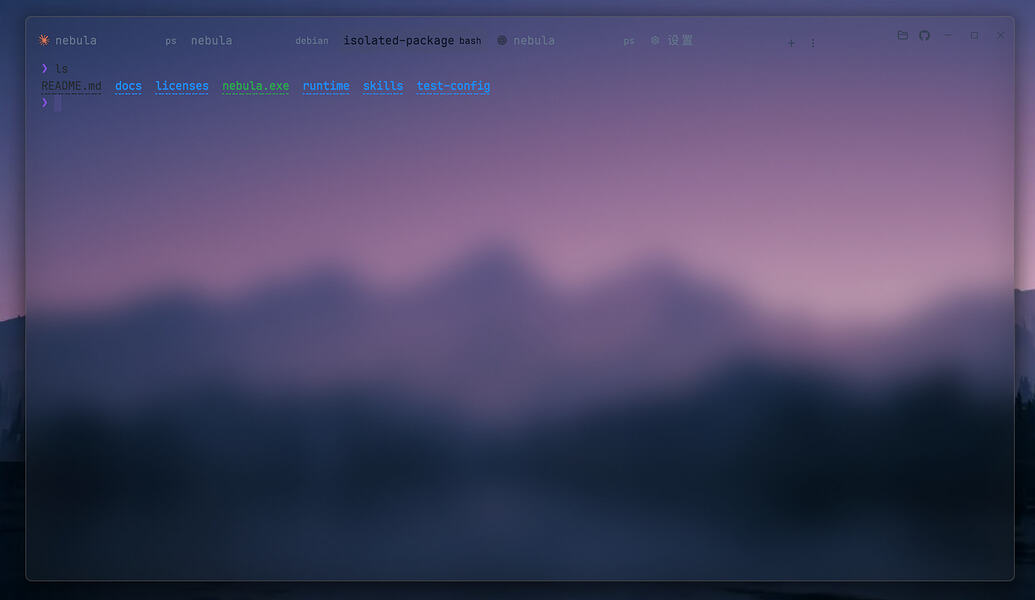
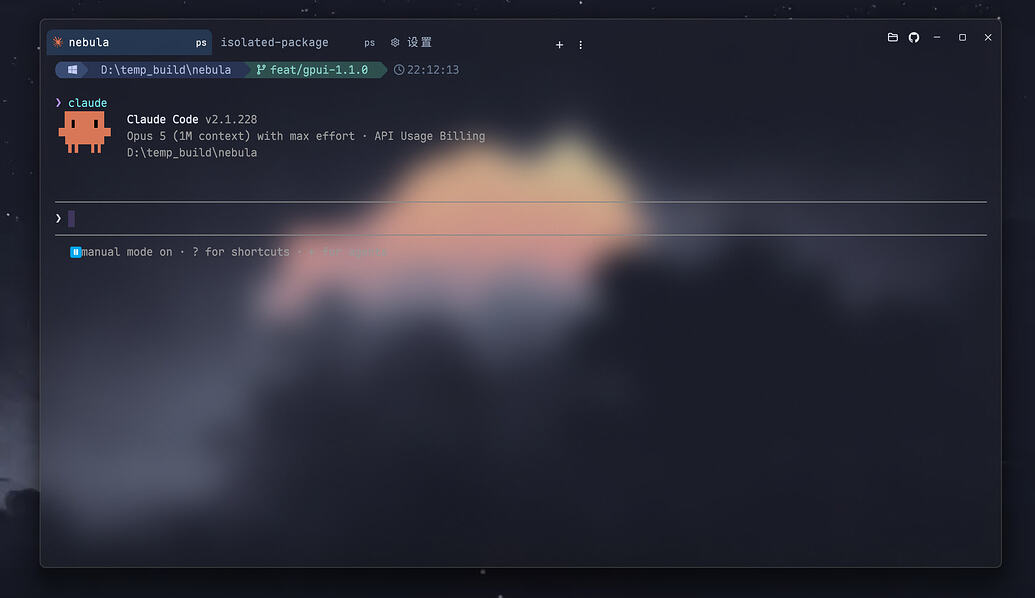
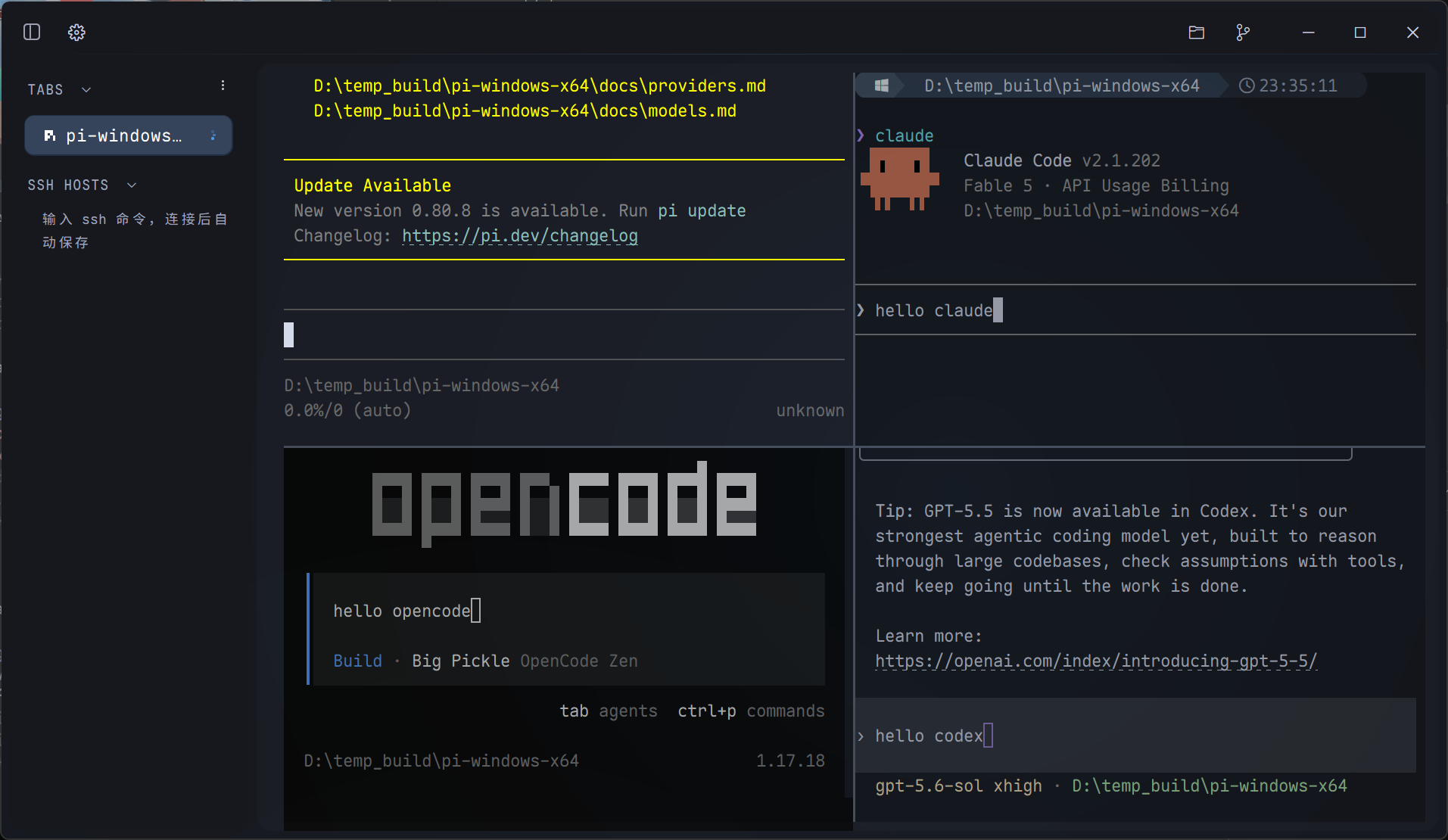
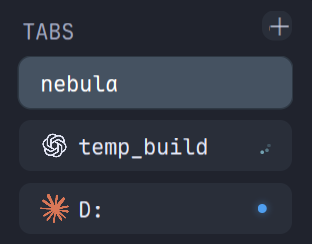
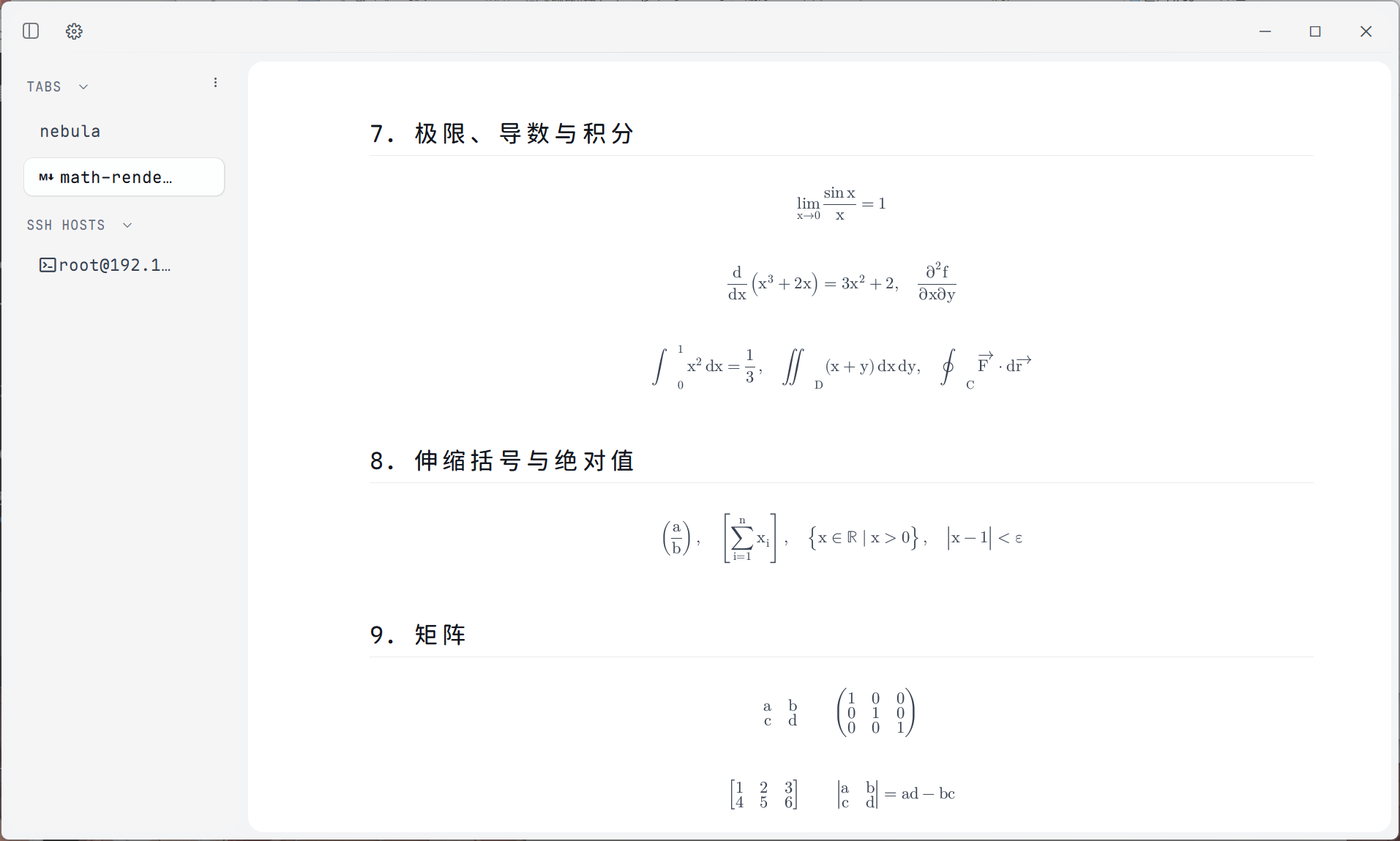
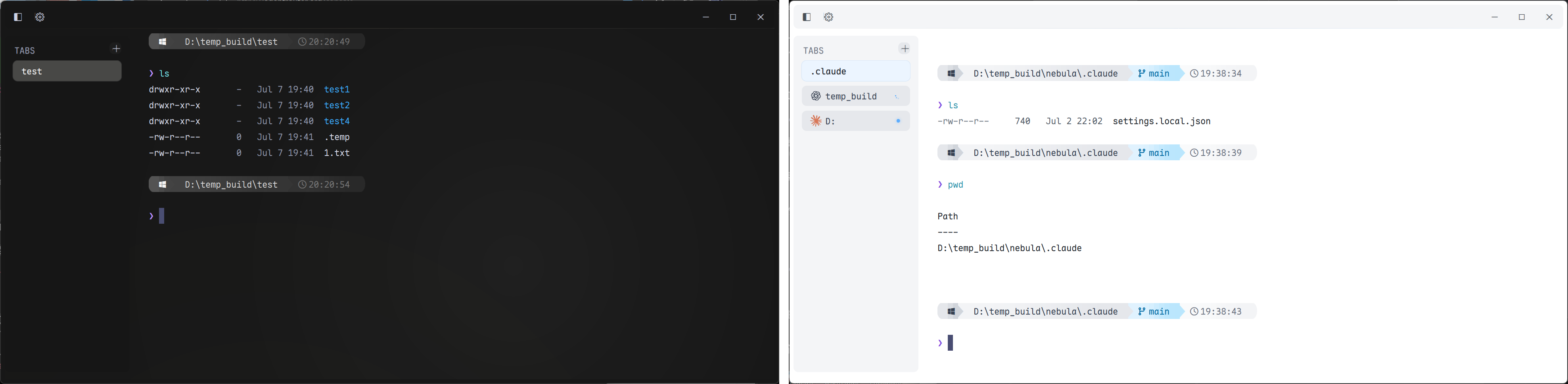
Pebrel (formerly Nebula) brings local shells, remote hosts, files, and AI command-line tools into a native desktop workspace. Arrange terminals in tabs and splits, follow each agent's activity, and read its output without leaving the application.
Get suggestions from your current Git repository, project scripts, SSH config, and filesystem—even when you have never run the command before. On Windows, Pebrel also completes registered WSL distributions. These candidates come from Pebrel's own completion engine, without a shell completion plugin or an AI request.
Five commands in a real Windows/PowerShell terminal: Git branches, npm scripts,
SSH aliases, WSL distributions, and a quoted filename with cat. Typed one
character at a time with the built-in Powerline prompt.
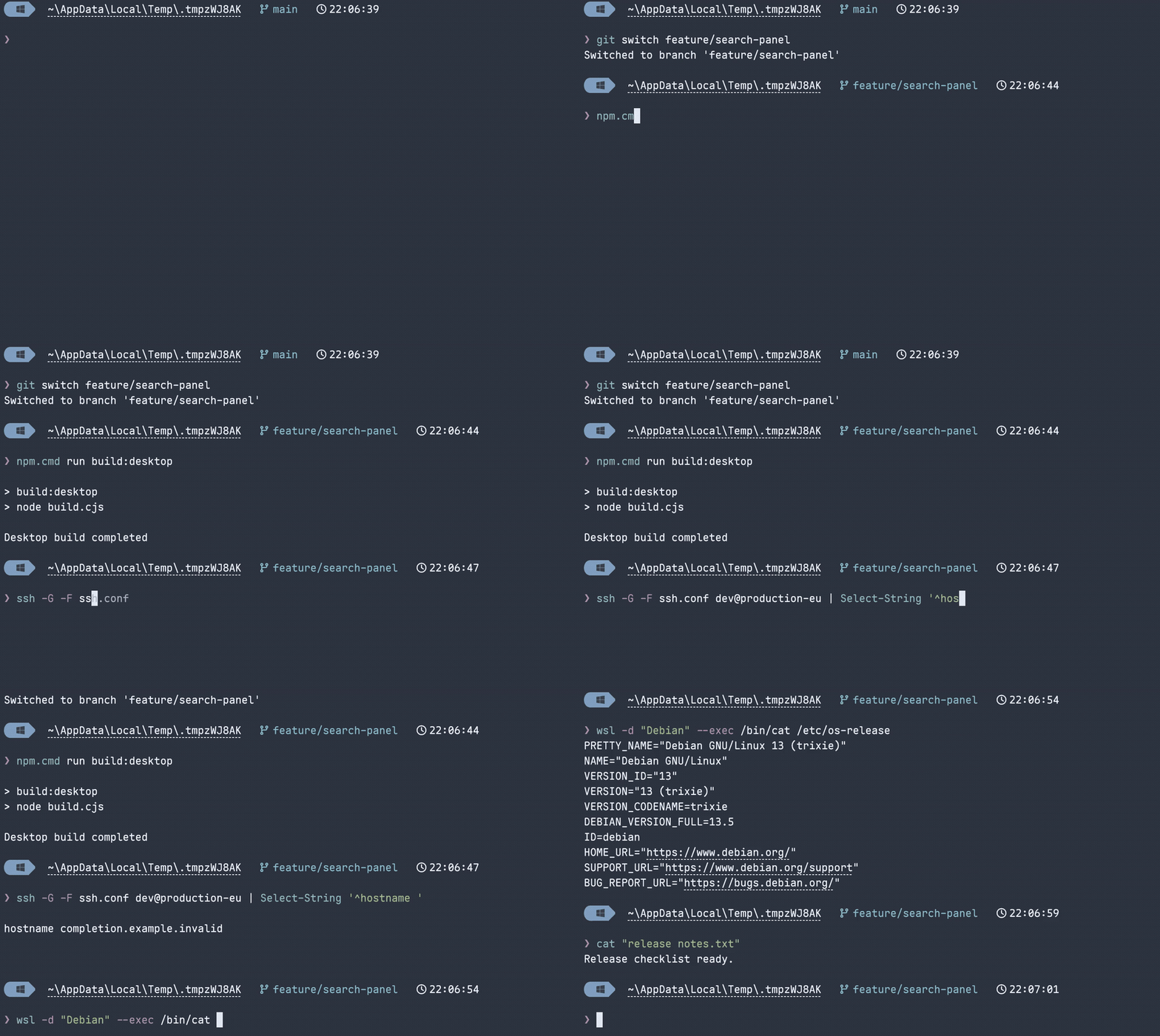
Choose Inline (Tab accepts the suggestion), List (Tab accepts the selected candidate), or Hybrid (→ accepts the inline suggestion; Tab opens the list) in Settings.
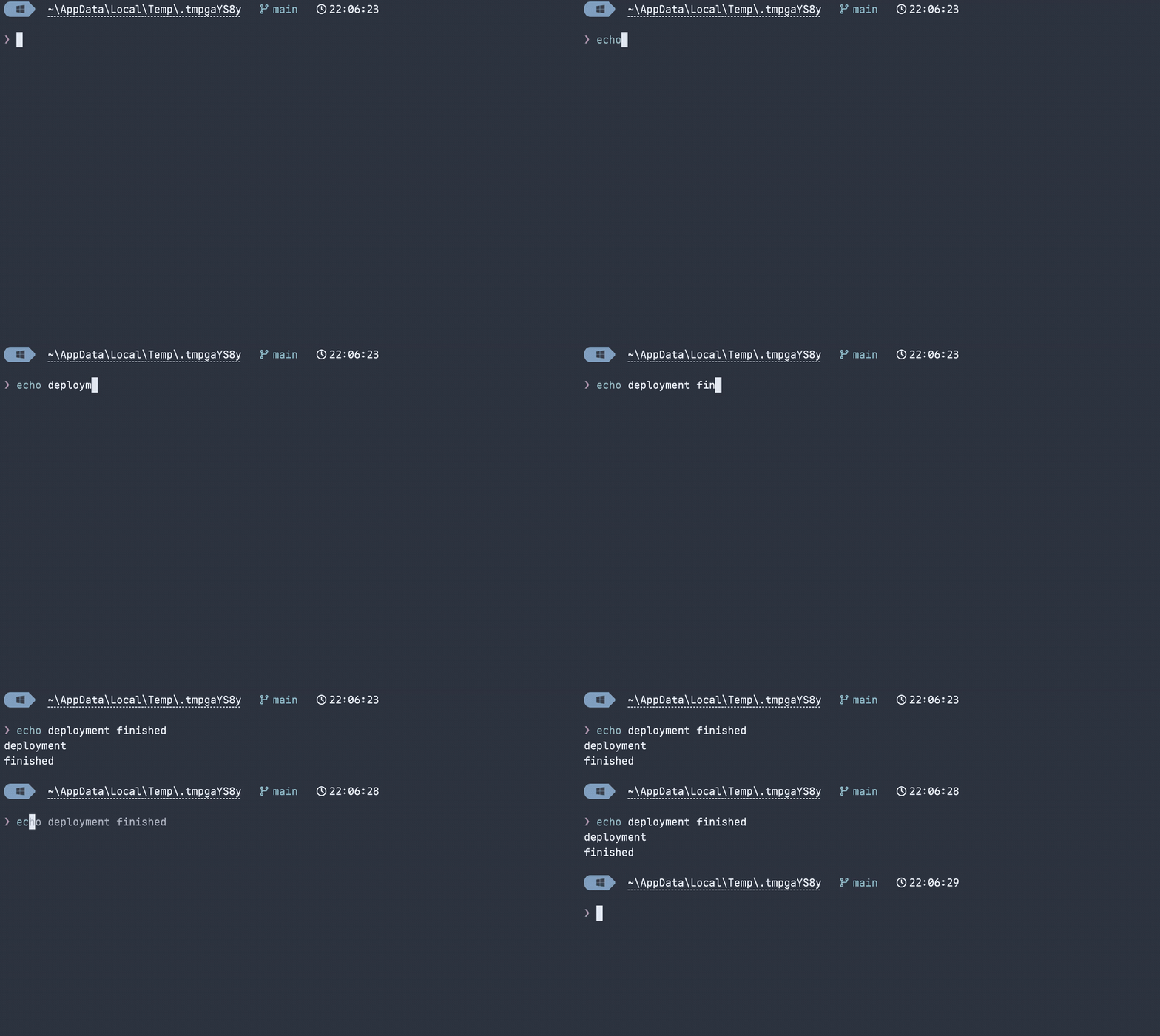
History completion recalls a command you have already executed. Here, echo dep
recalls echo deployment finished after its first run. The five examples above
discover candidates from the current environment without matching prior commands.
Choose a package from the latest release.
| System | Architecture | Packages |
|---|---|---|
| Windows 10 1809+ / 11 | x64 | Installer .exe, portable .zip |
| Linux Preview, glibc 2.35+ | x64 | .AppImage, .deb, portable .tar.gz |
| macOS Preview, deployment target 14+ | Apple Silicon / arm64 | .dmg |
| macOS Preview, deployment target 14+ | Intel / x64 | .dmg |
Package names follow Pebrel-v<version>-<system>-<architecture>. Windows offers
stable installers ending in -setup.exe and portable ZIPs. Linux and macOS are
Preview builds, marked -preview before the extension. A legacy-named Windows
installer is also supplied for older automatic-update clients.
On Windows, run the installer or extract the ZIP and launch pebrel.exe, keeping
the bundled directories together. On Linux, install the DEB or make the AppImage
executable. On macOS, open the matching DMG and drag Pebrel into Applications.
Ad-hoc-signed macOS builds may require Open Anyway in System Settings >
Privacy & Security on first launch. Native macOS CI runs on macOS 15; the
deployment target alone does not establish validation on every older OS version.
Pebrel 2.1 connects native tray actions, quick-terminal shortcuts, login startup, and local AI-hook setup on Windows, macOS, and Linux. Linux tray integration uses a status notifier, and Wayland shortcuts use the desktop portal. Windows and macOS provide native update installation; Linux upgrades use its package manager or a new package. See installation details for platform requirements and upgrading an existing Nebula installation.
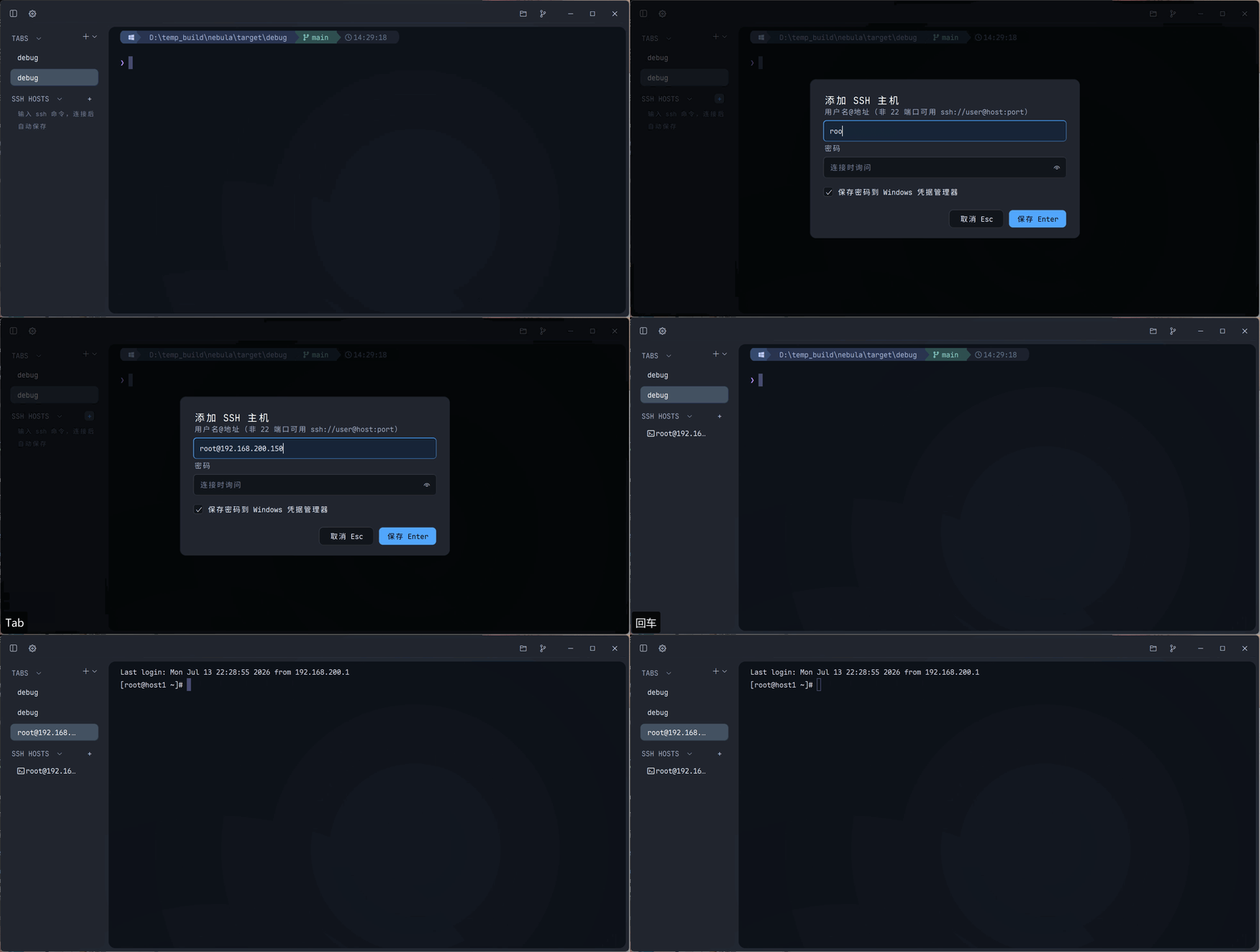
On your phone, save an SSH host with password or private-key authentication, then select that host in relay setup. For key authentication, the credential field is the private-key passphrase; leave it empty for an unencrypted key. It is not a relay password. After installation, select the SSH host under desktop Settings → Phone connection → Relay, then generate the phone pairing QR code.
See offline relay installation for server
requirements, verification and management. The original v2.1.1 Release assets
did not include an offline relay kit. A source checkout containing that installer
can use mobile/tools/package_manual_relay.py to generate a two-architecture Linux
kit and SHA256 sidecar from a verified APK. The tool does not download executables
or publish or replace Release assets.
Older APKs also need Cargo dependency notices collected from their matching source;
the installation guide includes those commands.
pebrel config init --language en-US
pebrel config check
The generated Lua configuration uses require 'pebrel' and
pebrel.config_builder(). Invalid reloads retain the last valid configuration.
See the Lua configuration guide for settings and examples.
In Settings → Terminal → Alerts, Notification duration selects Use defaults,
5, 10, 30, or 90 seconds, or Until dismissed. The default preserves existing
lifetimes: short toasts last 5 seconds, message banners 90 seconds, and update
notices remain until dismissed. The saved preference applies to all newly shown
or refreshed in-app cards, independently of the AI-toast visibility switch.
Only the latest three cards are retained; newer cards replace older ones without
performing their actions, including in persistent mode.
Hiding a card never approves or rejects a request or changes task state; requests
remain available in their terminals and updates in Settings. System notifications
are unchanged. The persisted key is notification_duration, with values default,
5, 10, 30, 90, or persistent.
See the notification duration menu.
With the pinned Rust toolchain and the platform dependencies installed:
cargo build --release --locked -p nebula --bin pebrel --features gpui-shell
The internal Cargo package is still named nebula; the application and command
are pebrel. GPUI is the product interface. The older renderer is available only
through the explicit legacy-shell feature.
Discord: discord.gg/VFn4rcxmhn
Pebrel includes third-party terminal, interface and font components. Their provenance, copyright and license notices are preserved in THIRD-PARTY-NOTICES and licenses/.
AI-native, GPU-accelerated terminal emulator for Windows with SSH, persistent sessions, split panes, and first-class AI CLI workflows.
See the code
A GPU-accelerated terminal, SSH workspace, and home for your AI CLI sessions.
Built with Rust and GPUI for Windows, macOS, and Linux.
Split terminals · SSH & SFTP · Claude Code & Codex workflows · Native document reader
English · 简体中文
|
Sidrune AI |
One entry point for accessing and managing the world's leading AI models Thanks to Sidrune AI for sponsoring this project! Sidrune AI serves individual developers, technical teams and enterprises with a unified API for accessing and managing the world's leading AI models. Dynamic multi-route scheduling improves availability, and model performance, response time and cost stay transparent. Depending on the model and route, API calls can cost 40%–98% less than official or benchmark prices. Visit and sign up now to receive $3 in API credit. |
For business cooperation or sponsorship, contact: [email protected]
Pebrel (formerly Nebula) brings local shells, remote hosts, files, and AI command-line tools into a native desktop workspace. Arrange terminals in tabs and splits, follow each agent's activity, and read its output without leaving the application.
Get suggestions from your current Git repository, project scripts, SSH config, and filesystem—even when you have never run the command before. On Windows, Pebrel also completes registered WSL distributions. These candidates come from Pebrel's own completion engine, without a shell completion plugin or an AI request.
Five commands in a real Windows/PowerShell terminal: Git branches, npm scripts,
SSH aliases, WSL distributions, and a quoted filename with cat. Typed one
character at a time with the built-in Powerline prompt.
Choose Inline (Tab accepts the suggestion), List (Tab accepts the selected candidate), or Hybrid (→ accepts the inline suggestion; Tab opens the list) in Settings.
History completion recalls a command you have already executed. Here, echo dep
recalls echo deployment finished after its first run. The five examples above
discover candidates from the current environment without matching prior commands.
Choose a package from the latest release.
| System | Architecture | Packages |
|---|---|---|
| Windows 10 1809+ / 11 | x64 | Installer .exe, portable .zip |
| Linux Preview, glibc 2.35+ | x64 | .AppImage, .deb, portable .tar.gz |
| macOS Preview, deployment target 14+ | Apple Silicon / arm64 | .dmg |
| macOS Preview, deployment target 14+ | Intel / x64 | .dmg |
Package names follow Pebrel-v<version>-<system>-<architecture>. Windows offers
stable installers ending in -setup.exe and portable ZIPs. Linux and macOS are
Preview builds, marked -preview before the extension. A legacy-named Windows
installer is also supplied for older automatic-update clients.
On Windows, run the installer or extract the ZIP and launch pebrel.exe, keeping
the bundled directories together. On Linux, install the DEB or make the AppImage
executable. On macOS, open the matching DMG and drag Pebrel into Applications.
Ad-hoc-signed macOS builds may require Open Anyway in System Settings >
Privacy & Security on first launch. Native macOS CI runs on macOS 15; the
deployment target alone does not establish validation on every older OS version.
Pebrel 2.1 connects native tray actions, quick-terminal shortcuts, login startup, and local AI-hook setup on Windows, macOS, and Linux. Linux tray integration uses a status notifier, and Wayland shortcuts use the desktop portal. Windows and macOS provide native update installation; Linux upgrades use its package manager or a new package. See installation details for platform requirements and upgrading an existing Nebula installation.
On your phone, save an SSH host with password or private-key authentication, then select that host in relay setup. For key authentication, the credential field is the private-key passphrase; leave it empty for an unencrypted key. It is not a relay password. After installation, select the SSH host under desktop Settings → Phone connection → Relay, then generate the phone pairing QR code.
See offline relay installation for server
requirements, verification and management. The original v2.1.1 Release assets
did not include an offline relay kit. A source checkout containing that installer
can use mobile/tools/package_manual_relay.py to generate a two-architecture Linux
kit and SHA256 sidecar from a verified APK. The tool does not download executables
or publish or replace Release assets.
Older APKs also need Cargo dependency notices collected from their matching source;
the installation guide includes those commands.
pebrel config init --language en-US
pebrel config check
The generated Lua configuration uses require 'pebrel' and
pebrel.config_builder(). Invalid reloads retain the last valid configuration.
See the Lua configuration guide for settings and examples.
In Settings → Terminal → Alerts, Notification duration selects Use defaults,
5, 10, 30, or 90 seconds, or Until dismissed. The default preserves existing
lifetimes: short toasts last 5 seconds, message banners 90 seconds, and update
notices remain until dismissed. The saved preference applies to all newly shown
or refreshed in-app cards, independently of the AI-toast visibility switch.
Only the latest three cards are retained; newer cards replace older ones without
performing their actions, including in persistent mode.
Hiding a card never approves or rejects a request or changes task state; requests
remain available in their terminals and updates in Settings. System notifications
are unchanged. The persisted key is notification_duration, with values default,
5, 10, 30, 90, or persistent.
See the notification duration menu.
With the pinned Rust toolchain and the platform dependencies installed:
cargo build --release --locked -p nebula --bin pebrel --features gpui-shell
The internal Cargo package is still named nebula; the application and command
are pebrel. GPUI is the product interface. The older renderer is available only
through the explicit legacy-shell feature.
Discord: discord.gg/VFn4rcxmhn
Pebrel includes third-party terminal, interface and font components. Their provenance, copyright and license notices are preserved in THIRD-PARTY-NOTICES and licenses/.



