
IntelliJ-style JPA language injection for @Query strings in Kotlin Spring Data repositories: JPQL/native SQL highlighting, entity/field completion, and a real sqls LSP for native queries.
Lua
2
11 commits
updated Aug 4, 2026
See what people are saying
README
springboot-jpql.nvim
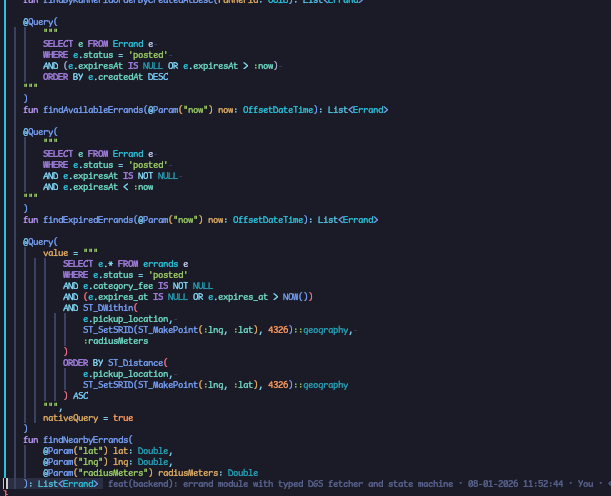
IntelliJ-style JPA "language injection" for @Query annotations in Kotlin
and Java Spring Data repositories:
@Query("""SELECT e FROM Errand e WHERE e.status = 'posted' ...""")
fun findAvailableErrands(...): List<Errand>

@Query(value = """SELECT e.* FROM errands e WHERE ...""", nativeQuery = true)
fun findNearbyErrands(...): List<Errand>
@Query("SELECT b FROM BonusPeriod b WHERE b.status = :status")
Page<BonusPeriod> findByStatus(@Param("status") BonusStatus status, Pageable pageable);

@Query(nativeQuery = true, value = "SELECT * FROM bonus_periods WHERE ...")
List<BonusPeriod> findRaw();
nativeQuery = truestrings are injected as realsqland get a livesqlsLSP client (completion/hover against a real DB connection, read from the project's own.env— see Configuration), via otter.nvim.- JPQL strings (everything else) get SQL-flavored syntax highlighting
(via a
jpql"language" that reuses SQL's grammar/highlights but stays fully separate from realsql— see How it works) and completion for entity names, field names (parsed from your@Entityclasses via treesitter — JPA property names, not DB column names), aliases declared in the query, and JPQL keywords, via a blink.cmp source. :namenamed parameters (used in both native and JPQL queries) get completion for the enclosing repository method's@Param("...")values (or raw Kotlin parameter names where@Paramisn't used).
Requirements
- Neovim >= 0.10
nvim-treesitterwith thekotlinand/orjavaparser installed, plussql- otter.nvim
sqlson your$PATH— only needed for native query completion/hover. Depend on it viamason-org/mason.nvim'sensure_installed(see below) rather than installing it yourself.blink.cmp— only needed for JPQL/native-param completion
Install (lazy.nvim)
{
  "kratosgado/springboot-jpql.nvim", -- or `dir = "/path/to/springboot-jpql.nvim"` for local dev
  ft = "kotlin",
  dependencies = {
    "nvim-treesitter/nvim-treesitter",
    "jmbuhr/otter.nvim",
  },
  opts = {
    entities = {
      globs = { "src/main/kotlin/**/*.kt", "src/main/java/**/*.java" },
    },
  },
},

-- sqls' own dependency: request it via mason's ensure_installed instead of
-- installing it yourself.
{
  "mason-org/mason.nvim",
  opts = function(_, opts)
    opts.ensure_installed = opts.ensure_installed or {}
    table.insert(opts.ensure_installed, "sqls")
  end,
},
DB connection details are read per project from that project's own
.env file — nothing to hardcode in your Neovim config (see
Configuration to point it at different env var names, or to
override with an explicit connection).
Then register the JPQL completion source in your blink.cmp config:
{
  "saghen/blink.cmp",
  opts = {
    sources = {
      default = { "springboot_jpql" },
      providers = {
        springboot_jpql = {
          name = "SpringbootJpql",
          module = "springboot-jpql.blink_source",
        },
      },
    },
  },
},
(sources.default is additive here if your existing blink.cmp spec declares
opts_extend = { "sources.default" }, as LazyVim's does — otherwise merge the
list yourself.)
Configuration
require("springboot-jpql").setup({
  sqls = {
    -- DB connection is read PER PROJECT from that project's `.env` file --
    -- this is the normal case and usually needs no configuration at all.
    -- `env` names the *env vars* to read (not values). Each can be a single
    -- name or a list of candidates tried in order; the defaults already
    -- cover both DATABASE_URL-style and DB_URL-style projects, so this only
    -- needs overriding for something else entirely.
    env = {
      url = { "DATABASE_URL", "DB_URL", "SPRING_DATASOURCE_URL" }, -- a JDBC URL: jdbc:postgresql://host:port/db
      user = { "DATABASE_USERNAME", "DB_USER", "DB_USERNAME", "SPRING_DATASOURCE_USERNAME" },
      password = { "DATABASE_PASSWORD", "DB_PASS", "DB_PASSWORD", "SPRING_DATASOURCE_PASSWORD" },
    },
    -- Filename to look for at the project root. Default: ".env"
    env_file = ".env",
    -- Map a JDBC driver id (e.g. "postgresql") to sqls' driver name, for the
    -- rare case they differ.
    driver_map = nil,
    -- Files/dirs used to find the project root (also where `.env` is looked
    -- up). Order matters: see the comment in lua/springboot-jpql/sqls.lua --
    -- build-file markers should come before `.git` so a monorepo's top-level
    -- .git doesn't win over the actual Gradle/Maven project root.
    root_markers = { "build.gradle.kts", "build.gradle", "settings.gradle.kts", "pom.xml", ".git" },
    -- Explicit sqls connections -- if given, used for *every* project
    -- instead of reading `.env` at all:
    -- connections = {
    --   { driver = "postgresql", dataSourceName = "host=127.0.0.1 port=5432 user=postgres password=postgres dbname=mydb sslmode=disable" },
    --   -- or with individual fields instead of dataSourceName:
    --   -- { driver = "postgresql", proto = "tcp", host = "127.0.0.1", port = 5432, user = "postgres", passwd = "postgres", dbName = "mydb" },
    -- },
    -- Override the full LSP command (fun(dispatchers, config) or a string[]).
    cmd = nil,
    -- Override root_dir resolution (fun(bufnr, on_dir)).
    root_dir = nil,
  },
  otter = {
    enabled = true,
    -- Languages passed to otter.activate(). Kept narrow to "sql" so kotlin's
    -- own builtin injections (regex/printf/comment) don't spin up otter
    -- buffers we have no use for here.
    languages = { "sql" },
  },
  entities = {
    -- Project root to resolve globs against.
    root = nil, -- default: vim.fn.getcwd()
    -- Glob patterns (relative to root) for files that may contain @Entity classes.
    globs = { "src/main/kotlin/**/*.kt", "src/main/java/**/*.java" },
  },
})
sqls is generated a fresh sqls.yml per project root (under
stdpath("data")/springboot-jpql/<hash of root>/sqls.yml) the first time its
client starts for that root, so multiple projects with different databases
open in the same Neovim session don't collide.
Run :SpringbootJpqlRefreshEntities to force a full rescan (entities are also
automatically rescanned per-file on save).
How it works
- queries/kotlin/injections.scm and
queries/java/injections.scm each match the
string argument to
@Query(...)(positional orvalue = ..., single string or text block) for their respective grammars, and use a custom#has-native-query?/#has-native-query-java?treesitter predicate (registered in lua/springboot-jpql/treesitter.lua) to check sibling arguments fornativeQuery = true. Native queries are taggedinjection.language "sql"; everything else is tagged"jpql". Java string concatenation (@Query("a" + "b")) isn't matched -- see Limitations. "jpql"is registered as its own treesitter language, backed by the same compiled SQL parser binary (vim.treesitter.language.add("jpql", { path = <sql.so>, symbol_name = "sql" })), with queries/jpql/highlights.scm just inheriting SQL's highlights (;inherits: sql). This gets JPQL real SQL-flavored syntax highlighting despite there being no dedicated JPQL grammar, while keeping it a genuinely distinct language from"sql"for grouping purposes — otter.nvim's own region scan groups injected children by resolved language name, so"jpql"and"sql"regions never get merged, and otter/sqls never sees (or attaches the real DB LSP to) a JPQL region.- lua/springboot-jpql/sqls.lua registers
sqlsviavim.lsp.config/vim.lsp.enablewith a dynamiccmd: at client-start time (per project root), it reads that project's.env(lua/springboot-jpql/dotenv.lua), parses the JDBC URL (lua/springboot-jpql/jdbc.lua), renders sqls' connection YAML, and startssqls -config <that file>. - lua/springboot-jpql/otter_integration.lua
calls
otter.activate({"sql"}, ...)onFileType kotlin,java. otter.nvim finds thesql-tagged regions via the same core treesitter injection mechanism, creates a hidden buffer per region, and proxies LSP requests from the main buffer to it — so blink.cmp's existing"lsp"source (or nvim-cmp'scmp-nvim-lsp) picks up native-query completions automatically; no otter-specific completion source is needed. - lua/springboot-jpql/entities.lua scans
files matching your configured globs for
@Entity-annotated classes and their field names via treesitter (no type resolution — just the property names, which is what JPQL references): Kotlin primary-constructor properties, or Javafield_declarations. - lua/springboot-jpql/jpql.lua detects whether
the cursor is inside a
jpql-tagged region (in either language's tree, matching the buffer's own filetype), and does a best-effort scan of that one query's text forFROM Entity [AS] alias/JOIN Entity [AS] aliasbindings (only recorded whenEntitymatches a known@Entityclass — collection-navigation joins likeJOIN e.ratings rare skipped since resolving those needs real type resolution, out of scope here). - lua/springboot-jpql/params.lua walks back
from the cursor (staying within the host language's own tree, not the
injected one) to the enclosing
@Querymethod's parameters, reading@Param("...")values (falling back to the raw parameter name) — Kotlin'sfunction_value_parameters/parameter_modifierspairing, or Java's simplerformal_parameters/formal_parameter(which carries its own annotations and name as direct children, no cross-sibling pairing needed). - lua/springboot-jpql/blink_source.lua
is a blink.cmp source: enabled for
kotlin/javabuffers when the cursor is in a JPQL or native region. After:it offers the enclosing method's parameter names (in either region type); in JPQL it also offers field names afteralias., and JPQL keywords + entity names + declared aliases otherwise.
Limitations
- JPQL alias resolution is a lightweight text scan of the current query, not
a real JPQL parser — it handles the common
FROM Entity alias/JOIN Entity aliasshapes and does not resolve collection-navigation joins (JOIN e.someCollection x) to their target entity. - Entity fields come from Kotlin primary-constructor properties or Java
field_declarations only; Kotlin class-body property declarations aren't scanned. - No cross-file type resolution: field types aren't inspected, so there's
no relationship-aware completion (e.g. it won't know
e.ratingsis aList<Rating>). - Java string concatenation (
@Query("a" + "b" + "c")) gets no injection/highlighting/completion at all — tree-sitter query patterns can't express "capture every fragment at any depth of a left-recursivebinary_expression" without per-depth duplication. Increasingly rare now that text blocks exist; use those instead. .envparsing is intentionally minimal (KEY=value,#comments, optional quotes) — noexport,$VARinterpolation, or multiline values.
Similar repos


IntelliJ-style JPA language injection for @Query strings in Kotlin Spring Data repositories: JPQL/native SQL highlighting, entity/field completion, and a real sqls LSP for native queries.
Lua
2
11 commits
updated Aug 4, 2026
See what people are saying
README
springboot-jpql.nvim
IntelliJ-style JPA "language injection" for @Query annotations in Kotlin
and Java Spring Data repositories:
@Query("""SELECT e FROM Errand e WHERE e.status = 'posted' ...""")
fun findAvailableErrands(...): List<Errand>

@Query(value = """SELECT e.* FROM errands e WHERE ...""", nativeQuery = true)
fun findNearbyErrands(...): List<Errand>
@Query("SELECT b FROM BonusPeriod b WHERE b.status = :status")
Page<BonusPeriod> findByStatus(@Param("status") BonusStatus status, Pageable pageable);

@Query(nativeQuery = true, value = "SELECT * FROM bonus_periods WHERE ...")
List<BonusPeriod> findRaw();
nativeQuery = truestrings are injected as realsqland get a livesqlsLSP client (completion/hover against a real DB connection, read from the project's own.env— see Configuration), via otter.nvim.- JPQL strings (everything else) get SQL-flavored syntax highlighting
(via a
jpql"language" that reuses SQL's grammar/highlights but stays fully separate from realsql— see How it works) and completion for entity names, field names (parsed from your@Entityclasses via treesitter — JPA property names, not DB column names), aliases declared in the query, and JPQL keywords, via a blink.cmp source. :namenamed parameters (used in both native and JPQL queries) get completion for the enclosing repository method's@Param("...")values (or raw Kotlin parameter names where@Paramisn't used).
Requirements
- Neovim >= 0.10
nvim-treesitterwith thekotlinand/orjavaparser installed, plussql- otter.nvim
sqlson your$PATH— only needed for native query completion/hover. Depend on it viamason-org/mason.nvim'sensure_installed(see below) rather than installing it yourself.blink.cmp— only needed for JPQL/native-param completion
Install (lazy.nvim)
{
  "kratosgado/springboot-jpql.nvim", -- or `dir = "/path/to/springboot-jpql.nvim"` for local dev
  ft = "kotlin",
  dependencies = {
    "nvim-treesitter/nvim-treesitter",
    "jmbuhr/otter.nvim",
  },
  opts = {
    entities = {
      globs = { "src/main/kotlin/**/*.kt", "src/main/java/**/*.java" },
    },
  },
},

-- sqls' own dependency: request it via mason's ensure_installed instead of
-- installing it yourself.
{
  "mason-org/mason.nvim",
  opts = function(_, opts)
    opts.ensure_installed = opts.ensure_installed or {}
    table.insert(opts.ensure_installed, "sqls")
  end,
},
DB connection details are read per project from that project's own
.env file — nothing to hardcode in your Neovim config (see
Configuration to point it at different env var names, or to
override with an explicit connection).
Then register the JPQL completion source in your blink.cmp config:
{
  "saghen/blink.cmp",
  opts = {
    sources = {
      default = { "springboot_jpql" },
      providers = {
        springboot_jpql = {
          name = "SpringbootJpql",
          module = "springboot-jpql.blink_source",
        },
      },
    },
  },
},
(sources.default is additive here if your existing blink.cmp spec declares
opts_extend = { "sources.default" }, as LazyVim's does — otherwise merge the
list yourself.)
Configuration
require("springboot-jpql").setup({
  sqls = {
    -- DB connection is read PER PROJECT from that project's `.env` file --
    -- this is the normal case and usually needs no configuration at all.
    -- `env` names the *env vars* to read (not values). Each can be a single
    -- name or a list of candidates tried in order; the defaults already
    -- cover both DATABASE_URL-style and DB_URL-style projects, so this only
    -- needs overriding for something else entirely.
    env = {
      url = { "DATABASE_URL", "DB_URL", "SPRING_DATASOURCE_URL" }, -- a JDBC URL: jdbc:postgresql://host:port/db
      user = { "DATABASE_USERNAME", "DB_USER", "DB_USERNAME", "SPRING_DATASOURCE_USERNAME" },
      password = { "DATABASE_PASSWORD", "DB_PASS", "DB_PASSWORD", "SPRING_DATASOURCE_PASSWORD" },
    },
    -- Filename to look for at the project root. Default: ".env"
    env_file = ".env",
    -- Map a JDBC driver id (e.g. "postgresql") to sqls' driver name, for the
    -- rare case they differ.
    driver_map = nil,
    -- Files/dirs used to find the project root (also where `.env` is looked
    -- up). Order matters: see the comment in lua/springboot-jpql/sqls.lua --
    -- build-file markers should come before `.git` so a monorepo's top-level
    -- .git doesn't win over the actual Gradle/Maven project root.
    root_markers = { "build.gradle.kts", "build.gradle", "settings.gradle.kts", "pom.xml", ".git" },
    -- Explicit sqls connections -- if given, used for *every* project
    -- instead of reading `.env` at all:
    -- connections = {
    --   { driver = "postgresql", dataSourceName = "host=127.0.0.1 port=5432 user=postgres password=postgres dbname=mydb sslmode=disable" },
    --   -- or with individual fields instead of dataSourceName:
    --   -- { driver = "postgresql", proto = "tcp", host = "127.0.0.1", port = 5432, user = "postgres", passwd = "postgres", dbName = "mydb" },
    -- },
    -- Override the full LSP command (fun(dispatchers, config) or a string[]).
    cmd = nil,
    -- Override root_dir resolution (fun(bufnr, on_dir)).
    root_dir = nil,
  },
  otter = {
    enabled = true,
    -- Languages passed to otter.activate(). Kept narrow to "sql" so kotlin's
    -- own builtin injections (regex/printf/comment) don't spin up otter
    -- buffers we have no use for here.
    languages = { "sql" },
  },
  entities = {
    -- Project root to resolve globs against.
    root = nil, -- default: vim.fn.getcwd()
    -- Glob patterns (relative to root) for files that may contain @Entity classes.
    globs = { "src/main/kotlin/**/*.kt", "src/main/java/**/*.java" },
  },
})
sqls is generated a fresh sqls.yml per project root (under
stdpath("data")/springboot-jpql/<hash of root>/sqls.yml) the first time its
client starts for that root, so multiple projects with different databases
open in the same Neovim session don't collide.
Run :SpringbootJpqlRefreshEntities to force a full rescan (entities are also
automatically rescanned per-file on save).
How it works
- queries/kotlin/injections.scm and
queries/java/injections.scm each match the
string argument to
@Query(...)(positional orvalue = ..., single string or text block) for their respective grammars, and use a custom#has-native-query?/#has-native-query-java?treesitter predicate (registered in lua/springboot-jpql/treesitter.lua) to check sibling arguments fornativeQuery = true. Native queries are taggedinjection.language "sql"; everything else is tagged"jpql". Java string concatenation (@Query("a" + "b")) isn't matched -- see Limitations. "jpql"is registered as its own treesitter language, backed by the same compiled SQL parser binary (vim.treesitter.language.add("jpql", { path = <sql.so>, symbol_name = "sql" })), with queries/jpql/highlights.scm just inheriting SQL's highlights (;inherits: sql). This gets JPQL real SQL-flavored syntax highlighting despite there being no dedicated JPQL grammar, while keeping it a genuinely distinct language from"sql"for grouping purposes — otter.nvim's own region scan groups injected children by resolved language name, so"jpql"and"sql"regions never get merged, and otter/sqls never sees (or attaches the real DB LSP to) a JPQL region.- lua/springboot-jpql/sqls.lua registers
sqlsviavim.lsp.config/vim.lsp.enablewith a dynamiccmd: at client-start time (per project root), it reads that project's.env(lua/springboot-jpql/dotenv.lua), parses the JDBC URL (lua/springboot-jpql/jdbc.lua), renders sqls' connection YAML, and startssqls -config <that file>. - lua/springboot-jpql/otter_integration.lua
calls
otter.activate({"sql"}, ...)onFileType kotlin,java. otter.nvim finds thesql-tagged regions via the same core treesitter injection mechanism, creates a hidden buffer per region, and proxies LSP requests from the main buffer to it — so blink.cmp's existing"lsp"source (or nvim-cmp'scmp-nvim-lsp) picks up native-query completions automatically; no otter-specific completion source is needed. - lua/springboot-jpql/entities.lua scans
files matching your configured globs for
@Entity-annotated classes and their field names via treesitter (no type resolution — just the property names, which is what JPQL references): Kotlin primary-constructor properties, or Javafield_declarations. - lua/springboot-jpql/jpql.lua detects whether
the cursor is inside a
jpql-tagged region (in either language's tree, matching the buffer's own filetype), and does a best-effort scan of that one query's text forFROM Entity [AS] alias/JOIN Entity [AS] aliasbindings (only recorded whenEntitymatches a known@Entityclass — collection-navigation joins likeJOIN e.ratings rare skipped since resolving those needs real type resolution, out of scope here). - lua/springboot-jpql/params.lua walks back
from the cursor (staying within the host language's own tree, not the
injected one) to the enclosing
@Querymethod's parameters, reading@Param("...")values (falling back to the raw parameter name) — Kotlin'sfunction_value_parameters/parameter_modifierspairing, or Java's simplerformal_parameters/formal_parameter(which carries its own annotations and name as direct children, no cross-sibling pairing needed). - lua/springboot-jpql/blink_source.lua
is a blink.cmp source: enabled for
kotlin/javabuffers when the cursor is in a JPQL or native region. After:it offers the enclosing method's parameter names (in either region type); in JPQL it also offers field names afteralias., and JPQL keywords + entity names + declared aliases otherwise.
Limitations
- JPQL alias resolution is a lightweight text scan of the current query, not
a real JPQL parser — it handles the common
FROM Entity alias/JOIN Entity aliasshapes and does not resolve collection-navigation joins (JOIN e.someCollection x) to their target entity. - Entity fields come from Kotlin primary-constructor properties or Java
field_declarations only; Kotlin class-body property declarations aren't scanned. - No cross-file type resolution: field types aren't inspected, so there's
no relationship-aware completion (e.g. it won't know
e.ratingsis aList<Rating>). - Java string concatenation (
@Query("a" + "b" + "c")) gets no injection/highlighting/completion at all — tree-sitter query patterns can't express "capture every fragment at any depth of a left-recursivebinary_expression" without per-depth duplication. Increasingly rare now that text blocks exist; use those instead. .envparsing is intentionally minimal (KEY=value,#comments, optional quotes) — noexport,$VARinterpolation, or multiline values.