
Super cool audio to text tool, one link to analyzed report application _ Developed By Kerwin
Python
22
6 commits
updated Sep 24, 2026
See what people are saying
README

Verbatim
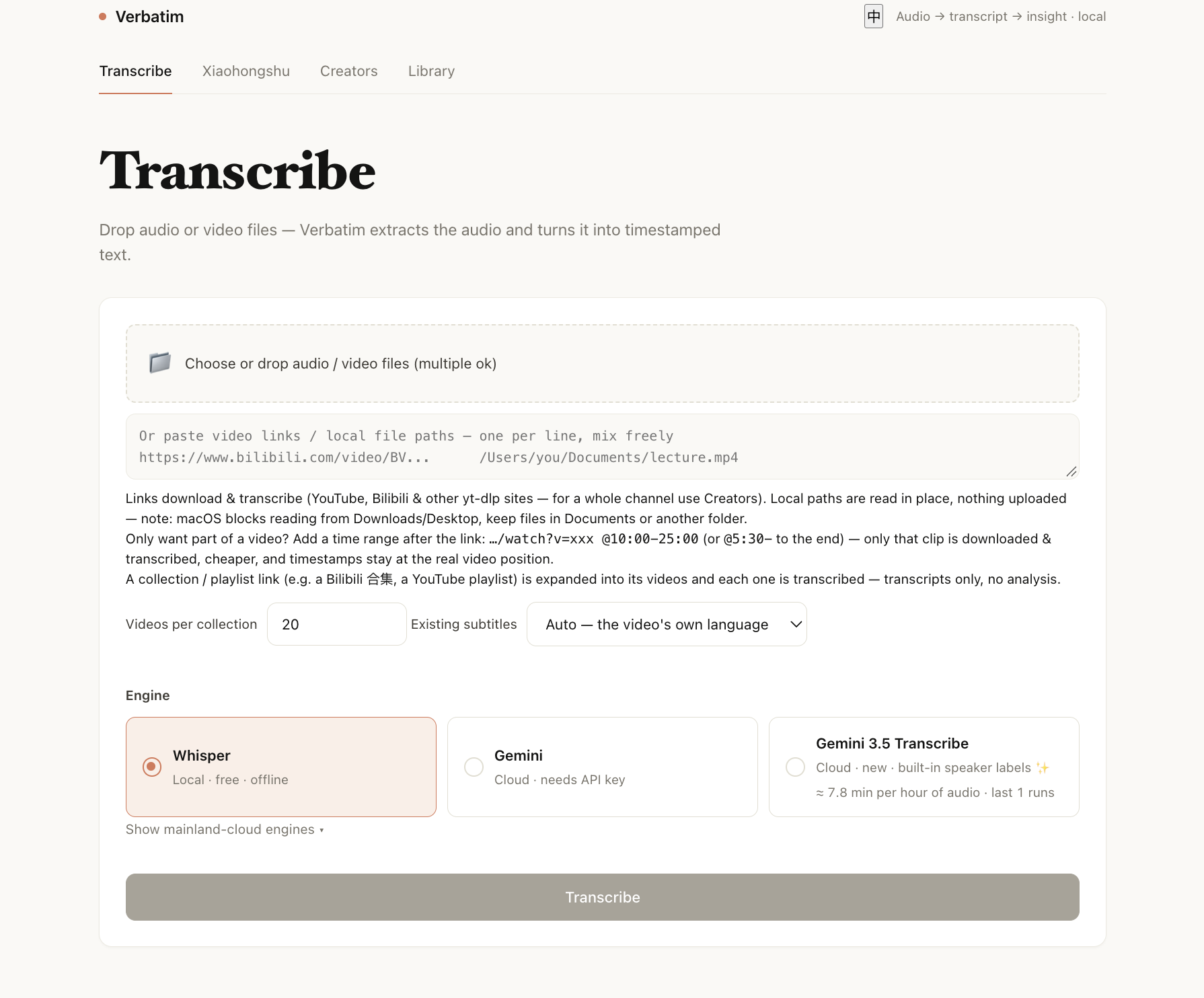
Free, local, unlimited-length transcription. Paste a YouTube/Bilibili link, get a transcript with timestamps. No account needed.
Built by Kapozux/Kerwin, student in Shanghai. In active development since March 2026.
What it does
Paste a link and Verbatim downloads the video, transcribes it, and writes a timestamped summary. Paste a whole channel or playlist instead, and it pulls every episode, transcribes each one, extracts evidence cards from every episode, and builds a portrait of the creator from those cards. If a cloud engine fails on a file, that file falls back to local Whisper automatically. It works with YouTube, Bilibili, and local audio/video files.
Why I built it
I can't sit through an hour-long video, but I still want to know what was said. Existing tools were either expensive or bad at Chinese, so I built my own. I've used it daily for six months and put 790+ hours of audio through it.
Quick Start
brew install ffmpeg yt-dlp
git clone https://github.com/Kapozux/_Verbatim_.git && cd _Verbatim_/getAudio
pip install -r requirements.txt
bash run.sh        # open http://localhost:5001
Python 3.9+. Use Homebrew's yt-dlp, not the pip package.
Engines
| Engine | Good for |
|---|---|
| Whisper | Local and free (GPU-accelerated on Apple Silicon) |
| Gemini | Mixed Chinese/English |
| Gemini 3.5 | Tells speakers apart |
| QwenASR | Strong on Chinese |
| Precise | Hybrid: Gemini text + Alibaba speaker diarization |
Local Whisper transcription needs no API key. Summaries and creator analysis use Gemini; add keys in
Settings or in getAudio/.env:
GEMINI_API_KEY=...        # Gemini engines, summaries, analysis
DASHSCOPE_API_KEY=...     # QwenASR / Precise
OPENROUTER_API_KEY=...    # optional: Claude as the analysis model
Evidence Cards
Every sentence in a creator analysis traces back to a specific timestamp in the original video. 33,832 evidence cards generated so far.
MCP Server
pipx install verbatim-transcribe-mcp
Claude Code and other agents can call Verbatim directly: transcribe links, search transcripts, run creator analysis.
Stats
| Lines of code | Commits | Transcripts | Hours transcribed | Evidence cards |
|---|---|---|---|---|
| ~16,000 | 100+ | 2,058 | 795 | 33,832 |
Known Issues
- Creator pipelines don't auto-resume after a server restart. They're marked failed; click Continue to reuse everything already done and redo only what's missing.
--cookies-from-browserrequires the named browser to be installed locally.- Gemini may block sensitive material; that file falls back to local Whisper instead of failing.
- The Xiaohongshu tab needs a companion scraper project (
XHS_PROJECTenv var) anduv. It's not a pip dependency, since it drives a real logged-in browser session. - Not built yet: a full-text index for search at scale (currently a linear scan), pipeline auto-resume across restarts, and Gemini Batch API for cheaper bulk analysis.
Under the hood
Browser (SPA, SSE progress)
   │  fetch / SSE
Flask (app.py)
   ├─ ThreadPoolExecutor + per-engine semaphores   ── transcription concurrency
   ├─ global download / analysis semaphores        ── throttling shared across all pipelines
   ├─ SQLite (taskdb.py, usage.db)                 ── task state, restart recovery, cost tracking
   └─ results/<uuid>/…, results/_chains/<id>/…     ── transcripts and creator analyses
- Control flow lives in Python, not the model.
harness.pygives two primitives,fanout(concurrent, order-preserving map) andagent(one LLM call with retries and optional schema validation). Every multi-step pipeline is a plain Python loop over them. - Download and transcription overlap. Each video starts transcribing the moment its download finishes.
- Hallucination cleanup is deterministic.
sanitize.pycollapses filler runs, dedups loops, repairs timestamps, and removes silence-masked hallucinations, acting only when several signals agree. - Analysis is evidence-first. Episodes are reduced to neutral cards (observation + verbatim quote + timestamp) before any judgment. The portrait is built only from cards, then a self-verify pass cuts claims the cards don't support.
- Safe by construction. IDs are validated before filesystem joins, local files are read via symlink so originals are never touched, and user-influenced strings are HTML-escaped.
Key settings live in config.py (engine concurrency, Whisper model size, analysis model presets).
License
MIT
Transcription and analysis of third-party content is for private study. Respect the source platforms' terms and creators' rights.
Similar repos


Languages
Python
54.4%
JavaScript
28.7%
CSS
8.7%
HTML
8.0%
Super cool audio to text tool, one link to analyzed report application _ Developed By Kerwin
Python
22
6 commits
updated Sep 24, 2026
See what people are saying
README
Verbatim
Free, local, unlimited-length transcription. Paste a YouTube/Bilibili link, get a transcript with timestamps. No account needed.
Built by Kapozux/Kerwin, student in Shanghai. In active development since March 2026.
What it does
Paste a link and Verbatim downloads the video, transcribes it, and writes a timestamped summary. Paste a whole channel or playlist instead, and it pulls every episode, transcribes each one, extracts evidence cards from every episode, and builds a portrait of the creator from those cards. If a cloud engine fails on a file, that file falls back to local Whisper automatically. It works with YouTube, Bilibili, and local audio/video files.
Why I built it
I can't sit through an hour-long video, but I still want to know what was said. Existing tools were either expensive or bad at Chinese, so I built my own. I've used it daily for six months and put 790+ hours of audio through it.
Quick Start
brew install ffmpeg yt-dlp
git clone https://github.com/Kapozux/_Verbatim_.git && cd _Verbatim_/getAudio
pip install -r requirements.txt
bash run.sh        # open http://localhost:5001
Python 3.9+. Use Homebrew's yt-dlp, not the pip package.
Engines
| Engine | Good for |
|---|---|
| Whisper | Local and free (GPU-accelerated on Apple Silicon) |
| Gemini | Mixed Chinese/English |
| Gemini 3.5 | Tells speakers apart |
| QwenASR | Strong on Chinese |
| Precise | Hybrid: Gemini text + Alibaba speaker diarization |
Local Whisper transcription needs no API key. Summaries and creator analysis use Gemini; add keys in
Settings or in getAudio/.env:
GEMINI_API_KEY=...        # Gemini engines, summaries, analysis
DASHSCOPE_API_KEY=...     # QwenASR / Precise
OPENROUTER_API_KEY=...    # optional: Claude as the analysis model
Evidence Cards
Every sentence in a creator analysis traces back to a specific timestamp in the original video. 33,832 evidence cards generated so far.
MCP Server
pipx install verbatim-transcribe-mcp
Claude Code and other agents can call Verbatim directly: transcribe links, search transcripts, run creator analysis.
Stats
| Lines of code | Commits | Transcripts | Hours transcribed | Evidence cards |
|---|---|---|---|---|
| ~16,000 | 100+ | 2,058 | 795 | 33,832 |
Known Issues
- Creator pipelines don't auto-resume after a server restart. They're marked failed; click Continue to reuse everything already done and redo only what's missing.
--cookies-from-browserrequires the named browser to be installed locally.- Gemini may block sensitive material; that file falls back to local Whisper instead of failing.
- The Xiaohongshu tab needs a companion scraper project (
XHS_PROJECTenv var) anduv. It's not a pip dependency, since it drives a real logged-in browser session. - Not built yet: a full-text index for search at scale (currently a linear scan), pipeline auto-resume across restarts, and Gemini Batch API for cheaper bulk analysis.
Under the hood
Browser (SPA, SSE progress)
   │  fetch / SSE
Flask (app.py)
   ├─ ThreadPoolExecutor + per-engine semaphores   ── transcription concurrency
   ├─ global download / analysis semaphores        ── throttling shared across all pipelines
   ├─ SQLite (taskdb.py, usage.db)                 ── task state, restart recovery, cost tracking
   └─ results/<uuid>/…, results/_chains/<id>/…     ── transcripts and creator analyses
- Control flow lives in Python, not the model.
harness.pygives two primitives,fanout(concurrent, order-preserving map) andagent(one LLM call with retries and optional schema validation). Every multi-step pipeline is a plain Python loop over them. - Download and transcription overlap. Each video starts transcribing the moment its download finishes.
- Hallucination cleanup is deterministic.
sanitize.pycollapses filler runs, dedups loops, repairs timestamps, and removes silence-masked hallucinations, acting only when several signals agree. - Analysis is evidence-first. Episodes are reduced to neutral cards (observation + verbatim quote + timestamp) before any judgment. The portrait is built only from cards, then a self-verify pass cuts claims the cards don't support.
- Safe by construction. IDs are validated before filesystem joins, local files are read via symlink so originals are never touched, and user-influenced strings are HTML-escaped.
Key settings live in config.py (engine concurrency, Whisper model size, analysis model presets).
License
MIT
Transcription and analysis of third-party content is for private study. Respect the source platforms' terms and creators' rights.
Similar repos
Languages
Python
54.4%
JavaScript
28.7%
CSS
8.7%
HTML
8.0%