Relevant but Incomplete: Referential Dangling as a Paradigm-Level Failure Mode in Hard Prompt Compression
See the code

Zhengpei Hu1,∗, Kai Li2,∗, Dapeng Fu3, Xuechao Zou2, Yuanhao Tang1, Yue Li1, Tengfei Cao1, Jianqiang Huang1,†
1School of Computer Technology and Application, Qinghai University
2Tsinghua University · 3Ant Group Security and Intelligence Laboratory (SIL)
∗Equal contribution · †Corresponding author
🌐 Project Page |
💻 Code |
🤗 Model |
📄 Paper

TL;DR: Hard prompt compression can preserve an answer-bearing fragment while deleting the definition or bridge fact needed to interpret it; we call this failure referential dangling and study how to diagnose and repair it.
Run these commands from the release root:
python -m venv .venv
source .venv/bin/activate
pip install -r requirements.txt
The following entry points expose the main analysis and training options (the
--help calls only print arguments; they do not launch a full experiment):
# Required for BEAVER-based entry points after following third_party/README.md
export PYTHONPATH="$PWD/third_party/BEAVER:${PYTHONPATH:-}"

python src/diagnose.py --help
python src/metric_c.py --help
python src/exp_candidate_ablation.py --help
python src/expE_span_longdoc.py --help
python src/train_detector.py --help
Full runs additionally require the external compressor setup described in
third_party/README.md, public benchmark inputs, a
CUDA-capable GPU, and Hugging Face access for model checkpoints. The restoration
scripts download the dependency detector from
JusperLee/referential-dangling-detector
by default; pass --bert_model /path/to/checkpoint to use a local checkpoint.
Long-context language models can process much more text than earlier systems, but prefill cost and distractor sensitivity make it attractive to shorten the input before inference. Hard compressors score tokens, sentences, or chunks independently and retain the most salient fragments under a budget.
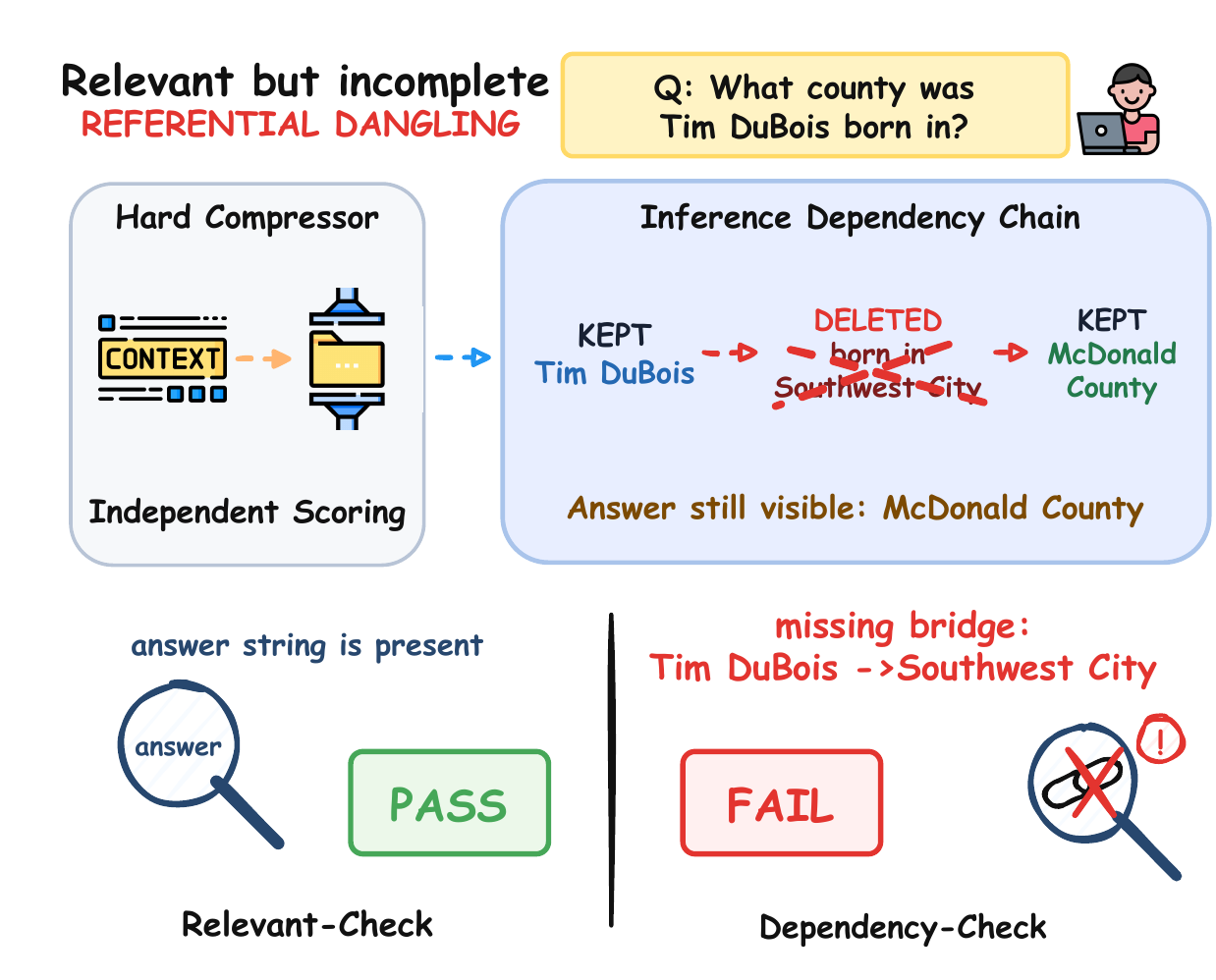
The central question of this paper is whether individually important fragments remain jointly usable after compression. A fragment can still contain an answer string while losing the earlier definition, antecedent, or bridge fact that makes the answer interpretable. This failure is easy to miss if evaluation checks only relevance or answer-string retention.
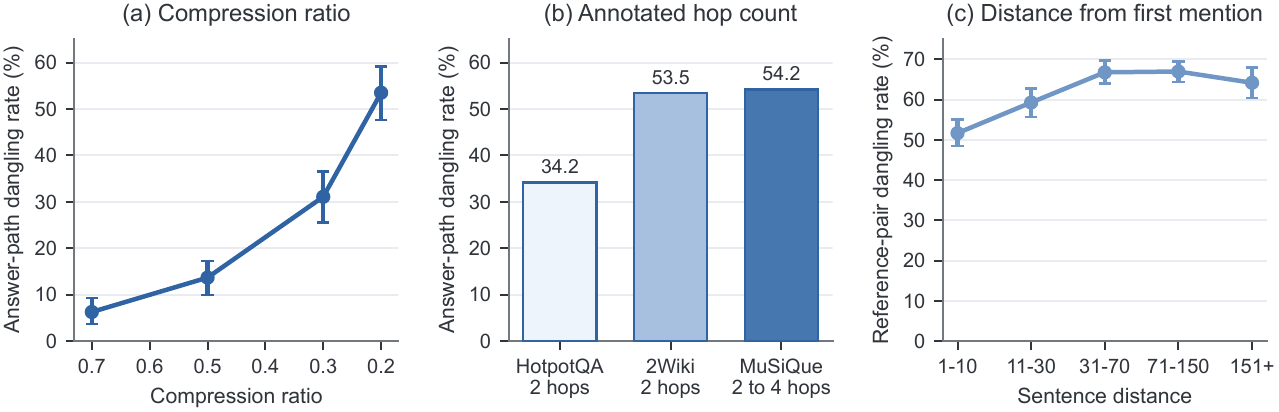
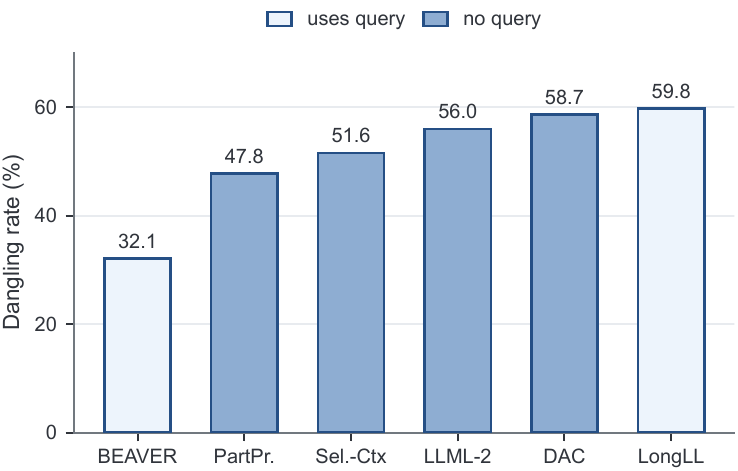
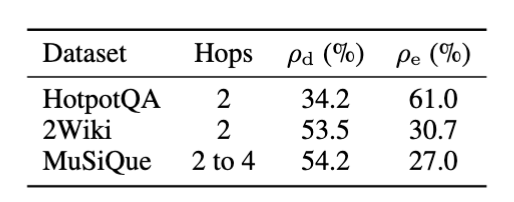
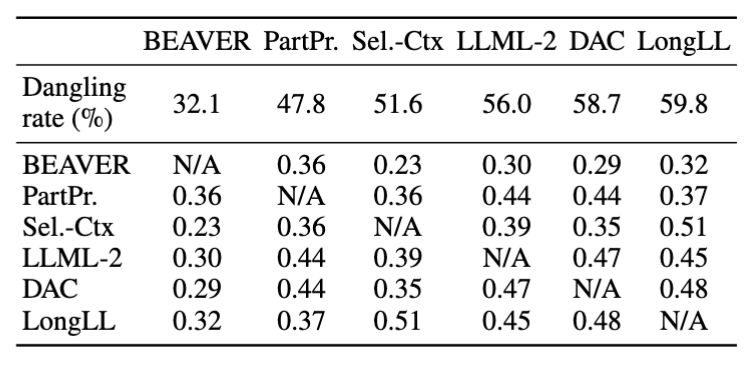
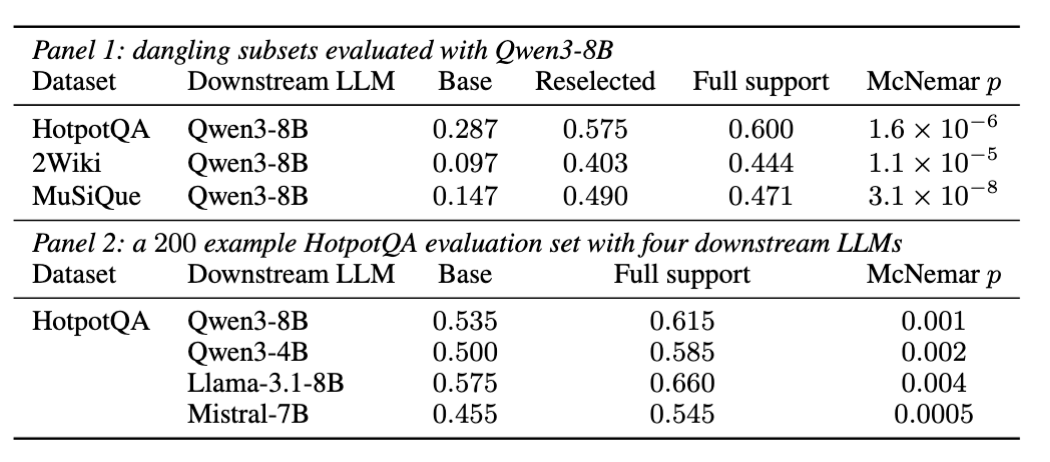
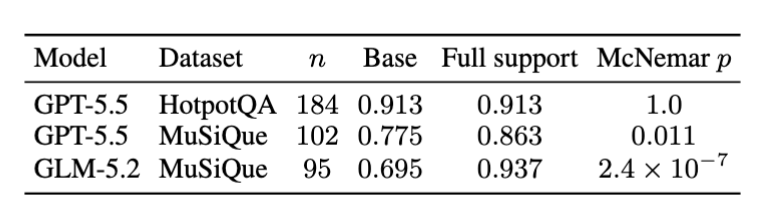
These results show that referential dangling is widespread rather than a rare edge case, and that it causes substantial downstream errors. At a nominal compression ratio of 0.30, the diagnostic identifies incomplete answer paths in 34–54% of bridge examples; a human audit confirms genuine dependency loss with 95% precision, all six tested compressors exhibit dangling at 32–60%, and every one of the 80 LongBench-v2 documents examined contains at least one dangling reference. Under the same nominal token budget, dependency-preserving reselection improves Qwen3-8B accuracy by 28.8–34.3 points on dangling subsets. In a separate Base-versus-Full-support comparison, restoring both supporting paragraphs improves MuSiQue accuracy by 8.8 points for GPT-5.5 and 24.2 points for GLM-5.2.
The paper introduces a dependency-oriented view of prompt compression:
0.30, the diagnostic flags incomplete answer paths in 34–54% of bridge examples across HotpotQA, 2WikiMultiHopQA, and MuSiQue.
 | 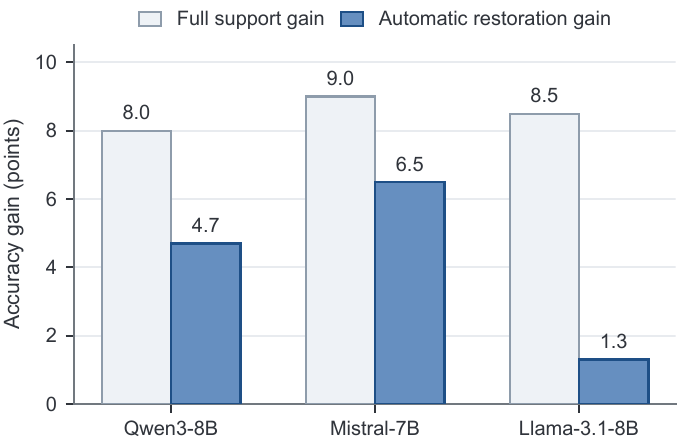 |
Open-source and closed-source downstream model results under Base and Full support.
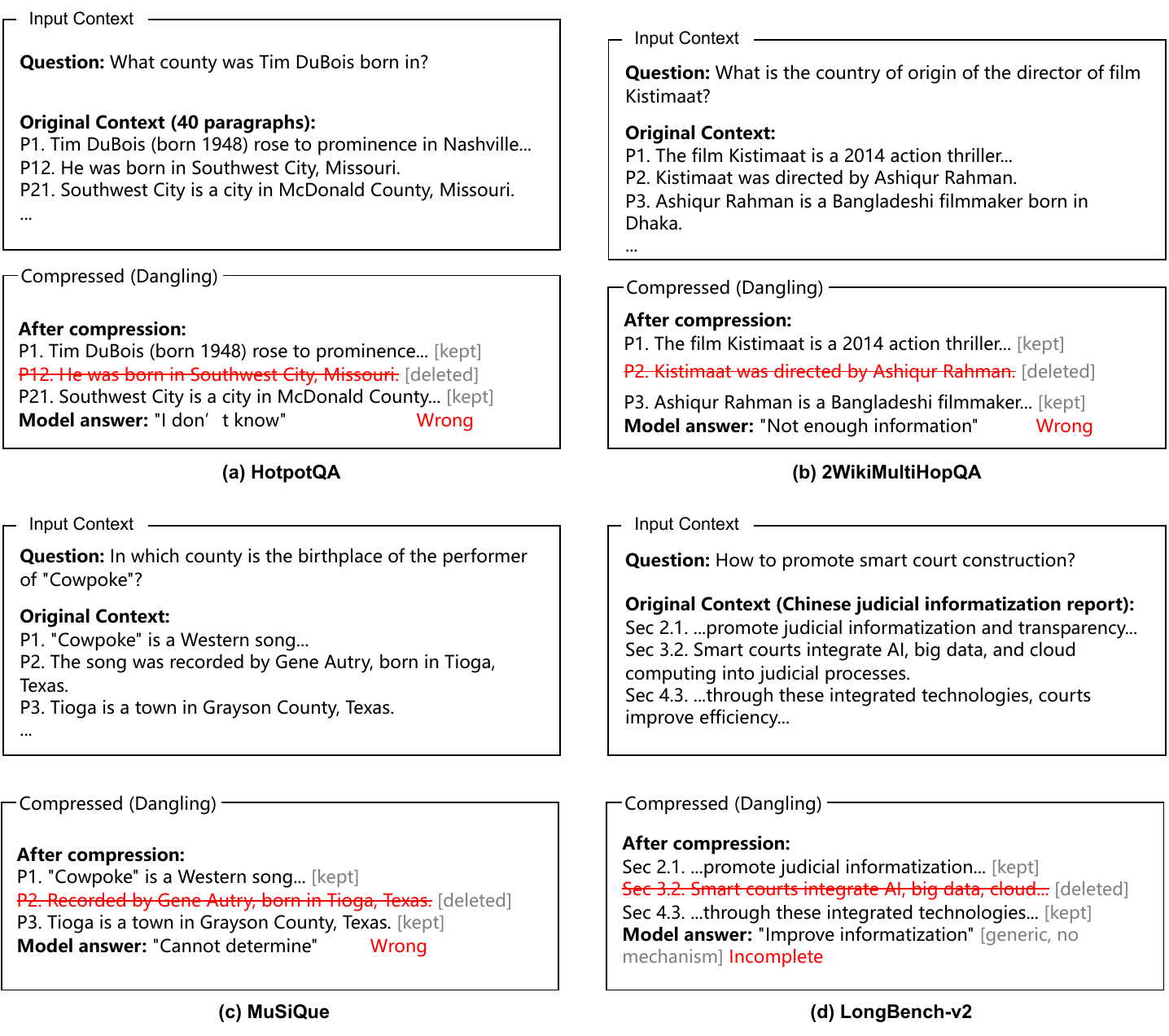
The examples illustrate the recurring pattern: the compressed context retains a relevant-looking fragment, but the missing bridge prevents the downstream model from completing the intended inference.
@article{hu2026relevant,
  title={Relevant but Incomplete: Referential Dangling as a Paradigm-Level Failure Mode in Hard Prompt Compression},
  author={Zhengpei Hu and Kai Li and Dapeng Fu and Xuechao Zou and Yuanhao Tang and Yue Li and Tengfei Cao and Jianqiang Huang},
  journal={arXiv preprint arXiv:2608.04569},
  year={2026},
  url={https://arxiv.org/pdf/2608.04569}
}
This package is released under the MIT License. Third-party compressors and benchmark datasets retain their original licenses.
Relevant but Incomplete: Referential Dangling as a Paradigm-Level Failure Mode in Hard Prompt Compression
See the code
Zhengpei Hu1,∗, Kai Li2,∗, Dapeng Fu3, Xuechao Zou2, Yuanhao Tang1, Yue Li1, Tengfei Cao1, Jianqiang Huang1,†
1School of Computer Technology and Application, Qinghai University
2Tsinghua University · 3Ant Group Security and Intelligence Laboratory (SIL)
∗Equal contribution · †Corresponding author
🌐 Project Page |
💻 Code |
🤗 Model |
📄 Paper
TL;DR: Hard prompt compression can preserve an answer-bearing fragment while deleting the definition or bridge fact needed to interpret it; we call this failure referential dangling and study how to diagnose and repair it.
Run these commands from the release root:
python -m venv .venv
source .venv/bin/activate
pip install -r requirements.txt
The following entry points expose the main analysis and training options (the
--help calls only print arguments; they do not launch a full experiment):
# Required for BEAVER-based entry points after following third_party/README.md
export PYTHONPATH="$PWD/third_party/BEAVER:${PYTHONPATH:-}"

python src/diagnose.py --help
python src/metric_c.py --help
python src/exp_candidate_ablation.py --help
python src/expE_span_longdoc.py --help
python src/train_detector.py --help
Full runs additionally require the external compressor setup described in
third_party/README.md, public benchmark inputs, a
CUDA-capable GPU, and Hugging Face access for model checkpoints. The restoration
scripts download the dependency detector from
JusperLee/referential-dangling-detector
by default; pass --bert_model /path/to/checkpoint to use a local checkpoint.
Long-context language models can process much more text than earlier systems, but prefill cost and distractor sensitivity make it attractive to shorten the input before inference. Hard compressors score tokens, sentences, or chunks independently and retain the most salient fragments under a budget.
The central question of this paper is whether individually important fragments remain jointly usable after compression. A fragment can still contain an answer string while losing the earlier definition, antecedent, or bridge fact that makes the answer interpretable. This failure is easy to miss if evaluation checks only relevance or answer-string retention.
These results show that referential dangling is widespread rather than a rare edge case, and that it causes substantial downstream errors. At a nominal compression ratio of 0.30, the diagnostic identifies incomplete answer paths in 34–54% of bridge examples; a human audit confirms genuine dependency loss with 95% precision, all six tested compressors exhibit dangling at 32–60%, and every one of the 80 LongBench-v2 documents examined contains at least one dangling reference. Under the same nominal token budget, dependency-preserving reselection improves Qwen3-8B accuracy by 28.8–34.3 points on dangling subsets. In a separate Base-versus-Full-support comparison, restoring both supporting paragraphs improves MuSiQue accuracy by 8.8 points for GPT-5.5 and 24.2 points for GLM-5.2.
The paper introduces a dependency-oriented view of prompt compression:
0.30, the diagnostic flags incomplete answer paths in 34–54% of bridge examples across HotpotQA, 2WikiMultiHopQA, and MuSiQue.
| |
Open-source and closed-source downstream model results under Base and Full support.
The examples illustrate the recurring pattern: the compressed context retains a relevant-looking fragment, but the missing bridge prevents the downstream model from completing the intended inference.
@article{hu2026relevant,
  title={Relevant but Incomplete: Referential Dangling as a Paradigm-Level Failure Mode in Hard Prompt Compression},
  author={Zhengpei Hu and Kai Li and Dapeng Fu and Xuechao Zou and Yuanhao Tang and Yue Li and Tengfei Cao and Jianqiang Huang},
  journal={arXiv preprint arXiv:2608.04569},
  year={2026},
  url={https://arxiv.org/pdf/2608.04569}
}
This package is released under the MIT License. Third-party compressors and benchmark datasets retain their original licenses.