Official code implementation for "SignSparK: Efficient Multilingual Sign Language Production via Sparse Keyframe Learning" (ECCV 2026).
See the codeJianhe Low, Alexandre Symeonidis-Herzig, Maksym Ivashechkin, Özge Mercanoğlu Sincan, Richard Bowden
Centre for Vision, Speech and Signal Processing (CVSSP), University of Surrey
ECCV 2026


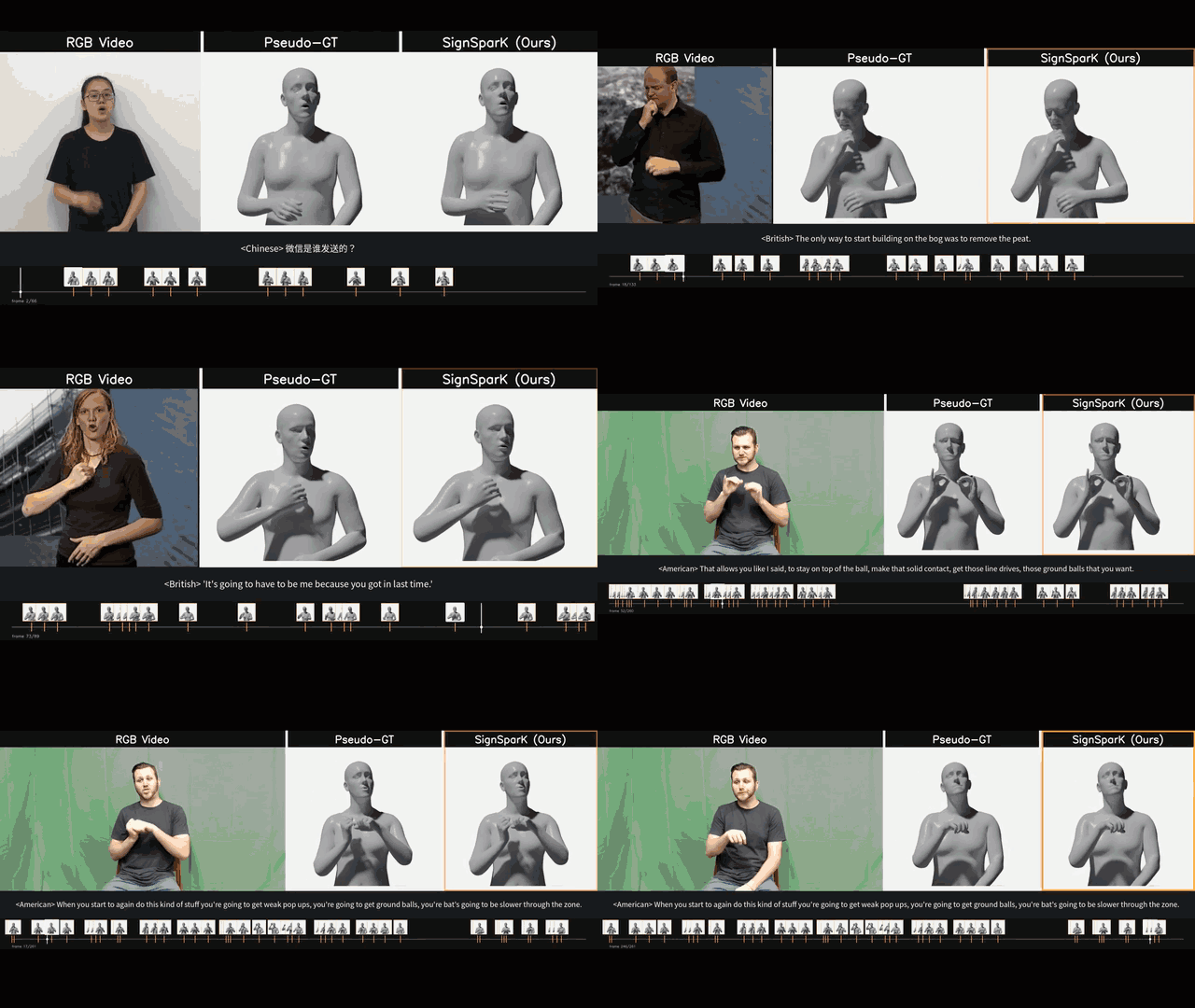
Full-resolution video on the project page.
SignSparK is a Conditional Flow Matching framework for multilingual Sign Language Production (SLP). Instead of regressing dense pose sequences, which collapses toward the mean and yields under-articulated signing, SignSparK learns from sparse keyframes that capture the underlying kinematic distribution of human signing, then synthesises fluid 3D signing sequences conditioned on spoken-language text and those keyframes (Keyframe-to-Pose generation). The framework supports four sign languages and achieves state-of-the-art results across multiple benchmarks.
This repository contains the flow-matching training and sampling code. The model is trained per body stream (i.e. hand, body, and face), which are combined to produce the full signer.
📄 Paper: https://arxiv.org/abs/2603.10446 · 🌐 Project page: https://cogvis-cvssp.github.io/papers/signspark/
Python 3.10, PyTorch 2.10 with CUDA 12.8 (required for Blackwell / RTX 50-series GPUs; works on older GPUs too):
conda env create -f environment.yml
conda activate signspark
Or with pip into your own environment:
pip install -r requirements.txt
Both pull PyTorch from the
cu128wheel index. For a different CUDA version, change the index URL (e.g..../whl/cu121) and drop the+cu128tags inenvironment.yml/requirements.txt. Do not upgradehuggingface_hubpast<1.0—transformers 4.56.1requires it.
SignSparK reads pose data from LMDB databases. We release prebuilt LMDBs for CSL-Daily, How2Sign and PHOENIX-2014T (6D pose features + translations + glosses + segment annotations). Thus, no local build step is required:
Note: The released datasets and checkpoints are higher quality than those used in the paper. Datasets have been reoptimized for improved contact points, while checkpoints have been trained on 15x more data, so reproduced results may exceed the originally reported numbers.
python tools/download_data.py --datasets CSL-Daily How2Sign PHOENIX-2014T --dest ./data
export DATA_ROOT=$(pwd)/data
python tools/inspect_lmdb.py ${DATA_ROOT}/lmdb/train/CSL-Daily_reopt_train.lmdb  # sanity-check
Pretrained checkpoints (per stream) download into $SIGNSPARK_CKPT_DIR:
Note: Our official checkpoint is trained on CSL-Daily, How2Sign, BOBSL, and CSL-News. PHOENIX14T is excluded due to poor 3D estimation quality on its low-resolution footage, though the processed data remains available on HuggingFace.
python tools/download_models.py --streams hand body face --dest ./checkpoints
export SIGNSPARK_CKPT_DIR=$(pwd)/checkpoints   # -> <stream>/ema_0.9999_<iter>.pt
See DATA.md for the record schema, directory layout, segment labels, and the left-hand convention. Datasets and checkpoints live on the Hub:
🤗 Data: LionelLow/SignSparK_data · Models: LionelLow/SignSparK · Back-translation: LionelLow/SignSparK_BT
Configure paths via environment variables (copy .env.example → .env):
| Variable | Meaning | Default |
|---|---|---|
DATA_ROOT | root holding lmdb/<split>/*.lmdb (downloaded data) | ./data |
SIGNSPARK_CKPT_DIR | released checkpoints, {hand,body,face}/ema_*.pt (read for sampling) | ./checkpoints |
OUTPUT_DIR | where training writes its runs/checkpoints | ./outputs |
OUTPUT_DIR (training output) and SIGNSPARK_CKPT_DIR (released weights for
sampling) are deliberately separate — to sample your own freshly-trained model,
point eval.model_path= at the file under OUTPUT_DIR.
FAST, the temporal sign language segmentor behind SignSparK's sparse
keyframes, labels every frame 0 (non-sign), 2 (sign onset) or 1
(continuation), following the segment field of the LMDB schema.
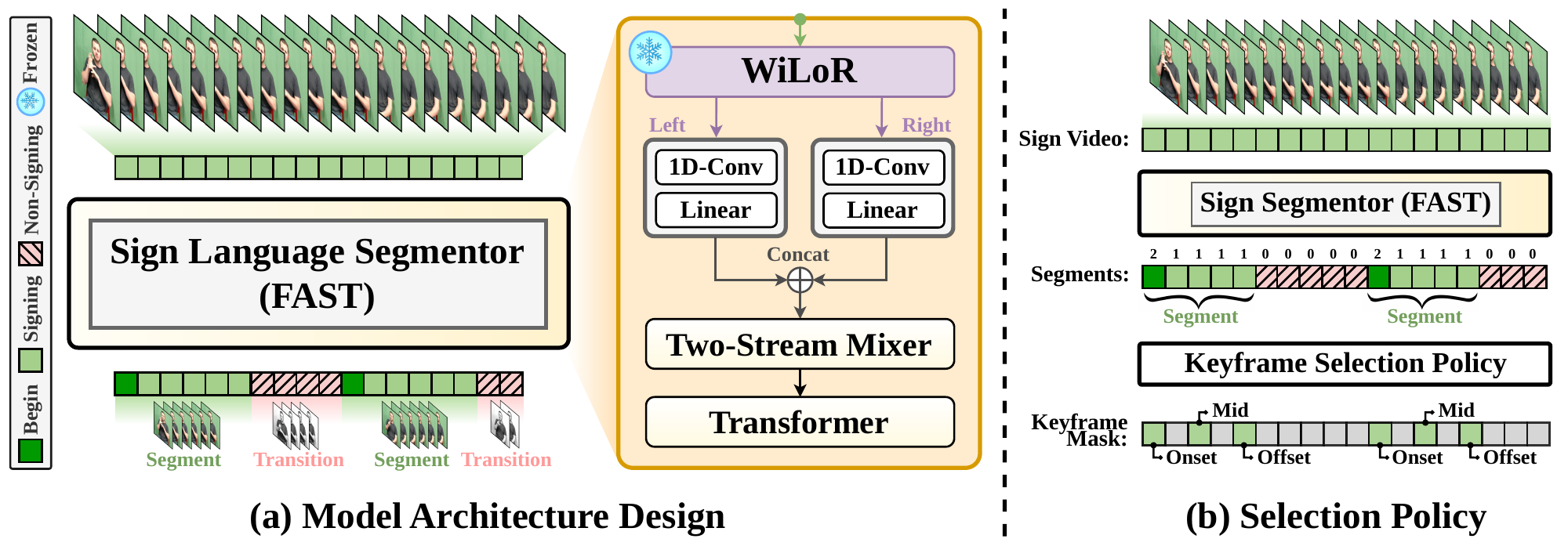
FAST ships in our Sign Language Toolkit:
pip install "signlangtk[wilor]==0.3.1"   # drop [wilor] if you already have WiLoR .h5 features
python fast/segment.py clip.mp4 -o segments.pt --keyframes
For RGB video inputs, it additionally needs signlangtk[wilor] and the licence-gated
MANO models. See fast/README.md.
Configs are managed with Hydra; select the body stream with
data_v2=<hand|body|face|full> and override any key on the CLI.
# Single GPU
python train.py data_v2=hand

# Multi-GPU (via 🤗 Accelerate)
accelerate launch train.py data_v2=hand
Train each stream separately (hand, body, face). Checkpoints (including EMA
weights) are written under ${OUTPUT_DIR}. Common overrides:
python train.py data_v2=body batch_size=128 learning_steps=500000 \
                train_data='[CSL-Daily]' base_path=${DATA_ROOT}/lmdb
Logging is opt-in: metrics go to Weights & Biases only if you set
WANDB_MODE=online (and WANDB_PROJECT / WANDB_ENTITY); otherwise it runs
disabled.
Generate poses for a single stream using the inference config and a checkpoint:
python sample.py data_v2=hand data_v2/common@common=inference \
                 eval.model_path=${SIGNSPARK_CKPT_DIR}/hand/ema_0.9999_200000.pt \
                 eval.split=test eval.ode_stepnum=50
Or sample all three streams sequentially with sample_all.py (edit its CONFIG
dict, or pass the same overrides on the CLI — CLI wins):
python sample_all.py eval.note=CSLDaily eval.ode_stepnum=50 test_data='[CSL-Daily]'
Key sampling options (eval.*, set in the inference config or overridden):
| Option | Meaning |
|---|---|
eval.split | which split to sample: test / dev / train |
test_data (or dev_data/train_data) | which dataset for that split, e.g. '[CSL-Daily]', '[How2Sign]' or '[PHOENIX-2014T]' — the eval set is chosen by this list in split.yaml, not a dataset= arg |
eval.ode_stepnum | number of ODE sampling steps |
eval.candidate_num | samples drawn per clip |
eval.max_samples | cap clips sampled (-1 = whole split) |
eval.model_path | checkpoint to load (per-stream) |
flip_left_hand | flip left hand to right-hand frame if your LMDB stores SMPLX-left (see DATA.md) |
sample_all.py resolves per-stream checkpoints from
${SIGNSPARK_CKPT_DIR}/<stream>/ema_0.9999_<iter>.pt and runs the streams one at
a time to keep peak VRAM at a single stream's footprint.
Classifier-free guidance / text-free sampling. Set eval.text_guidance_scale
above 0 to apply text guidance (uses classifier_free.py).
For fully unconditional (no keyframe) sampling, set eval.keyframes_mask_all=True.
With eval.text_guidance_scale=-1 guidance is off.
Outputs are written as .npy dictionaries containing predicted poses, lengths,
keyframe masks, conditioning text, and ground-truth poses.
tools/visualize.py turns the sampled .npy files into
side-by-side (ground truth vs prediction) SMPL-X mesh videos:
python tools/visualize.py --body body_eval.npy --hand hand_eval.npy \
                          --face face_eval.npy --model-folder ${SMPLX_DIR} \
                          --out outputs/viz
It uses the official smplx package; you
must download the (license-gated) SMPL-X model files yourself. See
VISUALIZATION.md for setup and options.
Metrics. For the quantitative evaluation protocol (MPJPE / PA-MPJPE / DTW), use the official evaluation code at github.com/2000ZRL/SOKE. For back-translation metrics (BLEU / chrF / ROUGE), see below.
SignSparK-BT is the evaluation
companion to this repo: it translates generated SMPL+MANO poses back to spoken
language and scores them with BLEU, chrF and ROUGE. It reads the same LMDBs
as SignSparK, so DATA_ROOT can carry without changes.
git clone https://github.com/JianHe0628/SignSparK_BT.git && cd SignSparK_BT
conda env create -f environment.yml && conda activate signspark-bt && pip install -e .

# same DATA_ROOT as SignSparK; back-translation weights are a separate download
export DATA_ROOT=/path/to/signspark/data
python tools/download_models.py --datasets PHOENIX-2014T CSL-Daily How2Sign --dest ./checkpoints
Score a sample_all.py run by pointing it at the body and hand dumps
from that same run. Note that the face stream is unused, so the model takes body 60 + both
hands 90 each = 240 dims. Note also that sample.py writes each dump next to the checkpoint
it loaded, under <ckpt dir>/debug0_eulerstepsize<steps>_can<n>_anchor<0|1>_samples/:
RUN=debug0_eulerstepsize50_can1_anchor0_samples
signspark-bt score checkpoints/PHOENIX-2014T \
    --body-npy ${SIGNSPARK_CKPT_DIR}/body/${RUN}/seed123_clampstep0_PHOENIX14T.npy \
    --hand-npy ${SIGNSPARK_CKPT_DIR}/hand/${RUN}/seed123_clampstep0_PHOENIX14T.npy
(the seed and trailing name come from eval.seed, eval.clamp_step and
eval.note of that run.)
It scores ground-truth and generated poses in one pass and reports the drop between them. Released models and the updated score tables: 🤗 LionelLow/SignSparK_BT · full README.
Note: The released back-translation models are retrained on the reoptimized LMDBs, so both the ground-truth ceiling and the reported drop differ from the paper.
If you find this work useful, please cite:
@inproceedings{low2026signspark,
  title={SignSparK: Efficient Multilingual Sign Language Production via Sparse Keyframe Learning},
  author={Low, Jianhe and Symeonidis-Herzig, Alexandre and Ivashechkin, Maksym and Sincan, Ozge Mercanoglu and Bowden, Richard},
  booktitle={European Conference on Computer Vision},
  pages={648--670},
  year={2026},
  organization={Springer}
}
The flow-matching training scaffold builds on ideas from FlowSeq, while evaluation metrics come from SOKE. We sincerely thank the authors for open-sourcing their codebases.
The code in this repository is released under the Apache License 2.0.
The released datasets and model checkpoints are derived from CSL-Daily, How2Sign, PHOENIX-2014T and BOBSL and are provided for non-commercial research use only, under the terms of those source datasets.
Official code implementation for "SignSparK: Efficient Multilingual Sign Language Production via Sparse Keyframe Learning" (ECCV 2026).
See the codeJianhe Low, Alexandre Symeonidis-Herzig, Maksym Ivashechkin, Özge Mercanoğlu Sincan, Richard Bowden
Centre for Vision, Speech and Signal Processing (CVSSP), University of Surrey
ECCV 2026
Full-resolution video on the project page.
SignSparK is a Conditional Flow Matching framework for multilingual Sign Language Production (SLP). Instead of regressing dense pose sequences, which collapses toward the mean and yields under-articulated signing, SignSparK learns from sparse keyframes that capture the underlying kinematic distribution of human signing, then synthesises fluid 3D signing sequences conditioned on spoken-language text and those keyframes (Keyframe-to-Pose generation). The framework supports four sign languages and achieves state-of-the-art results across multiple benchmarks.
This repository contains the flow-matching training and sampling code. The model is trained per body stream (i.e. hand, body, and face), which are combined to produce the full signer.
📄 Paper: https://arxiv.org/abs/2603.10446 · 🌐 Project page: https://cogvis-cvssp.github.io/papers/signspark/
Python 3.10, PyTorch 2.10 with CUDA 12.8 (required for Blackwell / RTX 50-series GPUs; works on older GPUs too):
conda env create -f environment.yml
conda activate signspark
Or with pip into your own environment:
pip install -r requirements.txt
Both pull PyTorch from the
cu128wheel index. For a different CUDA version, change the index URL (e.g..../whl/cu121) and drop the+cu128tags inenvironment.yml/requirements.txt. Do not upgradehuggingface_hubpast<1.0—transformers 4.56.1requires it.
SignSparK reads pose data from LMDB databases. We release prebuilt LMDBs for CSL-Daily, How2Sign and PHOENIX-2014T (6D pose features + translations + glosses + segment annotations). Thus, no local build step is required:
Note: The released datasets and checkpoints are higher quality than those used in the paper. Datasets have been reoptimized for improved contact points, while checkpoints have been trained on 15x more data, so reproduced results may exceed the originally reported numbers.
python tools/download_data.py --datasets CSL-Daily How2Sign PHOENIX-2014T --dest ./data
export DATA_ROOT=$(pwd)/data
python tools/inspect_lmdb.py ${DATA_ROOT}/lmdb/train/CSL-Daily_reopt_train.lmdb  # sanity-check
Pretrained checkpoints (per stream) download into $SIGNSPARK_CKPT_DIR:
Note: Our official checkpoint is trained on CSL-Daily, How2Sign, BOBSL, and CSL-News. PHOENIX14T is excluded due to poor 3D estimation quality on its low-resolution footage, though the processed data remains available on HuggingFace.
python tools/download_models.py --streams hand body face --dest ./checkpoints
export SIGNSPARK_CKPT_DIR=$(pwd)/checkpoints   # -> <stream>/ema_0.9999_<iter>.pt
See DATA.md for the record schema, directory layout, segment labels, and the left-hand convention. Datasets and checkpoints live on the Hub:
🤗 Data: LionelLow/SignSparK_data · Models: LionelLow/SignSparK · Back-translation: LionelLow/SignSparK_BT
Configure paths via environment variables (copy .env.example → .env):
| Variable | Meaning | Default |
|---|---|---|
DATA_ROOT | root holding lmdb/<split>/*.lmdb (downloaded data) | ./data |
SIGNSPARK_CKPT_DIR | released checkpoints, {hand,body,face}/ema_*.pt (read for sampling) | ./checkpoints |
OUTPUT_DIR | where training writes its runs/checkpoints | ./outputs |
OUTPUT_DIR (training output) and SIGNSPARK_CKPT_DIR (released weights for
sampling) are deliberately separate — to sample your own freshly-trained model,
point eval.model_path= at the file under OUTPUT_DIR.
FAST, the temporal sign language segmentor behind SignSparK's sparse
keyframes, labels every frame 0 (non-sign), 2 (sign onset) or 1
(continuation), following the segment field of the LMDB schema.
FAST ships in our Sign Language Toolkit:
pip install "signlangtk[wilor]==0.3.1"   # drop [wilor] if you already have WiLoR .h5 features
python fast/segment.py clip.mp4 -o segments.pt --keyframes
For RGB video inputs, it additionally needs signlangtk[wilor] and the licence-gated
MANO models. See fast/README.md.
Configs are managed with Hydra; select the body stream with
data_v2=<hand|body|face|full> and override any key on the CLI.
# Single GPU
python train.py data_v2=hand

# Multi-GPU (via 🤗 Accelerate)
accelerate launch train.py data_v2=hand
Train each stream separately (hand, body, face). Checkpoints (including EMA
weights) are written under ${OUTPUT_DIR}. Common overrides:
python train.py data_v2=body batch_size=128 learning_steps=500000 \
                train_data='[CSL-Daily]' base_path=${DATA_ROOT}/lmdb
Logging is opt-in: metrics go to Weights & Biases only if you set
WANDB_MODE=online (and WANDB_PROJECT / WANDB_ENTITY); otherwise it runs
disabled.
Generate poses for a single stream using the inference config and a checkpoint:
python sample.py data_v2=hand data_v2/common@common=inference \
                 eval.model_path=${SIGNSPARK_CKPT_DIR}/hand/ema_0.9999_200000.pt \
                 eval.split=test eval.ode_stepnum=50
Or sample all three streams sequentially with sample_all.py (edit its CONFIG
dict, or pass the same overrides on the CLI — CLI wins):
python sample_all.py eval.note=CSLDaily eval.ode_stepnum=50 test_data='[CSL-Daily]'
Key sampling options (eval.*, set in the inference config or overridden):
| Option | Meaning |
|---|---|
eval.split | which split to sample: test / dev / train |
test_data (or dev_data/train_data) | which dataset for that split, e.g. '[CSL-Daily]', '[How2Sign]' or '[PHOENIX-2014T]' — the eval set is chosen by this list in split.yaml, not a dataset= arg |
eval.ode_stepnum | number of ODE sampling steps |
eval.candidate_num | samples drawn per clip |
eval.max_samples | cap clips sampled (-1 = whole split) |
eval.model_path | checkpoint to load (per-stream) |
flip_left_hand | flip left hand to right-hand frame if your LMDB stores SMPLX-left (see DATA.md) |
sample_all.py resolves per-stream checkpoints from
${SIGNSPARK_CKPT_DIR}/<stream>/ema_0.9999_<iter>.pt and runs the streams one at
a time to keep peak VRAM at a single stream's footprint.
Classifier-free guidance / text-free sampling. Set eval.text_guidance_scale
above 0 to apply text guidance (uses classifier_free.py).
For fully unconditional (no keyframe) sampling, set eval.keyframes_mask_all=True.
With eval.text_guidance_scale=-1 guidance is off.
Outputs are written as .npy dictionaries containing predicted poses, lengths,
keyframe masks, conditioning text, and ground-truth poses.
tools/visualize.py turns the sampled .npy files into
side-by-side (ground truth vs prediction) SMPL-X mesh videos:
python tools/visualize.py --body body_eval.npy --hand hand_eval.npy \
                          --face face_eval.npy --model-folder ${SMPLX_DIR} \
                          --out outputs/viz
It uses the official smplx package; you
must download the (license-gated) SMPL-X model files yourself. See
VISUALIZATION.md for setup and options.
Metrics. For the quantitative evaluation protocol (MPJPE / PA-MPJPE / DTW), use the official evaluation code at github.com/2000ZRL/SOKE. For back-translation metrics (BLEU / chrF / ROUGE), see below.
SignSparK-BT is the evaluation
companion to this repo: it translates generated SMPL+MANO poses back to spoken
language and scores them with BLEU, chrF and ROUGE. It reads the same LMDBs
as SignSparK, so DATA_ROOT can carry without changes.
git clone https://github.com/JianHe0628/SignSparK_BT.git && cd SignSparK_BT
conda env create -f environment.yml && conda activate signspark-bt && pip install -e .

# same DATA_ROOT as SignSparK; back-translation weights are a separate download
export DATA_ROOT=/path/to/signspark/data
python tools/download_models.py --datasets PHOENIX-2014T CSL-Daily How2Sign --dest ./checkpoints
Score a sample_all.py run by pointing it at the body and hand dumps
from that same run. Note that the face stream is unused, so the model takes body 60 + both
hands 90 each = 240 dims. Note also that sample.py writes each dump next to the checkpoint
it loaded, under <ckpt dir>/debug0_eulerstepsize<steps>_can<n>_anchor<0|1>_samples/:
RUN=debug0_eulerstepsize50_can1_anchor0_samples
signspark-bt score checkpoints/PHOENIX-2014T \
    --body-npy ${SIGNSPARK_CKPT_DIR}/body/${RUN}/seed123_clampstep0_PHOENIX14T.npy \
    --hand-npy ${SIGNSPARK_CKPT_DIR}/hand/${RUN}/seed123_clampstep0_PHOENIX14T.npy
(the seed and trailing name come from eval.seed, eval.clamp_step and
eval.note of that run.)
It scores ground-truth and generated poses in one pass and reports the drop between them. Released models and the updated score tables: 🤗 LionelLow/SignSparK_BT · full README.
Note: The released back-translation models are retrained on the reoptimized LMDBs, so both the ground-truth ceiling and the reported drop differ from the paper.
If you find this work useful, please cite:
@inproceedings{low2026signspark,
  title={SignSparK: Efficient Multilingual Sign Language Production via Sparse Keyframe Learning},
  author={Low, Jianhe and Symeonidis-Herzig, Alexandre and Ivashechkin, Maksym and Sincan, Ozge Mercanoglu and Bowden, Richard},
  booktitle={European Conference on Computer Vision},
  pages={648--670},
  year={2026},
  organization={Springer}
}
The flow-matching training scaffold builds on ideas from FlowSeq, while evaluation metrics come from SOKE. We sincerely thank the authors for open-sourcing their codebases.
The code in this repository is released under the Apache License 2.0.
The released datasets and model checkpoints are derived from CSL-Daily, How2Sign, PHOENIX-2014T and BOBSL and are provided for non-commercial research use only, under the terms of those source datasets.



