
RL models to play Sokoban. The fastest recipe wins.
Python
31
190 commits
updated Jul 25, 2026
README
Sokoban Speedrun
Fastest recipes to RL models to solve Sokoban to a held-out target on one node:
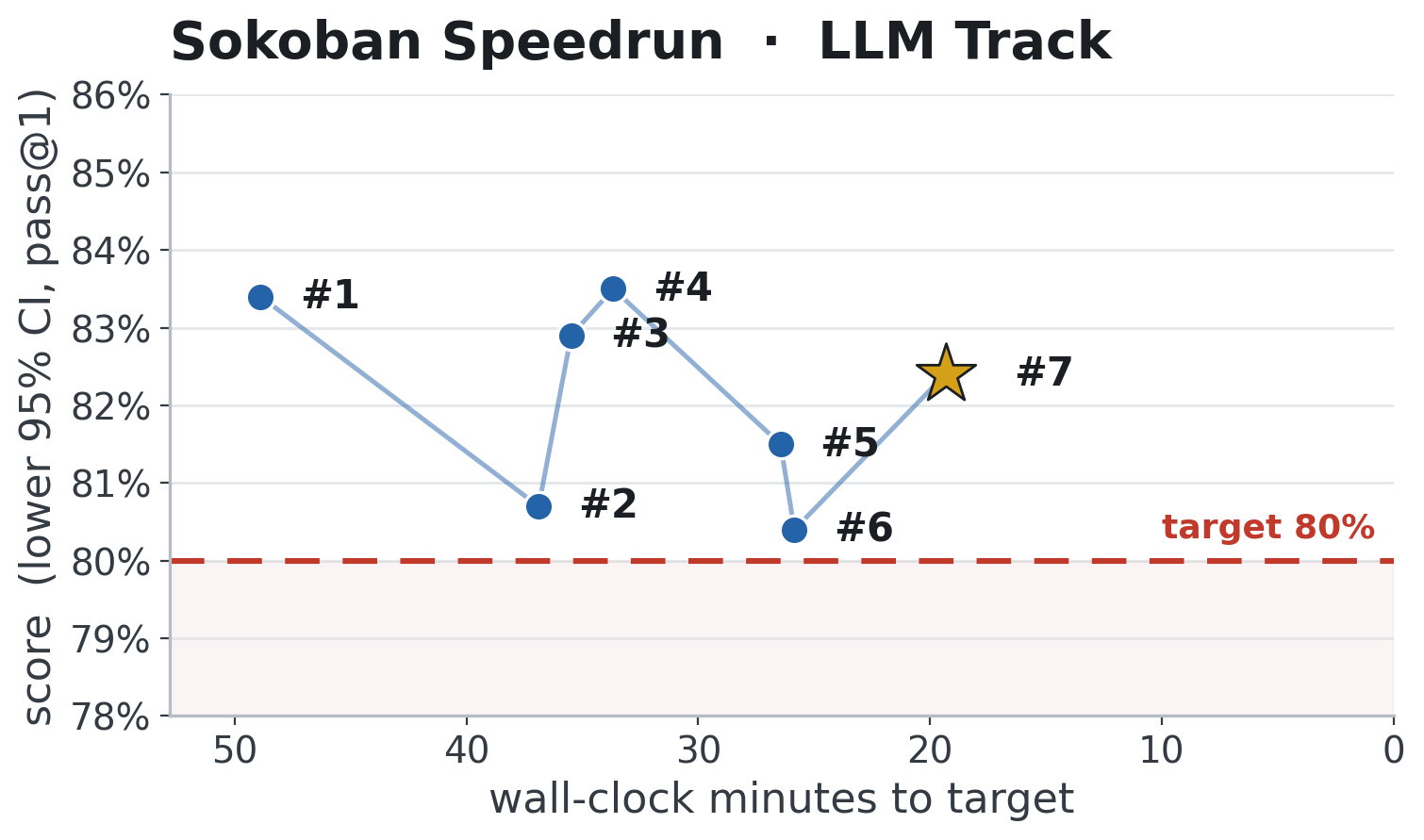
- LLM Track: RL-fine-tune Qwen3-4B-Instruct-2507 from 57% to >80% held-out pass@1 on one 8xH100.
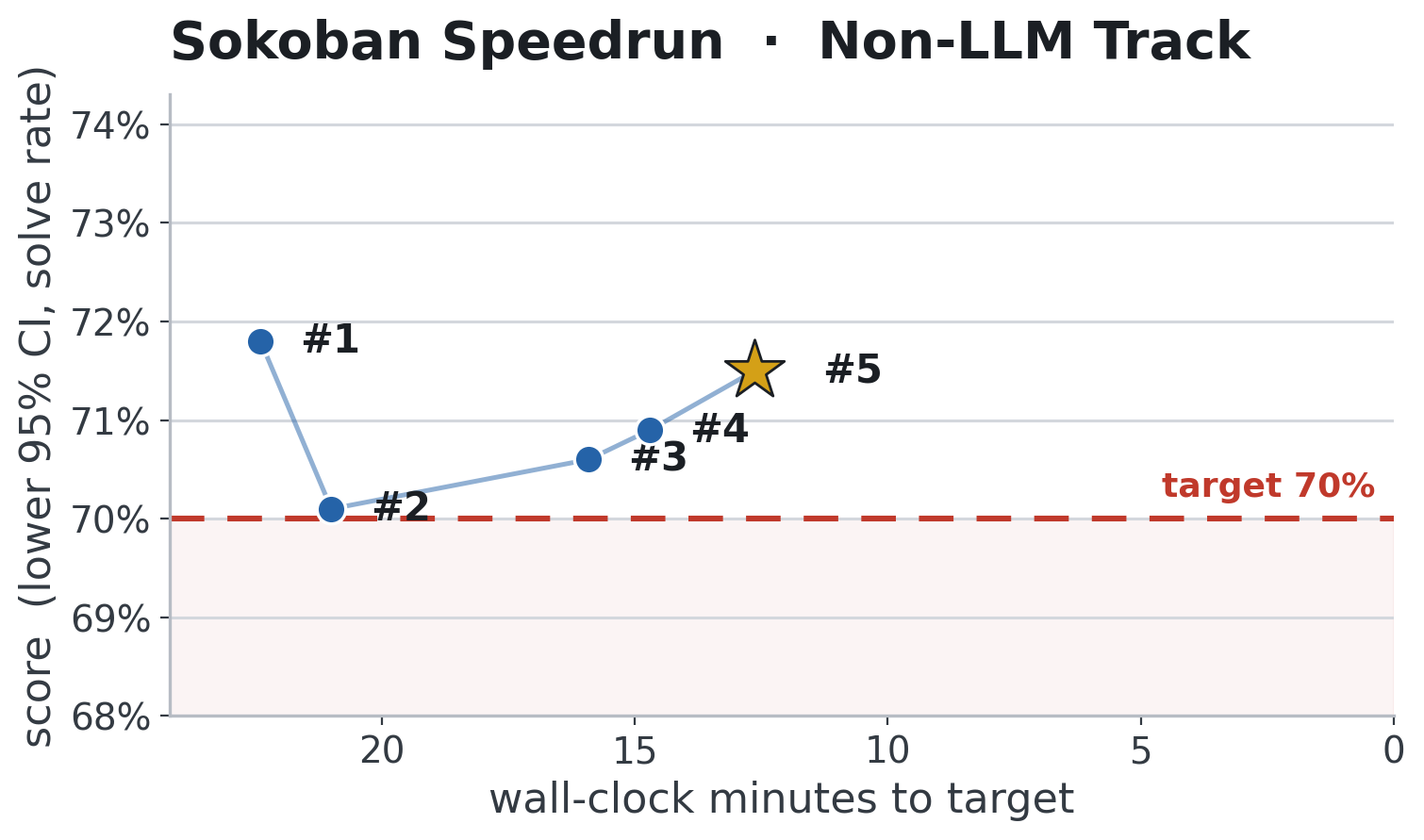
- Non-LLM Track: train a from-scratch agent on a single H100.
Play Sokoban if the task is unfamiliar.
LLM Track
World record history
| # | Record time (mm:ss) | Description | Date | Log | score | Contributors |
|---|---|---|---|---|---|---|
| 1 | 48:53 | GRPO, LR 1.6e-6 annealed, 75 steps | 2026-06-29 | llm/records/2026-06-29_01 | 0.834 | @JeanKaddour |
| 2 | 36:53 | steps + LR-decay horizon 75 → 60 | 2026-06-29 | llm/records/2026-06-29_02 | 0.807 | @dexhunter |
| 3 | 35:29 | earlier stop: 54 steps | 2026-07-02 | llm/records/2026-07-02_01 | 0.829 | @dexhunter |
| 4 | 33:40 | Weco advantage shaping, 52 steps | 2026-07-02 | llm/records/2026-07-02_02 | 0.835 | @dexhunter |
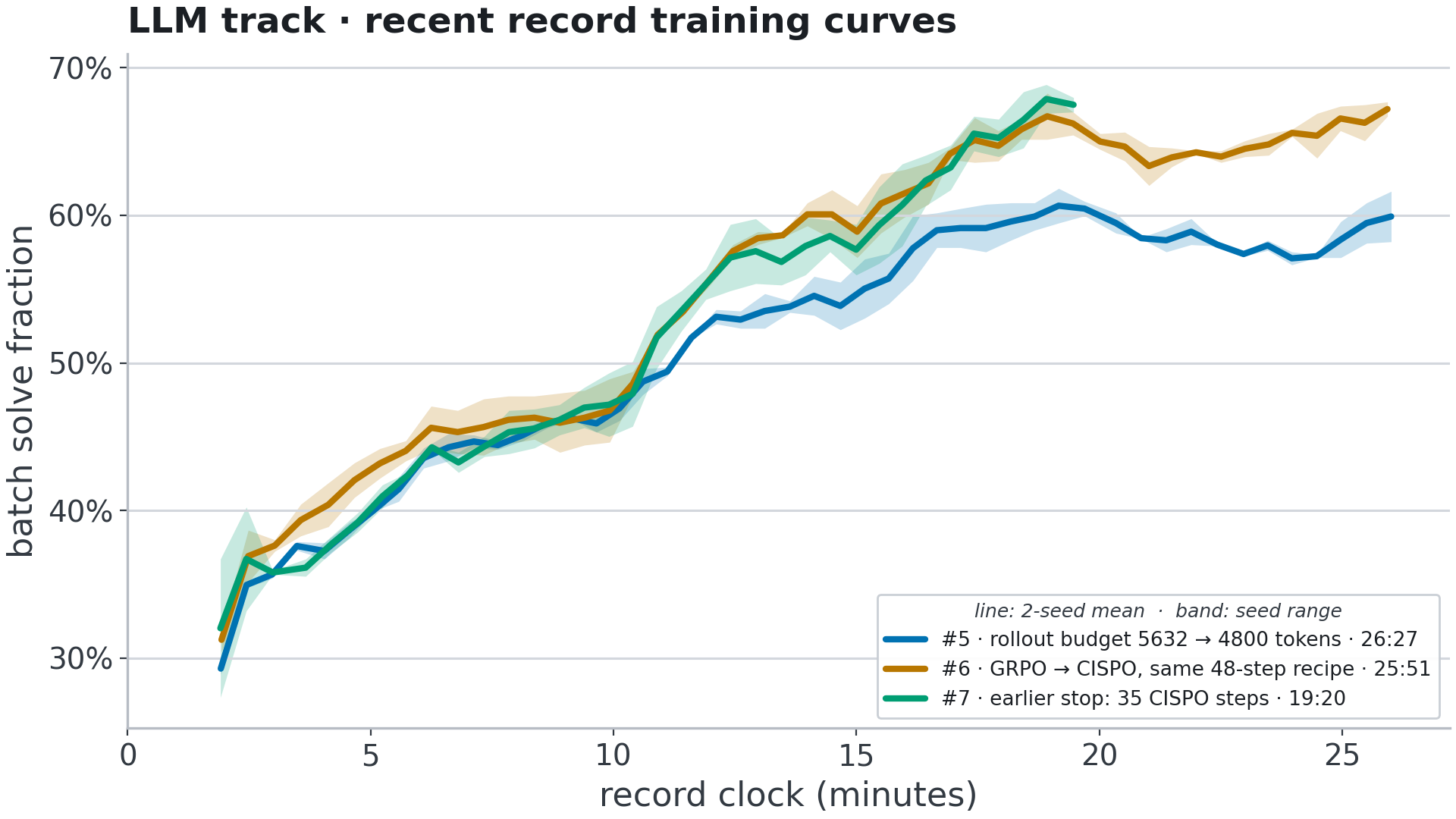
| 5 | 26:27 | rollout budget 5632 → 4800 tokens, 48 steps | 2026-07-02 | llm/records/2026-07-02_03 | 0.815 | @lorenzflow |
| 6 | 25:51 | GRPO → CISPO, same 48-step recipe | 2026-07-14 | llm/records/2026-07-14_01 | 0.804 | @lorenzflow |
| 7 | 19:20 | earlier stop: 35 CISPO steps | 2026-07-15 | llm/records/2026-07-15_01 | 0.824 | @lorenzflow |
Rules
Fastest wall-clock run wins: one run on one 8xH100 node, from training step 1 through the final training update.
- Score: the lower 95% bootstrap CI of pass@1 on llm/datasets/sokoban_eval.jsonl — a record must score > 0.80.
- Eval: 8 completions/puzzle, 12,288 tokens, temperature 0.8, top-p 0.95, seed 12345.
- Fixed: model, train set, eval set, reward function, hardware.
- Open: RL algorithm, loss, schedules, engine, parallelism, domain-agnostic rewards, prompt.
- Not allowed: Sokoban-specific hints, heuristics, or few-shot examples.
- Verification: Rerun with a second seed; both runs must score above the target. The score column reports the worse of the two runs.
Running
cd llm
uv sync
NODE_GPUS=8 uv run torchrun --standalone --nproc_per_node=3 -m speedrun
uv run python -m eval_speedrun --eval-checkpoint outputs/<run>/step_000051
Non-LLM Track
This track uses PufferLib's Boxoban environment; the initial PPO implementation was forked from pufferlib/torch_pufferl.py.
World record history
| # | Record time (mm:ss) | Description | Date | Log | score | Contributors |
|---|---|---|---|---|---|---|
| 1 | 22:24 | cnn-mingru h256 | 2026-06-21 | non_llm/records/2026-06-21_01 | 0.718 | @JeanKaddour |
| 2 | 21:00 | same recipe as #1, earliest clearing checkpoint | 2026-06-29 | non_llm/records/2026-06-29_01 | 0.701 | @JeanKaddour |
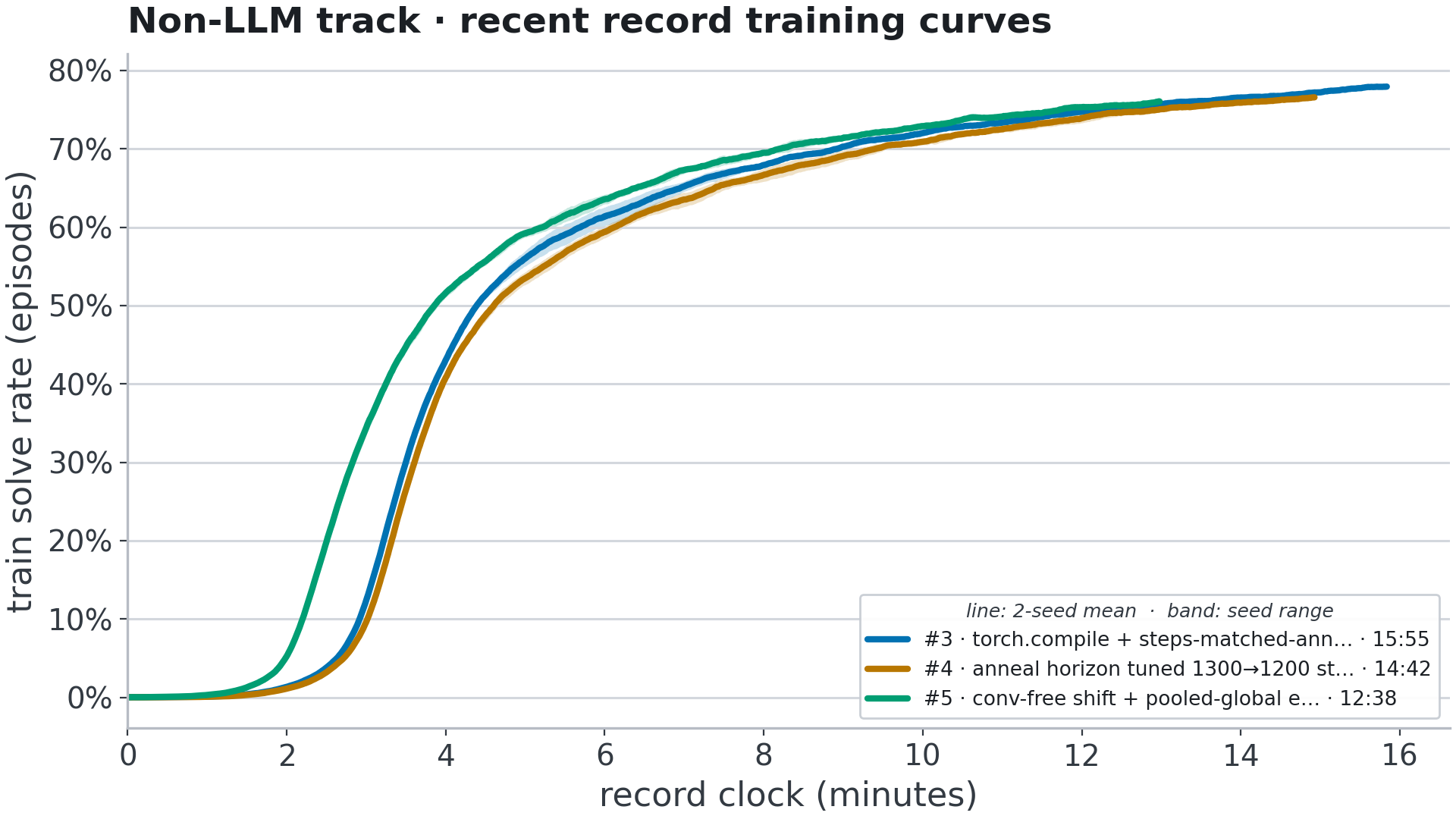
| 3 | 15:55 | torch.compile + steps-matched-anneal | 2026-06-30 | non_llm/records/2026-06-30_01 | 0.706 | @JeanKaddour |
| 4 | 14:42 | anneal horizon tuned 1300→1200 steps | 2026-07-02 | non_llm/records/2026-07-02_01 | 0.709 | @JeanKaddour |
| 5 | 12:38 | conv-free shift + pooled-global encoder (sgpm2), 950-step anneal | 2026-07-02 | non_llm/records/2026-07-02_02 | 0.715 | @srijanpatel |
Rules
Fastest wall-clock run wins: one run on a single H100, from training step 1 through the final training update.
- Score: the lower 95% CI of the held-out solve rate — a record must score > 0.70.
- Eval: official DeepMind Boxoban test split
unfiltered/test. - Open: policy architecture, RL algorithm, optimizer, schedules, implementation.
- Verification: Rerun with a second seed; both runs must score above the target. The score column reports the worse of the two runs.
Running
cd non_llm
uv sync
uv run python speedrun.py
Submitting a record
Each track's assemble_record.sh (llm/, non_llm/) turns a finished run into a record dir: it collects the log, eval JSON, and source snapshot, builds the report, pins the top-level speedrun.py, runs verify_record.py, and adds or refreshes the record's row + redraws the leaderboard and rolling recent-training figures. Configure record runs by editing RECIPE in speedrun.py and launch them flag-free — the pinned speedrun.py then is the recipe (assembly rejects flag-configured runs). It reads a local outputs/<RUN>/ by default; pass SOURCE=modal to pull off the volume.
-
Train + eval with your track's Running commands.
-
Assemble the record:
cd llm        # or: cd non_llm
RUN=<RUN> DEST=records/<date>_01_<name> ./assemble_record.sh
The record's
README.mdis scaffolded with a placeholder## Ideasection. Review the pinnedspeedrun.pydiff, then fill in by hand: the record's## Idea, and the new leaderboard row's Description + Contributors in this top-levelREADME.md. -
Open a PR with the record dir + new row.
Optional: verify it yourself with a second seed (otherwise the maintainers do; either way both seeds must clear the target), assembled into the record's verification/ subdir:
RUN=<VRUN> VERIFY_OF=records/<date>_01_<name> ./assemble_record.sh
The top-level speedrun.py files always hold the current record's recipe.
Credits
@joshua-a-harris's nanoRL speedrun, nanochat, modded-nanoGPT, ScaleRL, ReasoningGym for the LLM-track Sokoban env, DeepMind for Boxoban and PufferLib for the efficient boxoban implementation.
Contributors



Similar repos






Languages
Python
99.4%
RL models to play Sokoban. The fastest recipe wins.
Python
31
190 commits
updated Jul 25, 2026
README
Sokoban Speedrun
Fastest recipes to RL models to solve Sokoban to a held-out target on one node:
- LLM Track: RL-fine-tune Qwen3-4B-Instruct-2507 from 57% to >80% held-out pass@1 on one 8xH100.
- Non-LLM Track: train a from-scratch agent on a single H100.
Play Sokoban if the task is unfamiliar.
LLM Track
World record history
| # | Record time (mm:ss) | Description | Date | Log | score | Contributors |
|---|---|---|---|---|---|---|
| 1 | 48:53 | GRPO, LR 1.6e-6 annealed, 75 steps | 2026-06-29 | llm/records/2026-06-29_01 | 0.834 | @JeanKaddour |
| 2 | 36:53 | steps + LR-decay horizon 75 → 60 | 2026-06-29 | llm/records/2026-06-29_02 | 0.807 | @dexhunter |
| 3 | 35:29 | earlier stop: 54 steps | 2026-07-02 | llm/records/2026-07-02_01 | 0.829 | @dexhunter |
| 4 | 33:40 | Weco advantage shaping, 52 steps | 2026-07-02 | llm/records/2026-07-02_02 | 0.835 | @dexhunter |
| 5 | 26:27 | rollout budget 5632 → 4800 tokens, 48 steps | 2026-07-02 | llm/records/2026-07-02_03 | 0.815 | @lorenzflow |
| 6 | 25:51 | GRPO → CISPO, same 48-step recipe | 2026-07-14 | llm/records/2026-07-14_01 | 0.804 | @lorenzflow |
| 7 | 19:20 | earlier stop: 35 CISPO steps | 2026-07-15 | llm/records/2026-07-15_01 | 0.824 | @lorenzflow |
Rules
Fastest wall-clock run wins: one run on one 8xH100 node, from training step 1 through the final training update.
- Score: the lower 95% bootstrap CI of pass@1 on llm/datasets/sokoban_eval.jsonl — a record must score > 0.80.
- Eval: 8 completions/puzzle, 12,288 tokens, temperature 0.8, top-p 0.95, seed 12345.
- Fixed: model, train set, eval set, reward function, hardware.
- Open: RL algorithm, loss, schedules, engine, parallelism, domain-agnostic rewards, prompt.
- Not allowed: Sokoban-specific hints, heuristics, or few-shot examples.
- Verification: Rerun with a second seed; both runs must score above the target. The score column reports the worse of the two runs.
Running
cd llm
uv sync
NODE_GPUS=8 uv run torchrun --standalone --nproc_per_node=3 -m speedrun
uv run python -m eval_speedrun --eval-checkpoint outputs/<run>/step_000051
Non-LLM Track
This track uses PufferLib's Boxoban environment; the initial PPO implementation was forked from pufferlib/torch_pufferl.py.
World record history
| # | Record time (mm:ss) | Description | Date | Log | score | Contributors |
|---|---|---|---|---|---|---|
| 1 | 22:24 | cnn-mingru h256 | 2026-06-21 | non_llm/records/2026-06-21_01 | 0.718 | @JeanKaddour |
| 2 | 21:00 | same recipe as #1, earliest clearing checkpoint | 2026-06-29 | non_llm/records/2026-06-29_01 | 0.701 | @JeanKaddour |
| 3 | 15:55 | torch.compile + steps-matched-anneal | 2026-06-30 | non_llm/records/2026-06-30_01 | 0.706 | @JeanKaddour |
| 4 | 14:42 | anneal horizon tuned 1300→1200 steps | 2026-07-02 | non_llm/records/2026-07-02_01 | 0.709 | @JeanKaddour |
| 5 | 12:38 | conv-free shift + pooled-global encoder (sgpm2), 950-step anneal | 2026-07-02 | non_llm/records/2026-07-02_02 | 0.715 | @srijanpatel |
Rules
Fastest wall-clock run wins: one run on a single H100, from training step 1 through the final training update.
- Score: the lower 95% CI of the held-out solve rate — a record must score > 0.70.
- Eval: official DeepMind Boxoban test split
unfiltered/test. - Open: policy architecture, RL algorithm, optimizer, schedules, implementation.
- Verification: Rerun with a second seed; both runs must score above the target. The score column reports the worse of the two runs.
Running
cd non_llm
uv sync
uv run python speedrun.py
Submitting a record
Each track's assemble_record.sh (llm/, non_llm/) turns a finished run into a record dir: it collects the log, eval JSON, and source snapshot, builds the report, pins the top-level speedrun.py, runs verify_record.py, and adds or refreshes the record's row + redraws the leaderboard and rolling recent-training figures. Configure record runs by editing RECIPE in speedrun.py and launch them flag-free — the pinned speedrun.py then is the recipe (assembly rejects flag-configured runs). It reads a local outputs/<RUN>/ by default; pass SOURCE=modal to pull off the volume.
-
Train + eval with your track's Running commands.
-
Assemble the record:
cd llm        # or: cd non_llm
RUN=<RUN> DEST=records/<date>_01_<name> ./assemble_record.sh
The record's
README.mdis scaffolded with a placeholder## Ideasection. Review the pinnedspeedrun.pydiff, then fill in by hand: the record's## Idea, and the new leaderboard row's Description + Contributors in this top-levelREADME.md. -
Open a PR with the record dir + new row.
Optional: verify it yourself with a second seed (otherwise the maintainers do; either way both seeds must clear the target), assembled into the record's verification/ subdir:
RUN=<VRUN> VERIFY_OF=records/<date>_01_<name> ./assemble_record.sh
The top-level speedrun.py files always hold the current record's recipe.
Credits
@joshua-a-harris's nanoRL speedrun, nanochat, modded-nanoGPT, ScaleRL, ReasoningGym for the LLM-track Sokoban env, DeepMind for Boxoban and PufferLib for the efficient boxoban implementation.
Similar repos
Contributors
Languages
Python
99.4%