
README
English | 中文
Nano-LLaDA is a lightweight discrete diffusion language model project. The current release is v0.1.0 with about 30M parameters. It builds on open-source minimind and tiny-diffusion, and provides a full AR + Diffusion pipeline for pretraining, SFT, and evaluation.
News
We are continuously publishing updates on the test branch in the form of experimental reports, including implementation details and incremental progress. These changes will be merged into main at appropriate milestones. If you want the latest updates, please check the test branch.
Project Status
- Current version:
v0.1.0 - Parameter scale:
~30M - Current capability: initial engineering reproduction of the LLaDA 1.0 idea
- Progress: after SFT,
Nano-LLaDAhas gained basic question-answering ability; training and tuning are still ongoing for better results. - Note: this implementation is not yet a strict 1:1 reproduction of every technical detail from the original LLaDA 1.0 report. We are continuously refining components.
- Training tracks:
- AR (MiniMind-style causal LM)
- Diffusion (LLaDA-style masked denoising)
Overall Approach
We reuse minimind for base model construction, dataset format, and tokenizer. We first pretrain an autoregressive model, then build a parameter-matched LLaDA model inspired by LLaDA 2.0 training techniques, initialize it from AR pretrained weights, and continue with SFT and evaluation.
LLaDA 1.0 / 2.0 Module Mapping
The current Nano-LLaDA release implements the core diffusion modeling mechanism from LLaDA 1.0, and also introduces several training enhancements proposed in LLaDA 2.0. To avoid conceptual confusion, the module mapping is listed below.
1. LLaDA 1.0 Core Mechanisms (Implemented)
- Bidirectional Transformer Mask Predictor
- Attention is configured as
is_causal=False - Masked tokens are predicted from full-context conditioning
- Attention is configured as
iid_tMasking (Eq.3)- Sample
t ~ Uniform(eps, 1-eps)for each sample - Independently mask each token with
Bernoulli(t) - Ensure at least one token is masked
- Sample
1/t-weighted Masked Cross Entropy- Loss is computed only on masked tokens
- Uses Eq.3-style Monte Carlo approximation
- Iterative Remasking Sampling
- Predict all masked tokens at each step
- Remask low-confidence tokens by confidence ranking
- Use
s/tratio to align with the forward process
Enable with:
--mask-schedule iid_t
--repeat-penalty-weight 0
This mode is the closest to the original LLaDA 1.0 setting.
2. LLaDA 2.0 Training Enhancements (Partially Implemented)
The current release includes several stabilization and continual pretraining strategies from LLaDA 2.0:
Some items in this section are not fully tested in end-to-end training yet.
- WSD (Warmup-Stable-Decay) Mask Schedule
- Supports warmup / stable / decay phases for mask ratio
- Optional block curriculum
- Block Curriculum
- Gradually increase block size during diffusion training
- Then shrink block size back for efficiency
- Time-Weighted Loss
- Uses diffusion-time weight
alpha'(t)/(1-alpha(t)) - Replaces the
1/tapproximation form
- Uses diffusion-time weight
- Document-level Attention Mask
- Builds document-segmented attention using EOS boundaries
- Restricts attention propagation across documents
Example flags:
--mask-schedule wsd
--use-block-curriculum
--time-weighted-loss
--use-doc-attention-mask
Shared Architecture (AR + LLaDA)
flowchart TD
    A[Tokenizer Input IDs] --> B[Token Embedding]
    B --> C[N x Transformer Block]

    subgraph C [Shared Transformer Backbone]
      C1[RMSNorm]
      C2[Multi Head Attention with RoPE]
      C3[Residual Add]
      C4[RMSNorm]
      C5[SwiGLU MLP gate up down projections]
      C6[Residual Add]
      C1 --> C2 --> C3 --> C4 --> C5 --> C6
    end

    C --> D[Final RMSNorm]
    D --> E[LM Head Linear to Vocab Logits]

    E --> F1[AR Branch MiniMind]
    E --> F2[LLaDA Branch Diffusion]

    F1 --> G1[Causal Attention and Next Token CE Loss]
    F1 --> H1[Autoregressive Decoding]

    F2 --> G2[Non Causal Masked Denoising Loss]
    F2 --> H2[Iterative Unmask Decoding confidence topk cap]
Environment Setup
pip install uv
uv sync
Dataset Setup
pip install modelscope
mkdir -p dataset && modelscope download --dataset gongjy/minimind_dataset pretrain_hq.jsonl --local_dir ./dataset
mkdir -p dataset && modelscope download --dataset gongjy/minimind_dataset sft_mini_512.jsonl --local_dir ./dataset
Training and Evaluation
1. AR Pretraining
uv run python -m scripts.train.train_pretrain \
  --data ./dataset/pretrain_hq.jsonl \
  --jsonl-field text \
  --tokenizer-dir . \
  --run-name minimind_pretrain \
  --hidden-size 512 \
  --num-hidden-layers 8 \
  --num-attention-heads 8 \
  --max-seq-len 256 \
  --epochs 1 \
  --batch-size 96
2. AR Evaluation
uv run python -m scripts.eval.eval_minimind \
  --checkpoint weights/minimind_pretrain_state_dict.pt \
  --tokenizer-dir . \
  --prompt "请介绍你自己。" \
  --max-new-tokens 200
3. Nano-LLaDA Pretraining
The command below currently runs in LLaDA 1.0 style. The main LLaDA 2.0-inspired part is AR-to-diffusion initialization (--init-from-minimind) for continual pretraining.
uv run python -m scripts.train.diffusion \
  --train \
  --use-tokenizer \
  --data ./dataset/pretrain_hq.jsonl \
  --inference-rope-scaling \
  --learning-rate 4e-4 \
  --warmup-steps 2000 \
  --min-lr-ratio 0.025 \
  --mask-schedule iid_t \
  --repeat-penalty-weight 0 \
  --init-from-minimind weights/minimind_pretrain_state_dict.pt \
  --run-name diffusion_from_ar_eq3 \
  --early-stop-patience 5 \
  --early-stop-min-delta 0.001 \
  --max-iters 40000 \
  --batch-size 96
4. Nano-LLaDA Evaluation
uv run python -m scripts.eval.eval_diffusion \
  --checkpoint weights/diffusion_no_v1.pt \
  --tokenizer-dir . \
  --seq-len 256 \
  --prompt "请介绍你自己。" \
  --max-new-tokens 200
Nano-LLaDA Pretraining Loss (Chinese Dataset)
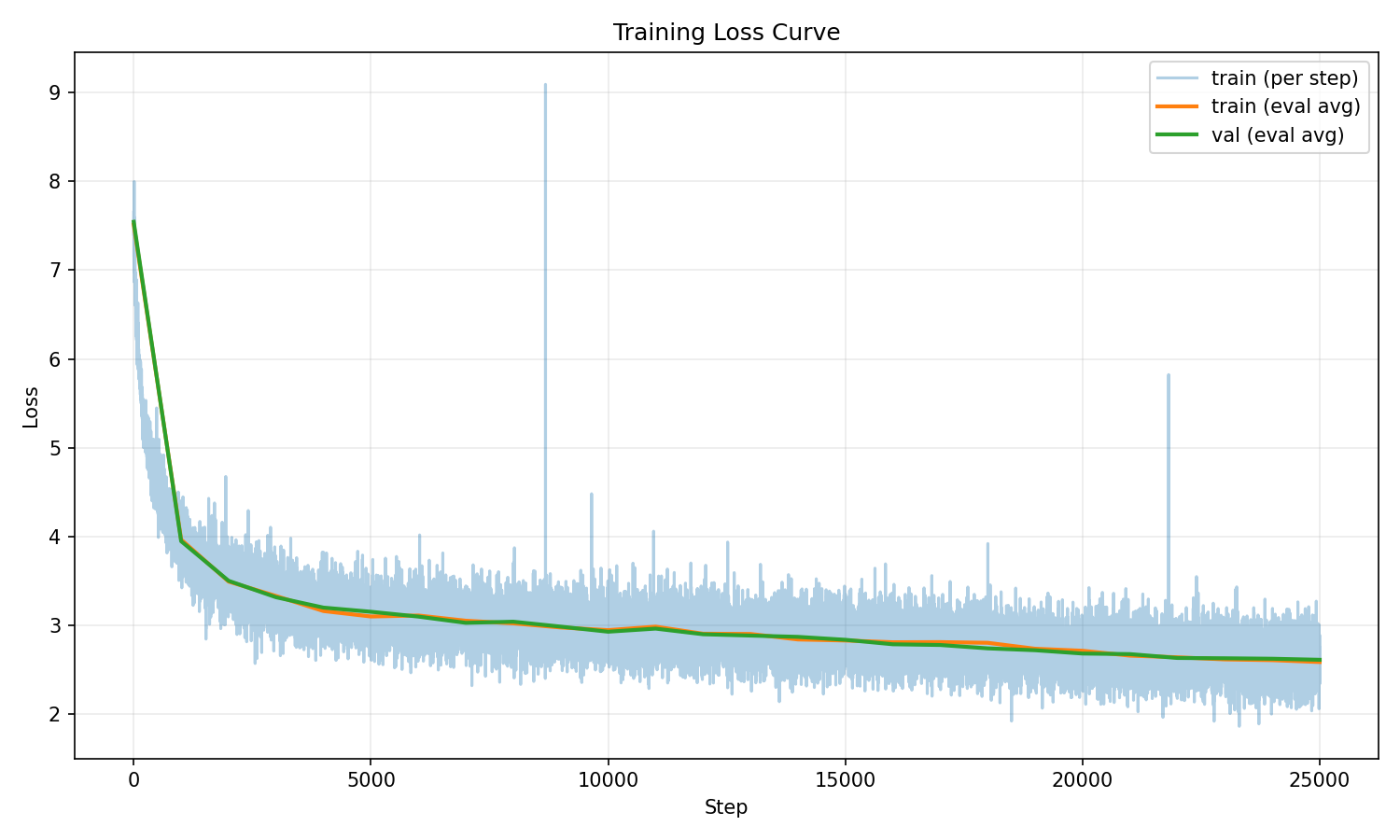
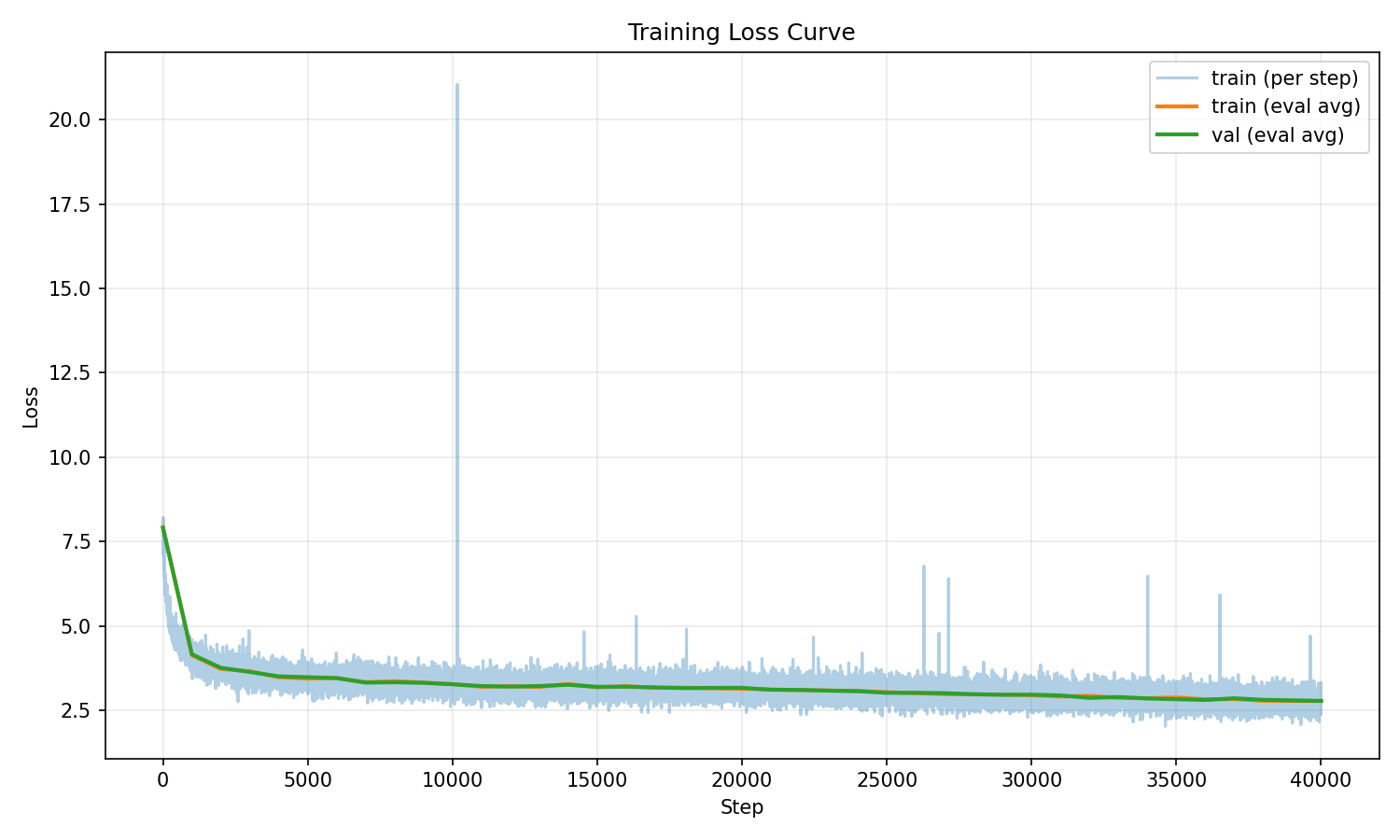
The following are diffusion pretraining loss curves on the Chinese dataset:
25ksteps:
40ksteps:
5. AR SFT
uv run python -m scripts.train.train_sft_minimind \
  --data dataset/sft_mini_512.jsonl \
  --tokenizer-dir . \
  --load-from weights/minimind_pretrain_state_dict.pt \
  --run-name minimind_sft \
  --max-seq-len 512 \
  --batch-size 96 \
  --epochs 2
6. Nano-LLaDA SFT
uv run python -m scripts.train.train_sft_diffusion \
  --data dataset/sft_mini_512.jsonl \
  --tokenizer-dir . \
  --load-from weights/diffusion_from_ar_eq3_3g_en.pt \
  --run-name diffusion_sft \
  --max-seq-len 512 \
  --batch-size 96 \
  --epochs 3
7. Single-Prompt SFT Evaluation
AR SFT:
uv run python -m scripts.eval.eval_sft_one_prompt \
  --prompt "你好,请介绍你自己。" \
  --tokenizer-dir . \
  --minimind-checkpoint weights/minimind_sft_state_dict.pt \
  --seq-len 512 \
  --max-new-tokens 128
Nano-LLaDA SFT:
uv run python -m scripts.eval.eval_sft_one_prompt \
  --prompt "你好,请介绍你自己。" \
  --tokenizer-dir . \
  --diffusion-checkpoint weights/diffusion_sft_state_dict.pt \
  --seq-len 512 \
  --max-new-tokens 128
AR + Nano-LLaDA comparison:
uv run python -m scripts.eval.eval_sft_one_prompt \
  --prompt "你好,请介绍你自己。" \
  --tokenizer-dir . \
  --minimind-checkpoint weights/minimind_sft_state_dict.pt \
  --diffusion-checkpoint weights/diffusion_sft_state_dict.pt \
  --seq-len 512 \
  --max-new-tokens 128
Technical Report
See technical_report.md.
Positioning:
- engineering implementation of
Nano-LLaDA (~30M) - current version is
v0.1.0 - continuous iterative refinement in this repository
Roadmap
- Improve
v0.1.x(training stability, decoding strategy, evaluation pipeline). - Reproduce
LLaDA 2.0. - Reproduce
LLaDA 2.1. - Train on English datasets and build a unified Chinese/English evaluation protocol.
- Target stronger controllable generation quality and overall performance.
References
- LLaDA: https://arxiv.org/pdf/2502.09992
- LLaDA 2.0: https://arxiv.org/abs/2512.15745
- LLaDA 2.1: https://arxiv.org/abs/2602.08676
- minimind: https://github.com/jingyaogong/minimind
- tiny-diffusion: https://github.com/nathan-barry/tiny-diffusion
Acknowledgements
Our training and evaluation is powered by NVIDIA H100 GPUs sponsored by the Lambda.ai Research Grant. Thanks Lambda!
Similar repos


Languages
Python
100.0%
README
English | 中文
Nano-LLaDA is a lightweight discrete diffusion language model project. The current release is v0.1.0 with about 30M parameters. It builds on open-source minimind and tiny-diffusion, and provides a full AR + Diffusion pipeline for pretraining, SFT, and evaluation.
News
We are continuously publishing updates on the test branch in the form of experimental reports, including implementation details and incremental progress. These changes will be merged into main at appropriate milestones. If you want the latest updates, please check the test branch.
Project Status
- Current version:
v0.1.0 - Parameter scale:
~30M - Current capability: initial engineering reproduction of the LLaDA 1.0 idea
- Progress: after SFT,
Nano-LLaDAhas gained basic question-answering ability; training and tuning are still ongoing for better results. - Note: this implementation is not yet a strict 1:1 reproduction of every technical detail from the original LLaDA 1.0 report. We are continuously refining components.
- Training tracks:
- AR (MiniMind-style causal LM)
- Diffusion (LLaDA-style masked denoising)
Overall Approach
We reuse minimind for base model construction, dataset format, and tokenizer. We first pretrain an autoregressive model, then build a parameter-matched LLaDA model inspired by LLaDA 2.0 training techniques, initialize it from AR pretrained weights, and continue with SFT and evaluation.
LLaDA 1.0 / 2.0 Module Mapping
The current Nano-LLaDA release implements the core diffusion modeling mechanism from LLaDA 1.0, and also introduces several training enhancements proposed in LLaDA 2.0. To avoid conceptual confusion, the module mapping is listed below.
1. LLaDA 1.0 Core Mechanisms (Implemented)
- Bidirectional Transformer Mask Predictor
- Attention is configured as
is_causal=False - Masked tokens are predicted from full-context conditioning
- Attention is configured as
iid_tMasking (Eq.3)- Sample
t ~ Uniform(eps, 1-eps)for each sample - Independently mask each token with
Bernoulli(t) - Ensure at least one token is masked
- Sample
1/t-weighted Masked Cross Entropy- Loss is computed only on masked tokens
- Uses Eq.3-style Monte Carlo approximation
- Iterative Remasking Sampling
- Predict all masked tokens at each step
- Remask low-confidence tokens by confidence ranking
- Use
s/tratio to align with the forward process
Enable with:
--mask-schedule iid_t
--repeat-penalty-weight 0
This mode is the closest to the original LLaDA 1.0 setting.
2. LLaDA 2.0 Training Enhancements (Partially Implemented)
The current release includes several stabilization and continual pretraining strategies from LLaDA 2.0:
Some items in this section are not fully tested in end-to-end training yet.
- WSD (Warmup-Stable-Decay) Mask Schedule
- Supports warmup / stable / decay phases for mask ratio
- Optional block curriculum
- Block Curriculum
- Gradually increase block size during diffusion training
- Then shrink block size back for efficiency
- Time-Weighted Loss
- Uses diffusion-time weight
alpha'(t)/(1-alpha(t)) - Replaces the
1/tapproximation form
- Uses diffusion-time weight
- Document-level Attention Mask
- Builds document-segmented attention using EOS boundaries
- Restricts attention propagation across documents
Example flags:
--mask-schedule wsd
--use-block-curriculum
--time-weighted-loss
--use-doc-attention-mask
Shared Architecture (AR + LLaDA)
flowchart TD
    A[Tokenizer Input IDs] --> B[Token Embedding]
    B --> C[N x Transformer Block]

    subgraph C [Shared Transformer Backbone]
      C1[RMSNorm]
      C2[Multi Head Attention with RoPE]
      C3[Residual Add]
      C4[RMSNorm]
      C5[SwiGLU MLP gate up down projections]
      C6[Residual Add]
      C1 --> C2 --> C3 --> C4 --> C5 --> C6
    end

    C --> D[Final RMSNorm]
    D --> E[LM Head Linear to Vocab Logits]

    E --> F1[AR Branch MiniMind]
    E --> F2[LLaDA Branch Diffusion]

    F1 --> G1[Causal Attention and Next Token CE Loss]
    F1 --> H1[Autoregressive Decoding]

    F2 --> G2[Non Causal Masked Denoising Loss]
    F2 --> H2[Iterative Unmask Decoding confidence topk cap]
Environment Setup
pip install uv
uv sync
Dataset Setup
pip install modelscope
mkdir -p dataset && modelscope download --dataset gongjy/minimind_dataset pretrain_hq.jsonl --local_dir ./dataset
mkdir -p dataset && modelscope download --dataset gongjy/minimind_dataset sft_mini_512.jsonl --local_dir ./dataset
Training and Evaluation
1. AR Pretraining
uv run python -m scripts.train.train_pretrain \
  --data ./dataset/pretrain_hq.jsonl \
  --jsonl-field text \
  --tokenizer-dir . \
  --run-name minimind_pretrain \
  --hidden-size 512 \
  --num-hidden-layers 8 \
  --num-attention-heads 8 \
  --max-seq-len 256 \
  --epochs 1 \
  --batch-size 96
2. AR Evaluation
uv run python -m scripts.eval.eval_minimind \
  --checkpoint weights/minimind_pretrain_state_dict.pt \
  --tokenizer-dir . \
  --prompt "请介绍你自己。" \
  --max-new-tokens 200
3. Nano-LLaDA Pretraining
The command below currently runs in LLaDA 1.0 style. The main LLaDA 2.0-inspired part is AR-to-diffusion initialization (--init-from-minimind) for continual pretraining.
uv run python -m scripts.train.diffusion \
  --train \
  --use-tokenizer \
  --data ./dataset/pretrain_hq.jsonl \
  --inference-rope-scaling \
  --learning-rate 4e-4 \
  --warmup-steps 2000 \
  --min-lr-ratio 0.025 \
  --mask-schedule iid_t \
  --repeat-penalty-weight 0 \
  --init-from-minimind weights/minimind_pretrain_state_dict.pt \
  --run-name diffusion_from_ar_eq3 \
  --early-stop-patience 5 \
  --early-stop-min-delta 0.001 \
  --max-iters 40000 \
  --batch-size 96
4. Nano-LLaDA Evaluation
uv run python -m scripts.eval.eval_diffusion \
  --checkpoint weights/diffusion_no_v1.pt \
  --tokenizer-dir . \
  --seq-len 256 \
  --prompt "请介绍你自己。" \
  --max-new-tokens 200
Nano-LLaDA Pretraining Loss (Chinese Dataset)
The following are diffusion pretraining loss curves on the Chinese dataset:
25ksteps:
40ksteps:
5. AR SFT
uv run python -m scripts.train.train_sft_minimind \
  --data dataset/sft_mini_512.jsonl \
  --tokenizer-dir . \
  --load-from weights/minimind_pretrain_state_dict.pt \
  --run-name minimind_sft \
  --max-seq-len 512 \
  --batch-size 96 \
  --epochs 2
6. Nano-LLaDA SFT
uv run python -m scripts.train.train_sft_diffusion \
  --data dataset/sft_mini_512.jsonl \
  --tokenizer-dir . \
  --load-from weights/diffusion_from_ar_eq3_3g_en.pt \
  --run-name diffusion_sft \
  --max-seq-len 512 \
  --batch-size 96 \
  --epochs 3
7. Single-Prompt SFT Evaluation
AR SFT:
uv run python -m scripts.eval.eval_sft_one_prompt \
  --prompt "你好,请介绍你自己。" \
  --tokenizer-dir . \
  --minimind-checkpoint weights/minimind_sft_state_dict.pt \
  --seq-len 512 \
  --max-new-tokens 128
Nano-LLaDA SFT:
uv run python -m scripts.eval.eval_sft_one_prompt \
  --prompt "你好,请介绍你自己。" \
  --tokenizer-dir . \
  --diffusion-checkpoint weights/diffusion_sft_state_dict.pt \
  --seq-len 512 \
  --max-new-tokens 128
AR + Nano-LLaDA comparison:
uv run python -m scripts.eval.eval_sft_one_prompt \
  --prompt "你好,请介绍你自己。" \
  --tokenizer-dir . \
  --minimind-checkpoint weights/minimind_sft_state_dict.pt \
  --diffusion-checkpoint weights/diffusion_sft_state_dict.pt \
  --seq-len 512 \
  --max-new-tokens 128
Technical Report
See technical_report.md.
Positioning:
- engineering implementation of
Nano-LLaDA (~30M) - current version is
v0.1.0 - continuous iterative refinement in this repository
Roadmap
- Improve
v0.1.x(training stability, decoding strategy, evaluation pipeline). - Reproduce
LLaDA 2.0. - Reproduce
LLaDA 2.1. - Train on English datasets and build a unified Chinese/English evaluation protocol.
- Target stronger controllable generation quality and overall performance.
References
- LLaDA: https://arxiv.org/pdf/2502.09992
- LLaDA 2.0: https://arxiv.org/abs/2512.15745
- LLaDA 2.1: https://arxiv.org/abs/2602.08676
- minimind: https://github.com/jingyaogong/minimind
- tiny-diffusion: https://github.com/nathan-barry/tiny-diffusion
Acknowledgements
Our training and evaluation is powered by NVIDIA H100 GPUs sponsored by the Lambda.ai Research Grant. Thanks Lambda!
Similar repos
Languages
Python
100.0%