
README
fcbnerd
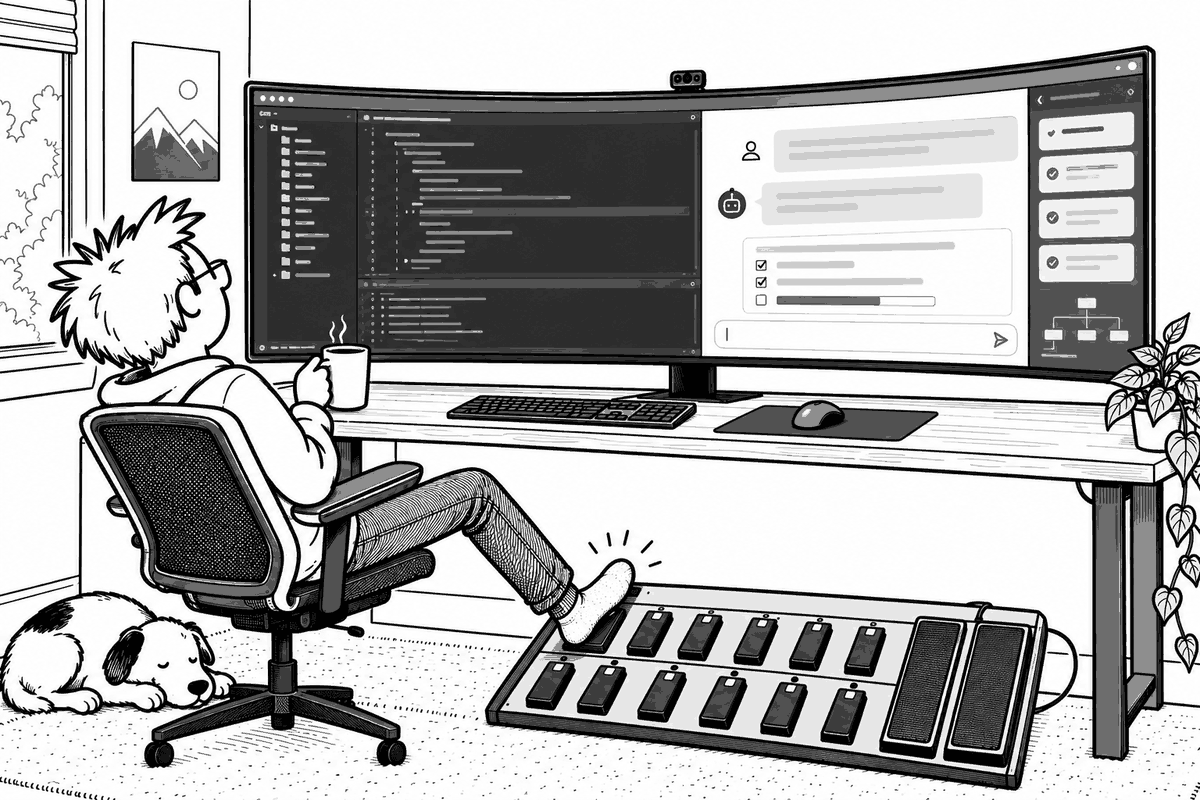
Use a MIDI foot controller as an extra keyboard for your Mac. fcbnerd
connects to your MIDI sources and either runs a shell command when a
footswitch or pedal sends a message you've bound, or prints one JSON object
per line for every message so another program can decide what a stomp
means.
$ fcbnerd -q --bind '1:20:127=open ~/Downloads' --bind 'pc:1:0=say hello'
Or stream everything for another program to handle:
$ fcbnerd
{"type":"connected","source":"UM-ONE","time":"2026-09-14T20:01:00.120Z"}
{"type":"pc","channel":1,"program":0,"source":"UM-ONE","time":"2026-09-14T20:01:02.345Z"}
{"type":"cc","channel":1,"controller":27,"value":84,"source":"UM-ONE","time":"2026-09-14T20:01:03.910Z"}
Built for the Behringer FCB1010, but nothing in it is FCB1010-specific: any CoreMIDI source works.
Why a command-line tool instead of an app
Anything that acts on your Mac, like pressing keys or running scripts, needs
permissions that sandboxed apps can't get, and every user wants a different
set of actions anyway. fcbnerd only reads MIDI, which needs no permissions.
The actions belong to your shell, or to a tool that already has the access,
such as Hammerspoon or Keyboard Maestro.
Install
brew trust --tap jamesryanatx/tap   # Homebrew 7+ won't load third-party taps until you trust them
brew install JamesRyanATX/tap/fcbnerd
Or from source without Homebrew (Xcode or the Swift toolchain, macOS 13+):
swift build -c release
cp .build/release/fcbnerd /usr/local/bin/
Usage
fcbnerd [listen] [--source NAME] [--format json|text] [--bind BINDING]... [--quiet] [--shell PATH]
fcbnerd list [--format json|text]
fcbnerd simulate
listen(default) connects to every MIDI source, or only those whose name contains--source, and streams events until interrupted. It follows hotplug: unplug the interface mid-set and plug it back in, and the stream carries on withdisconnected/connectedlines.listprints the sources available right now.simulatepublishes a virtual MIDI source namedfcbnerd simulatorthat plays synthetic presses, a pedal sweep and a sysex message on a loop. Run it in one terminal andfcbnerdin another to build a consumer with no pedal attached.--format textprints aligned columns for eyeballing, including abind=pattern for each message you can bind. Scripts should use the default JSON; the text layout may change.--bindruns a command when a message matches; see below.--quietstops printing events, leaving only the bound commands.--shell PATHpicks the shell that runs bound commands (default/bin/sh).
Status messages go to stderr; stdout carries only events. Each line is flushed as soon as it's written, so pipes see events immediately.
Binding commands
First find out what your pedal sends. Run fcbnerd -f text and press the
switch:
$ fcbnerd -f text
16:30:41.115  pc                channel=1 program=7  bind=pc:1:7  [USB MIDI Interface]
16:30:41.115  cc                channel=1 controller=20 value=127  bind=1:20:127  [USB MIDI Interface]
Then bind a command to that pattern:
fcbnerd --bind '1:20:127=open ~/Downloads'
A binding is PATTERN=COMMAND. Everything after the first = is the command,
so it can contain = and : itself. Use --bind as many times as you like.
Every binding that matches a message starts, in the order given, and they run
at the same time.
| Pattern | Matches |
|---|---|
CHANNEL:CONTROLLER:VALUE | Control change, e.g. 1:20:127. cc:1:20:127 also works. |
pc:CHANNEL:PROGRAM | Program change, e.g. pc:1:7. |
Any number can be *: 1:27:* is every value of controller 27 on channel 1,
which is how you bind an expression pedal.
Commands run in the background through /bin/sh -c, or the shell you give
with --shell. Their stdin is /dev/null. Their stdout goes to fcbnerd's
stderr, so it can't corrupt the event stream; with --quiet it goes to
stdout. They see these environment variables:
| Variable | |
|---|---|
MIDI_TYPE | cc or pc |
MIDI_CHANNEL | 1–16 |
MIDI_CONTROLLER, MIDI_VALUE | For cc |
MIDI_PROGRAM | For pc |
MIDI_SOURCE | MIDI source name |
# Expression pedal sets output volume
fcbnerd -q --bind '1:27:*=osascript -e "set volume output volume $((MIDI_VALUE * 100 / 127))"'
Every stomp runs the command, so two quick presses run it twice even if the
first run hasn't finished. That also means every matching message starts a
shell. Keep broad patterns like *:*:127 or pc:*:* away from noisy devices.
Pedal sweeps are the exception. A sweep sends dozens of values a second, so
for a binding with a * value, only one copy of the command runs at a time
for each control (channel and controller). While it runs, fcbnerd keeps only
that control's newest value and runs it next, which keeps the shell count down
and still ends on the pedal's final position. If a command is still running
after 5 seconds, fcbnerd says so on stderr.
A command that exits non-zero gets its binding and exit status printed to
stderr. Stopping fcbnerd (Ctrl+C, kill, closing the terminal, or a closed
stdout) sends SIGTERM to any command still running, including processes it
started.
Shell functions
Functions and aliases from your interactive shell aren't loaded in sh -c. In bash, export a function to make it visible
(macOS's /bin/sh is bash, so the default shell sees it):
greet() { say "preset $MIDI_PROGRAM"; }
export -f greet
fcbnerd -q --bind 'pc:1:*=greet'
zsh can't export functions. Put them in a file and source it with zsh:
--shell /bin/zsh --bind 'pc:1:*=source ~/.fcbnerd.zsh && greet'.
On/off switches
The FCB1010 sends nothing when you let go of a switch (see
FCB1010 notes), so a binding fires on the press only. For
on/off behavior, keep the state in the command, for example by toggling a
file in /tmp.
Output
fcbnerd listen prints one JSON object per line. Every object has type,
source (the MIDI source's display name) and time (when fcbnerd received
the message: ISO 8601, UTC, milliseconds). Channels are 1–16; note,
controller, program, velocity and pressure values are the raw 0–127 MIDI
values.
type | Extra fields | Notes |
|---|---|---|
pc | channel, program | Program change. program is 0-based on the wire. |
cc | channel, controller, value | Control change: switches and expression pedals. |
note_on | channel, note, velocity | |
note_off | channel, note, velocity | Also emitted for note-on with velocity 0. |
poly_pressure | channel, note, pressure | |
channel_pressure | channel, pressure | |
pitch_bend | channel, value | 0–16383, center 8192. |
sysex | length, data | data is lowercase hex including the f0…f7 framing; length counts those bytes. |
connected | A source appeared and is being listened to. Always precedes that source's events. | |
disconnected | A source went away. A message already in flight may still follow it. |
System real-time messages (MIDI clock and so on) and system common messages (song position, MTC) are not emitted. New event types or fields may be added in future versions; existing ones won't change meaning. Consumers should ignore types and fields they don't recognize.
Read the stream promptly. If a consumer stops reading, fcbnerd queues events in memory and delivers them all when reading resumes, so a stalled consumer will act on a burst of stale presses.
fcbnerd list --format json prints a different shape, one line per source:
{"type":"source","name":"UM-ONE","id":-1234567}. id is the CoreMIDI
unique ID.
Examples
Shell and jq
Program 0 switches to the next Space, and program 1 to the previous one. This needs more than one Space, the "Move left/right a space" shortcuts enabled (the default) in System Settings → Keyboard → Keyboard Shortcuts → Mission Control, and for your terminal app both Accessibility permission and Automation permission to control System Events. macOS asks for the Automation permission the first time.
fcbnerd | jq --unbuffered -r 'select(.type == "pc") | .program' |
while read -r program; do
  case "$program" in
    0) osascript -e 'tell application "System Events" to key code 124 using control down' ;;
    1) osascript -e 'tell application "System Events" to key code 123 using control down' ;;
  esac
done
Hammerspoon
Program 0 toggles play/pause, and an expression pedal on CC 27 sets the output
volume. Output can arrive in
partial chunks, so buffer until a newline. The path is for Apple Silicon;
Homebrew on Intel installs to /usr/local/bin.
local buffer = ""
fcbnerd = hs.task.new("/opt/homebrew/bin/fcbnerd", nil, function(_, stdout, _)
  buffer = buffer .. stdout
  for line in buffer:gmatch("([^\n]*)\n") do
    local event = hs.json.decode(line)
    if event and event.type == "pc" and event.program == 0 then
      hs.eventtap.event.newSystemKeyEvent("PLAY", true):post()
      hs.eventtap.event.newSystemKeyEvent("PLAY", false):post()
    elseif event and event.type == "cc" and event.controller == 27 then
      hs.audiodevice.defaultOutputDevice():setVolume(event.value / 127 * 100)
    end
  end
  buffer = buffer:match("[^\n]*$")
  return true
end)
fcbnerd:start()
FCB1010 notes
Things about the pedal that consumers need to handle:
- A press sends one message and letting go sends nothing. On/off behavior (first press "on", second "off") has to be tracked by the consumer.
- The factory presets send different CC numbers from the same switch
depending on which preset is active. Run
fcbnerd -f text, press each switch you plan to use, and note what it sends. - Pressing a switch also re-sends that preset's expression-pedal values, so
not every
ccon a pedal's controller means the foot moved. - The expression pedals don't reach the full 0–127 range. Part of the travel sends nothing and the sweep covers roughly two-thirds of the values, so rescale to the range you actually see.
- The pedal has 5-pin DIN MIDI only. You need a USB MIDI interface, which
shows up as the
sourcename.
Development
swift build
swift test                                 # decoder, formatter and binding tests
.build/debug/fcbnerd simulate &            # fake pedal
.build/debug/fcbnerd --format text         # watch it
Sources/FCBNerdCore decodes CoreMIDI's Universal MIDI Packets, formats
output and parses bindings. It has no CoreMIDI dependency, so its tests run
without hardware.
Sources/fcbnerd is the CLI: CoreMIDI connections, hotplug and the
simulator.
To release, bump version in Sources/fcbnerd/main.swift, commit, and push a
matching tag:
git tag -a v1.2.3 -m "fcbnerd 1.2.3" && git push origin v1.2.3
The release workflow tests, publishes a GitHub Release with a universal binary, and updates the formula in JamesRyanATX/homebrew-tap.
License
MIT
Contributors

8 commits
See what people are saying
Similar repos


Languages
Swift
100.0%
README
fcbnerd
Use a MIDI foot controller as an extra keyboard for your Mac. fcbnerd
connects to your MIDI sources and either runs a shell command when a
footswitch or pedal sends a message you've bound, or prints one JSON object
per line for every message so another program can decide what a stomp
means.
$ fcbnerd -q --bind '1:20:127=open ~/Downloads' --bind 'pc:1:0=say hello'
Or stream everything for another program to handle:
$ fcbnerd
{"type":"connected","source":"UM-ONE","time":"2026-09-14T20:01:00.120Z"}
{"type":"pc","channel":1,"program":0,"source":"UM-ONE","time":"2026-09-14T20:01:02.345Z"}
{"type":"cc","channel":1,"controller":27,"value":84,"source":"UM-ONE","time":"2026-09-14T20:01:03.910Z"}
Built for the Behringer FCB1010, but nothing in it is FCB1010-specific: any CoreMIDI source works.
Why a command-line tool instead of an app
Anything that acts on your Mac, like pressing keys or running scripts, needs
permissions that sandboxed apps can't get, and every user wants a different
set of actions anyway. fcbnerd only reads MIDI, which needs no permissions.
The actions belong to your shell, or to a tool that already has the access,
such as Hammerspoon or Keyboard Maestro.
Install
brew trust --tap jamesryanatx/tap   # Homebrew 7+ won't load third-party taps until you trust them
brew install JamesRyanATX/tap/fcbnerd
Or from source without Homebrew (Xcode or the Swift toolchain, macOS 13+):
swift build -c release
cp .build/release/fcbnerd /usr/local/bin/
Usage
fcbnerd [listen] [--source NAME] [--format json|text] [--bind BINDING]... [--quiet] [--shell PATH]
fcbnerd list [--format json|text]
fcbnerd simulate
listen(default) connects to every MIDI source, or only those whose name contains--source, and streams events until interrupted. It follows hotplug: unplug the interface mid-set and plug it back in, and the stream carries on withdisconnected/connectedlines.listprints the sources available right now.simulatepublishes a virtual MIDI source namedfcbnerd simulatorthat plays synthetic presses, a pedal sweep and a sysex message on a loop. Run it in one terminal andfcbnerdin another to build a consumer with no pedal attached.--format textprints aligned columns for eyeballing, including abind=pattern for each message you can bind. Scripts should use the default JSON; the text layout may change.--bindruns a command when a message matches; see below.--quietstops printing events, leaving only the bound commands.--shell PATHpicks the shell that runs bound commands (default/bin/sh).
Status messages go to stderr; stdout carries only events. Each line is flushed as soon as it's written, so pipes see events immediately.
Binding commands
First find out what your pedal sends. Run fcbnerd -f text and press the
switch:
$ fcbnerd -f text
16:30:41.115  pc                channel=1 program=7  bind=pc:1:7  [USB MIDI Interface]
16:30:41.115  cc                channel=1 controller=20 value=127  bind=1:20:127  [USB MIDI Interface]
Then bind a command to that pattern:
fcbnerd --bind '1:20:127=open ~/Downloads'
A binding is PATTERN=COMMAND. Everything after the first = is the command,
so it can contain = and : itself. Use --bind as many times as you like.
Every binding that matches a message starts, in the order given, and they run
at the same time.
| Pattern | Matches |
|---|---|
CHANNEL:CONTROLLER:VALUE | Control change, e.g. 1:20:127. cc:1:20:127 also works. |
pc:CHANNEL:PROGRAM | Program change, e.g. pc:1:7. |
Any number can be *: 1:27:* is every value of controller 27 on channel 1,
which is how you bind an expression pedal.
Commands run in the background through /bin/sh -c, or the shell you give
with --shell. Their stdin is /dev/null. Their stdout goes to fcbnerd's
stderr, so it can't corrupt the event stream; with --quiet it goes to
stdout. They see these environment variables:
| Variable | |
|---|---|
MIDI_TYPE | cc or pc |
MIDI_CHANNEL | 1–16 |
MIDI_CONTROLLER, MIDI_VALUE | For cc |
MIDI_PROGRAM | For pc |
MIDI_SOURCE | MIDI source name |
# Expression pedal sets output volume
fcbnerd -q --bind '1:27:*=osascript -e "set volume output volume $((MIDI_VALUE * 100 / 127))"'
Every stomp runs the command, so two quick presses run it twice even if the
first run hasn't finished. That also means every matching message starts a
shell. Keep broad patterns like *:*:127 or pc:*:* away from noisy devices.
Pedal sweeps are the exception. A sweep sends dozens of values a second, so
for a binding with a * value, only one copy of the command runs at a time
for each control (channel and controller). While it runs, fcbnerd keeps only
that control's newest value and runs it next, which keeps the shell count down
and still ends on the pedal's final position. If a command is still running
after 5 seconds, fcbnerd says so on stderr.
A command that exits non-zero gets its binding and exit status printed to
stderr. Stopping fcbnerd (Ctrl+C, kill, closing the terminal, or a closed
stdout) sends SIGTERM to any command still running, including processes it
started.
Shell functions
Functions and aliases from your interactive shell aren't loaded in sh -c. In bash, export a function to make it visible
(macOS's /bin/sh is bash, so the default shell sees it):
greet() { say "preset $MIDI_PROGRAM"; }
export -f greet
fcbnerd -q --bind 'pc:1:*=greet'
zsh can't export functions. Put them in a file and source it with zsh:
--shell /bin/zsh --bind 'pc:1:*=source ~/.fcbnerd.zsh && greet'.
On/off switches
The FCB1010 sends nothing when you let go of a switch (see
FCB1010 notes), so a binding fires on the press only. For
on/off behavior, keep the state in the command, for example by toggling a
file in /tmp.
Output
fcbnerd listen prints one JSON object per line. Every object has type,
source (the MIDI source's display name) and time (when fcbnerd received
the message: ISO 8601, UTC, milliseconds). Channels are 1–16; note,
controller, program, velocity and pressure values are the raw 0–127 MIDI
values.
type | Extra fields | Notes |
|---|---|---|
pc | channel, program | Program change. program is 0-based on the wire. |
cc | channel, controller, value | Control change: switches and expression pedals. |
note_on | channel, note, velocity | |
note_off | channel, note, velocity | Also emitted for note-on with velocity 0. |
poly_pressure | channel, note, pressure | |
channel_pressure | channel, pressure | |
pitch_bend | channel, value | 0–16383, center 8192. |
sysex | length, data | data is lowercase hex including the f0…f7 framing; length counts those bytes. |
connected | A source appeared and is being listened to. Always precedes that source's events. | |
disconnected | A source went away. A message already in flight may still follow it. |
System real-time messages (MIDI clock and so on) and system common messages (song position, MTC) are not emitted. New event types or fields may be added in future versions; existing ones won't change meaning. Consumers should ignore types and fields they don't recognize.
Read the stream promptly. If a consumer stops reading, fcbnerd queues events in memory and delivers them all when reading resumes, so a stalled consumer will act on a burst of stale presses.
fcbnerd list --format json prints a different shape, one line per source:
{"type":"source","name":"UM-ONE","id":-1234567}. id is the CoreMIDI
unique ID.
Examples
Shell and jq
Program 0 switches to the next Space, and program 1 to the previous one. This needs more than one Space, the "Move left/right a space" shortcuts enabled (the default) in System Settings → Keyboard → Keyboard Shortcuts → Mission Control, and for your terminal app both Accessibility permission and Automation permission to control System Events. macOS asks for the Automation permission the first time.
fcbnerd | jq --unbuffered -r 'select(.type == "pc") | .program' |
while read -r program; do
  case "$program" in
    0) osascript -e 'tell application "System Events" to key code 124 using control down' ;;
    1) osascript -e 'tell application "System Events" to key code 123 using control down' ;;
  esac
done
Hammerspoon
Program 0 toggles play/pause, and an expression pedal on CC 27 sets the output
volume. Output can arrive in
partial chunks, so buffer until a newline. The path is for Apple Silicon;
Homebrew on Intel installs to /usr/local/bin.
local buffer = ""
fcbnerd = hs.task.new("/opt/homebrew/bin/fcbnerd", nil, function(_, stdout, _)
  buffer = buffer .. stdout
  for line in buffer:gmatch("([^\n]*)\n") do
    local event = hs.json.decode(line)
    if event and event.type == "pc" and event.program == 0 then
      hs.eventtap.event.newSystemKeyEvent("PLAY", true):post()
      hs.eventtap.event.newSystemKeyEvent("PLAY", false):post()
    elseif event and event.type == "cc" and event.controller == 27 then
      hs.audiodevice.defaultOutputDevice():setVolume(event.value / 127 * 100)
    end
  end
  buffer = buffer:match("[^\n]*$")
  return true
end)
fcbnerd:start()
FCB1010 notes
Things about the pedal that consumers need to handle:
- A press sends one message and letting go sends nothing. On/off behavior (first press "on", second "off") has to be tracked by the consumer.
- The factory presets send different CC numbers from the same switch
depending on which preset is active. Run
fcbnerd -f text, press each switch you plan to use, and note what it sends. - Pressing a switch also re-sends that preset's expression-pedal values, so
not every
ccon a pedal's controller means the foot moved. - The expression pedals don't reach the full 0–127 range. Part of the travel sends nothing and the sweep covers roughly two-thirds of the values, so rescale to the range you actually see.
- The pedal has 5-pin DIN MIDI only. You need a USB MIDI interface, which
shows up as the
sourcename.
Development
swift build
swift test                                 # decoder, formatter and binding tests
.build/debug/fcbnerd simulate &            # fake pedal
.build/debug/fcbnerd --format text         # watch it
Sources/FCBNerdCore decodes CoreMIDI's Universal MIDI Packets, formats
output and parses bindings. It has no CoreMIDI dependency, so its tests run
without hardware.
Sources/fcbnerd is the CLI: CoreMIDI connections, hotplug and the
simulator.
To release, bump version in Sources/fcbnerd/main.swift, commit, and push a
matching tag:
git tag -a v1.2.3 -m "fcbnerd 1.2.3" && git push origin v1.2.3
The release workflow tests, publishes a GitHub Release with a universal binary, and updates the formula in JamesRyanATX/homebrew-tap.
License
MIT
See what people are saying
Similar repos
Contributors
8 commits
Languages
Swift
100.0%