ORL: On-Policy Residual Learning for Diffusion Language Models
Python
17
3 commits
updated Oct 16, 2026
Yifan Yu1,2,*, Yuqing Jian1,*, Jisen Li1,*, Yuezhou Hu3, Tianyi Zhang1,
Xiaoxia Wu1, Rui-Jie Zhu4, Junxiong Wang1, Zhongzhu Zhou1,†, Fan Lai2,†,‡,
James Zou1,5,†, Chenfeng Xu1,6,†,‡
1Together AI 2University of Illinois Urbana-Champaign
3University of California, Berkeley 4University of California, Santa Cruz
5Stanford University 6The University of Texas at Austin
*Equal contribution †Equal advising ‡Corresponding authors




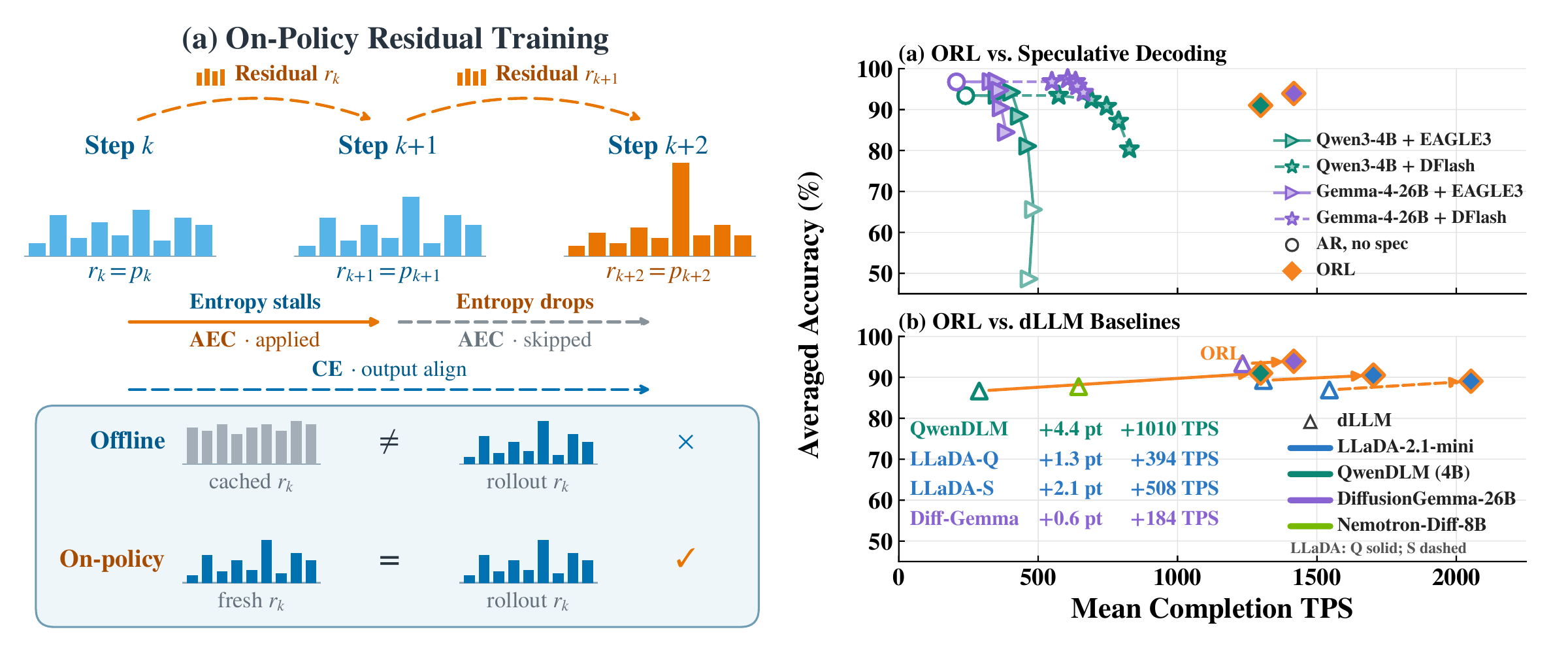
ORL trains a diffusion language model on its own residual trajectories. On QwenDLM (4B) it raises tokens per forward by up to 6.2× and end-to-end throughput by about 5× (about 6.9× together with dlmrt) at comparable or better quality, and it improves LLaDA-2.1-mini and DiffusionGemma the same way.
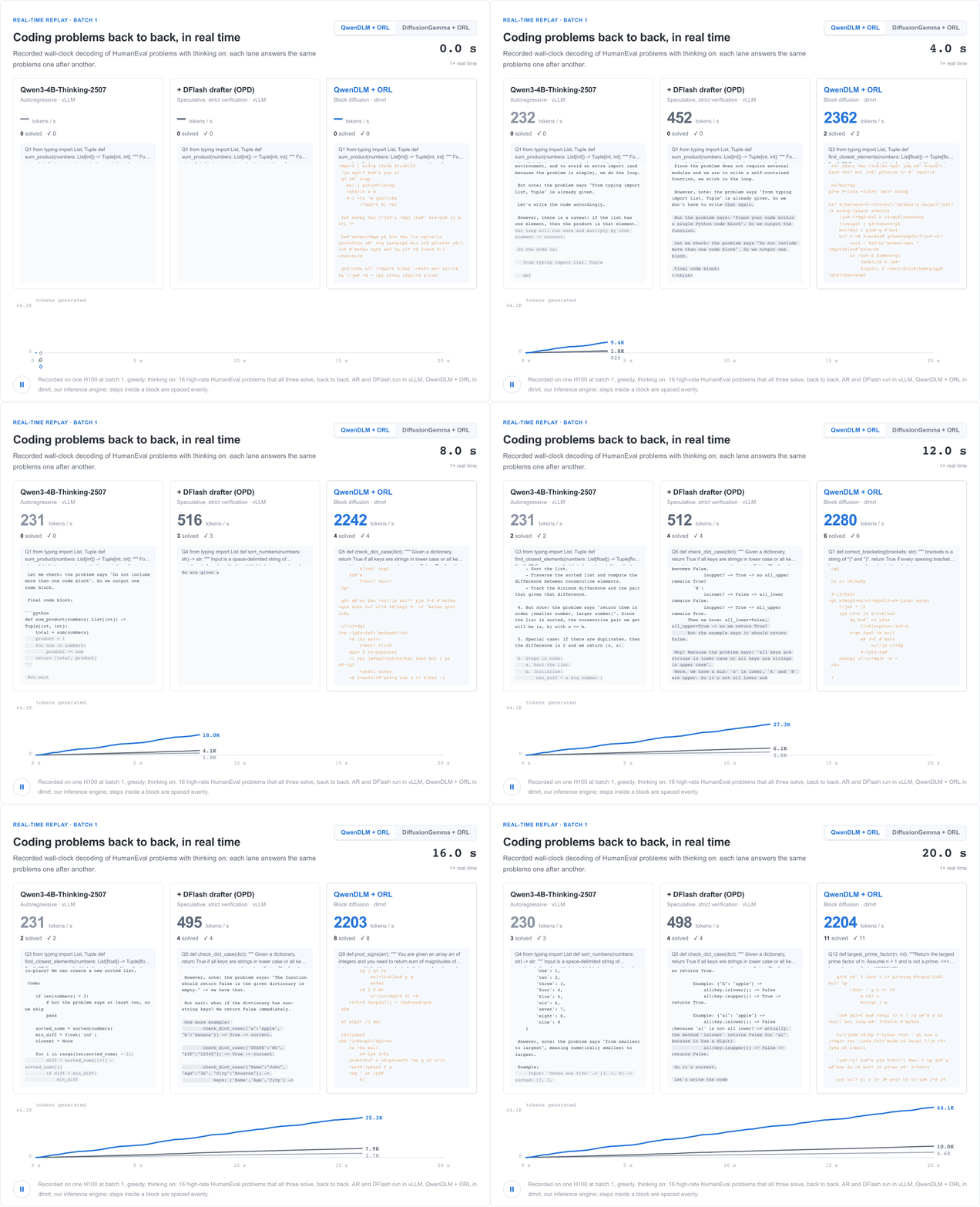
QwenDLM + ORL against Qwen3-4B-Thinking-2507 (autoregressive) and the same model with a DFlash drafter, answering HumanEval problems back to back in real time.
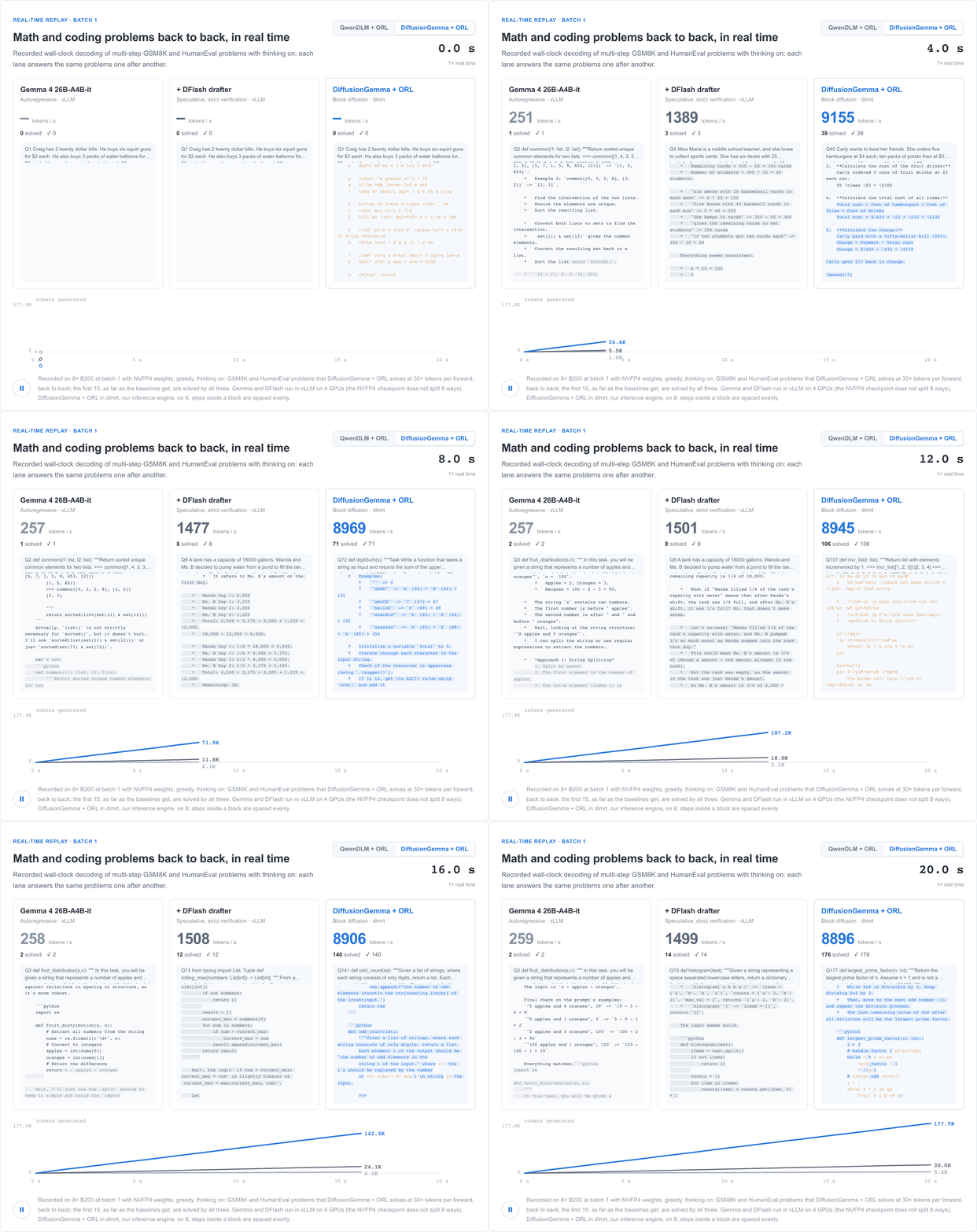
DiffusionGemma + ORL against Gemma 4 26B-A4B-it and its DFlash variant on GSM8K and HumanEval problems.
Both ORL models run in dlmrt, our inference engine. The project page plays the same recordings interactively, and its forward-pass explorer steps through one GSM8K problem decoded three ways under the same forward-pass budget.
training/env/), the QwenDLM recipe
reproduces the paper's checkpoint bit for bit| Model | GSM8K | MATH-500 | HumanEval | MBPP |
|---|---|---|---|---|
| QwenDLM (4B) | 90.4 / 2.4 | 88.0 / 2.1 | 82.9 / 1.8 | 79.2 / 2.1 |
| QwenDLM + ORL | 92.4 / 5.9 | 92.2 / 5.8 | 89.6 / 11.1 | 79.4 / 8.0 |
| LLaDA-2.1-mini | 91.9 / 5.6 | 84.6 / 8.2 | 86.6 / 11.3 | 77.5 / 7.7 |
| LLaDA-2.1-mini + ORL | 92.0 / 8.5 | 87.0 / 10.2 | 89.0 / 13.1 | 77.3 / 10.3 |
| DiffusionGemma | 95.8 / 26.0 | 92.3 / 23.7 | 90.9 / 24.5 | 87.7 / 23.1 |
| DiffusionGemma + ORL | 96.0 / 30.0 | 92.3 / 27.4 | 91.9 / 27.9 | 87.4 / 28.7 |
Base and ORL models each use their selected family-specific decoder, so a comparison includes both model and decoder.
| Decoder | Tokens / s |
|---|---|
| Autoregressive | 240 |
| EAGLE3, strict verification | 353 |
| EAGLE3, relaxed verification | 405 |
| DFlash, strict verification | 573 |
| DFlash, relaxed verification | 746 |
| QwenDLM + ORL, dlmrt | 1,298 |
QwenDLM + ORL averages 91.0% on GSM8K and HumanEval. Strict verification keeps the accuracy of the autoregressive model, 2.4 points higher; relaxed verification uses the fastest setting whose accuracy is at most 0.5 points below ORL's.
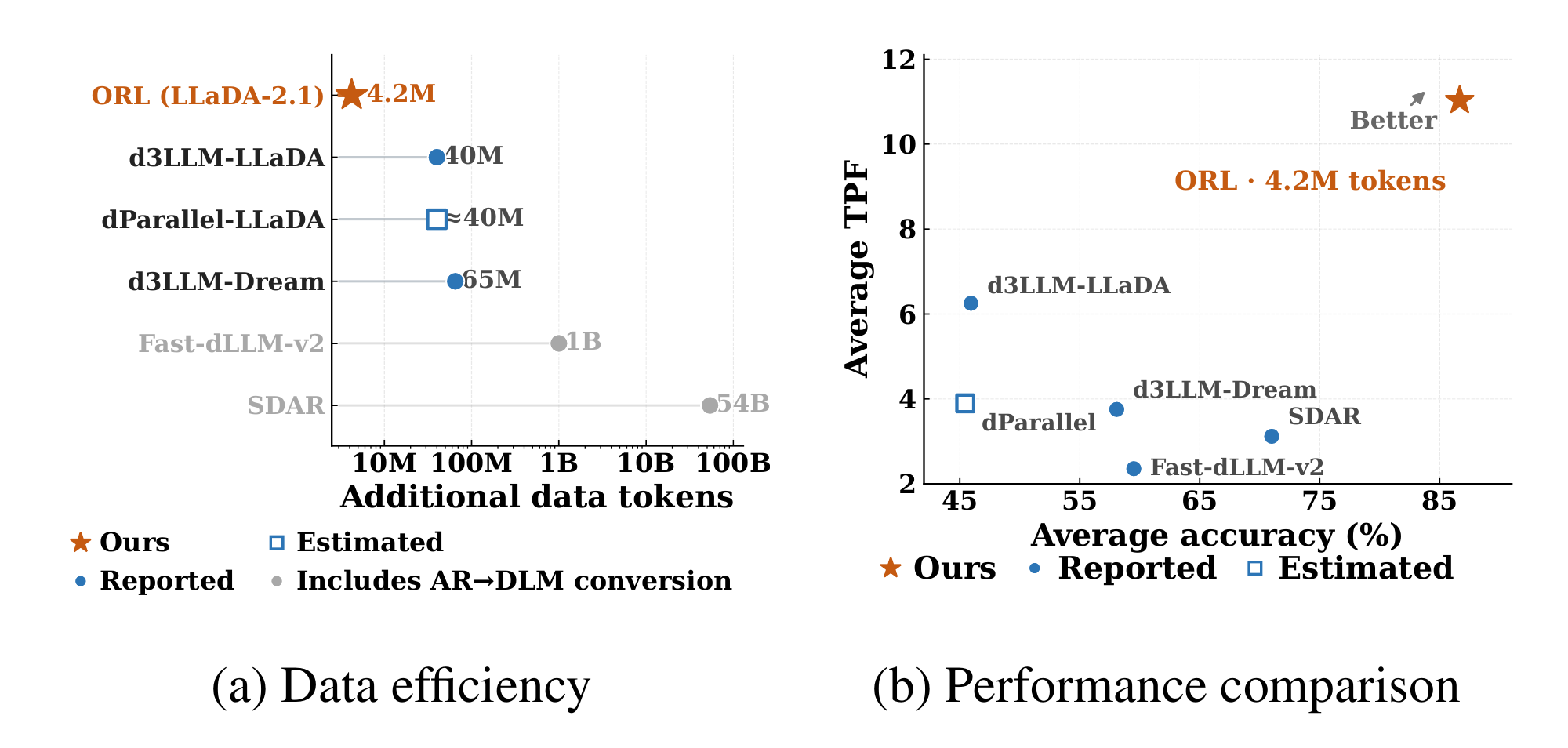
The project page compares against further diffusion baselines and against speculative decoding at matched quality.
dlmrt is our inference engine for running the ORL models one request at a time, as fast as the GPU allows.
Why a single request. Personal agents, on-device assistants and local coding tools serve one user, not many. Their requests arrive one at a time, and an agent's next step waits for the answer to the current one, so what the user feels is how quickly a single request finishes, not how many requests a GPU serves at once. Serving engines such as vLLM and SGLang are built to batch many users' requests. With a single request each forward pass is small: most of the GPU's compute sits idle, and kernel launches and scheduling take a large share of every step. A diffusion model can spend that idle compute on committing many tokens per forward pass, ORL trains it to commit more, and dlmrt removes the overhead around each forward pass, so fewer forward passes become lower latency. One denoising round takes 5.0 ms for QwenDLM + ORL on an H100 and 2.0 ms for LLaDA-2.1-mini + ORL in NVFP4 on a B200.
What it does. Each block of tokens runs as one CUDA graph whose denoising loop stays on the GPU: a conditional node decides after every round whether to continue, so the host only launches the block and reads back its tokens. The kernels are written around a single request and follow each model's reference numerics. On Blackwell GPUs the routed experts run in NVFP4 on FP4 tensor cores, and tensor parallelism spans an NVLink node through a fused reduction with no barriers. On one H100, with the same checkpoints and decoders, dlmrt is 1.2–1.6× faster than SGLang (QwenDLM, LLaDA-2.1-mini) and vLLM (DiffusionGemma).
How fast. Tokens per second for a single request, with the paper's prompts and decoders:
| Model | GPUs | Precision | GSM8K | MATH-500 | HumanEval | MBPP |
|---|---|---|---|---|---|---|
| QwenDLM + ORL | 1 × H100 | BF16 | 987 | 701 | 1,609 | 1,222 |
| LLaDA-2.1-mini + ORL | 1 × H100 | BF16 | 1,281 | 1,627 | 2,124 | 1,539 |
| 1 × B200 | NVFP4 | 2,953 | 3,882 | 5,046 | 3,564 | |
| 1 × RTX 5090 | NVFP4 | 1,648 | 2,081 | 2,788 | 2,053 | |
| DiffusionGemma + ORL | 1 × H100 | BF16 | 1,456 | 1,415 | 1,378 | 1,361 |
| 1 × B200 | NVFP4 | 4,214 | 3,805 | 3,949 | 3,898 | |
| 8 × B200 | NVFP4 | 7,708 | 7,123 | 7,026 | 6,871 | |
| 1 × RTX 5090 | NVFP4 | 1,540 | 1,408 | 1,490 | 1,465 |
NVFP4 on one B200 is 2.3–2.9× faster than BF16 on one H100, with comparable accuracy. The NVFP4 models fit in the 32 GB of a single consumer RTX 5090, which runs them at about the speed of BF16 on an H100 or faster, so fast decoding does not need a datacenter GPU. DiffusionGemma's single-B200 row averages generation seeds 1234–1236, and its 8 × B200 and RTX 5090 rows use seed 1234. Accuracy for every row and the measurement protocol are in dlmrt's performance page; to run the models yourself, see Fast Inference.
All checkpoints are in the Hugging Face collection.
| Model | HuggingFace | Description |
|---|---|---|
| QwenDLM + ORL | yifanyu/QwenDLM-4B-ORL | ORL on QwenDLM-4B |
| LLaDA-2.1-mini + ORL | yifanyu/LLaDA2.1-mini-ORL | ORL on inclusionAI/LLaDA2.1-mini |
| DiffusionGemma + ORL | yifanyu/DiffusionGemma-26B-A4B-it-ORL | ORL on google/diffusiongemma-26B-A4B-it |
| LLaDA-2.1-mini + ORL, NVFP4 | yifanyu/LLaDA2.1-mini-ORL-NVFP4 | NVFP4 quantization of LLaDA-2.1-mini + ORL for Blackwell GPUs |
| DiffusionGemma + ORL, NVFP4 | yifanyu/DiffusionGemma-26B-A4B-it-ORL-NVFP4 | NVFP4 quantization of DiffusionGemma + ORL for Blackwell GPUs; the demo's model |
| QwenDLM-4B | yifanyu/QwenDLM-4B | Qwen3-4B-Thinking-2507 converted to 256-token block diffusion; start model of QwenDLM + ORL |
| ORL training data | yifanyu/ORL-training-data | Dataset of all three training runs |
The pinned revisions used for evaluation are listed in evaluation/docs/reproduction/CHECKPOINTS.md.
git clone https://github.com/Introspective-Diffusion/ORL orl
cd orl
dlmrt, our inference engine, decodes the ORL models one request at a time at the speeds above, and it runs the demo. Install it as in its README, then pick the checkpoint for your GPU:
| GPU | Checkpoints |
|---|---|
| H100 (Hopper) | yifanyu/QwenDLM-4B-ORL, yifanyu/LLaDA2.1-mini-ORL, yifanyu/DiffusionGemma-26B-A4B-it-ORL |
| B200, B300, RTX 50 series (Blackwell) | yifanyu/LLaDA2.1-mini-ORL-NVFP4, yifanyu/DiffusionGemma-26B-A4B-it-ORL-NVFP4 |
Pass role="orl" for the LLaDA-2.1-mini and DiffusionGemma checkpoints: it selects the ORL decoder the paper
evaluates (the default is the base model's). QwenDLM's default decoder is already ORL's.
from dlmrt import LLM

llm = LLM("yifanyu/DiffusionGemma-26B-A4B-it-ORL-NVFP4", role="orl")  # NVFP4 experts on Blackwell
out = llm.generate("Write a Python function that checks whether a number is prime.", max_new_tokens=2048)
print(out.text)
print(f"{out.request_tps:.0f} tokens/s")
On an NVLink node, run the same program under torchrun --nproc-per-node 8 for tensor parallelism, or serve the model
over HTTP:
torchrun --nproc-per-node 8 -m dlmrt serve --model yifanyu/DiffusionGemma-26B-A4B-it-ORL-NVFP4 --role orl --port 18080
The paper measures the DLMs' throughput (tokens/s) with dlmrt, so reproducing it needs dlmrt. The evaluation below reproduces the paper's accuracy and tokens per forward with the SGLang and vLLM engines of the paper's runs.
Needs NVIDIA GPUs and Apptainer; every generation job runs in an isolated container on one GPU.
export ORL_EVAL_WORK=/path/to/eval-work MODELS=/path/to/models
bash evaluation/scripts/build_images.sh     # SGLang, vLLM and scorer images, pinned by digest
bash evaluation/scripts/prepare.sh          # engine runtimes, frozen inputs, decoder configs, scorer
hf download yifanyu/QwenDLM-4B-ORL --revision e12b90bf8267aa5d994bcf73996f00e00d484239 \
  --local-dir $MODELS/QwenDLM-4B-ORL
bash evaluation/scripts/main_table.sh qwen-dlm-orl $MODELS/QwenDLM-4B-ORL   # or llada-orl, dg-orl, *-base
It prints accuracy and TPF for GSM8K, MATH-500, HumanEval and MBPP next to the numbers above. Reproduced numbers can differ slightly from the paper's; the differences are small. See evaluation/README.md for details.
All runs use 8 × H100 80GB per node. Set up the Apptainer runtime ($SIF, $PY) as in
training/README.md, and the start models under $MODELS and the DiffusionGemma
Transformers overlay ($OVERLAY) as in its next section.
$DATA and $RUNS are directories of your choice, and $HEAD_IP and $WORKER_IP are the addresses of the two
DiffusionGemma nodes:
hf download yifanyu/ORL-training-data --repo-type dataset --local-dir $DATA
# QwenDLM + ORL, 1 node
bash training/scripts/reproduce_qwen_dlm.sh $RUNS/qwen_dlm $MODELS/QwenDLM-4B-scrp8 $DATA --sif $SIF --python $PY
# LLaDA-2.1-mini + ORL, 1 node
bash training/scripts/reproduce_llada2.sh $RUNS/llada2 $MODELS/LLaDA2.1-mini-actor $DATA --sif $SIF --python $PY
# DiffusionGemma + ORL, 2 nodes: the same command with `head` on the actor node and `worker` on the rollout node
bash training/scripts/reproduce_diffusion_gemma.sh head $RUNS/dgemma $SIF $PY $MODELS/diffusiongemma-26B-A4B-it \
  $DATA $OVERLAY $HEAD_IP $WORKER_IP
See training/README.md for the complete recipe of each model: start model, training, export to a Hugging Face directory and evaluation.
offline/ builds QwenDLM-4B from Qwen3-4B-Thinking-2507 in four stages of block-diffusion training
(its training data is not included); the QwenDLM runs start from the released yifanyu/QwenDLM-4B, rescaled with
training/tools/make_scrp_base.py --gamma 8.
This release covers the main table end to end: the offline training code for QwenDLM-4B, training the three ORL models
and evaluating them, where evaluation/scripts/main_table.sh evaluates one model in a single command. For the transfer
evaluation (Table 2), evaluation/repro/eval/transfer_generate.py generates from the frozen task files and checks each
against its SHA256: MMLU-Pro and IFEval are included, and evaluation/repro/eval/build_transfer_inputs.py rebuilds
AIME, LiveCodeBench and GPQA, the last from your own Hugging Face access, since its terms rule out sharing it in plain
text. Throughput is reproduced with dlmrt (see Fast Inference); here the same-GPU throughput check
can only be dry-run, with evaluation/repro/paper/plan.py --suite tps.

Residual context carries a diffusion model's predictive distributions from one denoising step to the next. What the model learns from it depends on the trajectories the model itself produces, so ORL learns on-policy:
AEC asks the next state to cut the normalized entropy of the unresolved positions by a fraction ρ, with the source entropy detached:
\mathcal{L}_{\text{AEC}} = \big[\max\big(0,\ H_{\text{next}} - (1-\rho)\,H_{\text{source}}\big)\big]^2
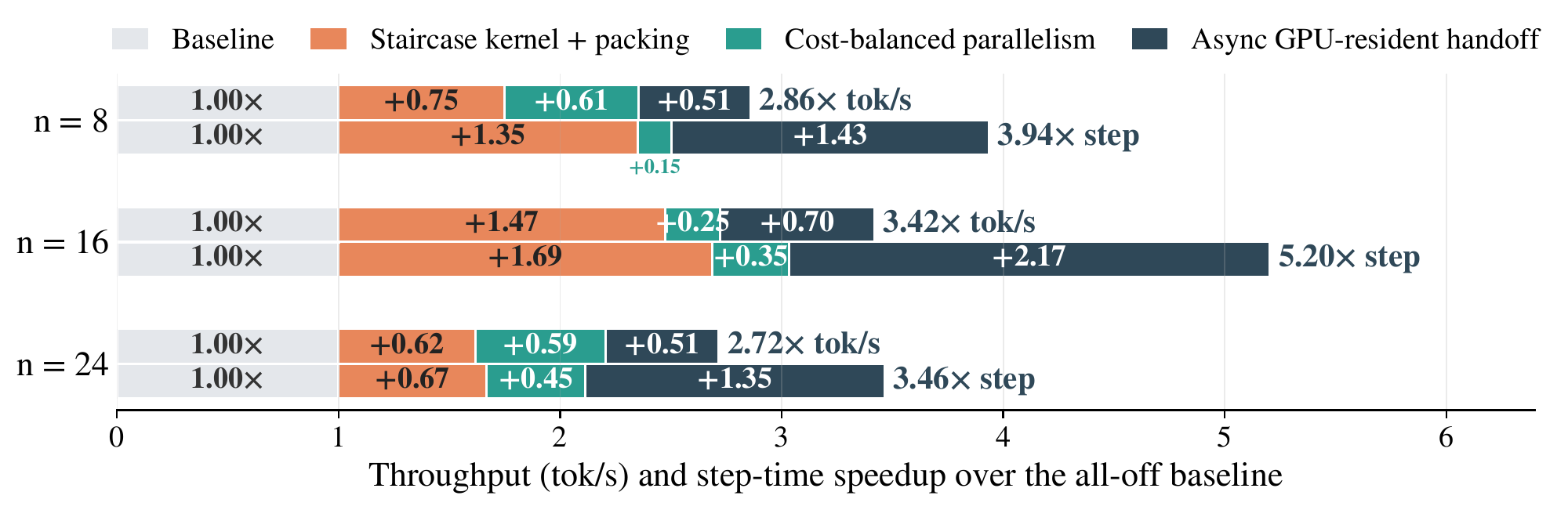
Exact residual supervision means capturing, keeping and replaying many trajectory-dependent states. The training system snapshots them asynchronously during generation (CUDA IPC when training is colocated), packs variable-length states and balances them by estimated compute, and enforces block-diffusion visibility with a Triton "staircase" attention kernel that skips invisible tiles.
Reproducing the paper's runs requires this Triton kernel (training/kernels/fast-diffusion-attention). The latest kernels, derived from FlashAttention-2 (Ampere and Ada GPUs) and FlashAttention-3 (Hopper), are available in fast-diffusion-attention, and we are still working on integrating them into ORL training.
See training/README.md for setup and usage.
orl/
├── training/                  # ORL training (see training/README.md)
│   ├── verl/                  # Trainer: fork of VERL with exact residual replay, AEC, packed replay
│   ├── sglang/                # Rollout engine for QwenDLM and LLaDA-2.1-mini (fork of SGLang)
│   ├── sglang_dgemma/         # Rollout engine for DiffusionGemma (fork of SGLang)
│   ├── kernels/               # Staircase block-diffusion attention
│   ├── overlays/              # Model code for the three families
│   ├── recipes/               # The paper's training recipes
│   ├── scripts/               # Launcher, two-node Ray setup, reproduce_*.sh
│   └── tools/                 # Start-model preparation, Hugging Face export
├── evaluation/                # Main-table evaluation (see evaluation/README.md)
│   ├── scripts/               # build_images.sh, prepare.sh, main_table.sh
│   ├── inference/             # Request clients and engine patches
│   ├── repro/                 # Recipes, generation, isolated scoring, aggregation
│   ├── inputs/                # Frozen benchmark inputs
│   └── configs/paper/         # Recorded decoding protocols
├── offline/                   # Offline training that builds QwenDLM-4B (see offline/README.md)
│   ├── llama_factory_sdar/    # Trainer: fork of LLaMA-Factory with block-diffusion SFT
│   ├── recipes/               # The four stages
│   ├── tools/                 # Stage start models
│   └── scripts/               # Single- and multi-node launcher
├── assets/                    # Figures and demo recordings
└── README.md
This project builds upon:
@misc{yu2026orl,
  title         = {On-Policy Residual Learning for Diffusion Language Models},
  author        = {Yu, Yifan and Jian, Yuqing and Li, Jisen and Hu, Yuezhou and Zhang, Tianyi and Wu, Xiaoxia and
                   Zhu, Rui-Jie and Wang, Junxiong and Zhou, Zhongzhu and Lai, Fan and Zou, James and Xu, Chenfeng},
  year          = {2026},
  eprint        = {2610.20687},
  archivePrefix = {arXiv},
  primaryClass  = {cs.LG},
  url           = {https://arxiv.org/abs/2610.20687}
}
MIT License. See LICENSE for details. Third-party components keep their own licenses, listed in NOTICE.
ORL: On-Policy Residual Learning for Diffusion Language Models
Python
17
3 commits
updated Oct 16, 2026
Yifan Yu1,2,*, Yuqing Jian1,*, Jisen Li1,*, Yuezhou Hu3, Tianyi Zhang1,
Xiaoxia Wu1, Rui-Jie Zhu4, Junxiong Wang1, Zhongzhu Zhou1,†, Fan Lai2,†,‡,
James Zou1,5,†, Chenfeng Xu1,6,†,‡
1Together AI 2University of Illinois Urbana-Champaign
3University of California, Berkeley 4University of California, Santa Cruz
5Stanford University 6The University of Texas at Austin
*Equal contribution †Equal advising ‡Corresponding authors
ORL trains a diffusion language model on its own residual trajectories. On QwenDLM (4B) it raises tokens per forward by up to 6.2× and end-to-end throughput by about 5× (about 6.9× together with dlmrt) at comparable or better quality, and it improves LLaDA-2.1-mini and DiffusionGemma the same way.
QwenDLM + ORL against Qwen3-4B-Thinking-2507 (autoregressive) and the same model with a DFlash drafter, answering HumanEval problems back to back in real time.
DiffusionGemma + ORL against Gemma 4 26B-A4B-it and its DFlash variant on GSM8K and HumanEval problems.
Both ORL models run in dlmrt, our inference engine. The project page plays the same recordings interactively, and its forward-pass explorer steps through one GSM8K problem decoded three ways under the same forward-pass budget.
training/env/), the QwenDLM recipe
reproduces the paper's checkpoint bit for bit| Model | GSM8K | MATH-500 | HumanEval | MBPP |
|---|---|---|---|---|
| QwenDLM (4B) | 90.4 / 2.4 | 88.0 / 2.1 | 82.9 / 1.8 | 79.2 / 2.1 |
| QwenDLM + ORL | 92.4 / 5.9 | 92.2 / 5.8 | 89.6 / 11.1 | 79.4 / 8.0 |
| LLaDA-2.1-mini | 91.9 / 5.6 | 84.6 / 8.2 | 86.6 / 11.3 | 77.5 / 7.7 |
| LLaDA-2.1-mini + ORL | 92.0 / 8.5 | 87.0 / 10.2 | 89.0 / 13.1 | 77.3 / 10.3 |
| DiffusionGemma | 95.8 / 26.0 | 92.3 / 23.7 | 90.9 / 24.5 | 87.7 / 23.1 |
| DiffusionGemma + ORL | 96.0 / 30.0 | 92.3 / 27.4 | 91.9 / 27.9 | 87.4 / 28.7 |
Base and ORL models each use their selected family-specific decoder, so a comparison includes both model and decoder.
| Decoder | Tokens / s |
|---|---|
| Autoregressive | 240 |
| EAGLE3, strict verification | 353 |
| EAGLE3, relaxed verification | 405 |
| DFlash, strict verification | 573 |
| DFlash, relaxed verification | 746 |
| QwenDLM + ORL, dlmrt | 1,298 |
QwenDLM + ORL averages 91.0% on GSM8K and HumanEval. Strict verification keeps the accuracy of the autoregressive model, 2.4 points higher; relaxed verification uses the fastest setting whose accuracy is at most 0.5 points below ORL's.
The project page compares against further diffusion baselines and against speculative decoding at matched quality.
dlmrt is our inference engine for running the ORL models one request at a time, as fast as the GPU allows.
Why a single request. Personal agents, on-device assistants and local coding tools serve one user, not many. Their requests arrive one at a time, and an agent's next step waits for the answer to the current one, so what the user feels is how quickly a single request finishes, not how many requests a GPU serves at once. Serving engines such as vLLM and SGLang are built to batch many users' requests. With a single request each forward pass is small: most of the GPU's compute sits idle, and kernel launches and scheduling take a large share of every step. A diffusion model can spend that idle compute on committing many tokens per forward pass, ORL trains it to commit more, and dlmrt removes the overhead around each forward pass, so fewer forward passes become lower latency. One denoising round takes 5.0 ms for QwenDLM + ORL on an H100 and 2.0 ms for LLaDA-2.1-mini + ORL in NVFP4 on a B200.
What it does. Each block of tokens runs as one CUDA graph whose denoising loop stays on the GPU: a conditional node decides after every round whether to continue, so the host only launches the block and reads back its tokens. The kernels are written around a single request and follow each model's reference numerics. On Blackwell GPUs the routed experts run in NVFP4 on FP4 tensor cores, and tensor parallelism spans an NVLink node through a fused reduction with no barriers. On one H100, with the same checkpoints and decoders, dlmrt is 1.2–1.6× faster than SGLang (QwenDLM, LLaDA-2.1-mini) and vLLM (DiffusionGemma).
How fast. Tokens per second for a single request, with the paper's prompts and decoders:
| Model | GPUs | Precision | GSM8K | MATH-500 | HumanEval | MBPP |
|---|---|---|---|---|---|---|
| QwenDLM + ORL | 1 × H100 | BF16 | 987 | 701 | 1,609 | 1,222 |
| LLaDA-2.1-mini + ORL | 1 × H100 | BF16 | 1,281 | 1,627 | 2,124 | 1,539 |
| 1 × B200 | NVFP4 | 2,953 | 3,882 | 5,046 | 3,564 | |
| 1 × RTX 5090 | NVFP4 | 1,648 | 2,081 | 2,788 | 2,053 | |
| DiffusionGemma + ORL | 1 × H100 | BF16 | 1,456 | 1,415 | 1,378 | 1,361 |
| 1 × B200 | NVFP4 | 4,214 | 3,805 | 3,949 | 3,898 | |
| 8 × B200 | NVFP4 | 7,708 | 7,123 | 7,026 | 6,871 | |
| 1 × RTX 5090 | NVFP4 | 1,540 | 1,408 | 1,490 | 1,465 |
NVFP4 on one B200 is 2.3–2.9× faster than BF16 on one H100, with comparable accuracy. The NVFP4 models fit in the 32 GB of a single consumer RTX 5090, which runs them at about the speed of BF16 on an H100 or faster, so fast decoding does not need a datacenter GPU. DiffusionGemma's single-B200 row averages generation seeds 1234–1236, and its 8 × B200 and RTX 5090 rows use seed 1234. Accuracy for every row and the measurement protocol are in dlmrt's performance page; to run the models yourself, see Fast Inference.
All checkpoints are in the Hugging Face collection.
| Model | HuggingFace | Description |
|---|---|---|
| QwenDLM + ORL | yifanyu/QwenDLM-4B-ORL | ORL on QwenDLM-4B |
| LLaDA-2.1-mini + ORL | yifanyu/LLaDA2.1-mini-ORL | ORL on inclusionAI/LLaDA2.1-mini |
| DiffusionGemma + ORL | yifanyu/DiffusionGemma-26B-A4B-it-ORL | ORL on google/diffusiongemma-26B-A4B-it |
| LLaDA-2.1-mini + ORL, NVFP4 | yifanyu/LLaDA2.1-mini-ORL-NVFP4 | NVFP4 quantization of LLaDA-2.1-mini + ORL for Blackwell GPUs |
| DiffusionGemma + ORL, NVFP4 | yifanyu/DiffusionGemma-26B-A4B-it-ORL-NVFP4 | NVFP4 quantization of DiffusionGemma + ORL for Blackwell GPUs; the demo's model |
| QwenDLM-4B | yifanyu/QwenDLM-4B | Qwen3-4B-Thinking-2507 converted to 256-token block diffusion; start model of QwenDLM + ORL |
| ORL training data | yifanyu/ORL-training-data | Dataset of all three training runs |
The pinned revisions used for evaluation are listed in evaluation/docs/reproduction/CHECKPOINTS.md.
git clone https://github.com/Introspective-Diffusion/ORL orl
cd orl
dlmrt, our inference engine, decodes the ORL models one request at a time at the speeds above, and it runs the demo. Install it as in its README, then pick the checkpoint for your GPU:
| GPU | Checkpoints |
|---|---|
| H100 (Hopper) | yifanyu/QwenDLM-4B-ORL, yifanyu/LLaDA2.1-mini-ORL, yifanyu/DiffusionGemma-26B-A4B-it-ORL |
| B200, B300, RTX 50 series (Blackwell) | yifanyu/LLaDA2.1-mini-ORL-NVFP4, yifanyu/DiffusionGemma-26B-A4B-it-ORL-NVFP4 |
Pass role="orl" for the LLaDA-2.1-mini and DiffusionGemma checkpoints: it selects the ORL decoder the paper
evaluates (the default is the base model's). QwenDLM's default decoder is already ORL's.
from dlmrt import LLM

llm = LLM("yifanyu/DiffusionGemma-26B-A4B-it-ORL-NVFP4", role="orl")  # NVFP4 experts on Blackwell
out = llm.generate("Write a Python function that checks whether a number is prime.", max_new_tokens=2048)
print(out.text)
print(f"{out.request_tps:.0f} tokens/s")
On an NVLink node, run the same program under torchrun --nproc-per-node 8 for tensor parallelism, or serve the model
over HTTP:
torchrun --nproc-per-node 8 -m dlmrt serve --model yifanyu/DiffusionGemma-26B-A4B-it-ORL-NVFP4 --role orl --port 18080
The paper measures the DLMs' throughput (tokens/s) with dlmrt, so reproducing it needs dlmrt. The evaluation below reproduces the paper's accuracy and tokens per forward with the SGLang and vLLM engines of the paper's runs.
Needs NVIDIA GPUs and Apptainer; every generation job runs in an isolated container on one GPU.
export ORL_EVAL_WORK=/path/to/eval-work MODELS=/path/to/models
bash evaluation/scripts/build_images.sh     # SGLang, vLLM and scorer images, pinned by digest
bash evaluation/scripts/prepare.sh          # engine runtimes, frozen inputs, decoder configs, scorer
hf download yifanyu/QwenDLM-4B-ORL --revision e12b90bf8267aa5d994bcf73996f00e00d484239 \
  --local-dir $MODELS/QwenDLM-4B-ORL
bash evaluation/scripts/main_table.sh qwen-dlm-orl $MODELS/QwenDLM-4B-ORL   # or llada-orl, dg-orl, *-base
It prints accuracy and TPF for GSM8K, MATH-500, HumanEval and MBPP next to the numbers above. Reproduced numbers can differ slightly from the paper's; the differences are small. See evaluation/README.md for details.
All runs use 8 × H100 80GB per node. Set up the Apptainer runtime ($SIF, $PY) as in
training/README.md, and the start models under $MODELS and the DiffusionGemma
Transformers overlay ($OVERLAY) as in its next section.
$DATA and $RUNS are directories of your choice, and $HEAD_IP and $WORKER_IP are the addresses of the two
DiffusionGemma nodes:
hf download yifanyu/ORL-training-data --repo-type dataset --local-dir $DATA
# QwenDLM + ORL, 1 node
bash training/scripts/reproduce_qwen_dlm.sh $RUNS/qwen_dlm $MODELS/QwenDLM-4B-scrp8 $DATA --sif $SIF --python $PY
# LLaDA-2.1-mini + ORL, 1 node
bash training/scripts/reproduce_llada2.sh $RUNS/llada2 $MODELS/LLaDA2.1-mini-actor $DATA --sif $SIF --python $PY
# DiffusionGemma + ORL, 2 nodes: the same command with `head` on the actor node and `worker` on the rollout node
bash training/scripts/reproduce_diffusion_gemma.sh head $RUNS/dgemma $SIF $PY $MODELS/diffusiongemma-26B-A4B-it \
  $DATA $OVERLAY $HEAD_IP $WORKER_IP
See training/README.md for the complete recipe of each model: start model, training, export to a Hugging Face directory and evaluation.
offline/ builds QwenDLM-4B from Qwen3-4B-Thinking-2507 in four stages of block-diffusion training
(its training data is not included); the QwenDLM runs start from the released yifanyu/QwenDLM-4B, rescaled with
training/tools/make_scrp_base.py --gamma 8.
This release covers the main table end to end: the offline training code for QwenDLM-4B, training the three ORL models
and evaluating them, where evaluation/scripts/main_table.sh evaluates one model in a single command. For the transfer
evaluation (Table 2), evaluation/repro/eval/transfer_generate.py generates from the frozen task files and checks each
against its SHA256: MMLU-Pro and IFEval are included, and evaluation/repro/eval/build_transfer_inputs.py rebuilds
AIME, LiveCodeBench and GPQA, the last from your own Hugging Face access, since its terms rule out sharing it in plain
text. Throughput is reproduced with dlmrt (see Fast Inference); here the same-GPU throughput check
can only be dry-run, with evaluation/repro/paper/plan.py --suite tps.
Residual context carries a diffusion model's predictive distributions from one denoising step to the next. What the model learns from it depends on the trajectories the model itself produces, so ORL learns on-policy:
AEC asks the next state to cut the normalized entropy of the unresolved positions by a fraction ρ, with the source entropy detached:
\mathcal{L}_{\text{AEC}} = \big[\max\big(0,\ H_{\text{next}} - (1-\rho)\,H_{\text{source}}\big)\big]^2
Exact residual supervision means capturing, keeping and replaying many trajectory-dependent states. The training system snapshots them asynchronously during generation (CUDA IPC when training is colocated), packs variable-length states and balances them by estimated compute, and enforces block-diffusion visibility with a Triton "staircase" attention kernel that skips invisible tiles.
Reproducing the paper's runs requires this Triton kernel (training/kernels/fast-diffusion-attention). The latest kernels, derived from FlashAttention-2 (Ampere and Ada GPUs) and FlashAttention-3 (Hopper), are available in fast-diffusion-attention, and we are still working on integrating them into ORL training.
See training/README.md for setup and usage.
orl/
├── training/                  # ORL training (see training/README.md)
│   ├── verl/                  # Trainer: fork of VERL with exact residual replay, AEC, packed replay
│   ├── sglang/                # Rollout engine for QwenDLM and LLaDA-2.1-mini (fork of SGLang)
│   ├── sglang_dgemma/         # Rollout engine for DiffusionGemma (fork of SGLang)
│   ├── kernels/               # Staircase block-diffusion attention
│   ├── overlays/              # Model code for the three families
│   ├── recipes/               # The paper's training recipes
│   ├── scripts/               # Launcher, two-node Ray setup, reproduce_*.sh
│   └── tools/                 # Start-model preparation, Hugging Face export
├── evaluation/                # Main-table evaluation (see evaluation/README.md)
│   ├── scripts/               # build_images.sh, prepare.sh, main_table.sh
│   ├── inference/             # Request clients and engine patches
│   ├── repro/                 # Recipes, generation, isolated scoring, aggregation
│   ├── inputs/                # Frozen benchmark inputs
│   └── configs/paper/         # Recorded decoding protocols
├── offline/                   # Offline training that builds QwenDLM-4B (see offline/README.md)
│   ├── llama_factory_sdar/    # Trainer: fork of LLaMA-Factory with block-diffusion SFT
│   ├── recipes/               # The four stages
│   ├── tools/                 # Stage start models
│   └── scripts/               # Single- and multi-node launcher
├── assets/                    # Figures and demo recordings
└── README.md
This project builds upon:
@misc{yu2026orl,
  title         = {On-Policy Residual Learning for Diffusion Language Models},
  author        = {Yu, Yifan and Jian, Yuqing and Li, Jisen and Hu, Yuezhou and Zhang, Tianyi and Wu, Xiaoxia and
                   Zhu, Rui-Jie and Wang, Junxiong and Zhou, Zhongzhu and Lai, Fan and Zou, James and Xu, Chenfeng},
  year          = {2026},
  eprint        = {2610.20687},
  archivePrefix = {arXiv},
  primaryClass  = {cs.LG},
  url           = {https://arxiv.org/abs/2610.20687}
}
MIT License. See LICENSE for details. Third-party components keep their own licenses, listed in NOTICE.



