Python
1
8 commits
updated Jul 12, 2026
An end-to-end Arabic RAG platform — from raw web pages to grounded LLM answers — built as a production-style async FastAPI system. It covers the full retrieval-augmented generation lifecycle: scraping and cleaning Arabic articles, generating vector embeddings, HNSW-indexed semantic search over pgvector, a provider-agnostic RAG pipeline with source attribution and cost tracking, and a custom QLoRA fine-tuned Command-R7B Arabic model (ibrahim-nada/cmdr7b-ar-seo-qlora-v1) served in-process for SEO generation.
Skip to the Showcase to see real inference results, or Fine-Tuning for training details.
Article URL ──► Scrape ──► Embed (Ollama) ──► Store in pgvector ──► Semantic Search
                                                       │
                                           ┌───────────┴───────────┐
                                           ▼                       ▼
                                    RAG Pipeline             SEO Generation
                                (ChatGPT/DeepSeek/      (QLoRA fine-tuned
                                 Ollama/Claude)          Command-R7B Arabic)
c4ai-command-r7b-arabic (4-bit quantized), trained in this repoX-API-Key header), CORS, rate limiting (slowapi)Annotated type aliasesILLMProvider, IWebScraper) with factory-based resolutionAsyncClient), queue (aio-pika)ResponseDto[T] with .success() / .fail() factory methodsAll screenshots below are real responses from the running system against a corpus of scraped Arabic articles.
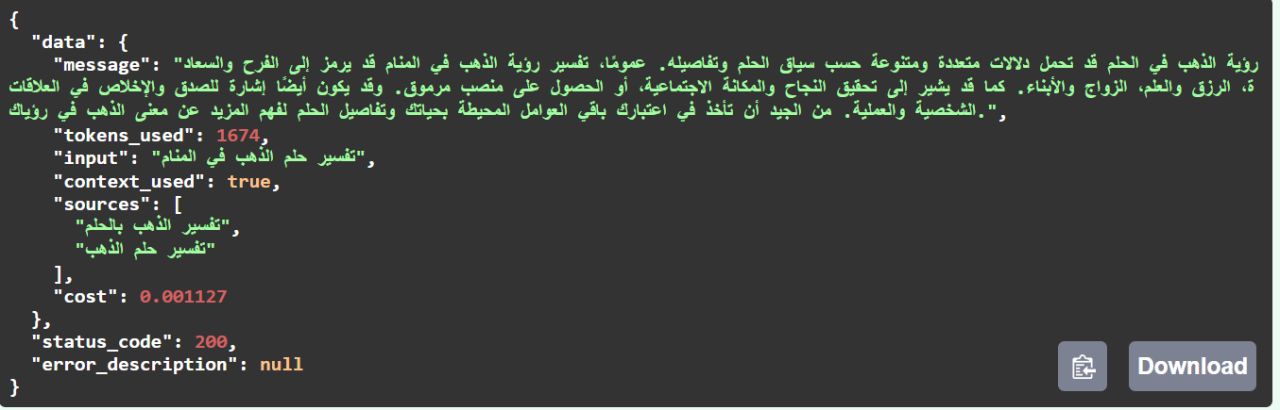
A question in Arabic ("تفسير حلم الذهب في المنام" — interpretation of gold in a dream) is answered using retrieved paragraph context. Note the context_used flag, the sources that grounded the answer, token usage, and the computed API cost:
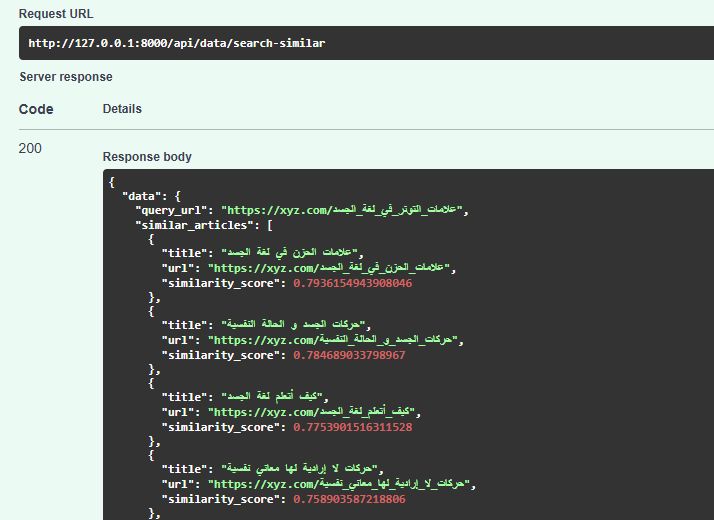
Given an article URL about signs of stress in body language, the system returns semantically related articles (grief in body language, body movements and psychological state, learning body language) ranked by cosine similarity — pure vector semantics, no keyword matching:
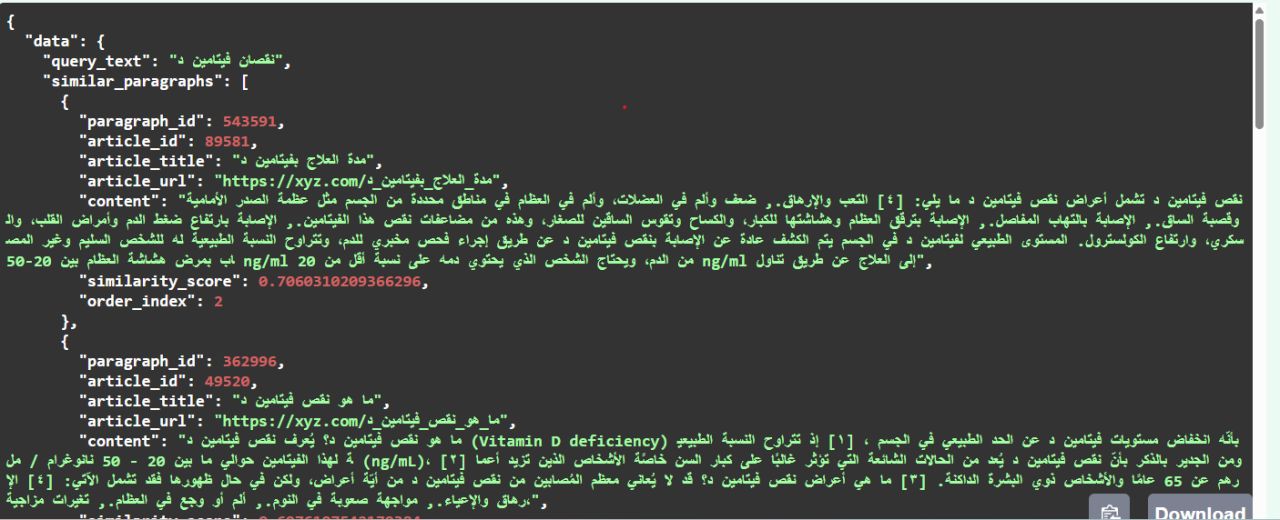
A short free-text query ("نقصان فيتامين د" — vitamin D deficiency) retrieves the most relevant individual paragraphs across the entire corpus, each with its similarity score and source article:
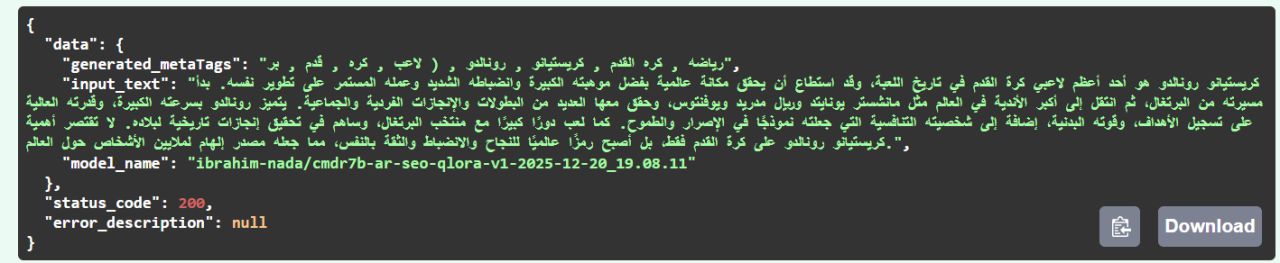
The QLoRA fine-tuned Command-R7B Arabic model generates SEO meta tags for an Arabic article (about Cristiano Ronaldo) — served directly by the API with 4-bit quantization:
The SEO generation module runs a custom fine-tune trained in this repo — full training code in cmdr7b_arabic_seo_lora.ipynb:
| Base model | CohereLabs/c4ai-command-r7b-arabic-02-2025 |
| Method | QLoRA — PEFT adapters on a 4-bit NF4 double-quantized base (TRL SFTTrainer) |
| Task | Arabic article → SEO meta description / meta tags |
| Training data | ibrahim-nada/xyz-seo-preprocessed-cleaned — prompt/completion pairs prepared from the scraped article corpus, filtered to ≤ 450 words and > 10 tokens |
| Published adapter | ibrahim-nada/cmdr7b-ar-seo-qlora-v1-2025-12-20_19.08.11 |
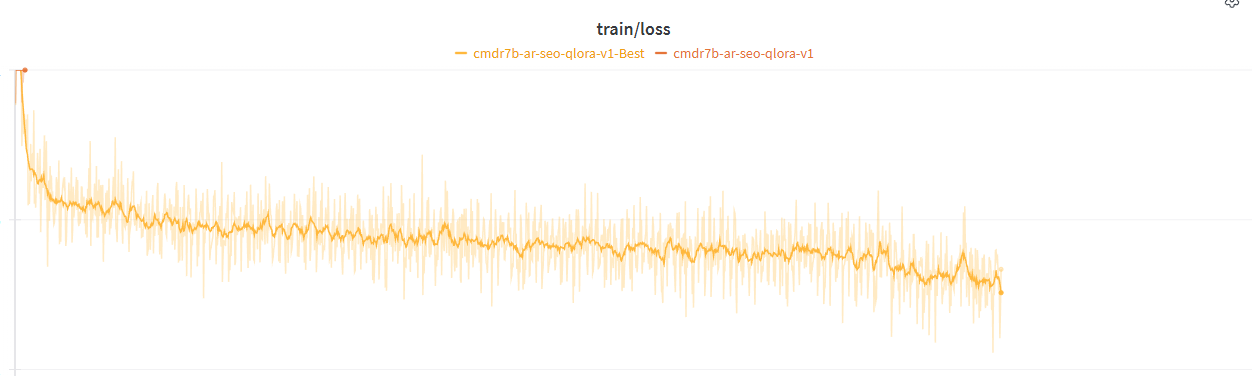
| Tracking | Weights & Biases (loss curve below), checkpoints pushed to HF Hub every 100 steps |
| Serving | Lazy-loaded in-process, BitsAndBytesConfig 4-bit NF4 + fp16 compute, CPU offload fallback |
Hyperparameters:
| LoRA | Training |
|---|---|
r=16, alpha=32, dropout=0.1 | 3 epochs, batch size 8, max seq len 1024 |
Target modules: all attention (q/k/v/o_proj) + MLP (gate/up/down_proj) | LR 1e-4, cosine schedule, warmup ratio 0.01 |
| 4-bit NF4 double quant, bf16 compute (Ampere+) | paged_adamw_32bit, weight decay 0.001, max grad norm 0.3 |
Prompt template (structured markers for instruction, article, and output):
<SEO_PROMPT_PREFIX>
اكتب وصف ميتا للمقال التالي

<ARTICLE_TEXT>
{article}

<SEO_OUTPUT_PREFIX>
{meta_description}
Training loss over the fine-tuning run:
| Layer | Technology |
|---|---|
| API | FastAPI 0.116.1, Uvicorn |
| Database | PostgreSQL + pgvector (async via asyncpg) |
| ORM | SQLAlchemy 2.0.43 (async) |
| Migrations | Alembic 1.16.5 |
| Embeddings | Ollama (nomic-embed-text, 1024-dim) |
| Scraping | httpx (async) + BeautifulSoup4 |
| LLM Providers | OpenAI SDK (ChatGPT, DeepSeek), Ollama, Claude |
| Queue | RabbitMQ via aio-pika (optional) |
| Cache | Redis (optional) |
| Logging | seqlog → Seq (optional) |
| Arabic NLP | Inline diacritics/normalization (no runtime camel-tools dependency) |
| Fine-tuning | Transformers, PEFT (QLoRA), bitsandbytes (4-bit), PyTorch |
| Rate Limiting | slowapi |
nomic-embed-text modelOptional:
git clone https://github.com/IbrahimMNada/nlp-semantic-lab.git
cd nlp-semantic-lab

python -m venv .venv
source .venv/bin/activate  # Linux/Mac
# .venv\Scripts\activate   # Windows

pip install -r requirements.txt

cp .env.example .env
# Edit .env — at minimum set DATABASE_URL

alembic upgrade head
# Install Ollama: https://ollama.ai
ollama pull nomic-embed-text

# Optional: local LLM for RAG (if using Ollama as LLM_PROVIDER)
ollama pull llama3.2
cd docker && docker compose up -d
Starts: RabbitMQ (5673, management on 15673), Redis (6380), RedisInsight (8082), Seq (5343), PostgreSQL (5433), Ollama (11435).
uvicorn src.main:app --reload
| URL | |
|---|---|
| API | http://localhost:8000 |
| Swagger UI | http://localhost:8000/docs |
| ReDoc | http://localhost:8000/redoc |
Set QUEUE_ENABLED=true in .env, then in a separate terminal:
python -m src.modules.data.consumers.embeddings_consumer
All settings via environment variables (.env). See .env.example for the full list.
| Variable | Purpose | Default |
|---|---|---|
DATABASE_URL | PostgreSQL connection string | (required) |
OLLAMA_URL | Ollama server for embeddings | http://localhost:11435 |
OLLAMA_MODEL_NAME | Embedding model name | nomic-embed-text |
LLM_PROVIDER | RAG LLM backend: chatgpt, claude, deepseek, ollama | chatgpt |
OPENAI_API_KEY | OpenAI key (for ChatGPT provider) | |
DEEPSEEK_API_KEY | DeepSeek key | |
QUEUE_ENABLED | Enable RabbitMQ async embeddings | false |
REDIS_URL | Redis connection URL | redis://localhost:6380/0 |
API_KEY_ENABLED | Require X-API-Key header | false |
API_KEY | Expected API key value | |
CORS_ALLOWED_ORIGINS | Allowed CORS origins | ["*"] |
SEQ_ENABLED | Enable Seq structured logging | false |
HF_TOKEN | HuggingFace token (for SEO model download) |
| Method | Path | Description |
|---|---|---|
GET | /ping | Returns app name |
/api/data| Method | Path | Rate Limit | Description |
|---|---|---|---|
POST | /process | 10/min | Scrape URL → save article → generate embeddings |
POST | /search-similar | 30/min | Find similar articles by URL (article-level vectors) |
POST | /search-similar-paragraphs | 30/min | Find similar paragraphs by text (paragraph-level vectors) |
POST | /rebuild-index | 2/min | Recreate HNSW vector indexes |
POST | /compute-article-embeddings | — | Precompute article vectors from paragraph averages |
POST | /process-articles-without-embeddings | — | Backfill embeddings for existing articles |
GET | /random-articles?limit=10 | — | Random articles with SEO metadata |
POST /api/data/process
Content-Type: application/json

{ "url": "https://example.com/article" }
POST /api/data/search-similar
Content-Type: application/json

{ "url": "https://example.com/article", "limit": 10, "threshold": 0.7 }
POST /api/data/search-similar-paragraphs
Content-Type: application/json

{ "text": "search query text", "limit": 10, "threshold": 0.5, "min_words": 10 }
/api/rag| Method | Path | Rate Limit | Description |
|---|---|---|---|
POST | /search-context | 30/min | Search paragraphs via the data module event bus |
POST | /ask-with-context | 20/min | Retrieve context → build prompt → call LLM → return answer |
POST /api/rag/ask-with-context
Content-Type: application/json

{
  "question": "What is the article about?",
  "limit": 3,
  "similarity_threshold": 0.5,
  "temperature": 0.7,
  "max_tokens": 1000
}
{
  "data": {
    "message": "AI-generated answer grounded in your data...",
    "tokens_used": 450,
    "context_used": true,
    "sources": ["https://example.com/article1"],
    "cost": 0.0012
  },
  "status_code": 200,
  "error_description": null
}
/api/seo| Method | Path | Rate Limit | Description |
|---|---|---|---|
POST | /generate | 10/min | Generate Arabic SEO meta description from article text |
GET | /dataset/random-samples?num_samples=10 | — | Random samples from the training dataset |
POST /api/seo/generate
Content-Type: application/json

{ "text": "Arabic article text...", "max_length": 512, "temperature": 0.7, "top_p": 0.9 }
{
  "data": {
    "generated_text": "Generated SEO description...",
    "input_text": "Original input...",
    "model_name": "ibrahim-nada/cmdr7b-ar-seo-qlora-v1-2025-12-20_19.08.11"
  },
  "status_code": 200,
  "error_description": null
}
When API_KEY_ENABLED=true, all module endpoints require the header:
X-API-Key: your-key
src/
├── main.py                          # FastAPI app, middleware, lifespan
├── core/                            # Cross-cutting infrastructure
│   ├── config.py                    #   Pydantic Settings (env vars, lru_cache singleton)
│   ├── database.py                  #   Async/sync SQLAlchemy session factories
│   ├── security.py                  #   API key verification, rate limiter
│   ├── cache_service.py             #   Redis cache wrapper (graceful degradation)
│   ├── base.py                      #   SQLAlchemy declarative base
│   ├── base_dtos/                   #   Generic ResponseDto[T]
│   └── exceptions/                  #   BadRequestException
├── abstractions/interfaces/         # ILLMProvider, IWebScraper
├── contracts/data/                  # Shared DTOs for inter-module communication
├── shared/                          # Utilities
│   ├── arabic_text_processor.py     #   Diacritics, normalization, stopwords
│   ├── text_utils.py                #   Unicode cleanup
│   ├── event_bus.py                 #   In-process signal bus (register/send)
│   └── modules_http_client.py       #   Type-safe internal HTTP client
└── modules/
    ├── data/                        # Scraping, embeddings, vector search
    │   ├── routes.py                #   7 endpoints
    │   ├── dependencies.py          #   DI wiring (Annotated type aliases)
    │   ├── services/
    │   │   ├── data_service.py      #     Orchestration service
    │   │   ├── embedding_service.py #     Ollama embedding generation + storage
    │   │   ├── article_repository.py#     DB access (upsert, query, delete)
    │   │   ├── web_scraper.py       #     Default HTML scraper
    │   │   └── web_scraper_factory.py#    Domain-based scraper resolution
    │   ├── consumers/
    │   │   └── embeddings_consumer.py#    RabbitMQ async consumer
    │   ├── entities/                #   Article, ArticleParagraph, embedding tables
    │   └── dtos/                    #   Request/response DTOs
    ├── rag/                         # RAG pipeline
    │   ├── routes.py                #   2 endpoints
    │   ├── dependencies.py          #   LLM provider factory
    │   ├── services/
    │   │   └── rag_service.py       #     Context retrieval + LLM orchestration
    │   └── remote_models/           #   LLM provider implementations
    │       ├── chatgpt_consumer.py
    │       ├── claude_consumer.py
    │       ├── deepseek_consumer.py
    │       └── ollama_consumer.py
    ├── seo_generation/              # SEO content generation
    │   ├── routes.py                #   2 endpoints
    │   ├── dependencies.py
    │   └── services/
    │       ├── seo_service.py       #     QLoRA model loading + inference
    │       └── dataset_service.py   #     HuggingFace dataset access
    └── model_traning/               # Fine-tuning
        ├── cmdr7b_arabic_seo_lora.ipynb  # Full QLoRA training run (Colab GPU)
        ├── fine-tuner.py            #   Training imports/entry point
        ├── data_set_services.py     #   Dataset preparation
        └── notebooks/               #   Training datasets
PostgreSQL with pgvector extension — four tables:
| Table | Purpose |
|---|---|
articles | Scraped content with flattened SEO metadata (meta tags, Open Graph, Twitter Cards as JSON) |
article_paragraphs | Individual paragraphs with order_index, FK → articles |
paragraph_embeddings_1024 | 1024-dim vector per paragraph, HNSW indexed (m=16, ef_construction=64, cosine) |
article_embedding_1024 | 1024-dim vector per article (mean of paragraph vectors), HNSW indexed |
Scrape → Embed → Search:
POST /api/data/process { url }
  → WebScraperFactory resolves scraper by domain
  → Scrape HTML → extract title, author, paragraphs, SEO metadata
  → ArticleRepository: upsert article + save paragraphs
  → EmbeddingService: generate 1024-dim vector per paragraph via Ollama
  → Compute article embedding (mean of paragraph vectors)
  → Store vectors in pgvector with HNSW index
RAG:
POST /api/rag/ask-with-context { question }
  → Event bus → Data module: search similar paragraphs (cosine similarity)
  → Build prompt with retrieved context
  → Call configured LLM provider (ChatGPT / DeepSeek / Ollama / Claude)
  → Return answer with sources and cost
SEO Generation:
POST /api/seo/generate { text }
  → Load QLoRA adapter on 4-bit quantized Command-R7B base (lazy init)
  → Preprocess Arabic text (normalize, strip diacritics)
  → Tokenize, truncate to 1020 tokens, generate (max 25 new tokens)
  → Return cleaned meta description
| Pattern | Implementation |
|---|---|
| Dependency Injection | Annotated + Depends type aliases per module (DataServiceDep, RagServiceDep) |
| Repository | ArticleRepository — all SQL/ORM access isolated |
| Service Layer | DataService, RagService, SeoService — orchestration logic |
| Factory | WebScraperFactory (domain → scraper), get_llm_provider() (config → LLM) |
| Interface Abstraction | ILLMProvider, IWebScraper — pluggable implementations |
| Singleton | @lru_cache() on service factories |
| Event Bus | event_bus.register() / event_bus.send() — decoupled inter-module calls |
| Generic DTO | ResponseDto[T] with .success() / .fail() |
alembic upgrade head                              # Run migrations
alembic revision --autogenerate -m "description"  # Create migration
uvicorn src.main:app --reload                     # Start with hot reload
| Service | URL |
|---|---|
| Swagger UI | http://localhost:8000/docs |
| ReDoc | http://localhost:8000/redoc |
| RabbitMQ Management | http://localhost:15673 |
| RedisInsight | http://localhost:8082 |
| Seq | http://localhost:5343 |
MIT — see LICENSE.
Python
1
8 commits
updated Jul 12, 2026
An end-to-end Arabic RAG platform — from raw web pages to grounded LLM answers — built as a production-style async FastAPI system. It covers the full retrieval-augmented generation lifecycle: scraping and cleaning Arabic articles, generating vector embeddings, HNSW-indexed semantic search over pgvector, a provider-agnostic RAG pipeline with source attribution and cost tracking, and a custom QLoRA fine-tuned Command-R7B Arabic model (ibrahim-nada/cmdr7b-ar-seo-qlora-v1) served in-process for SEO generation.
Skip to the Showcase to see real inference results, or Fine-Tuning for training details.
Article URL ──► Scrape ──► Embed (Ollama) ──► Store in pgvector ──► Semantic Search
                                                       │
                                           ┌───────────┴───────────┐
                                           ▼                       ▼
                                    RAG Pipeline             SEO Generation
                                (ChatGPT/DeepSeek/      (QLoRA fine-tuned
                                 Ollama/Claude)          Command-R7B Arabic)
c4ai-command-r7b-arabic (4-bit quantized), trained in this repoX-API-Key header), CORS, rate limiting (slowapi)Annotated type aliasesILLMProvider, IWebScraper) with factory-based resolutionAsyncClient), queue (aio-pika)ResponseDto[T] with .success() / .fail() factory methodsAll screenshots below are real responses from the running system against a corpus of scraped Arabic articles.
A question in Arabic ("تفسير حلم الذهب في المنام" — interpretation of gold in a dream) is answered using retrieved paragraph context. Note the context_used flag, the sources that grounded the answer, token usage, and the computed API cost:
Given an article URL about signs of stress in body language, the system returns semantically related articles (grief in body language, body movements and psychological state, learning body language) ranked by cosine similarity — pure vector semantics, no keyword matching:
A short free-text query ("نقصان فيتامين د" — vitamin D deficiency) retrieves the most relevant individual paragraphs across the entire corpus, each with its similarity score and source article:
The QLoRA fine-tuned Command-R7B Arabic model generates SEO meta tags for an Arabic article (about Cristiano Ronaldo) — served directly by the API with 4-bit quantization:
The SEO generation module runs a custom fine-tune trained in this repo — full training code in cmdr7b_arabic_seo_lora.ipynb:
| Base model | CohereLabs/c4ai-command-r7b-arabic-02-2025 |
| Method | QLoRA — PEFT adapters on a 4-bit NF4 double-quantized base (TRL SFTTrainer) |
| Task | Arabic article → SEO meta description / meta tags |
| Training data | ibrahim-nada/xyz-seo-preprocessed-cleaned — prompt/completion pairs prepared from the scraped article corpus, filtered to ≤ 450 words and > 10 tokens |
| Published adapter | ibrahim-nada/cmdr7b-ar-seo-qlora-v1-2025-12-20_19.08.11 |
| Tracking | Weights & Biases (loss curve below), checkpoints pushed to HF Hub every 100 steps |
| Serving | Lazy-loaded in-process, BitsAndBytesConfig 4-bit NF4 + fp16 compute, CPU offload fallback |
Hyperparameters:
| LoRA | Training |
|---|---|
r=16, alpha=32, dropout=0.1 | 3 epochs, batch size 8, max seq len 1024 |
Target modules: all attention (q/k/v/o_proj) + MLP (gate/up/down_proj) | LR 1e-4, cosine schedule, warmup ratio 0.01 |
| 4-bit NF4 double quant, bf16 compute (Ampere+) | paged_adamw_32bit, weight decay 0.001, max grad norm 0.3 |
Prompt template (structured markers for instruction, article, and output):
<SEO_PROMPT_PREFIX>
اكتب وصف ميتا للمقال التالي

<ARTICLE_TEXT>
{article}

<SEO_OUTPUT_PREFIX>
{meta_description}
Training loss over the fine-tuning run:
| Layer | Technology |
|---|---|
| API | FastAPI 0.116.1, Uvicorn |
| Database | PostgreSQL + pgvector (async via asyncpg) |
| ORM | SQLAlchemy 2.0.43 (async) |
| Migrations | Alembic 1.16.5 |
| Embeddings | Ollama (nomic-embed-text, 1024-dim) |
| Scraping | httpx (async) + BeautifulSoup4 |
| LLM Providers | OpenAI SDK (ChatGPT, DeepSeek), Ollama, Claude |
| Queue | RabbitMQ via aio-pika (optional) |
| Cache | Redis (optional) |
| Logging | seqlog → Seq (optional) |
| Arabic NLP | Inline diacritics/normalization (no runtime camel-tools dependency) |
| Fine-tuning | Transformers, PEFT (QLoRA), bitsandbytes (4-bit), PyTorch |
| Rate Limiting | slowapi |
nomic-embed-text modelOptional:
git clone https://github.com/IbrahimMNada/nlp-semantic-lab.git
cd nlp-semantic-lab

python -m venv .venv
source .venv/bin/activate  # Linux/Mac
# .venv\Scripts\activate   # Windows

pip install -r requirements.txt

cp .env.example .env
# Edit .env — at minimum set DATABASE_URL

alembic upgrade head
# Install Ollama: https://ollama.ai
ollama pull nomic-embed-text

# Optional: local LLM for RAG (if using Ollama as LLM_PROVIDER)
ollama pull llama3.2
cd docker && docker compose up -d
Starts: RabbitMQ (5673, management on 15673), Redis (6380), RedisInsight (8082), Seq (5343), PostgreSQL (5433), Ollama (11435).
uvicorn src.main:app --reload
| URL | |
|---|---|
| API | http://localhost:8000 |
| Swagger UI | http://localhost:8000/docs |
| ReDoc | http://localhost:8000/redoc |
Set QUEUE_ENABLED=true in .env, then in a separate terminal:
python -m src.modules.data.consumers.embeddings_consumer
All settings via environment variables (.env). See .env.example for the full list.
| Variable | Purpose | Default |
|---|---|---|
DATABASE_URL | PostgreSQL connection string | (required) |
OLLAMA_URL | Ollama server for embeddings | http://localhost:11435 |
OLLAMA_MODEL_NAME | Embedding model name | nomic-embed-text |
LLM_PROVIDER | RAG LLM backend: chatgpt, claude, deepseek, ollama | chatgpt |
OPENAI_API_KEY | OpenAI key (for ChatGPT provider) | |
DEEPSEEK_API_KEY | DeepSeek key | |
QUEUE_ENABLED | Enable RabbitMQ async embeddings | false |
REDIS_URL | Redis connection URL | redis://localhost:6380/0 |
API_KEY_ENABLED | Require X-API-Key header | false |
API_KEY | Expected API key value | |
CORS_ALLOWED_ORIGINS | Allowed CORS origins | ["*"] |
SEQ_ENABLED | Enable Seq structured logging | false |
HF_TOKEN | HuggingFace token (for SEO model download) |
| Method | Path | Description |
|---|---|---|
GET | /ping | Returns app name |
/api/data| Method | Path | Rate Limit | Description |
|---|---|---|---|
POST | /process | 10/min | Scrape URL → save article → generate embeddings |
POST | /search-similar | 30/min | Find similar articles by URL (article-level vectors) |
POST | /search-similar-paragraphs | 30/min | Find similar paragraphs by text (paragraph-level vectors) |
POST | /rebuild-index | 2/min | Recreate HNSW vector indexes |
POST | /compute-article-embeddings | — | Precompute article vectors from paragraph averages |
POST | /process-articles-without-embeddings | — | Backfill embeddings for existing articles |
GET | /random-articles?limit=10 | — | Random articles with SEO metadata |
POST /api/data/process
Content-Type: application/json

{ "url": "https://example.com/article" }
POST /api/data/search-similar
Content-Type: application/json

{ "url": "https://example.com/article", "limit": 10, "threshold": 0.7 }
POST /api/data/search-similar-paragraphs
Content-Type: application/json

{ "text": "search query text", "limit": 10, "threshold": 0.5, "min_words": 10 }
/api/rag| Method | Path | Rate Limit | Description |
|---|---|---|---|
POST | /search-context | 30/min | Search paragraphs via the data module event bus |
POST | /ask-with-context | 20/min | Retrieve context → build prompt → call LLM → return answer |
POST /api/rag/ask-with-context
Content-Type: application/json

{
  "question": "What is the article about?",
  "limit": 3,
  "similarity_threshold": 0.5,
  "temperature": 0.7,
  "max_tokens": 1000
}
{
  "data": {
    "message": "AI-generated answer grounded in your data...",
    "tokens_used": 450,
    "context_used": true,
    "sources": ["https://example.com/article1"],
    "cost": 0.0012
  },
  "status_code": 200,
  "error_description": null
}
/api/seo| Method | Path | Rate Limit | Description |
|---|---|---|---|
POST | /generate | 10/min | Generate Arabic SEO meta description from article text |
GET | /dataset/random-samples?num_samples=10 | — | Random samples from the training dataset |
POST /api/seo/generate
Content-Type: application/json

{ "text": "Arabic article text...", "max_length": 512, "temperature": 0.7, "top_p": 0.9 }
{
  "data": {
    "generated_text": "Generated SEO description...",
    "input_text": "Original input...",
    "model_name": "ibrahim-nada/cmdr7b-ar-seo-qlora-v1-2025-12-20_19.08.11"
  },
  "status_code": 200,
  "error_description": null
}
When API_KEY_ENABLED=true, all module endpoints require the header:
X-API-Key: your-key
src/
├── main.py                          # FastAPI app, middleware, lifespan
├── core/                            # Cross-cutting infrastructure
│   ├── config.py                    #   Pydantic Settings (env vars, lru_cache singleton)
│   ├── database.py                  #   Async/sync SQLAlchemy session factories
│   ├── security.py                  #   API key verification, rate limiter
│   ├── cache_service.py             #   Redis cache wrapper (graceful degradation)
│   ├── base.py                      #   SQLAlchemy declarative base
│   ├── base_dtos/                   #   Generic ResponseDto[T]
│   └── exceptions/                  #   BadRequestException
├── abstractions/interfaces/         # ILLMProvider, IWebScraper
├── contracts/data/                  # Shared DTOs for inter-module communication
├── shared/                          # Utilities
│   ├── arabic_text_processor.py     #   Diacritics, normalization, stopwords
│   ├── text_utils.py                #   Unicode cleanup
│   ├── event_bus.py                 #   In-process signal bus (register/send)
│   └── modules_http_client.py       #   Type-safe internal HTTP client
└── modules/
    ├── data/                        # Scraping, embeddings, vector search
    │   ├── routes.py                #   7 endpoints
    │   ├── dependencies.py          #   DI wiring (Annotated type aliases)
    │   ├── services/
    │   │   ├── data_service.py      #     Orchestration service
    │   │   ├── embedding_service.py #     Ollama embedding generation + storage
    │   │   ├── article_repository.py#     DB access (upsert, query, delete)
    │   │   ├── web_scraper.py       #     Default HTML scraper
    │   │   └── web_scraper_factory.py#    Domain-based scraper resolution
    │   ├── consumers/
    │   │   └── embeddings_consumer.py#    RabbitMQ async consumer
    │   ├── entities/                #   Article, ArticleParagraph, embedding tables
    │   └── dtos/                    #   Request/response DTOs
    ├── rag/                         # RAG pipeline
    │   ├── routes.py                #   2 endpoints
    │   ├── dependencies.py          #   LLM provider factory
    │   ├── services/
    │   │   └── rag_service.py       #     Context retrieval + LLM orchestration
    │   └── remote_models/           #   LLM provider implementations
    │       ├── chatgpt_consumer.py
    │       ├── claude_consumer.py
    │       ├── deepseek_consumer.py
    │       └── ollama_consumer.py
    ├── seo_generation/              # SEO content generation
    │   ├── routes.py                #   2 endpoints
    │   ├── dependencies.py
    │   └── services/
    │       ├── seo_service.py       #     QLoRA model loading + inference
    │       └── dataset_service.py   #     HuggingFace dataset access
    └── model_traning/               # Fine-tuning
        ├── cmdr7b_arabic_seo_lora.ipynb  # Full QLoRA training run (Colab GPU)
        ├── fine-tuner.py            #   Training imports/entry point
        ├── data_set_services.py     #   Dataset preparation
        └── notebooks/               #   Training datasets
PostgreSQL with pgvector extension — four tables:
| Table | Purpose |
|---|---|
articles | Scraped content with flattened SEO metadata (meta tags, Open Graph, Twitter Cards as JSON) |
article_paragraphs | Individual paragraphs with order_index, FK → articles |
paragraph_embeddings_1024 | 1024-dim vector per paragraph, HNSW indexed (m=16, ef_construction=64, cosine) |
article_embedding_1024 | 1024-dim vector per article (mean of paragraph vectors), HNSW indexed |
Scrape → Embed → Search:
POST /api/data/process { url }
  → WebScraperFactory resolves scraper by domain
  → Scrape HTML → extract title, author, paragraphs, SEO metadata
  → ArticleRepository: upsert article + save paragraphs
  → EmbeddingService: generate 1024-dim vector per paragraph via Ollama
  → Compute article embedding (mean of paragraph vectors)
  → Store vectors in pgvector with HNSW index
RAG:
POST /api/rag/ask-with-context { question }
  → Event bus → Data module: search similar paragraphs (cosine similarity)
  → Build prompt with retrieved context
  → Call configured LLM provider (ChatGPT / DeepSeek / Ollama / Claude)
  → Return answer with sources and cost
SEO Generation:
POST /api/seo/generate { text }
  → Load QLoRA adapter on 4-bit quantized Command-R7B base (lazy init)
  → Preprocess Arabic text (normalize, strip diacritics)
  → Tokenize, truncate to 1020 tokens, generate (max 25 new tokens)
  → Return cleaned meta description
| Pattern | Implementation |
|---|---|
| Dependency Injection | Annotated + Depends type aliases per module (DataServiceDep, RagServiceDep) |
| Repository | ArticleRepository — all SQL/ORM access isolated |
| Service Layer | DataService, RagService, SeoService — orchestration logic |
| Factory | WebScraperFactory (domain → scraper), get_llm_provider() (config → LLM) |
| Interface Abstraction | ILLMProvider, IWebScraper — pluggable implementations |
| Singleton | @lru_cache() on service factories |
| Event Bus | event_bus.register() / event_bus.send() — decoupled inter-module calls |
| Generic DTO | ResponseDto[T] with .success() / .fail() |
alembic upgrade head                              # Run migrations
alembic revision --autogenerate -m "description"  # Create migration
uvicorn src.main:app --reload                     # Start with hot reload
| Service | URL |
|---|---|
| Swagger UI | http://localhost:8000/docs |
| ReDoc | http://localhost:8000/redoc |
| RabbitMQ Management | http://localhost:15673 |
| RedisInsight | http://localhost:8082 |
| Seq | http://localhost:5343 |
MIT — see LICENSE.



