[ICLR 2026] RecA: visual understanding help generation through self-supervised learning
See the code RecA: Reconstruction Alignment Improves Unified Multimodal Models



-fcd022?style=for-the-badge&logo=huggingface&logoColor=000)
Improving image generation through visual understanding. Reconstruction Alignment (RecA) is a self-supervised post-training method for pretrained unified multimodal models (UMMs). It trains a model to reconstruct images from its own visual understanding features, using the original images as targets instead of image-specific captions. This semantic reconstruction objective transfers to text-to-image generation and image editing while preserving the model's original inference interface.
📖 Want to try RecA on your own architecture? Please read our Reproduction Guide or its Chinese Version first! It contains crucial details and insights that are essential for successful reproduction.

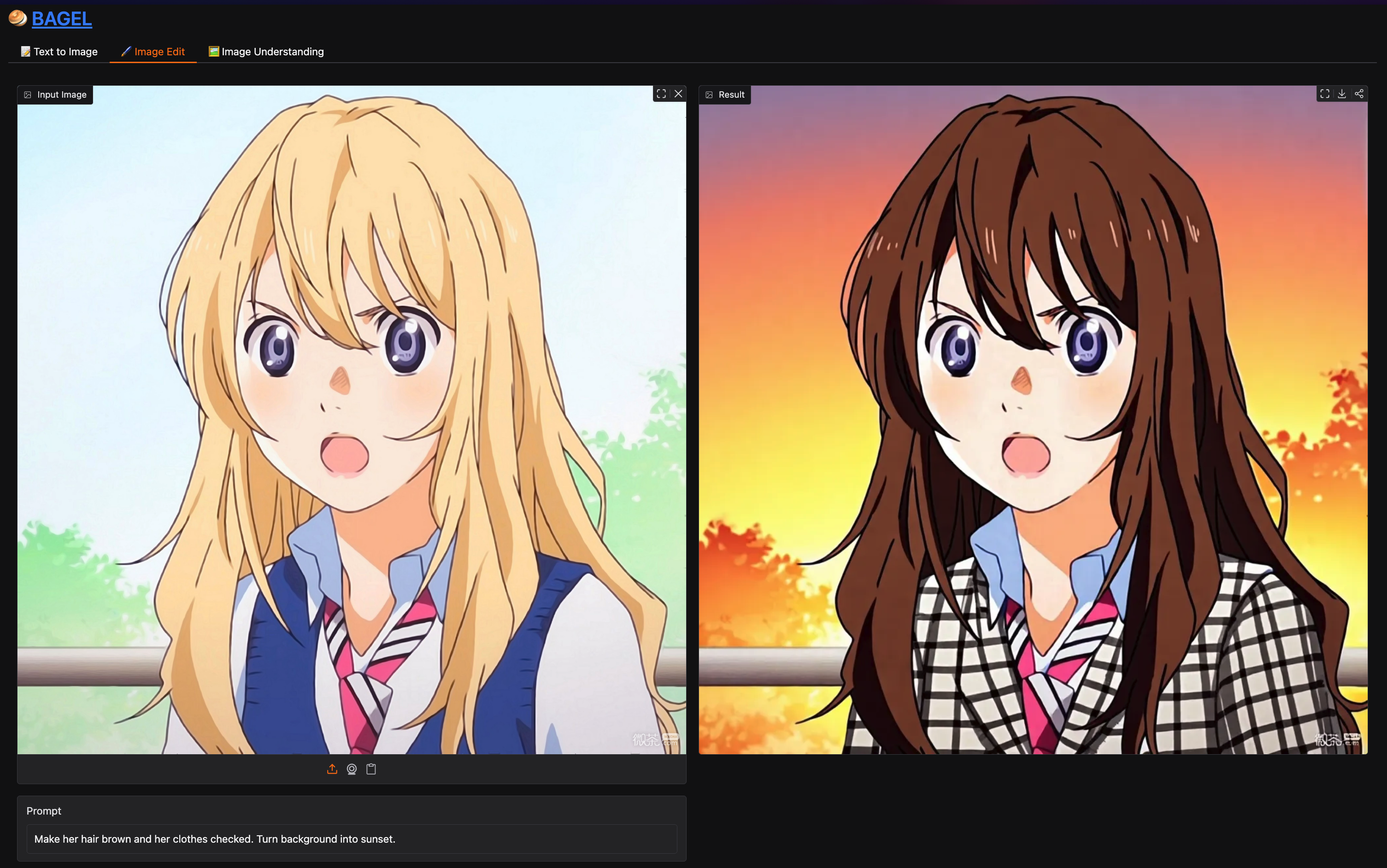
models/bagel/BAGEL-7B-MoT/ema.safetensors with RecA-tuned one. The ComfyUI-BAGEL repo already supports the NF4 and INT8 conversion of BAGEL.wget https://huggingface.co/sanaka87/BAGEL-RecA/blob/main/model_bf16.safetensors
mv model_bf16.safetensors models/bagel/BAGEL-7B-MoT/ema.safetensors
You can also download weight of NF4 and INT8 version of BAGEL in BAGEL-RecA. DF11 version BAGEL-RecA (heartfelt thank to @theunlikely !!!).
Local Setup: Follow the instructions in the BAGEL Installation Guide to set up the environment, and run BAGEL/inference.ipynb to test the model locally!
Full Training & Evaluation: For detailed instructions on installation, training, and evaluation, please refer to the respective repository READMEs:
Benchmark Evaluation Guide: Multi-benchmark evaluation scripts and setup instructions.
BAGEL Installation Guide: Complete guide for BAGEL model training and evaluation.
Harmon Installation Guide: Comprehensive instructions for Harmon model training and evaluation.
OpenUni Training Guide: Detailed training and evaluation guide for OpenUni models.
Show-o Training Guide: Comprehensive training guide for Show-o models with CLIP and VQGAN variants.
A collection of RecA models on Hugging Face with benchmark performance:
| Model Name | Parameters | GenEval | DPGBench | ImgEdit | GEdit |
|---|---|---|---|---|---|
| BAGEL-RecA (support INT8, NF4) | 14B | 82.4 (+3.6) | 85.29 (+1.26) | 3.75 (+0.37) | 7.27 (+0.33) |
| Harmon-0.5B-RecA | 0.5B | 78.7 (+11.1) | 84.67 (+4.55) | - | - |
| Harmon-1.5B-RecA | 1.5B | 85.7 (+12.8) | 87.21 (+6.28) | - | - |
| Show-o-RecA (CLIP) | 1.3B | 61.9 (+5.3) | 75.70 (+5.05) | - | - |
| Show-o-512x512-RecA (CLIP) | 1.3B | 72.3 (+6.1) | 84.94 (+2.73) | - | - |
| Harmon-1.5B-RecA-plus | 1.5B | 90.0 | 88.15 | - | - |
| OpenUni-1-0.6B-RecA | 1.6B | 70.4 (+14.4) | 80.45 (+4.16) | - | - |
| OpenUni-2-1.6B-RecA | 3.6B | 74.1 (+12.2) | 82.75 (+3.73) | - | - |
Unlocking the Massive Zero-shot Potential in Unified Multimodal Models through Self-supervised Learning.
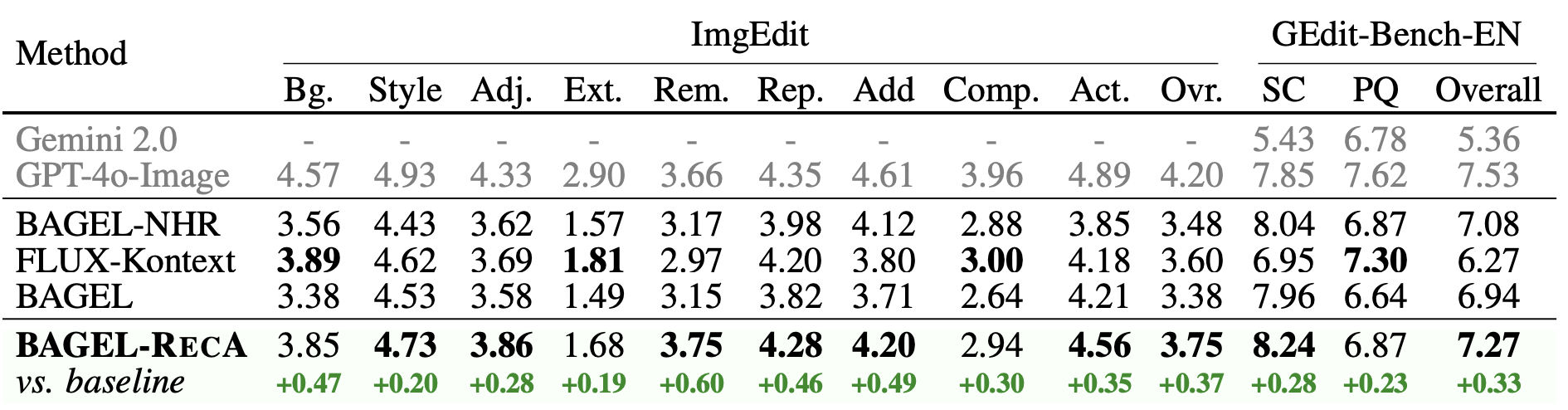
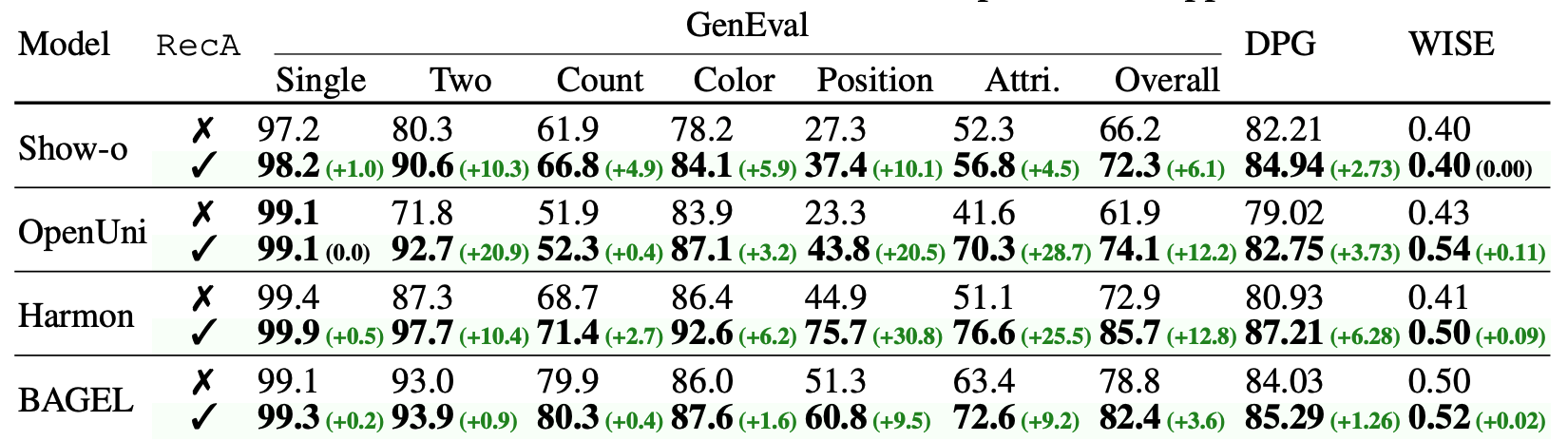
Harmon-1.5B with RecA achieves GenEval 0.86 and DPGBench 87.21 without GPT-4o distillation data or reinforcement learning. A separate two-stage experiment, using GPT-4o-Image distillation data for supervised fine-tuning before RecA, reaches 0.90 and 88.15, respectively. BAGEL-RecA improves generation and editing scores as listed in the Model Zoo. These are separate model configurations; see the paper for baselines, evaluation protocols, and per-model training costs.
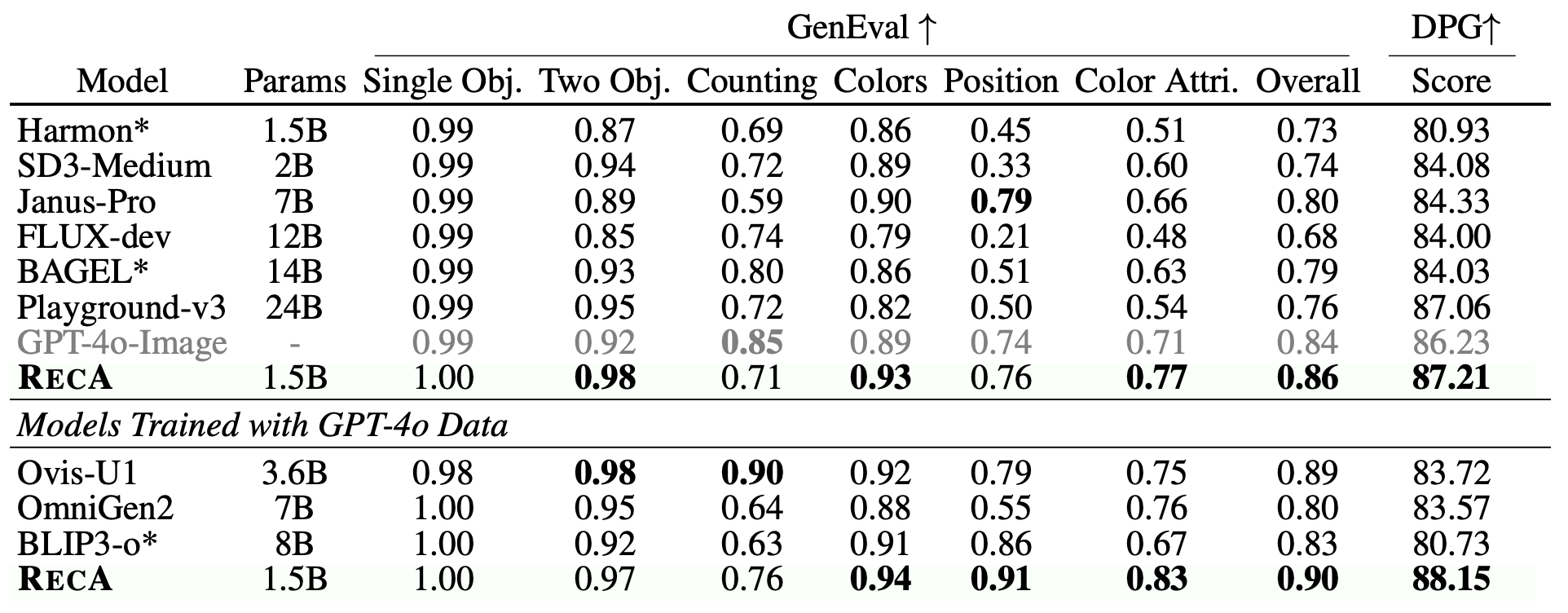
The paper reports generation improvements on Show-o, OpenUni, Harmon, and BAGEL. Understanding evaluations and architecture-specific limitations are discussed in the paper and Reproduction Guide.

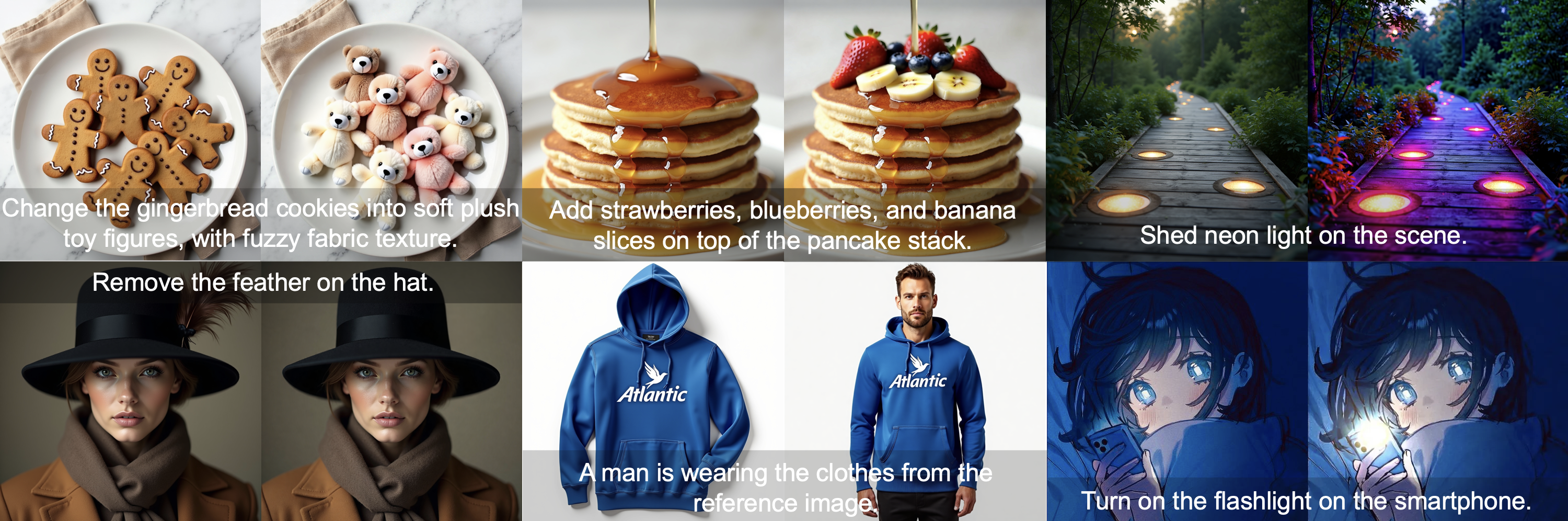
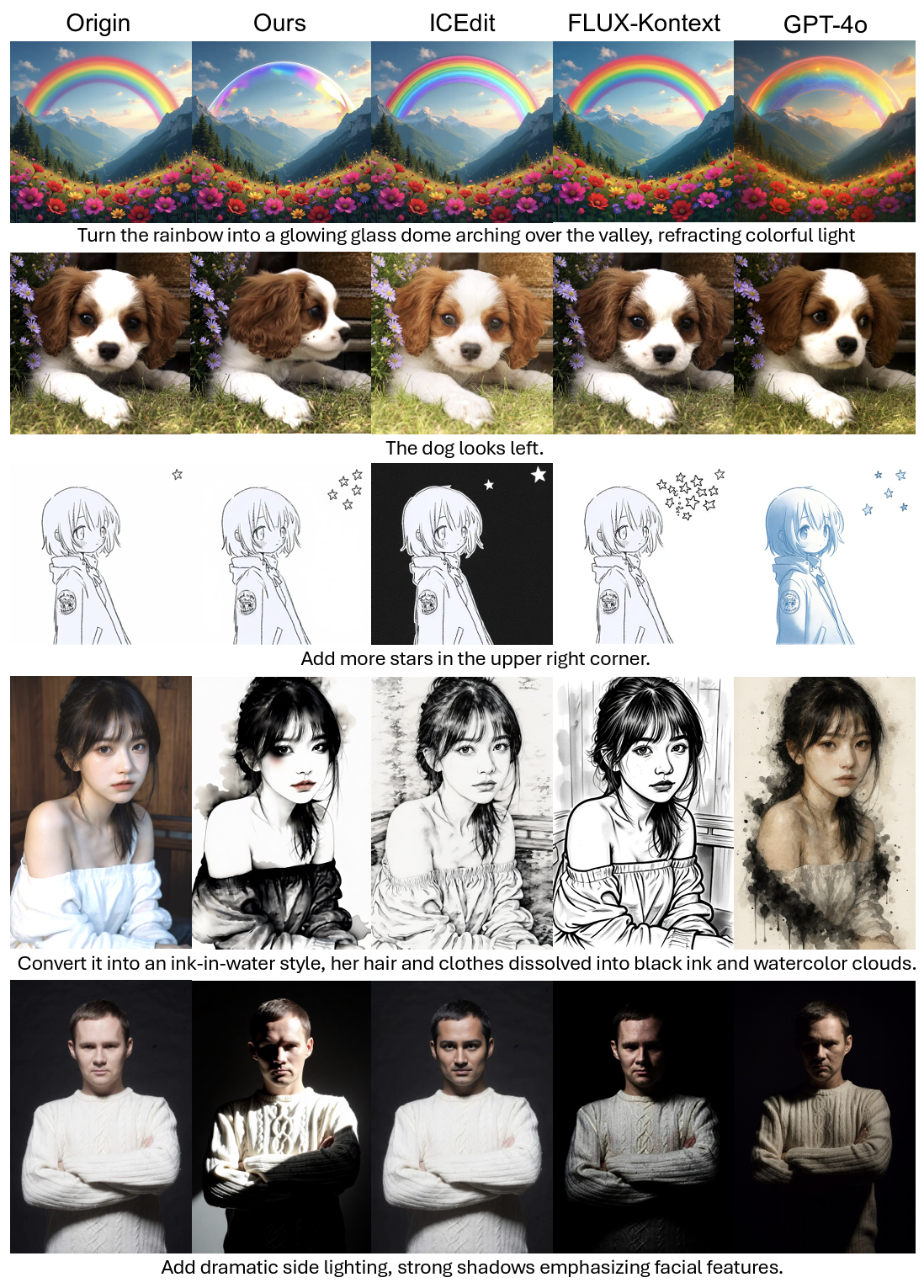
Qualitative image-editing comparisons with ICEdit, FLUX-Kontext, and GPT-4o are shown below. For aggregate editing scores and evaluation settings, see Table 3 of the paper.
This project is built upon several excellent open-source projects: BAGEL, Harmon, OpenUni, Show-o. We sincerely thank the authors for their contributions:
We are grateful to the broader research community for their open-source spirit and collaborative efforts.
The majority of RecA is licensed under the Apache License, however portions of the project are available under their own license terms: BAGEL and Show-o are licensed under Apache, Harmon and OpenUni are licensed under S-Lab license; If you later add other third party code, please keep this license info updated, and please let us know if that component is licensed under something other than Apache, CC-BY-NC, MIT, or CC0.
For feedback, or collaboration opportunities, feel free to reach out!
If you have any general questions, feel free to email us at sanaka@berkeley.edu and xdwang@eecs.berkeley.edu. If you have code or implementation-related questions, please feel free to send emails to us or open an issue in this codebase (We recommend that you open an issue in this codebase, because your questions may help others).
If you find our work inspiring or use our codebase in your research, please consider giving a star ⭐ and a citation.
Download BibTeX · Paper abstract and publication details. The CITATION.cff file provides machine-readable metadata for the ICLR 2026 paper, with the full author list.
@inproceedings{xie2026reconstruction,
  title={Reconstruction alignment improves unified multimodal models},
  author={Xie, Ji and Zettlemoyer, Luke and Wang, Xudong and others},
  booktitle={International Conference on Learning Representations},
  volume={2026},
  pages={120095--120137},
  year={2026}
}
⭐ If you find this project helpful, please consider giving it a star! ⭐
27 followers · starred Sep 2025
123 followers · starred Sep 2025
12 followers · starred Jan 2026
259 followers · starred Sep 2025
[ICLR 2026] RecA: visual understanding help generation through self-supervised learning
See the code
RecA: Reconstruction Alignment Improves Unified Multimodal Models
Improving image generation through visual understanding. Reconstruction Alignment (RecA) is a self-supervised post-training method for pretrained unified multimodal models (UMMs). It trains a model to reconstruct images from its own visual understanding features, using the original images as targets instead of image-specific captions. This semantic reconstruction objective transfers to text-to-image generation and image editing while preserving the model's original inference interface.
📖 Want to try RecA on your own architecture? Please read our Reproduction Guide or its Chinese Version first! It contains crucial details and insights that are essential for successful reproduction.
models/bagel/BAGEL-7B-MoT/ema.safetensors with RecA-tuned one. The ComfyUI-BAGEL repo already supports the NF4 and INT8 conversion of BAGEL.wget https://huggingface.co/sanaka87/BAGEL-RecA/blob/main/model_bf16.safetensors
mv model_bf16.safetensors models/bagel/BAGEL-7B-MoT/ema.safetensors
You can also download weight of NF4 and INT8 version of BAGEL in BAGEL-RecA. DF11 version BAGEL-RecA (heartfelt thank to @theunlikely !!!).
Local Setup: Follow the instructions in the BAGEL Installation Guide to set up the environment, and run BAGEL/inference.ipynb to test the model locally!
Full Training & Evaluation: For detailed instructions on installation, training, and evaluation, please refer to the respective repository READMEs:
Benchmark Evaluation Guide: Multi-benchmark evaluation scripts and setup instructions.
BAGEL Installation Guide: Complete guide for BAGEL model training and evaluation.
Harmon Installation Guide: Comprehensive instructions for Harmon model training and evaluation.
OpenUni Training Guide: Detailed training and evaluation guide for OpenUni models.
Show-o Training Guide: Comprehensive training guide for Show-o models with CLIP and VQGAN variants.
A collection of RecA models on Hugging Face with benchmark performance:
| Model Name | Parameters | GenEval | DPGBench | ImgEdit | GEdit |
|---|---|---|---|---|---|
| BAGEL-RecA (support INT8, NF4) | 14B | 82.4 (+3.6) | 85.29 (+1.26) | 3.75 (+0.37) | 7.27 (+0.33) |
| Harmon-0.5B-RecA | 0.5B | 78.7 (+11.1) | 84.67 (+4.55) | - | - |
| Harmon-1.5B-RecA | 1.5B | 85.7 (+12.8) | 87.21 (+6.28) | - | - |
| Show-o-RecA (CLIP) | 1.3B | 61.9 (+5.3) | 75.70 (+5.05) | - | - |
| Show-o-512x512-RecA (CLIP) | 1.3B | 72.3 (+6.1) | 84.94 (+2.73) | - | - |
| Harmon-1.5B-RecA-plus | 1.5B | 90.0 | 88.15 | - | - |
| OpenUni-1-0.6B-RecA | 1.6B | 70.4 (+14.4) | 80.45 (+4.16) | - | - |
| OpenUni-2-1.6B-RecA | 3.6B | 74.1 (+12.2) | 82.75 (+3.73) | - | - |
Unlocking the Massive Zero-shot Potential in Unified Multimodal Models through Self-supervised Learning.
Harmon-1.5B with RecA achieves GenEval 0.86 and DPGBench 87.21 without GPT-4o distillation data or reinforcement learning. A separate two-stage experiment, using GPT-4o-Image distillation data for supervised fine-tuning before RecA, reaches 0.90 and 88.15, respectively. BAGEL-RecA improves generation and editing scores as listed in the Model Zoo. These are separate model configurations; see the paper for baselines, evaluation protocols, and per-model training costs.
The paper reports generation improvements on Show-o, OpenUni, Harmon, and BAGEL. Understanding evaluations and architecture-specific limitations are discussed in the paper and Reproduction Guide.
Qualitative image-editing comparisons with ICEdit, FLUX-Kontext, and GPT-4o are shown below. For aggregate editing scores and evaluation settings, see Table 3 of the paper.
This project is built upon several excellent open-source projects: BAGEL, Harmon, OpenUni, Show-o. We sincerely thank the authors for their contributions:
We are grateful to the broader research community for their open-source spirit and collaborative efforts.
The majority of RecA is licensed under the Apache License, however portions of the project are available under their own license terms: BAGEL and Show-o are licensed under Apache, Harmon and OpenUni are licensed under S-Lab license; If you later add other third party code, please keep this license info updated, and please let us know if that component is licensed under something other than Apache, CC-BY-NC, MIT, or CC0.
For feedback, or collaboration opportunities, feel free to reach out!
If you have any general questions, feel free to email us at sanaka@berkeley.edu and xdwang@eecs.berkeley.edu. If you have code or implementation-related questions, please feel free to send emails to us or open an issue in this codebase (We recommend that you open an issue in this codebase, because your questions may help others).
If you find our work inspiring or use our codebase in your research, please consider giving a star ⭐ and a citation.
Download BibTeX · Paper abstract and publication details. The CITATION.cff file provides machine-readable metadata for the ICLR 2026 paper, with the full author list.
@inproceedings{xie2026reconstruction,
  title={Reconstruction alignment improves unified multimodal models},
  author={Xie, Ji and Zettlemoyer, Luke and Wang, Xudong and others},
  booktitle={International Conference on Learning Representations},
  volume={2026},
  pages={120095--120137},
  year={2026}
}
⭐ If you find this project helpful, please consider giving it a star! ⭐
27 followers · starred Sep 2025
123 followers · starred Sep 2025
12 followers · starred Jan 2026
259 followers · starred Sep 2025