
Fast Matrix Multiplications for Lookup Table-Quantized LLMs
See the codeREADME

FLUTE: Flexible Lookup Table Engine for LUT-quantized LLMs



Update
- February, 2024. HIGGS will appear in NAACL 2025.
- January 9, 2025. Added (very) experimental support for removing specialization on shapes + GPU via auto-tune.
- December 12, 2024. Added support for Hadamard Transform (via HadaCore).
- November 26, 2024. Added support for vector (de)quantization (
vector_size=2), as part of HIGGS. - October 5, 2024. FLUTE will appear in EMNLP 2024 (Findings).
- September 15, 2024. Added experimental support for loading pre-quantized FLUTE models in HuggingFace.
- September 6, 2024. Added (unlearned) NF-quantized LLaMA-3.1 (405B) models: base and instruction tuned.
- August 31, 2024. Added support and example for the Learned Normal Float (NFL) quantization.
- August 26, 2024. Added support for converting
bitsandbytesmodel into FLUTE model. - August 5, 2024. Added quantized LLaMA-3.1 (8B/70B) models.
- August 2, 2024. Added support for RTX4090.
- July 27, 2024. Added support for LLaMA-3.1 (405B) and tuned BF16 performance. FP16 is still the recommended data type, especially for 3-bit settings.
Installation
Install FLUTE with pip or from source:
# For CUDA 12.1
pip install flute-kernel
# For CUDA 11.8
pip install flute-kernel -i https://flute-ai.github.io/whl/cu118
# For CUDA 12.4
pip install flute-kernel -i https://flute-ai.github.io/whl/cu124
Head over to Getting Started and try it out!
Background
Uniform quantization converts full precision weights to lower-precision intervals of equal size. Lookup table (LUT) quantization is a flexible variant of non-uniform quantization which can map intervals to arbitrary values via a lookup table.
| Uniform (Integer) Quantization | Lookup Table Quantization |
|---|---|
|
$$\widehat{\mathbf{W}} = \mathtt{float}(\mathbf{Q}) \cdot \mathbf{s}$$ |
$$\widehat{\mathbf{W}} = \mathtt{tableLookup}(\mathbf{Q}, \mathtt{table}) \cdot \mathbf{s}$$ |
where $\mathbf{Q}$ denote the quantized weight, $\mathbf{s}$ the (group-wise) scales, and $\widehat{\mathbf{W}}$ the de-quantized weight. Here are some examples of the lookup table suppored in FLUTE.
| Examples | Notes |
|---|---|
|
|
recovers uniform/integer quantization |
|
| |
|
|
generalizes the |
|
any arbitrary table |
you could even learn it! |
New Models Powered by FLUTE
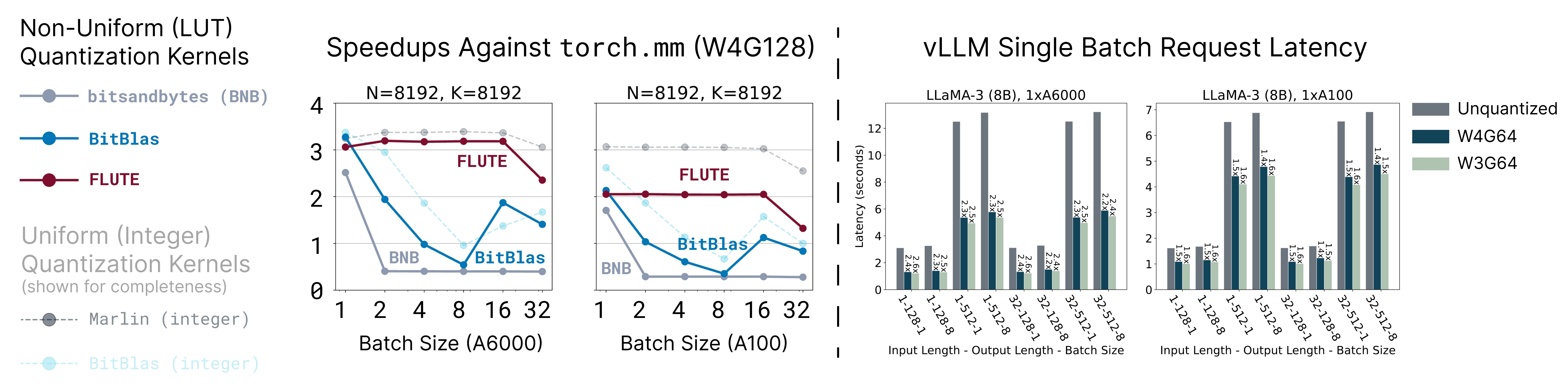
The flexibility of the kernel could lead to new quantization algorithms. As a proof of concept, we are releasing a few models quantized using Learned Normal Float (NFL) --- a simple extension to the nf4 data format introduced in QLoRA. NFL initialized the lookup table and the scales with those from NF quantization. Then, it uses calibration data to learn the scales via straight through estimation for for the gradient with respect to the scales.
Benchmarks
For additional benchmarks, detailed breakdowns, and corresponding instruction-tuned models, please refer to the paper and the model zoo.
LLaMA-3.1
| Wiki PPL | C4 PPL | LLM Eval Avg. | Wiki PPL | C4 PPL | LLM Eval Avg. | ||
|---|---|---|---|---|---|---|---|
| LLaMA-3.1 (8B) | 6.31 | 9.60 | 69.75 | LLaMA-3.1 (70B) | 2.82 | 7.18 | 75.45 |
| + NFL W4G64 | 6.24 | 10.06 | 69.13 | + NFL W4G64 | 3.09 | 7.53 | 74.84 |
| + NFL W3G64 | 7.23 | 11.83 | 65.66 | + NFL W3G64 | 4.29 | 8.91 | 72.65 |
Gemma-2
| Wiki PPL | C4 PPL | LLM Eval Avg. | Wiki PPL | C4 PPL | LLM Eval Avg. | ||
|---|---|---|---|---|---|---|---|
| Gemma-2 (9B) | 6.88 | 10.12 | 73.12 | Gemma-2 (27B) | 5.70 | 8.98 | 75.71 |
| + NFL W4G64 | 6.49 | 10.35 | 72.50 | + NFL W4G64 | 5.69 | 9.31 | 74.11 |
Getting Started
FLUTE + vLLM
FLUTE-quantized models (Model Zoo) can be directly served using exisiting frameworks such as vLLM.
- python -m vllm.entrypoints.openai.api_server \
+ python -m flute.integrations.vllm vllm.entrypoints.openai.api_server \
    --model [MODEL] \
    --revision [REVISION] \
    --tensor-parallel-size [TP_SIZE] \
+   --quantization flute
For example, the following commmand runs the FLUTE-quantized LLaMA-3.1 (8B) on a single GPU.
python -m flute.integrations.vllm vllm.entrypoints.openai.api_server \
    --model radi-cho/Meta-Llama-3.1-8B-FLUTE \
    --quantization flute
We can then query the vLLM server as usual.
curl http://localhost:8000/v1/completions \
    -H "Content-Type: application/json" \
    -d '{
        "model": "radi-cho/Meta-Llama-3.1-8B-FLUTE",
        "prompt": "San Francisco is a",
        "max_tokens": 7,
        "temperature": 0
    }'
FLUTE + HuggingFace
FLUTE also runs out of the box with HuggingFace and its accelerate extension. This integration is mostly experimental and not optimized. Users sensitive to performance considerations should use the vLLM integration instead.
- Loading a pre-quantized FLUTE model.
import flute.integrations.huggingface

- model = AutoModelForCausalLM.from_pretrained(
+ model = flute.integrations.huggingface.from_pretrained(
    "radi-cho/Meta-Llama-3.1-8B-FLUTE",
    # all of your favoriate HF flags will be forwarded
    device_map="auto")
- Loading and quantizing a dense model.
import flute.integrations.base
flute.integrations.base.prepare_model_flute(
    name="model.model.layers",
    module=model.model.layers,  # for LLaMA-3 and Gemma-2
    num_bits=num_bits,
    group_size=group_size,
    fake=False,
    handle_hooks=True)  # for `accelerate` hooks
After this, the model can be used as normal. Please checkout the quantization guide for more information.
Support and Compatibility
Kernel
| Description | Supported (via pip) | Supported (build from source) |
|---|---|---|
| Input dtypes | torch.float16 torch.bfloat16 | |
| Bits | 4bit 3bit | 2bit |
| Group Sizes | 32 64 128 256 | ❓ |
| GPUs | A100 A6000 RTX 4090 | H100 (unoptimized) |
[!WARNING] In the current release, we noticed
torch.bfloat16is slower thantorch.float16. This likely because of lack of tuning, and that Ampere GPUs lack a hardware acceleration forbfloat16vectorized atomic-add.
[!WARNING] We noticed several numerically unstable situations using
bits=4, group-size=256, GPU=A100, though this is relatively rare (8 of 9360 test cases failed). We also noticed correctness issues in some situations withbits=4, group-size=256, dtype=bfloat16, GPU=RTX4090(1 of 52 test cases failed). We will be looking into this, but we suggest avoiding these particular use cases (W4G256) for now.
Models
[!NOTE] As of the current release, the kernel is shape-specialized due to legacy reasons (i.e., we tune tile sizes etc for each matrix shape). Please see the below chart for the supported use cases, as different platform and tensor parallel size changes the matrix shapes. We plan to add supports for a broad range of shapes in the near future. In the meantime, please let us know if you have any specific models in mind and we are happy to add support for them.
| Model | Single GPU / Pipeline Parallel | Tensor Parallel |
|---|---|---|
| LLaMA-3/3.1 (8B) | ✅ | |
| LLaMA-3/3.1 (70B) | ✅ | 2 or 4 GPUs |
| LLaMA-3.1 (405B) | ✅ | 4 or 8 GPUs |
| Gemma-2 (9B) | ✅ | |
| Gemma-2 (27B) | ✅ | 2 or 4 GPUs |
Model Zoo
[!NOTE] The models we release here are trained on more data and hence different from those in the paper.
[!TIP] The HuggingFace Hub links are for
NFL W4G64quantization by default. To use theNFL W3G64quantization, add--revision nfl_w3g64.
LLaMA-3.1 (8B)
| Wiki | C4 | PIQA | ARC-E | ARC-C | HellaSwag | Wino | Avg. | |
|---|---|---|---|---|---|---|---|---|
| Unquantized | 6.31 | 9.60 | 79.16 | 82.20 | 52.65 | 60.71 | 74.03 | 69.75 |
| NFL W4G64 | 6.24 | 10.06 | 79.38 | 81.61 | 51.54 | 59.57 | 73.56 | 69.13 |
| NFL W3G64 | 7.23 | 11.83 | 77.91 | 76.98 | 46.33 | 56.74 | 70.32 | 65.66 |
LLaMA-3.1 (70B)
| Wiki | C4 | PIQA | ARC-E | ARC-C | HellaSwag | Wino | Avg. | |
|---|---|---|---|---|---|---|---|---|
| Unquantized | 2.82 | 7.18 | 82.81 | 85.31 | 59.64 | 67.49 | 82.00 | 75.45 |
| NFL W4G64 | 3.09 | 7.53 | 83.03 | 85.52 | 58.19 | 67.04 | 80.43 | 74.84 |
| NFL W3G64 | 4.29 | 8.91 | 82.04 | 83.29 | 54.78 | 64.99 | 78.14 | 72.65 |
LLaMA-3.1 (405B)
Note that the weights are in the branch nf_w4g64 and thus --revision nf_w4g64 is needed since these are not on the default branch.
LLaMA-3.1 Instruct (8B)
| Wiki | C4 | |
|---|---|---|
| NFL W4G64 | 6.78 | 11.11 |
| NFL W3G64 | 7.73 | 12.83 |
LLaMA-3.1 Instruct (70B)
| Wiki | C4 | |
|---|---|---|
| NFL W4G64 | 4.15 | 9.18 |
| NFL W3G64 | 4.74 | 9.48 |
LLaMA-3.1 Instruct (405B)
Note that the weights are in the branch nf_w4g64 and thus --revision nf_w4g64 is needed since these are not on the default branch.
LLaMA-3 (8B)
| Wiki | C4 | PIQA | ARC-E | ARC-C | HellaSwag | Wino | Avg. | |
|---|---|---|---|---|---|---|---|---|
| Unquantized | 6.1 | 9.2 | 79.9 | 80.1 | 50.4 | 60.2 | 72.8 | 68.6 |
| NFL W4G64 | 6.11 | 9.38 | 79.33 | 79.79 | 49.74 | 59.22 | 73.95 | 68.41 |
| NFL W3G64 | 7.13 | 11.06 | 78.78 | 76.22 | 44.37 | 56.69 | 70.32 | 65.28 |
LLaMA-3 (70B)
| Wiki | C4 | PIQA | ARC-E | ARC-C | HellaSwag | Wino | Avg. | |
|---|---|---|---|---|---|---|---|---|
| Unquantized | 2.9 | 6.9 | 82.4 | 86.9 | 60.3 | 66.4 | 80.6 | 75.3 |
| NFL W4G64 | 3.03 | 7.03 | 82.15 | 85.98 | 57.85 | 66.17 | 79.79 | 74.39 |
| NFL W3G64 | 4.15 | 8.10 | 80.74 | 83.71 | 55.29 | 64.05 | 78.45 | 72.45 |
LLaMA-3 Instruct (8B)
| Wiki | C4 | |
|---|---|---|
| NFL W4G64 | 6.78 | 10.61 |
| NFL W3G64 | 7.75 | 12.28 |
LLaMA-3 Instruct (70B)
| Wiki | C4 | |
|---|---|---|
| NFL W4G64 | 3.67 | 7.95 |
| NFL W3G64 | 4.90 | 10.86 |
Gemma-2 (9B)
| Wiki | C4 | PIQA | ARC-E | ARC-C | HellaSwag | Wino | Avg. | |
|---|---|---|---|---|---|---|---|---|
| Unquantized | 6.88 | 10.12 | 81.39 | 87.37 | 61.35 | 61.23 | 74.27 | 73.12 |
| NFL W4G64 | 6.49 | 10.35 | 81.28 | 86.24 | 59.30 | 60.40 | 75.30 | 72.50 |
| NFL W3G64 | 7.06 | 11.14 | 80.52 | 83.16 | 55.46 | 58.28 | 72.69 | 70.02 |
Gemma-2 (27B)
| Wiki | C4 | PIQA | ARC-E | ARC-C | HellaSwag | Wino | Avg. | |
|---|---|---|---|---|---|---|---|---|
| Unquantized | 5.70 | 8.98 | 83.24 | 87.84 | 62.88 | 65.35 | 79.24 | 75.71 |
| NFL W4G64 | 5.69 | 9.31 | 82.53 | 86.45 | 59.22 | 64.13 | 78.21 | 74.11 |
Gemma-2 Instruct (9B)
| Wiki | C4 | |
|---|---|---|
| NFL W4G64 | 6.88 | 11.02 |
| NFL W3G64 | 7.35 | 11.72 |
Gemma-2 Instruct (27B)
| Wiki | C4 | |
|---|---|---|
| NFL W4G64 | 5.91 | 9.71 |
Quantizing Your Own Models
We provide two APIs to quantize a custom models. The easist way is to use the command line interface.
Simple Normal Float Quantization
python -m flute.integrations.base \
    --pretrained_model_name_or_path meta-llama/Meta-Llama-3-70B-Instruct \
    --save_directory Meta-Llama-3-70B-Instruct-NF4 \
    --num_bits 4 \
    --group_size 128
The CLI essentially wraps around the following Python API,
from transformers import (
    LlamaForCausalLM,
    Gemma2ForCausalLM,
    AutoModelForCausalLM)
import flute.integrations.base

model = AutoModelForCausalLM.from_pretrained(
    pretrained_model_name_or_path,
    device_map="cpu",
    torch_dtype="auto")

if isinstance(model, (LlamaForCausalLM, Gemma2ForCausalLM)):
    flute.integrations.base.prepare_model_flute(
        name="model.model.layers",
        module=model.model.layers,
        num_bits=num_bits,
        group_size=group_size,
        fake=False)
else:
    # more models to come
    raise NotImplementedError
Converting bitsandbytes Model into FLUTE Model
While FLUTE has its own Normal Float (NF) implementation, we could convert an existing HuggingFace model quantized via bitsandbytes into FLUTE format. To do so, just add two lines to the Python API,
flute.integrations.base.prepare_model_flute(
    name="model.model.layers",
    module=model.model.layers,
    num_bits=num_bits,
    group_size=group_size,
    fake=False,
+   prepare_bnb_layers=True,
+   default_bnb_dtype=torch.float16,
)
It's worth noting that we do not support double quantization, and the conversion will materialize the first-level scales.
Learned Normal Float Quantization (NFL)
NFL initialized the lookup table and the scales with those from NF quantization. Then, it uses calibration data to learn the scales via straight through estimation for for the gradient with respect to the scales.
To use NFL quantization, call the following function before prepare_model_flute. We also provide an example jupyter notebook to illustrate the entire process.
import flute.integrations.learnable

flute.integrations.learnable.learn_scales(
    model=model,
    tokenizer=tokenizer,
    num_bits=num_bits,
    group_size=group_size,
    custom_corpora=list_of_corpora,
    samples=num_samples,
)
Extending to New Models (Experimental)
At the moment, FLUTE kernel is specialized to the combination of GPU, matrix shapes, data types, bits, and group sizes. This means adding supporting new models requires tuning the kernel configurations for the corresponding use cases. We are hoping to add support for just-in-time tuning, but in the meantime, here are the ways to tune the kernel ahead-of-time.
Step 1: Build the raw version of the library that exposes all templates.
- Reset the previously tuned kernel,
cp flute/csrc/qgemm_kernel_generated.template.cu flute/csrc/qgemm_kernel_generated.cu
- Un-comment the combination(s) to tune in
flute/csrc/qgemm_kernel_raw_generated.cu,
INSTANTIATE_TEMPLATE(NUM_SMs, DTYPE, cute::uint16_t, __half2, BITS, GROUP_SIZE);
Example for W4G64 on A100
-// INSTANTIATE_TEMPLATE(108, cute::half_t    , cute::uint16_t, __half2       , 4, 64);
+INSTANTIATE_TEMPLATE(108, cute::half_t    , cute::uint16_t, __half2       , 4, 64);

-// INSTANTIATE_TEMPLATE(108, cute::bfloat16_t, cute::uint16_t, __nv_bfloat162, 4, 64);
+INSTANTIATE_TEMPLATE(108, cute::bfloat16_t, cute::uint16_t, __nv_bfloat162, 4, 64);
- Remove settings not tuned in
flute/csrc/qgemm.cpp,flute/__init__.py, andflute/ops.py
[!NOTE] Although including other settings could still build, it could break the linking process and require re-compiling the library.
Example for W4G64 on A100
diff --git a/flute/csrc/qgemm.cpp b/flute/csrc/qgemm.cpp
index 84bae95..c4a0236 100644
--- a/flute/csrc/qgemm.cpp
+++ b/flute/csrc/qgemm.cpp
@@ -314,3 +313,0 @@ qgemm_raw_simple(const at::Tensor& input,
-        case 32:                                      \
-            RUN_QGEMM_RAW(T, NUM_BITS, 32);           \
-            break;                                    \
@@ -320,6 +316,0 @@ qgemm_raw_simple(const at::Tensor& input,
-        case 128:                                     \
-            RUN_QGEMM_RAW(T, NUM_BITS, 128);          \
-            break;                                    \
-        case 256:                                     \
-            RUN_QGEMM_RAW(T, NUM_BITS, 256);          \
-            break;                                    \
@@ -335,6 +325,0 @@ qgemm_raw_simple(const at::Tensor& input,
-        case 2:                                          \
-            RUN_QGEMM_RAW_SWITCH_GROUP_SIZE(T, 2);       \
-            break;                                       \
-        case 3:                                          \
-            RUN_QGEMM_RAW_SWITCH_GROUP_SIZE(T, 3);       \
-            break;                                       \
@@ -381 +366 @@ TORCH_LIBRARY(flute, m) {
-    // m.def("qgemm_raw_simple_80(Tensor input, Tensor weight, Tensor(a!) output, Tensor scales, Tensor table, Tensor table2, Tensor(b!) workspace, int
 num_bits, int group_size, int template_id) -> ()");
+    m.def("qgemm_raw_simple_80(Tensor input, Tensor weight, Tensor(a!) output, Tensor scales, Tensor table, Tensor table2, Tensor(b!) workspace,
int num_bits, int group_size, int template_id) -> ()");
@@ -391 +376 @@ TORCH_LIBRARY_IMPL(flute, CUDA, m) {
-    // m.impl("qgemm_raw_simple_80", &qgemm_raw_simple<cute::Int<108>>);
+    m.impl("qgemm_raw_simple_80", &qgemm_raw_simple<cute::Int<108>>);
diff --git a/flute/__init__.py b/flute/__init__.py
index 34b1a26..f524841 100644
--- a/flute/__init__.py
+++ b/flute/__init__.py
@@ -69 +69 @@ QGEMM_SIMPLE_DICT = {
-# QGEMM_RAW_SIMPLE_DICT = {
+QGEMM_RAW_SIMPLE_DICT = {
@@ -71 +71 @@ QGEMM_SIMPLE_DICT = {
-#     108: cast(QGEMM_RAW_SIMPLE_TYPE, torch.ops.flute.qgemm_raw_simple_80),
+    108: cast(QGEMM_RAW_SIMPLE_TYPE, torch.ops.flute.qgemm_raw_simple_80),
@@ -73 +73 @@ QGEMM_SIMPLE_DICT = {
-# }
+}
@@ -76 +76 @@ qgemm_simple     = QGEMM_SIMPLE_DICT[NUM_SMS]
-qgemm_raw_simple = None  # QGEMM_RAW_SIMPLE_DICT[NUM_SMS]
+qgemm_raw_simple = QGEMM_RAW_SIMPLE_DICT[NUM_SMS]
diff --git a/flute/ops.py b/flute/ops.py
index 9fd91a2..80782ea 100644
--- a/flute/ops.py
+++ b/flute/ops.py
@@ -124 +124 @@ def _qgemm_simple_89_abstract(
-# @torch.library.register_fake("flute::qgemm_raw_simple_80")
+@torch.library.register_fake("flute::qgemm_raw_simple_80")
- Build from source (see instructions below).
pip install -e . --no-build-isolation # `--no-build-isolation` is optional
Depending on the number of configurations to tune, this could take time in the order of tens of minutes to hours.
Step 2: Tune FLUTE on the new matrix shapes.
import torch
from flute.tune import TuneTask, tune_tasks_legacy

tasks = [
    TuneTask(
        M=1,                  # batch size (x sequence length, usually 1 for token-by-token generation)
        N=1024,               # parameter dimension (note when using tensor-parallelism, this could change)
        K=4096,               # parameter dimension (note when using tensor-parallelism, this could change)
        num_bits=4,           # number of bits
        group_size=64,        # group size
        num_sms=108,          # number of streaming multiprocessors of the GPU
        dtype=torch.float16,  # data type
        device=torch.device("cuda:0")
    ),
]

tune_tasks_legacy(tasks)
After this step is complete, artifacts will be saved in flute/data/.
Step 3: Build the newly-tuned kernel
# remove changes
git checkout -- flute/csrc/

# generating new dispatching logic based on tuning artifacts
bash scripts/codegen_tuned.sh

# remove changes
git checkout -- \
    flute/ops.py \
    flute/__init__.py

# Build
pip install -e . --no-build-isolation
Note that if only one data type is tuned, you will also need to edit flute/utils.py.
Example
diff --git a/flute/utils.py b/flute/utils.py
index 5add543..13f49c0 100644
--- a/flute/utils.py
+++ b/flute/utils.py
@@ -270,7 +270,7 @@ def pack(

         K, N = W.shape
         template_ids = []
-        for dtype in [torch.float16, torch.bfloat16]:
+        for dtype in [torch.float16]:
             template_id = TEMPLATE_TUNED_WITHOUT_M_CONFIGS[(
                 NUM_SMS,
                 num_bits,
Finally, please follow the examples in tests/ to verify that the kernel is working correctly.
Build From Source
- Clone the CUTLASS library.
# Unfortunately, the path is hard-coded as of now. If you install CUTLASS
# in a different directory, please make sure the corresponding path in
# `setup.py` is updated.
cd /workspace

git clone https://github.com/NVIDIA/cutlass.git
cd cutlass
git checkout v3.4.1
- Build.
git clone https://github.com/HanGuo97/flute
cd flute
pip install -e .
Note: the build process requires having the local CUDA version (nvcc --version) match PyTorch's CUDA. In situations in which the build process throws an error related to CUDA version mismatch, try adding --no-build-isolation.
Acknowledgement and Citation
Special thanks to Dmytro Ivchenko, Yijie Bei, and the Fireworks AI team for helpful discussion. If you find any of the models or code in this repo useful, please feel free to cite:
@inproceedings{flute2024,
  title={Fast Matrix Multiplications for Lookup Table-Quantized LLMs},
  author={Guo, Han and Brandon, William and Cholakov, Radostin and Ragan-Kelley, Jonathan and Xing, Eric and Kim, Yoon},
  booktitle={Findings of the Association for Computational Linguistics: EMNLP 2024},
  pages={12419--12433},
  year={2024}
}

@article{higgs2024,
  title={Pushing the Limits of Large Language Model Quantization via the Linearity Theorem},
  author={Malinovskii, Vladimir and Panferov, Andrei and Ilin, Ivan and Guo, Han and Richt{\'a}rik, Peter and Alistarh, Dan},
  journal={arXiv preprint arXiv:2411.17525},
  year={2024}
}
Significant stargazers

2,193 followers · starred Jul 2024

363 followers · starred Apr 2025

99 followers · starred Apr 2025

63 followers · starred Apr 2025
Similar repos


Fast Matrix Multiplications for Lookup Table-Quantized LLMs
See the codeREADME
FLUTE: Flexible Lookup Table Engine for LUT-quantized LLMs
Update
- February, 2024. HIGGS will appear in NAACL 2025.
- January 9, 2025. Added (very) experimental support for removing specialization on shapes + GPU via auto-tune.
- December 12, 2024. Added support for Hadamard Transform (via HadaCore).
- November 26, 2024. Added support for vector (de)quantization (
vector_size=2), as part of HIGGS. - October 5, 2024. FLUTE will appear in EMNLP 2024 (Findings).
- September 15, 2024. Added experimental support for loading pre-quantized FLUTE models in HuggingFace.
- September 6, 2024. Added (unlearned) NF-quantized LLaMA-3.1 (405B) models: base and instruction tuned.
- August 31, 2024. Added support and example for the Learned Normal Float (NFL) quantization.
- August 26, 2024. Added support for converting
bitsandbytesmodel into FLUTE model. - August 5, 2024. Added quantized LLaMA-3.1 (8B/70B) models.
- August 2, 2024. Added support for RTX4090.
- July 27, 2024. Added support for LLaMA-3.1 (405B) and tuned BF16 performance. FP16 is still the recommended data type, especially for 3-bit settings.
Installation
Install FLUTE with pip or from source:
# For CUDA 12.1
pip install flute-kernel
# For CUDA 11.8
pip install flute-kernel -i https://flute-ai.github.io/whl/cu118
# For CUDA 12.4
pip install flute-kernel -i https://flute-ai.github.io/whl/cu124
Head over to Getting Started and try it out!
Background
Uniform quantization converts full precision weights to lower-precision intervals of equal size. Lookup table (LUT) quantization is a flexible variant of non-uniform quantization which can map intervals to arbitrary values via a lookup table.
| Uniform (Integer) Quantization | Lookup Table Quantization |
|---|---|
|
$$\widehat{\mathbf{W}} = \mathtt{float}(\mathbf{Q}) \cdot \mathbf{s}$$ |
$$\widehat{\mathbf{W}} = \mathtt{tableLookup}(\mathbf{Q}, \mathtt{table}) \cdot \mathbf{s}$$ |
where $\mathbf{Q}$ denote the quantized weight, $\mathbf{s}$ the (group-wise) scales, and $\widehat{\mathbf{W}}$ the de-quantized weight. Here are some examples of the lookup table suppored in FLUTE.
| Examples | Notes |
|---|---|
|
|
recovers uniform/integer quantization |
|
| |
|
|
generalizes the |
|
any arbitrary table |
you could even learn it! |
New Models Powered by FLUTE
The flexibility of the kernel could lead to new quantization algorithms. As a proof of concept, we are releasing a few models quantized using Learned Normal Float (NFL) --- a simple extension to the nf4 data format introduced in QLoRA. NFL initialized the lookup table and the scales with those from NF quantization. Then, it uses calibration data to learn the scales via straight through estimation for for the gradient with respect to the scales.
Benchmarks
For additional benchmarks, detailed breakdowns, and corresponding instruction-tuned models, please refer to the paper and the model zoo.
LLaMA-3.1
| Wiki PPL | C4 PPL | LLM Eval Avg. | Wiki PPL | C4 PPL | LLM Eval Avg. | ||
|---|---|---|---|---|---|---|---|
| LLaMA-3.1 (8B) | 6.31 | 9.60 | 69.75 | LLaMA-3.1 (70B) | 2.82 | 7.18 | 75.45 |
| + NFL W4G64 | 6.24 | 10.06 | 69.13 | + NFL W4G64 | 3.09 | 7.53 | 74.84 |
| + NFL W3G64 | 7.23 | 11.83 | 65.66 | + NFL W3G64 | 4.29 | 8.91 | 72.65 |
Gemma-2
| Wiki PPL | C4 PPL | LLM Eval Avg. | Wiki PPL | C4 PPL | LLM Eval Avg. | ||
|---|---|---|---|---|---|---|---|
| Gemma-2 (9B) | 6.88 | 10.12 | 73.12 | Gemma-2 (27B) | 5.70 | 8.98 | 75.71 |
| + NFL W4G64 | 6.49 | 10.35 | 72.50 | + NFL W4G64 | 5.69 | 9.31 | 74.11 |
Getting Started
FLUTE + vLLM
FLUTE-quantized models (Model Zoo) can be directly served using exisiting frameworks such as vLLM.
- python -m vllm.entrypoints.openai.api_server \
+ python -m flute.integrations.vllm vllm.entrypoints.openai.api_server \
    --model [MODEL] \
    --revision [REVISION] \
    --tensor-parallel-size [TP_SIZE] \
+   --quantization flute
For example, the following commmand runs the FLUTE-quantized LLaMA-3.1 (8B) on a single GPU.
python -m flute.integrations.vllm vllm.entrypoints.openai.api_server \
    --model radi-cho/Meta-Llama-3.1-8B-FLUTE \
    --quantization flute
We can then query the vLLM server as usual.
curl http://localhost:8000/v1/completions \
    -H "Content-Type: application/json" \
    -d '{
        "model": "radi-cho/Meta-Llama-3.1-8B-FLUTE",
        "prompt": "San Francisco is a",
        "max_tokens": 7,
        "temperature": 0
    }'
FLUTE + HuggingFace
FLUTE also runs out of the box with HuggingFace and its accelerate extension. This integration is mostly experimental and not optimized. Users sensitive to performance considerations should use the vLLM integration instead.
- Loading a pre-quantized FLUTE model.
import flute.integrations.huggingface

- model = AutoModelForCausalLM.from_pretrained(
+ model = flute.integrations.huggingface.from_pretrained(
    "radi-cho/Meta-Llama-3.1-8B-FLUTE",
    # all of your favoriate HF flags will be forwarded
    device_map="auto")
- Loading and quantizing a dense model.
import flute.integrations.base
flute.integrations.base.prepare_model_flute(
    name="model.model.layers",
    module=model.model.layers,  # for LLaMA-3 and Gemma-2
    num_bits=num_bits,
    group_size=group_size,
    fake=False,
    handle_hooks=True)  # for `accelerate` hooks
After this, the model can be used as normal. Please checkout the quantization guide for more information.
Support and Compatibility
Kernel
| Description | Supported (via pip) | Supported (build from source) |
|---|---|---|
| Input dtypes | torch.float16 torch.bfloat16 | |
| Bits | 4bit 3bit | 2bit |
| Group Sizes | 32 64 128 256 | ❓ |
| GPUs | A100 A6000 RTX 4090 | H100 (unoptimized) |
[!WARNING] In the current release, we noticed
torch.bfloat16is slower thantorch.float16. This likely because of lack of tuning, and that Ampere GPUs lack a hardware acceleration forbfloat16vectorized atomic-add.
[!WARNING] We noticed several numerically unstable situations using
bits=4, group-size=256, GPU=A100, though this is relatively rare (8 of 9360 test cases failed). We also noticed correctness issues in some situations withbits=4, group-size=256, dtype=bfloat16, GPU=RTX4090(1 of 52 test cases failed). We will be looking into this, but we suggest avoiding these particular use cases (W4G256) for now.
Models
[!NOTE] As of the current release, the kernel is shape-specialized due to legacy reasons (i.e., we tune tile sizes etc for each matrix shape). Please see the below chart for the supported use cases, as different platform and tensor parallel size changes the matrix shapes. We plan to add supports for a broad range of shapes in the near future. In the meantime, please let us know if you have any specific models in mind and we are happy to add support for them.
| Model | Single GPU / Pipeline Parallel | Tensor Parallel |
|---|---|---|
| LLaMA-3/3.1 (8B) | ✅ | |
| LLaMA-3/3.1 (70B) | ✅ | 2 or 4 GPUs |
| LLaMA-3.1 (405B) | ✅ | 4 or 8 GPUs |
| Gemma-2 (9B) | ✅ | |
| Gemma-2 (27B) | ✅ | 2 or 4 GPUs |
Model Zoo
[!NOTE] The models we release here are trained on more data and hence different from those in the paper.
[!TIP] The HuggingFace Hub links are for
NFL W4G64quantization by default. To use theNFL W3G64quantization, add--revision nfl_w3g64.
LLaMA-3.1 (8B)
| Wiki | C4 | PIQA | ARC-E | ARC-C | HellaSwag | Wino | Avg. | |
|---|---|---|---|---|---|---|---|---|
| Unquantized | 6.31 | 9.60 | 79.16 | 82.20 | 52.65 | 60.71 | 74.03 | 69.75 |
| NFL W4G64 | 6.24 | 10.06 | 79.38 | 81.61 | 51.54 | 59.57 | 73.56 | 69.13 |
| NFL W3G64 | 7.23 | 11.83 | 77.91 | 76.98 | 46.33 | 56.74 | 70.32 | 65.66 |
LLaMA-3.1 (70B)
| Wiki | C4 | PIQA | ARC-E | ARC-C | HellaSwag | Wino | Avg. | |
|---|---|---|---|---|---|---|---|---|
| Unquantized | 2.82 | 7.18 | 82.81 | 85.31 | 59.64 | 67.49 | 82.00 | 75.45 |
| NFL W4G64 | 3.09 | 7.53 | 83.03 | 85.52 | 58.19 | 67.04 | 80.43 | 74.84 |
| NFL W3G64 | 4.29 | 8.91 | 82.04 | 83.29 | 54.78 | 64.99 | 78.14 | 72.65 |
LLaMA-3.1 (405B)
Note that the weights are in the branch nf_w4g64 and thus --revision nf_w4g64 is needed since these are not on the default branch.
LLaMA-3.1 Instruct (8B)
| Wiki | C4 | |
|---|---|---|
| NFL W4G64 | 6.78 | 11.11 |
| NFL W3G64 | 7.73 | 12.83 |
LLaMA-3.1 Instruct (70B)
| Wiki | C4 | |
|---|---|---|
| NFL W4G64 | 4.15 | 9.18 |
| NFL W3G64 | 4.74 | 9.48 |
LLaMA-3.1 Instruct (405B)
Note that the weights are in the branch nf_w4g64 and thus --revision nf_w4g64 is needed since these are not on the default branch.
LLaMA-3 (8B)
| Wiki | C4 | PIQA | ARC-E | ARC-C | HellaSwag | Wino | Avg. | |
|---|---|---|---|---|---|---|---|---|
| Unquantized | 6.1 | 9.2 | 79.9 | 80.1 | 50.4 | 60.2 | 72.8 | 68.6 |
| NFL W4G64 | 6.11 | 9.38 | 79.33 | 79.79 | 49.74 | 59.22 | 73.95 | 68.41 |
| NFL W3G64 | 7.13 | 11.06 | 78.78 | 76.22 | 44.37 | 56.69 | 70.32 | 65.28 |
LLaMA-3 (70B)
| Wiki | C4 | PIQA | ARC-E | ARC-C | HellaSwag | Wino | Avg. | |
|---|---|---|---|---|---|---|---|---|
| Unquantized | 2.9 | 6.9 | 82.4 | 86.9 | 60.3 | 66.4 | 80.6 | 75.3 |
| NFL W4G64 | 3.03 | 7.03 | 82.15 | 85.98 | 57.85 | 66.17 | 79.79 | 74.39 |
| NFL W3G64 | 4.15 | 8.10 | 80.74 | 83.71 | 55.29 | 64.05 | 78.45 | 72.45 |
LLaMA-3 Instruct (8B)
| Wiki | C4 | |
|---|---|---|
| NFL W4G64 | 6.78 | 10.61 |
| NFL W3G64 | 7.75 | 12.28 |
LLaMA-3 Instruct (70B)
| Wiki | C4 | |
|---|---|---|
| NFL W4G64 | 3.67 | 7.95 |
| NFL W3G64 | 4.90 | 10.86 |
Gemma-2 (9B)
| Wiki | C4 | PIQA | ARC-E | ARC-C | HellaSwag | Wino | Avg. | |
|---|---|---|---|---|---|---|---|---|
| Unquantized | 6.88 | 10.12 | 81.39 | 87.37 | 61.35 | 61.23 | 74.27 | 73.12 |
| NFL W4G64 | 6.49 | 10.35 | 81.28 | 86.24 | 59.30 | 60.40 | 75.30 | 72.50 |
| NFL W3G64 | 7.06 | 11.14 | 80.52 | 83.16 | 55.46 | 58.28 | 72.69 | 70.02 |
Gemma-2 (27B)
| Wiki | C4 | PIQA | ARC-E | ARC-C | HellaSwag | Wino | Avg. | |
|---|---|---|---|---|---|---|---|---|
| Unquantized | 5.70 | 8.98 | 83.24 | 87.84 | 62.88 | 65.35 | 79.24 | 75.71 |
| NFL W4G64 | 5.69 | 9.31 | 82.53 | 86.45 | 59.22 | 64.13 | 78.21 | 74.11 |
Gemma-2 Instruct (9B)
| Wiki | C4 | |
|---|---|---|
| NFL W4G64 | 6.88 | 11.02 |
| NFL W3G64 | 7.35 | 11.72 |
Gemma-2 Instruct (27B)
| Wiki | C4 | |
|---|---|---|
| NFL W4G64 | 5.91 | 9.71 |
Quantizing Your Own Models
We provide two APIs to quantize a custom models. The easist way is to use the command line interface.
Simple Normal Float Quantization
python -m flute.integrations.base \
    --pretrained_model_name_or_path meta-llama/Meta-Llama-3-70B-Instruct \
    --save_directory Meta-Llama-3-70B-Instruct-NF4 \
    --num_bits 4 \
    --group_size 128
The CLI essentially wraps around the following Python API,
from transformers import (
    LlamaForCausalLM,
    Gemma2ForCausalLM,
    AutoModelForCausalLM)
import flute.integrations.base

model = AutoModelForCausalLM.from_pretrained(
    pretrained_model_name_or_path,
    device_map="cpu",
    torch_dtype="auto")

if isinstance(model, (LlamaForCausalLM, Gemma2ForCausalLM)):
    flute.integrations.base.prepare_model_flute(
        name="model.model.layers",
        module=model.model.layers,
        num_bits=num_bits,
        group_size=group_size,
        fake=False)
else:
    # more models to come
    raise NotImplementedError
Converting bitsandbytes Model into FLUTE Model
While FLUTE has its own Normal Float (NF) implementation, we could convert an existing HuggingFace model quantized via bitsandbytes into FLUTE format. To do so, just add two lines to the Python API,
flute.integrations.base.prepare_model_flute(
    name="model.model.layers",
    module=model.model.layers,
    num_bits=num_bits,
    group_size=group_size,
    fake=False,
+   prepare_bnb_layers=True,
+   default_bnb_dtype=torch.float16,
)
It's worth noting that we do not support double quantization, and the conversion will materialize the first-level scales.
Learned Normal Float Quantization (NFL)
NFL initialized the lookup table and the scales with those from NF quantization. Then, it uses calibration data to learn the scales via straight through estimation for for the gradient with respect to the scales.
To use NFL quantization, call the following function before prepare_model_flute. We also provide an example jupyter notebook to illustrate the entire process.
import flute.integrations.learnable

flute.integrations.learnable.learn_scales(
    model=model,
    tokenizer=tokenizer,
    num_bits=num_bits,
    group_size=group_size,
    custom_corpora=list_of_corpora,
    samples=num_samples,
)
Extending to New Models (Experimental)
At the moment, FLUTE kernel is specialized to the combination of GPU, matrix shapes, data types, bits, and group sizes. This means adding supporting new models requires tuning the kernel configurations for the corresponding use cases. We are hoping to add support for just-in-time tuning, but in the meantime, here are the ways to tune the kernel ahead-of-time.
Step 1: Build the raw version of the library that exposes all templates.
- Reset the previously tuned kernel,
cp flute/csrc/qgemm_kernel_generated.template.cu flute/csrc/qgemm_kernel_generated.cu
- Un-comment the combination(s) to tune in
flute/csrc/qgemm_kernel_raw_generated.cu,
INSTANTIATE_TEMPLATE(NUM_SMs, DTYPE, cute::uint16_t, __half2, BITS, GROUP_SIZE);
Example for W4G64 on A100
-// INSTANTIATE_TEMPLATE(108, cute::half_t    , cute::uint16_t, __half2       , 4, 64);
+INSTANTIATE_TEMPLATE(108, cute::half_t    , cute::uint16_t, __half2       , 4, 64);

-// INSTANTIATE_TEMPLATE(108, cute::bfloat16_t, cute::uint16_t, __nv_bfloat162, 4, 64);
+INSTANTIATE_TEMPLATE(108, cute::bfloat16_t, cute::uint16_t, __nv_bfloat162, 4, 64);
- Remove settings not tuned in
flute/csrc/qgemm.cpp,flute/__init__.py, andflute/ops.py
[!NOTE] Although including other settings could still build, it could break the linking process and require re-compiling the library.
Example for W4G64 on A100
diff --git a/flute/csrc/qgemm.cpp b/flute/csrc/qgemm.cpp
index 84bae95..c4a0236 100644
--- a/flute/csrc/qgemm.cpp
+++ b/flute/csrc/qgemm.cpp
@@ -314,3 +313,0 @@ qgemm_raw_simple(const at::Tensor& input,
-        case 32:                                      \
-            RUN_QGEMM_RAW(T, NUM_BITS, 32);           \
-            break;                                    \
@@ -320,6 +316,0 @@ qgemm_raw_simple(const at::Tensor& input,
-        case 128:                                     \
-            RUN_QGEMM_RAW(T, NUM_BITS, 128);          \
-            break;                                    \
-        case 256:                                     \
-            RUN_QGEMM_RAW(T, NUM_BITS, 256);          \
-            break;                                    \
@@ -335,6 +325,0 @@ qgemm_raw_simple(const at::Tensor& input,
-        case 2:                                          \
-            RUN_QGEMM_RAW_SWITCH_GROUP_SIZE(T, 2);       \
-            break;                                       \
-        case 3:                                          \
-            RUN_QGEMM_RAW_SWITCH_GROUP_SIZE(T, 3);       \
-            break;                                       \
@@ -381 +366 @@ TORCH_LIBRARY(flute, m) {
-    // m.def("qgemm_raw_simple_80(Tensor input, Tensor weight, Tensor(a!) output, Tensor scales, Tensor table, Tensor table2, Tensor(b!) workspace, int
 num_bits, int group_size, int template_id) -> ()");
+    m.def("qgemm_raw_simple_80(Tensor input, Tensor weight, Tensor(a!) output, Tensor scales, Tensor table, Tensor table2, Tensor(b!) workspace,
int num_bits, int group_size, int template_id) -> ()");
@@ -391 +376 @@ TORCH_LIBRARY_IMPL(flute, CUDA, m) {
-    // m.impl("qgemm_raw_simple_80", &qgemm_raw_simple<cute::Int<108>>);
+    m.impl("qgemm_raw_simple_80", &qgemm_raw_simple<cute::Int<108>>);
diff --git a/flute/__init__.py b/flute/__init__.py
index 34b1a26..f524841 100644
--- a/flute/__init__.py
+++ b/flute/__init__.py
@@ -69 +69 @@ QGEMM_SIMPLE_DICT = {
-# QGEMM_RAW_SIMPLE_DICT = {
+QGEMM_RAW_SIMPLE_DICT = {
@@ -71 +71 @@ QGEMM_SIMPLE_DICT = {
-#     108: cast(QGEMM_RAW_SIMPLE_TYPE, torch.ops.flute.qgemm_raw_simple_80),
+    108: cast(QGEMM_RAW_SIMPLE_TYPE, torch.ops.flute.qgemm_raw_simple_80),
@@ -73 +73 @@ QGEMM_SIMPLE_DICT = {
-# }
+}
@@ -76 +76 @@ qgemm_simple     = QGEMM_SIMPLE_DICT[NUM_SMS]
-qgemm_raw_simple = None  # QGEMM_RAW_SIMPLE_DICT[NUM_SMS]
+qgemm_raw_simple = QGEMM_RAW_SIMPLE_DICT[NUM_SMS]
diff --git a/flute/ops.py b/flute/ops.py
index 9fd91a2..80782ea 100644
--- a/flute/ops.py
+++ b/flute/ops.py
@@ -124 +124 @@ def _qgemm_simple_89_abstract(
-# @torch.library.register_fake("flute::qgemm_raw_simple_80")
+@torch.library.register_fake("flute::qgemm_raw_simple_80")
- Build from source (see instructions below).
pip install -e . --no-build-isolation # `--no-build-isolation` is optional
Depending on the number of configurations to tune, this could take time in the order of tens of minutes to hours.
Step 2: Tune FLUTE on the new matrix shapes.
import torch
from flute.tune import TuneTask, tune_tasks_legacy

tasks = [
    TuneTask(
        M=1,                  # batch size (x sequence length, usually 1 for token-by-token generation)
        N=1024,               # parameter dimension (note when using tensor-parallelism, this could change)
        K=4096,               # parameter dimension (note when using tensor-parallelism, this could change)
        num_bits=4,           # number of bits
        group_size=64,        # group size
        num_sms=108,          # number of streaming multiprocessors of the GPU
        dtype=torch.float16,  # data type
        device=torch.device("cuda:0")
    ),
]

tune_tasks_legacy(tasks)
After this step is complete, artifacts will be saved in flute/data/.
Step 3: Build the newly-tuned kernel
# remove changes
git checkout -- flute/csrc/

# generating new dispatching logic based on tuning artifacts
bash scripts/codegen_tuned.sh

# remove changes
git checkout -- \
    flute/ops.py \
    flute/__init__.py

# Build
pip install -e . --no-build-isolation
Note that if only one data type is tuned, you will also need to edit flute/utils.py.
Example
diff --git a/flute/utils.py b/flute/utils.py
index 5add543..13f49c0 100644
--- a/flute/utils.py
+++ b/flute/utils.py
@@ -270,7 +270,7 @@ def pack(

         K, N = W.shape
         template_ids = []
-        for dtype in [torch.float16, torch.bfloat16]:
+        for dtype in [torch.float16]:
             template_id = TEMPLATE_TUNED_WITHOUT_M_CONFIGS[(
                 NUM_SMS,
                 num_bits,
Finally, please follow the examples in tests/ to verify that the kernel is working correctly.
Build From Source
- Clone the CUTLASS library.
# Unfortunately, the path is hard-coded as of now. If you install CUTLASS
# in a different directory, please make sure the corresponding path in
# `setup.py` is updated.
cd /workspace

git clone https://github.com/NVIDIA/cutlass.git
cd cutlass
git checkout v3.4.1
- Build.
git clone https://github.com/HanGuo97/flute
cd flute
pip install -e .
Note: the build process requires having the local CUDA version (nvcc --version) match PyTorch's CUDA. In situations in which the build process throws an error related to CUDA version mismatch, try adding --no-build-isolation.
Acknowledgement and Citation
Special thanks to Dmytro Ivchenko, Yijie Bei, and the Fireworks AI team for helpful discussion. If you find any of the models or code in this repo useful, please feel free to cite:
@inproceedings{flute2024,
  title={Fast Matrix Multiplications for Lookup Table-Quantized LLMs},
  author={Guo, Han and Brandon, William and Cholakov, Radostin and Ragan-Kelley, Jonathan and Xing, Eric and Kim, Yoon},
  booktitle={Findings of the Association for Computational Linguistics: EMNLP 2024},
  pages={12419--12433},
  year={2024}
}

@article{higgs2024,
  title={Pushing the Limits of Large Language Model Quantization via the Linearity Theorem},
  author={Malinovskii, Vladimir and Panferov, Andrei and Ilin, Ivan and Guo, Han and Richt{\'a}rik, Peter and Alistarh, Dan},
  journal={arXiv preprint arXiv:2411.17525},
  year={2024}
}
Similar repos
Significant stargazers
2,193 followers · starred Jul 2024
363 followers · starred Apr 2025
99 followers · starred Apr 2025
63 followers · starred Apr 2025