
🎬 OraRL — Annotations as Rollouts for efficient, scalable reinforcement learning of unified video MLLMs.
See the codeREADME
OraRL
Annotations as Rollouts
Efficient and scalable reinforcement learning for unified video MLLMs
Yunheng Li · Guohong Mu · Hao Li · Shengsheng Qian · Dingwen Zhang · Qibin Hou · Ming-Ming Cheng
📄 Paper · 🌐 Project Page · 🎮 Live Demo · 🤗 Models (4B / 9B)
⚙️ Environment · 🚀 Training · 📊 Evaluation · ⚖️ License


View all 11 verified evaluations on Papers with Code
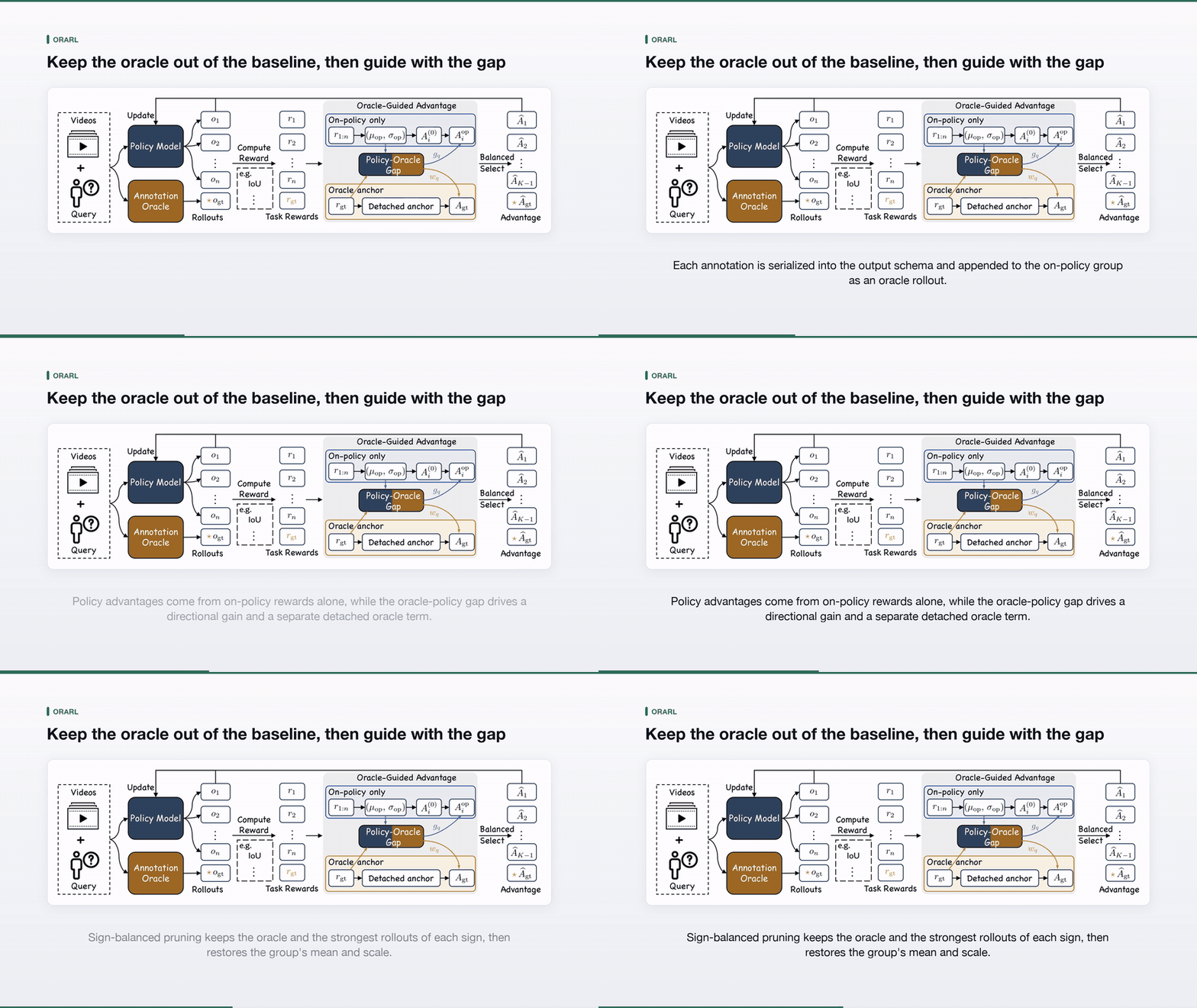
▶ Click the image to watch the 1:38 project overview.
Why OraRL
- Annotation-as-rollout: annotations become reliable positive rollouts while policy samples retain an on-policy baseline.
- Seven task families: one update rule covers temporal and spatial grounding, segmentation, tracking, spatial-temporal grounding, video QA, and spatial intelligence.
- Efficient training (4B): sign-balanced pruning delivers 1.48× faster updates (92.5 → 62.4 s/step) while reducing peak per-GPU memory from 62.4 to 50.9 GB.
- Efficient inference: on one H20 with vLLM in BF16, weight loading occupies 8.6 GiB (4B) and 17.6 GiB (9B). On ten-minute, 2-fps videos, answer-only decoding cuts median post-TTFT latency from 4.78 s to 130 ms and total latency from 29.03 to 24.30 s.
- Multimodal veRL infrastructure: a unified video contract carries cached artifacts, raw paths, or inline frame tensors through vLLM rollouts and FSDP updates, with decode-once frame reuse, temporal metadata, task-grouped batching, asynchronous Ray rewards, and safe hybrid-engine cache handling.
OraRL in One Update
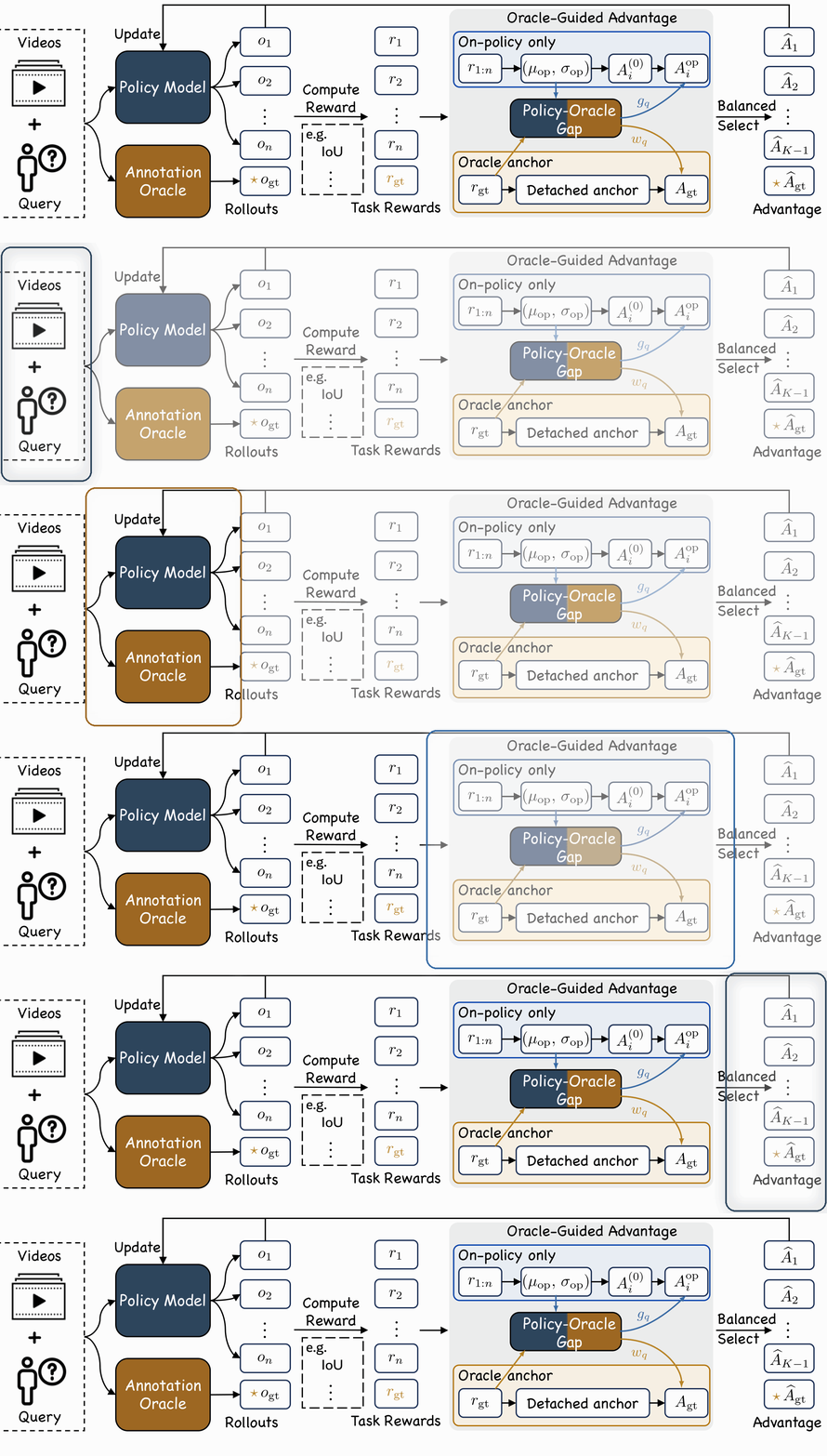
An OraRL update separates reliable annotation guidance from on-policy normalization:
- Build the group: append one serialized annotation rollout to the policy samples generated for the same prompt.
- Keep the baseline on-policy: estimate the group baseline from policy rewards only.
- Guide and select: convert the annotation-policy reward gap into a correction, then retain a sign-balanced subset for the update.
This design uses task-native annotations directly and requires no chain-of-thought supervision or decoding.
Video-ORA Results
Dataset-Level Results

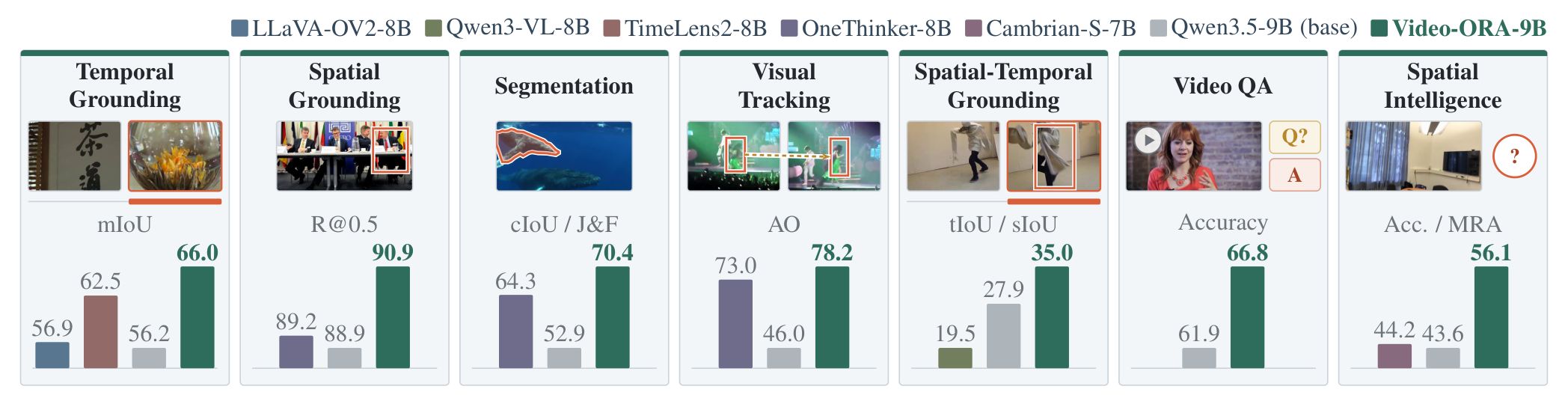
Video-ORA-9B leads the matched seven-family comparison without CoT decoding.
Best and second-best values are highlighted per row; † denotes an
original-report value whose frame, prompt, split, or decoding settings may
differ. Averages require complete family coverage.
Model Scaling
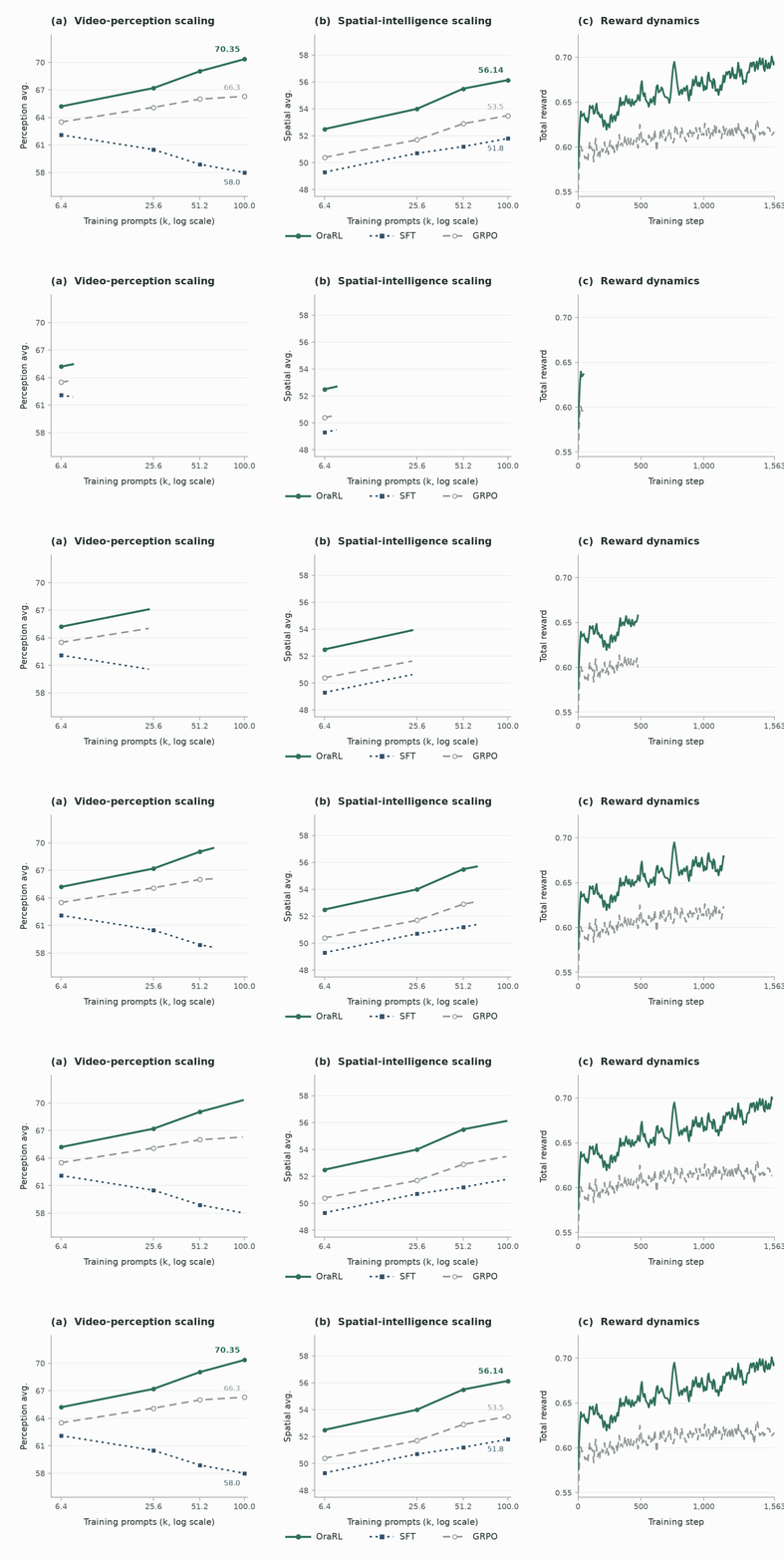
Data Scaling
Models
| Model | Backbone | Released recipe | Weights |
|---|---|---|---|
| Video-ORA-9B | Qwen3.5-9B | orarl_9b.yaml | Hugging Face |
| Video-ORA-4B | Qwen3.5-4B | orarl_4b.yaml | Hugging Face |
vLLM Serving
Both Video-ORA checkpoints load directly with vLLM 0.19.1 for OpenAI-compatible serving:
MODEL=OraRL/Video-ORA-9B

vllm serve "$MODEL" \
  --served-model-name Video-ORA-9B \
  --trust-remote-code \
  --dtype bfloat16 \
  --tensor-parallel-size 1 \
  --max-model-len 131072 \
  --limit-mm-per-prompt '{"image": 1, "video": 1}'
Set --tensor-parallel-size to the GPU count for multi-GPU deployment and
lower --max-model-len on smaller-memory devices. Use
enable_thinking=false in the chat template for answer-only inference.
Use OraRL
The release is organized around three user-facing workflows:
- Environment: install the pinned CUDA stack that covers both the bundled trainer and the evaluators.
- Training: prepare licensed local training data and launch GRPO or OraRL on one or multiple nodes.
- Evaluation: download Video-ORA and OraRL-Data, then run a smoke test or the complete paper suite.
Training and evaluation are dry runs by default; inspect the resolved command
before adding --run. Checkpoints and evaluation media are hosted under the
OraRL Hugging Face organization.
Acknowledgements
OraRL is built on veRL — a high-performance RL framework with HybridEngine. We thank its authors and contributors for open-sourcing the training infrastructure.
License
OraRL source is released under Apache-2.0. Datasets, models, benchmarks, and optional dependencies retain their original licenses; see NOTICE.
Citation
If you find OraRL useful, please consider giving this repository a ⭐ and citing our paper.
@article{li2026orarl,
  title   = {Annotations as Rollouts: Efficient and Scalable
             Reinforcement Learning for Video MLLMs},
  author  = {Li, Yunheng and Mu, Guohong and Li, Hao and
             Qian, Shengsheng and Zhang, Dingwen and Hou, Qibin
             and Cheng, Ming-Ming},
  journal = {arXiv preprint arXiv:2608.20492},
  year    = {2026},
  url     = {https://arxiv.org/abs/2608.20492}
}
Similar repos


Languages
Python
92.9%
Shell
7.1%
🎬 OraRL — Annotations as Rollouts for efficient, scalable reinforcement learning of unified video MLLMs.
See the codeREADME
OraRL
Annotations as Rollouts
Efficient and scalable reinforcement learning for unified video MLLMs
Yunheng Li · Guohong Mu · Hao Li · Shengsheng Qian · Dingwen Zhang · Qibin Hou · Ming-Ming Cheng
📄 Paper · 🌐 Project Page · 🎮 Live Demo · 🤗 Models (4B / 9B)
⚙️ Environment · 🚀 Training · 📊 Evaluation · ⚖️ License
View all 11 verified evaluations on Papers with Code
▶ Click the image to watch the 1:38 project overview.
Why OraRL
- Annotation-as-rollout: annotations become reliable positive rollouts while policy samples retain an on-policy baseline.
- Seven task families: one update rule covers temporal and spatial grounding, segmentation, tracking, spatial-temporal grounding, video QA, and spatial intelligence.
- Efficient training (4B): sign-balanced pruning delivers 1.48× faster updates (92.5 → 62.4 s/step) while reducing peak per-GPU memory from 62.4 to 50.9 GB.
- Efficient inference: on one H20 with vLLM in BF16, weight loading occupies 8.6 GiB (4B) and 17.6 GiB (9B). On ten-minute, 2-fps videos, answer-only decoding cuts median post-TTFT latency from 4.78 s to 130 ms and total latency from 29.03 to 24.30 s.
- Multimodal veRL infrastructure: a unified video contract carries cached artifacts, raw paths, or inline frame tensors through vLLM rollouts and FSDP updates, with decode-once frame reuse, temporal metadata, task-grouped batching, asynchronous Ray rewards, and safe hybrid-engine cache handling.
OraRL in One Update
An OraRL update separates reliable annotation guidance from on-policy normalization:
- Build the group: append one serialized annotation rollout to the policy samples generated for the same prompt.
- Keep the baseline on-policy: estimate the group baseline from policy rewards only.
- Guide and select: convert the annotation-policy reward gap into a correction, then retain a sign-balanced subset for the update.
This design uses task-native annotations directly and requires no chain-of-thought supervision or decoding.
Video-ORA Results
Dataset-Level Results
Video-ORA-9B leads the matched seven-family comparison without CoT decoding.
Best and second-best values are highlighted per row; † denotes an
original-report value whose frame, prompt, split, or decoding settings may
differ. Averages require complete family coverage.
Model Scaling
Data Scaling
Models
| Model | Backbone | Released recipe | Weights |
|---|---|---|---|
| Video-ORA-9B | Qwen3.5-9B | orarl_9b.yaml | Hugging Face |
| Video-ORA-4B | Qwen3.5-4B | orarl_4b.yaml | Hugging Face |
vLLM Serving
Both Video-ORA checkpoints load directly with vLLM 0.19.1 for OpenAI-compatible serving:
MODEL=OraRL/Video-ORA-9B

vllm serve "$MODEL" \
  --served-model-name Video-ORA-9B \
  --trust-remote-code \
  --dtype bfloat16 \
  --tensor-parallel-size 1 \
  --max-model-len 131072 \
  --limit-mm-per-prompt '{"image": 1, "video": 1}'
Set --tensor-parallel-size to the GPU count for multi-GPU deployment and
lower --max-model-len on smaller-memory devices. Use
enable_thinking=false in the chat template for answer-only inference.
Use OraRL
The release is organized around three user-facing workflows:
- Environment: install the pinned CUDA stack that covers both the bundled trainer and the evaluators.
- Training: prepare licensed local training data and launch GRPO or OraRL on one or multiple nodes.
- Evaluation: download Video-ORA and OraRL-Data, then run a smoke test or the complete paper suite.
Training and evaluation are dry runs by default; inspect the resolved command
before adding --run. Checkpoints and evaluation media are hosted under the
OraRL Hugging Face organization.
Acknowledgements
OraRL is built on veRL — a high-performance RL framework with HybridEngine. We thank its authors and contributors for open-sourcing the training infrastructure.
License
OraRL source is released under Apache-2.0. Datasets, models, benchmarks, and optional dependencies retain their original licenses; see NOTICE.
Citation
If you find OraRL useful, please consider giving this repository a ⭐ and citing our paper.
@article{li2026orarl,
  title   = {Annotations as Rollouts: Efficient and Scalable
             Reinforcement Learning for Video MLLMs},
  author  = {Li, Yunheng and Mu, Guohong and Li, Hao and
             Qian, Shengsheng and Zhang, Dingwen and Hou, Qibin
             and Cheng, Ming-Ming},
  journal = {arXiv preprint arXiv:2608.20492},
  year    = {2026},
  url     = {https://arxiv.org/abs/2608.20492}
}
Similar repos
Languages
Python
92.9%
Shell
7.1%