
The official code of "Beyond VLM-Based Rewards: Diffusion-Native Latent Reward Modeling"
See the codeREADME
Beyond VLM-Based Rewards: Diffusion-Native Latent Reward Modeling



1HKUST 2Huawei Hong Kong AI Framework
a diffusion-native latent reward model, competitive reward accuracy, much cheaper for alignment
🗺️ Open-source Roadmap:
- Training and Inference source code, and pre-trained checkpoints for SD3.5-Medium.
- Release of the preprocessed training dataset and training guidance.
- Training code for alignment stage.
- Support for additional backbones (e.g., Flux, Z-image-turbo).
- Support MindSpore + Ascend training and inference via the
mindsporebranch, with the SD3 reward head checkpoint available here. - Evaluation code & logistic normalization.
⚙️ Installation
To set up the environment, we recommend using Conda to manage dependencies. Follow these steps to get started:
# 1. Create a new conda environment
conda create -n diffusion-rm python=3.10 -y
conda activate diffusion-rm

# 2. (Optional) For Flow-GRPO training support
cd flow-grpo-rm
pip install -e .
cd ../

# 3. Install the package
# This will install all necessary dependencies
pip install -e .
⚡ Inference & Testing
We provide two primary methods to evaluate images using DiNa-LRM. You can either score images generated on-the-fly or score existing image files from your local disk.
1. Reward from Pipeline-Generated Latents
In this scenario, the model scores the "clean" latent directly produced by the diffusion transformer before the final VAE decoding.
import torch
from diffusers import StableDiffusion3Pipeline
from diffusion_rm.models.sd3_rm import encode_prompt
from diffusion_rm.infer.inference import DRMInferencer

# Load SD3.5 Pipeline
device = torch.device('cuda:0')
dtype = torch.bfloat16
pipe = StableDiffusion3Pipeline.from_pretrained(
    "stabilityai/stable-diffusion-3.5-medium",
    torch_dtype=dtype
).to(device)
pipe.vae.to(device, dtype=dtype)
pipe.text_encoder.to(device, dtype=dtype)
pipe.text_encoder_2.to(device, dtype=dtype)
pipe.text_encoder_3.to(device, dtype=dtype)
pipe.transformer.to(device, dtype=dtype)

text_encoders = [pipe.text_encoder, pipe.text_encoder_2, pipe.text_encoder_3]
tokenizers = [pipe.tokenizer, pipe.tokenizer_2, pipe.tokenizer_3]
def compute_text_embeddings(text_encoders, tokenizers, prompts):
    with torch.no_grad():
        prompt_embeds, pooled_prompt_embeds = encode_prompt(
            text_encoders, tokenizers, prompts, max_sequence_length=256
        )
        prompt_embeds = prompt_embeds.to(text_encoders[0].device)
        pooled_prompt_embeds = pooled_prompt_embeds.to(text_encoders[0].device)

    return prompt_embeds, pooled_prompt_embeds

# Initialize DiNa-LRM Scorer
scorer = DRMInferencer(
    pipeline=pipe,
    config_path=None,
    model_path="liuhuohuo/DiNa-LRM-SD35M-12layers",
    device=device,
    model_dtype=dtype,
    load_from_disk=False,
)

# 1. Generate latents (Set output_type='latent' for DiNa-LRM)
prompt = "A girl walking in the street"

with torch.no_grad():
    # Helper to get embeddings
    prompt_embeds, pooled_embeds = compute_text_embedding(text_encoders, tokenizers, [prompt], )

    output = pipe(prompt_embeds=prompt_embeds, pooled_prompt_embeds=pooled_prompt_embeds, num_inference_steps=40, guidance_scale=4.5, output_type='latent')
    latents = output.images


# 2. compute reward
with torch.no_grad():
    raw_score = scorer.reward(
        text_conds={'encoder_hidden_states': prompt_embeds.to(device), 'pooled_projections': pooled_embeds.to(device)},
        latents=latents,
        u=0.4
    )
    score = (raw_score + 10.0) / 10.0
    print(f"DiNa-LRM Score: {score.item()}")

# 3. [Optional] decode and save images
with torch.no_grad():
    latents_decoded = (latents / pipe.vae.config.scaling_factor) + pipe.vae.config.shift_factor
    image = pipe.vae.decode(latents_decoded.to(pipe.vae.dtype), return_dict=False)[0]
    image = pipe.image_processor.postprocess(image, output_type="pil")[0]

image.save("example.png")
2. Reward from Local Image Files
To score existing images, we first encode the image into the latent space using the VAE encoder.
import torch
from diffusers import StableDiffusion3Pipeline
from diffusion_rm.models.sd3_rm import encode_prompt
from diffusion_rm.infer.inference import DRMInferencer

# Load SD3.5 Pipeline
device = torch.device('cuda:0')
dtype = torch.bfloat16
pipe = StableDiffusion3Pipeline.from_pretrained(
    "stabilityai/stable-diffusion-3.5-medium",
    torch_dtype=dtype
).to(device)
pipe.vae.to(device, dtype=dtype)
pipe.text_encoder.to(device, dtype=dtype)
pipe.text_encoder_2.to(device, dtype=dtype)
pipe.text_encoder_3.to(device, dtype=dtype)
pipe.transformer.to(device, dtype=dtype)

text_encoders = [pipe.text_encoder, pipe.text_encoder_2, pipe.text_encoder_3]
tokenizers = [pipe.tokenizer, pipe.tokenizer_2, pipe.tokenizer_3]
def compute_text_embeddings(text_encoders, tokenizers, prompts):
    with torch.no_grad():
        prompt_embeds, pooled_prompt_embeds = encode_prompt(
            text_encoders, tokenizers, prompts, max_sequence_length=256
        )
        prompt_embeds = prompt_embeds.to(text_encoders[0].device)
        pooled_prompt_embeds = pooled_prompt_embeds.to(text_encoders[0].device)

    return prompt_embeds, pooled_prompt_embeds


# Initialize DiNa-LRM Scorer
scorer = DRMInferencer(
    pipeline=pipe,
    config_path=None,
    model_path="liuhuohuo/DiNa-LRM-SD35M-12layers",
    device=device,
    model_dtype=dtype,
    load_from_disk=False,
)

# 1. Load and Preprocess Image
image_path = "assets/example.png"
raw_image = Image.open(image_path).convert("RGB")
transform = T.Compose([T.ToTensor(), T.Normalize([0.5], [0.5])])
image_tensor = transform(raw_image).unsqueeze(0).to(device, dtype=dtype)

prompt = "A girl walking in the street"

with torch.no_grad():
    # Helper to get embeddings
    prompt_embeds, pooled_embeds = compute_text_embedding(text_encoders, tokenizers, [prompt], )


# 2. Encode to Latent Space
with torch.no_grad():
    latents = pipe.vae.encode(image_tensor).latent_dist.sample()
    latents = (latents - pipe.vae.config.shift_factor) * pipe.vae.config.scaling_factor

# 3. Compute Reward
# Note: score normalization is often calculated as: $$score = \frac{raw\_score + 10.0}{10.0}$$
raw_score = scorer.reward(
    text_conds={'encoder_hidden_states': prompt_embeds, 'pooled_projections': pooled_embeds},
    latents=latents,
    u=0.1 # Lower u is recommended for static/clean images
)
score = (raw_score + 10.0) / 10.0
print(f"Local Image Score: {score.item()}")
🛠️ Reward Model Training
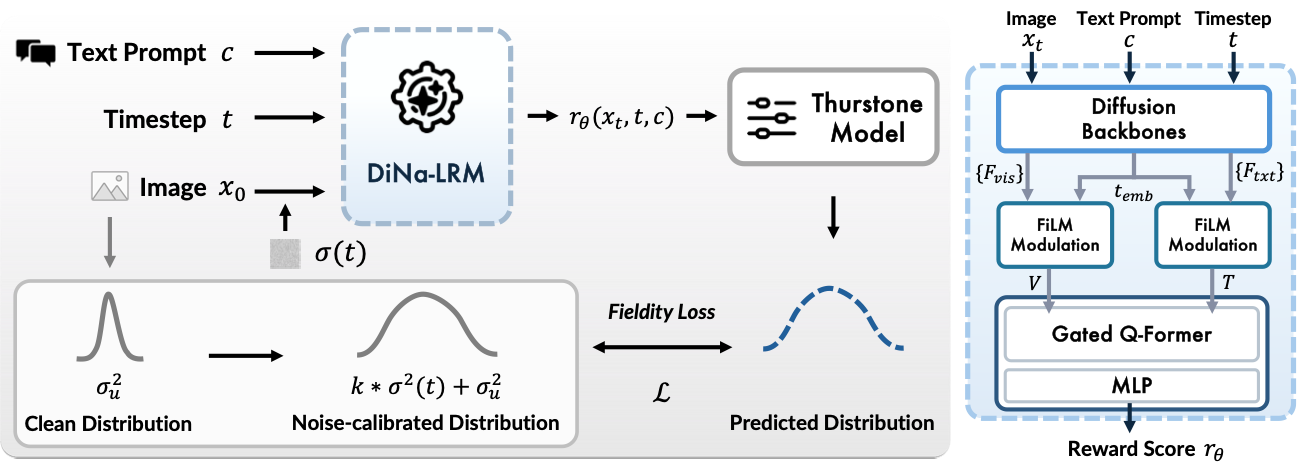
To train the reward model, follow these steps:
- Data Preparation: To avoid extra computational overhead during training, we preprocess the pixel-domain training data by encoding it into the latent space using the VAE.
- We provide the preprocessed dataset here: DiNa-LRM-SD35m-HPSv3-Preprocess-Data.
- Alternatively, you can preprocess the data manually by following the instructions in
tools/data_process/README.md.
- Configuration: Adjust your training config file, ensuring all data paths are set correctly.
- Start Training: Launch the single-node training script:
bash scripts/run/single_node/task_train.sh
🚀 Alignment Stage Training
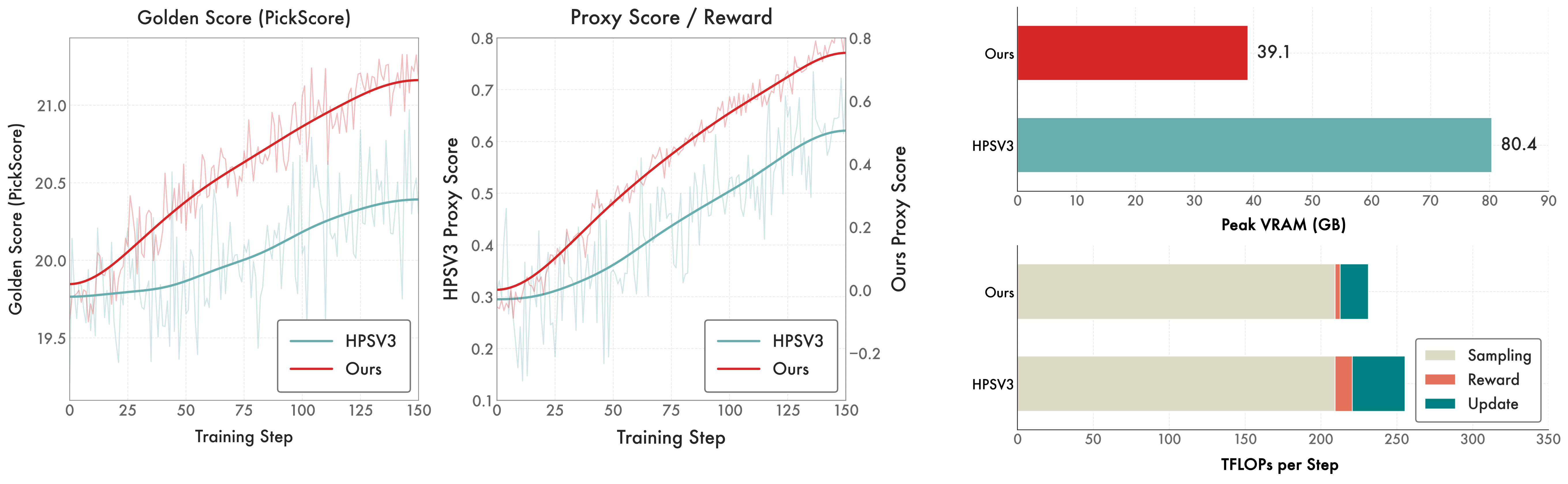
We provide reward model implementations based on DiNa-LRM (see flow-grpo-rm/flow_grpo/rewards.py:diffusion_rm_score) and include training examples for both ReFL and Flow-GRPO alignment:
- ReFL:
flow-grpo-rm/scripts/train_sd3_refl_rm.py - Flow-GRPO:
flow-grpo-rm/scripts/train_sd3_fast_rm.py
For ReFL Training:
bash flow-grpo-rm/scripts/single_node/refl_rm.sh
Note: ReFL is prone to reward hacking. To mitigate this, we recommend either 1) adding a pretrained loss (can be adjusted in the config directly), or 2) applying early stopping, as reward hacking is typically not obvious within the first 150 steps.
For Flow-GRPO Training:
bash flow-grpo-rm/scripts/single_node/grpo_rm.sh
Note: Our model tends to favor image quality. To better balance semantic alignment, we recommend mixing it with other advantages (e.g., PickScore). This usually leads to better optimization performance.
📧 Contact
If you have any question, please reach out to me at gongyeliuu@gmail.com.
🎓 Citation
If you find this work helpful, please consider citing:
@article{liu2026beyond,
  title={Beyond VLM-Based Rewards: Diffusion-Native Latent Reward Modeling},
  author={Liu, Gongye and Yang, Bo and Zhi, Yida and Zhong, Zhizhou and Ke, Lei and Deng, Didan and Gao, Han and Huang, Yongxiang and Zhang, Kaihao and Fu, Hongbo and others},
  journal={arXiv preprint arXiv:2602.11146},
  year={2026}
}
Contributors

15 commits
Similar repos


Languages
Python
99.2%
The official code of "Beyond VLM-Based Rewards: Diffusion-Native Latent Reward Modeling"
See the codeREADME
Beyond VLM-Based Rewards: Diffusion-Native Latent Reward Modeling
1HKUST 2Huawei Hong Kong AI Framework
a diffusion-native latent reward model, competitive reward accuracy, much cheaper for alignment
🗺️ Open-source Roadmap:
- Training and Inference source code, and pre-trained checkpoints for SD3.5-Medium.
- Release of the preprocessed training dataset and training guidance.
- Training code for alignment stage.
- Support for additional backbones (e.g., Flux, Z-image-turbo).
- Support MindSpore + Ascend training and inference via the
mindsporebranch, with the SD3 reward head checkpoint available here. - Evaluation code & logistic normalization.
⚙️ Installation
To set up the environment, we recommend using Conda to manage dependencies. Follow these steps to get started:
# 1. Create a new conda environment
conda create -n diffusion-rm python=3.10 -y
conda activate diffusion-rm

# 2. (Optional) For Flow-GRPO training support
cd flow-grpo-rm
pip install -e .
cd ../

# 3. Install the package
# This will install all necessary dependencies
pip install -e .
⚡ Inference & Testing
We provide two primary methods to evaluate images using DiNa-LRM. You can either score images generated on-the-fly or score existing image files from your local disk.
1. Reward from Pipeline-Generated Latents
In this scenario, the model scores the "clean" latent directly produced by the diffusion transformer before the final VAE decoding.
import torch
from diffusers import StableDiffusion3Pipeline
from diffusion_rm.models.sd3_rm import encode_prompt
from diffusion_rm.infer.inference import DRMInferencer

# Load SD3.5 Pipeline
device = torch.device('cuda:0')
dtype = torch.bfloat16
pipe = StableDiffusion3Pipeline.from_pretrained(
    "stabilityai/stable-diffusion-3.5-medium",
    torch_dtype=dtype
).to(device)
pipe.vae.to(device, dtype=dtype)
pipe.text_encoder.to(device, dtype=dtype)
pipe.text_encoder_2.to(device, dtype=dtype)
pipe.text_encoder_3.to(device, dtype=dtype)
pipe.transformer.to(device, dtype=dtype)

text_encoders = [pipe.text_encoder, pipe.text_encoder_2, pipe.text_encoder_3]
tokenizers = [pipe.tokenizer, pipe.tokenizer_2, pipe.tokenizer_3]
def compute_text_embeddings(text_encoders, tokenizers, prompts):
    with torch.no_grad():
        prompt_embeds, pooled_prompt_embeds = encode_prompt(
            text_encoders, tokenizers, prompts, max_sequence_length=256
        )
        prompt_embeds = prompt_embeds.to(text_encoders[0].device)
        pooled_prompt_embeds = pooled_prompt_embeds.to(text_encoders[0].device)

    return prompt_embeds, pooled_prompt_embeds

# Initialize DiNa-LRM Scorer
scorer = DRMInferencer(
    pipeline=pipe,
    config_path=None,
    model_path="liuhuohuo/DiNa-LRM-SD35M-12layers",
    device=device,
    model_dtype=dtype,
    load_from_disk=False,
)

# 1. Generate latents (Set output_type='latent' for DiNa-LRM)
prompt = "A girl walking in the street"

with torch.no_grad():
    # Helper to get embeddings
    prompt_embeds, pooled_embeds = compute_text_embedding(text_encoders, tokenizers, [prompt], )

    output = pipe(prompt_embeds=prompt_embeds, pooled_prompt_embeds=pooled_prompt_embeds, num_inference_steps=40, guidance_scale=4.5, output_type='latent')
    latents = output.images


# 2. compute reward
with torch.no_grad():
    raw_score = scorer.reward(
        text_conds={'encoder_hidden_states': prompt_embeds.to(device), 'pooled_projections': pooled_embeds.to(device)},
        latents=latents,
        u=0.4
    )
    score = (raw_score + 10.0) / 10.0
    print(f"DiNa-LRM Score: {score.item()}")

# 3. [Optional] decode and save images
with torch.no_grad():
    latents_decoded = (latents / pipe.vae.config.scaling_factor) + pipe.vae.config.shift_factor
    image = pipe.vae.decode(latents_decoded.to(pipe.vae.dtype), return_dict=False)[0]
    image = pipe.image_processor.postprocess(image, output_type="pil")[0]

image.save("example.png")
2. Reward from Local Image Files
To score existing images, we first encode the image into the latent space using the VAE encoder.
import torch
from diffusers import StableDiffusion3Pipeline
from diffusion_rm.models.sd3_rm import encode_prompt
from diffusion_rm.infer.inference import DRMInferencer

# Load SD3.5 Pipeline
device = torch.device('cuda:0')
dtype = torch.bfloat16
pipe = StableDiffusion3Pipeline.from_pretrained(
    "stabilityai/stable-diffusion-3.5-medium",
    torch_dtype=dtype
).to(device)
pipe.vae.to(device, dtype=dtype)
pipe.text_encoder.to(device, dtype=dtype)
pipe.text_encoder_2.to(device, dtype=dtype)
pipe.text_encoder_3.to(device, dtype=dtype)
pipe.transformer.to(device, dtype=dtype)

text_encoders = [pipe.text_encoder, pipe.text_encoder_2, pipe.text_encoder_3]
tokenizers = [pipe.tokenizer, pipe.tokenizer_2, pipe.tokenizer_3]
def compute_text_embeddings(text_encoders, tokenizers, prompts):
    with torch.no_grad():
        prompt_embeds, pooled_prompt_embeds = encode_prompt(
            text_encoders, tokenizers, prompts, max_sequence_length=256
        )
        prompt_embeds = prompt_embeds.to(text_encoders[0].device)
        pooled_prompt_embeds = pooled_prompt_embeds.to(text_encoders[0].device)

    return prompt_embeds, pooled_prompt_embeds


# Initialize DiNa-LRM Scorer
scorer = DRMInferencer(
    pipeline=pipe,
    config_path=None,
    model_path="liuhuohuo/DiNa-LRM-SD35M-12layers",
    device=device,
    model_dtype=dtype,
    load_from_disk=False,
)

# 1. Load and Preprocess Image
image_path = "assets/example.png"
raw_image = Image.open(image_path).convert("RGB")
transform = T.Compose([T.ToTensor(), T.Normalize([0.5], [0.5])])
image_tensor = transform(raw_image).unsqueeze(0).to(device, dtype=dtype)

prompt = "A girl walking in the street"

with torch.no_grad():
    # Helper to get embeddings
    prompt_embeds, pooled_embeds = compute_text_embedding(text_encoders, tokenizers, [prompt], )


# 2. Encode to Latent Space
with torch.no_grad():
    latents = pipe.vae.encode(image_tensor).latent_dist.sample()
    latents = (latents - pipe.vae.config.shift_factor) * pipe.vae.config.scaling_factor

# 3. Compute Reward
# Note: score normalization is often calculated as: $$score = \frac{raw\_score + 10.0}{10.0}$$
raw_score = scorer.reward(
    text_conds={'encoder_hidden_states': prompt_embeds, 'pooled_projections': pooled_embeds},
    latents=latents,
    u=0.1 # Lower u is recommended for static/clean images
)
score = (raw_score + 10.0) / 10.0
print(f"Local Image Score: {score.item()}")
🛠️ Reward Model Training
To train the reward model, follow these steps:
- Data Preparation: To avoid extra computational overhead during training, we preprocess the pixel-domain training data by encoding it into the latent space using the VAE.
- We provide the preprocessed dataset here: DiNa-LRM-SD35m-HPSv3-Preprocess-Data.
- Alternatively, you can preprocess the data manually by following the instructions in
tools/data_process/README.md.
- Configuration: Adjust your training config file, ensuring all data paths are set correctly.
- Start Training: Launch the single-node training script:
bash scripts/run/single_node/task_train.sh
🚀 Alignment Stage Training
We provide reward model implementations based on DiNa-LRM (see flow-grpo-rm/flow_grpo/rewards.py:diffusion_rm_score) and include training examples for both ReFL and Flow-GRPO alignment:
- ReFL:
flow-grpo-rm/scripts/train_sd3_refl_rm.py - Flow-GRPO:
flow-grpo-rm/scripts/train_sd3_fast_rm.py
For ReFL Training:
bash flow-grpo-rm/scripts/single_node/refl_rm.sh
Note: ReFL is prone to reward hacking. To mitigate this, we recommend either 1) adding a pretrained loss (can be adjusted in the config directly), or 2) applying early stopping, as reward hacking is typically not obvious within the first 150 steps.
For Flow-GRPO Training:
bash flow-grpo-rm/scripts/single_node/grpo_rm.sh
Note: Our model tends to favor image quality. To better balance semantic alignment, we recommend mixing it with other advantages (e.g., PickScore). This usually leads to better optimization performance.
📧 Contact
If you have any question, please reach out to me at gongyeliuu@gmail.com.
🎓 Citation
If you find this work helpful, please consider citing:
@article{liu2026beyond,
  title={Beyond VLM-Based Rewards: Diffusion-Native Latent Reward Modeling},
  author={Liu, Gongye and Yang, Bo and Zhi, Yida and Zhong, Zhizhou and Ke, Lei and Deng, Didan and Gao, Han and Huang, Yongxiang and Zhang, Kaihao and Fu, Hongbo and others},
  journal={arXiv preprint arXiv:2602.11146},
  year={2026}
}
Similar repos
Contributors
15 commits
Languages
Python
99.2%