
Decision proxy in front of SearXNG with Brave Search API fallback
Go
7
31 commits
updated Sep 17, 2026
See what people are saying (1)
README
searxng-gateway
Decision proxy in front of SearXNG: speculative execution — starts SearXNG and the configured premium-provider pass concurrently, selects providers via round-robin, invokes premium providers serially within that pass, merges results with URL dedup, and loops through remaining providers until a configurable threshold is met or timeout expires. Same JSON shape as SearXNG, Prometheus /metrics, in-memory LRU cache.
🚀 Works with zero API keys in keyless mode. See docs/keyless.md.
Originally derived from sx; adds HTTP server, per-engine circuit breaker, Prometheus metrics, cache, and Docker packaging.
Quick Start
# 1. Clone
git clone https://github.com/Ghilteras/searxng-gateway.git
cd searxng-gateway

# 2. (Optional) Create .env with API keys — or skip for keyless mode
echo 'BRAVE_API_KEY=your_key' > .env
echo 'SERPER_API_KEY=your_key' >> .env

# 3. Start
docker compose -f docker-compose.example.yml up -d

# 4. Test
curl 'http://localhost:8080/search?q=hello+world&format=json'
curl 'http://localhost:8080/metrics'
Architecture
Client ───▶ searxng-gateway (:8080) ───▶ SearXNG (Tier 1 free engines)
                    │                        │
                    │  ┌─────────────────────┤
                    │  │ Speculative execution│
                    │  │ (parallel round-robin)│
                    │  └─────────────────────┤
                    │                        ├── Serper (Google via API)
                    │                        ├── Bing, Wikipedia, GitHub...
                    │                        └── Circuit breaker per engine
                    │
                    └──▶ Tier 2 hot path (T1_PREMIUM_COUNT providers)
                    │    ├── Brave ──┐
                    │    ├── Exa     ├── round-robin alongside SearXNG;
                    │    ├── Jina    │   with SearXNG. Dedup URL.
                    │    └── Tavily ─┘
                    │
                    └──▶ Fallback loop (if merged < SUFFICIENT_MIN_RESULTS)
                         Round-robin through remaining Tier 2 providers
                         until threshold, exhaustion, or FALLBACK_TIMEOUT
See docs/architecture.md for the full design.
Supported fallback providers
Set FALLBACK_PROVIDERS to a comma-separated list of premium backend names. Each needs its _API_KEY env var. T1_PREMIUM_COUNT controls how many of them run alongside SearXNG in every request (round-robin selection); the rest are used in the fallback loop when the merged result count is below SUFFICIENT_MIN_RESULTS.
| Provider | Env var | Free tier | Production |
|---|---|---|---|
| Brave | BRAVE_API_KEY | $5 credit (1,000/mo) | ✅ Yes |
| Exa | EXA_API_KEY | $20 + $10/mo (~2,800 searches) | ✅ Yes |
| Jina | JINA_API_KEY | 10M tokens, 500 RPM | ✅ Yes |
| Tavily | TAVILY_API_KEY | 1,000 credits/mo | ✅ Yes |
Example:
FALLBACK_PROVIDERS=brave,exa,jina
BRAVE_API_KEY=xxx
EXA_API_KEY=xxx
JINA_API_KEY=xxx
Keyless mode (no API keys) works out of the box using SearXNG's free engines (Bing, Wikipedia, GitHub, etc.). Premium providers require their respective API keys.
Features
- Speculative execution —
T1_PREMIUM_COUNTpremium providers are selected via atomic round-robin and invoked in the hot path while SearXNG runs concurrently; premium calls are serial within the pass. Results are merged and deduplicated by URL. - Bounded fallback loop — if merged results <
SUFFICIENT_MIN_RESULTS, remaining Tier 2 providers are tried via round-robin until threshold, exhaustion, orFALLBACK_TIMEOUT_SECONDS. - Circuit breaker per engine — 4xx on an engine opens the circuit for 5 min; auto-recovers
- Exponential backoff retry — 3 retries with 1s/2s/4s backoff on 5xx/timeout
- Prometheus /metrics — 15+ gauges and counters prefixed
searxng_gateway_ - LRU cache — 1000 entries, 1h TTL, in-memory
- SearXNG config tuning — reference
examples/searxng/with engine selection,suspended_timestuning, custom User-Agent, and custom Python engines (Serper, Mojeek) - Fallback billing alert —
engine_results_totaltracks premium API usage so you can alert before hitting quota limits
Observability
The gateway exposes Prometheus metrics at :8080/metrics.
Grafana dashboard
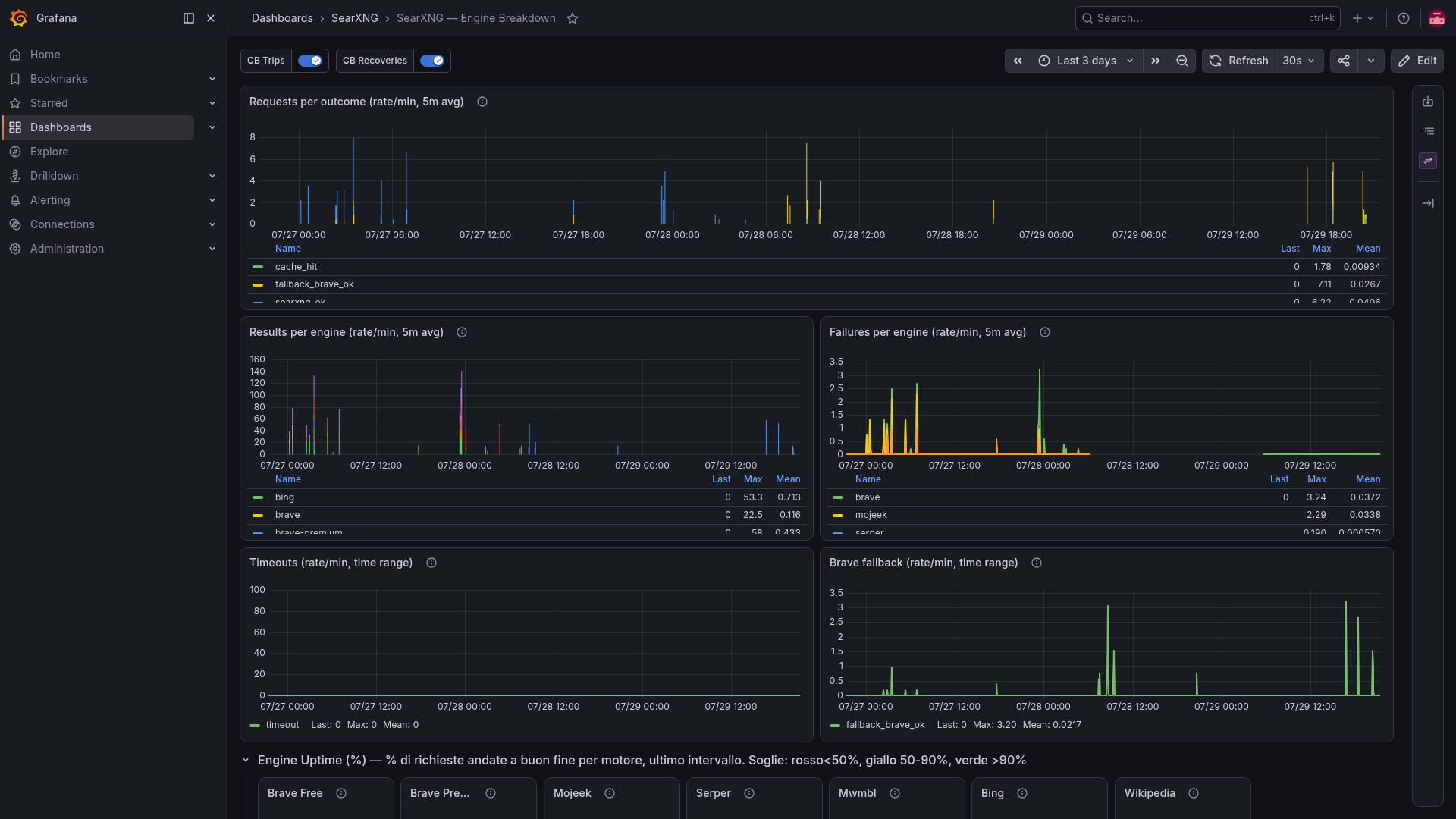
A reference dashboard is included at examples/grafana/searxng-gateway-dashboard.json. Import it into Grafana, select your Prometheus datasource, and you'll see:
Circuit Breaker State (per engine)
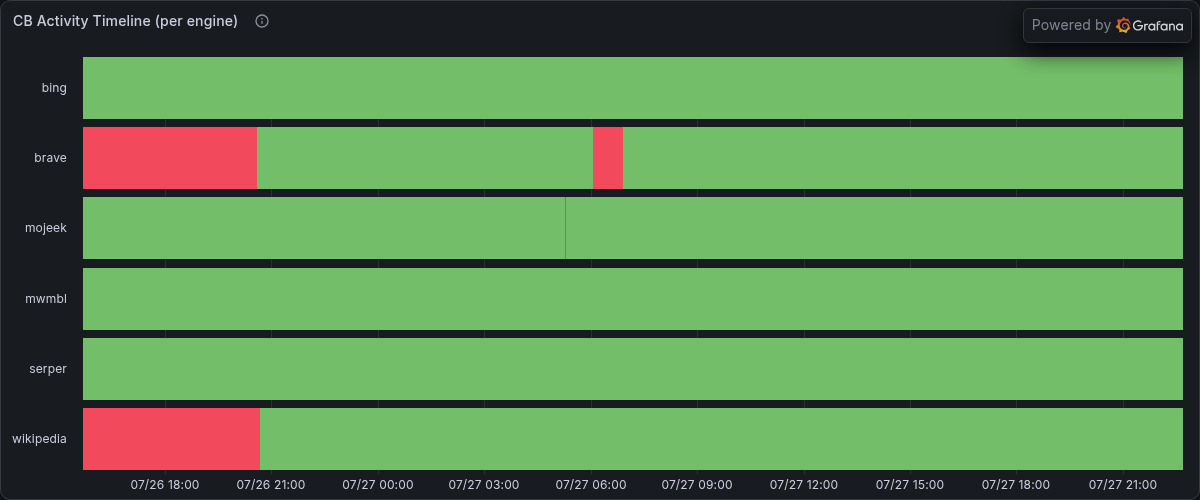
Each engine gets its own row. 🟢 Closed → 🟡 Half-Open → 🔴 Open. When an engine returns 4xx, the circuit opens for 5 minutes, then auto-recovers.
Circuit Breaker Trips (cumulative)
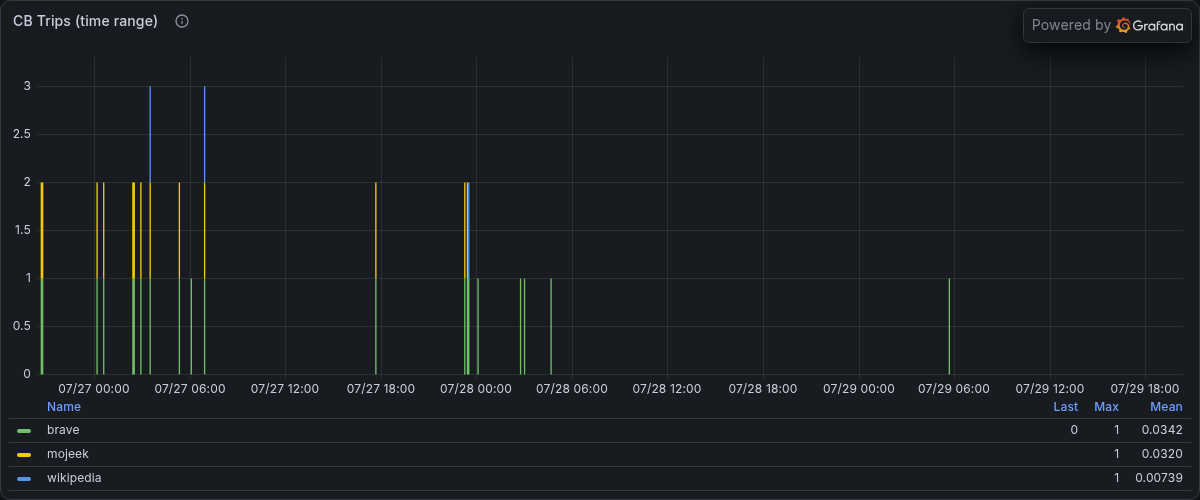
Each trip means the gateway caught a 4xx and opened the circuit before the engine could degrade further queries. Colored by reason: rate_limited, access_denied, captcha.
Circuit Breaker Recoveries (auto-healing)
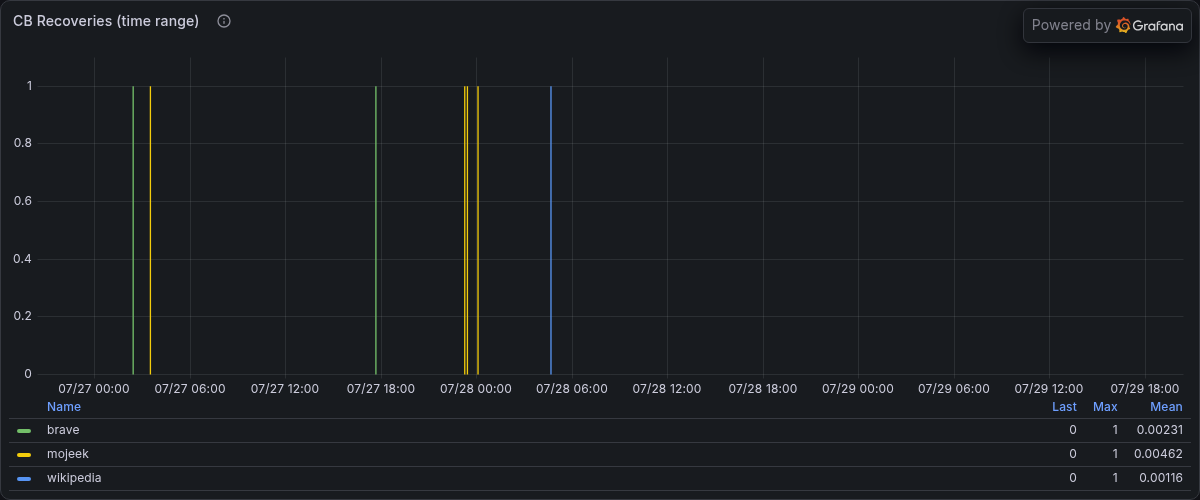
After 5 minutes of cooldown, the gateway probes the engine. If it responds, the circuit closes and a recovery is recorded.
Cache hit rate & Cache size
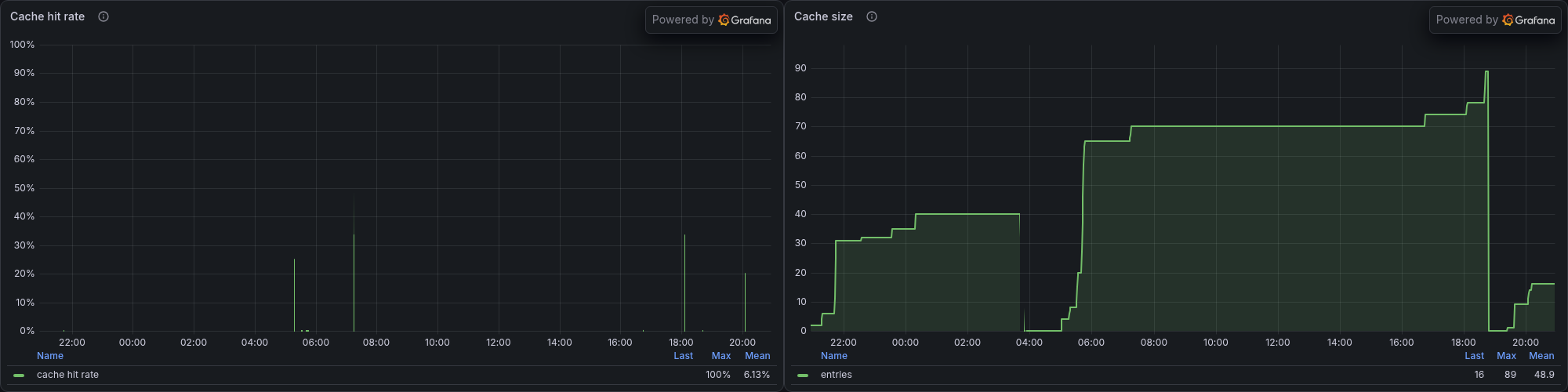
Repeated queries are served from the in-memory LRU cache (1000 entries, 1h TTL). "Cache hit rate" is the percentage of requests answered from cache (100 * rate(cache_hit) / rate(total)); "Cache size" tracks the current entry count. A low hit rate means every query is hitting SearXNG and premium providers — tune CACHE_SIZE/CACHE_TTL_SECONDS accordingly.
Alerting
Example Prometheus alert rules (vmalert/Mimir compatible):
groups:
  - name: searxng-gateway
    rules:
      - alert: SearxngCBStuckOpen
        expr: searxng_gateway_circuit_breaker_state == 2
        for: 5m
        annotations:
          summary: "Circuit breaker stuck open for engine {{ $labels.engine }}"

      - alert: SearxngRetryExhausted
        expr: rate(searxng_gateway_retry_exhausted_total[5m]) > 0.01
        for: 5m
        annotations:
          summary: "Retry exhaustion rate elevated"

      - alert: FallbackBillSpike
        expr: rate(searxng_gateway_engine_results_total[1h]) * 3600 > 100
        for: 10m
        annotations:
          summary: "Fallback API usage > 100 calls/hour — check billing"
Endpoints
GET /search?q=<query>&format=json— proxy endpointGET /healthz— livenessGET /metrics— Prometheus exposition
Env vars
| Var | Default | Required | Description |
|---|---|---|---|
LISTEN_ADDR | :8080 | no | HTTP listen address |
SEARXNG_BACKEND_URL | http://searxng-primary:8080 | no | SearXNG instance URL |
FALLBACK_PROVIDERS | brave | no | Comma-separated list of premium provider names |
BRAVE_API_KEY | — | no | Brave Search API key |
EXA_API_KEY | — | no | Exa Search API key |
JINA_API_KEY | — | no | Jina Search API key |
TAVILY_API_KEY | — | no | Tavily Search API key |
SUFFICIENT_MIN_RESULTS | 1 | no | Target merged result count; loop stops when reached (recommend 10 with premiums) |
T1_PREMIUM_COUNT | 0 | no | Number of premium providers to call in the hot path while SearXNG runs (0 = none; premium calls are serial within the pass) |
FALLBACK_TIMEOUT_SECONDS | 30 | no | Maximum time for speculative execution + fallback loop |
SEARXNG_TIMEOUT_SECONDS | 25 | no | Per-request timeout for SearXNG |
SEARXNG_FAIL_THRESHOLD | 6 | no | Consecutive SearXNG failures before cooldown |
SEARXNG_FAIL_COOLDOWN_SECONDS | 180 | no | Cooldown duration for SearXNG (seconds) |
BRAVE_FAIL_THRESHOLD | 3 | no | Consecutive Brave failures before cooldown |
BRAVE_FAIL_COOLDOWN_SECONDS | 300 | no | Cooldown duration for Brave (seconds) |
BRAVE_TIMEOUT_SECONDS | 15 | no | Per-request timeout for Brave API |
CACHE_SIZE | 1000 | no | LRU cache entries (in-memory) |
CACHE_TTL_SECONDS | 3600 | no | Cache entry TTL (seconds) |
LOG_LEVEL | info | no | Log level (debug, info, warn, error) |
METRICS_PATH | /metrics | no | Prometheus metrics endpoint path |
Adding a new provider
Implement the SearchBackend interface in backends/:
type MyProvider struct { APIKey string; Timeout time.Duration }

func (m *MyProvider) Name() string { return "myprovider" }
func (m *MyProvider) IsAvailable() bool { return m.APIKey != "" }
func (m *MyProvider) Search(opts SearchOptions) ([]SearchResult, error) { /* ... */ }
Then add a case to backends/factory.go and set MYPROVIDER_API_KEY in the environment. The rest (registry, fallback chain, circuit breaker) is automatic.
Reference deployment
docker-compose.example.yml— SearXNG + gateway, one commandexamples/searxng/— reference SearXNG config with multi-tier engine postureexamples/searxng-engines/— custom SearXNG engines (Serper, Mojeek API)docs/architecture.md— design decisions, circuit breaker, metricsdocs/keyless.md— how to run without any API keys
Build
The image is built and pushed automatically by GitHub Actions on every push to main and on v* tags: see .github/workflows/build.yml (docker/build-push-action@v6, platforms linux/amd64,linux/arm64, gha cache, push to GHCR). No local multi-arch build needed — the local multiarch buildx builder was removed from the homelab (2026-08-04).
License
MIT — see LICENSE.
Contributors

31 commits
Similar repos


Languages
Go
98.8%
Decision proxy in front of SearXNG with Brave Search API fallback
Go
7
31 commits
updated Sep 17, 2026
See what people are saying (1)
README
searxng-gateway
Decision proxy in front of SearXNG: speculative execution — starts SearXNG and the configured premium-provider pass concurrently, selects providers via round-robin, invokes premium providers serially within that pass, merges results with URL dedup, and loops through remaining providers until a configurable threshold is met or timeout expires. Same JSON shape as SearXNG, Prometheus /metrics, in-memory LRU cache.
🚀 Works with zero API keys in keyless mode. See docs/keyless.md.
Originally derived from sx; adds HTTP server, per-engine circuit breaker, Prometheus metrics, cache, and Docker packaging.
Quick Start
# 1. Clone
git clone https://github.com/Ghilteras/searxng-gateway.git
cd searxng-gateway

# 2. (Optional) Create .env with API keys — or skip for keyless mode
echo 'BRAVE_API_KEY=your_key' > .env
echo 'SERPER_API_KEY=your_key' >> .env

# 3. Start
docker compose -f docker-compose.example.yml up -d

# 4. Test
curl 'http://localhost:8080/search?q=hello+world&format=json'
curl 'http://localhost:8080/metrics'
Architecture
Client ───▶ searxng-gateway (:8080) ───▶ SearXNG (Tier 1 free engines)
                    │                        │
                    │  ┌─────────────────────┤
                    │  │ Speculative execution│
                    │  │ (parallel round-robin)│
                    │  └─────────────────────┤
                    │                        ├── Serper (Google via API)
                    │                        ├── Bing, Wikipedia, GitHub...
                    │                        └── Circuit breaker per engine
                    │
                    └──▶ Tier 2 hot path (T1_PREMIUM_COUNT providers)
                    │    ├── Brave ──┐
                    │    ├── Exa     ├── round-robin alongside SearXNG;
                    │    ├── Jina    │   with SearXNG. Dedup URL.
                    │    └── Tavily ─┘
                    │
                    └──▶ Fallback loop (if merged < SUFFICIENT_MIN_RESULTS)
                         Round-robin through remaining Tier 2 providers
                         until threshold, exhaustion, or FALLBACK_TIMEOUT
See docs/architecture.md for the full design.
Supported fallback providers
Set FALLBACK_PROVIDERS to a comma-separated list of premium backend names. Each needs its _API_KEY env var. T1_PREMIUM_COUNT controls how many of them run alongside SearXNG in every request (round-robin selection); the rest are used in the fallback loop when the merged result count is below SUFFICIENT_MIN_RESULTS.
| Provider | Env var | Free tier | Production |
|---|---|---|---|
| Brave | BRAVE_API_KEY | $5 credit (1,000/mo) | ✅ Yes |
| Exa | EXA_API_KEY | $20 + $10/mo (~2,800 searches) | ✅ Yes |
| Jina | JINA_API_KEY | 10M tokens, 500 RPM | ✅ Yes |
| Tavily | TAVILY_API_KEY | 1,000 credits/mo | ✅ Yes |
Example:
FALLBACK_PROVIDERS=brave,exa,jina
BRAVE_API_KEY=xxx
EXA_API_KEY=xxx
JINA_API_KEY=xxx
Keyless mode (no API keys) works out of the box using SearXNG's free engines (Bing, Wikipedia, GitHub, etc.). Premium providers require their respective API keys.
Features
- Speculative execution —
T1_PREMIUM_COUNTpremium providers are selected via atomic round-robin and invoked in the hot path while SearXNG runs concurrently; premium calls are serial within the pass. Results are merged and deduplicated by URL. - Bounded fallback loop — if merged results <
SUFFICIENT_MIN_RESULTS, remaining Tier 2 providers are tried via round-robin until threshold, exhaustion, orFALLBACK_TIMEOUT_SECONDS. - Circuit breaker per engine — 4xx on an engine opens the circuit for 5 min; auto-recovers
- Exponential backoff retry — 3 retries with 1s/2s/4s backoff on 5xx/timeout
- Prometheus /metrics — 15+ gauges and counters prefixed
searxng_gateway_ - LRU cache — 1000 entries, 1h TTL, in-memory
- SearXNG config tuning — reference
examples/searxng/with engine selection,suspended_timestuning, custom User-Agent, and custom Python engines (Serper, Mojeek) - Fallback billing alert —
engine_results_totaltracks premium API usage so you can alert before hitting quota limits
Observability
The gateway exposes Prometheus metrics at :8080/metrics.
Grafana dashboard
A reference dashboard is included at examples/grafana/searxng-gateway-dashboard.json. Import it into Grafana, select your Prometheus datasource, and you'll see:
Circuit Breaker State (per engine)
Each engine gets its own row. 🟢 Closed → 🟡 Half-Open → 🔴 Open. When an engine returns 4xx, the circuit opens for 5 minutes, then auto-recovers.
Circuit Breaker Trips (cumulative)
Each trip means the gateway caught a 4xx and opened the circuit before the engine could degrade further queries. Colored by reason: rate_limited, access_denied, captcha.
Circuit Breaker Recoveries (auto-healing)
After 5 minutes of cooldown, the gateway probes the engine. If it responds, the circuit closes and a recovery is recorded.
Cache hit rate & Cache size
Repeated queries are served from the in-memory LRU cache (1000 entries, 1h TTL). "Cache hit rate" is the percentage of requests answered from cache (100 * rate(cache_hit) / rate(total)); "Cache size" tracks the current entry count. A low hit rate means every query is hitting SearXNG and premium providers — tune CACHE_SIZE/CACHE_TTL_SECONDS accordingly.
Alerting
Example Prometheus alert rules (vmalert/Mimir compatible):
groups:
  - name: searxng-gateway
    rules:
      - alert: SearxngCBStuckOpen
        expr: searxng_gateway_circuit_breaker_state == 2
        for: 5m
        annotations:
          summary: "Circuit breaker stuck open for engine {{ $labels.engine }}"

      - alert: SearxngRetryExhausted
        expr: rate(searxng_gateway_retry_exhausted_total[5m]) > 0.01
        for: 5m
        annotations:
          summary: "Retry exhaustion rate elevated"

      - alert: FallbackBillSpike
        expr: rate(searxng_gateway_engine_results_total[1h]) * 3600 > 100
        for: 10m
        annotations:
          summary: "Fallback API usage > 100 calls/hour — check billing"
Endpoints
GET /search?q=<query>&format=json— proxy endpointGET /healthz— livenessGET /metrics— Prometheus exposition
Env vars
| Var | Default | Required | Description |
|---|---|---|---|
LISTEN_ADDR | :8080 | no | HTTP listen address |
SEARXNG_BACKEND_URL | http://searxng-primary:8080 | no | SearXNG instance URL |
FALLBACK_PROVIDERS | brave | no | Comma-separated list of premium provider names |
BRAVE_API_KEY | — | no | Brave Search API key |
EXA_API_KEY | — | no | Exa Search API key |
JINA_API_KEY | — | no | Jina Search API key |
TAVILY_API_KEY | — | no | Tavily Search API key |
SUFFICIENT_MIN_RESULTS | 1 | no | Target merged result count; loop stops when reached (recommend 10 with premiums) |
T1_PREMIUM_COUNT | 0 | no | Number of premium providers to call in the hot path while SearXNG runs (0 = none; premium calls are serial within the pass) |
FALLBACK_TIMEOUT_SECONDS | 30 | no | Maximum time for speculative execution + fallback loop |
SEARXNG_TIMEOUT_SECONDS | 25 | no | Per-request timeout for SearXNG |
SEARXNG_FAIL_THRESHOLD | 6 | no | Consecutive SearXNG failures before cooldown |
SEARXNG_FAIL_COOLDOWN_SECONDS | 180 | no | Cooldown duration for SearXNG (seconds) |
BRAVE_FAIL_THRESHOLD | 3 | no | Consecutive Brave failures before cooldown |
BRAVE_FAIL_COOLDOWN_SECONDS | 300 | no | Cooldown duration for Brave (seconds) |
BRAVE_TIMEOUT_SECONDS | 15 | no | Per-request timeout for Brave API |
CACHE_SIZE | 1000 | no | LRU cache entries (in-memory) |
CACHE_TTL_SECONDS | 3600 | no | Cache entry TTL (seconds) |
LOG_LEVEL | info | no | Log level (debug, info, warn, error) |
METRICS_PATH | /metrics | no | Prometheus metrics endpoint path |
Adding a new provider
Implement the SearchBackend interface in backends/:
type MyProvider struct { APIKey string; Timeout time.Duration }

func (m *MyProvider) Name() string { return "myprovider" }
func (m *MyProvider) IsAvailable() bool { return m.APIKey != "" }
func (m *MyProvider) Search(opts SearchOptions) ([]SearchResult, error) { /* ... */ }
Then add a case to backends/factory.go and set MYPROVIDER_API_KEY in the environment. The rest (registry, fallback chain, circuit breaker) is automatic.
Reference deployment
docker-compose.example.yml— SearXNG + gateway, one commandexamples/searxng/— reference SearXNG config with multi-tier engine postureexamples/searxng-engines/— custom SearXNG engines (Serper, Mojeek API)docs/architecture.md— design decisions, circuit breaker, metricsdocs/keyless.md— how to run without any API keys
Build
The image is built and pushed automatically by GitHub Actions on every push to main and on v* tags: see .github/workflows/build.yml (docker/build-push-action@v6, platforms linux/amd64,linux/arm64, gha cache, push to GHCR). No local multi-arch build needed — the local multiarch buildx builder was removed from the homelab (2026-08-04).
License
MIT — see LICENSE.
Similar repos
Contributors
31 commits
Languages
Go
98.8%