NLP Project that calculates stance and classifies Arabic tweets about COVID-19 Vaccine
Jupyter Notebook
16
32 commits
updated Jan 12, 2023
NLP Python code that calculates stance and classifies Arabic tweets about COVID-19 vaccination.
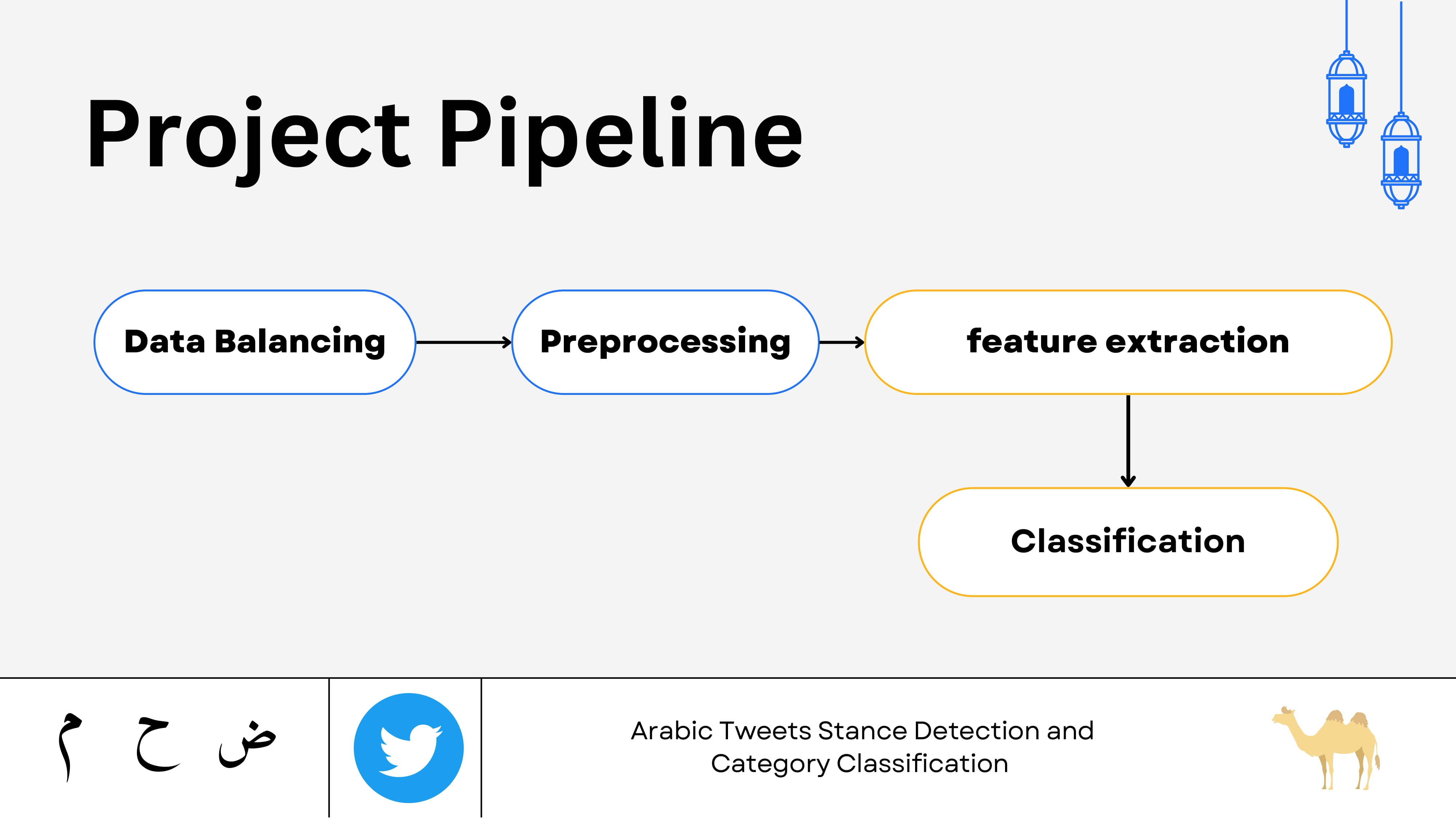
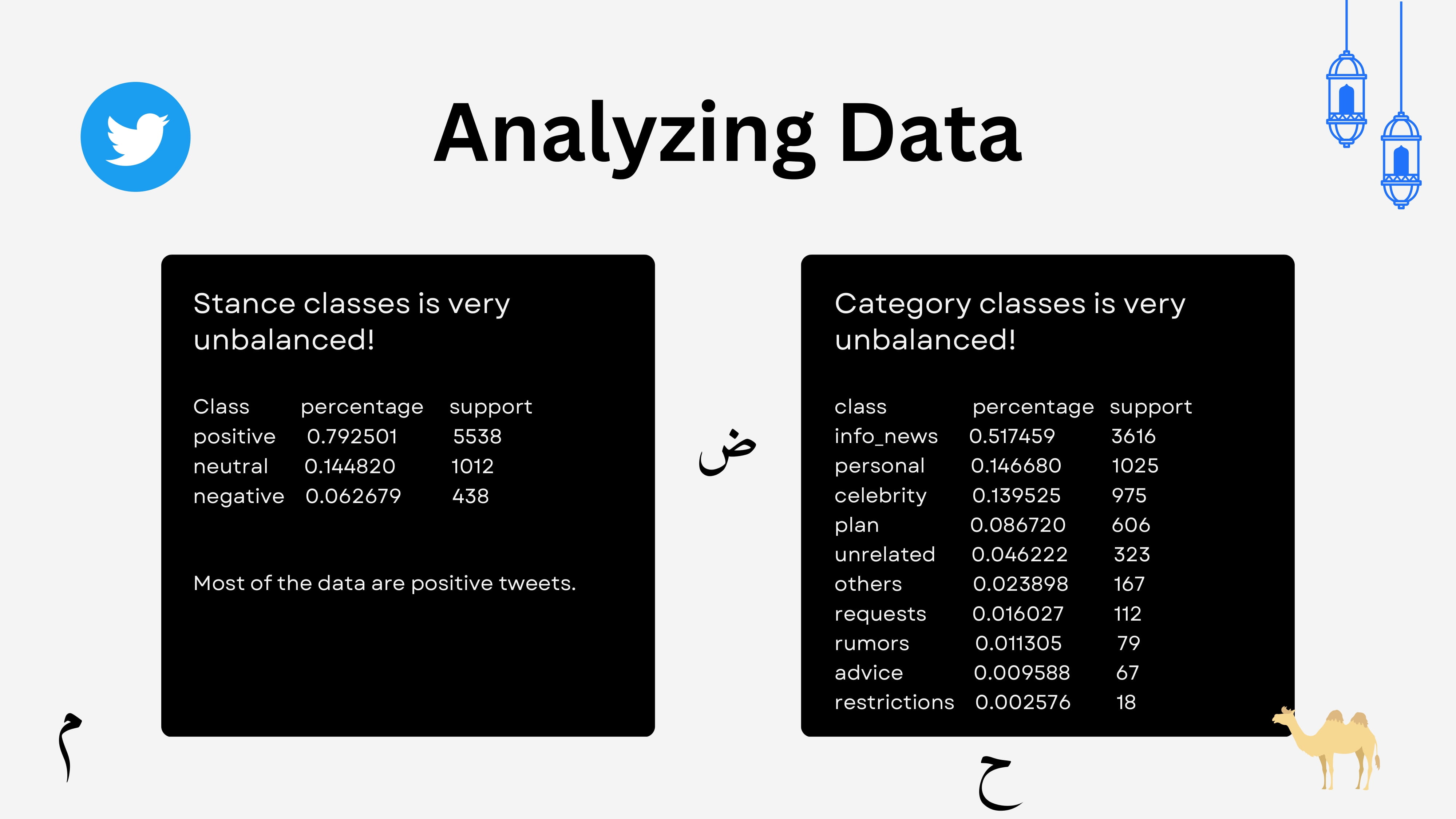
Problem was un-avoidable as unlike 'accuracy', 'macro f1' score will just collapse when we ignore some very low probabilty classes. We implemented two approaches:
Oversampling
More samples for minoriy classes, using class_weight='balanced' in scikit-learn classifiers.
Penalizing mistakes
Higher penalty for minority classses, using imblearn.
We used regex, camel-tools, farasapy, Arabic-Stopwords and nltk
أ إ آ -> اn times.nltk and Arabic-Stopwords) e.g. 'وأيها' , 'عندنا' , 'معي'.camel-tools simple word tokenizer.n-grams and Character n-grams.pooler output from Bert, which resemble embeddings and feed them to SVM as a feature.n_estimators = 1000n_iterations = 300Best results was:
| Preprocessing | Features | Classifier Model | Acc | F1 |
|---|---|---|---|---|
| Farasa lemmatize + dediacritized camel lemmatize + original text | TFIDF char + word | Linear SVM | 80 | 56 |
Other results:
| Features | Classifier Model | Acc | F1 |
|---|---|---|---|
| BOW | Naive Bayes | 56 | 42 |
| BOW | Logistic Regression | 77 | 55 |
| BOW | Random Forest | 80 | 46 |
| BOW | Linear SVM | 76 | 51 |
| CBOW | Ridge Classifier | 73 | 38 |
| S-Gram | Ridge Classifier | 80 | 40 |
In the sequence models family, we’ve built a 3-layer LSTM followed by a linear neural network layer.
LSTM’s Training Settings:
| Epochs | Batch Size | Learning rate | Embedding Dimension | LSTM Hidden layers Dimension |
|---|---|---|---|---|
| 50 | 256 | 0.001 | 300 | 50 |
Best result on Categorization problem:
| Data | Features | Classifier Model | Acc | F1 |
|---|---|---|---|---|
| Oversampled data | Embedding Layer | 3-layer LSTM + 1 NN layer | 56.6 | 25.9 |

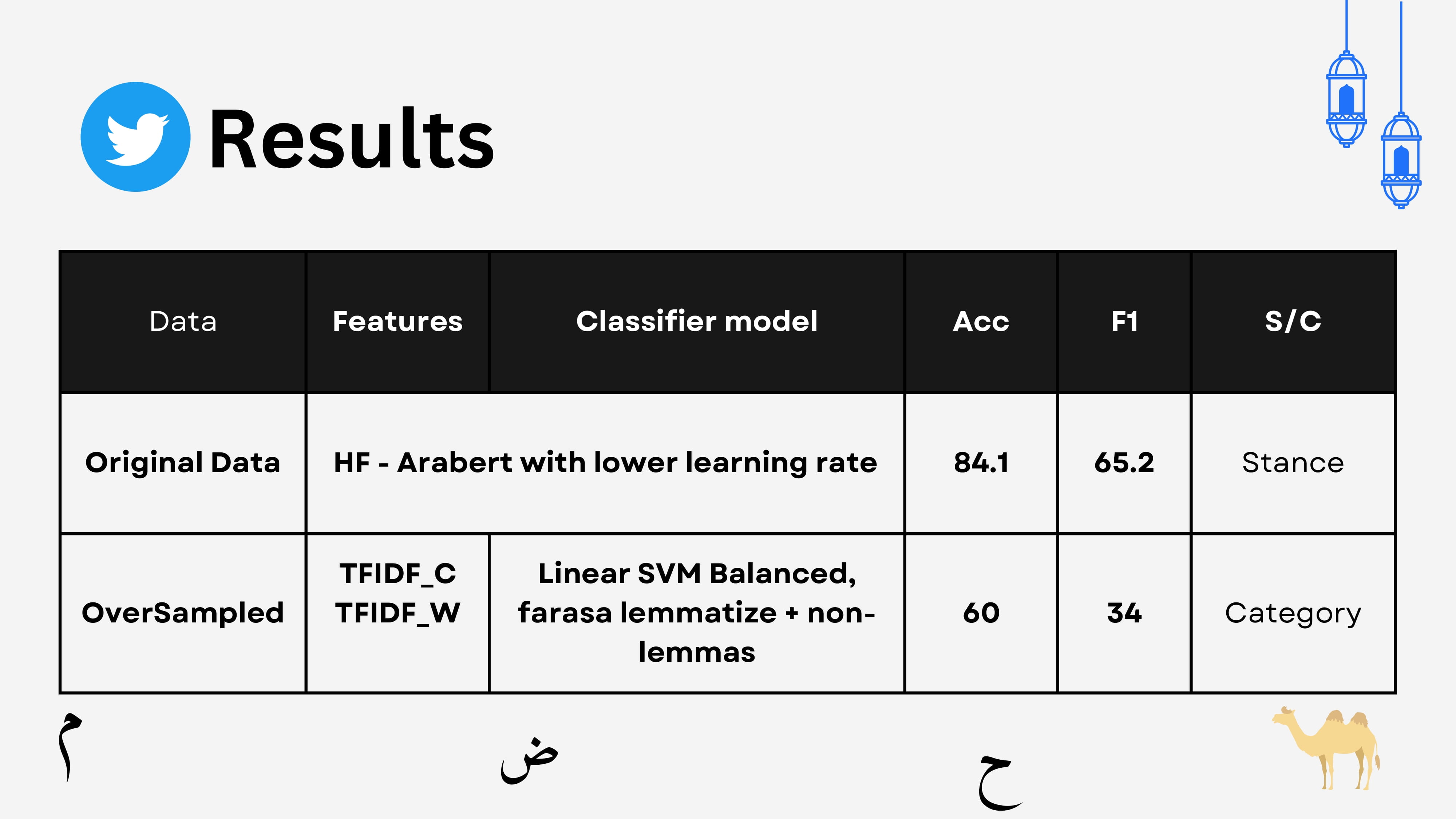
In the transformers family, we’ve fine-tuned an Arabic bert model on our dataset.
The arabic bert used was aubmindlab/bert-base-arabertv02-twitter from hugging face. We’ve chosen this model because it was trained on ~60 Million Arabic tweets.
As per the documentation, we’ve used the preprocessing and tokenizer that was used when the model authors built their model. Fine-tuning:
We use the AraBert as a feature extractor, by first freezing the bert’s parameters, then passing the data through this arabert model, and producing the embedding as output. The sentence embedding is calculated by taking the last layer hidden-state of the first token of the sequence CLS token.
Then the sentence embeddings enters a classifier head we’ve built. The classifier head consists of 2 neural network layers in order to fine tune the weights of the model on our data.
Arabert Training Settings:
| Epochs | Batch Size | Learnign rate |
|---|---|---|
| 50 | 16 | 0.001 |
Arabert embeddings with SVM classifier:
Extract sentences’ embeddings using arabert, then train these embeddings using a linear-kernel SVM.
nltkArabic-Stopwordscamel-tools==1.2.0farasapyarabertpandasscikit-learngensimTransformersimblearn
NLP Project that calculates stance and classifies Arabic tweets about COVID-19 Vaccine
Jupyter Notebook
16
32 commits
updated Jan 12, 2023
NLP Python code that calculates stance and classifies Arabic tweets about COVID-19 vaccination.
Problem was un-avoidable as unlike 'accuracy', 'macro f1' score will just collapse when we ignore some very low probabilty classes. We implemented two approaches:
Oversampling
More samples for minoriy classes, using class_weight='balanced' in scikit-learn classifiers.
Penalizing mistakes
Higher penalty for minority classses, using imblearn.
We used regex, camel-tools, farasapy, Arabic-Stopwords and nltk
أ إ آ -> اn times.nltk and Arabic-Stopwords) e.g. 'وأيها' , 'عندنا' , 'معي'.camel-tools simple word tokenizer.n-grams and Character n-grams.pooler output from Bert, which resemble embeddings and feed them to SVM as a feature.n_estimators = 1000n_iterations = 300Best results was:
| Preprocessing | Features | Classifier Model | Acc | F1 |
|---|---|---|---|---|
| Farasa lemmatize + dediacritized camel lemmatize + original text | TFIDF char + word | Linear SVM | 80 | 56 |
Other results:
| Features | Classifier Model | Acc | F1 |
|---|---|---|---|
| BOW | Naive Bayes | 56 | 42 |
| BOW | Logistic Regression | 77 | 55 |
| BOW | Random Forest | 80 | 46 |
| BOW | Linear SVM | 76 | 51 |
| CBOW | Ridge Classifier | 73 | 38 |
| S-Gram | Ridge Classifier | 80 | 40 |
In the sequence models family, we’ve built a 3-layer LSTM followed by a linear neural network layer.
LSTM’s Training Settings:
| Epochs | Batch Size | Learning rate | Embedding Dimension | LSTM Hidden layers Dimension |
|---|---|---|---|---|
| 50 | 256 | 0.001 | 300 | 50 |
Best result on Categorization problem:
| Data | Features | Classifier Model | Acc | F1 |
|---|---|---|---|---|
| Oversampled data | Embedding Layer | 3-layer LSTM + 1 NN layer | 56.6 | 25.9 |
In the transformers family, we’ve fine-tuned an Arabic bert model on our dataset.
The arabic bert used was aubmindlab/bert-base-arabertv02-twitter from hugging face. We’ve chosen this model because it was trained on ~60 Million Arabic tweets.
As per the documentation, we’ve used the preprocessing and tokenizer that was used when the model authors built their model. Fine-tuning:
We use the AraBert as a feature extractor, by first freezing the bert’s parameters, then passing the data through this arabert model, and producing the embedding as output. The sentence embedding is calculated by taking the last layer hidden-state of the first token of the sequence CLS token.
Then the sentence embeddings enters a classifier head we’ve built. The classifier head consists of 2 neural network layers in order to fine tune the weights of the model on our data.
Arabert Training Settings:
| Epochs | Batch Size | Learnign rate |
|---|---|---|
| 50 | 16 | 0.001 |
Arabert embeddings with SVM classifier:
Extract sentences’ embeddings using arabert, then train these embeddings using a linear-kernel SVM.
nltkArabic-Stopwordscamel-tools==1.2.0farasapyarabertpandasscikit-learngensimTransformersimblearn



