
2021-MICCAI-Progressively Normalized Self-Attention Network for Video Polyp Segmentation
Python
121
83 commits
updated Jun 6, 2026
README
[2021][MICCAI][PNS-Net]Progressively Normalized Self-Attention Network for Video Polyp Segmentation
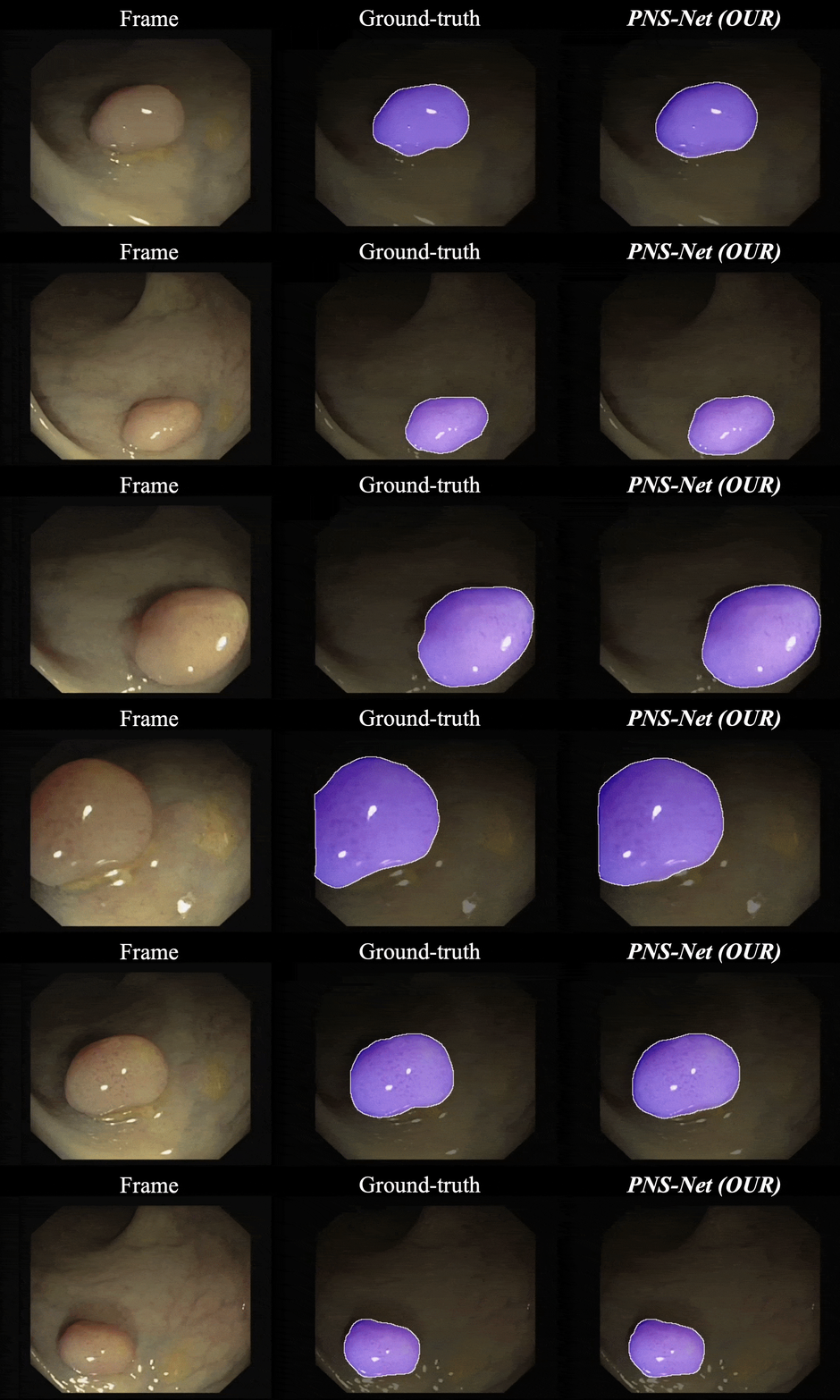
Authors: Ge-Peng Ji*, Yu-Cheng Chou*, Deng-Ping Fan, Geng Chen, Huazhu Fu, Debesh Jha, & Ling Shao.
This repository provides code for paper "Progressively Normalized Self-Attention Network for Video Polyp Segmentation" published at the MICCAI-2021 conference (arXiv Version & Springer version). If you have any questions about our paper, feel free to contact me. And if you like our PNS-Net or evaluation toolbox for your personal research, please cite this paper (BibTeX).
Features
- Hyper Real-time Speed: Our method, named Progressively Normalized Self-Attention Network (PNS-Net), can efficiently learn representations from polyp videos with real-time speed (~140fps) on a single NVIDIA RTX 2080 GPU without any post-processing techniques (e.g., Dense-CRF).
- Plug-and-Play Module: The proposed core module, termed Normalized Self-attention (NS), utilizes channel split,query-dependent, and normalization rules to reduce the computational cost and improve the accuracy, respectively. Note that this module can be flexibly plugged into any framework customed.
- Cutting-edge Performance: Experiments on three challenging video polyp segmentation (VPS) datasets demonstrate that the proposed PNS-Net achieves state-of-the-art performance.
- One-key Evaluation Toolbox: We release the first one-key evaluation toolbox in the VPS field.
1.1. 🔥NEWS🔥 :
- [2022/03/27] :boom: We release a new large-scale dataset on Video Polyp Segmentation (VPS) task, please enjoy it. ProjectLink/ PDF.
- [2021/12/09] The pretraining & training code is released. Please enjoy it.
- [2021/07/09] 「MICCAI 2021 | 超实时140FPS !PNS-Net:从视频中分割息肉」 TechBeat中文解读.
- [2021/06/25]:fire: Our paper have been elected to be honred a MICCAI Student Travel Award.
- [2021/06/19]:fire: A short introduction of our paper is available on my YouTube channel (2min).
- [2021/06/18] Release the inference code! The whole project will be available at the time of MICCAI-2021.
- [2021/06/18] The Chinese translation of our paper is coming, please enjoy it [pdf].
- [2021/05/27] Uploading the training/testing dataset, snapshot, and benchmarking results.
- [2021/05/14] Our work is provisionally accepted at MICCAI 2021. Many thanks to my collaborator Yu-Cheng Chou and supervisor Prof. Deng-Ping Fan.
- [2021/03/10] Create repository.
1.2. Table of Contents
Table of contents generated with markdown-toc
2. Overview
2.1. Introduction
Existing video polyp segmentation (VPS) models typically employ convolutional neural networks (CNNs) to extract features. However, due to their limited receptive fields, CNNs can not fully exploit the global temporal and spatial information in successive video frames, resulting in false-positive segmentation results. In this paper, we propose the novel PNS-Net (Progressively Normalized Self-attention Network), which can efficiently learn representations from polyp videos with real-time speed (~140fps) on a single RTX 2080 GPU and no post-processing.
Our PNS-Net is based solely on a basic normalized self-attention block, dispensing with recurrence and CNNs entirely. Experiments on challenging VPS datasets demonstrate that the proposed PNS-Net achieves state-of-the-art performance. We also conduct extensive experiments to study the effectiveness of the channel split, soft-attention, and progressive learning strategy. We find that our PNS-Net works well under different settings, making it a promising solution to the VPS task.
2.2. Framework Overview
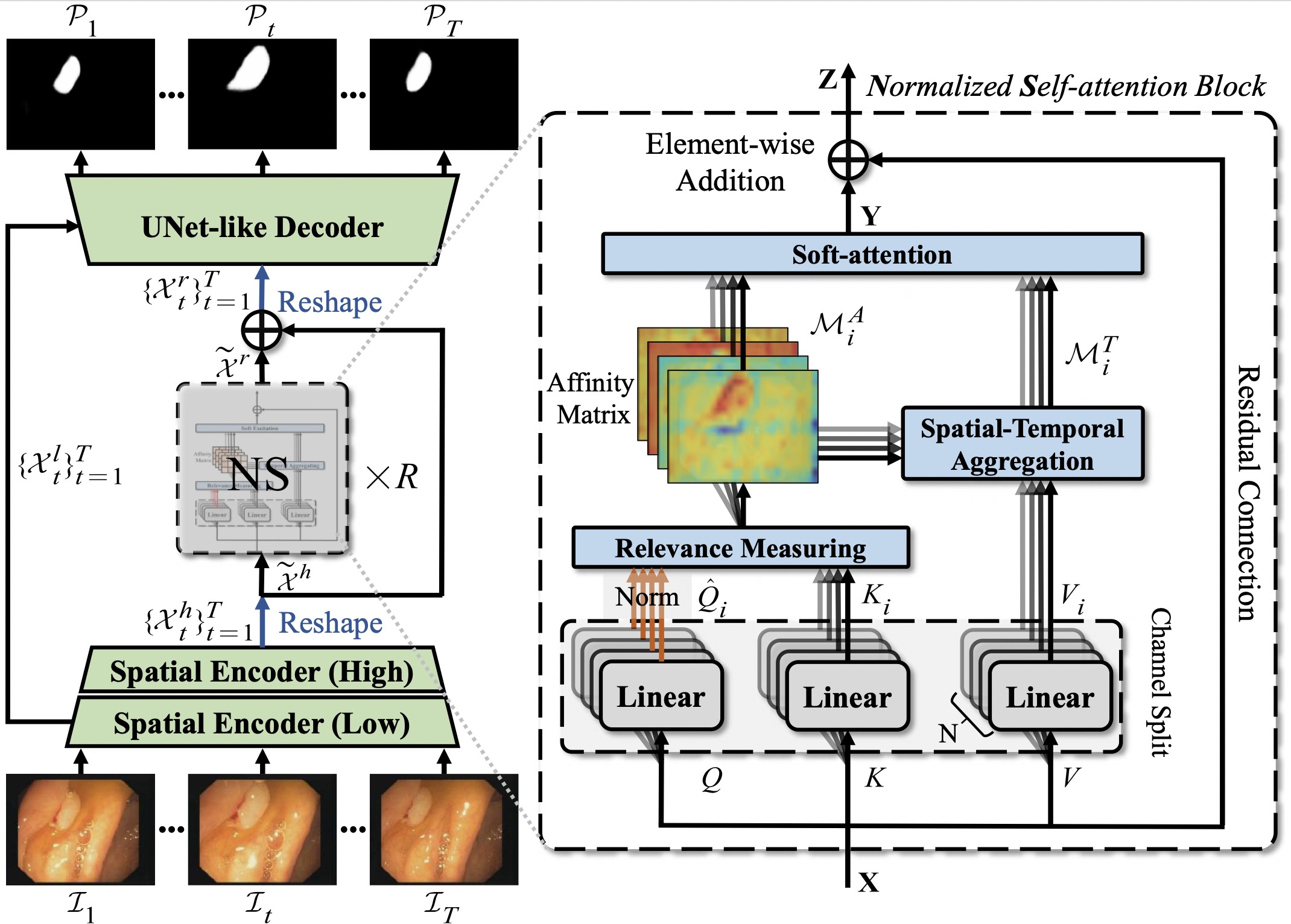
Figure 1: Overview of the proposed PNS-Net, including the normalized self-attention block (see § 2.1) with a stacked (×R) learning strategy.
See § 2 in the paper for details.
2.3. Qualitative Results
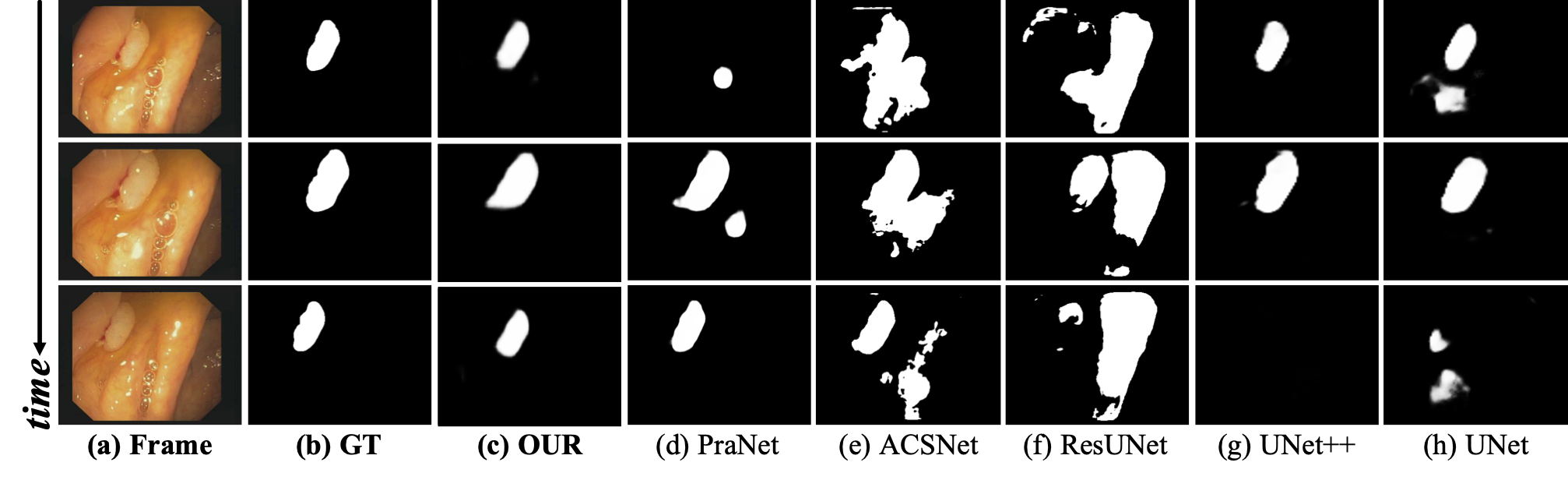
Figure 2: Qualitative Results.
3. Proposed Baseline
3.1. Training/Testing
The training and testing experiments are conducted using PyTorch with a single GeForce RTX 2080 GPU of 8 GB Memory.
-
Configuring your environment (Prerequisites):
Note that PNS-Net is only tested on Ubuntu OS with the following environments. It may work on other operating systems as well but we do not guarantee that it will.
- Creating a virtual environment in terminal:
conda create -n PNSNet python=3.6.- Installing necessary packages PyTorch 1.1:
conda create -n PNSNet python=3.6 conda activate PNSNet conda install pytorch=1.1.0 torchvision -c pytorch pip install tensorboardX tqdm Pillow==6.2.2 pip install git+https://github.com/pytorch/tnt.git@master- Our core design is built on CUDA OP with torchlib. Please ensure the base CUDA toolkit version is 10.x (not at conda env), and then build the NS Block:
cd ./lib/PNS python setup.py build develop -
Downloading necessary data:
-
downloading the training/testing dataset and move it into
./dataset/*, which can be found in this download link (Google Drive, 2.23GB). -
downloading pre-trained weights and move it into
snapshot/ours/PNS.pth, which can be found in this download link (Google Drive, 98.5MB).
-
-
Testing Configuration:
- After you download all the pre-trained model and testing dataset,
just run
MyTest_finetune.pyto generate the final prediction map in./res. - Just enjoy it!
- The prediction results of all competitors and our PNS-Net can be found at Google Drive (7.7MB).
- After you download all the pre-trained model and testing dataset,
just run
-
Training Configuration:
-
With the training dataset downloaded, you can pre-train the model first then fine-tune with the pre-trained weights, just run
MyTrain_Pretrain.pyfirstly andMyTrain_Finetune.pysecondly. -
Remember to configure the
pretrain_state_dictinconfig.pyfor different training stages.
-
3.2 Evaluating your trained model:
One-key evaluation is written in MATLAB code (link),
please follow the instructions in ./eval/main_VPS.m and just run it to generate the evaluation results in ./eval-Result/.
NOTE: The different strategies of the sequential model may generate a various number of predictions, such as optical flow based method only generates T-1 frames due to forward/backward frame-difference strategy. Thus, we test the T-2 frames by removing the first and end frames for a fair comparison.
4. Citation
Please cite our paper if you find the work useful:
@inproceedings{ji2021progressively,
  title={Progressively normalized self-attention network for video polyp segmentation},
  author={Ji, Ge-Peng and Chou, Yu-Cheng and Fan, Deng-Ping and Chen, Geng and Fu, Huazhu and Jha, Debesh and Shao, Ling},
  booktitle={International Conference on Medical Image Computing and Computer-Assisted Intervention},
  pages={142--152},
  year={2021},
  organization={Springer}
}

@inproceedings{fan2020pranet,
  title={Pranet: Parallel reverse attention network for polyp segmentation},
  author={Fan, Deng-Ping and Ji, Ge-Peng and Zhou, Tao and Chen, Geng and Fu, Huazhu and Shen, Jianbing and Shao, Ling},
  booktitle={International conference on medical image computing and computer-assisted intervention},
  pages={263--273},
  year={2020},
  organization={Springer}
}
5. FAQ
-
If you want to improve the usability or any piece of advice, please feel free to contact me directly (E-mail).
-
If the image cannot be loaded on the page (mostly in the domestic network situations): Solution Link
-
Thanks to Tuo Wang for providing a great solution to upgrade the CUDA version when compling the NS block.
6. Acknowledgements
This code is built on SINetV2 (PyTorch) and PyramidCSA (PyTorch). We thank the authors for sharing the codes.
Contributors

78 commits

5 commits
Similar repos


Languages
Python
49.5%
MATLAB
21.9%
C++
15.7%
Cuda
10.5%
C
1.7%
2021-MICCAI-Progressively Normalized Self-Attention Network for Video Polyp Segmentation
Python
121
83 commits
updated Jun 6, 2026
README
[2021][MICCAI][PNS-Net]Progressively Normalized Self-Attention Network for Video Polyp Segmentation
Authors: Ge-Peng Ji*, Yu-Cheng Chou*, Deng-Ping Fan, Geng Chen, Huazhu Fu, Debesh Jha, & Ling Shao.
This repository provides code for paper "Progressively Normalized Self-Attention Network for Video Polyp Segmentation" published at the MICCAI-2021 conference (arXiv Version & Springer version). If you have any questions about our paper, feel free to contact me. And if you like our PNS-Net or evaluation toolbox for your personal research, please cite this paper (BibTeX).
Features
- Hyper Real-time Speed: Our method, named Progressively Normalized Self-Attention Network (PNS-Net), can efficiently learn representations from polyp videos with real-time speed (~140fps) on a single NVIDIA RTX 2080 GPU without any post-processing techniques (e.g., Dense-CRF).
- Plug-and-Play Module: The proposed core module, termed Normalized Self-attention (NS), utilizes channel split,query-dependent, and normalization rules to reduce the computational cost and improve the accuracy, respectively. Note that this module can be flexibly plugged into any framework customed.
- Cutting-edge Performance: Experiments on three challenging video polyp segmentation (VPS) datasets demonstrate that the proposed PNS-Net achieves state-of-the-art performance.
- One-key Evaluation Toolbox: We release the first one-key evaluation toolbox in the VPS field.
1.1. 🔥NEWS🔥 :
- [2022/03/27] :boom: We release a new large-scale dataset on Video Polyp Segmentation (VPS) task, please enjoy it. ProjectLink/ PDF.
- [2021/12/09] The pretraining & training code is released. Please enjoy it.
- [2021/07/09] 「MICCAI 2021 | 超实时140FPS !PNS-Net:从视频中分割息肉」 TechBeat中文解读.
- [2021/06/25]:fire: Our paper have been elected to be honred a MICCAI Student Travel Award.
- [2021/06/19]:fire: A short introduction of our paper is available on my YouTube channel (2min).
- [2021/06/18] Release the inference code! The whole project will be available at the time of MICCAI-2021.
- [2021/06/18] The Chinese translation of our paper is coming, please enjoy it [pdf].
- [2021/05/27] Uploading the training/testing dataset, snapshot, and benchmarking results.
- [2021/05/14] Our work is provisionally accepted at MICCAI 2021. Many thanks to my collaborator Yu-Cheng Chou and supervisor Prof. Deng-Ping Fan.
- [2021/03/10] Create repository.
1.2. Table of Contents
Table of contents generated with markdown-toc
2. Overview
2.1. Introduction
Existing video polyp segmentation (VPS) models typically employ convolutional neural networks (CNNs) to extract features. However, due to their limited receptive fields, CNNs can not fully exploit the global temporal and spatial information in successive video frames, resulting in false-positive segmentation results. In this paper, we propose the novel PNS-Net (Progressively Normalized Self-attention Network), which can efficiently learn representations from polyp videos with real-time speed (~140fps) on a single RTX 2080 GPU and no post-processing.
Our PNS-Net is based solely on a basic normalized self-attention block, dispensing with recurrence and CNNs entirely. Experiments on challenging VPS datasets demonstrate that the proposed PNS-Net achieves state-of-the-art performance. We also conduct extensive experiments to study the effectiveness of the channel split, soft-attention, and progressive learning strategy. We find that our PNS-Net works well under different settings, making it a promising solution to the VPS task.
2.2. Framework Overview
Figure 1: Overview of the proposed PNS-Net, including the normalized self-attention block (see § 2.1) with a stacked (×R) learning strategy.
See § 2 in the paper for details.
2.3. Qualitative Results
Figure 2: Qualitative Results.
3. Proposed Baseline
3.1. Training/Testing
The training and testing experiments are conducted using PyTorch with a single GeForce RTX 2080 GPU of 8 GB Memory.
-
Configuring your environment (Prerequisites):
Note that PNS-Net is only tested on Ubuntu OS with the following environments. It may work on other operating systems as well but we do not guarantee that it will.
- Creating a virtual environment in terminal:
conda create -n PNSNet python=3.6.- Installing necessary packages PyTorch 1.1:
conda create -n PNSNet python=3.6 conda activate PNSNet conda install pytorch=1.1.0 torchvision -c pytorch pip install tensorboardX tqdm Pillow==6.2.2 pip install git+https://github.com/pytorch/tnt.git@master- Our core design is built on CUDA OP with torchlib. Please ensure the base CUDA toolkit version is 10.x (not at conda env), and then build the NS Block:
cd ./lib/PNS python setup.py build develop -
Downloading necessary data:
-
downloading the training/testing dataset and move it into
./dataset/*, which can be found in this download link (Google Drive, 2.23GB). -
downloading pre-trained weights and move it into
snapshot/ours/PNS.pth, which can be found in this download link (Google Drive, 98.5MB).
-
-
Testing Configuration:
- After you download all the pre-trained model and testing dataset,
just run
MyTest_finetune.pyto generate the final prediction map in./res. - Just enjoy it!
- The prediction results of all competitors and our PNS-Net can be found at Google Drive (7.7MB).
- After you download all the pre-trained model and testing dataset,
just run
-
Training Configuration:
-
With the training dataset downloaded, you can pre-train the model first then fine-tune with the pre-trained weights, just run
MyTrain_Pretrain.pyfirstly andMyTrain_Finetune.pysecondly. -
Remember to configure the
pretrain_state_dictinconfig.pyfor different training stages.
-
3.2 Evaluating your trained model:
One-key evaluation is written in MATLAB code (link),
please follow the instructions in ./eval/main_VPS.m and just run it to generate the evaluation results in ./eval-Result/.
NOTE: The different strategies of the sequential model may generate a various number of predictions, such as optical flow based method only generates T-1 frames due to forward/backward frame-difference strategy. Thus, we test the T-2 frames by removing the first and end frames for a fair comparison.
4. Citation
Please cite our paper if you find the work useful:
@inproceedings{ji2021progressively,
  title={Progressively normalized self-attention network for video polyp segmentation},
  author={Ji, Ge-Peng and Chou, Yu-Cheng and Fan, Deng-Ping and Chen, Geng and Fu, Huazhu and Jha, Debesh and Shao, Ling},
  booktitle={International Conference on Medical Image Computing and Computer-Assisted Intervention},
  pages={142--152},
  year={2021},
  organization={Springer}
}

@inproceedings{fan2020pranet,
  title={Pranet: Parallel reverse attention network for polyp segmentation},
  author={Fan, Deng-Ping and Ji, Ge-Peng and Zhou, Tao and Chen, Geng and Fu, Huazhu and Shen, Jianbing and Shao, Ling},
  booktitle={International conference on medical image computing and computer-assisted intervention},
  pages={263--273},
  year={2020},
  organization={Springer}
}
5. FAQ
-
If you want to improve the usability or any piece of advice, please feel free to contact me directly (E-mail).
-
If the image cannot be loaded on the page (mostly in the domestic network situations): Solution Link
-
Thanks to Tuo Wang for providing a great solution to upgrade the CUDA version when compling the NS block.
6. Acknowledgements
This code is built on SINetV2 (PyTorch) and PyramidCSA (PyTorch). We thank the authors for sharing the codes.
Similar repos
Contributors
78 commits
5 commits
Languages
Python
49.5%
MATLAB
21.9%
C++
15.7%
Cuda
10.5%
C
1.7%