[ICML 2026 Spotlight] Latent Collaboration in Multi-Agent Systems
See the code






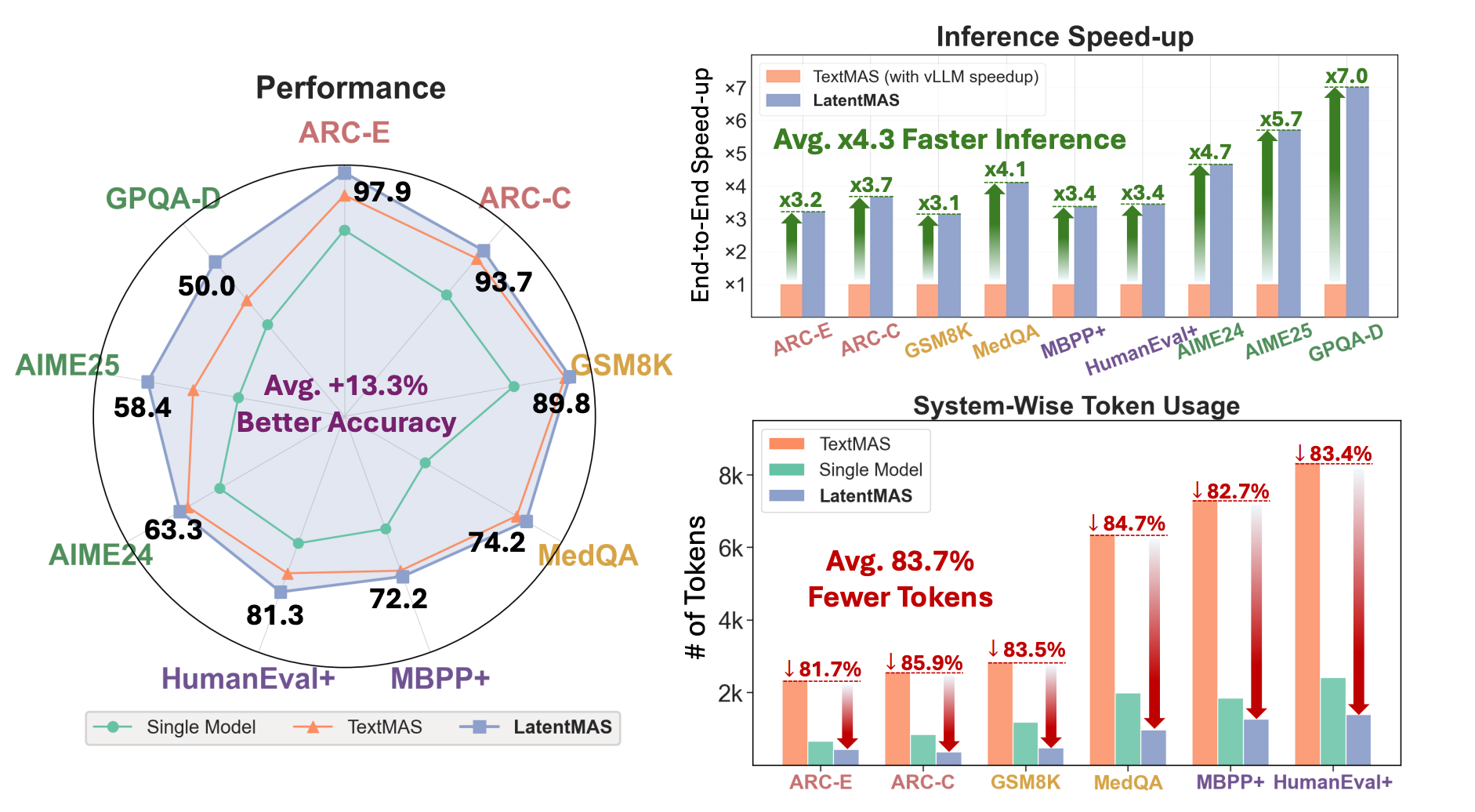
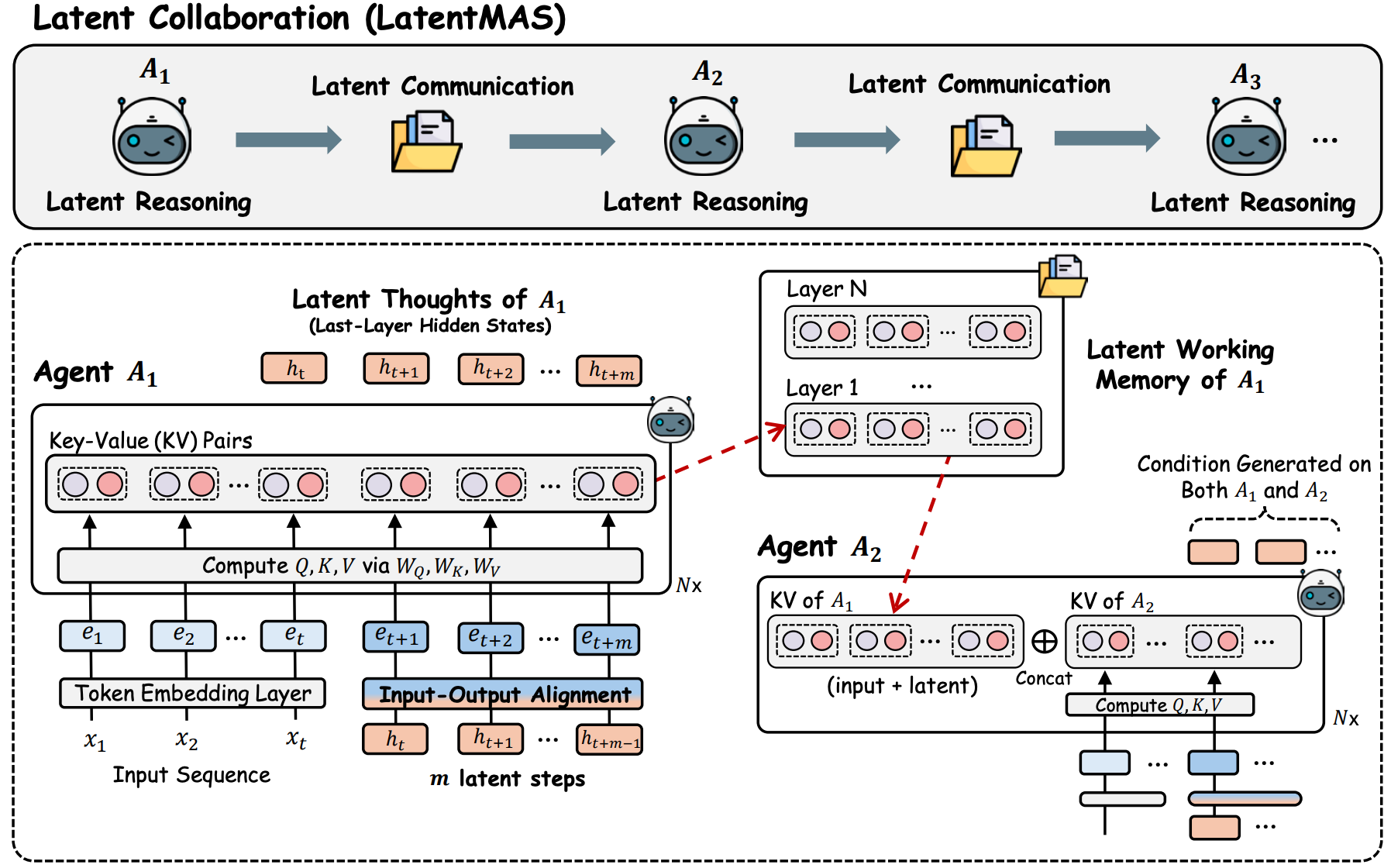
LatentMAS is a multi-agent reasoning framework that moves agent collaboration from token space into the model’s latent space.
Instead of producing long textual reasoning traces, agents communicate by passing latent thoughts through their own working memory. LatentMAS has the following key features:
Overall, LatentMAS achieves superior performance, lower token usage, and major wall-clock speedups of the multi-agent system.
[2026-05-01] LatentMAS has been accepted into ICML 2026 as a spotlight !
[2026-02-26] 🦞 Check out OpenClaw-RL from our Gen-Verse group! OpenClaw-RL is a fully asynchronous RL framework that trains personalized AI agents directly from natural conversation feedback — no manual labels, no API keys. It introduces two learning paradigms (Binary RL via GRPO and On-Policy Distillation) and runs the entire stack on your own infrastructure. A great complement to LatentMAS's efficient multi-agent reasoning!
[2025-12-20] Check Science-LatentMAS, an excellent extension of LatentMAS developed by Prof. Markus J. Buehler and the LAMM Lab at MIT. Science-LatentMAS is specifically designed for the scientific discovery downstream applications! For more details and instructions, please check our README section "Science-LatentMAS" below and the new Science-LatentMAS branch.
[2025-12-15] Check out these amazing community-driven extensions of LatentMAS!
[2025-11-25] We have released our paper and code implementations for LatentMAS! Stay tuned for more model-backbone supports and advanced features!
[2025-11-25] We are featured as 🤗 HuggingFace 1st Paper of the Day!
Explore community-driven extensions that expand LatentMAS into new domains, architectures, and collaboration patterns:
By Prof. Markus J. Buehler & MIT LAMM Group
By Bookmaster9
By nhminle
By Everest-AN
By Arifuzzaman Joy
By VectorArc
If your work extends LatentMAS, feel free to open a PR and we’ll feature it here! 🚀
Three main tables from our paper spanning 9 tasks across math & science reasoning, commensonse reasoning, and code generation:
Table 1 — LatentMAS under the Sequantial MAS setting
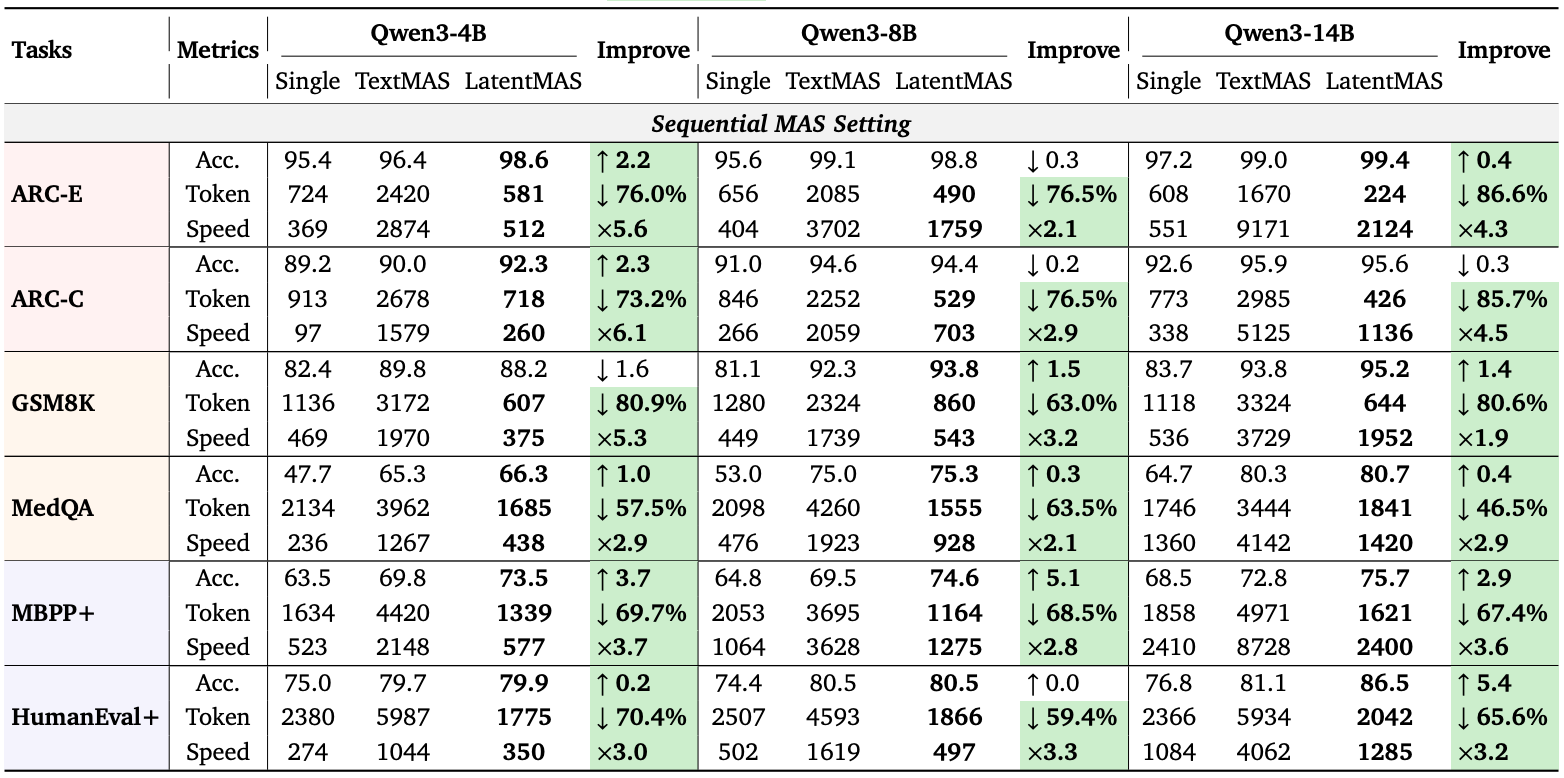
Table 2 — LatentMAS under the Hierarchical MAS setting
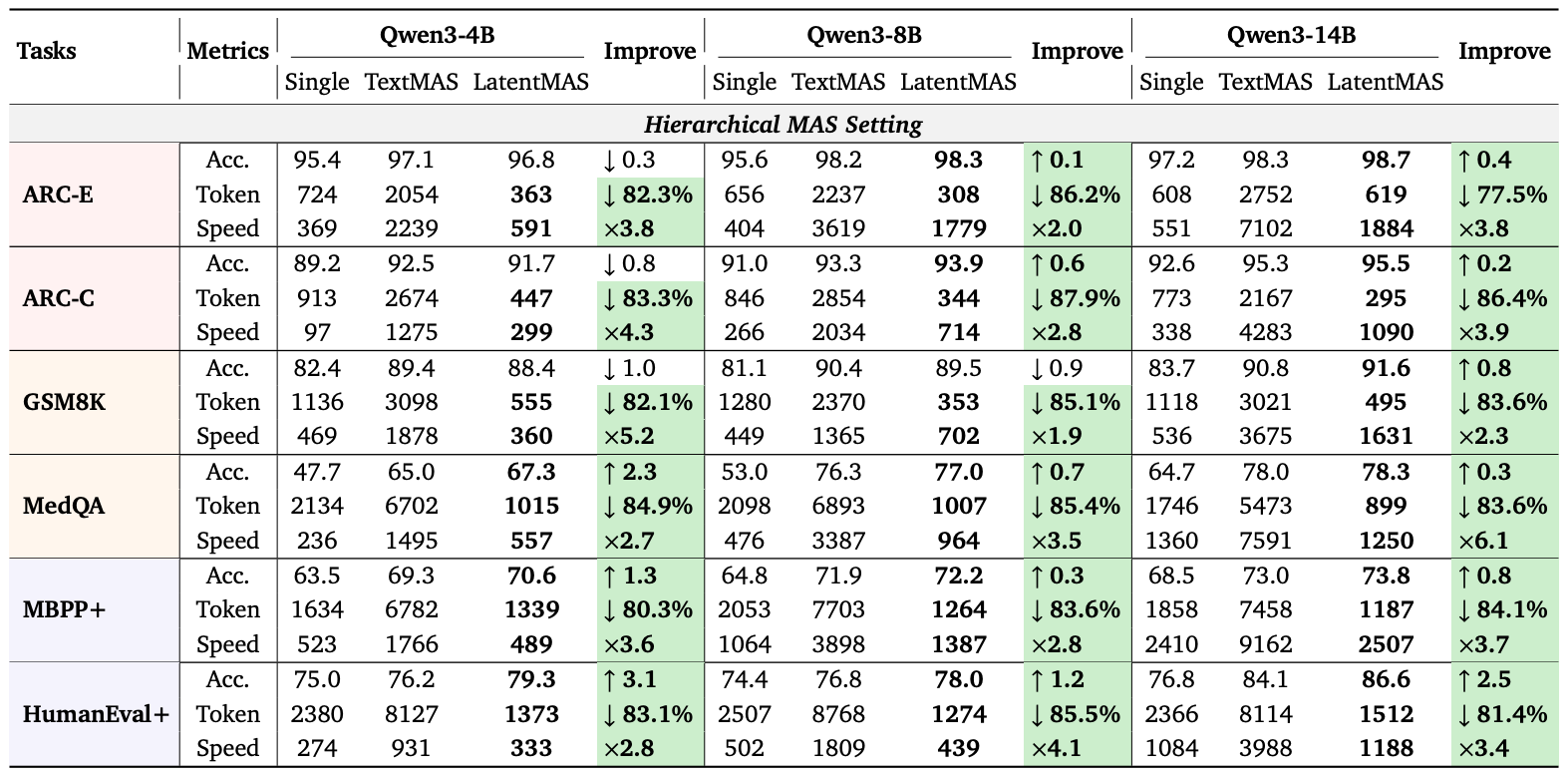
Table 3 — Main Results on Reasoning Intensive Tasks
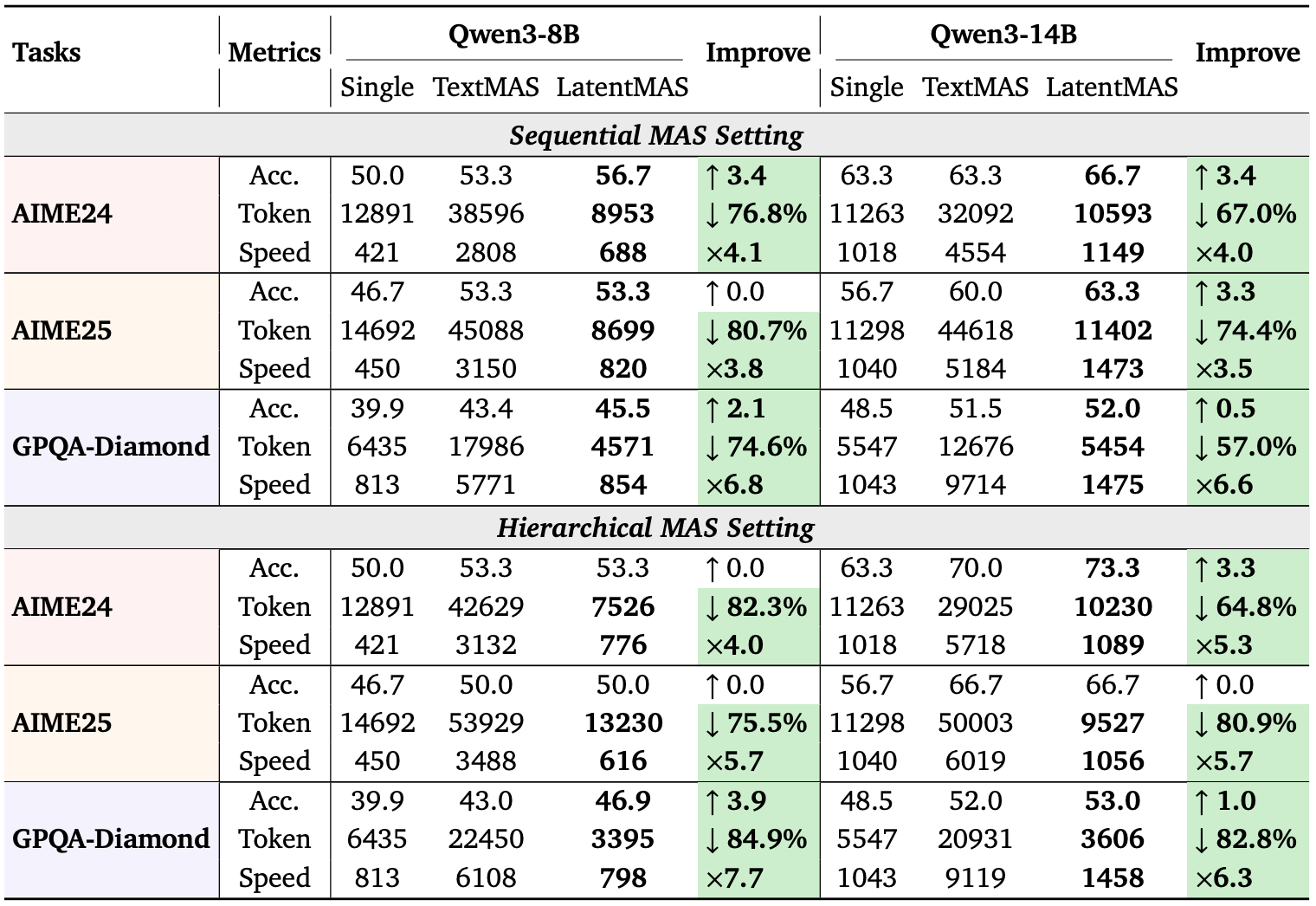
Overall, LatentMAS reduces:
This repository provides all code for reproducing LatentMAS, TextMAS, and baseline single-agent experiments across GSM8K, AIME24/25, GPQA, ARC-Easy/Challenge, MBPP+, HumanEval+, and MedQA.
We recommend setting your HF cache directory to avoid repeated downloads:
export HF_HOME=/path/to/huggingface
export TRANSFORMERS_CACHE=$HF_HOME
export HF_DATASETS_CACHE=$HF_HOME
Models and datasets will automatically be downloaded into $HF_HOME.
conda create -n latentmas python=3.10 -y
conda activate latentmas

pip install -r requirements.txt
If you want vLLM support, also install:
pip install vllm
git clone https://github.com/Gen-Verse/LatentMAS.git
cd LatentMAS
LatentMAS/
│── run.py                 # Main entry for experiments
│── models.py              # Wrapper for HF + vLLM + latent realignment
│── methods/
│   ├── baseline.py        # Single-agent baseline
│   ├── text_mas.py        # Token-space multi-agent method
│   └── latent_mas.py      # Latent-space multi-agent (our method)
│── prompts.py             # Prompt constructors
│── data.py                # Dataset loaders
│── data/                  # Provided data + figures (We give medqa.json as an example here)
│── utils.py               # Answer parsing / timeout / helpers
│── example_logs/          # Example logs from LatentMAS
│── requirements.txt
python run.py --method baseline --model_name Qwen/Qwen3-14B --task gsm8k --max_samples -1 --max_new_tokens 2048
python run.py --method text_mas --model_name Qwen/Qwen3-14B --task gsm8k --prompt sequential --max_samples -1 --max_new_tokens 2048
# 4B example command
python run.py --method latent_mas --model_name Qwen/Qwen3-4B --task gsm8k --prompt sequential --max_samples -1 --max_new_tokens 2048

# 8B example command
python run.py --method latent_mas --model_name Qwen/Qwen3-8B --task gsm8k --prompt sequential --max_samples -1 --max_new_tokens 2048

# 14B example command
python run.py --method latent_mas --model_name Qwen/Qwen3-14B --task gsm8k --prompt sequential --max_samples -1 --max_new_tokens 2048
--latent_steps ∈ [0, 80]
Tune for best performance.--latent_space_realign
Enables latent→embedding alignment
We treat this as a hyperparameter — enable/disable depending on task/model:python run.py --method latent_mas --model_name Qwen/Qwen3-14B --task gsm8k --prompt sequential --max_samples -1 --latent_space_realign --max_new_tokens 2048
Two example LatentMAS logs are provided for reference purposes:
example_logs/qwen3_14b_mbppplus_sequential.txtexample_logs/qwen3_14b_humanevalplus_hierarchical.txtPlease refer to additional experiment logs here. You can open them to view the full agent interaction traces and outputs.
LatentMAS supports vLLM for faster inference.
python run.py --method baseline --model_name Qwen/Qwen3-14B --task gsm8k --max_samples -1 --use_vllm --max_new_tokens 2048
python run.py --method text_mas --model_name Qwen/Qwen3-14B --task gsm8k --prompt sequential --max_samples -1 --use_vllm --max_new_tokens 2048
LatentMAS supports a hybrid HF + vLLM pipeline for fast inference:
For this setup, we recommend using two GPUs:
--device, e.g., cuda:0)--device2, e.g., cuda:1)CUDA_VISIBLE_DEVICES=0,1 python run.py --method latent_mas --model_name Qwen/Qwen3-14B --task gsm8k --prompt sequential --max_samples -1 --max_new_tokens 2048 \
--use_vllm \
--use_second_HF_model \
--enable_prefix_caching \
--device2 cuda:1
📍Important Note:
vLLM does not officially support modifying KV-cache or prompting via latent embeddings. We modify the partial inner package inside vLLM backend for our method implementation. Note minor numeric differences may arise compared to offical HF backend due to different decoding (generation) strategies. Please Use the HF backend to reproduce the official published results.
💫 If you find LatentMAS helpful, please kindly give us a star ⭐️ and cite below. Thanks!
@inproceedings{
zou2025latentmas,
  title={Latent Collaboration in Multi-Agent Systems},
  author={Jiaru Zou and Ruizhong Qiu and Gaotang Li and Xiyuan Yang and Katherine Tieu and Pan Lu and Ke Shen and Hanghang Tong and Yejin Choi and Jingrui He and James Zou and Mengdi Wang and Ling Yang},
  booktitle={Forty-third International Conference on Machine Learning},
  year={2026}
}
This code is partially based on the amazing work of vLLM.
169 followers · starred Feb 2026
3,548 followers · starred Dec 2025
1,330 followers · starred Sep 2026
235 followers · starred Nov 2025
[ICML 2026 Spotlight] Latent Collaboration in Multi-Agent Systems
See the code
LatentMAS is a multi-agent reasoning framework that moves agent collaboration from token space into the model’s latent space.
Instead of producing long textual reasoning traces, agents communicate by passing latent thoughts through their own working memory. LatentMAS has the following key features:
Overall, LatentMAS achieves superior performance, lower token usage, and major wall-clock speedups of the multi-agent system.
[2026-05-01] LatentMAS has been accepted into ICML 2026 as a spotlight !
[2026-02-26] 🦞 Check out OpenClaw-RL from our Gen-Verse group! OpenClaw-RL is a fully asynchronous RL framework that trains personalized AI agents directly from natural conversation feedback — no manual labels, no API keys. It introduces two learning paradigms (Binary RL via GRPO and On-Policy Distillation) and runs the entire stack on your own infrastructure. A great complement to LatentMAS's efficient multi-agent reasoning!
[2025-12-20] Check Science-LatentMAS, an excellent extension of LatentMAS developed by Prof. Markus J. Buehler and the LAMM Lab at MIT. Science-LatentMAS is specifically designed for the scientific discovery downstream applications! For more details and instructions, please check our README section "Science-LatentMAS" below and the new Science-LatentMAS branch.
[2025-12-15] Check out these amazing community-driven extensions of LatentMAS!
[2025-11-25] We have released our paper and code implementations for LatentMAS! Stay tuned for more model-backbone supports and advanced features!
[2025-11-25] We are featured as 🤗 HuggingFace 1st Paper of the Day!
Explore community-driven extensions that expand LatentMAS into new domains, architectures, and collaboration patterns:
By Prof. Markus J. Buehler & MIT LAMM Group
By Bookmaster9
By nhminle
By Everest-AN
By Arifuzzaman Joy
By VectorArc
If your work extends LatentMAS, feel free to open a PR and we’ll feature it here! 🚀
Three main tables from our paper spanning 9 tasks across math & science reasoning, commensonse reasoning, and code generation:
Table 1 — LatentMAS under the Sequantial MAS setting
Table 2 — LatentMAS under the Hierarchical MAS setting
Table 3 — Main Results on Reasoning Intensive Tasks
Overall, LatentMAS reduces:
This repository provides all code for reproducing LatentMAS, TextMAS, and baseline single-agent experiments across GSM8K, AIME24/25, GPQA, ARC-Easy/Challenge, MBPP+, HumanEval+, and MedQA.
We recommend setting your HF cache directory to avoid repeated downloads:
export HF_HOME=/path/to/huggingface
export TRANSFORMERS_CACHE=$HF_HOME
export HF_DATASETS_CACHE=$HF_HOME
Models and datasets will automatically be downloaded into $HF_HOME.
conda create -n latentmas python=3.10 -y
conda activate latentmas

pip install -r requirements.txt
If you want vLLM support, also install:
pip install vllm
git clone https://github.com/Gen-Verse/LatentMAS.git
cd LatentMAS
LatentMAS/
│── run.py                 # Main entry for experiments
│── models.py              # Wrapper for HF + vLLM + latent realignment
│── methods/
│   ├── baseline.py        # Single-agent baseline
│   ├── text_mas.py        # Token-space multi-agent method
│   └── latent_mas.py      # Latent-space multi-agent (our method)
│── prompts.py             # Prompt constructors
│── data.py                # Dataset loaders
│── data/                  # Provided data + figures (We give medqa.json as an example here)
│── utils.py               # Answer parsing / timeout / helpers
│── example_logs/          # Example logs from LatentMAS
│── requirements.txt
python run.py --method baseline --model_name Qwen/Qwen3-14B --task gsm8k --max_samples -1 --max_new_tokens 2048
python run.py --method text_mas --model_name Qwen/Qwen3-14B --task gsm8k --prompt sequential --max_samples -1 --max_new_tokens 2048
# 4B example command
python run.py --method latent_mas --model_name Qwen/Qwen3-4B --task gsm8k --prompt sequential --max_samples -1 --max_new_tokens 2048

# 8B example command
python run.py --method latent_mas --model_name Qwen/Qwen3-8B --task gsm8k --prompt sequential --max_samples -1 --max_new_tokens 2048

# 14B example command
python run.py --method latent_mas --model_name Qwen/Qwen3-14B --task gsm8k --prompt sequential --max_samples -1 --max_new_tokens 2048
--latent_steps ∈ [0, 80]
Tune for best performance.--latent_space_realign
Enables latent→embedding alignment
We treat this as a hyperparameter — enable/disable depending on task/model:python run.py --method latent_mas --model_name Qwen/Qwen3-14B --task gsm8k --prompt sequential --max_samples -1 --latent_space_realign --max_new_tokens 2048
Two example LatentMAS logs are provided for reference purposes:
example_logs/qwen3_14b_mbppplus_sequential.txtexample_logs/qwen3_14b_humanevalplus_hierarchical.txtPlease refer to additional experiment logs here. You can open them to view the full agent interaction traces and outputs.
LatentMAS supports vLLM for faster inference.
python run.py --method baseline --model_name Qwen/Qwen3-14B --task gsm8k --max_samples -1 --use_vllm --max_new_tokens 2048
python run.py --method text_mas --model_name Qwen/Qwen3-14B --task gsm8k --prompt sequential --max_samples -1 --use_vllm --max_new_tokens 2048
LatentMAS supports a hybrid HF + vLLM pipeline for fast inference:
For this setup, we recommend using two GPUs:
--device, e.g., cuda:0)--device2, e.g., cuda:1)CUDA_VISIBLE_DEVICES=0,1 python run.py --method latent_mas --model_name Qwen/Qwen3-14B --task gsm8k --prompt sequential --max_samples -1 --max_new_tokens 2048 \
--use_vllm \
--use_second_HF_model \
--enable_prefix_caching \
--device2 cuda:1
📍Important Note:
vLLM does not officially support modifying KV-cache or prompting via latent embeddings. We modify the partial inner package inside vLLM backend for our method implementation. Note minor numeric differences may arise compared to offical HF backend due to different decoding (generation) strategies. Please Use the HF backend to reproduce the official published results.
💫 If you find LatentMAS helpful, please kindly give us a star ⭐️ and cite below. Thanks!
@inproceedings{
zou2025latentmas,
  title={Latent Collaboration in Multi-Agent Systems},
  author={Jiaru Zou and Ruizhong Qiu and Gaotang Li and Xiyuan Yang and Katherine Tieu and Pan Lu and Ke Shen and Hanghang Tong and Yejin Choi and Jingrui He and James Zou and Mengdi Wang and Ling Yang},
  booktitle={Forty-third International Conference on Machine Learning},
  year={2026}
}
This code is partially based on the amazing work of vLLM.
169 followers · starred Feb 2026
3,548 followers · starred Dec 2025
1,330 followers · starred Sep 2026
235 followers · starred Nov 2025



