Anima: a Claude Code skill that turns a biology idea into an interactive, sourced, isometric figure. Dopamine receptors, stimulants, addiction circuits, semaglutide.
See the codeAsk Claude for a biology figure. Get an interactive, sourced, isometric one.
A Claude Code skill that turns "show me how cocaine and amphetamine act differently at a dopamine synapse" into a live, standalone page: real structures, a mechanism you can toggle, a readout driven by one small model, and a citation for every number on screen.
Watch the 35-second launch video · Full demo (MP4) · Try every figure live
Most science graphics are either static diagrams or confident-looking animations with no sources. This skill holds itself to a different standard:
npx skills add Garinmckayl/anima -g -a claude-code
Requires Claude Code and Node.js 20.10 or later. The drawing kit uses only Node built-ins and has zero runtime dependencies. Chrome or Chromium is needed only for the capture and verification scripts.
In Claude Code:
/anima show how cocaine and amphetamine act differently at the dopamine transporter, with a drug selector and sourced mechanisms; standalone HTML
/anima visualize semaglutide acting on a pancreatic beta cell, with glucose-dependent insulin release, cited label numbers and an educational-use note
/anima show D1 and D2 receptor signalling in a striatal neuron, with the G-protein cycle and a receptor-antagonist toggle
/anima make a mid-sagittal brain showing the mesolimbic pathway and one model of how it changes with repeated drug exposure; cite every claim
Name the biological subject, the mechanism to explain, the audience and the output format. The skill sizes the job first (Figure, Hero or Epic), collects sources before drawing, builds the page, then checks it the way a reviewer would: zoomed in, in both themes, at phone width.
Each figure builds to a standalone HTML page in dark and light themes. Open the pages straight from the repo, or live on GitHub Pages.
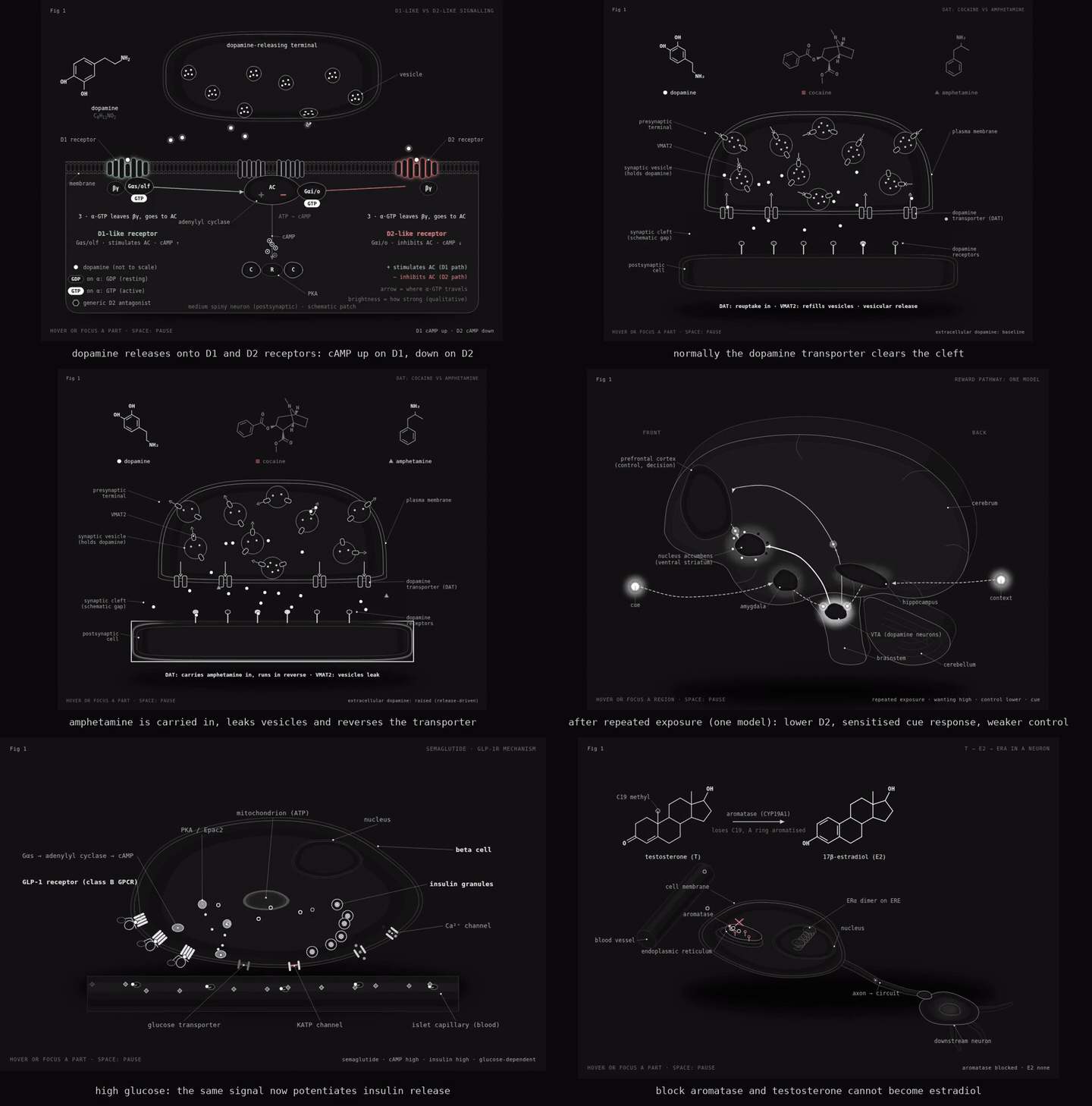
| Dopamine receptors (light) D1-like receptors couple Gαs/olf and raise cAMP; D2-like receptors couple Gαi/o and lower it. Full G-protein cycle, a dopamine-level slider and a generic D2-antagonist toggle. 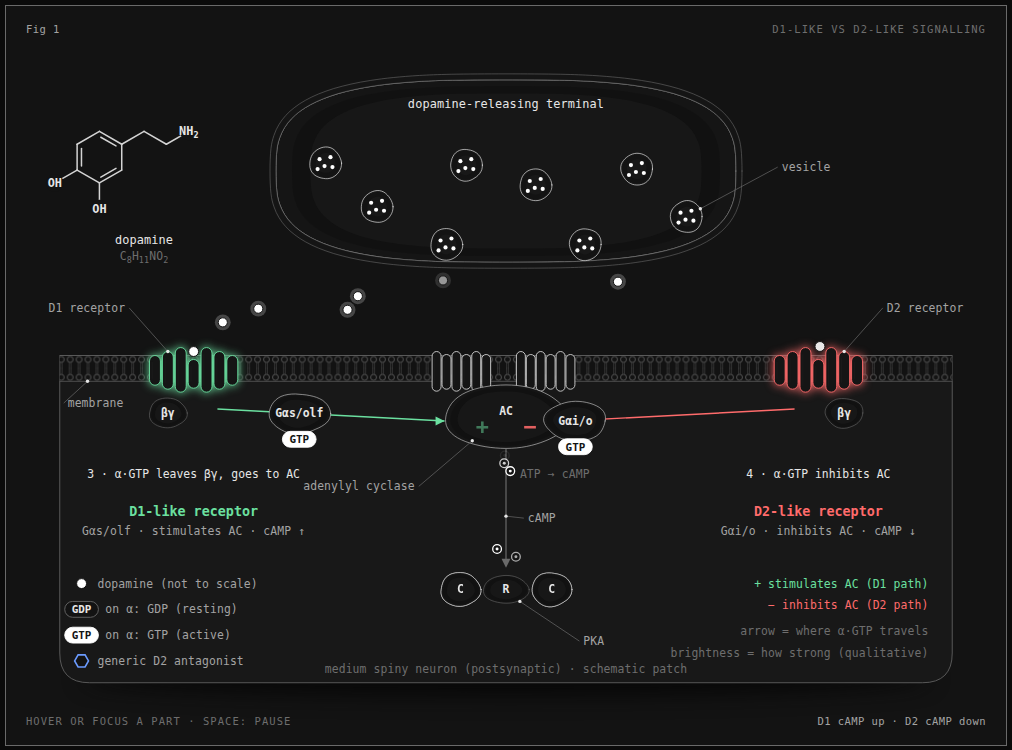 | Stimulants at the transporter (light) None, cocaine or amphetamine. Reuptake, blockade, and amphetamine's transport, vesicle leak and reverse efflux. Skeletal formulas from PubChem. 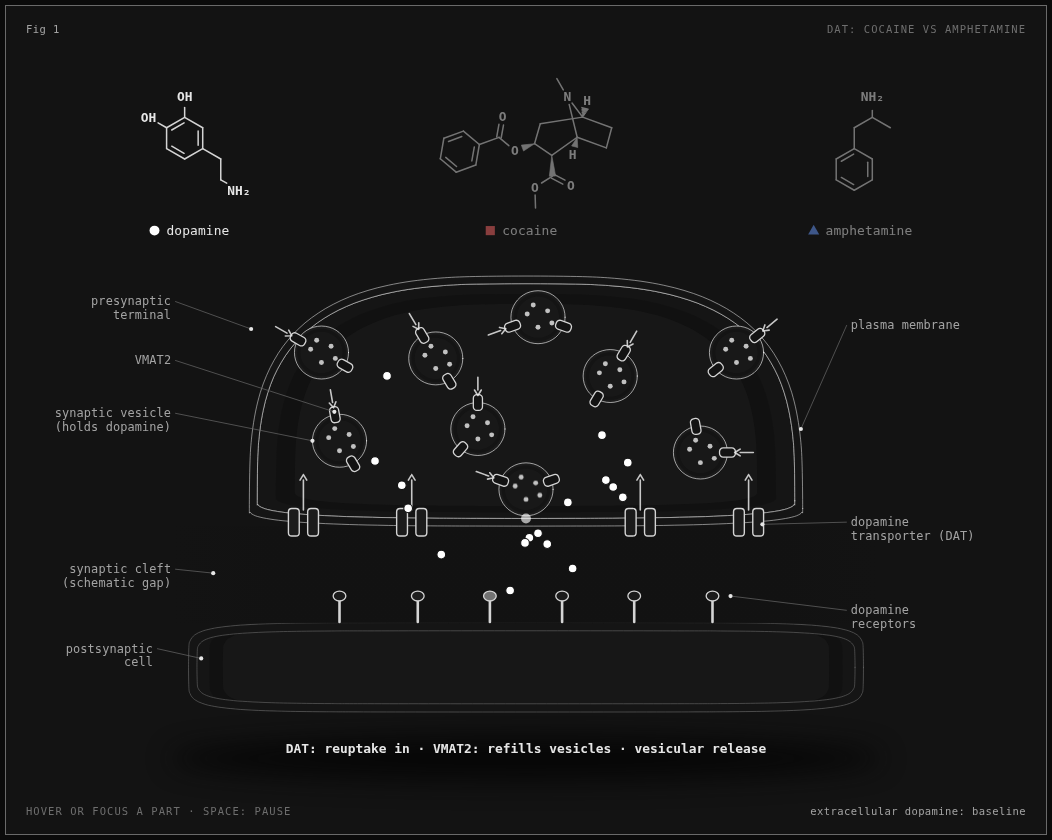 |
| Reward and addiction (light) The mesolimbic pathway, a cue sequence, and one leading model of what changes after repeated exposure. Framed as a model, with sources. 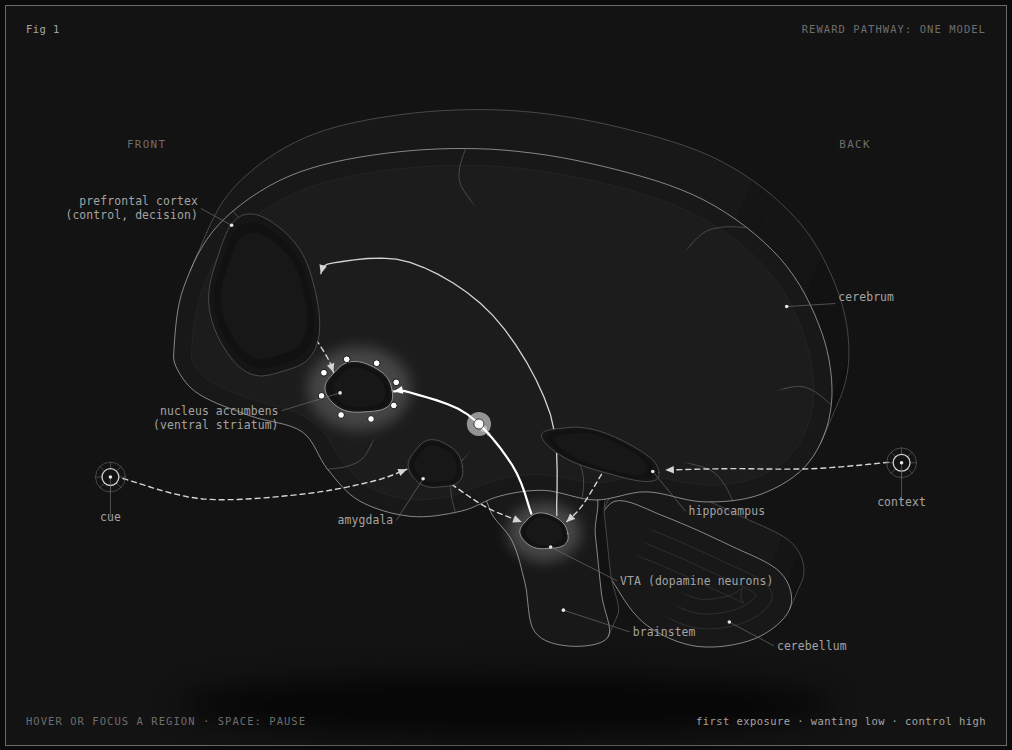 | Semaglutide and GLP-1 (light) A GLP-1 receptor agonist on a beta cell: glucose-dependent insulin release, the molecule's engineered features, and the preclinical-versus-clinical state of the appetite and reward evidence. 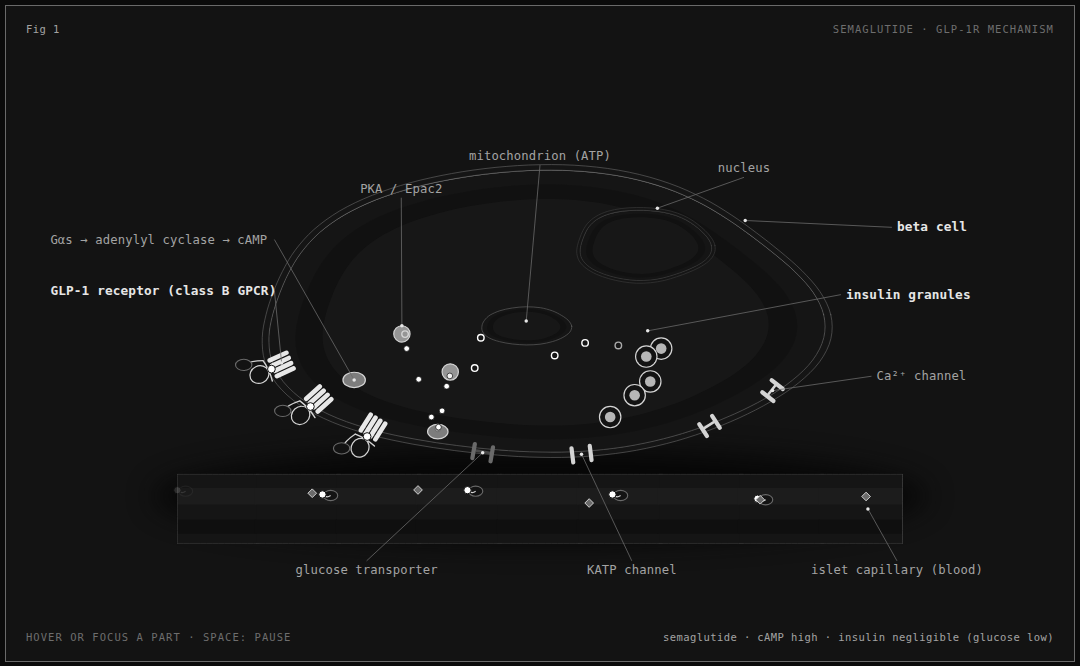 |
| Estrogen and aggression (light) Testosterone to estradiol by aromatase, then estrogen receptor α, in an amygdala-type neuron. States that the human evidence is weak (pooled Fisher z 0.16 across 14 studies). 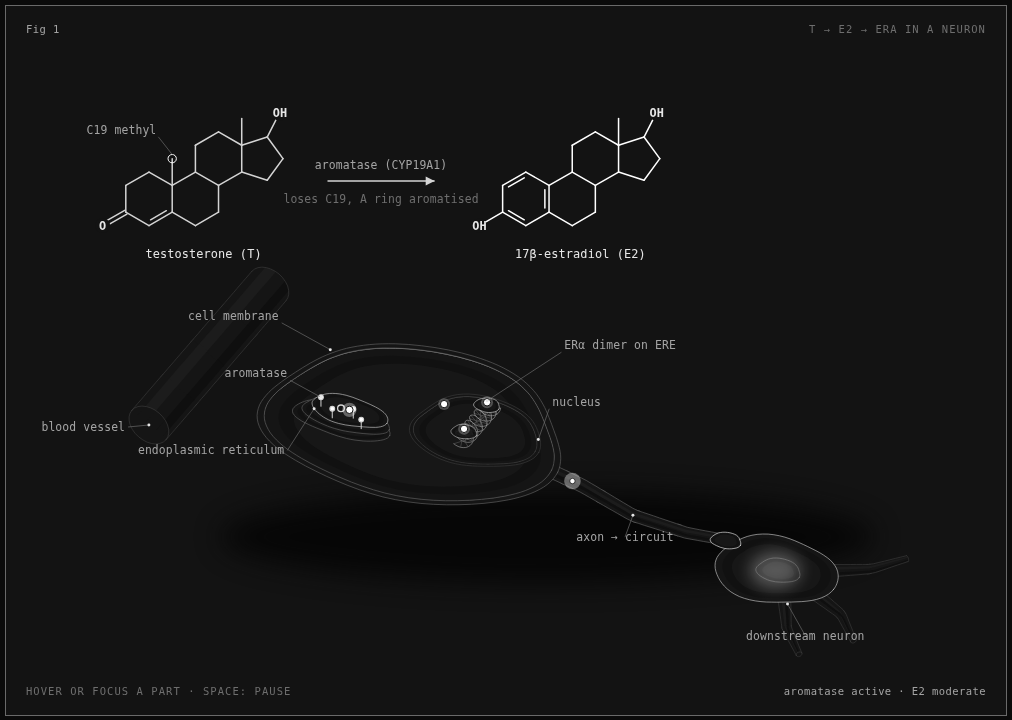 | A myelinated neuron (light) Saltatory conduction along a myelinated axon with a hoverable synapse. 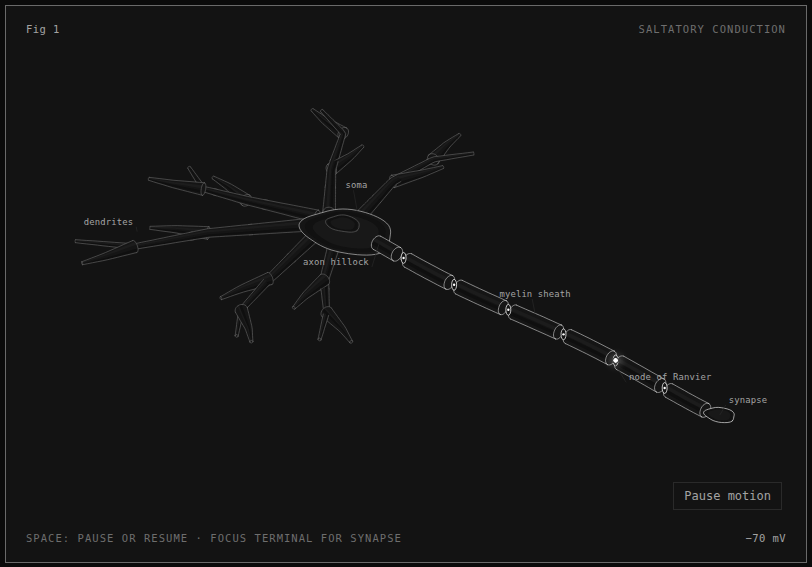 |
Fig n top left, a short title top right, the interaction hint bottom left, a live readout bottom right.prefers-reduced-motion, and no animation while offscreen.Copy the closest example and change the biology:
node examples/dopamine-receptors/build.mjs
node examples/dopamine-receptors/build.mjs --light
Each build.mjs imports the kit from kit/ and writes standalone pages next to itself. kit/blob.mjs draws organic forms, kit/branch.mjs branching structures, kit/chem.mjs molecules, helices and ribbons, and kit/bio-audit.mjs checks membrane intersections, label targets and declared scale. WebGL shaders and a 3D mode are optional extras for figures that need them.
Record a demo of your own figures with scripts/make-demo.mjs (needs Chrome and ffmpeg), and check a page with scripts/capture.mjs, scripts/drive.mjs and scripts/lines.mjs. CONTRIBUTING.md lists every check.
SKILL.md defines the workflow, visual standards, sourcing rules and safety limits.kit/ is the isometric drawing library plus the biology primitives.references/ has general, neurobiology, pharmacology and molecular-biology guidance alongside the craft and rendering guides.evals/evals.json holds representative biology requests with what a good answer must contain.Every displayed number, including sizes, concentrations, potentials, rates and doses, must cite its source in the caption or a sources block, with species, tissue, conditions and units. Schematic scales are labelled as schematic.
These are educational figures. They are not medical advice, not a validated anatomy atlas, and not a diagnostic or prescribing tool. Drug figures explain mechanism only. Biology varies between species, tissues and individuals, and a 2D or isometric illustration cannot capture every spatial relationship.
If you or someone you know is struggling with substance use, a local health service or helpline can help.
MIT. See LICENSE.
Anima: a Claude Code skill that turns a biology idea into an interactive, sourced, isometric figure. Dopamine receptors, stimulants, addiction circuits, semaglutide.
See the codeAsk Claude for a biology figure. Get an interactive, sourced, isometric one.
A Claude Code skill that turns "show me how cocaine and amphetamine act differently at a dopamine synapse" into a live, standalone page: real structures, a mechanism you can toggle, a readout driven by one small model, and a citation for every number on screen.
Watch the 35-second launch video · Full demo (MP4) · Try every figure live
Most science graphics are either static diagrams or confident-looking animations with no sources. This skill holds itself to a different standard:
npx skills add Garinmckayl/anima -g -a claude-code
Requires Claude Code and Node.js 20.10 or later. The drawing kit uses only Node built-ins and has zero runtime dependencies. Chrome or Chromium is needed only for the capture and verification scripts.
In Claude Code:
/anima show how cocaine and amphetamine act differently at the dopamine transporter, with a drug selector and sourced mechanisms; standalone HTML
/anima visualize semaglutide acting on a pancreatic beta cell, with glucose-dependent insulin release, cited label numbers and an educational-use note
/anima show D1 and D2 receptor signalling in a striatal neuron, with the G-protein cycle and a receptor-antagonist toggle
/anima make a mid-sagittal brain showing the mesolimbic pathway and one model of how it changes with repeated drug exposure; cite every claim
Name the biological subject, the mechanism to explain, the audience and the output format. The skill sizes the job first (Figure, Hero or Epic), collects sources before drawing, builds the page, then checks it the way a reviewer would: zoomed in, in both themes, at phone width.
Each figure builds to a standalone HTML page in dark and light themes. Open the pages straight from the repo, or live on GitHub Pages.
| Dopamine receptors (light) D1-like receptors couple Gαs/olf and raise cAMP; D2-like receptors couple Gαi/o and lower it. Full G-protein cycle, a dopamine-level slider and a generic D2-antagonist toggle. | Stimulants at the transporter (light) None, cocaine or amphetamine. Reuptake, blockade, and amphetamine's transport, vesicle leak and reverse efflux. Skeletal formulas from PubChem. |
| Reward and addiction (light) The mesolimbic pathway, a cue sequence, and one leading model of what changes after repeated exposure. Framed as a model, with sources. | Semaglutide and GLP-1 (light) A GLP-1 receptor agonist on a beta cell: glucose-dependent insulin release, the molecule's engineered features, and the preclinical-versus-clinical state of the appetite and reward evidence. |
| Estrogen and aggression (light) Testosterone to estradiol by aromatase, then estrogen receptor α, in an amygdala-type neuron. States that the human evidence is weak (pooled Fisher z 0.16 across 14 studies). | A myelinated neuron (light) Saltatory conduction along a myelinated axon with a hoverable synapse. |
Fig n top left, a short title top right, the interaction hint bottom left, a live readout bottom right.prefers-reduced-motion, and no animation while offscreen.Copy the closest example and change the biology:
node examples/dopamine-receptors/build.mjs
node examples/dopamine-receptors/build.mjs --light
Each build.mjs imports the kit from kit/ and writes standalone pages next to itself. kit/blob.mjs draws organic forms, kit/branch.mjs branching structures, kit/chem.mjs molecules, helices and ribbons, and kit/bio-audit.mjs checks membrane intersections, label targets and declared scale. WebGL shaders and a 3D mode are optional extras for figures that need them.
Record a demo of your own figures with scripts/make-demo.mjs (needs Chrome and ffmpeg), and check a page with scripts/capture.mjs, scripts/drive.mjs and scripts/lines.mjs. CONTRIBUTING.md lists every check.
SKILL.md defines the workflow, visual standards, sourcing rules and safety limits.kit/ is the isometric drawing library plus the biology primitives.references/ has general, neurobiology, pharmacology and molecular-biology guidance alongside the craft and rendering guides.evals/evals.json holds representative biology requests with what a good answer must contain.Every displayed number, including sizes, concentrations, potentials, rates and doses, must cite its source in the caption or a sources block, with species, tissue, conditions and units. Schematic scales are labelled as schematic.
These are educational figures. They are not medical advice, not a validated anatomy atlas, and not a diagnostic or prescribing tool. Drug figures explain mechanism only. Biology varies between species, tissues and individuals, and a 2D or isometric illustration cannot capture every spatial relationship.
If you or someone you know is struggling with substance use, a local health service or helpline can help.
MIT. See LICENSE.



