
Parallel EVM inspired by BlockSTM
See the codeREADME
Grevm
Grevm is a Block-STM-inspired optimistic parallel EVM execution engine built on revm. It combines multi-version state, read-set validation, and dependency-aware scheduling while preserving block-order outcomes and state.
See Use Grevm with reth for the public API and integration model.
Current execution pipeline
- Speculative workers execute transactions against multi-version memory and record their read and write sets.
- Validation checks every read against the latest preceding writer and incarnation. Conflicts are marked as estimates and rescheduled; discovered dependencies are scheduling hints, not the source of correctness.
- One finality loop publishes only the contiguous prefix whose validations remain newer than every relevant validation rewind.
- One ordered-commit loop validates each original transaction nonce against committed state when nonce checking is enabled, folds any deferred beneficiary reward into the EVM state, commits it once, records the outcome, and only then publishes the new committed-prefix boundary.
- A nonce mismatch or recoverable scheduler abort replays only the uncommitted suffix
sequentially. Invalid transactions become ordered
Skippedoutcomes; fatal errors retain the successfully committed prefix.
GrevmConfig::concurrency_level controls the number of speculative workers. The finality and
ordered-commit loops are additional coordinator threads.
Historical Grevm 2.1 highlights
The following results and diagram describe the Grevm 2.1 release. Static hints, Task Groups, and the original lock-free DAG are historical designs and do not describe the current scheduler.
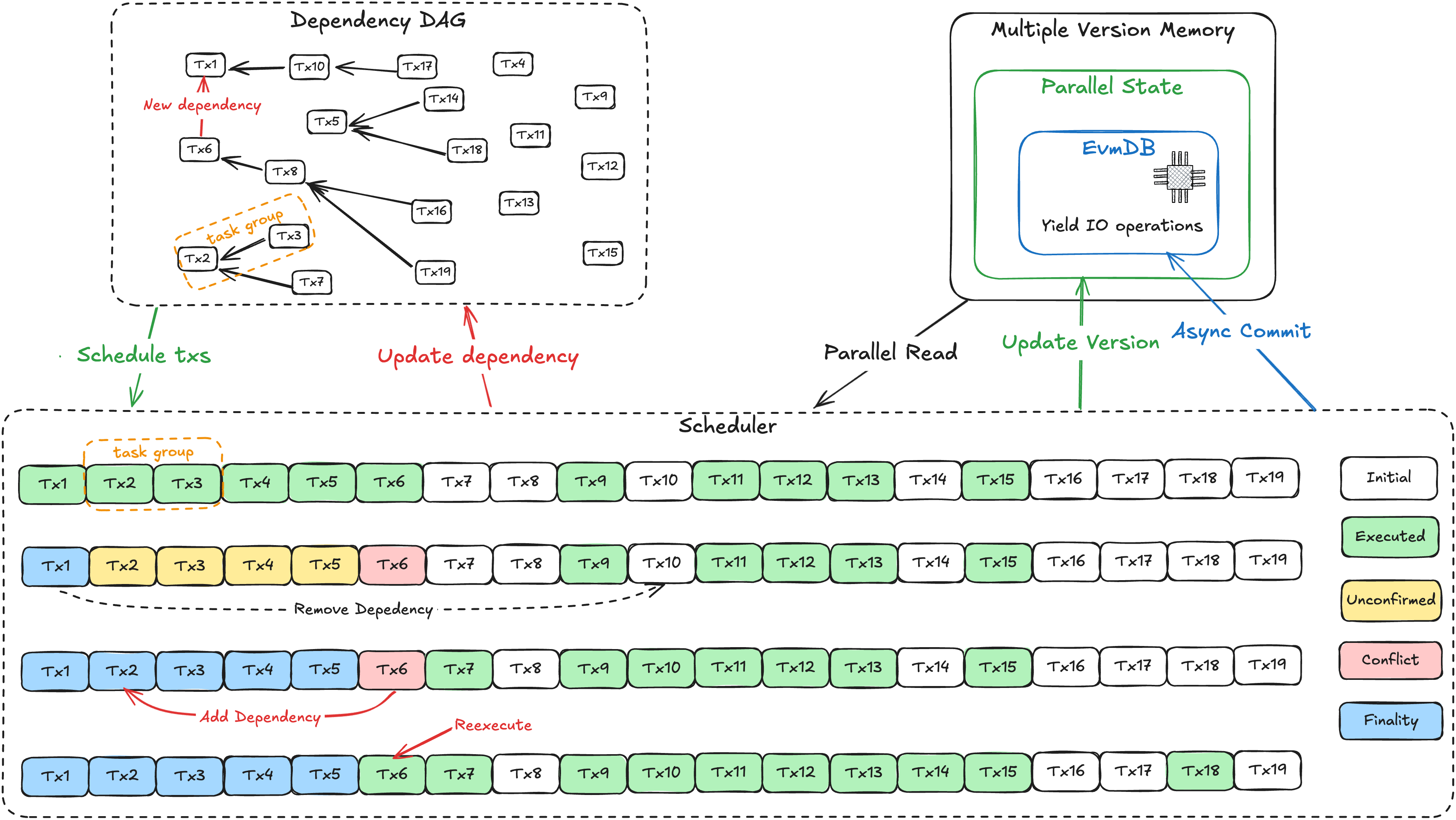
- Grevm 2.1 achieves near-optimal performance in low-contention scenarios, matching Block-STM with 11.25 gigagas/s for Uniswap workloads and outperforming it with 95% less CPU usage in inherently non-parallelizable cases by 20–30%, achieving performance close to sequential execution.
- Breaks Grevm 1.0’s limitations in handling highly dependent transactions, delivering a 5.5× throughput increase to 2.96 gigagas/s in 30%-hot-ratio hybrid workloads by minimizing re-executions through DAG-based scheduling and Task Groups.
- Introduces Parallel State Store, leveraging asynchronous execution result bundling to overlap and amortize 30-60ms of post-execution overhead within parallel execution, effectively hiding these costs within execution time. It also seamlessly handles miner rewards and the self-destruct opcode without the performance penalties of sequential fallbacks.
- In-depth analysis of optimistic parallel execution reveals the underestimated efficiency of Block-STM and the strength of optimistic parallelism, providing new insights into parallel execution.
- Lock-Free DAG (introduced in 2.1) replaces global locking with fine-grained, node-level synchronization. This change reduces DAG scheduling overhead by 60% and improves overall performance by more than 30%. In workloads with fast-executing transactions—such as raw and ERC20 transfers—it delivers nearly 2× higher throughput.
Testing
Core library tests run without optional features:
cargo test
The integration suites, fixtures, and benchmarks use test-utils:
cargo test --features test-utils
This runs the library unit tests plus the integration suites (erc20, native_transfers,
uniswap, eip-7702, delegated_safety, and mainnet replay). See
Testing & Benchmarking for the full guide, including how to replay real mainnet
blocks (EIP-7702 included) and the available environment-variable knobs.
Running the Benchmark
To reproduce the synthetic gigagas benchmark:
JEMALLOC_SYS_WITH_MALLOC_CONF="thp:always,metadata_thp:always" \
NUM_EOA=<num_accounts> HOT_RATIO=<hot_ratio> DB_LATENCY_US=<latency_in_us> \
cargo bench --features test-utils --bench gigagas
Replace <num_accounts>, <hot_ratio>, and <latency_in_us> with your desired parameters. There
is also a continuous benchmark that runs merged real-mainnet "big blocks"; see
Testing & Benchmarking.
Further Details
For historical design context and benchmark analysis, refer to the versioned technical reports. Some implementation details in those reports, such as static dependency hints, describe their respective releases rather than the current code.
Contributors


Similar repos


Languages
Rust
100.0%
Parallel EVM inspired by BlockSTM
See the codeREADME
Grevm
Grevm is a Block-STM-inspired optimistic parallel EVM execution engine built on revm. It combines multi-version state, read-set validation, and dependency-aware scheduling while preserving block-order outcomes and state.
See Use Grevm with reth for the public API and integration model.
Current execution pipeline
- Speculative workers execute transactions against multi-version memory and record their read and write sets.
- Validation checks every read against the latest preceding writer and incarnation. Conflicts are marked as estimates and rescheduled; discovered dependencies are scheduling hints, not the source of correctness.
- One finality loop publishes only the contiguous prefix whose validations remain newer than every relevant validation rewind.
- One ordered-commit loop validates each original transaction nonce against committed state when nonce checking is enabled, folds any deferred beneficiary reward into the EVM state, commits it once, records the outcome, and only then publishes the new committed-prefix boundary.
- A nonce mismatch or recoverable scheduler abort replays only the uncommitted suffix
sequentially. Invalid transactions become ordered
Skippedoutcomes; fatal errors retain the successfully committed prefix.
GrevmConfig::concurrency_level controls the number of speculative workers. The finality and
ordered-commit loops are additional coordinator threads.
Historical Grevm 2.1 highlights
The following results and diagram describe the Grevm 2.1 release. Static hints, Task Groups, and the original lock-free DAG are historical designs and do not describe the current scheduler.
- Grevm 2.1 achieves near-optimal performance in low-contention scenarios, matching Block-STM with 11.25 gigagas/s for Uniswap workloads and outperforming it with 95% less CPU usage in inherently non-parallelizable cases by 20–30%, achieving performance close to sequential execution.
- Breaks Grevm 1.0’s limitations in handling highly dependent transactions, delivering a 5.5× throughput increase to 2.96 gigagas/s in 30%-hot-ratio hybrid workloads by minimizing re-executions through DAG-based scheduling and Task Groups.
- Introduces Parallel State Store, leveraging asynchronous execution result bundling to overlap and amortize 30-60ms of post-execution overhead within parallel execution, effectively hiding these costs within execution time. It also seamlessly handles miner rewards and the self-destruct opcode without the performance penalties of sequential fallbacks.
- In-depth analysis of optimistic parallel execution reveals the underestimated efficiency of Block-STM and the strength of optimistic parallelism, providing new insights into parallel execution.
- Lock-Free DAG (introduced in 2.1) replaces global locking with fine-grained, node-level synchronization. This change reduces DAG scheduling overhead by 60% and improves overall performance by more than 30%. In workloads with fast-executing transactions—such as raw and ERC20 transfers—it delivers nearly 2× higher throughput.
Testing
Core library tests run without optional features:
cargo test
The integration suites, fixtures, and benchmarks use test-utils:
cargo test --features test-utils
This runs the library unit tests plus the integration suites (erc20, native_transfers,
uniswap, eip-7702, delegated_safety, and mainnet replay). See
Testing & Benchmarking for the full guide, including how to replay real mainnet
blocks (EIP-7702 included) and the available environment-variable knobs.
Running the Benchmark
To reproduce the synthetic gigagas benchmark:
JEMALLOC_SYS_WITH_MALLOC_CONF="thp:always,metadata_thp:always" \
NUM_EOA=<num_accounts> HOT_RATIO=<hot_ratio> DB_LATENCY_US=<latency_in_us> \
cargo bench --features test-utils --bench gigagas
Replace <num_accounts>, <hot_ratio>, and <latency_in_us> with your desired parameters. There
is also a continuous benchmark that runs merged real-mainnet "big blocks"; see
Testing & Benchmarking.
Further Details
For historical design context and benchmark analysis, refer to the versioned technical reports. Some implementation details in those reports, such as static dependency hints, describe their respective releases rather than the current code.
Similar repos
Contributors
Languages
Rust
100.0%