
README
LIMO: Less Is More for Reasoning 🚀
📄 Paper | 🌐 Dataset (v2) | 📘 Model (v2)
Updates
- [2025/07/30] 🎉 NEW! We have released LIMO-v2! This includes an updated paper, new dataset (LIMO-v2), and improved model. Check out the new resources below!
- [2025/07/08] 🎉 LIMO has been accepted by COLM 2025!
- [2025/02/18] 🚨 We've added LIMO's performance on the recently completed AIME 2025 evaluation, where it achieved a solid score of 44.6, demonstrating competitive performance using only 817 training samples compared to other models trained on much larger datasets (800k samples).
- [2025/02/10] 🚨 Third-party evaluations highlight LIMO's strong generalization capabilities
- [2025/02/08] 🚨 The LIMO dataset has received positive recognition from the community. According to third-party evaluations, the dataset achieved a 10-percentage point performance improvement on AIME24 and GPQA benchmarks, and a 3-point improvement on MATH-500. These experimental results demonstrate LIMO's potential in enhancing RL Scaling.
📌 Table of Contents
Overview
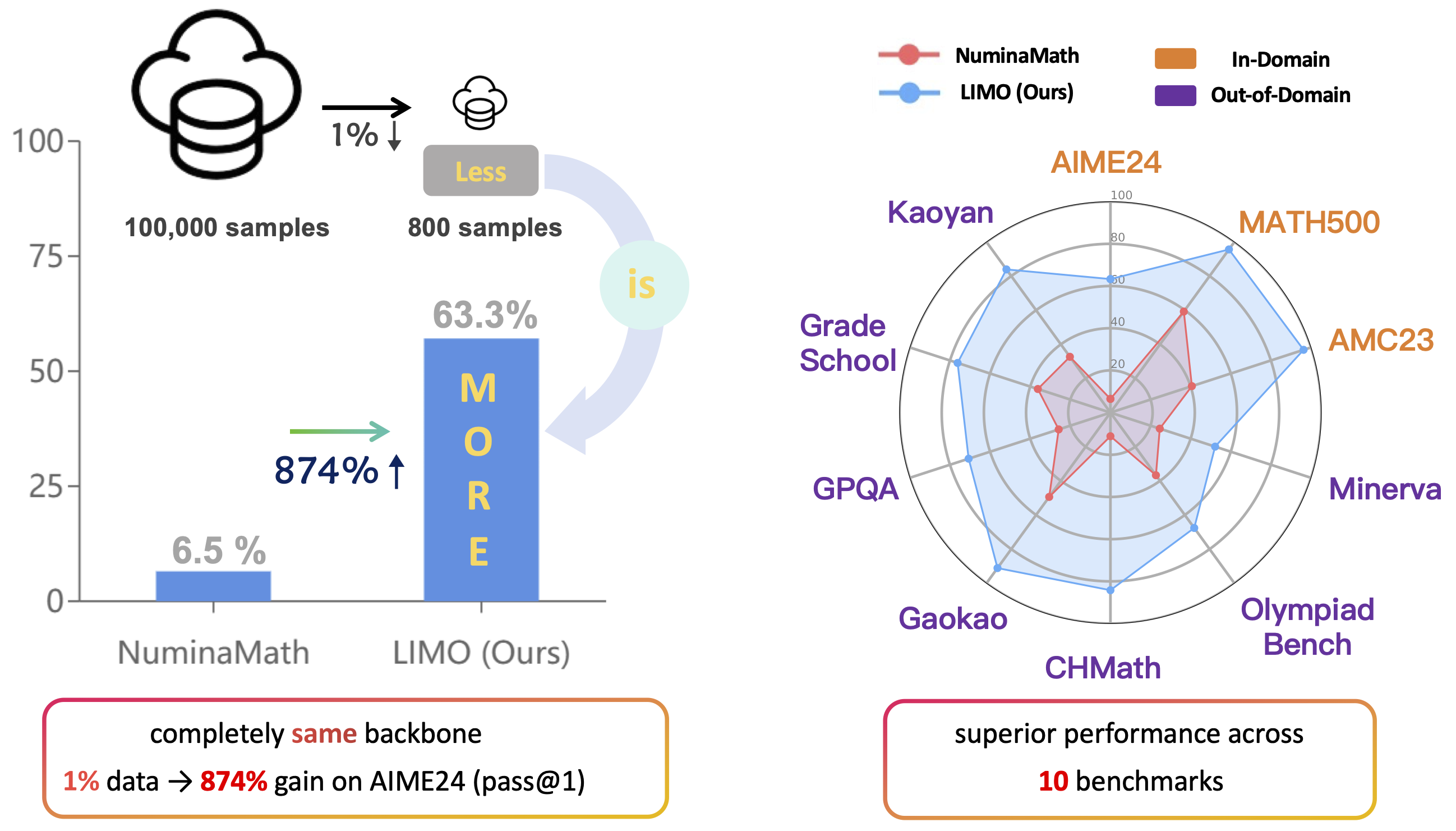
LIMO challenges the conventional wisdom in mathematical reasoning by demonstrating that models can achieve superior performance with significantly less but higher quality training data. Our approach:
- 🎯 Achieves SOTA with carefully curated training samples
- 🌟 Shows strong generalization across diverse problem types
- 🔬 Provides comprehensive evaluation tools
- 📚 Releases high-quality datasets and models
Model Zoo
Our LIMO models are available on Hugging Face 🤗:
| Model | Backbone | Size | Link |
|---|---|---|---|
| LIMO-v2 (Latest) | Qwen2.5-32B-Instruct | 32B | 🤗 |
| LIMO-v1 | Qwen2.5-32B-Instruct | 32B | 🤗 |
Datasets
We release our datasets through Hugging Face 🤗:
| Dataset | Description | Link |
|---|---|---|
| LIMO-v2 (Latest) | Updated training set for the latest paper version (800 samples) | 🤗 |
| LIMO-v1 | Original training set (817 samples) | 🤗 |
Quick Start
Our models are fine-tuned on Qwen2.5-32B-Instruct and are compatible with most mainstream frameworks like HF Transformers, VLLM, TensorRT-LLM and etc.
Using the Latest Model (LIMO-v2)
Start with HF Transformers
# Install required packages
pip install transformers
from transformers import AutoModelForCausalLM, AutoTokenizer
import torch

# Initialize model and tokenizer
model = AutoModelForCausalLM.from_pretrained(
    "GAIR/LIMO-v2",
    torch_dtype="auto",
    trust_remote_code=True,
    device_map="auto"
)
tokenizer = AutoTokenizer.from_pretrained("GAIR/LIMO-v2", trust_remote_code=True)

# Prepare input messages (We use the following template and system prompt during training and inference)
messages = [
    {"role": "system", "content": "Please reason step by step, and put your final answer within \\boxed{}."},
    {"role": "user", "content": "What is the result of 1+1?"}
]

# Format input using chat template
text = tokenizer.apply_chat_template(
    messages,
    tokenize=False,
    add_generation_prompt=True
)

# Tokenize input
inputs = tokenizer(text, return_tensors="pt").to(model.device)

# Generate response
outputs = model.generate(
    **inputs,
    max_new_tokens=32768,
    temperature=0.7,
    top_p=0.95,
    do_sample=True
)

# Decode and print response
response = tokenizer.decode(outputs[0][inputs['input_ids'].shape[1]:], skip_special_tokens=True)
print(response)
Start with VLLM
# Install required packages
pip install vllm
from vllm import LLM, SamplingParams
from transformers import AutoTokenizer

# Initialize the model
llm = LLM(
    model="GAIR/LIMO-v2",
    tensor_parallel_size=4,  # adjust based on available GPUs
    trust_remote_code=True,
    swap_space=60,
    gpu_memory_utilization=0.96,
)

# Prepare input messages (We use the following template and system prompt during training and inference)
messages = [
    {"role": "system", "content": "Please reason step by step, and put your final answer within \\boxed{}."},
    {"role": "user", "content": "What is the result of 1+1?"}
]

# Setup tokenizer
tokenizer = AutoTokenizer.from_pretrained("GAIR/LIMO-v2", trust_remote_code=True)
text = tokenizer.apply_chat_template(
    messages,
    tokenize=False,
    add_generation_prompt=True
)

# Configure generation parameters
sampling_params = SamplingParams(
    temperature=0.7,
    max_tokens=32768,
    top_p=0.95,
)

# Generate response
output = llm.generate(text, sampling_params)
print(output[0].outputs[0].text)
Training
We utilize LLaMA-Factory framework for training, which provides a convenient and efficient training pipeline.
Training Setup
-
Environment Setup
- Set up LLaMA-Factory following their official documentation.
- Ensure all dependencies are properly installed and configured.
-
Data Preparation
- Obtain the LIMO-v2 dataset from 🤗 Hugging Face.
- Format the dataset according to LLaMA-Factory's data preparation guidelines.
-
Configuration
- Use our provided configuration file.
- The config file contains all necessary hyperparameters and training settings.
Launch Training
For multi-node training, use the following command:
FORCE_TORCHRUN=1 \
NNODES=${PET_NNODES} \
NODE_RANK=${PET_NODE_RANK} \
MASTER_ADDR=${MASTER_ADDR} \
MASTER_PORT=${MASTER_PORT} \
llamafactory-cli train <path to yaml config file>
Where:
PET_NNODES: Total number of nodesPET_NODE_RANK: Rank of current node (0-based)MASTER_ADDR: Address of master nodeMASTER_PORT: Port for communication<path to yaml config file>: Path to your training configuration YAML
For more detailed training examples and configurations, refer to LLaMA-Factory's official training examples.
Note: Multi-node training environments can vary significantly between different machines and cluster setups. You'll need to adapt the training configuration and launch commands according to your specific environment and infrastructure.
Evaluation
We also release scripts for evaluating Large Language Models (LLMs) on mathematical reasoning tasks. The evaluation framework includes both inference (using the VLLM framework) and evaluation (using both rule-based and model-based approaches) components.
For rule-based evaluation, we support pure numerical problems like AIME and most MATH problems. For more complex responses (expressions, equations, or natural language descriptions), we employ model-based evaluation using Qwen2.5-32B-Instruct as the judge model.
For detailed instructions and implementation details, please refer to eval/README.md.
Legacy Resources (v1)
If you need the original LIMO resources from the initial paper version, they are still available:
- Model: GAIR/LIMO (Original 817-sample trained model)
- Dataset: GAIR/LIMO (Original 817 training samples)
The v1 resources correspond to the initial paper submission and contain the experimental results that were previously shown in this README.
License
This project is licensed under the MIT License - see the LICENSE file for details.
Citation
@misc{ye2025limoreasoning,
      title={LIMO: Less is More for Reasoning},
      author={Yixin Ye and Zhen Huang and Yang Xiao and Ethan Chern and Shijie Xia and Pengfei Liu},
      year={2025},
      eprint={2502.03387},
      archivePrefix={arXiv},
      primaryClass={cs.CL},
      url={https://arxiv.org/abs/2502.03387},
}
Contributors


Similar repos




Languages
Python
99.2%
README
LIMO: Less Is More for Reasoning 🚀
📄 Paper | 🌐 Dataset (v2) | 📘 Model (v2)
Updates
- [2025/07/30] 🎉 NEW! We have released LIMO-v2! This includes an updated paper, new dataset (LIMO-v2), and improved model. Check out the new resources below!
- [2025/07/08] 🎉 LIMO has been accepted by COLM 2025!
- [2025/02/18] 🚨 We've added LIMO's performance on the recently completed AIME 2025 evaluation, where it achieved a solid score of 44.6, demonstrating competitive performance using only 817 training samples compared to other models trained on much larger datasets (800k samples).
- [2025/02/10] 🚨 Third-party evaluations highlight LIMO's strong generalization capabilities
- [2025/02/08] 🚨 The LIMO dataset has received positive recognition from the community. According to third-party evaluations, the dataset achieved a 10-percentage point performance improvement on AIME24 and GPQA benchmarks, and a 3-point improvement on MATH-500. These experimental results demonstrate LIMO's potential in enhancing RL Scaling.
📌 Table of Contents
Overview
LIMO challenges the conventional wisdom in mathematical reasoning by demonstrating that models can achieve superior performance with significantly less but higher quality training data. Our approach:
- 🎯 Achieves SOTA with carefully curated training samples
- 🌟 Shows strong generalization across diverse problem types
- 🔬 Provides comprehensive evaluation tools
- 📚 Releases high-quality datasets and models
Model Zoo
Our LIMO models are available on Hugging Face 🤗:
| Model | Backbone | Size | Link |
|---|---|---|---|
| LIMO-v2 (Latest) | Qwen2.5-32B-Instruct | 32B | 🤗 |
| LIMO-v1 | Qwen2.5-32B-Instruct | 32B | 🤗 |
Datasets
We release our datasets through Hugging Face 🤗:
| Dataset | Description | Link |
|---|---|---|
| LIMO-v2 (Latest) | Updated training set for the latest paper version (800 samples) | 🤗 |
| LIMO-v1 | Original training set (817 samples) | 🤗 |
Quick Start
Our models are fine-tuned on Qwen2.5-32B-Instruct and are compatible with most mainstream frameworks like HF Transformers, VLLM, TensorRT-LLM and etc.
Using the Latest Model (LIMO-v2)
Start with HF Transformers
# Install required packages
pip install transformers
from transformers import AutoModelForCausalLM, AutoTokenizer
import torch

# Initialize model and tokenizer
model = AutoModelForCausalLM.from_pretrained(
    "GAIR/LIMO-v2",
    torch_dtype="auto",
    trust_remote_code=True,
    device_map="auto"
)
tokenizer = AutoTokenizer.from_pretrained("GAIR/LIMO-v2", trust_remote_code=True)

# Prepare input messages (We use the following template and system prompt during training and inference)
messages = [
    {"role": "system", "content": "Please reason step by step, and put your final answer within \\boxed{}."},
    {"role": "user", "content": "What is the result of 1+1?"}
]

# Format input using chat template
text = tokenizer.apply_chat_template(
    messages,
    tokenize=False,
    add_generation_prompt=True
)

# Tokenize input
inputs = tokenizer(text, return_tensors="pt").to(model.device)

# Generate response
outputs = model.generate(
    **inputs,
    max_new_tokens=32768,
    temperature=0.7,
    top_p=0.95,
    do_sample=True
)

# Decode and print response
response = tokenizer.decode(outputs[0][inputs['input_ids'].shape[1]:], skip_special_tokens=True)
print(response)
Start with VLLM
# Install required packages
pip install vllm
from vllm import LLM, SamplingParams
from transformers import AutoTokenizer

# Initialize the model
llm = LLM(
    model="GAIR/LIMO-v2",
    tensor_parallel_size=4,  # adjust based on available GPUs
    trust_remote_code=True,
    swap_space=60,
    gpu_memory_utilization=0.96,
)

# Prepare input messages (We use the following template and system prompt during training and inference)
messages = [
    {"role": "system", "content": "Please reason step by step, and put your final answer within \\boxed{}."},
    {"role": "user", "content": "What is the result of 1+1?"}
]

# Setup tokenizer
tokenizer = AutoTokenizer.from_pretrained("GAIR/LIMO-v2", trust_remote_code=True)
text = tokenizer.apply_chat_template(
    messages,
    tokenize=False,
    add_generation_prompt=True
)

# Configure generation parameters
sampling_params = SamplingParams(
    temperature=0.7,
    max_tokens=32768,
    top_p=0.95,
)

# Generate response
output = llm.generate(text, sampling_params)
print(output[0].outputs[0].text)
Training
We utilize LLaMA-Factory framework for training, which provides a convenient and efficient training pipeline.
Training Setup
-
Environment Setup
- Set up LLaMA-Factory following their official documentation.
- Ensure all dependencies are properly installed and configured.
-
Data Preparation
- Obtain the LIMO-v2 dataset from 🤗 Hugging Face.
- Format the dataset according to LLaMA-Factory's data preparation guidelines.
-
Configuration
- Use our provided configuration file.
- The config file contains all necessary hyperparameters and training settings.
Launch Training
For multi-node training, use the following command:
FORCE_TORCHRUN=1 \
NNODES=${PET_NNODES} \
NODE_RANK=${PET_NODE_RANK} \
MASTER_ADDR=${MASTER_ADDR} \
MASTER_PORT=${MASTER_PORT} \
llamafactory-cli train <path to yaml config file>
Where:
PET_NNODES: Total number of nodesPET_NODE_RANK: Rank of current node (0-based)MASTER_ADDR: Address of master nodeMASTER_PORT: Port for communication<path to yaml config file>: Path to your training configuration YAML
For more detailed training examples and configurations, refer to LLaMA-Factory's official training examples.
Note: Multi-node training environments can vary significantly between different machines and cluster setups. You'll need to adapt the training configuration and launch commands according to your specific environment and infrastructure.
Evaluation
We also release scripts for evaluating Large Language Models (LLMs) on mathematical reasoning tasks. The evaluation framework includes both inference (using the VLLM framework) and evaluation (using both rule-based and model-based approaches) components.
For rule-based evaluation, we support pure numerical problems like AIME and most MATH problems. For more complex responses (expressions, equations, or natural language descriptions), we employ model-based evaluation using Qwen2.5-32B-Instruct as the judge model.
For detailed instructions and implementation details, please refer to eval/README.md.
Legacy Resources (v1)
If you need the original LIMO resources from the initial paper version, they are still available:
- Model: GAIR/LIMO (Original 817-sample trained model)
- Dataset: GAIR/LIMO (Original 817 training samples)
The v1 resources correspond to the initial paper submission and contain the experimental results that were previously shown in this README.
License
This project is licensed under the MIT License - see the LICENSE file for details.
Citation
@misc{ye2025limoreasoning,
      title={LIMO: Less is More for Reasoning},
      author={Yixin Ye and Zhen Huang and Yang Xiao and Ethan Chern and Shijie Xia and Pengfei Liu},
      year={2025},
      eprint={2502.03387},
      archivePrefix={arXiv},
      primaryClass={cs.CL},
      url={https://arxiv.org/abs/2502.03387},
}
Similar repos
Contributors
Languages
Python
99.2%