
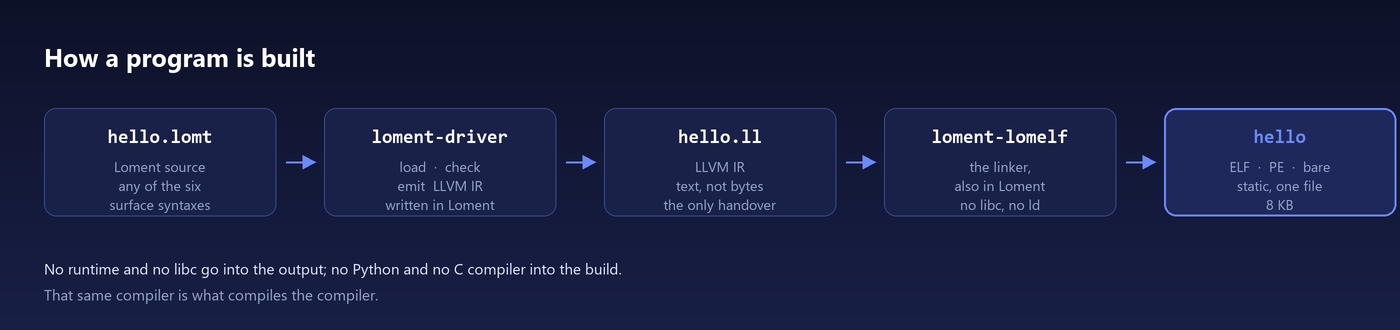
Loment — a systems programming language. Compiles to native x86-64 (Linux ELF, Windows PE, or freestanding for bare metal) with no runtime and no libc. The toolchain is itself written in Loment; source can be written in its Rust-flavored base syntax or six more: C, C++, Java, C#, Go, Python.
See the codeSee what people are saying
README
Loment

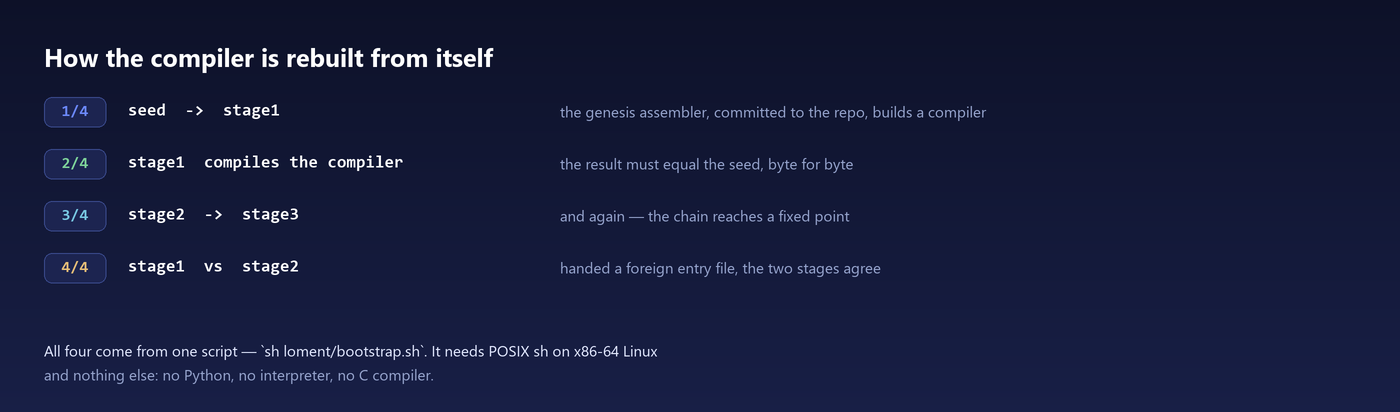
Loment is a systems programming language. It compiles to native x86-64 executables — Linux ELF, Windows PE, or a freestanding object for bare metal — with no runtime and no libc. The toolchain is itself written in Loment and needs no Python to run. Its own syntax is Rust-flavored, and the same program can be written in six more: C, C++, Java, C#, Go or Python.
Download 0.1.4 · Quick start · Project site · Manual · Language guide · Examples · Contributing · Issues · Discord
The release has a Linux tar.gz, a Windows zip and a Windows installer — installing and
running needs no Python, no clang and no WSL. loment run hello.lomt and you are done.
Status
0.1.4. It ships as a package — the
Loment 0.1.4 release carries a Linux
tar.gz, a Windows zip, a Windows setup.exe installer and the agent-guide zip. You can also
build the toolchain from a checkout (QUICKSTART.md). What 0.1.4 does not
include yet is listed honestly in docs/202.
The toolchain is self-hosted at run time: it compiles and runs with no Python and no
libc. The development side is not, and 0.1.4 shipped before that gap closed:
tools/ still holds the reference implementation (tools/lomentc.py and friends) and the
Python test suites (docs/189). The work is done one criterion
at a time — each Python criterion gains a Loment twin, and the two must agree byte for byte
before the Python side can be retired. Until that finishes, both copies are in the repository
on purpose, and "the repository contains only Loment" is not yet true.
What 0.1.4 does and does not include is listed item by item, and was audited, in docs/202 — including the three items still open (a hosted layer, two GC tiers, full self-hosting).
The language surface is frozen — docs/158 says what changing it costs — and the implementation is not.
A first program
module hello

fn _start() {
    let s: str = "hello from Loment\n";
    syscall4(1, 1, str_ptr(s) as u64, str_len(s) as u64);
    syscall4(60, 0, 0, 0);
}
$ loment run hello.lomt
hello from Loment
_start is the entry point, because there is no runtime to call one for you, and output goes
through the write system call, because there is no printf. QUICKSTART.md
takes it from here — sources, toolchain, and the first four rows below.
What it is for
Most languages answer "what can this program do?". Loment is arranged around a narrower question — who can run what, in what scope, and can that be settled without reading the source? Three things carry it:
| Capability domains | capability blk : disk[0..4] declares the range a unit may reach and guard blk(i); checks the index against it — at compile time when the index is a literal, otherwise at run time, where an out-of-range index traps. docs/146 states the boundary rather than glossing it: a guard bounds the index, not the subject. |
| Potato form objects | Every unit exports a declared, machine-readable summary of what it contains and what it reaches, judged by two independent validators — so "what can this touch" is answerable without reading the source. docs/147 |
| A compat layer | Ten languages' libraries, callable end to end: C, C++, Rust and Zig behind the C ABI by static linking, then Go, Python, Java, JavaScript, Perl and Lua over a process bridge. docs/173 is the honest ledger — dynamic libraries and embedding a runtime are not started. |
The rest of the language exists to keep that question answerable. The core stays small; what grows is the layer around it (docs/175).
What else is different
| A standard library, imported one module at a time | lompi/store/ ships with the toolchain: std (127 modules — vectors, maps, text, big integers, floats, hashing, compression) and host (files, argv, directories). use vec, use map, use fs. The package facade use std also works, but pulls all 127 modules into one unit — emitted symbols are flat, so that is slow and collision-prone. Prefer per-module. |
| Can be written in six other syntaxes | C, C++, Java, C#, Go, Python. Only the spelling changes; the meaning is always Loment's — it is a syntax, not a semantics, and each front end says so on its first line. Declaring it in the file (choose write grammar) is not wired into the compiler yet; the translators are. docs/188 · docs/179 |
| A project mode, not a crate attribute | choose std or choose no_std, at most once, in the root unit. "Hosted or freestanding" becomes a property of the whole program — the compiler can refuse a half-hosted one, and a form object can carry the setting. docs/180 |
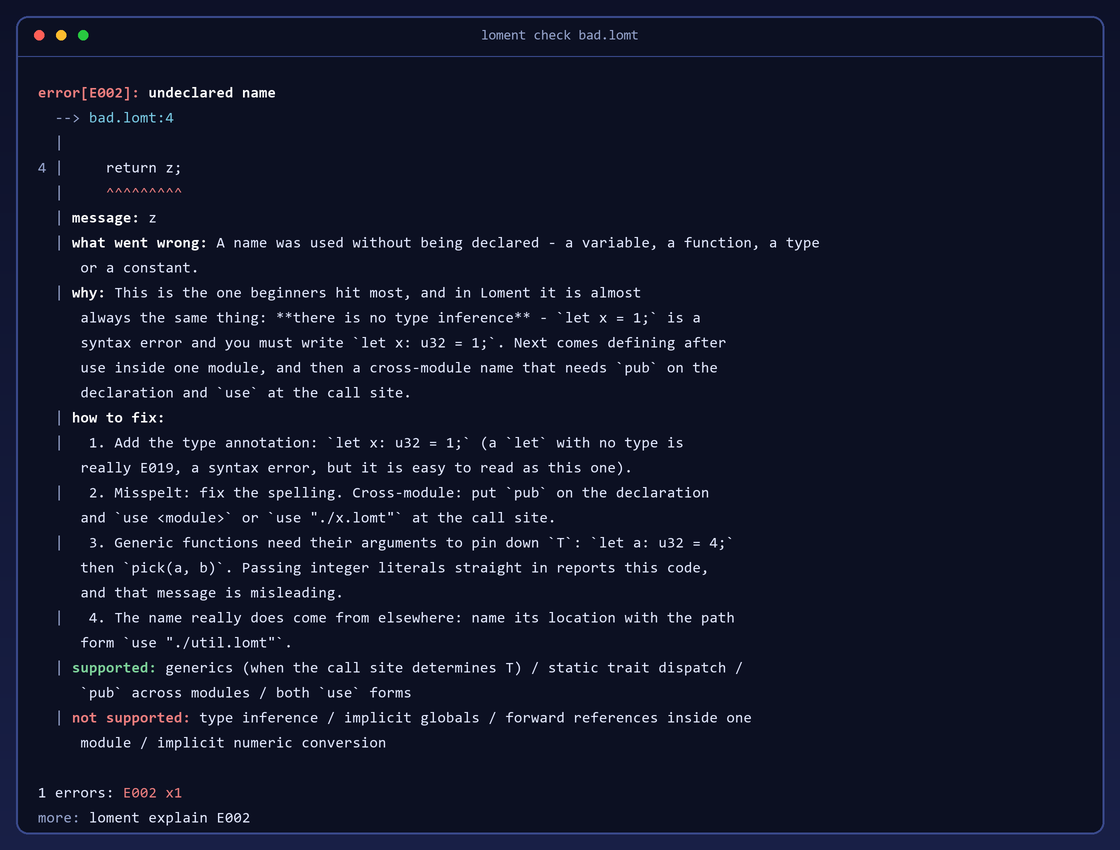
| Reports errors from a separate program | The compiler emits structured diagnostics; lomenterr adds the title, the location and how to fix it, so the compiler carries no message table of its own. docs/182 |
| Everything is customizable | The source suffix, the command surface (loment-<name> on PATH; official commands always win), the libraries (a directory whose identity is a content hash), and the toolchain itself. No registry — the extension points are files on disk. |
That last row, in full — the report you actually read when a line does not compile. The
compiler emitted a code and a position; everything below message: came from lomenterr:
Documentation
.claude/skills/loment/SKILL.md | The language guide: syntax, built-ins, error codes, and the deviations from Rust. Self-contained, shipped inside the package (loment skill --print), and the fastest way in. |
loment/examples/tour.lomt | The whole language in one file, with commentary (loment example tour). |
docs/manual/ | The generated manual: specifications, plus a page per example. |
docs/143-l1-loment-v0.md · docs/146 · docs/158 | The specification, capability semantics, and what is frozen. |
docs/173 · docs/188 · docs/189 | The three long-running threads: the compat layer, multi-syntax, and full self-hosting. |
docs/ | Design and measurement records, numbered by document. Most are written in Chinese. |
| FujoJTOP/lompi | The package manager. |
Repository layout
loment/selfhost/ | The compiler. It is written in Loment. |
loment/tools/ | CLI, formatter, documentation generator, language server, linker, error reporter — and the Loment-side criteria that mirror tools/. |
loment/lib/ | Core library modules: mem, num, json, sha256, proc; plus lumtui, a terminal UI library (docs/196). |
lompi/store/ | The standard library, shipped with the toolchain: std (127 modules) and host (syscalls, files, argv, directories). One use per module — use vec, use map, use fs. |
loment/examples/ | 32 example programs. |
lom/ | Interface layer: one declaration source that generates constants and decoders for other languages. |
lompi/ | The package manager, written in Loment. |
editors/ | Editor support: VS Code and Vim. |
tools/ | The reference implementation and the Python test suites. Full self-hosting is what removes them — see Status. |
docs/ | Design and measurement records. |
How this is built
Loment is developed with AI coding agents in the loop, and says so: CLAUDE.md and
AGENTS.md at the root are the working conventions, and the language guide sits where agents
are configured to look for it — the same file ships in the package as loment skill --print.
What that buys is less the tooling than the discipline around it: a change here is checked by
a program rather than by a reviewer's memory. Two implementations of the language surface must
agree byte for byte, every claim in docs/ is tied to a criterion, and those criteria are
what keep the claims on this page honest.
Getting help and contributing
Ask in an issue or on
Discord — questions are as welcome as bug reports. Loment is
developed in this repository; the working conventions, including how a change is checked
before it lands, are in AGENTS.md.
License
MIT. See LICENSE.
Contributors


Similar repos


Languages
Rust
62.3%
Python
36.1%
Loment — a systems programming language. Compiles to native x86-64 (Linux ELF, Windows PE, or freestanding for bare metal) with no runtime and no libc. The toolchain is itself written in Loment; source can be written in its Rust-flavored base syntax or six more: C, C++, Java, C#, Go, Python.
See the codeSee what people are saying
README
Loment
Loment is a systems programming language. It compiles to native x86-64 executables — Linux ELF, Windows PE, or a freestanding object for bare metal — with no runtime and no libc. The toolchain is itself written in Loment and needs no Python to run. Its own syntax is Rust-flavored, and the same program can be written in six more: C, C++, Java, C#, Go or Python.
Download 0.1.4 · Quick start · Project site · Manual · Language guide · Examples · Contributing · Issues · Discord
The release has a Linux tar.gz, a Windows zip and a Windows installer — installing and
running needs no Python, no clang and no WSL. loment run hello.lomt and you are done.
Status
0.1.4. It ships as a package — the
Loment 0.1.4 release carries a Linux
tar.gz, a Windows zip, a Windows setup.exe installer and the agent-guide zip. You can also
build the toolchain from a checkout (QUICKSTART.md). What 0.1.4 does not
include yet is listed honestly in docs/202.
The toolchain is self-hosted at run time: it compiles and runs with no Python and no
libc. The development side is not, and 0.1.4 shipped before that gap closed:
tools/ still holds the reference implementation (tools/lomentc.py and friends) and the
Python test suites (docs/189). The work is done one criterion
at a time — each Python criterion gains a Loment twin, and the two must agree byte for byte
before the Python side can be retired. Until that finishes, both copies are in the repository
on purpose, and "the repository contains only Loment" is not yet true.
What 0.1.4 does and does not include is listed item by item, and was audited, in docs/202 — including the three items still open (a hosted layer, two GC tiers, full self-hosting).
The language surface is frozen — docs/158 says what changing it costs — and the implementation is not.
A first program
module hello

fn _start() {
    let s: str = "hello from Loment\n";
    syscall4(1, 1, str_ptr(s) as u64, str_len(s) as u64);
    syscall4(60, 0, 0, 0);
}
$ loment run hello.lomt
hello from Loment
_start is the entry point, because there is no runtime to call one for you, and output goes
through the write system call, because there is no printf. QUICKSTART.md
takes it from here — sources, toolchain, and the first four rows below.
What it is for
Most languages answer "what can this program do?". Loment is arranged around a narrower question — who can run what, in what scope, and can that be settled without reading the source? Three things carry it:
| Capability domains | capability blk : disk[0..4] declares the range a unit may reach and guard blk(i); checks the index against it — at compile time when the index is a literal, otherwise at run time, where an out-of-range index traps. docs/146 states the boundary rather than glossing it: a guard bounds the index, not the subject. |
| Potato form objects | Every unit exports a declared, machine-readable summary of what it contains and what it reaches, judged by two independent validators — so "what can this touch" is answerable without reading the source. docs/147 |
| A compat layer | Ten languages' libraries, callable end to end: C, C++, Rust and Zig behind the C ABI by static linking, then Go, Python, Java, JavaScript, Perl and Lua over a process bridge. docs/173 is the honest ledger — dynamic libraries and embedding a runtime are not started. |
The rest of the language exists to keep that question answerable. The core stays small; what grows is the layer around it (docs/175).
What else is different
| A standard library, imported one module at a time | lompi/store/ ships with the toolchain: std (127 modules — vectors, maps, text, big integers, floats, hashing, compression) and host (files, argv, directories). use vec, use map, use fs. The package facade use std also works, but pulls all 127 modules into one unit — emitted symbols are flat, so that is slow and collision-prone. Prefer per-module. |
| Can be written in six other syntaxes | C, C++, Java, C#, Go, Python. Only the spelling changes; the meaning is always Loment's — it is a syntax, not a semantics, and each front end says so on its first line. Declaring it in the file (choose write grammar) is not wired into the compiler yet; the translators are. docs/188 · docs/179 |
| A project mode, not a crate attribute | choose std or choose no_std, at most once, in the root unit. "Hosted or freestanding" becomes a property of the whole program — the compiler can refuse a half-hosted one, and a form object can carry the setting. docs/180 |
| Reports errors from a separate program | The compiler emits structured diagnostics; lomenterr adds the title, the location and how to fix it, so the compiler carries no message table of its own. docs/182 |
| Everything is customizable | The source suffix, the command surface (loment-<name> on PATH; official commands always win), the libraries (a directory whose identity is a content hash), and the toolchain itself. No registry — the extension points are files on disk. |
That last row, in full — the report you actually read when a line does not compile. The
compiler emitted a code and a position; everything below message: came from lomenterr:
Documentation
.claude/skills/loment/SKILL.md | The language guide: syntax, built-ins, error codes, and the deviations from Rust. Self-contained, shipped inside the package (loment skill --print), and the fastest way in. |
loment/examples/tour.lomt | The whole language in one file, with commentary (loment example tour). |
docs/manual/ | The generated manual: specifications, plus a page per example. |
docs/143-l1-loment-v0.md · docs/146 · docs/158 | The specification, capability semantics, and what is frozen. |
docs/173 · docs/188 · docs/189 | The three long-running threads: the compat layer, multi-syntax, and full self-hosting. |
docs/ | Design and measurement records, numbered by document. Most are written in Chinese. |
| FujoJTOP/lompi | The package manager. |
Repository layout
loment/selfhost/ | The compiler. It is written in Loment. |
loment/tools/ | CLI, formatter, documentation generator, language server, linker, error reporter — and the Loment-side criteria that mirror tools/. |
loment/lib/ | Core library modules: mem, num, json, sha256, proc; plus lumtui, a terminal UI library (docs/196). |
lompi/store/ | The standard library, shipped with the toolchain: std (127 modules) and host (syscalls, files, argv, directories). One use per module — use vec, use map, use fs. |
loment/examples/ | 32 example programs. |
lom/ | Interface layer: one declaration source that generates constants and decoders for other languages. |
lompi/ | The package manager, written in Loment. |
editors/ | Editor support: VS Code and Vim. |
tools/ | The reference implementation and the Python test suites. Full self-hosting is what removes them — see Status. |
docs/ | Design and measurement records. |
How this is built
Loment is developed with AI coding agents in the loop, and says so: CLAUDE.md and
AGENTS.md at the root are the working conventions, and the language guide sits where agents
are configured to look for it — the same file ships in the package as loment skill --print.
What that buys is less the tooling than the discipline around it: a change here is checked by
a program rather than by a reviewer's memory. Two implementations of the language surface must
agree byte for byte, every claim in docs/ is tied to a criterion, and those criteria are
what keep the claims on this page honest.
Getting help and contributing
Ask in an issue or on
Discord — questions are as welcome as bug reports. Loment is
developed in this repository; the working conventions, including how a change is checked
before it lands, are in AGENTS.md.
License
MIT. See LICENSE.
Similar repos
Contributors
Languages
Rust
62.3%
Python
36.1%