
Reversense (Dexcalibur2) is a fully rewriting and rethinking of Dexcalibur. Reversense is a binary intelligence platform that automates the reverse engineering of mobile and embedded applications.
TypeScript
1,175
1,708 commits
updated Sep 18, 2026
README

Reversense (also known as Dexcalibur 2)



Current git master branch is 2.0.0
Description
Reversense (Dexcalibur2) is a fully rewriting and rethinking of Dexcalibur. It is a new project which aims to provide a better user experience, and a better coverage, suitable for intelligence and offensive security.
Reversense is a binary intelligence platform that automates the reverse engineering of mobile and embedded applications. It analyzes applications in their real execution context and supports a wide range of target languages, architectures, and operating systems.
Instead of scattering work across disconnected tools, Reversense aggregates static analysis, dynamic instrumentation, emulation, and scanning into a single universal representation of the target — and lets teams explore it together.
Do you want share something or do you need some help ? Join our official chats :
 : the prefered way to give a response
Telegram - Alternative for whose are not familiar with Discord
For Professional use, support & modules : www.reversense.com
Table of contents
- Why Reversense
- Highlights
- How it works
- Features
- Interoperability
- Use cases
- Getting started
- Documentation
- Contributing
- Services
- About
- License
Why Reversense
Mobile and embedded applications are everywhere, yet their internal behavior stays opaque: what data they process, whether they are vulnerable or malicious, and how they defend themselves. Traditional approaches run into recurring walls:
- Obfuscated binaries that resist static reading.
- Behavior that depends on a specific device model or execution context.
- Secure channels, white-box crypto, and proprietary protocols that defeat ordinary network interception.
- Vulnerable third-party dependencies that stay invisible without an SBOM.
- A manual reverse-engineering process that is slow, costly, and hard to staff. Reversense addresses these by modeling the whole application and its environment, then automatically instrumenting and executing it to observe what really happens.
Highlights
- Collaborative by design — several analysts work on the same project and binary codebase at once, each running the target on their own terminal, without conflicts.
- Automated scanning — one-click SAST / DAST / IAST batteries driven by a customizable assurance model, producing shareable reports.
- LLM-ready — every feature is invokable by an AI through a built-in MCP server, with the same access control as the standard API.
- Device-farm compatible — allocate and drive physical or virtual terminals, locally or in a farm.
How it works
Reversense operates in four phases:
- Discovery — discovers the execution environment (permissions, hardware capabilities, CPU, TEE, …), retrieves the target application or firmware, and provisions a virtual test bench.
- Modeling — models the entire application and environment into the Reversense universal representation, which is updated automatically as tools and bots discover new data.
- Instrumentation — identifies points of interest (POIs), automatically generates probes to trace flows and mechanisms, then refines and tags the collected traces back into the model.
- Execution, exploration & test — runs the application to generate traces, then enriches the model and deductions. Stateful instrumentation lets the platform adapt to protections observed in previous runs.
Features
Discovery & test bench
Manual or batch target selection (or directly from a device), authenticated download from a store/server/terminal, allocation of one or more devices, and automatic or manual configuration of the target OS to match fine hardware contexts (TV, watches, IoT). Project access control by user, team, or organization.
Universal modeling
Exhaustive data extraction from all files and archives; a universal abstraction that brings machine code, binaries, graphical components, scripts, dumps, network traces, and system calls into one place. Combined static analysis, partial emulation, and symbolic execution. Native Radare2 integration and a Merlin search engine to explore the representation and find code by its execution behavior.
Instrumentation & dynamic analysis
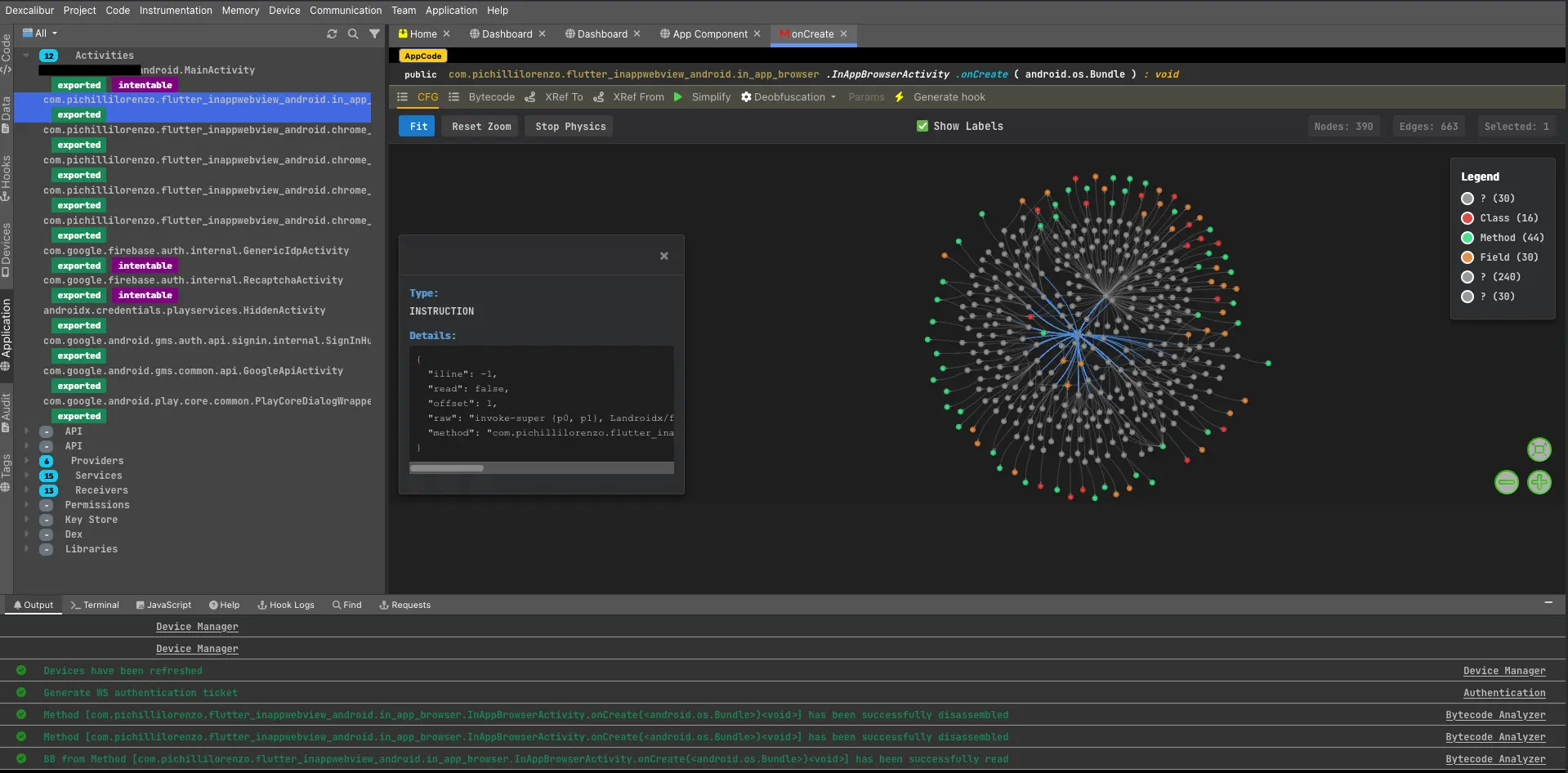
Automatic generation of hooks (Java methods, Objective-C, native functions, instructions, interrupts, instances) in a few clicks. A KeyPoints scheduler marks moments in the app lifecycle to load/unload hooks and trigger actions (memory dumps, screen recording, custom scenarios). Multi-thread and inter-process observation, multi-terminal scenarios for protocol analysis, device-fingerprint control, and a fuzzing engine. Dynamic cross-references are built automatically during execution.
Scan & exploration
One-click SAST / DAST / IAST / SCA batteries, organized by theme against an editable assurance model. Scanners behave like a real user, building a test plan and producing explorable results plus artifacts (screenshots, input and traffic recordings). Coverage includes permissions, SELinux policy, OWASP MASTG, SBOM, and detection of 90+ types of personal data across multiple states.
Deobfuscation
Automatic on-the-fly decompilation with static analysis and AST update for dynamically loaded code. Ready-to-use bypass tactics for common RASP (anti-hook, anti-root, anti-emulator, …). Code synthesis via concrete and symbolic execution to generate simplified representations or find bypass options.
Analysis tooling
- Stereoscopic analysis — a search engine over traces and ASTs spanning 100+ node types (UI components, file content, hooks, …) with adjacency search, taint analysis, and distance; plus a tag system (400+ tags by default) to sort, search, and trigger actions.
- Topological analysis — system-API projection, application-topology visualization, and automatic UI-component inventory.
- Binary analysis — explore all target libraries, unit-emulate with Unicorn, spoof inputs/outputs/CPU context, fuzz, explore ASTs, and contextually spin up an emulator from any point of execution.
Collaboration
One project, many terminals, many analysts, without conflicts. Markers, tags, and Merlin queries can be kept private or shared with the team. Traces and the hook configuration that produced them can be pooled and visualized across users.
Device manager
A single interface to allocate and manage physical or virtual terminals, locally or in a farm. Virtual patching of terminal properties (Reversense generates the required low-level hooks). Access controls and quotas so terminals can be reserved for teams or projects.
Extensibility
- Inspectors — plugins that extend analysis: define instrumentation strategies, chain them into analysis pipelines, and use inter-execution variables for stateful scenarios.
- Actions — attach actions to application states (download a file, dump process/region memory, trigger a host action) and record screen, network, or Bluetooth.
- AssuranceModels — scan binaries versus a set of SAST/DAST/IAST rules redacted inside an assurance model.
Interoperability
- Web Services API — every feature and piece of information is reachable through a standardized API, documented in OpenAPI format.
- Authentication — two modules (API key and SSO) for production use.
- MCP server — exposes all features to an AI, enforcing the same access control as the standard API.
- Model-Context Protocol API — a dedicated API to enrich your own MCP server with Reversense capabilities.
Use cases
Vulnerability research · threat intelligence · personal-data-flow analysis · deobfuscation and malicious-behavior detection · trojanization · security- function bypass · re-engineering and feature extraction · firmware reverse engineering · cryptographic-asset inventory and SBOMs · API identification · integration with an AI-driven system.
Getting started
Start the server and visit the home page
Prerequisites
- List runtime/OS requirements (e.g. Linux, Docker, device access, …)
Installation
# TODO: replace with the real installation steps
git clone https://github.com/YOUR_USER/reversense.git
cd reversense
# ...
Quick start
# TODO: minimal end-to-end example (load a target, run a scan, open results)
Documentation
Full documentation: https://reversenseorg.github.io/rs-doc/
Show Dexcalibur 0.7 (old) demo video : Demo: Less than 1 minute to hook 61 methods ? Not a problem. (youtube)
Contributing
Contributions are welcome. Please read CONTRIBUTING.md before opening an issue or a pull request.
Services
Reversense company is not a consulting firm, but professional services are available to tailor the platform to your needs: training on the platform and on reverse engineering, complete SBOM extraction, cryptographic-function inventory (CBOM), fuzzing consulting, application network-flow mapping, deobfuscation and protection-bypass support, custom scan repositories, and preparation of specific environments (e.g. Tizen).
About
Reversense is a French company founded in 2020 and based in Toulouse, specializing in offensive cybersecurity, application security, and AI. Its mission is to give security professionals the tools to automatically audit the most complex applications as needs evolve.
Get started
Prior to the first run, please create $HOME/.dexcalibur/ folder where global settings will be stored
Frida Version : 16.1.4
- KeyCloak config
- SSO Config
- Init User DB
NODE_ENV=production DXC_SCHEMA=http DXC_HOSTNAME="127.0.0.1:8080" node ./dist/dexcalibur.js --gui=home,pro --dry
1.x Local administrator account
When Dexcalibur is installed, it generates an administrator account with random username and password.
This account is stored locally, into $HOME/.dexcalibur folder until the database is fully configured, then the local admin account is stored into DB.
This user account is tagged "local" instead of "federated", and can be disabled later by server administrator or restricted to be accessed only over a specific IP address.
2. Authentication Settings
2.A OpenID Connect
Copy following code into $HOME/.dexcalibur
{
    "discoverUri":"http://127.0.0.1:8080/realms/dxc-stagging",
    "client_id":"dxcengine_api",
    "client_secret":"<REDACTED>>",
    "redirectUris":[
        "http://127.0.0.1:8080/api-auth/cb"
    ],
    "postLogoutRedirectUris":[
        "http://127.0.0.1:8080/api-logout"
     ],

    "responseType":["code"]
}
3. Unit test
Some tests require environment variable to work properly. Find it below :
| Name | Type | Description | Example |
|---|---|---|---|
| DXC_MONGO_URL | string | MongoDB uri | |
| DXC_MONGO_PORT | number | MongoDB listening port | |
| DXC_BINWALK_PATH | path | Local path of binwalk binary | /opt/homebrew/bin/binwalk |
Some unit tests are skipped if such vars are not defined :
| Name | Test |
|---|---|
| DXC_BINWALK_PATH | BinwalkRunner.test.ts |
Run test :
npm run test
5. Troubleshoot
5.1 Add local admin created at install to existing projects in DB
db.getCollection('project').updateMany({ '_attr.owner': { $regex: /^16/ }},{ $set: { _attr: { owner: { _n: 'owner', _v: [ '0:fd49eb00-ff8b-4a67-a437-75dd3f2f7517' ] }, tester: { _n: 'tester', _v: [ '0:fd49eb00-ff8b-4a67-a437-75dd3f2f7517' ] }} }})
db.getCollection('project')
    .updateMany({
        '_attr.owner': { $regex: /^16/ }
    },{
        $set: {
            _attr: {
                owner: { _n: 'owner', _v: [ 'USER_UUID' ] },
                tester: { _n: 'tester', _v: [ 'USER_UUID' ] }
            }
        }
    });
db.getCollection('project').updateMany({'_attr.owner': { $regex: /^16/ }},{ $set: {_attr: {owner: { _n: 'owner', _v: [ '0:380110fd-5dd4-468c-a1e5-9c5b38bc14bc' ] },tester: { _n: 'tester', _v: [ '0:380110fd-5dd4-468c-a1e5-9c5b38bc14bc' ] }}}});
Parameters :
| ENV | Description | Required | Format |
|---|---|---|---|
| DXC_VDM_HOST | Uri of remote VDM | uri | |
| DXC_VDM_PORT | Port for remote VDM | string | |
| DXC_NODE_RKNAME | Name of the property holding the registration key | string | |
| DXC_NODE_REG_KEY | Path of the file containing the hash of the registration key | string | |
| DXC_NODE_REG | Name of the property holding the registration key | boolean | |
| DXC_NODE_HEAP_SZ | Max memory allowed for heap of slave nodes | number | |
| DXC_HOSTNAME | Public hostname where the service canbe reach (URL) | uri | |
| DXC_MASTER_URI | URI of master node | uri | |
| DXC_MASTER_SSL | Enforce SSL between slave nodes and master nodes | boolean | |
| DXC_PRIV_IP | IP address or name of the node | uri | |
| DXP_SLAVE_HTTP_PORT | Static HTTP port for slave node | number | |
| DXP_SLAVE_HTTPS_PORT | Static WS port for slave node | number | |
| DXP_HC_TIMEOUT | Response timeout (ms) for HealthCheck requests from master to slaves. Default : 100000 | number |
8. Development setup
You must configure a global environment variable DXC_DEV_WS pointing to the development workspace directory, in your bashrc file.
With something like:
export DXC_DEV_WS=$HOME/dxc
Then makefile and others script will use this variable.
/*
networkActivity:NetworkTransaction[] = [
    {   server:{ ip:"216.34.12.98", countryCode:'US'},
        type:'req',
        protocol:'http',
        method:'GET',
        url:'https://firebase-settings.crashlytics.com/spi/v2/platforms/android/gmp/1:907869380789:android:305455082b687916/settings',
        body:{ size:0 },
        time:now-200000,
        source:SOURCES.SMITM
        },
    { server:{ ip:"216.34.12.98", countryCode:'US'},
        type:'req',
        protocol:'https',
        method:'POST',
        url:'https://crashlyticsreports-pa.googleapis.com/v1/firelog/legacy/batchlog',

        body:{ size:0 }, time:now-200500, source:SOURCES.SMITM },
    { type:'rep',
        protocol:'http',
        method:'GET',
        url:'',
        body:{ format:'json', data:JSON.stringify({rooted:true}), size: 17 }, time:now-200520, source:SOURCES.SMITM },
    { server:{ ip:"132.1.4.15", countryCode:'ES'}, type:'req', protocol:'https', method:'GET', url:'',  body:{ size:0 }, time:now-200600, source:SOURCES.IAST },
];*/
Community
- Website: https://reversenseorg.github.io/rs-doc/
- Company: https://www.reversense.com
- Discord: Server
- Telegram: Channel
- Twitter: Profile
- Home: Github
Sponsors
 |
|---|
| They offered a license for All Products <3 |
Resources
There is actually few documentation and training resources about Dexcalibur. If you successfully used Dexcalibur to win CTF challenge or to find vulnerability, i highly encourage you to share your experience.
- THCon 2020
- SSTIC 2020
- Slides of Pass the SALT 2019 (PDF)
- Youtube : demonstration
- CLI User Guide
- User Guide
- Troubleshoots
- Screenshots
They wrote something about Dexcalibur
- Awesome Frida
- Awesome OpenSource Security
- n0secure.org - PassTheSalt2019 J2
- rootshell.be - PassTheSalt2019 Wrap Up
- PentesterLand - the 5 hacking newsletter 61
- Technology Knowledge Database
- Xuanwu Lab Security
- Mobile Gitbook
- 274 - AppsSec Ezine
- ysh329 / Android Reverse Engineering
Notes
Blog post : https://swarm.ptsecurity.com/fork-bomb-for-flutter/
Contributors


Similar repos


Languages
TypeScript
82.2%
HTML
16.2%
Reversense (Dexcalibur2) is a fully rewriting and rethinking of Dexcalibur. Reversense is a binary intelligence platform that automates the reverse engineering of mobile and embedded applications.
TypeScript
1,175
1,708 commits
updated Sep 18, 2026
README
Reversense (also known as Dexcalibur 2)
Current git master branch is 2.0.0
Description
Reversense (Dexcalibur2) is a fully rewriting and rethinking of Dexcalibur. It is a new project which aims to provide a better user experience, and a better coverage, suitable for intelligence and offensive security.
Reversense is a binary intelligence platform that automates the reverse engineering of mobile and embedded applications. It analyzes applications in their real execution context and supports a wide range of target languages, architectures, and operating systems.
Instead of scattering work across disconnected tools, Reversense aggregates static analysis, dynamic instrumentation, emulation, and scanning into a single universal representation of the target — and lets teams explore it together.
Do you want share something or do you need some help ? Join our official chats :
: the prefered way to give a response
Telegram - Alternative for whose are not familiar with Discord
For Professional use, support & modules : www.reversense.com
Table of contents
- Why Reversense
- Highlights
- How it works
- Features
- Interoperability
- Use cases
- Getting started
- Documentation
- Contributing
- Services
- About
- License
Why Reversense
Mobile and embedded applications are everywhere, yet their internal behavior stays opaque: what data they process, whether they are vulnerable or malicious, and how they defend themselves. Traditional approaches run into recurring walls:
- Obfuscated binaries that resist static reading.
- Behavior that depends on a specific device model or execution context.
- Secure channels, white-box crypto, and proprietary protocols that defeat ordinary network interception.
- Vulnerable third-party dependencies that stay invisible without an SBOM.
- A manual reverse-engineering process that is slow, costly, and hard to staff. Reversense addresses these by modeling the whole application and its environment, then automatically instrumenting and executing it to observe what really happens.
Highlights
- Collaborative by design — several analysts work on the same project and binary codebase at once, each running the target on their own terminal, without conflicts.
- Automated scanning — one-click SAST / DAST / IAST batteries driven by a customizable assurance model, producing shareable reports.
- LLM-ready — every feature is invokable by an AI through a built-in MCP server, with the same access control as the standard API.
- Device-farm compatible — allocate and drive physical or virtual terminals, locally or in a farm.
How it works
Reversense operates in four phases:
- Discovery — discovers the execution environment (permissions, hardware capabilities, CPU, TEE, …), retrieves the target application or firmware, and provisions a virtual test bench.
- Modeling — models the entire application and environment into the Reversense universal representation, which is updated automatically as tools and bots discover new data.
- Instrumentation — identifies points of interest (POIs), automatically generates probes to trace flows and mechanisms, then refines and tags the collected traces back into the model.
- Execution, exploration & test — runs the application to generate traces, then enriches the model and deductions. Stateful instrumentation lets the platform adapt to protections observed in previous runs.
Features
Discovery & test bench
Manual or batch target selection (or directly from a device), authenticated download from a store/server/terminal, allocation of one or more devices, and automatic or manual configuration of the target OS to match fine hardware contexts (TV, watches, IoT). Project access control by user, team, or organization.
Universal modeling
Exhaustive data extraction from all files and archives; a universal abstraction that brings machine code, binaries, graphical components, scripts, dumps, network traces, and system calls into one place. Combined static analysis, partial emulation, and symbolic execution. Native Radare2 integration and a Merlin search engine to explore the representation and find code by its execution behavior.
Instrumentation & dynamic analysis
Automatic generation of hooks (Java methods, Objective-C, native functions, instructions, interrupts, instances) in a few clicks. A KeyPoints scheduler marks moments in the app lifecycle to load/unload hooks and trigger actions (memory dumps, screen recording, custom scenarios). Multi-thread and inter-process observation, multi-terminal scenarios for protocol analysis, device-fingerprint control, and a fuzzing engine. Dynamic cross-references are built automatically during execution.
Scan & exploration
One-click SAST / DAST / IAST / SCA batteries, organized by theme against an editable assurance model. Scanners behave like a real user, building a test plan and producing explorable results plus artifacts (screenshots, input and traffic recordings). Coverage includes permissions, SELinux policy, OWASP MASTG, SBOM, and detection of 90+ types of personal data across multiple states.
Deobfuscation
Automatic on-the-fly decompilation with static analysis and AST update for dynamically loaded code. Ready-to-use bypass tactics for common RASP (anti-hook, anti-root, anti-emulator, …). Code synthesis via concrete and symbolic execution to generate simplified representations or find bypass options.
Analysis tooling
- Stereoscopic analysis — a search engine over traces and ASTs spanning 100+ node types (UI components, file content, hooks, …) with adjacency search, taint analysis, and distance; plus a tag system (400+ tags by default) to sort, search, and trigger actions.
- Topological analysis — system-API projection, application-topology visualization, and automatic UI-component inventory.
- Binary analysis — explore all target libraries, unit-emulate with Unicorn, spoof inputs/outputs/CPU context, fuzz, explore ASTs, and contextually spin up an emulator from any point of execution.
Collaboration
One project, many terminals, many analysts, without conflicts. Markers, tags, and Merlin queries can be kept private or shared with the team. Traces and the hook configuration that produced them can be pooled and visualized across users.
Device manager
A single interface to allocate and manage physical or virtual terminals, locally or in a farm. Virtual patching of terminal properties (Reversense generates the required low-level hooks). Access controls and quotas so terminals can be reserved for teams or projects.
Extensibility
- Inspectors — plugins that extend analysis: define instrumentation strategies, chain them into analysis pipelines, and use inter-execution variables for stateful scenarios.
- Actions — attach actions to application states (download a file, dump process/region memory, trigger a host action) and record screen, network, or Bluetooth.
- AssuranceModels — scan binaries versus a set of SAST/DAST/IAST rules redacted inside an assurance model.
Interoperability
- Web Services API — every feature and piece of information is reachable through a standardized API, documented in OpenAPI format.
- Authentication — two modules (API key and SSO) for production use.
- MCP server — exposes all features to an AI, enforcing the same access control as the standard API.
- Model-Context Protocol API — a dedicated API to enrich your own MCP server with Reversense capabilities.
Use cases
Vulnerability research · threat intelligence · personal-data-flow analysis · deobfuscation and malicious-behavior detection · trojanization · security- function bypass · re-engineering and feature extraction · firmware reverse engineering · cryptographic-asset inventory and SBOMs · API identification · integration with an AI-driven system.
Getting started
Start the server and visit the home page
Prerequisites
- List runtime/OS requirements (e.g. Linux, Docker, device access, …)
Installation
# TODO: replace with the real installation steps
git clone https://github.com/YOUR_USER/reversense.git
cd reversense
# ...
Quick start
# TODO: minimal end-to-end example (load a target, run a scan, open results)
Documentation
Full documentation: https://reversenseorg.github.io/rs-doc/
Show Dexcalibur 0.7 (old) demo video : Demo: Less than 1 minute to hook 61 methods ? Not a problem. (youtube)
Contributing
Contributions are welcome. Please read CONTRIBUTING.md before opening an issue or a pull request.
Services
Reversense company is not a consulting firm, but professional services are available to tailor the platform to your needs: training on the platform and on reverse engineering, complete SBOM extraction, cryptographic-function inventory (CBOM), fuzzing consulting, application network-flow mapping, deobfuscation and protection-bypass support, custom scan repositories, and preparation of specific environments (e.g. Tizen).
About
Reversense is a French company founded in 2020 and based in Toulouse, specializing in offensive cybersecurity, application security, and AI. Its mission is to give security professionals the tools to automatically audit the most complex applications as needs evolve.
Get started
Prior to the first run, please create $HOME/.dexcalibur/ folder where global settings will be stored
Frida Version : 16.1.4
- KeyCloak config
- SSO Config
- Init User DB
NODE_ENV=production DXC_SCHEMA=http DXC_HOSTNAME="127.0.0.1:8080" node ./dist/dexcalibur.js --gui=home,pro --dry
1.x Local administrator account
When Dexcalibur is installed, it generates an administrator account with random username and password.
This account is stored locally, into $HOME/.dexcalibur folder until the database is fully configured, then the local admin account is stored into DB.
This user account is tagged "local" instead of "federated", and can be disabled later by server administrator or restricted to be accessed only over a specific IP address.
2. Authentication Settings
2.A OpenID Connect
Copy following code into $HOME/.dexcalibur
{
    "discoverUri":"http://127.0.0.1:8080/realms/dxc-stagging",
    "client_id":"dxcengine_api",
    "client_secret":"<REDACTED>>",
    "redirectUris":[
        "http://127.0.0.1:8080/api-auth/cb"
    ],
    "postLogoutRedirectUris":[
        "http://127.0.0.1:8080/api-logout"
     ],

    "responseType":["code"]
}
3. Unit test
Some tests require environment variable to work properly. Find it below :
| Name | Type | Description | Example |
|---|---|---|---|
| DXC_MONGO_URL | string | MongoDB uri | |
| DXC_MONGO_PORT | number | MongoDB listening port | |
| DXC_BINWALK_PATH | path | Local path of binwalk binary | /opt/homebrew/bin/binwalk |
Some unit tests are skipped if such vars are not defined :
| Name | Test |
|---|---|
| DXC_BINWALK_PATH | BinwalkRunner.test.ts |
Run test :
npm run test
5. Troubleshoot
5.1 Add local admin created at install to existing projects in DB
db.getCollection('project').updateMany({ '_attr.owner': { $regex: /^16/ }},{ $set: { _attr: { owner: { _n: 'owner', _v: [ '0:fd49eb00-ff8b-4a67-a437-75dd3f2f7517' ] }, tester: { _n: 'tester', _v: [ '0:fd49eb00-ff8b-4a67-a437-75dd3f2f7517' ] }} }})
db.getCollection('project')
    .updateMany({
        '_attr.owner': { $regex: /^16/ }
    },{
        $set: {
            _attr: {
                owner: { _n: 'owner', _v: [ 'USER_UUID' ] },
                tester: { _n: 'tester', _v: [ 'USER_UUID' ] }
            }
        }
    });
db.getCollection('project').updateMany({'_attr.owner': { $regex: /^16/ }},{ $set: {_attr: {owner: { _n: 'owner', _v: [ '0:380110fd-5dd4-468c-a1e5-9c5b38bc14bc' ] },tester: { _n: 'tester', _v: [ '0:380110fd-5dd4-468c-a1e5-9c5b38bc14bc' ] }}}});
Parameters :
| ENV | Description | Required | Format |
|---|---|---|---|
| DXC_VDM_HOST | Uri of remote VDM | uri | |
| DXC_VDM_PORT | Port for remote VDM | string | |
| DXC_NODE_RKNAME | Name of the property holding the registration key | string | |
| DXC_NODE_REG_KEY | Path of the file containing the hash of the registration key | string | |
| DXC_NODE_REG | Name of the property holding the registration key | boolean | |
| DXC_NODE_HEAP_SZ | Max memory allowed for heap of slave nodes | number | |
| DXC_HOSTNAME | Public hostname where the service canbe reach (URL) | uri | |
| DXC_MASTER_URI | URI of master node | uri | |
| DXC_MASTER_SSL | Enforce SSL between slave nodes and master nodes | boolean | |
| DXC_PRIV_IP | IP address or name of the node | uri | |
| DXP_SLAVE_HTTP_PORT | Static HTTP port for slave node | number | |
| DXP_SLAVE_HTTPS_PORT | Static WS port for slave node | number | |
| DXP_HC_TIMEOUT | Response timeout (ms) for HealthCheck requests from master to slaves. Default : 100000 | number |
8. Development setup
You must configure a global environment variable DXC_DEV_WS pointing to the development workspace directory, in your bashrc file.
With something like:
export DXC_DEV_WS=$HOME/dxc
Then makefile and others script will use this variable.
/*
networkActivity:NetworkTransaction[] = [
    {   server:{ ip:"216.34.12.98", countryCode:'US'},
        type:'req',
        protocol:'http',
        method:'GET',
        url:'https://firebase-settings.crashlytics.com/spi/v2/platforms/android/gmp/1:907869380789:android:305455082b687916/settings',
        body:{ size:0 },
        time:now-200000,
        source:SOURCES.SMITM
        },
    { server:{ ip:"216.34.12.98", countryCode:'US'},
        type:'req',
        protocol:'https',
        method:'POST',
        url:'https://crashlyticsreports-pa.googleapis.com/v1/firelog/legacy/batchlog',

        body:{ size:0 }, time:now-200500, source:SOURCES.SMITM },
    { type:'rep',
        protocol:'http',
        method:'GET',
        url:'',
        body:{ format:'json', data:JSON.stringify({rooted:true}), size: 17 }, time:now-200520, source:SOURCES.SMITM },
    { server:{ ip:"132.1.4.15", countryCode:'ES'}, type:'req', protocol:'https', method:'GET', url:'',  body:{ size:0 }, time:now-200600, source:SOURCES.IAST },
];*/
Community
- Website: https://reversenseorg.github.io/rs-doc/
- Company: https://www.reversense.com
- Discord: Server
- Telegram: Channel
- Twitter: Profile
- Home: Github
Sponsors
|
|---|
| They offered a license for All Products <3 |
Resources
There is actually few documentation and training resources about Dexcalibur. If you successfully used Dexcalibur to win CTF challenge or to find vulnerability, i highly encourage you to share your experience.
- THCon 2020
- SSTIC 2020
- Slides of Pass the SALT 2019 (PDF)
- Youtube : demonstration
- CLI User Guide
- User Guide
- Troubleshoots
- Screenshots
They wrote something about Dexcalibur
- Awesome Frida
- Awesome OpenSource Security
- n0secure.org - PassTheSalt2019 J2
- rootshell.be - PassTheSalt2019 Wrap Up
- PentesterLand - the 5 hacking newsletter 61
- Technology Knowledge Database
- Xuanwu Lab Security
- Mobile Gitbook
- 274 - AppsSec Ezine
- ysh329 / Android Reverse Engineering
Notes
Blog post : https://swarm.ptsecurity.com/fork-bomb-for-flutter/
Similar repos
Contributors
Languages
TypeScript
82.2%
HTML
16.2%