
Rehearse how specific, known people will react to a document before they see it — a Claude Code skill.
Python
1
0 commits
updated Sep 29, 2026
See what people are saying
README
beforehand







evidence-based stakeholder panels
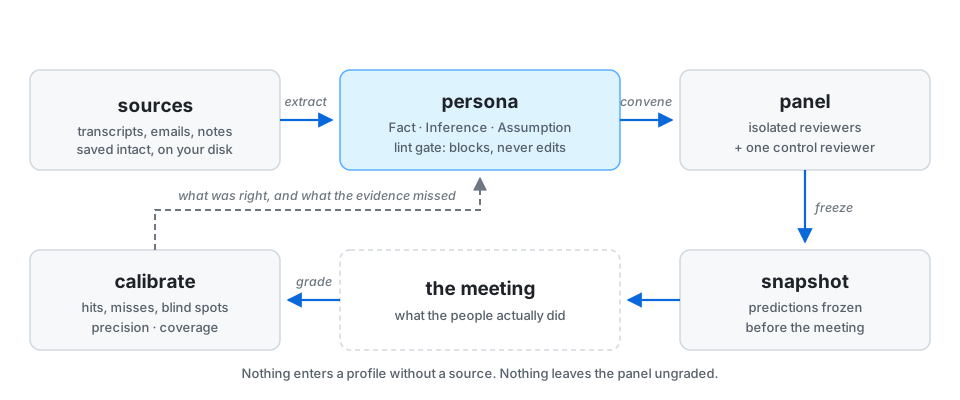
A Claude skill that rehearses how specific, known people will react to a document before they see it. From sources you own — transcripts, emails, notes — it builds a profile where every trait is labeled Fact, Inference or Assumption, every Fact carries the excerpt and the file it came from, and a deterministic linter checks that the excerpt is really there. That profile then stress-tests a draft, rehearses a conversation, or answers a question as that person would, and its predictions are graded afterwards against what the person actually did.
Local-first: the store lives outside any repository, nothing leaves the machine, and nothing enters a profile unlabeled.
A profile holds how someone judges and decides — mandate, judgment criteria, recurring objections, red lines, dissent style, panel dynamics — and not their tastes, personality or private life. The skill README spells out what is tracked and what deliberately is not.
Install
Claude Code, as a plugin — the repository is its own single-plugin marketplace:
claude plugin marketplace add FrancescoPolitano/beforehand
claude plugin install beforehand@beforehand
Claude Code, without the plugin system — the beforehand command line, run with
uv's uvx (nothing to install first):
uvx --from git+https://github.com/FrancescoPolitano/beforehand beforehand install
It copies the skill to ~/.claude/skills/beforehand and the reviewer agent to
~/.claude/agents/persona-reviewer.md, and prints what it wrote:
wrote ~/.claude/skills/beforehand/ (181 files)
wrote ~/.claude/skills/beforehand/.installed-by-beforehand
wrote ~/.claude/agents/persona-reviewer.md
installed beforehand 1.0.0
It copies, never symlinks, and it refuses (exit 1, with the reason) rather than overwrite
something it did not put there: a destination that is a symlink is never written through, a
skill directory without its .installed-by-beforehand marker is left alone, and an existing
install or a different agent file is replaced only with --update. The copy is staged beside
the target and swapped in, so an install is never half done. The same command upgrades and
removes:
uvx --from git+https://github.com/FrancescoPolitano/beforehand beforehand install --update
uvx --from git+https://github.com/FrancescoPolitano/beforehand beforehand uninstall
uninstall removes only a skill directory carrying the marker and an agent file identical
to the one this version ships. Both commands take --skills-dir DIR --agents-dir DIR for
other locations. beforehand --version prints beforehand 1.0.0; any other command is the
skill's own (beforehand doctor, beforehand test, beforehand help for the list).
Claude Cowork, or any host that installs a skill archive — expected to work, not yet
verified end to end. Download beforehand-1.0.0.skill from the
Releases page, or build it with
uvx --from git+https://github.com/FrancescoPolitano/beforehand beforehand bundle
(it writes beforehand-1.0.0.skill into the current folder, or into --out DIR), install it the way the
host installs a skill, and choose where the store lives:
export BEFOREHAND_STORE="<a folder you choose, outside any repository>"
Claude Desktop — consult only. The filesystem is ephemeral, so there is no store to keep; you can ask about a document with a profile supplied in the conversation, and nothing persists.
Development — a symlink from a clone, so your edits are live (the installer refuses to write through this link, by design):
git clone https://github.com/FrancescoPolitano/beforehand
cd beforehand
ln -s "$PWD/skills/beforehand" ~/.claude/skills/beforehand
CONTRIBUTING.md takes it from there.
Quickstart
# put a source on disk, intact, with its provenance header
python3 $SKILL/scripts/beforehand.py save --dir ./sources --date 2026-07-03 --what call-of-3-july \
  --ref "call of 3 July" --type private-communication --provenance machine-transcribed < transcript.txt

# settle who actually speaks in it before extracting anything
python3 $SKILL/scripts/beforehand.py speakers ./sources/2026-07-03-call-of-3-july.md

# read-only diagnosis of the context you are about to work in
python3 $SKILL/scripts/beforehand.py doctor --context halden
If you have the beforehand command from uvx (see Install above), it is a shorter form of
the same calls — beforehand save …, beforehand speakers …, beforehand doctor … — since
anything past its own commands (install, uninstall, bundle, help) passes straight
through to its bundled scripts/beforehand.py, byte-identical to the one under $SKILL.
Then, in the session: "build a persona for halden from ./sources/2026-07-03-call-of-3-july.md",
accept the proposed file, and "stress-test ./proposal.md for halden". $SKILL is the skill
directory; the store defaults to ~/.beforehand. Where the skill directory is depends on how you installed:
~/.claude/skills/beforehand after uvx … beforehand install, or
~/.claude/plugins/cache/beforehand/beforehand/1.0.0/skills/beforehand after the plugin-marketplace
route (the cache path is versioned, so it moves on upgrade).
A named label is not the same thing as one voice: a conference room arrives as one name, so
speakers prints a POSSIBLE SHARED MICROPHONE. block whenever the text carries clues of
one. That block is common rather than rare — a legitimate call where someone names their own
label or answers their own question trips it — and it is warn-only: no exit code changes, and
a clean run is not evidence of a single voice. When you have confirmed the room, record it in
your own words with --map "<label>=room: <who speaks>, <N> present".
Proactive offers (optional)
beforehand does not watch what you do: it runs when you ask it to. Its offer rules —
proposing an update when new material about someone you already track enters the session,
flagging a prediction snapshot that has come due — apply only once the skill is loaded, and the
skill loads when your request matches what it is for.
To make those rules fire while you work, add this line to your agent's context file
(CLAUDE.md for Claude Code, AGENTS.md for agents that follow that convention), in the
directory where you keep meeting material:
When a transcript, an email or call notes naming someone already in the
beforehandstore enter the session, invoke the skill and let it decide whether to offer an update. An offer executes nothing: you accept it.
For an overdue snapshot the sturdier route is not an instruction but a session-start hook that
runs doctor: it is deterministic and has no false positives.
Other agents. The scripts are plain Python 3.9 stdlib behind one command line, so they run
under any agent or none. The references are markdown and travel as text. What does not travel
is the isolation: a panel is worth what its separation is worth, and enforced-tools
isolation — where the host, not the prompt, holds a reviewer to its two files — is Claude
Code's. Elsewhere the review flow degrades to staged, inline or emulated, which it names
and requires you to disclose per persona.
Repository
| Path | What is in it |
|---|---|
skills/beforehand/README.md | the skill: flows, evidence model, all 14 commands, what a review looks like, host support, responsible use, limits |
docs/ARCHITECTURE.md | three layers — what the scripts guarantee, what they explicitly do not, and which rules rest on the prompt alone |
CHANGELOG.md | the releases; from 1.0 the history is in git |
CONTRIBUTING.md | how to work on this: the gate, the eight rules that gate every change, the pull-request checklist |
dev/ | the gate scripts (check_all.sh and the checks it calls), the pre-commit hook, build_skill.sh, norm-anchors.txt and public-identity.txt. Not part of the skill |
beforehand_cli/ | the beforehand command line behind uvx (install, uninstall, bundle) and its tests. Not part of the skill |
evals/ | the behavioural evals: seven cases, their checkers and their synthetic transcripts. Not part of the skill |
The whole repository is also a Claude Code plugin: .claude-plugin/plugin.json declares
skills/ and agents/. No hooks ship: the development usage logger is opt-in and lives
outside this repository (see dev/README.md).
Status
1.0.0 — the first public release; usable and used daily. The history lives in git from
1.0 on. sh dev/check_all.sh is the gate: 17 test suites, the router budget, the norm
anchors, the generality scan, the golden-store and determinism checks, the 3.9 syntax floor,
ruff, the eval checkers and the command-line tests. CONTRIBUTING.md is
how to run all of it.
Honest limits
Calibration here is a longitudinal case study, not a controlled experiment: small n, a single observer, assisted matching. Nothing here claims accuracy. It claims that every trait is traceable to something a real person actually said, and that you will know how often the panel was right.
All examples and fixtures are synthetic. Halden Logistics does not exist.
License
MIT — see LICENSE.
Similar repos


Languages
Python
94.7%
Shell
5.3%
Rehearse how specific, known people will react to a document before they see it — a Claude Code skill.
Python
1
0 commits
updated Sep 29, 2026
See what people are saying
README
beforehand
evidence-based stakeholder panels
A Claude skill that rehearses how specific, known people will react to a document before they see it. From sources you own — transcripts, emails, notes — it builds a profile where every trait is labeled Fact, Inference or Assumption, every Fact carries the excerpt and the file it came from, and a deterministic linter checks that the excerpt is really there. That profile then stress-tests a draft, rehearses a conversation, or answers a question as that person would, and its predictions are graded afterwards against what the person actually did.
Local-first: the store lives outside any repository, nothing leaves the machine, and nothing enters a profile unlabeled.
A profile holds how someone judges and decides — mandate, judgment criteria, recurring objections, red lines, dissent style, panel dynamics — and not their tastes, personality or private life. The skill README spells out what is tracked and what deliberately is not.
Install
Claude Code, as a plugin — the repository is its own single-plugin marketplace:
claude plugin marketplace add FrancescoPolitano/beforehand
claude plugin install beforehand@beforehand
Claude Code, without the plugin system — the beforehand command line, run with
uv's uvx (nothing to install first):
uvx --from git+https://github.com/FrancescoPolitano/beforehand beforehand install
It copies the skill to ~/.claude/skills/beforehand and the reviewer agent to
~/.claude/agents/persona-reviewer.md, and prints what it wrote:
wrote ~/.claude/skills/beforehand/ (181 files)
wrote ~/.claude/skills/beforehand/.installed-by-beforehand
wrote ~/.claude/agents/persona-reviewer.md
installed beforehand 1.0.0
It copies, never symlinks, and it refuses (exit 1, with the reason) rather than overwrite
something it did not put there: a destination that is a symlink is never written through, a
skill directory without its .installed-by-beforehand marker is left alone, and an existing
install or a different agent file is replaced only with --update. The copy is staged beside
the target and swapped in, so an install is never half done. The same command upgrades and
removes:
uvx --from git+https://github.com/FrancescoPolitano/beforehand beforehand install --update
uvx --from git+https://github.com/FrancescoPolitano/beforehand beforehand uninstall
uninstall removes only a skill directory carrying the marker and an agent file identical
to the one this version ships. Both commands take --skills-dir DIR --agents-dir DIR for
other locations. beforehand --version prints beforehand 1.0.0; any other command is the
skill's own (beforehand doctor, beforehand test, beforehand help for the list).
Claude Cowork, or any host that installs a skill archive — expected to work, not yet
verified end to end. Download beforehand-1.0.0.skill from the
Releases page, or build it with
uvx --from git+https://github.com/FrancescoPolitano/beforehand beforehand bundle
(it writes beforehand-1.0.0.skill into the current folder, or into --out DIR), install it the way the
host installs a skill, and choose where the store lives:
export BEFOREHAND_STORE="<a folder you choose, outside any repository>"
Claude Desktop — consult only. The filesystem is ephemeral, so there is no store to keep; you can ask about a document with a profile supplied in the conversation, and nothing persists.
Development — a symlink from a clone, so your edits are live (the installer refuses to write through this link, by design):
git clone https://github.com/FrancescoPolitano/beforehand
cd beforehand
ln -s "$PWD/skills/beforehand" ~/.claude/skills/beforehand
CONTRIBUTING.md takes it from there.
Quickstart
# put a source on disk, intact, with its provenance header
python3 $SKILL/scripts/beforehand.py save --dir ./sources --date 2026-07-03 --what call-of-3-july \
  --ref "call of 3 July" --type private-communication --provenance machine-transcribed < transcript.txt

# settle who actually speaks in it before extracting anything
python3 $SKILL/scripts/beforehand.py speakers ./sources/2026-07-03-call-of-3-july.md

# read-only diagnosis of the context you are about to work in
python3 $SKILL/scripts/beforehand.py doctor --context halden
If you have the beforehand command from uvx (see Install above), it is a shorter form of
the same calls — beforehand save …, beforehand speakers …, beforehand doctor … — since
anything past its own commands (install, uninstall, bundle, help) passes straight
through to its bundled scripts/beforehand.py, byte-identical to the one under $SKILL.
Then, in the session: "build a persona for halden from ./sources/2026-07-03-call-of-3-july.md",
accept the proposed file, and "stress-test ./proposal.md for halden". $SKILL is the skill
directory; the store defaults to ~/.beforehand. Where the skill directory is depends on how you installed:
~/.claude/skills/beforehand after uvx … beforehand install, or
~/.claude/plugins/cache/beforehand/beforehand/1.0.0/skills/beforehand after the plugin-marketplace
route (the cache path is versioned, so it moves on upgrade).
A named label is not the same thing as one voice: a conference room arrives as one name, so
speakers prints a POSSIBLE SHARED MICROPHONE. block whenever the text carries clues of
one. That block is common rather than rare — a legitimate call where someone names their own
label or answers their own question trips it — and it is warn-only: no exit code changes, and
a clean run is not evidence of a single voice. When you have confirmed the room, record it in
your own words with --map "<label>=room: <who speaks>, <N> present".
Proactive offers (optional)
beforehand does not watch what you do: it runs when you ask it to. Its offer rules —
proposing an update when new material about someone you already track enters the session,
flagging a prediction snapshot that has come due — apply only once the skill is loaded, and the
skill loads when your request matches what it is for.
To make those rules fire while you work, add this line to your agent's context file
(CLAUDE.md for Claude Code, AGENTS.md for agents that follow that convention), in the
directory where you keep meeting material:
When a transcript, an email or call notes naming someone already in the
beforehandstore enter the session, invoke the skill and let it decide whether to offer an update. An offer executes nothing: you accept it.
For an overdue snapshot the sturdier route is not an instruction but a session-start hook that
runs doctor: it is deterministic and has no false positives.
Other agents. The scripts are plain Python 3.9 stdlib behind one command line, so they run
under any agent or none. The references are markdown and travel as text. What does not travel
is the isolation: a panel is worth what its separation is worth, and enforced-tools
isolation — where the host, not the prompt, holds a reviewer to its two files — is Claude
Code's. Elsewhere the review flow degrades to staged, inline or emulated, which it names
and requires you to disclose per persona.
Repository
| Path | What is in it |
|---|---|
skills/beforehand/README.md | the skill: flows, evidence model, all 14 commands, what a review looks like, host support, responsible use, limits |
docs/ARCHITECTURE.md | three layers — what the scripts guarantee, what they explicitly do not, and which rules rest on the prompt alone |
CHANGELOG.md | the releases; from 1.0 the history is in git |
CONTRIBUTING.md | how to work on this: the gate, the eight rules that gate every change, the pull-request checklist |
dev/ | the gate scripts (check_all.sh and the checks it calls), the pre-commit hook, build_skill.sh, norm-anchors.txt and public-identity.txt. Not part of the skill |
beforehand_cli/ | the beforehand command line behind uvx (install, uninstall, bundle) and its tests. Not part of the skill |
evals/ | the behavioural evals: seven cases, their checkers and their synthetic transcripts. Not part of the skill |
The whole repository is also a Claude Code plugin: .claude-plugin/plugin.json declares
skills/ and agents/. No hooks ship: the development usage logger is opt-in and lives
outside this repository (see dev/README.md).
Status
1.0.0 — the first public release; usable and used daily. The history lives in git from
1.0 on. sh dev/check_all.sh is the gate: 17 test suites, the router budget, the norm
anchors, the generality scan, the golden-store and determinism checks, the 3.9 syntax floor,
ruff, the eval checkers and the command-line tests. CONTRIBUTING.md is
how to run all of it.
Honest limits
Calibration here is a longitudinal case study, not a controlled experiment: small n, a single observer, assisted matching. Nothing here claims accuracy. It claims that every trait is traceable to something a real person actually said, and that you will know how often the panel was right.
All examples and fixtures are synthetic. Halden Logistics does not exist.
License
MIT — see LICENSE.
Similar repos
Languages
Python
94.7%
Shell
5.3%