
[CVPR 2025] UniVAD: A Training-free Unified Model for Few-shot Visual Anomaly Detection
Jupyter Notebook
226
31 commits
updated Oct 20, 2025
README
UniVAD: A Training-free Unified Model for Few-shot Visual Anomaly Detection
Official implementation of paper UniVAD: A Training-free Unified Model for Few-shot Visual Anomaly Detection (CVPR 2025).
Introduction
Welcome to the official repository for "UniVAD: A Training-free Unified Model for Few-shot Visual Anomaly Detection." This work presents UniVAD, a novel approach that can detect anomalies across various domains, including industrial, logical, and medical fields, using a unified model without requiring domain-specific training.
UniVAD operates by leveraging a few normal samples as references during testing to detect anomalies in previously unseen objects. It consists of three key components:
- Contextual Component Clustering ($C^3$): Segments components within images accurately by combining clustering techniques with vision foundation models.
- Component-Aware Patch Matching (CAPM): Detects structural anomalies by matching patch-level features within each component.
- Graph-Enhanced Component Modeling (GECM): Identifies logical anomalies by modeling relationships between image components through graph-based feature aggregation.
Our experiments on nine datasets spanning industrial, logical, and medical domains demonstrate that UniVAD achieves state-of-the-art performance in few-shot anomaly detection tasks, outperforming domain-specific models and establishing a new paradigm for unified visual anomaly detection.
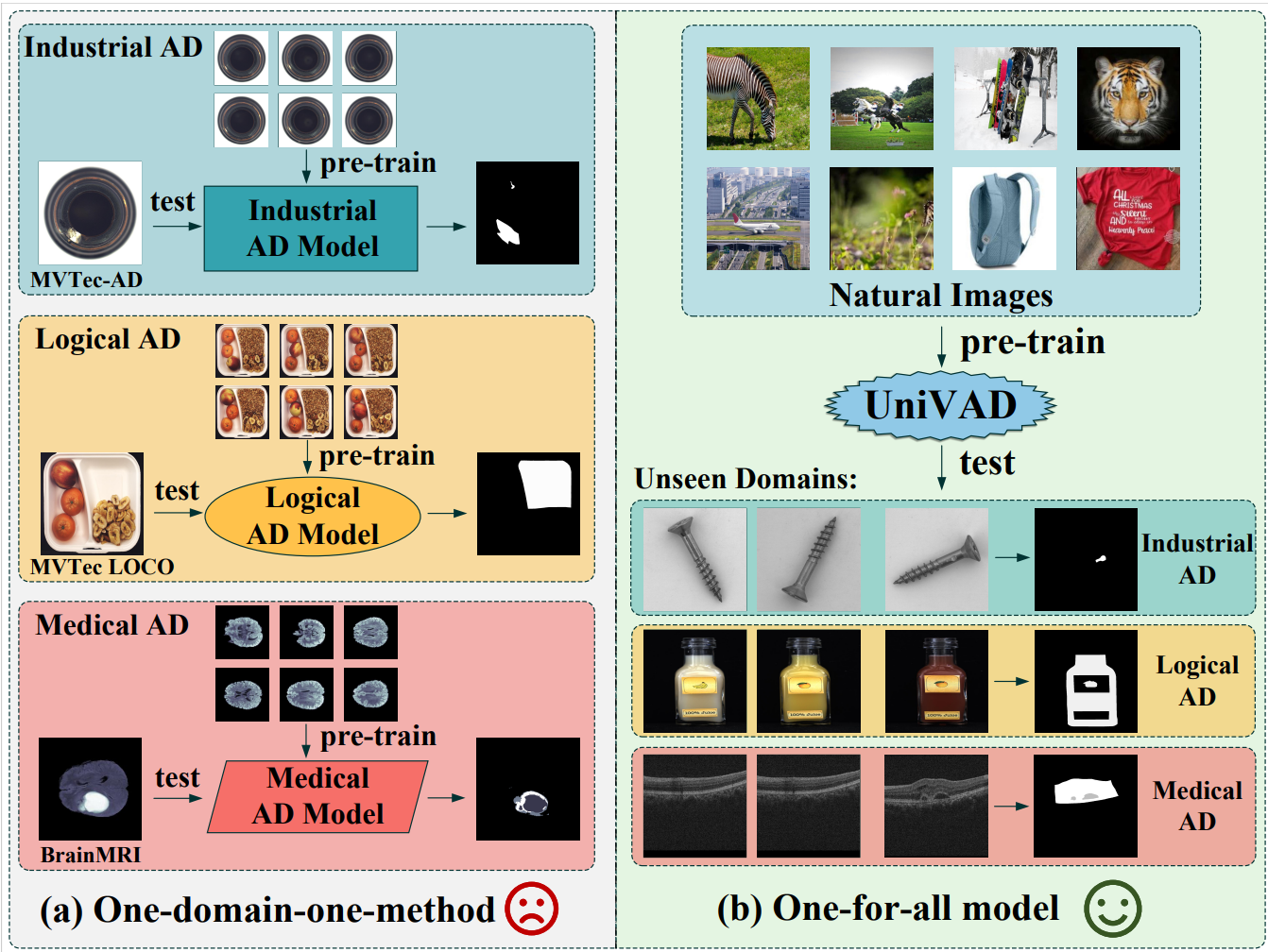
Overview of UniVAD
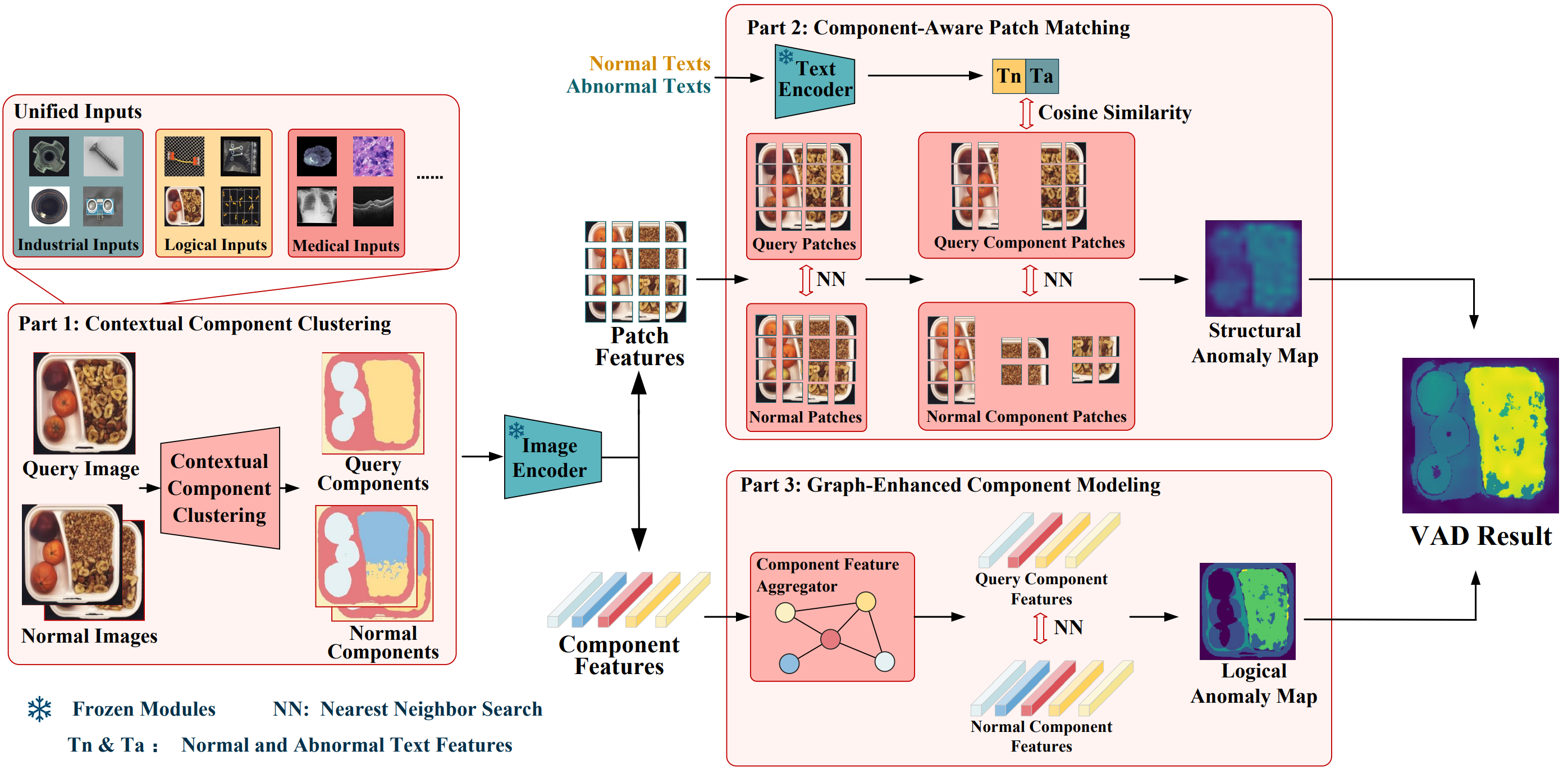
Runing UniVAD
Environment Installation
Clone the repository locally:
git clone --recurse-submodules https://github.com/FantasticGNU/UniVAD.git
Install the required packages:
pip install -r requirements.txt
Install the GroundingDINO
cd models/GroundingDINO;
pip install -e .
Prepare pretrained checkpoints
cd pretrained_ckpts;
wget https://huggingface.co/lkeab/hq-sam/resolve/main/sam_hq_vit_h.pth;
wget https://github.com/IDEA-Research/GroundingDINO/releases/download/v0.1.0-alpha/groundingdino_swint_ogc.pth
Prepare data
MVTec AD
- Download and extract MVTec AD into
data/mvtec - run
python data/mvtec_solver.pyto obtaindata/mvtec/meta.json
VisA
- Download and extract VisA
- Refer to the instructions in https://github.com/amazon-science/spot-diff?tab=readme-ov-file#data-preparation to get the 1-class format of the dataset and put it into
data/VisA_pytorch/1cls - run
python data/visa_solver.pyto obtaindata/VisA_pytorch/1cls/meta.json
MvTec LOCO AD
-
We use the improved MVTec LOCO Caption dataset here, which merges multiple ground truth masks in the original MVTec LOCO data into one. Please refer to https://github.com/hujiecpp/MVTec-Caption to obtain MVTec LOCO Caption dataset
-
run
python data/mvtec_loco_solver.pyto obtaindata/mvtec_loco_caption/meta.json
Medical datasets
- The data in the medical dataset we used are mainly obtained from BMAD, and we organized it according to the MVTec format
- Download from This OneDrive Link and put them into
data/
Data format
The prepared data format should be as follows
data
├── mvtec
    ├── meta.json
    ├── bottle
    ├── cable
    ├── ...
├── VisA_pytorch/1cls
    ├── meta.json
    ├── candle
    ├── capsules
    ├── ...
├── mvtec_loco_caption
    ├── meta.json
    ├── breakfast_box
    ├── juice_bottle
    ├── ...
├── BrainMRI
    ├── meta.json
    ├── train
    ├── test
    ├── ground_truth
├── LiverCT
    ├── meta.json
    ├── train
    ├── test
    ├── ground_truth
├── RESC
    ├── meta.json
    ├── train
    ├── test
    ├── ground_truth
├── HIS
    ├── meta.json
    ├── train
    ├── test
├── ChestXray
    ├── meta.json
    ├── train
    ├── test
├── OCT17
    ├── meta.json
    ├── train
    ├── test
Component Segmentation
Perform contextual component clustering for all data in advance to facilitate subsequent processing
python segment_components.py
Run the test script
bash test.sh
Citation:
If you found UniVAD useful in your research or applications, please kindly cite using the following BibTeX:
@article{gu2024univad,
  title={UniVAD: A Training-free Unified Model for Few-shot Visual Anomaly Detection},
  author={Gu, Zhaopeng and Zhu, Bingke and Zhu, Guibo and Chen, Yingying and Tang, Ming and Wang, Jinqiao},
  journal={arXiv preprint arXiv:2412.03342},
  year={2024}
}
Similar repos


Languages
Jupyter Notebook
77.7%
Python
20.8%
Cuda
1.3%
[CVPR 2025] UniVAD: A Training-free Unified Model for Few-shot Visual Anomaly Detection
Jupyter Notebook
226
31 commits
updated Oct 20, 2025
README
UniVAD: A Training-free Unified Model for Few-shot Visual Anomaly Detection
Official implementation of paper UniVAD: A Training-free Unified Model for Few-shot Visual Anomaly Detection (CVPR 2025).
Introduction
Welcome to the official repository for "UniVAD: A Training-free Unified Model for Few-shot Visual Anomaly Detection." This work presents UniVAD, a novel approach that can detect anomalies across various domains, including industrial, logical, and medical fields, using a unified model without requiring domain-specific training.
UniVAD operates by leveraging a few normal samples as references during testing to detect anomalies in previously unseen objects. It consists of three key components:
- Contextual Component Clustering ($C^3$): Segments components within images accurately by combining clustering techniques with vision foundation models.
- Component-Aware Patch Matching (CAPM): Detects structural anomalies by matching patch-level features within each component.
- Graph-Enhanced Component Modeling (GECM): Identifies logical anomalies by modeling relationships between image components through graph-based feature aggregation.
Our experiments on nine datasets spanning industrial, logical, and medical domains demonstrate that UniVAD achieves state-of-the-art performance in few-shot anomaly detection tasks, outperforming domain-specific models and establishing a new paradigm for unified visual anomaly detection.
Overview of UniVAD
Runing UniVAD
Environment Installation
Clone the repository locally:
git clone --recurse-submodules https://github.com/FantasticGNU/UniVAD.git
Install the required packages:
pip install -r requirements.txt
Install the GroundingDINO
cd models/GroundingDINO;
pip install -e .
Prepare pretrained checkpoints
cd pretrained_ckpts;
wget https://huggingface.co/lkeab/hq-sam/resolve/main/sam_hq_vit_h.pth;
wget https://github.com/IDEA-Research/GroundingDINO/releases/download/v0.1.0-alpha/groundingdino_swint_ogc.pth
Prepare data
MVTec AD
- Download and extract MVTec AD into
data/mvtec - run
python data/mvtec_solver.pyto obtaindata/mvtec/meta.json
VisA
- Download and extract VisA
- Refer to the instructions in https://github.com/amazon-science/spot-diff?tab=readme-ov-file#data-preparation to get the 1-class format of the dataset and put it into
data/VisA_pytorch/1cls - run
python data/visa_solver.pyto obtaindata/VisA_pytorch/1cls/meta.json
MvTec LOCO AD
-
We use the improved MVTec LOCO Caption dataset here, which merges multiple ground truth masks in the original MVTec LOCO data into one. Please refer to https://github.com/hujiecpp/MVTec-Caption to obtain MVTec LOCO Caption dataset
-
run
python data/mvtec_loco_solver.pyto obtaindata/mvtec_loco_caption/meta.json
Medical datasets
- The data in the medical dataset we used are mainly obtained from BMAD, and we organized it according to the MVTec format
- Download from This OneDrive Link and put them into
data/
Data format
The prepared data format should be as follows
data
├── mvtec
    ├── meta.json
    ├── bottle
    ├── cable
    ├── ...
├── VisA_pytorch/1cls
    ├── meta.json
    ├── candle
    ├── capsules
    ├── ...
├── mvtec_loco_caption
    ├── meta.json
    ├── breakfast_box
    ├── juice_bottle
    ├── ...
├── BrainMRI
    ├── meta.json
    ├── train
    ├── test
    ├── ground_truth
├── LiverCT
    ├── meta.json
    ├── train
    ├── test
    ├── ground_truth
├── RESC
    ├── meta.json
    ├── train
    ├── test
    ├── ground_truth
├── HIS
    ├── meta.json
    ├── train
    ├── test
├── ChestXray
    ├── meta.json
    ├── train
    ├── test
├── OCT17
    ├── meta.json
    ├── train
    ├── test
Component Segmentation
Perform contextual component clustering for all data in advance to facilitate subsequent processing
python segment_components.py
Run the test script
bash test.sh
Citation:
If you found UniVAD useful in your research or applications, please kindly cite using the following BibTeX:
@article{gu2024univad,
  title={UniVAD: A Training-free Unified Model for Few-shot Visual Anomaly Detection},
  author={Gu, Zhaopeng and Zhu, Bingke and Zhu, Guibo and Chen, Yingying and Tang, Ming and Wang, Jinqiao},
  journal={arXiv preprint arXiv:2412.03342},
  year={2024}
}
Similar repos
Languages
Jupyter Notebook
77.7%
Python
20.8%
Cuda
1.3%