
README
Foundation Models for Nuclear and Particle Physics (FM4NPP)
🎉 Accepted to ICLR 2026!
See the paper on OpenReview: https://openreview.net/forum?id=qaI3cLFsiX
Brookhaven National Laboratory
David Keetae Park*, Shuhang Li*, Yi Huang*, Xihaier Luo, Haiwang Yu, Yeonju Go, Christopher Pinkenburg, Yuewei Lin, Shinjae Yoo, Joseph D. Osborn, Jin Huang, Yihui "Ray" Ren†
* equal contribution; † corresponding author
[OpenReview] [Dataset] [Dataset Paper] [BibTeX] [Model Checkpoints]
Publication Repository: Minimal implementation for reproducibility
This repository contains the essential code for:
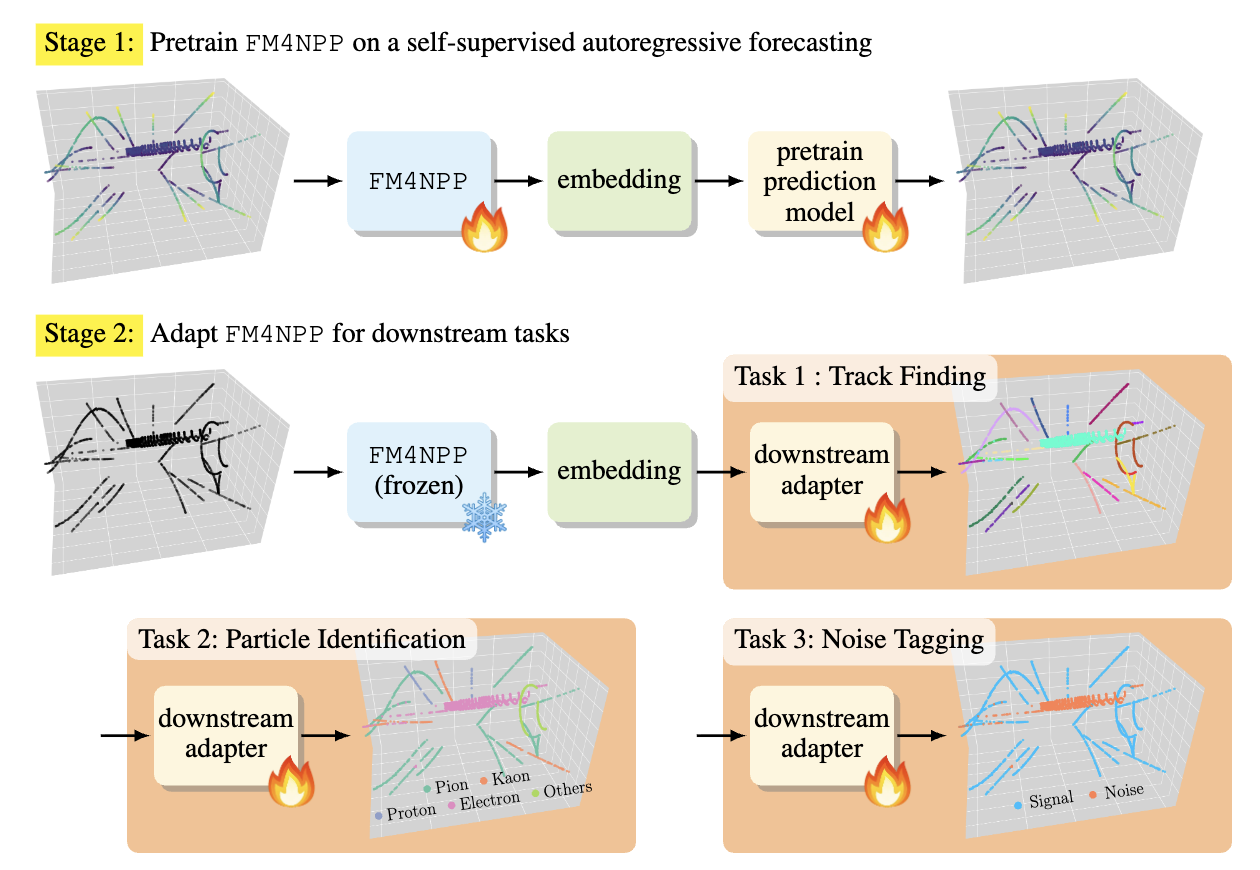
- Pretraining: State space models (Mamba, Mamba2) on particle physics data
- Downstream Task: Track reconstruction using pretrained representations
Paper (OpenReview): Foundation Models for Particle Physics
⚠️ Checkpoint naming: repo m1 is NOT the paper's m1
The released checkpoint filenames follow this repository's internal config names, which do not match the model names used in the paper. Check this table before downloading, or you will train an adapter on a model 16x larger (or smaller) than you intended.
| checkpoint on HF | repo config | width | params | paper's name |
|---|---|---|---|---|
pp_nerf_m1_k30.ckpt | d9_m1_k30_p20 | 256 | 5.3M | m3 |
pp_nerf_m3_k30.ckpt | d9_m3_k30_p20 | 512 | 21M | m4 |
pp_nerf_m4_k30.ckpt | d9_m4_k30_p20 | 1024 | 84M | m5 |
pp_nerf_m5_k30.ckpt | d9_m5_k30_p20 | 1536 | 188M | m6 |
The paper's m1 (width 64, 0.34M) and m2 (width 128, 1.3M) are configs
d9_m64_k30_p20 and d9_m128_k30_p20; their checkpoints are not published.
All released checkpoints are Mamba2 backbones (mambaversion: mamba2), and they
require mamba-ssm. Earlier text here said the opposite. Without the compiled kernels
fm4npp/models/mamba2.py takes a pure-PyTorch fallback which, until [B29], was not the
same model: it applied an ungated RMSNorm to the SSM input and replaced the SSD scan with
an EMA that discarded B and C. Checkpoints loaded into it with strict=True and then
scored about 0.09 ARI below the paper, with nothing to indicate why. The fallback is
corrected and still available for machines that cannot build the kernels, but it must be
requested with FM4NPP_ALLOW_FALLBACK=1 and validated with
scripts/check_kernel_equivalence.py.
Running on Perlmutter
A step-by-step walkthrough for NERSC Perlmutter -- environment, data, SLURM scripts, the checks to run at each stage, and the numbers to expect -- is in PERLMUTTER.md.
Repository Structure
FM4NPP_Public/
├── fm4npp/
│   ├── models/          # Model architectures (Mamba, Mamba2)
│   ├── datasets/        # Data loading and preprocessing
│   └── utils.py         # Utilities and configuration
├── train/
│   ├── pretrain/
│   │   └── nppmamba/    # Pretraining scripts
│   └── downstream/      # Track reconstruction training
├── scripts/
│   ├── configs/         # Configuration files
│   └── run/             # SLURM submission scripts
└── README.md
Installation
Requirements
- Python 3.10+
- PyTorch 2.4+
- CUDA 12.1+
- mamba-ssm (for Mamba models)
- causal-conv1d
- triton
Setup
# Create conda environment
conda create -n fm4npp python=3.10
conda activate fm4npp

# Install PyTorch
pip install torch torchvision --index-url https://download.pytorch.org/whl/cu121

# Install Mamba dependencies.
# NOT `pip install mamba-ssm causal-conv1d`: PyPI ships source only for both, so that
# compiles for 20-60 minutes and fails without --no-build-isolation.
pip install triton
bash tutorials/01_environment/install_kernels.sh

# Install other requirements
pip install pyyaml numpy scipy tqdm mmap-ninja
Usage
1. Pretraining
Train Mamba or Mamba2 models on particle physics data:
# Configure paths in scripts/configs/mamba_pretrain.yaml
# Edit: data_root, checkpoint_dir, stat_dir

# Submit pretraining job (SLURM)
sbatch scripts/run/submit_mamba_pretrain.sh

# Or run directly
python -m train.pretrain.nppmamba.train_multi_gpu \
    --yaml_config=scripts/configs/mamba_pretrain.yaml \
    --config=mamba_5m \
    --run_num=run0
2. Track Reconstruction (Downstream)
Fine-tune pretrained model for track finding:
# Configure paths in scripts/configs/mamba_tracking.yaml
# Edit: data_root, pretrained_ckpt, checkpoint_dir

# Submit downstream job (SLURM)
sbatch scripts/run/submit_downstream_mamba.sh

# Or run directly
python train/downstream/track_finding_trainer.py \
    --yaml_config=scripts/configs/mamba_tracking.yaml \
    --config=mamba_5m_downstream \
    --run_num=run0
Configuration
Key Parameters
Mamba 5M Model:
embed_dim: 256num_layers: 12d_state: 16 (state space dimension)d_conv: 4 (convolutional kernel size)expand: 2 (expansion factor)
Mamba2 5M Model:
embed_dim: 256num_layers: 12d_state: 128 (state space dimension)headdim: 64ngroups: 1
Training:
batch_size: 256 (distributed across GPUs)max_lr: 2e-4warmup_steps: 1000total_steps: 50000
Dataset
TPCpp-10M Dataset
We provide the preprocessed dataset used in our paper on Zenodo:
Dataset: TPCpp-10M: Simulated proton-proton collisions in Time Projection Chamber for AI Foundation Models
Dataset Paper (TPCpp-10M): https://www.sciencedirect.com/science/article/pii/S2352340925011060
Dataset Statistics:
- Unlabeled data: 10M events (100 files) for pretraining
- Labeled training: 70k events for downstream tasks
- Labeled validation: 13k events
- Labeled test: 7k events
- Total size: ~118.5 GB (compressed)
Data Format: NumPy compressed format (.npz)
Download Dataset
# Download from Zenodo
wget https://zenodo.org/records/16970029/files/TPCpp-10M.tar.gz

# Extract
tar -xzf TPCpp-10M.tar.gz

# Dataset structure after extraction (flat .npz, NOT RaggedMmap):
TPCpp-10M/
├── unlabeled/
└── labeled/
    ├── train/        # 70k labeled events
    │   ├── spacepoints.npz    # 'data' (N, 4) float32 + 'size' (n_events,)
    │   ├── track_ids.npz
    │   ├── pid_labels.npz
    │   └── noise_tags.npz
    ├── val/          # 13k
    └── test/         # 7k
The training code does not read .npz -- it reads memory-mapped RaggedMmap
directories. Convert first:
python scripts/prepare_data.py --in_dir TPCpp-10M/labeled/train \
                               --out /path/to/mmap_train --split pretrain
python scripts/prepare_data.py --in_dir TPCpp-10M/labeled/test \
                               --out /path/to/mmap_test  --split test
Note --split pretrain for the training data: the training dataloader is
hardcoded to the pretrain suffix. See SETUP.md.
Data Format Details
Each spacepoint includes:
- Position: (x, y, z) coordinates in TPC
- Energy: Energy deposition at the point
- Labels (for downstream tasks):
- Track IDs: Segmentation labels for track reconstruction
- Particle IDs: 5 classes (electron, photon, pion, kaon, proton)
- Noise tags: Binary labels (signal/noise)
Feature dimensions: 4D per point -- (E, x, y, z)
(Earlier revisions of this README claimed 30D with momentum and detector metadata.
That is wrong: the published spacepoints are 4-dimensional. See SETUP.md for the
target formats and for the reg_target layout that carries the momentum/vertex
information.)
Usage with Code
After downloading, update config paths:
# In scripts/configs/mamba_pretrain.yaml
data_root: /path/to/TPCpp-10M/unlabeled
stat_dir: /path/to/TPCpp-10M/statistics

# In scripts/configs/mamba_tracking.yaml
data_root: /path/to/TPCpp-10M/labeled_train
data_root_test: /path/to/TPCpp-10M/labeled_test
See demo.ipynb in the dataset for data exploration and visualization examples.
Citation
If you use this code or dataset, please cite both papers:
@article{park2025fm4npp,
  title={FM4NPP: A Scaling Foundation Model for Nuclear and Particle Physics},
  author={Park, David and Li, Shuhang and Huang, Yi and Luo, Xihaier and Yu, Haiwang and Go, Yeonju and Pinkenburg, Christopher and Lin, Yuewei and Yoo, Shinjae and Osborn, Joseph and others},
  journal={arXiv preprint arXiv:2508.14087},
  year={2025}
}

@article{tpcpp10m2025,
  title={TPCpp-10M: Simulated proton-proton collisions in a Time Projection Chamber for AI Foundation Models},
  author={Li, Shuhang and Huang, Yi and Park, David and Luo, Xihaier and Yu, Haiwang and Go, Yeonju and Pinkenburg, Christopher and Lin, Yuewei and Yoo, Shinjae and Osborn, Joseph and Roland, Christof and Huang, Jin and Ren, Yihui},
  journal={arXiv preprint arXiv:2509.05792},
  year={2025}
}
OpenReview:
- Model paper: https://openreview.net/forum?id=qaI3cLFsiX
Contact
For questions or issues, please open a GitHub issue.


Similar repos





Languages
Python
91.3%
Jupyter Notebook
4.5%
Shell
4.1%
README
Foundation Models for Nuclear and Particle Physics (FM4NPP)
🎉 Accepted to ICLR 2026!
See the paper on OpenReview: https://openreview.net/forum?id=qaI3cLFsiX
Brookhaven National Laboratory
David Keetae Park*, Shuhang Li*, Yi Huang*, Xihaier Luo, Haiwang Yu, Yeonju Go, Christopher Pinkenburg, Yuewei Lin, Shinjae Yoo, Joseph D. Osborn, Jin Huang, Yihui "Ray" Ren†
* equal contribution; † corresponding author
[OpenReview] [Dataset] [Dataset Paper] [BibTeX] [Model Checkpoints]
Publication Repository: Minimal implementation for reproducibility
This repository contains the essential code for:
- Pretraining: State space models (Mamba, Mamba2) on particle physics data
- Downstream Task: Track reconstruction using pretrained representations
Paper (OpenReview): Foundation Models for Particle Physics
⚠️ Checkpoint naming: repo m1 is NOT the paper's m1
The released checkpoint filenames follow this repository's internal config names, which do not match the model names used in the paper. Check this table before downloading, or you will train an adapter on a model 16x larger (or smaller) than you intended.
| checkpoint on HF | repo config | width | params | paper's name |
|---|---|---|---|---|
pp_nerf_m1_k30.ckpt | d9_m1_k30_p20 | 256 | 5.3M | m3 |
pp_nerf_m3_k30.ckpt | d9_m3_k30_p20 | 512 | 21M | m4 |
pp_nerf_m4_k30.ckpt | d9_m4_k30_p20 | 1024 | 84M | m5 |
pp_nerf_m5_k30.ckpt | d9_m5_k30_p20 | 1536 | 188M | m6 |
The paper's m1 (width 64, 0.34M) and m2 (width 128, 1.3M) are configs
d9_m64_k30_p20 and d9_m128_k30_p20; their checkpoints are not published.
All released checkpoints are Mamba2 backbones (mambaversion: mamba2), and they
require mamba-ssm. Earlier text here said the opposite. Without the compiled kernels
fm4npp/models/mamba2.py takes a pure-PyTorch fallback which, until [B29], was not the
same model: it applied an ungated RMSNorm to the SSM input and replaced the SSD scan with
an EMA that discarded B and C. Checkpoints loaded into it with strict=True and then
scored about 0.09 ARI below the paper, with nothing to indicate why. The fallback is
corrected and still available for machines that cannot build the kernels, but it must be
requested with FM4NPP_ALLOW_FALLBACK=1 and validated with
scripts/check_kernel_equivalence.py.
Running on Perlmutter
A step-by-step walkthrough for NERSC Perlmutter -- environment, data, SLURM scripts, the checks to run at each stage, and the numbers to expect -- is in PERLMUTTER.md.
Repository Structure
FM4NPP_Public/
├── fm4npp/
│   ├── models/          # Model architectures (Mamba, Mamba2)
│   ├── datasets/        # Data loading and preprocessing
│   └── utils.py         # Utilities and configuration
├── train/
│   ├── pretrain/
│   │   └── nppmamba/    # Pretraining scripts
│   └── downstream/      # Track reconstruction training
├── scripts/
│   ├── configs/         # Configuration files
│   └── run/             # SLURM submission scripts
└── README.md
Installation
Requirements
- Python 3.10+
- PyTorch 2.4+
- CUDA 12.1+
- mamba-ssm (for Mamba models)
- causal-conv1d
- triton
Setup
# Create conda environment
conda create -n fm4npp python=3.10
conda activate fm4npp

# Install PyTorch
pip install torch torchvision --index-url https://download.pytorch.org/whl/cu121

# Install Mamba dependencies.
# NOT `pip install mamba-ssm causal-conv1d`: PyPI ships source only for both, so that
# compiles for 20-60 minutes and fails without --no-build-isolation.
pip install triton
bash tutorials/01_environment/install_kernels.sh

# Install other requirements
pip install pyyaml numpy scipy tqdm mmap-ninja
Usage
1. Pretraining
Train Mamba or Mamba2 models on particle physics data:
# Configure paths in scripts/configs/mamba_pretrain.yaml
# Edit: data_root, checkpoint_dir, stat_dir

# Submit pretraining job (SLURM)
sbatch scripts/run/submit_mamba_pretrain.sh

# Or run directly
python -m train.pretrain.nppmamba.train_multi_gpu \
    --yaml_config=scripts/configs/mamba_pretrain.yaml \
    --config=mamba_5m \
    --run_num=run0
2. Track Reconstruction (Downstream)
Fine-tune pretrained model for track finding:
# Configure paths in scripts/configs/mamba_tracking.yaml
# Edit: data_root, pretrained_ckpt, checkpoint_dir

# Submit downstream job (SLURM)
sbatch scripts/run/submit_downstream_mamba.sh

# Or run directly
python train/downstream/track_finding_trainer.py \
    --yaml_config=scripts/configs/mamba_tracking.yaml \
    --config=mamba_5m_downstream \
    --run_num=run0
Configuration
Key Parameters
Mamba 5M Model:
embed_dim: 256num_layers: 12d_state: 16 (state space dimension)d_conv: 4 (convolutional kernel size)expand: 2 (expansion factor)
Mamba2 5M Model:
embed_dim: 256num_layers: 12d_state: 128 (state space dimension)headdim: 64ngroups: 1
Training:
batch_size: 256 (distributed across GPUs)max_lr: 2e-4warmup_steps: 1000total_steps: 50000
Dataset
TPCpp-10M Dataset
We provide the preprocessed dataset used in our paper on Zenodo:
Dataset: TPCpp-10M: Simulated proton-proton collisions in Time Projection Chamber for AI Foundation Models
Dataset Paper (TPCpp-10M): https://www.sciencedirect.com/science/article/pii/S2352340925011060
Dataset Statistics:
- Unlabeled data: 10M events (100 files) for pretraining
- Labeled training: 70k events for downstream tasks
- Labeled validation: 13k events
- Labeled test: 7k events
- Total size: ~118.5 GB (compressed)
Data Format: NumPy compressed format (.npz)
Download Dataset
# Download from Zenodo
wget https://zenodo.org/records/16970029/files/TPCpp-10M.tar.gz

# Extract
tar -xzf TPCpp-10M.tar.gz

# Dataset structure after extraction (flat .npz, NOT RaggedMmap):
TPCpp-10M/
├── unlabeled/
└── labeled/
    ├── train/        # 70k labeled events
    │   ├── spacepoints.npz    # 'data' (N, 4) float32 + 'size' (n_events,)
    │   ├── track_ids.npz
    │   ├── pid_labels.npz
    │   └── noise_tags.npz
    ├── val/          # 13k
    └── test/         # 7k
The training code does not read .npz -- it reads memory-mapped RaggedMmap
directories. Convert first:
python scripts/prepare_data.py --in_dir TPCpp-10M/labeled/train \
                               --out /path/to/mmap_train --split pretrain
python scripts/prepare_data.py --in_dir TPCpp-10M/labeled/test \
                               --out /path/to/mmap_test  --split test
Note --split pretrain for the training data: the training dataloader is
hardcoded to the pretrain suffix. See SETUP.md.
Data Format Details
Each spacepoint includes:
- Position: (x, y, z) coordinates in TPC
- Energy: Energy deposition at the point
- Labels (for downstream tasks):
- Track IDs: Segmentation labels for track reconstruction
- Particle IDs: 5 classes (electron, photon, pion, kaon, proton)
- Noise tags: Binary labels (signal/noise)
Feature dimensions: 4D per point -- (E, x, y, z)
(Earlier revisions of this README claimed 30D with momentum and detector metadata.
That is wrong: the published spacepoints are 4-dimensional. See SETUP.md for the
target formats and for the reg_target layout that carries the momentum/vertex
information.)
Usage with Code
After downloading, update config paths:
# In scripts/configs/mamba_pretrain.yaml
data_root: /path/to/TPCpp-10M/unlabeled
stat_dir: /path/to/TPCpp-10M/statistics

# In scripts/configs/mamba_tracking.yaml
data_root: /path/to/TPCpp-10M/labeled_train
data_root_test: /path/to/TPCpp-10M/labeled_test
See demo.ipynb in the dataset for data exploration and visualization examples.
Citation
If you use this code or dataset, please cite both papers:
@article{park2025fm4npp,
  title={FM4NPP: A Scaling Foundation Model for Nuclear and Particle Physics},
  author={Park, David and Li, Shuhang and Huang, Yi and Luo, Xihaier and Yu, Haiwang and Go, Yeonju and Pinkenburg, Christopher and Lin, Yuewei and Yoo, Shinjae and Osborn, Joseph and others},
  journal={arXiv preprint arXiv:2508.14087},
  year={2025}
}

@article{tpcpp10m2025,
  title={TPCpp-10M: Simulated proton-proton collisions in a Time Projection Chamber for AI Foundation Models},
  author={Li, Shuhang and Huang, Yi and Park, David and Luo, Xihaier and Yu, Haiwang and Go, Yeonju and Pinkenburg, Christopher and Lin, Yuewei and Yoo, Shinjae and Osborn, Joseph and Roland, Christof and Huang, Jin and Ren, Yihui},
  journal={arXiv preprint arXiv:2509.05792},
  year={2025}
}
OpenReview:
- Model paper: https://openreview.net/forum?id=qaI3cLFsiX
Contact
For questions or issues, please open a GitHub issue.
Similar repos
Languages
Python
91.3%
Jupyter Notebook
4.5%
Shell
4.1%