Official implementation of Formalizing Latent Thoughts: Four Axioms for Evaluating Thought Representations in LLMs
See the code








[2026.06.30] Check out the WisPaper blog and Daily AI Wire article covering our research!
[2026.06.29] Our paper is featured as 🤗 HuggingFace #1 Paper of the Day!
[2026.06.29] Covered by AK on X / HuggingFace Daily Papers.
[2026.06.29] Paper launch: X announcement and LinkedIn post.
[2026.05.07] We have released our paper on arXiv!
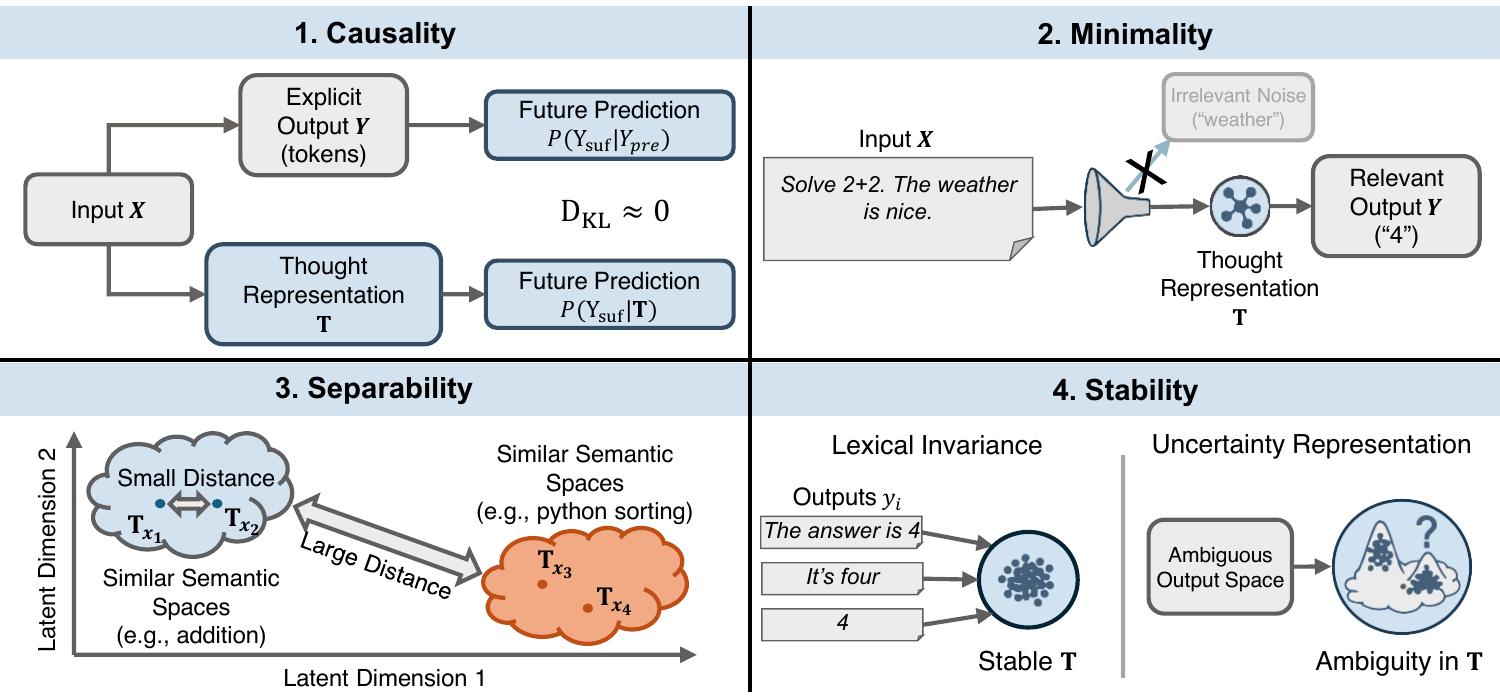
We introduce an axiomatic evaluation framework for latent thought representations in LLMs, comprising metrics that are independent of downstream benchmark scores and reveal representational failures that benchmark accuracy masks. Existing evaluations conflate representation quality with model capacity. Therefore, failures cannot be attributed to the representation rather than to the model that processes it. We formalize four functional axioms — Causality, Minimality, Separability, and Stability — and define a quantitative measure for each, computed directly on the representation independently of downstream accuracy. We audit open-weight LLMs across 23 reasoning tasks (e.g., Spatial Reasoning, Factual QA). We find that no candidate satisfies all four axioms simultaneously, that the representations distinguish task type reliably but cannot distinguish between two questions within the same task, and that the representations encode little information beyond what is already present in the input embedding. The failure is consistent across dense, reasoning-distilled, and RL-trained model families, indicating that the gap is structural rather than a property of model size or training procedure.
Python 3.12, CUDA 12.6, GCC 12.3.1.
Install uv, then:
uv pip install torch
uv sync
Optional flash-attention support (set CUDA_HOME and add to PATH first):
uv pip install psutil ninja packaging einops setuptools wheel
uv pip install flash-attn --no-build-isolation
Copy .env.example to .env and fill in your credentials:
cp .env.example .env
Download benchmarks before running the pipeline:
uv run python -m scripts.download.download_bbeh
All scripts use Hydra and must be run from the project root with uv run python -m. Phases must run in order: 1 → 2 → 3 → 4, then minimality, causality, and DCS can run in any order after Phase 4.
Generates LLM responses and first-token prefill hidden states for all 23 BBEH tasks.
# Llama-3.1-8B (default)
uv run python -m scripts.llm_data

# Other models — one config per model
uv run python -m scripts.llm_data --config-name=llm_data_70b
uv run python -m scripts.llm_data --config-name=llm_data_deepseek_r1_32b
uv run python -m scripts.llm_data --config-name=llm_data_skywork_or1_32b
uv run python -m scripts.llm_data --config-name=llm_data_gpt_oss_20b

# Quick smoke-test (10 examples, no wandb)
uv run python -m scripts.llm_data loader=dev wandb.use_wandb=false
Outputs land in outputs/llm_data_<model>/.
Builds positive/negative pair indices from Phase 1 outputs. Point llm_data_output_dir at the Phase 1 output.
uv run python -m scripts.disc_index \
    llm_data_output_dir=outputs/llm_data_8B
Outputs land in outputs/disc_index_output/.
Pre-generates cached TR vectors for all thought representation types. Must match the source model used in Phase 1.
# Llama-8B (hidden size 4096)
uv run python -m scripts.disc_data \
    llm_data_output_dir=outputs/llm_data_8B \
    disc_index_output_dir=outputs/disc_index_output

# Llama-70B (hidden size 8192)
uv run python -m scripts.disc_data \
    --config-name=disc_data \
    base_llm=llama_70b \
    llm_data_output_dir=outputs/llm_data_70b \
    discriminator.other_vector_dim=8192
Outputs land in outputs/disc_data_<model>/.
Trains one discriminator per TR type. Key overrides: tr_type, think_steps (for soft/latent thinking), source_hidden_size (must match source model).
# Example: last_input_token on Llama-8B
uv run python -m scripts.disc_trainer \
    tr_type=last_input_token \
    disc_data_output_dir=outputs/disc_data_8B

# Example: soft_thinking at 128 steps
uv run python -m scripts.disc_trainer \
    tr_type=soft_thinking \
    think_steps=128 \
    disc_data_output_dir=outputs/disc_data_8B

# Example: Llama-70B (override hidden size and layer count)
uv run python -m scripts.disc_trainer \
    tr_type=last_input_token \
    source_hidden_size=8192 \
    source_num_layers=81 \
    disc_data_output_dir=outputs/disc_data_70b
Outputs land in outputs/discriminator/.
Trains two probe families per TR type (both required for the IB-residual gap Delta_IB):
# Probe 1: predict Y from T  (ygt)
uv run python -m scripts.minimality_trainer \
    --config-name minimality_train_output \
    tr_type=last_input_token \
    llm_data_output_dir=outputs/llm_data_8B \
    tr_data_output_dir=outputs/disc_data_8B

# Probe 2: predict X from (Y, T)  (xgyt)
uv run python -m scripts.minimality_trainer \
    --config-name minimality_train_xgyt \
    tr_type=last_input_token \
    llm_data_output_dir=outputs/llm_data_8B \
    tr_data_output_dir=outputs/disc_data_8B
For soft/latent thinking, also pass think_steps=128. For non-8B models, also pass probe.vector_dim=<hidden_size> (70B → 8192, 32B → 5120).
Generate qualitative output samples:
uv run python -m scripts.minimality_samples
KL-substitution evaluation. Requires a trained discriminator from Phase 4. Use tile_to_length=128 to match the paper's tiling protocol.
uv run python -m scripts.causality_eval \
    tr_type=last_input_token \
    disc_dir=outputs/discriminator/llama_8b/last_input_token \
    tr_data_dir=outputs/disc_data_8B \
    tile_to_length=128
To use the minimality projection (appendix ablation), add:
    proj_source=minimality_output \
    min_proj_run_label=<RUN_LABEL> \
    min_proj_root=outputs/min_prob_output
Requires a trained discriminator from Phase 4.
uv run python -m scripts.dcs_eval \
    tr_type=last_input_token \
    disc_dir=outputs/discriminator/llama_8b/last_input_token \
    tr_data_dir=outputs/disc_data_8B

uv run python -m scripts.dcs_d_eval \
    tr_type=last_input_token \
    tr_data_dir=outputs/disc_data_8B
| Code | Description |
|---|---|
last_input_token | Hidden states from last prefill token, all layers |
last_input_hidden_state | Single hidden state at last prefill token |
soft_thinking | Iterative soft-thinking representations |
soft_thinking_noise | Soft-thinking with noise injection |
latent_thinking | Latent iterative representations |
embedding_no_pooling | Per-beam text embeddings (no pooling) |
embedding_pooling | Pooled text embeddings |
input_embedding | Input-only text embeddings |
random_vector | Random baseline |
uv run pytest tests/
uv run pytest tests/test_phase2.py::TestName
@misc{seddik2026formalizinglatentthoughtsaxioms,
  title         = {Formalizing Latent Thoughts: Four Axioms of Thought Representation in LLMs},
  author        = {Fahd Seddik and Fatemeh Fard},
  year          = {2026},
  eprint        = {2606.27378},
  archivePrefix = {arXiv},
  primaryClass  = {cs.CL},
  url           = {https://arxiv.org/abs/2606.27378}
}
This project is released under the MIT License.
Official implementation of Formalizing Latent Thoughts: Four Axioms for Evaluating Thought Representations in LLMs
See the code
[2026.06.30] Check out the WisPaper blog and Daily AI Wire article covering our research!
[2026.06.29] Our paper is featured as 🤗 HuggingFace #1 Paper of the Day!
[2026.06.29] Covered by AK on X / HuggingFace Daily Papers.
[2026.06.29] Paper launch: X announcement and LinkedIn post.
[2026.05.07] We have released our paper on arXiv!
We introduce an axiomatic evaluation framework for latent thought representations in LLMs, comprising metrics that are independent of downstream benchmark scores and reveal representational failures that benchmark accuracy masks. Existing evaluations conflate representation quality with model capacity. Therefore, failures cannot be attributed to the representation rather than to the model that processes it. We formalize four functional axioms — Causality, Minimality, Separability, and Stability — and define a quantitative measure for each, computed directly on the representation independently of downstream accuracy. We audit open-weight LLMs across 23 reasoning tasks (e.g., Spatial Reasoning, Factual QA). We find that no candidate satisfies all four axioms simultaneously, that the representations distinguish task type reliably but cannot distinguish between two questions within the same task, and that the representations encode little information beyond what is already present in the input embedding. The failure is consistent across dense, reasoning-distilled, and RL-trained model families, indicating that the gap is structural rather than a property of model size or training procedure.
Python 3.12, CUDA 12.6, GCC 12.3.1.
Install uv, then:
uv pip install torch
uv sync
Optional flash-attention support (set CUDA_HOME and add to PATH first):
uv pip install psutil ninja packaging einops setuptools wheel
uv pip install flash-attn --no-build-isolation
Copy .env.example to .env and fill in your credentials:
cp .env.example .env
Download benchmarks before running the pipeline:
uv run python -m scripts.download.download_bbeh
All scripts use Hydra and must be run from the project root with uv run python -m. Phases must run in order: 1 → 2 → 3 → 4, then minimality, causality, and DCS can run in any order after Phase 4.
Generates LLM responses and first-token prefill hidden states for all 23 BBEH tasks.
# Llama-3.1-8B (default)
uv run python -m scripts.llm_data

# Other models — one config per model
uv run python -m scripts.llm_data --config-name=llm_data_70b
uv run python -m scripts.llm_data --config-name=llm_data_deepseek_r1_32b
uv run python -m scripts.llm_data --config-name=llm_data_skywork_or1_32b
uv run python -m scripts.llm_data --config-name=llm_data_gpt_oss_20b

# Quick smoke-test (10 examples, no wandb)
uv run python -m scripts.llm_data loader=dev wandb.use_wandb=false
Outputs land in outputs/llm_data_<model>/.
Builds positive/negative pair indices from Phase 1 outputs. Point llm_data_output_dir at the Phase 1 output.
uv run python -m scripts.disc_index \
    llm_data_output_dir=outputs/llm_data_8B
Outputs land in outputs/disc_index_output/.
Pre-generates cached TR vectors for all thought representation types. Must match the source model used in Phase 1.
# Llama-8B (hidden size 4096)
uv run python -m scripts.disc_data \
    llm_data_output_dir=outputs/llm_data_8B \
    disc_index_output_dir=outputs/disc_index_output

# Llama-70B (hidden size 8192)
uv run python -m scripts.disc_data \
    --config-name=disc_data \
    base_llm=llama_70b \
    llm_data_output_dir=outputs/llm_data_70b \
    discriminator.other_vector_dim=8192
Outputs land in outputs/disc_data_<model>/.
Trains one discriminator per TR type. Key overrides: tr_type, think_steps (for soft/latent thinking), source_hidden_size (must match source model).
# Example: last_input_token on Llama-8B
uv run python -m scripts.disc_trainer \
    tr_type=last_input_token \
    disc_data_output_dir=outputs/disc_data_8B

# Example: soft_thinking at 128 steps
uv run python -m scripts.disc_trainer \
    tr_type=soft_thinking \
    think_steps=128 \
    disc_data_output_dir=outputs/disc_data_8B

# Example: Llama-70B (override hidden size and layer count)
uv run python -m scripts.disc_trainer \
    tr_type=last_input_token \
    source_hidden_size=8192 \
    source_num_layers=81 \
    disc_data_output_dir=outputs/disc_data_70b
Outputs land in outputs/discriminator/.
Trains two probe families per TR type (both required for the IB-residual gap Delta_IB):
# Probe 1: predict Y from T  (ygt)
uv run python -m scripts.minimality_trainer \
    --config-name minimality_train_output \
    tr_type=last_input_token \
    llm_data_output_dir=outputs/llm_data_8B \
    tr_data_output_dir=outputs/disc_data_8B

# Probe 2: predict X from (Y, T)  (xgyt)
uv run python -m scripts.minimality_trainer \
    --config-name minimality_train_xgyt \
    tr_type=last_input_token \
    llm_data_output_dir=outputs/llm_data_8B \
    tr_data_output_dir=outputs/disc_data_8B
For soft/latent thinking, also pass think_steps=128. For non-8B models, also pass probe.vector_dim=<hidden_size> (70B → 8192, 32B → 5120).
Generate qualitative output samples:
uv run python -m scripts.minimality_samples
KL-substitution evaluation. Requires a trained discriminator from Phase 4. Use tile_to_length=128 to match the paper's tiling protocol.
uv run python -m scripts.causality_eval \
    tr_type=last_input_token \
    disc_dir=outputs/discriminator/llama_8b/last_input_token \
    tr_data_dir=outputs/disc_data_8B \
    tile_to_length=128
To use the minimality projection (appendix ablation), add:
    proj_source=minimality_output \
    min_proj_run_label=<RUN_LABEL> \
    min_proj_root=outputs/min_prob_output
Requires a trained discriminator from Phase 4.
uv run python -m scripts.dcs_eval \
    tr_type=last_input_token \
    disc_dir=outputs/discriminator/llama_8b/last_input_token \
    tr_data_dir=outputs/disc_data_8B

uv run python -m scripts.dcs_d_eval \
    tr_type=last_input_token \
    tr_data_dir=outputs/disc_data_8B
| Code | Description |
|---|---|
last_input_token | Hidden states from last prefill token, all layers |
last_input_hidden_state | Single hidden state at last prefill token |
soft_thinking | Iterative soft-thinking representations |
soft_thinking_noise | Soft-thinking with noise injection |
latent_thinking | Latent iterative representations |
embedding_no_pooling | Per-beam text embeddings (no pooling) |
embedding_pooling | Pooled text embeddings |
input_embedding | Input-only text embeddings |
random_vector | Random baseline |
uv run pytest tests/
uv run pytest tests/test_phase2.py::TestName
@misc{seddik2026formalizinglatentthoughtsaxioms,
  title         = {Formalizing Latent Thoughts: Four Axioms of Thought Representation in LLMs},
  author        = {Fahd Seddik and Fatemeh Fard},
  year          = {2026},
  eprint        = {2606.27378},
  archivePrefix = {arXiv},
  primaryClass  = {cs.CL},
  url           = {https://arxiv.org/abs/2606.27378}
}
This project is released under the MIT License.



