
Privacy-first AI meeting notes for your computer. AutoDoc records, transcribes, labels speakers from separate mic and system-audio tracks, and summarizes meetings on-device with local transcription and Ollama. No cloud meeting bot. No AI API keys necessary.
11
stars
22
commits
TypeScript
primary language
Aug 17, 2026
updated
README
AutoDoc
AI meeting notes that never leave your computer.
AutoDoc lives in your macOS menu bar or Windows system tray, notices when a meeting starts, and hands you a clean transcript and structured notes when it ends. Everything — recording, transcription, speaker labels, and AI summaries — happens on your own machine. No AutoDoc account. No AI API keys necessary.






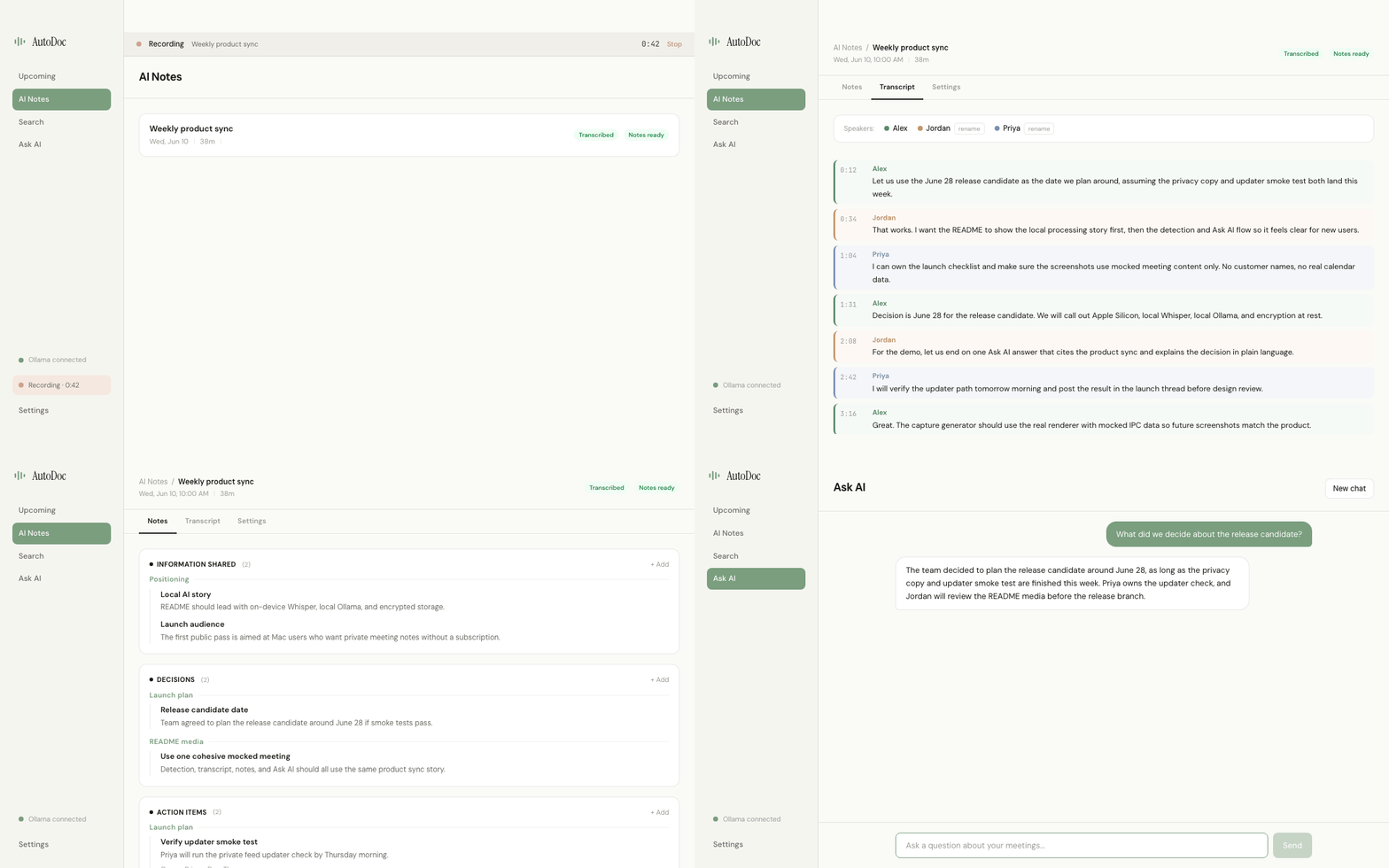
Table of Contents
- Why AutoDoc
- What you get
- Features
- Features in action
- Download
- Build from source
- Architecture
- Privacy
- FAQ
- Contributing
- License
- Acknowledgements
Why AutoDoc
Meeting AI tools are everywhere — but most of them ship your conversations to someone else's servers. AutoDoc takes the opposite stance: every recording, transcript, and summary stays on your computer.
- Truly local. Transcription runs on-device with NVIDIA NeMo Parakeet on Windows and Apple MLX Whisper on Apple Silicon. Summaries run through a local Ollama instance AutoDoc manages on both platforms. No API keys, inference bills, or network round-trips for your audio.
- Everything included. Speaker labels from separate mic and system-audio tracks, Google and Microsoft calendar integration, automatic meeting detection, per-event auto-record, and chat-with-your-meetings are all part of the app — not a paid upgrade.
- Encrypted at rest. Recordings and transcripts use AES-256-GCM. When Electron
safeStorageis available, the encryption key is protected by macOS Keychain or Windows DPAPI; otherwise, it is stored locally without operating-system protection. - Desktop-native. Lives in your macOS menu bar or Windows system tray, detects meetings as they start, and gets out of your way.
What you get
- End-to-end local workflow: detect → record → transcribe → label speakers → notes → Ask AI
- Platform-specific transcription: MLX Whisper on Apple Silicon, Parakeet on Windows
- Optional Google and Microsoft calendars
- Encrypted local storage, AGPL-3.0 source, no AutoDoc account or AI API keys
Features
- 🎙️ Multi-track capture — records screen, your microphone, and system audio as separate streams for clean speaker labeling.
- 📝 On-device transcription — Parakeet TDT 0.6B v3 on Windows; MLX Whisper with
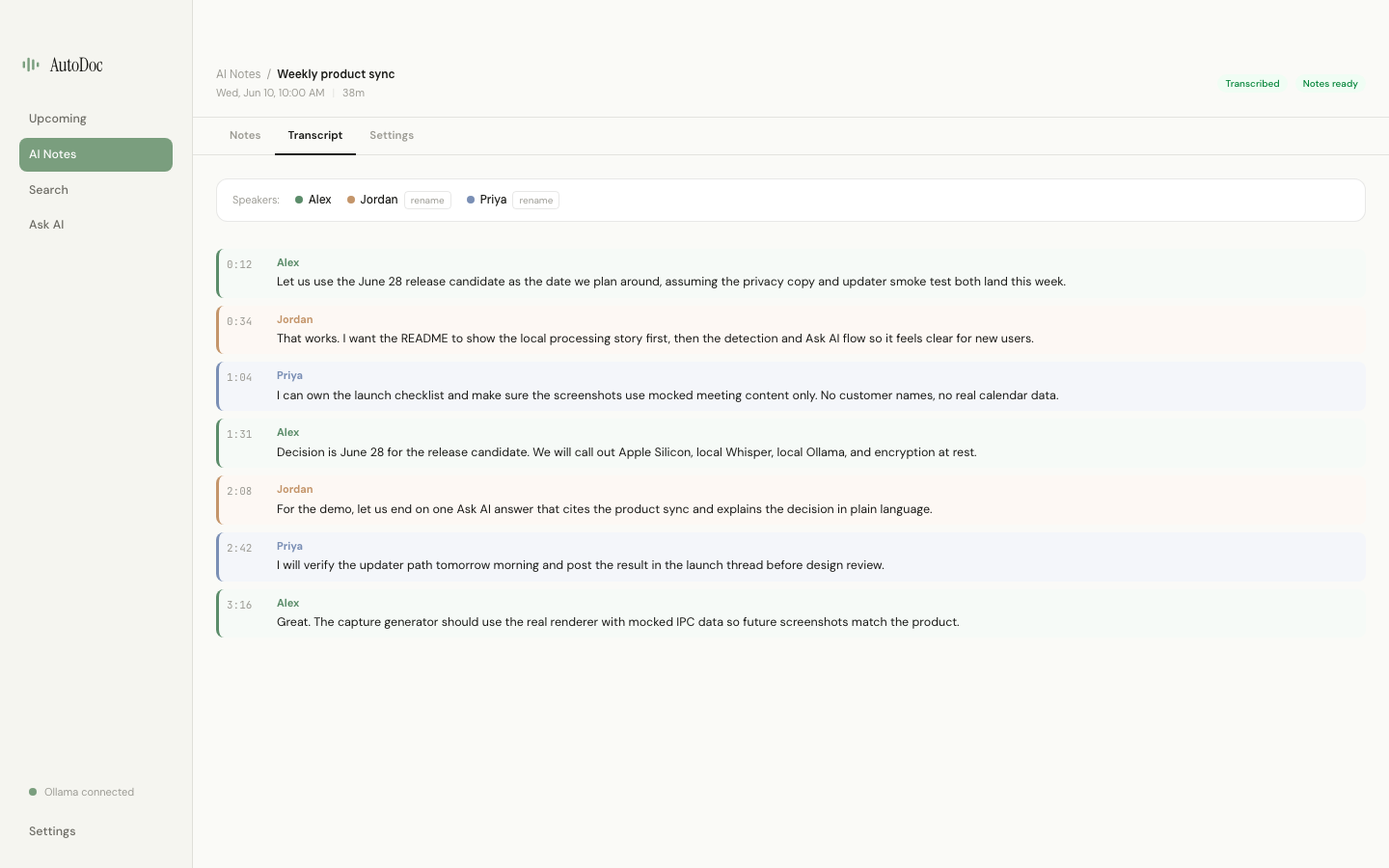
distil-large-v3on Apple Silicon. - 🗣️ Speaker labels — separates your mic from remote system audio, with calendar name suggestions and manual rename. It does not automatically recognize every remote participant by voice.
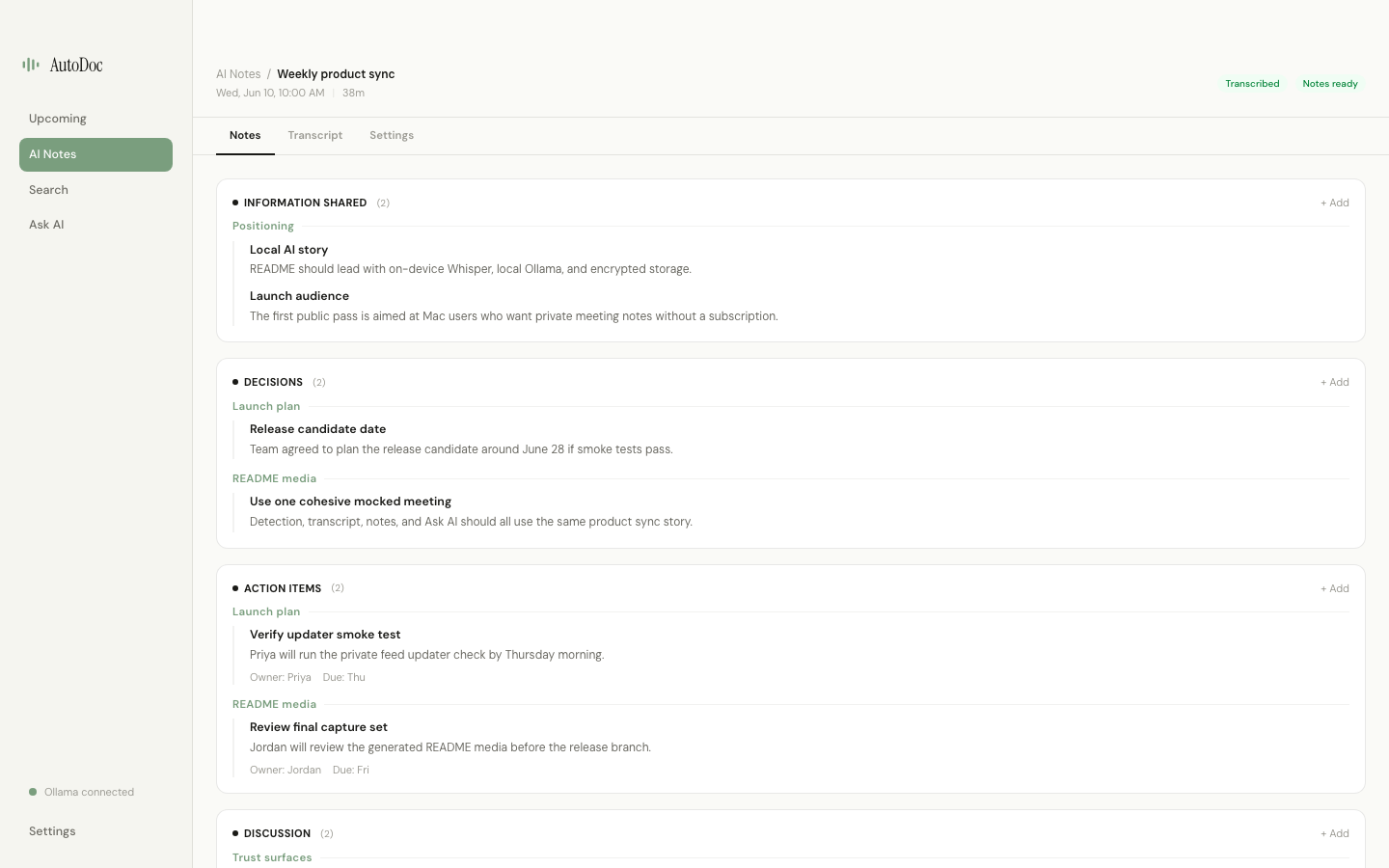
- 🧠 AI meeting notes — structured Decisions, Action Items, Information, Discussion, and Status Updates extracted locally with Ollama.
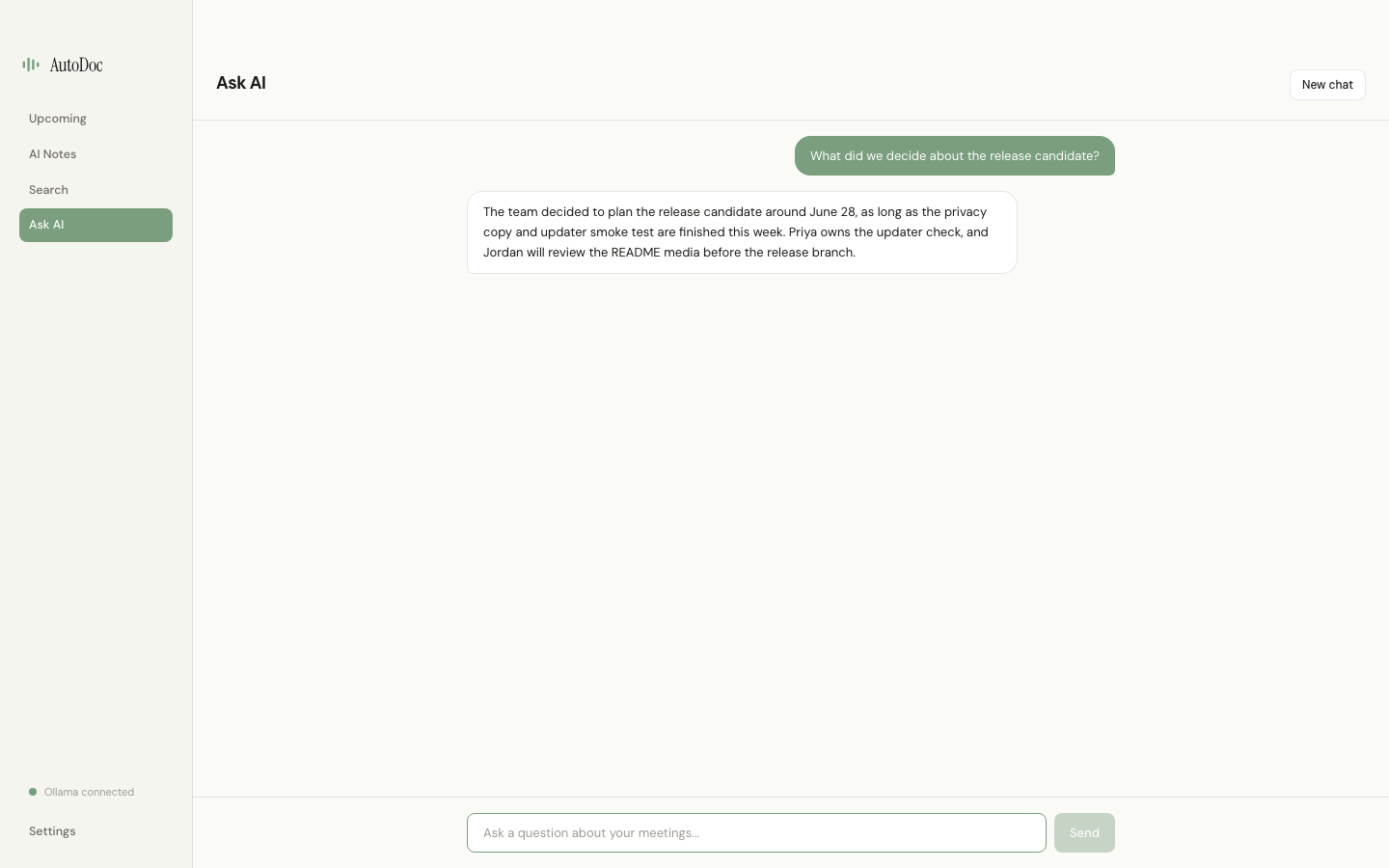
- 💬 Ask AI — ask questions across your meetings and get grounded answers, entirely on-device.
- 📅 Calendar integration — Google and Microsoft calendars, with Off / Once / Series auto-record per event.
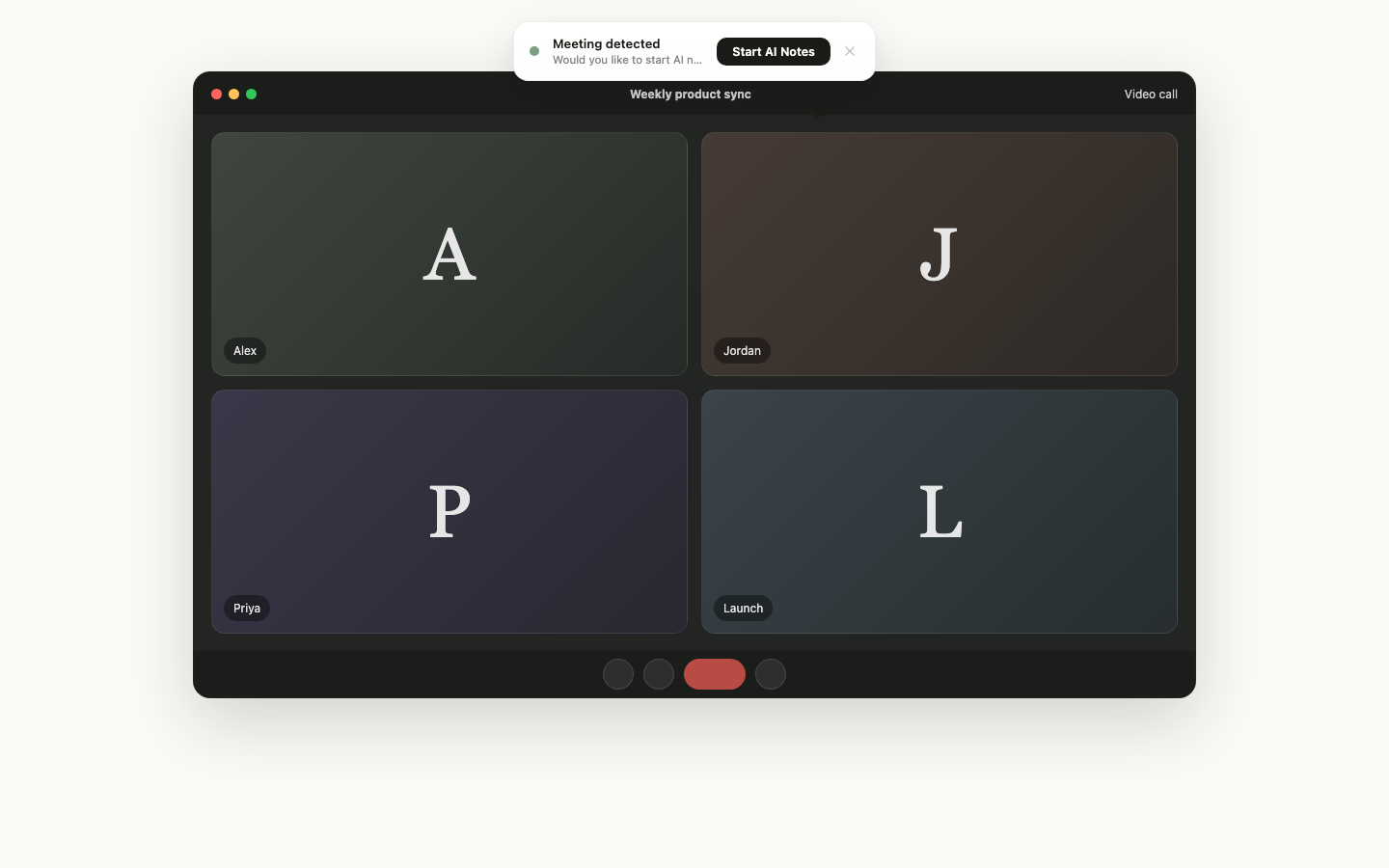
- 🔔 Automatic meeting detection — notices when a meeting starts (Zoom, Meet, Teams, Webex, Slack) and offers to record.
- 🔎 Full-text search — search every transcript and note, with deep links straight to the moment.
- 🔒 Encryption at rest — AES-256-GCM for recordings, transcripts, notes, and metadata. Electron
safeStorageprotects the key through the operating system when available; otherwise, the key is stored locally without operating-system protection.
See PRODUCT.md for a deep technical breakdown of every subsystem.
Features in action
| Automatic meeting detection | Speaker-colored transcript |
|---|---|
 |  |
| AI notes by category | Ask AI across meetings |
|---|---|
 |  |
Download
Official macOS and Windows installers are published on GitHub Releases. Open the latest release and choose the asset for your platform:
Platform support: AutoDoc supports macOS 14+ on Apple Silicon and Windows 10+ on x64 PCs. Intel Macs and Windows on ARM are not currently supported.
System requirements (macOS)
Local-first meeting apps need real hardware headroom for on-device transcription and summarization. AutoDoc adjusts its processing profile to the available hardware while keeping meeting content on your device.
| Requirement | |
|---|---|
| macOS | 14.0 (Sonoma) or later |
| Chip | Apple Silicon required (M1, M2, M3, M4, or later). Intel Macs are not supported. |
| Memory | 8 GB minimum · 16 GB recommended for the default concurrent processing profile |
| Storage | ~10 GB free for first-run downloads (Whisper + local Ollama model + MLX runtime cache), plus additional space for your encrypted recordings |
| Network | Required for the first-run model download. After setup, recording, transcription, and notes work offline. Optional network use later: app/model updates, calendar sync, and opt-in diagnostics. |
| Permissions | Screen Recording, Microphone, and System Audio Capture (for remote participant audio) |
What to expect on an 8 GB Mac: AutoDoc detects limited memory and switches to a lower-impact profile automatically — smaller notes model (llama3.2:3b), serialized audio processing, and longer transcription/notes times. Everything still runs locally; a 16 GB machine is simply more comfortable for hour-long meetings with concurrent processing.
Transcription is built on MLX and requires Apple Silicon — there is no Intel or Rosetta fallback.
System requirements (Windows)
| Requirement | |
|---|---|
| Windows | Windows 10 or later, 64-bit |
| Processor | x64 Intel or AMD processor |
| Memory | 8 GB minimum · 16 GB recommended |
| GPU | Optional. A compatible DirectML GPU with 4 GB+ VRAM enables accelerated Parakeet transcription; AutoDoc falls back to CPU automatically. |
| Storage | ~10 GB free recommended for first-run downloads and encrypted recordings |
| Network | Required for the first-run model download. After setup, recording, transcription, and notes work offline. Optional network use later: app/model updates, calendar sync, and opt-in diagnostics. |
| Permissions | Screen capture, Microphone, and System Audio |
On lower-spec Windows PCs, AutoDoc uses a CPU-optimized Parakeet model and processes audio sources sequentially. This reduces memory pressure but can take longer after a meeting ends.
What to expect on an 8 GB Windows PC: AutoDoc still generates notes locally with llama3.1. That uses a lot of RAM while notes are running, so transcription and notes take longer and the machine will feel pinned until they finish. A 16 GB machine is the comfortable default.
Download & install on macOS
⬇️ Download AutoDoc for macOS
Apple Silicon · macOS 14+
Then:
- On the latest release, download the macOS
.dmgasset. - Open the
.dmgand drag AutoDoc into your Applications folder. - Launch AutoDoc from Applications. On first run it walks you through granting Screen Recording and Microphone permissions; macOS verifies System Audio Capture separately when recording starts. AutoDoc then downloads its local transcription and AI models (~10 GB, one time).
That's it — no account, no API keys, nothing to configure. Meeting processing runs locally from here on.
Download & install on Windows
⬇️ Download AutoDoc for Windows
64-bit · Windows 10+
Then:
- On the latest release, download the Windows
.exeinstaller asset. - Open the installer and follow the setup prompts.
- Launch AutoDoc. On first run it walks you through capture permissions and downloads the local Parakeet and Ollama models.
Build from source
AutoDoc is an Electron + electron-vite app. To build it yourself:
Prerequisites
- macOS: Apple Silicon Mac (M1 or later) running macOS 14+, plus Xcode command-line tools and Homebrew
- Windows: Windows 10+ on x64, plus the prerequisites documented by the setup scripts
- Node.js 20+
Steps
git clone https://github.com/DuetDisplay/AutoDoc.git
cd AutoDoc
npm ci
cp .env.example .env   # optional: configure self-hosting knobs
npm run build:mac      # macOS: produces a DMG under dist/
# or
npm run build:win      # Windows: produces an installer under dist/
To run in development:
npm run dev
If you want calendar integration or your own hosted services in a fork build, see docs/SELF_HOSTING.md for the required environment variables and OAuth setup. Forks do not use Duet's hosted infrastructure by default.
Architecture
AutoDoc is a single Electron desktop app. The main process owns recording, the transcription / speaker-labeling / summarization pipeline, encryption, calendar sync, and the local Ollama lifecycle. The renderer is a React UI. All heavy processing happens locally.
flowchart TB
  subgraph app["AutoDoc on your computer"]
    UI["Renderer · React UI"] <-->|IPC| Main["Main process"]

    subgraph pipeline["Local processing pipeline"]
      direction LR
      Rec["Recording<br/>screen · mic · system"]
      Platform{"Current platform"}
      MacTrans["macOS transcription<br/>MLX Whisper"]
      WinTrans["Windows transcription<br/>Parakeet · GPU or CPU"]
      Labels["Speaker labels<br/>mic vs system audio"]
      Notes["AI notes<br/>Ollama"]
    end

    Main --> Rec
    Rec --> Platform
    Platform -->|macOS| MacTrans
    Platform -->|Windows| WinTrans
    MacTrans --> Labels
    WinTrans --> Labels
    Labels --> Notes
    Notes --> Store["Encrypted store<br/>AES-256-GCM"]

    Main -.->|"optional calendar"| Cal["Google / Microsoft<br/>Calendar APIs"]
    Main -.->|"optional OAuth token exchange"| Auth["Calendar auth worker"]
  end
Meeting content stays in the local pipeline and encrypted store. Optional calendar networking is separate:
- Optional calendar sync communicates directly with Google or Microsoft APIs. Duet's stateless OAuth worker only exchanges tokens and never receives meeting recordings, transcripts, or notes.
Model downloads, app updates, and opt-in analytics or crash reporting also use the network when those paths are active. Full details in PRODUCT.md and PRIVACY.md.
Privacy
AutoDoc processes meeting content on-device. Audio, transcripts, and notes are not uploaded to AutoDoc or a cloud AI API. Analytics and crash reporting are strictly opt-in; before opt-in, analytics facts stay local only. Read the full Privacy Policy for exactly what is and isn't collected.
FAQ
What stays on my computer? Your recordings, transcripts, notes, and Ask AI answers are processed on-device. They are not uploaded to AutoDoc or a cloud AI API.
When does AutoDoc use the network?
- Required once for the first-run download of local transcription and Ollama models
- Optional later: app updates and additional model downloads
- Optional Google/Microsoft calendar sync — the app talks to Google or Microsoft APIs for events; Duet's OAuth worker only exchanges tokens and never receives meeting recordings, transcripts, or notes
- Optional analytics / crash reporting, only if you opt in
After setup, recording, transcription, and notes work offline.
Do I need an OpenAI or Anthropic API key? No. AutoDoc runs summaries on a local Ollama instance it manages for you. There are no API keys and no per-meeting costs.
Which models does it use?
On Windows, AutoDoc uses Parakeet TDT 0.6B v3 and automatically selects DirectML GPU acceleration or a CPU-optimized model. On Apple Silicon, it uses distil-large-v3 through MLX Whisper. Notes use llama3.1 via Ollama on both platforms, with a smaller llama3.2:3b model on 8 GB Macs.
What Mac do I need? An Apple Silicon Mac (M1 or later) running macOS 14+, with 8 GB RAM minimum (16 GB recommended) and ~10 GB free storage for first-run model downloads. Intel Macs are not supported.
Is Windows supported? Yes. AutoDoc supports 64-bit Windows 10 and later. It requires 8 GB RAM; 16 GB is recommended. On 8 GB machines, notes take longer and use more RAM while they run. A compatible DirectML GPU is optional because AutoDoc can transcribe on the CPU.
How do I know AutoDoc is recording? While recording, AutoDoc shows a Recording banner in the app (with a timer and stop control) and switches the menu bar / tray icon to a recording state. Meeting detection only offers to start recording; it will not start silently unless you previously enabled calendar auto-record for that event (Once or Series). In that case, recording can begin without another prompt.
What about other participants? AutoDoc records on your computer. It does not join the call as a bot or announce itself to others. You are responsible for following the recording laws and norms that apply to your meeting.
Why AGPL-3.0? See License below.
Contributing
Contributions are welcome! Please read CONTRIBUTING.md and our CODE_OF_CONDUCT.md before opening a pull request. Security issues should follow the process in SECURITY.md.
License
AutoDoc is licensed under the GNU Affero General Public License v3.0 (LICENSE).
In plain English: you're free to use, study, modify, and share AutoDoc. The AGPL adds one important condition — if you run a modified version as a network service, you must make your source available to its users under the same license. We chose AGPL deliberately: it keeps AutoDoc and its derivatives open, and it prevents anyone from turning the project into a closed, hosted product on top of our work. For most individuals and teams using or self-hosting AutoDoc, this changes nothing.
Acknowledgements
AutoDoc stands on the shoulders of excellent open-source work:
- whisper.cpp — on-device speech-to-text
- NVIDIA NeMo Parakeet — Windows speech-to-text
- ONNX Runtime and DirectML — Windows inference
- faster-whisper and CTranslate2 — compatibility transcription
- Ollama — local LLM runtime
- Apple MLX — Apple Silicon acceleration
- FFmpeg — audio/video processing
- Electron + electron-vite — desktop app foundation
Contributors

19 commits

3 commits
Similar repos


Languages
TypeScript
91.6%
JavaScript
4.4%
Shell
2.0%
Privacy-first AI meeting notes for your computer. AutoDoc records, transcribes, labels speakers from separate mic and system-audio tracks, and summarizes meetings on-device with local transcription and Ollama. No cloud meeting bot. No AI API keys necessary.
11
stars
22
commits
TypeScript
primary language
Aug 17, 2026
updated
README
AutoDoc
AI meeting notes that never leave your computer.
AutoDoc lives in your macOS menu bar or Windows system tray, notices when a meeting starts, and hands you a clean transcript and structured notes when it ends. Everything — recording, transcription, speaker labels, and AI summaries — happens on your own machine. No AutoDoc account. No AI API keys necessary.
Table of Contents
- Why AutoDoc
- What you get
- Features
- Features in action
- Download
- Build from source
- Architecture
- Privacy
- FAQ
- Contributing
- License
- Acknowledgements
Why AutoDoc
Meeting AI tools are everywhere — but most of them ship your conversations to someone else's servers. AutoDoc takes the opposite stance: every recording, transcript, and summary stays on your computer.
- Truly local. Transcription runs on-device with NVIDIA NeMo Parakeet on Windows and Apple MLX Whisper on Apple Silicon. Summaries run through a local Ollama instance AutoDoc manages on both platforms. No API keys, inference bills, or network round-trips for your audio.
- Everything included. Speaker labels from separate mic and system-audio tracks, Google and Microsoft calendar integration, automatic meeting detection, per-event auto-record, and chat-with-your-meetings are all part of the app — not a paid upgrade.
- Encrypted at rest. Recordings and transcripts use AES-256-GCM. When Electron
safeStorageis available, the encryption key is protected by macOS Keychain or Windows DPAPI; otherwise, it is stored locally without operating-system protection. - Desktop-native. Lives in your macOS menu bar or Windows system tray, detects meetings as they start, and gets out of your way.
What you get
- End-to-end local workflow: detect → record → transcribe → label speakers → notes → Ask AI
- Platform-specific transcription: MLX Whisper on Apple Silicon, Parakeet on Windows
- Optional Google and Microsoft calendars
- Encrypted local storage, AGPL-3.0 source, no AutoDoc account or AI API keys
Features
- 🎙️ Multi-track capture — records screen, your microphone, and system audio as separate streams for clean speaker labeling.
- 📝 On-device transcription — Parakeet TDT 0.6B v3 on Windows; MLX Whisper with
distil-large-v3on Apple Silicon. - 🗣️ Speaker labels — separates your mic from remote system audio, with calendar name suggestions and manual rename. It does not automatically recognize every remote participant by voice.
- 🧠 AI meeting notes — structured Decisions, Action Items, Information, Discussion, and Status Updates extracted locally with Ollama.
- 💬 Ask AI — ask questions across your meetings and get grounded answers, entirely on-device.
- 📅 Calendar integration — Google and Microsoft calendars, with Off / Once / Series auto-record per event.
- 🔔 Automatic meeting detection — notices when a meeting starts (Zoom, Meet, Teams, Webex, Slack) and offers to record.
- 🔎 Full-text search — search every transcript and note, with deep links straight to the moment.
- 🔒 Encryption at rest — AES-256-GCM for recordings, transcripts, notes, and metadata. Electron
safeStorageprotects the key through the operating system when available; otherwise, the key is stored locally without operating-system protection.
See PRODUCT.md for a deep technical breakdown of every subsystem.
Features in action
| Automatic meeting detection | Speaker-colored transcript |
|---|---|
| |
| AI notes by category | Ask AI across meetings |
|---|---|
| |
Download
Official macOS and Windows installers are published on GitHub Releases. Open the latest release and choose the asset for your platform:
Platform support: AutoDoc supports macOS 14+ on Apple Silicon and Windows 10+ on x64 PCs. Intel Macs and Windows on ARM are not currently supported.
System requirements (macOS)
Local-first meeting apps need real hardware headroom for on-device transcription and summarization. AutoDoc adjusts its processing profile to the available hardware while keeping meeting content on your device.
| Requirement | |
|---|---|
| macOS | 14.0 (Sonoma) or later |
| Chip | Apple Silicon required (M1, M2, M3, M4, or later). Intel Macs are not supported. |
| Memory | 8 GB minimum · 16 GB recommended for the default concurrent processing profile |
| Storage | ~10 GB free for first-run downloads (Whisper + local Ollama model + MLX runtime cache), plus additional space for your encrypted recordings |
| Network | Required for the first-run model download. After setup, recording, transcription, and notes work offline. Optional network use later: app/model updates, calendar sync, and opt-in diagnostics. |
| Permissions | Screen Recording, Microphone, and System Audio Capture (for remote participant audio) |
What to expect on an 8 GB Mac: AutoDoc detects limited memory and switches to a lower-impact profile automatically — smaller notes model (llama3.2:3b), serialized audio processing, and longer transcription/notes times. Everything still runs locally; a 16 GB machine is simply more comfortable for hour-long meetings with concurrent processing.
Transcription is built on MLX and requires Apple Silicon — there is no Intel or Rosetta fallback.
System requirements (Windows)
| Requirement | |
|---|---|
| Windows | Windows 10 or later, 64-bit |
| Processor | x64 Intel or AMD processor |
| Memory | 8 GB minimum · 16 GB recommended |
| GPU | Optional. A compatible DirectML GPU with 4 GB+ VRAM enables accelerated Parakeet transcription; AutoDoc falls back to CPU automatically. |
| Storage | ~10 GB free recommended for first-run downloads and encrypted recordings |
| Network | Required for the first-run model download. After setup, recording, transcription, and notes work offline. Optional network use later: app/model updates, calendar sync, and opt-in diagnostics. |
| Permissions | Screen capture, Microphone, and System Audio |
On lower-spec Windows PCs, AutoDoc uses a CPU-optimized Parakeet model and processes audio sources sequentially. This reduces memory pressure but can take longer after a meeting ends.
What to expect on an 8 GB Windows PC: AutoDoc still generates notes locally with llama3.1. That uses a lot of RAM while notes are running, so transcription and notes take longer and the machine will feel pinned until they finish. A 16 GB machine is the comfortable default.
Download & install on macOS
⬇️ Download AutoDoc for macOS
Apple Silicon · macOS 14+
Then:
- On the latest release, download the macOS
.dmgasset. - Open the
.dmgand drag AutoDoc into your Applications folder. - Launch AutoDoc from Applications. On first run it walks you through granting Screen Recording and Microphone permissions; macOS verifies System Audio Capture separately when recording starts. AutoDoc then downloads its local transcription and AI models (~10 GB, one time).
That's it — no account, no API keys, nothing to configure. Meeting processing runs locally from here on.
Download & install on Windows
⬇️ Download AutoDoc for Windows
64-bit · Windows 10+
Then:
- On the latest release, download the Windows
.exeinstaller asset. - Open the installer and follow the setup prompts.
- Launch AutoDoc. On first run it walks you through capture permissions and downloads the local Parakeet and Ollama models.
Build from source
AutoDoc is an Electron + electron-vite app. To build it yourself:
Prerequisites
- macOS: Apple Silicon Mac (M1 or later) running macOS 14+, plus Xcode command-line tools and Homebrew
- Windows: Windows 10+ on x64, plus the prerequisites documented by the setup scripts
- Node.js 20+
Steps
git clone https://github.com/DuetDisplay/AutoDoc.git
cd AutoDoc
npm ci
cp .env.example .env   # optional: configure self-hosting knobs
npm run build:mac      # macOS: produces a DMG under dist/
# or
npm run build:win      # Windows: produces an installer under dist/
To run in development:
npm run dev
If you want calendar integration or your own hosted services in a fork build, see docs/SELF_HOSTING.md for the required environment variables and OAuth setup. Forks do not use Duet's hosted infrastructure by default.
Architecture
AutoDoc is a single Electron desktop app. The main process owns recording, the transcription / speaker-labeling / summarization pipeline, encryption, calendar sync, and the local Ollama lifecycle. The renderer is a React UI. All heavy processing happens locally.
flowchart TB
  subgraph app["AutoDoc on your computer"]
    UI["Renderer · React UI"] <-->|IPC| Main["Main process"]

    subgraph pipeline["Local processing pipeline"]
      direction LR
      Rec["Recording<br/>screen · mic · system"]
      Platform{"Current platform"}
      MacTrans["macOS transcription<br/>MLX Whisper"]
      WinTrans["Windows transcription<br/>Parakeet · GPU or CPU"]
      Labels["Speaker labels<br/>mic vs system audio"]
      Notes["AI notes<br/>Ollama"]
    end

    Main --> Rec
    Rec --> Platform
    Platform -->|macOS| MacTrans
    Platform -->|Windows| WinTrans
    MacTrans --> Labels
    WinTrans --> Labels
    Labels --> Notes
    Notes --> Store["Encrypted store<br/>AES-256-GCM"]

    Main -.->|"optional calendar"| Cal["Google / Microsoft<br/>Calendar APIs"]
    Main -.->|"optional OAuth token exchange"| Auth["Calendar auth worker"]
  end
Meeting content stays in the local pipeline and encrypted store. Optional calendar networking is separate:
- Optional calendar sync communicates directly with Google or Microsoft APIs. Duet's stateless OAuth worker only exchanges tokens and never receives meeting recordings, transcripts, or notes.
Model downloads, app updates, and opt-in analytics or crash reporting also use the network when those paths are active. Full details in PRODUCT.md and PRIVACY.md.
Privacy
AutoDoc processes meeting content on-device. Audio, transcripts, and notes are not uploaded to AutoDoc or a cloud AI API. Analytics and crash reporting are strictly opt-in; before opt-in, analytics facts stay local only. Read the full Privacy Policy for exactly what is and isn't collected.
FAQ
What stays on my computer? Your recordings, transcripts, notes, and Ask AI answers are processed on-device. They are not uploaded to AutoDoc or a cloud AI API.
When does AutoDoc use the network?
- Required once for the first-run download of local transcription and Ollama models
- Optional later: app updates and additional model downloads
- Optional Google/Microsoft calendar sync — the app talks to Google or Microsoft APIs for events; Duet's OAuth worker only exchanges tokens and never receives meeting recordings, transcripts, or notes
- Optional analytics / crash reporting, only if you opt in
After setup, recording, transcription, and notes work offline.
Do I need an OpenAI or Anthropic API key? No. AutoDoc runs summaries on a local Ollama instance it manages for you. There are no API keys and no per-meeting costs.
Which models does it use?
On Windows, AutoDoc uses Parakeet TDT 0.6B v3 and automatically selects DirectML GPU acceleration or a CPU-optimized model. On Apple Silicon, it uses distil-large-v3 through MLX Whisper. Notes use llama3.1 via Ollama on both platforms, with a smaller llama3.2:3b model on 8 GB Macs.
What Mac do I need? An Apple Silicon Mac (M1 or later) running macOS 14+, with 8 GB RAM minimum (16 GB recommended) and ~10 GB free storage for first-run model downloads. Intel Macs are not supported.
Is Windows supported? Yes. AutoDoc supports 64-bit Windows 10 and later. It requires 8 GB RAM; 16 GB is recommended. On 8 GB machines, notes take longer and use more RAM while they run. A compatible DirectML GPU is optional because AutoDoc can transcribe on the CPU.
How do I know AutoDoc is recording? While recording, AutoDoc shows a Recording banner in the app (with a timer and stop control) and switches the menu bar / tray icon to a recording state. Meeting detection only offers to start recording; it will not start silently unless you previously enabled calendar auto-record for that event (Once or Series). In that case, recording can begin without another prompt.
What about other participants? AutoDoc records on your computer. It does not join the call as a bot or announce itself to others. You are responsible for following the recording laws and norms that apply to your meeting.
Why AGPL-3.0? See License below.
Contributing
Contributions are welcome! Please read CONTRIBUTING.md and our CODE_OF_CONDUCT.md before opening a pull request. Security issues should follow the process in SECURITY.md.
License
AutoDoc is licensed under the GNU Affero General Public License v3.0 (LICENSE).
In plain English: you're free to use, study, modify, and share AutoDoc. The AGPL adds one important condition — if you run a modified version as a network service, you must make your source available to its users under the same license. We chose AGPL deliberately: it keeps AutoDoc and its derivatives open, and it prevents anyone from turning the project into a closed, hosted product on top of our work. For most individuals and teams using or self-hosting AutoDoc, this changes nothing.
Acknowledgements
AutoDoc stands on the shoulders of excellent open-source work:
- whisper.cpp — on-device speech-to-text
- NVIDIA NeMo Parakeet — Windows speech-to-text
- ONNX Runtime and DirectML — Windows inference
- faster-whisper and CTranslate2 — compatibility transcription
- Ollama — local LLM runtime
- Apple MLX — Apple Silicon acceleration
- FFmpeg — audio/video processing
- Electron + electron-vite — desktop app foundation
Similar repos
Contributors
19 commits
3 commits
Languages
TypeScript
91.6%
JavaScript
4.4%
Shell
2.0%