
Deepnar Workstation — Deepesh Sonar's portfolio as an interactive browser workstation: files, terminal, knowledge graph, pixel companion.
See the codeSee what people are saying
README
Deepnar Workstation
next.js · typescript · tailwind · zustand · xterm.js · d3-force · canvas
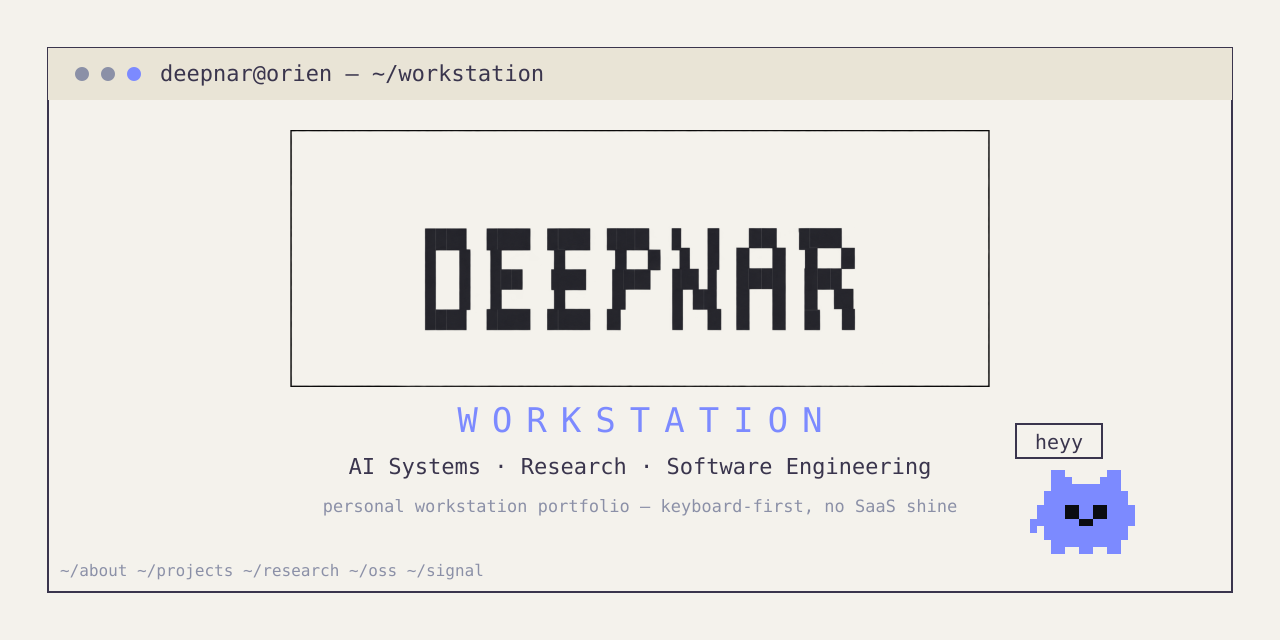
Live demo: coming with the first Vercel deploy (this repo has not been deployed yet — no URL is claimed until then).
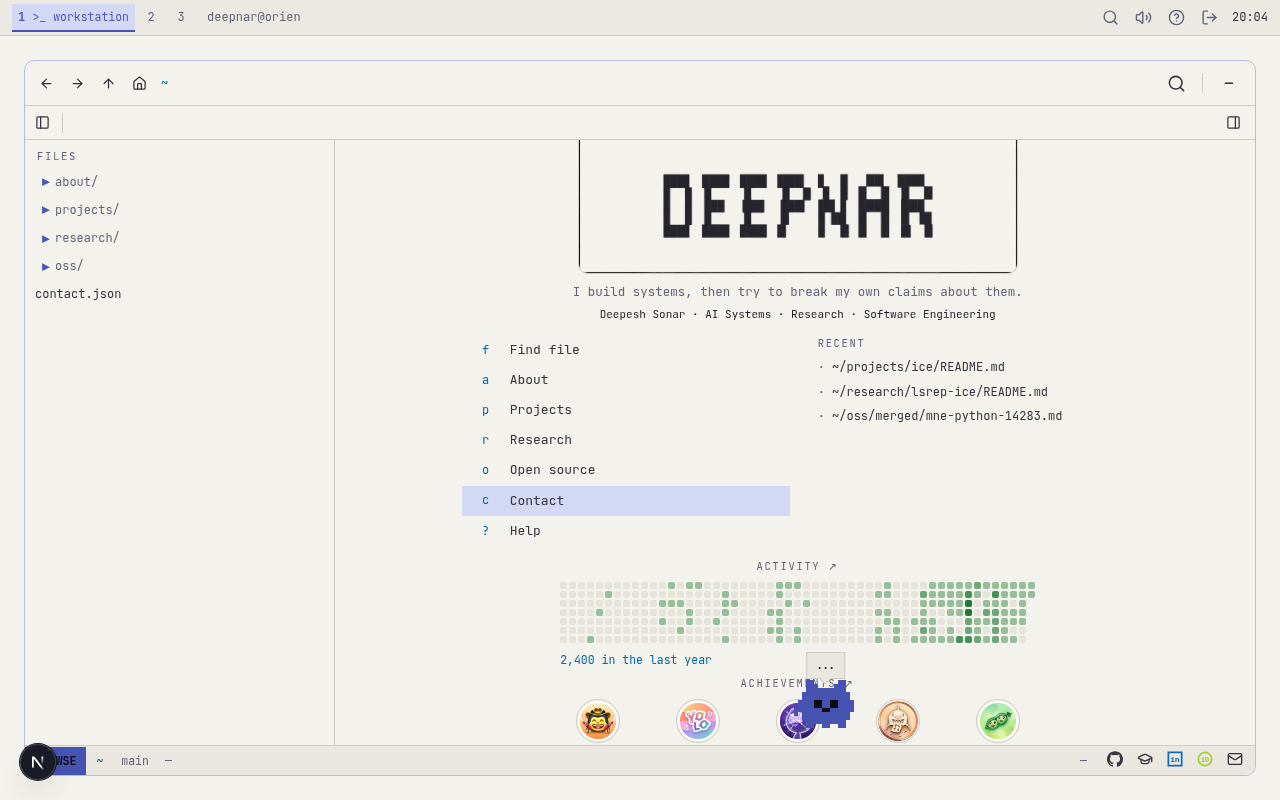
An interactive portfolio that behaves like a small research workstation, not a page of cards. You enter a guest session, open the workstation, and explore the work as files, terminal sessions, a knowledge graph, and git lanes.
“heyy” — pry, the small blue pixel companion who lives in the workstation. he notices your cursor sometimes, ignores it sometimes, and keeps his own opinions about your buffers.
Why it exists
Normal portfolios flatten everything into identical cards. This one keeps the shape of the work: projects live in a filesystem, research has an evaluation log, open source is a lane of real merged PRs, history is a graph you can drag around. If you can use a terminal and a file tree, you already know how to use this site.
What makes it different
- It is a workstation, not a page. Explorer + buffers + utility dock
(terminal / agent / web lookup), boot → greeter → desktop,
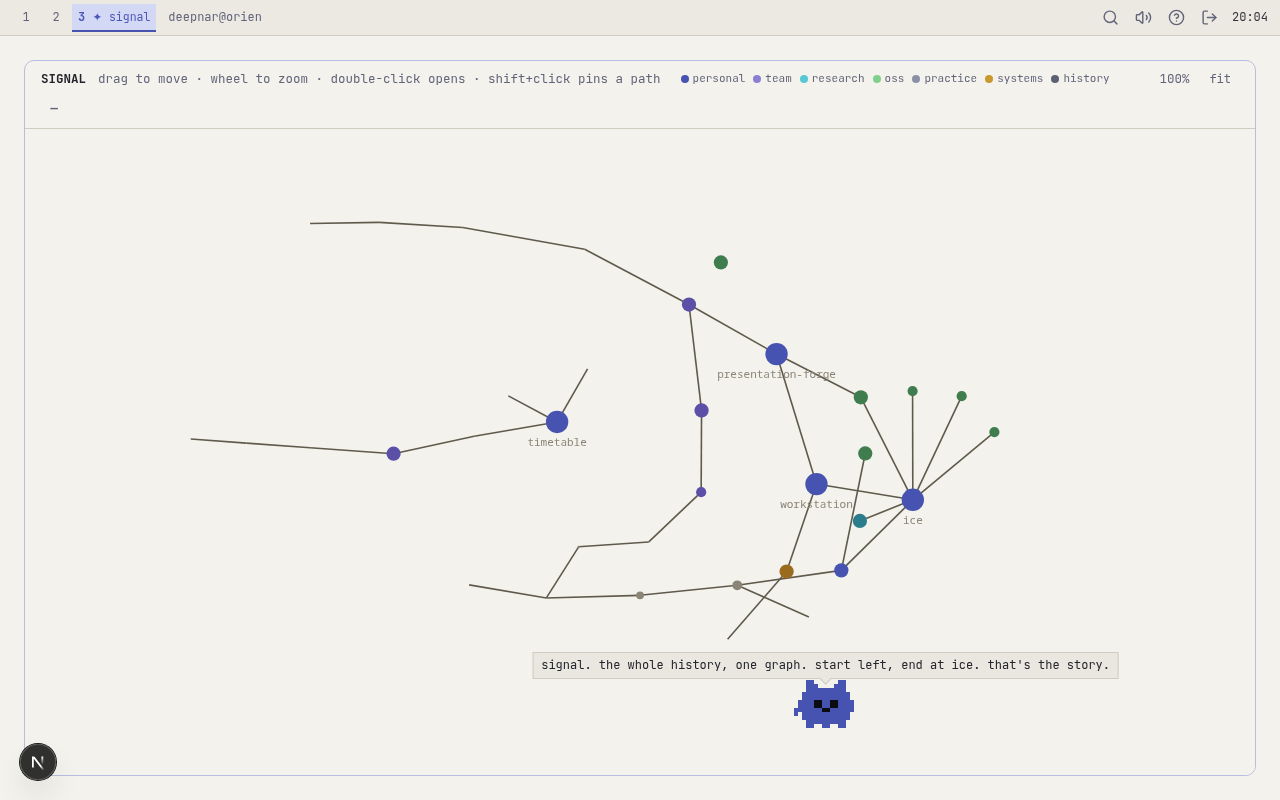
ctrl+kfinder,?help. Mobile gets the same workstation with a drawer + bottom sheet instead of squeezed columns. - Signal — the whole history as one deterministic, force-directed
knowledge graph (same layout every load, fit-to-content, magnetic
proximity picking, keyboard:
]/[/Enter/0). - Deterministic local agent — the
/assistant answers from a local content index with cited buffers. No model calls, no hallucinated pages. - Pry — an original pixel creature on canvas with his own dialogue per location. He once went silent because of a consume-on-speak race; there is a retry with rearming now. He has opinions.
- Orbit — a tiny playable game with a global leaderboard (Upstash).
- Evidence, not claims — certificates, papers, and EGD sheets open in a built-in document viewer with zoom / fit / download.
- Native Catppuccin cursors with upstream-verbatim hotspots
(
scripts/gen-cursors.mjsis the single pipeline; lint enforces it).
Run locally
npm install
npm run dev        # http://localhost:3000
npm run lint       # typecheck + secret scan + cursor check
npm run build      # static production build
npm start          # serve the production build
Boot → greeter → [ enter guest session ] → desktop → open workstation.
- Terminal:
ls · tree · cd · cat · open · find · grep · ask · neofetch - Buffers:
:e <path>·:bd·:bnext·:bprev - Deep links:
?open=~/projects/ice/README.md - Desktops:
1workstation ·2orbit ·3signal
Environment
The site works fully with no environment variables. One optional feature needs them:
| var | where | why |
|---|---|---|
NEXT_PUBLIC_UPSTASH_URL | browser | Orbit global leaderboard (REST) |
NEXT_PUBLIC_UPSTASH_TOKEN | browser | same — public by design (v1), see below |
Copy .env.example to .env.local if you want the leaderboard locally.
Without them, Orbit keeps a local best score and everything else is
unaffected. There is deliberately no GITHUB_TOKEN: GitHub metadata is
synced at authoring time (npm run sync-github with local gh auth →
committed src/generated/github.json → builds ship the JSON).
Architecture (short)
src/app/          next.js routes (static: / + /_not-found)
src/workstation/  explorer · buffers · dock · terminal · palette · agent
src/system/       boot/greeter/desktop · pry (pet) · sound · store wiring
src/apps/         signal graph · orbit game
src/vfs/          virtual filesystem (the site's content tree)
src/content/      verified data only (about · projects · research · oss)
src/lib/          zustand stores · terminal engine · deterministic assistant
public/evidence/  certificates · dipex · egd sheets (intentionally public)
public/research/  papers (intentionally public)
scripts/          tests · screenshots · cursor pipeline · banner · secret scan
Content rule: src/content/ holds verified data, the VFS presents it, and
nothing from private CV source material ships (see .env.example +
scan-secrets). Full decisions: ARCHITECTURE.md.
Privacy / security notes
- No analytics, no cookies, no accounts. Preferences (motion, layout) live
in your own
localStorage. - The Upstash token is a public leaderboard write key: scores are capped, trimmed to top-50, keyed by random IDs, carry no PII. Nothing valuable depends on it.
~/home/deepnar/…paths in the UI are the site's virtual filesystem, not the author's machine.- Preferences: respects
prefers-reduced-motion(seeds the motion default and neuters CSS animation), skip-link first in tab order, Escape closes overlays, focusable graph canvas.
Deploy
Static site — no server runtime. Push to GitHub → import in Vercel →
npm ci / npm run build / default output. Set the two Upstash vars for the
leaderboard. Social metadata is fixed to the production URL in
src/app/layout.tsx — no env var needed.
License / attribution
- This repo: MIT © 2026 Deepesh Sonar.
- Cursors: Catppuccin (see
public/cursors/LICENSE.catppuccin+ATTRIBUTION.md); hotspots re-derived from upstream v2.0.0 metadata. - Fonts: self-hosted via
next/font/google(JetBrains Mono, OFL). - Icons:
lucide-react(ISC). Terminal:xterm.js(MIT). - GitHub achievement art is displayed as earned-badge imagery alongside
profile links (see
public/achievements/ATTRIBUTION.md). - Papers/certs/EGD sheets under
public/are the author's own documents, published deliberately.
Similar repos


Languages
TypeScript
81.6%
JavaScript
16.2%
CSS
2.2%
Deepnar Workstation — Deepesh Sonar's portfolio as an interactive browser workstation: files, terminal, knowledge graph, pixel companion.
See the codeSee what people are saying
README
Deepnar Workstation
next.js · typescript · tailwind · zustand · xterm.js · d3-force · canvas
Live demo: coming with the first Vercel deploy (this repo has not been deployed yet — no URL is claimed until then).
An interactive portfolio that behaves like a small research workstation, not a page of cards. You enter a guest session, open the workstation, and explore the work as files, terminal sessions, a knowledge graph, and git lanes.
“heyy” — pry, the small blue pixel companion who lives in the workstation. he notices your cursor sometimes, ignores it sometimes, and keeps his own opinions about your buffers.
Why it exists
Normal portfolios flatten everything into identical cards. This one keeps the shape of the work: projects live in a filesystem, research has an evaluation log, open source is a lane of real merged PRs, history is a graph you can drag around. If you can use a terminal and a file tree, you already know how to use this site.
What makes it different
- It is a workstation, not a page. Explorer + buffers + utility dock
(terminal / agent / web lookup), boot → greeter → desktop,
ctrl+kfinder,?help. Mobile gets the same workstation with a drawer + bottom sheet instead of squeezed columns. - Signal — the whole history as one deterministic, force-directed
knowledge graph (same layout every load, fit-to-content, magnetic
proximity picking, keyboard:
]/[/Enter/0). - Deterministic local agent — the
/assistant answers from a local content index with cited buffers. No model calls, no hallucinated pages. - Pry — an original pixel creature on canvas with his own dialogue per location. He once went silent because of a consume-on-speak race; there is a retry with rearming now. He has opinions.
- Orbit — a tiny playable game with a global leaderboard (Upstash).
- Evidence, not claims — certificates, papers, and EGD sheets open in a built-in document viewer with zoom / fit / download.
- Native Catppuccin cursors with upstream-verbatim hotspots
(
scripts/gen-cursors.mjsis the single pipeline; lint enforces it).
Run locally
npm install
npm run dev        # http://localhost:3000
npm run lint       # typecheck + secret scan + cursor check
npm run build      # static production build
npm start          # serve the production build
Boot → greeter → [ enter guest session ] → desktop → open workstation.
- Terminal:
ls · tree · cd · cat · open · find · grep · ask · neofetch - Buffers:
:e <path>·:bd·:bnext·:bprev - Deep links:
?open=~/projects/ice/README.md - Desktops:
1workstation ·2orbit ·3signal
Environment
The site works fully with no environment variables. One optional feature needs them:
| var | where | why |
|---|---|---|
NEXT_PUBLIC_UPSTASH_URL | browser | Orbit global leaderboard (REST) |
NEXT_PUBLIC_UPSTASH_TOKEN | browser | same — public by design (v1), see below |
Copy .env.example to .env.local if you want the leaderboard locally.
Without them, Orbit keeps a local best score and everything else is
unaffected. There is deliberately no GITHUB_TOKEN: GitHub metadata is
synced at authoring time (npm run sync-github with local gh auth →
committed src/generated/github.json → builds ship the JSON).
Architecture (short)
src/app/          next.js routes (static: / + /_not-found)
src/workstation/  explorer · buffers · dock · terminal · palette · agent
src/system/       boot/greeter/desktop · pry (pet) · sound · store wiring
src/apps/         signal graph · orbit game
src/vfs/          virtual filesystem (the site's content tree)
src/content/      verified data only (about · projects · research · oss)
src/lib/          zustand stores · terminal engine · deterministic assistant
public/evidence/  certificates · dipex · egd sheets (intentionally public)
public/research/  papers (intentionally public)
scripts/          tests · screenshots · cursor pipeline · banner · secret scan
Content rule: src/content/ holds verified data, the VFS presents it, and
nothing from private CV source material ships (see .env.example +
scan-secrets). Full decisions: ARCHITECTURE.md.
Privacy / security notes
- No analytics, no cookies, no accounts. Preferences (motion, layout) live
in your own
localStorage. - The Upstash token is a public leaderboard write key: scores are capped, trimmed to top-50, keyed by random IDs, carry no PII. Nothing valuable depends on it.
~/home/deepnar/…paths in the UI are the site's virtual filesystem, not the author's machine.- Preferences: respects
prefers-reduced-motion(seeds the motion default and neuters CSS animation), skip-link first in tab order, Escape closes overlays, focusable graph canvas.
Deploy
Static site — no server runtime. Push to GitHub → import in Vercel →
npm ci / npm run build / default output. Set the two Upstash vars for the
leaderboard. Social metadata is fixed to the production URL in
src/app/layout.tsx — no env var needed.
License / attribution
- This repo: MIT © 2026 Deepesh Sonar.
- Cursors: Catppuccin (see
public/cursors/LICENSE.catppuccin+ATTRIBUTION.md); hotspots re-derived from upstream v2.0.0 metadata. - Fonts: self-hosted via
next/font/google(JetBrains Mono, OFL). - Icons:
lucide-react(ISC). Terminal:xterm.js(MIT). - GitHub achievement art is displayed as earned-badge imagery alongside
profile links (see
public/achievements/ATTRIBUTION.md). - Papers/certs/EGD sheets under
public/are the author's own documents, published deliberately.
Similar repos
Languages
TypeScript
81.6%
JavaScript
16.2%
CSS
2.2%