[NeurIPS 2026] SteerCast: Retrieval-Based Latent Steering for Decoder-Only Time Series Forecasting
Python
5
11 commits
updated Oct 11, 2026
Van Dai Do, Huu Hiep Nguyen, Minh Hoang Nguyen, Hung Le
Accepted (poster) at NeurIPS 2026
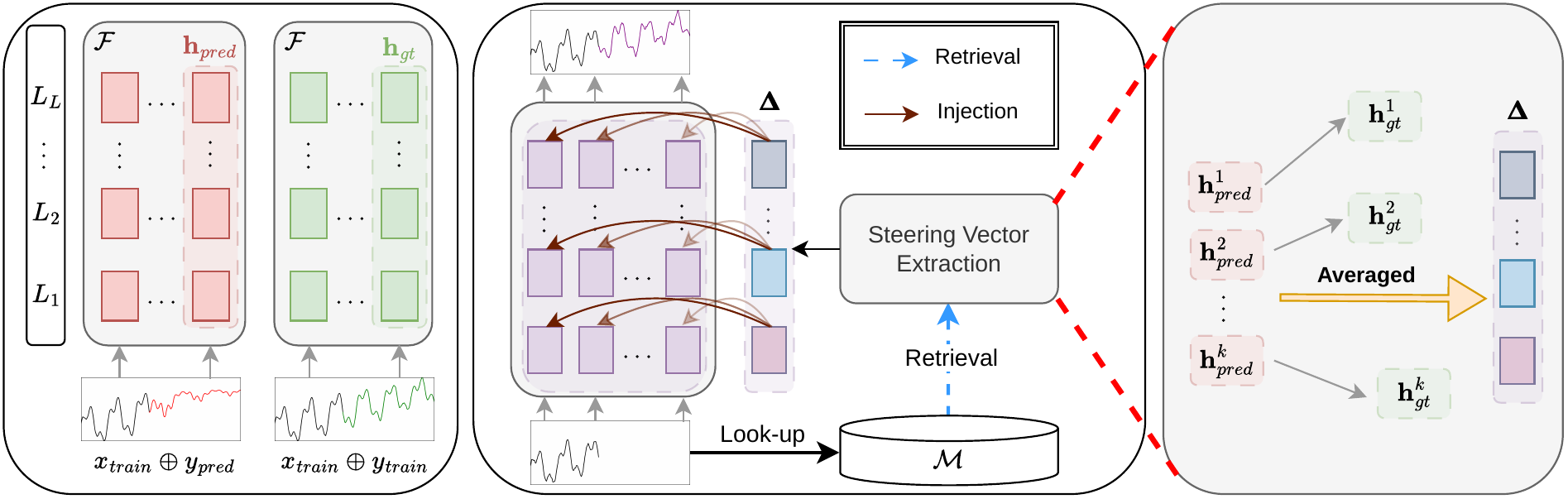
SteerCast improves an already fine-tuned decoder-only forecaster at inference time, without updating its parameters. It builds a database from the training set in which every history window is stored with a steering vector: the difference between the forecaster's hidden states when the window is continued with the ground truth and when it is continued with the model's own forecast. At test time SteerCast retrieves the nearest training histories, averages their steering vectors and injects the result into the hidden states at every autoregressive step.
This repository contains the code for SteerCast on three backbones (Time-MoE, Timer-XL and
TimesFM 2.5), the fine-tuning scripts, and the scripts used to produce the SteerCast results
of the paper. The project page lives in docs/.
x with continuation y:
r(x): final-layer hidden states of x, mean-pooled over time (Eq. 1);Δ = h([x; y]) − h([x; F(x)]): last-token states of every block under the ground-truth
and the model-predicted continuation (Eq. 2).k nearest entries are averaged (Eq. 3).λ (Eqs. 4–5).steercast/ # the method
pipeline.py # database construction + steered evaluation
steering.py # SteeringTail, attach_steering / detach_steering
vectors.py # steering vector aggregation
retrieval.py # nearest-neighbour retrieval
backbones/timesfm.py # TimesFM 2.5 wrapper
run_steercast_timemoe.py # SteerCast entry points, one per backbone
run_steercast_timerxl.py
run_steercast_timesfm.py
finetune/ # fine-tuning of the three backbones
scripts/ # reproduction scripts (finetune / steercast)
time_moe/ # Time-MoE model and data utilities (from the Time-MoE repository)
tools/convert_monash_tsf.py # converts Monash .tsf files to CSV
docs/ # project page (GitHub Pages)
conda create -n steercast python=3.10 -y
conda activate steercast
pip install -r requirements.txt
# optional, for faster attention in Time-MoE
pip install flash-attn --no-build-isolation
Time-MoE requires transformers==4.40.1. TimesFM 2.5 is only needed for the TimesFM experiments:
we use the official PyTorch code at commit 6bd8044. Its package requires Python ≥ 3.11, so with
the environment above simply put its sources on the path:
git clone https://github.com/google-research/timesfm.git
git -C timesfm checkout 6bd8044275f8b76cdc9554f2fecccac5f31a156c
export TIMESFM_SRC=$PWD/timesfm/src
Place the ten benchmarks under ./dataset (or point DATA_ROOT elsewhere):
dataset/
  ETT-small/{ETTh1,ETTh2,ETTm1,ETTm2}.csv
  exchange_rate/exchange_rate.csv
  weather/weather.csv
  illness/national_illness.csv
  us_births_dataset.csv
  saugeenday_dataset.csv
  sunspot_dataset_without_missing_values.csv
.tsf files with
python tools/convert_monash_tsf.py dataset/us_births_dataset.tsf (and likewise for the others).ETT uses the 12/4/4-month split; all other datasets use a 70/10/20 chronological split. Every split is standardised with training statistics and every channel is forecast independently.
# 1) fine-tune the backbone on the target dataset (here Time-MoE on ETTh1)
bash scripts/finetune/timemoe.sh ETTh1

# 2) SteerCast: build the database from the training split, then evaluate on the test split
python run_steercast_timemoe.py \
    -m checkpoints/timemoe/ETTh1 -d dataset/ETT-small/ETTh1.csv --data ETTh1 \
    -c 512 -p 96 -b 512 --k 1 --lam 0.01
The database is written to ./cache/<backbone>/<data>/<seq_len>_<db_pred_len>/<checkpoint>/ and
reused by later runs. Metrics are printed and saved as JSON under ./results/.
| Option | Meaning | Default |
|---|---|---|
--k | number of retrieved neighbours | 1 |
--lam | steering strength λ (--lam 0 gives the fine-tuned model) | 0.01 |
--beta | update rule: 0 = plain norm-preserving update, 1 = cosine-gated update of Eqs. 4–5, in between = interpolation | 0 |
--gate_b --gate_m --gate_p | gate floor b, margin m, power p | 0.1, 0.1, 1.25 |
--retrieval | euclidean or cosine | euclidean |
--whiten | whiten the steering vector by the spread of h_pred over the neighbours | 1 for Time-MoE, 0 otherwise |
--pool_number | the database uses the last pool_number time steps of the training split | 10000 |
--db_pred_len | continuation length used to build the database (reuse one database across horizons) | --pred_len |
--db_buffer | drop the last N training windows per channel (strict temporal isolation) | 0 |
--split | test, or val for hyper-parameter selection | test |
All scripts read DATA_ROOT, CKPT_ROOT, CACHE_ROOT and RESULTS_ROOT (defaults ./dataset,
./checkpoints, ./cache, ./results), take a protocol and an optional list of datasets, and
contain the per-dataset hyper-parameters.
# fine-tuning (FT)
bash scripts/finetune/timemoe.sh
bash scripts/finetune/timerxl.sh
bash scripts/finetune/timesfm.sh fixed        # TimesFM is fine-tuned per horizon

# SteerCast: Table 2 (fixed look-back 512) and Table 1 (look-back 512/1024/2048/3072)
bash scripts/steercast/timemoe.sh fixed
bash scripts/steercast/timemoe.sh various
bash scripts/steercast/timerxl.sh fixed  ETTh1 ETTh2      # any subset of datasets
bash scripts/steercast/timesfm.sh various

# fine-tuned model without steering (FT)
LAMBDA=0 bash scripts/steercast/timemoe.sh fixed
In the fixed protocol a single database, built for the shortest horizon, is reused for all horizons; in the various protocol a database is built for every look-back/horizon pair. TimesFM is fine-tuned per horizon, so it always uses one database per checkpoint.
‖Q − r‖_F over the batch of keys Q), Timer-XL and
TimesFM match its first window, and the database of the first window's channel is used. Results
therefore depend on --batch_size; the scripts use the batch sizes of the paper. Use -b 1 for
strictly per-window retrieval.--fast_retrieval computes Euclidean distances with one matrix product instead of one norm per
entry; it is much faster on large databases but may reorder near-ties.This code builds on Time-MoE (model and data utilities), Timer-XL, TimesFM, Time-Series-Library and the Monash forecasting archive. We thank the authors for releasing their code and data.
Released under the Apache 2.0 License (see LICENSE)
[NeurIPS 2026] SteerCast: Retrieval-Based Latent Steering for Decoder-Only Time Series Forecasting
Python
5
11 commits
updated Oct 11, 2026
Van Dai Do, Huu Hiep Nguyen, Minh Hoang Nguyen, Hung Le
Accepted (poster) at NeurIPS 2026
SteerCast improves an already fine-tuned decoder-only forecaster at inference time, without updating its parameters. It builds a database from the training set in which every history window is stored with a steering vector: the difference between the forecaster's hidden states when the window is continued with the ground truth and when it is continued with the model's own forecast. At test time SteerCast retrieves the nearest training histories, averages their steering vectors and injects the result into the hidden states at every autoregressive step.
This repository contains the code for SteerCast on three backbones (Time-MoE, Timer-XL and
TimesFM 2.5), the fine-tuning scripts, and the scripts used to produce the SteerCast results
of the paper. The project page lives in docs/.
x with continuation y:
r(x): final-layer hidden states of x, mean-pooled over time (Eq. 1);Δ = h([x; y]) − h([x; F(x)]): last-token states of every block under the ground-truth
and the model-predicted continuation (Eq. 2).k nearest entries are averaged (Eq. 3).λ (Eqs. 4–5).steercast/ # the method
pipeline.py # database construction + steered evaluation
steering.py # SteeringTail, attach_steering / detach_steering
vectors.py # steering vector aggregation
retrieval.py # nearest-neighbour retrieval
backbones/timesfm.py # TimesFM 2.5 wrapper
run_steercast_timemoe.py # SteerCast entry points, one per backbone
run_steercast_timerxl.py
run_steercast_timesfm.py
finetune/ # fine-tuning of the three backbones
scripts/ # reproduction scripts (finetune / steercast)
time_moe/ # Time-MoE model and data utilities (from the Time-MoE repository)
tools/convert_monash_tsf.py # converts Monash .tsf files to CSV
docs/ # project page (GitHub Pages)
conda create -n steercast python=3.10 -y
conda activate steercast
pip install -r requirements.txt
# optional, for faster attention in Time-MoE
pip install flash-attn --no-build-isolation
Time-MoE requires transformers==4.40.1. TimesFM 2.5 is only needed for the TimesFM experiments:
we use the official PyTorch code at commit 6bd8044. Its package requires Python ≥ 3.11, so with
the environment above simply put its sources on the path:
git clone https://github.com/google-research/timesfm.git
git -C timesfm checkout 6bd8044275f8b76cdc9554f2fecccac5f31a156c
export TIMESFM_SRC=$PWD/timesfm/src
Place the ten benchmarks under ./dataset (or point DATA_ROOT elsewhere):
dataset/
  ETT-small/{ETTh1,ETTh2,ETTm1,ETTm2}.csv
  exchange_rate/exchange_rate.csv
  weather/weather.csv
  illness/national_illness.csv
  us_births_dataset.csv
  saugeenday_dataset.csv
  sunspot_dataset_without_missing_values.csv
.tsf files with
python tools/convert_monash_tsf.py dataset/us_births_dataset.tsf (and likewise for the others).ETT uses the 12/4/4-month split; all other datasets use a 70/10/20 chronological split. Every split is standardised with training statistics and every channel is forecast independently.
# 1) fine-tune the backbone on the target dataset (here Time-MoE on ETTh1)
bash scripts/finetune/timemoe.sh ETTh1

# 2) SteerCast: build the database from the training split, then evaluate on the test split
python run_steercast_timemoe.py \
    -m checkpoints/timemoe/ETTh1 -d dataset/ETT-small/ETTh1.csv --data ETTh1 \
    -c 512 -p 96 -b 512 --k 1 --lam 0.01
The database is written to ./cache/<backbone>/<data>/<seq_len>_<db_pred_len>/<checkpoint>/ and
reused by later runs. Metrics are printed and saved as JSON under ./results/.
| Option | Meaning | Default |
|---|---|---|
--k | number of retrieved neighbours | 1 |
--lam | steering strength λ (--lam 0 gives the fine-tuned model) | 0.01 |
--beta | update rule: 0 = plain norm-preserving update, 1 = cosine-gated update of Eqs. 4–5, in between = interpolation | 0 |
--gate_b --gate_m --gate_p | gate floor b, margin m, power p | 0.1, 0.1, 1.25 |
--retrieval | euclidean or cosine | euclidean |
--whiten | whiten the steering vector by the spread of h_pred over the neighbours | 1 for Time-MoE, 0 otherwise |
--pool_number | the database uses the last pool_number time steps of the training split | 10000 |
--db_pred_len | continuation length used to build the database (reuse one database across horizons) | --pred_len |
--db_buffer | drop the last N training windows per channel (strict temporal isolation) | 0 |
--split | test, or val for hyper-parameter selection | test |
All scripts read DATA_ROOT, CKPT_ROOT, CACHE_ROOT and RESULTS_ROOT (defaults ./dataset,
./checkpoints, ./cache, ./results), take a protocol and an optional list of datasets, and
contain the per-dataset hyper-parameters.
# fine-tuning (FT)
bash scripts/finetune/timemoe.sh
bash scripts/finetune/timerxl.sh
bash scripts/finetune/timesfm.sh fixed        # TimesFM is fine-tuned per horizon

# SteerCast: Table 2 (fixed look-back 512) and Table 1 (look-back 512/1024/2048/3072)
bash scripts/steercast/timemoe.sh fixed
bash scripts/steercast/timemoe.sh various
bash scripts/steercast/timerxl.sh fixed  ETTh1 ETTh2      # any subset of datasets
bash scripts/steercast/timesfm.sh various

# fine-tuned model without steering (FT)
LAMBDA=0 bash scripts/steercast/timemoe.sh fixed
In the fixed protocol a single database, built for the shortest horizon, is reused for all horizons; in the various protocol a database is built for every look-back/horizon pair. TimesFM is fine-tuned per horizon, so it always uses one database per checkpoint.
‖Q − r‖_F over the batch of keys Q), Timer-XL and
TimesFM match its first window, and the database of the first window's channel is used. Results
therefore depend on --batch_size; the scripts use the batch sizes of the paper. Use -b 1 for
strictly per-window retrieval.--fast_retrieval computes Euclidean distances with one matrix product instead of one norm per
entry; it is much faster on large databases but may reorder near-ties.This code builds on Time-MoE (model and data utilities), Timer-XL, TimesFM, Time-Series-Library and the Monash forecasting archive. We thank the authors for releasing their code and data.
Released under the Apache 2.0 License (see LICENSE)



