Entity Linking Web App allowing for flexible NER and NED strategies adjustments
Jupyter Notebook
1
231 commits
updated Sep 9, 2025
A flexible, transparent entity linking system that leverages Named Entity Recognition (NER) class probabilities, contextual embeddings, and DBpedia knowledge-graph features to disambiguate and link mentions in text.
Keywords: entity linking, NER, NED, knowledge graphs, DBpedia, embeddings, Flask
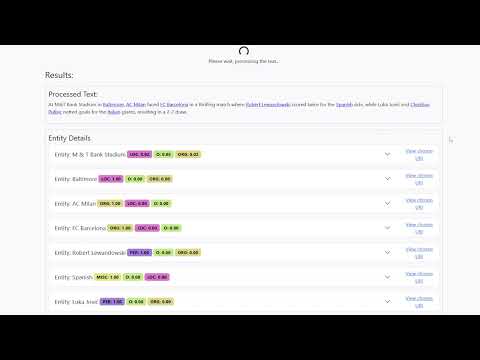
Multiple NER Models: Choose from three NER models trained using SpanMaker framework:
Type-Aware Disambiguation: Optional embedding features based on predicted NER types.
Feature-Rich Ranking: Combines string similarity, popularity, context embeddings, position, and type embeddings in an XGBoost model.
Interactive GUI:
Configurable: select one of the available NER models and toggle using type-score features during NED.
Input & Configuration
NER Stage
Candidate Retrieval
Feature Extraction
Ranking & Selection
Interactive Display
pipgit clone https://github.com/Danzigerrr/ProbNEL.git
cd ProbNEL
python -m venv venv
source venv/bin/activate # Linux/Mac
venv\\Scripts\\activate # Windows
pip install -r requirements.txt
cd App/NEL_project
python flask_app.py
Open your browser at http://127.0.0.1:5000/NEL_app.
Send a POST to /NEL_app with form-encoded parameters:
| Parameter | Description |
|---|---|
user_input | Raw text |
knowledge_graph | dbpedia |
ner_model | Full NER model identifier |
use_types_score | 0 or 1 |
Response is JSON with text, entities, probabilities, and candidates.
Candidate selector is an XGboost model which select the best candidate among the 10 candidates fetched from DBpedia for a recognized named entity in text. The code used for trainig and evaluation of differnt configurations of candidate selector model is presented in Candidate_selector.ipynb.
In order to reuse the feature scores calcualted for each candidate in trainig and test datasets two zip files containig the calculted scores was created.
Code for downloading and unzipping these zip files is included in Candidate_selector.ipynb in the Download and extract cached calculations and requests from zip files section.
ProbNEL integrates fine-grained NER outputs and context-aware scoring to disambiguate entity mentions. Experimental results on two widely used benchmarks demonstrate the effectiveness of this approach:
| Test Dataset | Baseline Accuracy (Surface-Form - Only NED) | ProbNEL Accuracy (Full System - End-to-End Entity Linking) |
|---|---|---|
| AIDA | 64.8% | 86–90% |
| ACE2004 | 72.0% | 86–90% |
The baseline uses only surface form matching, whereas ProbNEL combines contextual similarity, entity popularity, position in DBpedia results, and multiple type-embedding scores derived from predicted NER class distributions. These scores are used as features in an XGBoost classifier trained on annotated datasets.
By leveraging both structured type knowledge and deep contextual embeddings, ProbNEL significantly improves disambiguation accuracy. The system generalizes well across formal and informal texts, making it suitable for downstream applications such as question answering, information retrieval, and knowledge graph population.
This project is licensed under the GNU GPL v3.0. See LICENSE for details.
Entity Linking Web App allowing for flexible NER and NED strategies adjustments
Jupyter Notebook
1
231 commits
updated Sep 9, 2025
A flexible, transparent entity linking system that leverages Named Entity Recognition (NER) class probabilities, contextual embeddings, and DBpedia knowledge-graph features to disambiguate and link mentions in text.
Keywords: entity linking, NER, NED, knowledge graphs, DBpedia, embeddings, Flask
Multiple NER Models: Choose from three NER models trained using SpanMaker framework:
Type-Aware Disambiguation: Optional embedding features based on predicted NER types.
Feature-Rich Ranking: Combines string similarity, popularity, context embeddings, position, and type embeddings in an XGBoost model.
Interactive GUI:
Configurable: select one of the available NER models and toggle using type-score features during NED.
Input & Configuration
NER Stage
Candidate Retrieval
Feature Extraction
Ranking & Selection
Interactive Display
pipgit clone https://github.com/Danzigerrr/ProbNEL.git
cd ProbNEL
python -m venv venv
source venv/bin/activate # Linux/Mac
venv\\Scripts\\activate # Windows
pip install -r requirements.txt
cd App/NEL_project
python flask_app.py
Open your browser at http://127.0.0.1:5000/NEL_app.
Send a POST to /NEL_app with form-encoded parameters:
| Parameter | Description |
|---|---|
user_input | Raw text |
knowledge_graph | dbpedia |
ner_model | Full NER model identifier |
use_types_score | 0 or 1 |
Response is JSON with text, entities, probabilities, and candidates.
Candidate selector is an XGboost model which select the best candidate among the 10 candidates fetched from DBpedia for a recognized named entity in text. The code used for trainig and evaluation of differnt configurations of candidate selector model is presented in Candidate_selector.ipynb.
In order to reuse the feature scores calcualted for each candidate in trainig and test datasets two zip files containig the calculted scores was created.
Code for downloading and unzipping these zip files is included in Candidate_selector.ipynb in the Download and extract cached calculations and requests from zip files section.
ProbNEL integrates fine-grained NER outputs and context-aware scoring to disambiguate entity mentions. Experimental results on two widely used benchmarks demonstrate the effectiveness of this approach:
| Test Dataset | Baseline Accuracy (Surface-Form - Only NED) | ProbNEL Accuracy (Full System - End-to-End Entity Linking) |
|---|---|---|
| AIDA | 64.8% | 86–90% |
| ACE2004 | 72.0% | 86–90% |
The baseline uses only surface form matching, whereas ProbNEL combines contextual similarity, entity popularity, position in DBpedia results, and multiple type-embedding scores derived from predicted NER class distributions. These scores are used as features in an XGBoost classifier trained on annotated datasets.
By leveraging both structured type knowledge and deep contextual embeddings, ProbNEL significantly improves disambiguation accuracy. The system generalizes well across formal and informal texts, making it suitable for downstream applications such as question answering, information retrieval, and knowledge graph population.
This project is licensed under the GNU GPL v3.0. See LICENSE for details.






