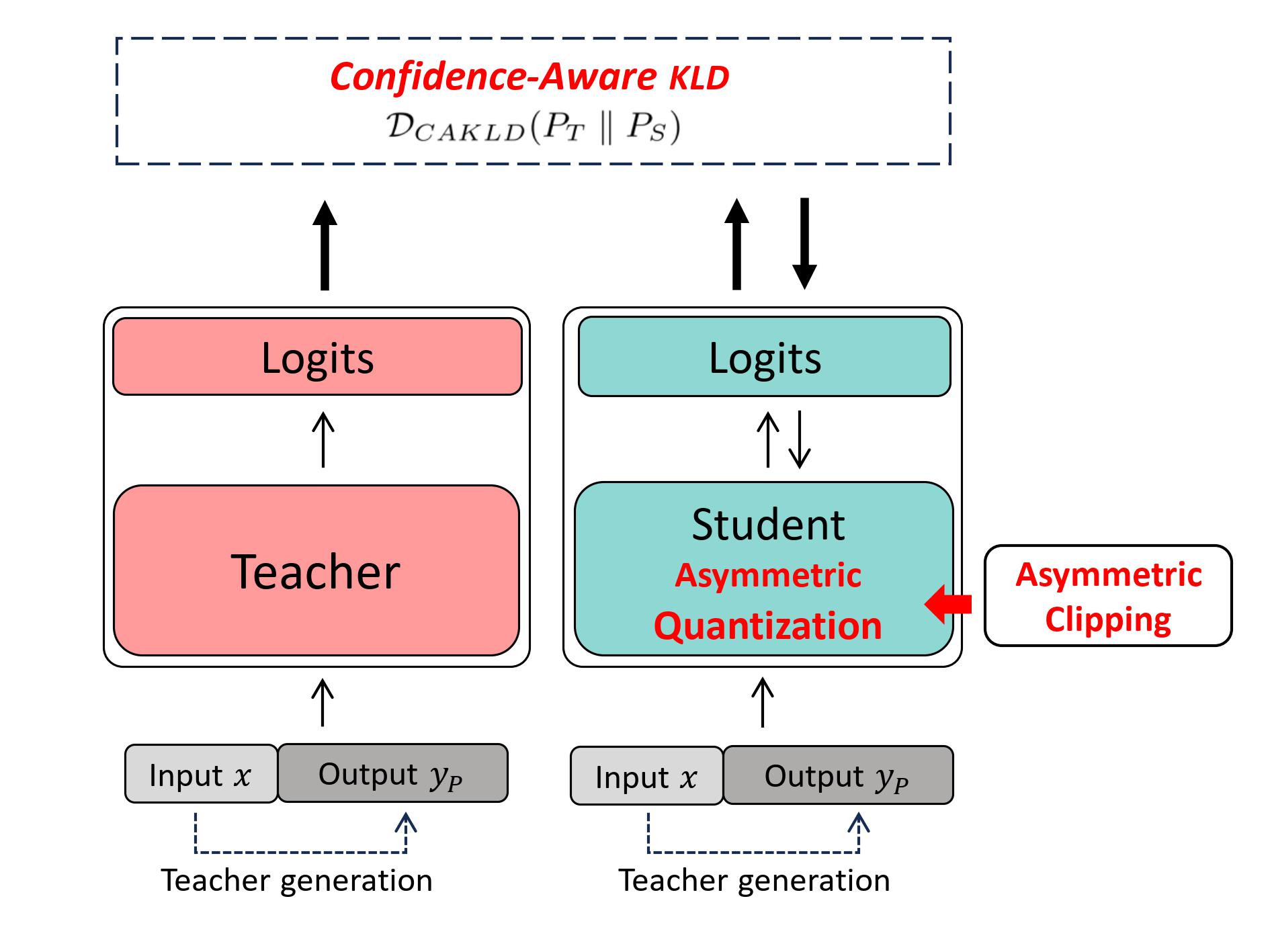
[ACL 2024] A novel QAT with Self-Distillation framework to enhance ultra low-bit LLMs.
Python
141
19 commits
updated May 16, 2024
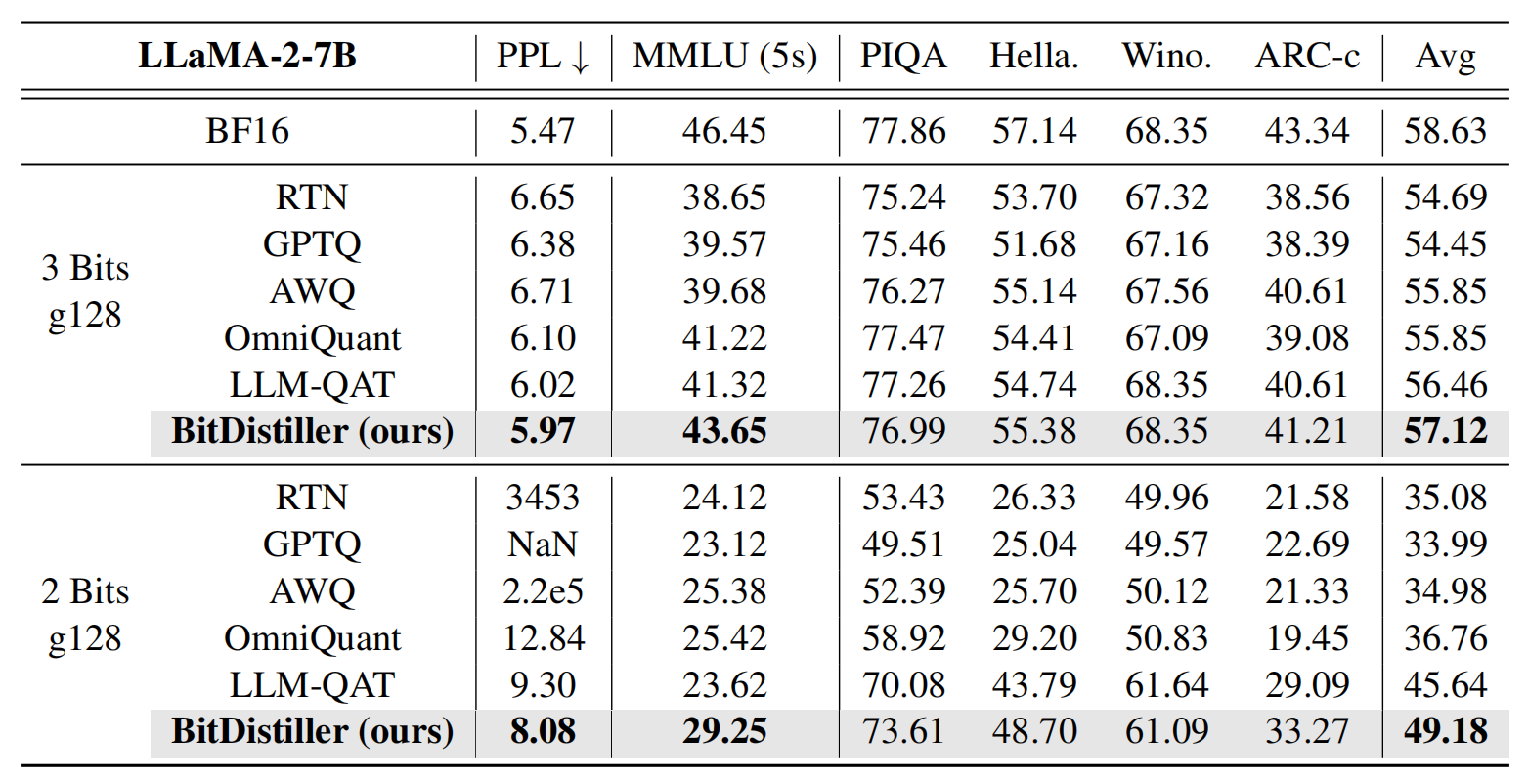
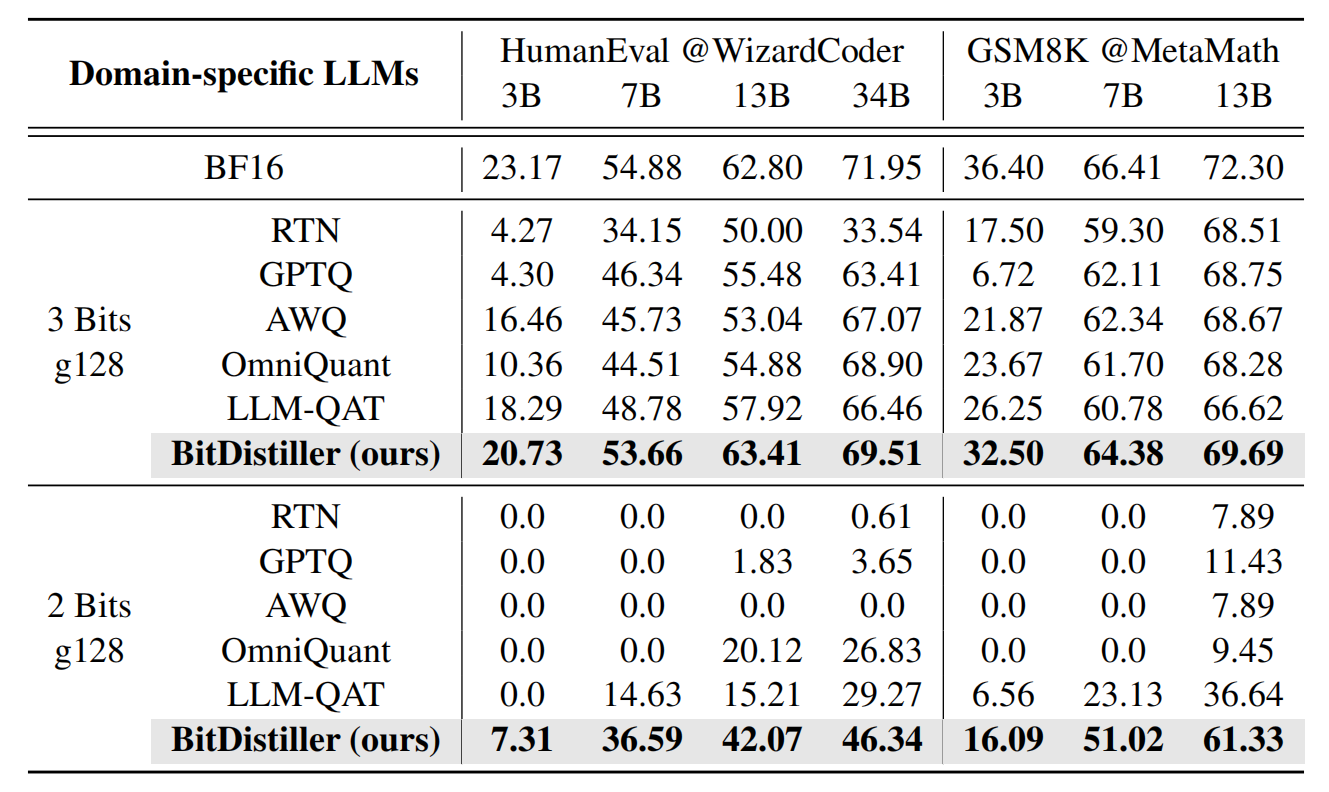
Implementing efficient sub-4-bit weight quantization (3 / 2 bits) in LLMs through advanced QAT-based Self-Distillation techniques.
python 3.9, pytorch >= 1.13
pip install -r requirement.txt
(You may need to change the version of transformers according to the model config)
Our results is running by following 3 steps:
Determine the type of quantization: use nf3 for 3 bits and int for 2 bits. Set w_bit and quant_type accordingly.
Perform clipping before training and save the clipping values using dump_clip (see quantization/autoclip.py).
This step can match or surpass the low-bit PTQ quantization results of GPTQ and AWQ.
data/generation).train/Get the Clipping result
cd BitDistiller/quantization

CUDA_VISIBLE_DEVICES=0 python autoclip.py --model_path <model_path> --calib_dataset pile --quant_type int --w_bit 2 --q_group_size 128 --run_clip --dump_clip ./clip_cache/hf-llama2-7b/int2-g128.pt
Get the Teacher Generation Data (Using vllm would be much faster)
# vllm
python generate_vllm.py --base_model <model_path> --dataset_name wikitext --out_path ./datasets/hf-llama-2-7b/ --max_sample 3000

python generate_vllm.py --base_model <model_path> --dataset_name alpaca --out_path ./datasets/hf-llama-2-7b/ --max_sample 5000

# change to path in .py
python mix_data.py
# torchrun
cd BitDistiller/data/generation

bash generate.sh <model_path> wikitext ../datasets/hf-llama-2-7b/ 16 3000

bash generate.sh <model_path> alpaca ../datasets/hf-llama-2-7b/ 16 5000

# change to path in .py
python mix_data.py
Run KD-base QAT
# Specify the pre-trained model path
# Specify the num_gpus and batch_size according to your GPU devices
# Specify the clipping cache path to the --clip

cd train

bash train.sh ../data/datasets/hf-llama-2-7b/mix_wiki_alpaca_8000.json ./ckpts/hf-llama-2-7b/int2-g128/ ./logs/hf-llama-2-7b/int2-g128/ 4
Get the Clipping result
cd BitDistiller/quantization

CUDA_VISIBLE_DEVICES=0 python autoclip.py --model_path <model_path> --calib_dataset code --quant_type int --w_bit 2 --q_group_size 128 --run_clip --dump_clip ./clip_cache/WizardCoder-7B/int2-g128.pt
Get the Teacher Generation Data
# vllm
python generate_vllm.py --base_model <model_path> --dataset_name code --out_path ./datasets/WizardCoder-7b/ --max_sample 3000
cd BitDistiller/data/generation

bash generate.sh /root/WizardCoder-Python-7B/ code ../datasets/WizardCoder-7b/ 16 3000
Run KD-base QAT
# Specify the pre-trained model path
# Specify the num_gpus and batch_size according to your GPU devices
# Specify the clipping cache path to the --clip

cd train

bash train.sh ../data/datasets/WizardCoder-7b/code_T0.7_N1024_S42_3000.json ./ckpts/WizardCoder-7b/int2-g128/ ./logs/WizardCoder-7b/int2-g128/ 2
Get the Clipping result
cd BitDistiller/quantization

CUDA_VISIBLE_DEVICES=0 python autoclip.py --model_path <model_path> --calib_dataset gsm8k --quant_type int --w_bit 2 --q_group_size 128 --run_clip --dump_clip ./clip_cache/MetaMath-7B/int2-g128.pt
Get the Teacher Generation Data
# vllm
python generate_vllm.py --base_model <model_path> --dataset_name math --out_path ./datasets/MetaMath-7B/ --max_sample 3000
cd BitDistiller/data/generation

bash generate.sh /root/MetaMath-7B-V1.0/ math ../datasets/MetaMath-7B/ 16 3000
Run KD-base QAT
# Specify the pre-trained model path
# Specify the num_gpus and batch_size according to your GPU devices
# Specify the clipping cache path to the --clip

cd train

bash train.sh ../data/datasets/MetaMath-7B/math_T0.7_N1024_S42_3000.json ./ckpts/MetaMath-7b/int2-g128/ ./logs/MetaMath-7b/int2-g128/ 2
cd test/general

python wiki_ppl.py --model ../../train/ckpts/hf-llama-2-7b/int2-g128/checkpoint-200/ --quant_type int --bits 2 --group_size 128
CUDA_VISIBLE_DEVICES=0 python llm_eval.py --model ../../train/ckpts/hf-llama-2-7b/int2-g128/checkpoint-200/ --eval_tasks hendrycksTest-* --test_set --bits 2 --group_size 128 --quant_type int --num_fewshot 5
CUDA_VISIBLE_DEVICES=0 python llm_eval.py --model ../../train/ckpts/hf-llama-2-7b/int2-g128/checkpoint-200/ --eval_tasks arc_challenge,winogrande,hellaswag,piqa --test_set --bits 2 --group_size 128 --quant_type int --num_fewshot 0
Install the environment according to the instructions of HumanEval,
Example script:
cd test/humaneval
bash gen_preds.sh [checkpoint_path] ./preds/7b/int2-g128/
Example script:
cd test/gsm8k
bash test.sh ../../train/ckpts/MetaMath-7b/int2-g128/ ./preds/7b/int2-g128/
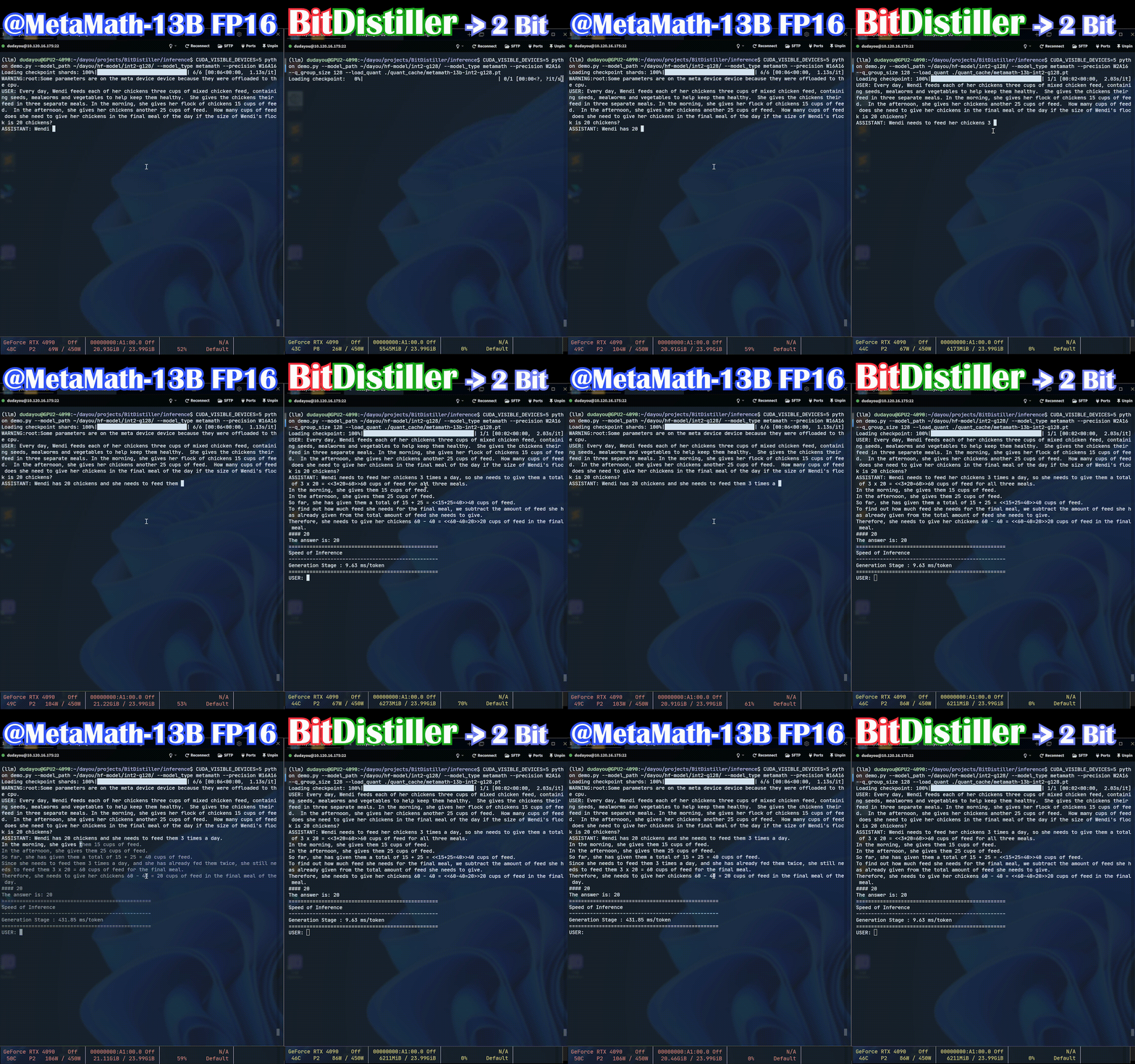
Please see inference/
If you find BitDistiller useful or relevant to your research, please kindly cite our paper:
@misc{du2024bitdistiller,
      title={BitDistiller: Unleashing the Potential of Sub-4-Bit LLMs via Self-Distillation},
      author={Dayou Du and Yijia Zhang and Shijie Cao and Jiaqi Guo and Ting Cao and Xiaowen Chu and Ningyi Xu},
      year={2024},
      eprint={2402.10631},
      archivePrefix={arXiv},
      primaryClass={cs.CL}
}
[ACL 2024] A novel QAT with Self-Distillation framework to enhance ultra low-bit LLMs.
Python
141
19 commits
updated May 16, 2024
Implementing efficient sub-4-bit weight quantization (3 / 2 bits) in LLMs through advanced QAT-based Self-Distillation techniques.
python 3.9, pytorch >= 1.13
pip install -r requirement.txt
(You may need to change the version of transformers according to the model config)
Our results is running by following 3 steps:
Determine the type of quantization: use nf3 for 3 bits and int for 2 bits. Set w_bit and quant_type accordingly.
Perform clipping before training and save the clipping values using dump_clip (see quantization/autoclip.py).
This step can match or surpass the low-bit PTQ quantization results of GPTQ and AWQ.
data/generation).train/Get the Clipping result
cd BitDistiller/quantization

CUDA_VISIBLE_DEVICES=0 python autoclip.py --model_path <model_path> --calib_dataset pile --quant_type int --w_bit 2 --q_group_size 128 --run_clip --dump_clip ./clip_cache/hf-llama2-7b/int2-g128.pt
Get the Teacher Generation Data (Using vllm would be much faster)
# vllm
python generate_vllm.py --base_model <model_path> --dataset_name wikitext --out_path ./datasets/hf-llama-2-7b/ --max_sample 3000

python generate_vllm.py --base_model <model_path> --dataset_name alpaca --out_path ./datasets/hf-llama-2-7b/ --max_sample 5000

# change to path in .py
python mix_data.py
# torchrun
cd BitDistiller/data/generation

bash generate.sh <model_path> wikitext ../datasets/hf-llama-2-7b/ 16 3000

bash generate.sh <model_path> alpaca ../datasets/hf-llama-2-7b/ 16 5000

# change to path in .py
python mix_data.py
Run KD-base QAT
# Specify the pre-trained model path
# Specify the num_gpus and batch_size according to your GPU devices
# Specify the clipping cache path to the --clip

cd train

bash train.sh ../data/datasets/hf-llama-2-7b/mix_wiki_alpaca_8000.json ./ckpts/hf-llama-2-7b/int2-g128/ ./logs/hf-llama-2-7b/int2-g128/ 4
Get the Clipping result
cd BitDistiller/quantization

CUDA_VISIBLE_DEVICES=0 python autoclip.py --model_path <model_path> --calib_dataset code --quant_type int --w_bit 2 --q_group_size 128 --run_clip --dump_clip ./clip_cache/WizardCoder-7B/int2-g128.pt
Get the Teacher Generation Data
# vllm
python generate_vllm.py --base_model <model_path> --dataset_name code --out_path ./datasets/WizardCoder-7b/ --max_sample 3000
cd BitDistiller/data/generation

bash generate.sh /root/WizardCoder-Python-7B/ code ../datasets/WizardCoder-7b/ 16 3000
Run KD-base QAT
# Specify the pre-trained model path
# Specify the num_gpus and batch_size according to your GPU devices
# Specify the clipping cache path to the --clip

cd train

bash train.sh ../data/datasets/WizardCoder-7b/code_T0.7_N1024_S42_3000.json ./ckpts/WizardCoder-7b/int2-g128/ ./logs/WizardCoder-7b/int2-g128/ 2
Get the Clipping result
cd BitDistiller/quantization

CUDA_VISIBLE_DEVICES=0 python autoclip.py --model_path <model_path> --calib_dataset gsm8k --quant_type int --w_bit 2 --q_group_size 128 --run_clip --dump_clip ./clip_cache/MetaMath-7B/int2-g128.pt
Get the Teacher Generation Data
# vllm
python generate_vllm.py --base_model <model_path> --dataset_name math --out_path ./datasets/MetaMath-7B/ --max_sample 3000
cd BitDistiller/data/generation

bash generate.sh /root/MetaMath-7B-V1.0/ math ../datasets/MetaMath-7B/ 16 3000
Run KD-base QAT
# Specify the pre-trained model path
# Specify the num_gpus and batch_size according to your GPU devices
# Specify the clipping cache path to the --clip

cd train

bash train.sh ../data/datasets/MetaMath-7B/math_T0.7_N1024_S42_3000.json ./ckpts/MetaMath-7b/int2-g128/ ./logs/MetaMath-7b/int2-g128/ 2
cd test/general

python wiki_ppl.py --model ../../train/ckpts/hf-llama-2-7b/int2-g128/checkpoint-200/ --quant_type int --bits 2 --group_size 128
CUDA_VISIBLE_DEVICES=0 python llm_eval.py --model ../../train/ckpts/hf-llama-2-7b/int2-g128/checkpoint-200/ --eval_tasks hendrycksTest-* --test_set --bits 2 --group_size 128 --quant_type int --num_fewshot 5
CUDA_VISIBLE_DEVICES=0 python llm_eval.py --model ../../train/ckpts/hf-llama-2-7b/int2-g128/checkpoint-200/ --eval_tasks arc_challenge,winogrande,hellaswag,piqa --test_set --bits 2 --group_size 128 --quant_type int --num_fewshot 0
Install the environment according to the instructions of HumanEval,
Example script:
cd test/humaneval
bash gen_preds.sh [checkpoint_path] ./preds/7b/int2-g128/
Example script:
cd test/gsm8k
bash test.sh ../../train/ckpts/MetaMath-7b/int2-g128/ ./preds/7b/int2-g128/
Please see inference/
If you find BitDistiller useful or relevant to your research, please kindly cite our paper:
@misc{du2024bitdistiller,
      title={BitDistiller: Unleashing the Potential of Sub-4-Bit LLMs via Self-Distillation},
      author={Dayou Du and Yijia Zhang and Shijie Cao and Jiaqi Guo and Ting Cao and Xiaowen Chu and Ningyi Xu},
      year={2024},
      eprint={2402.10631},
      archivePrefix={arXiv},
      primaryClass={cs.CL}
}



