
[CVPR 2024 Highlight] Mitigating Object Hallucinations in Large Vision-Language Models through Visual Contrastive Decoding
Python
421
34 commits
updated Oct 7, 2024
README
VCD: Mitigating Object Hallucinations in Large Vision-Language Models through Visual Contrastive Decoding
This is the official repo for Visual Contrastive Decoding, a simple, training-free method for mitigating hallucinations in LVLMs during decoding without utilizing external tools.



🔥 Update
- [2024-04-05]: ⭐️⭐️⭐️ VCD is selected as Poster Highlight in CVPR 2024! (Top 11.9% in accepted papers)
- [2023-11-29]: ⭐️ Paper of VCD online. Check out this link for details.
- [2023-11-28]: 🚀 Codes released.
🎯 Overview
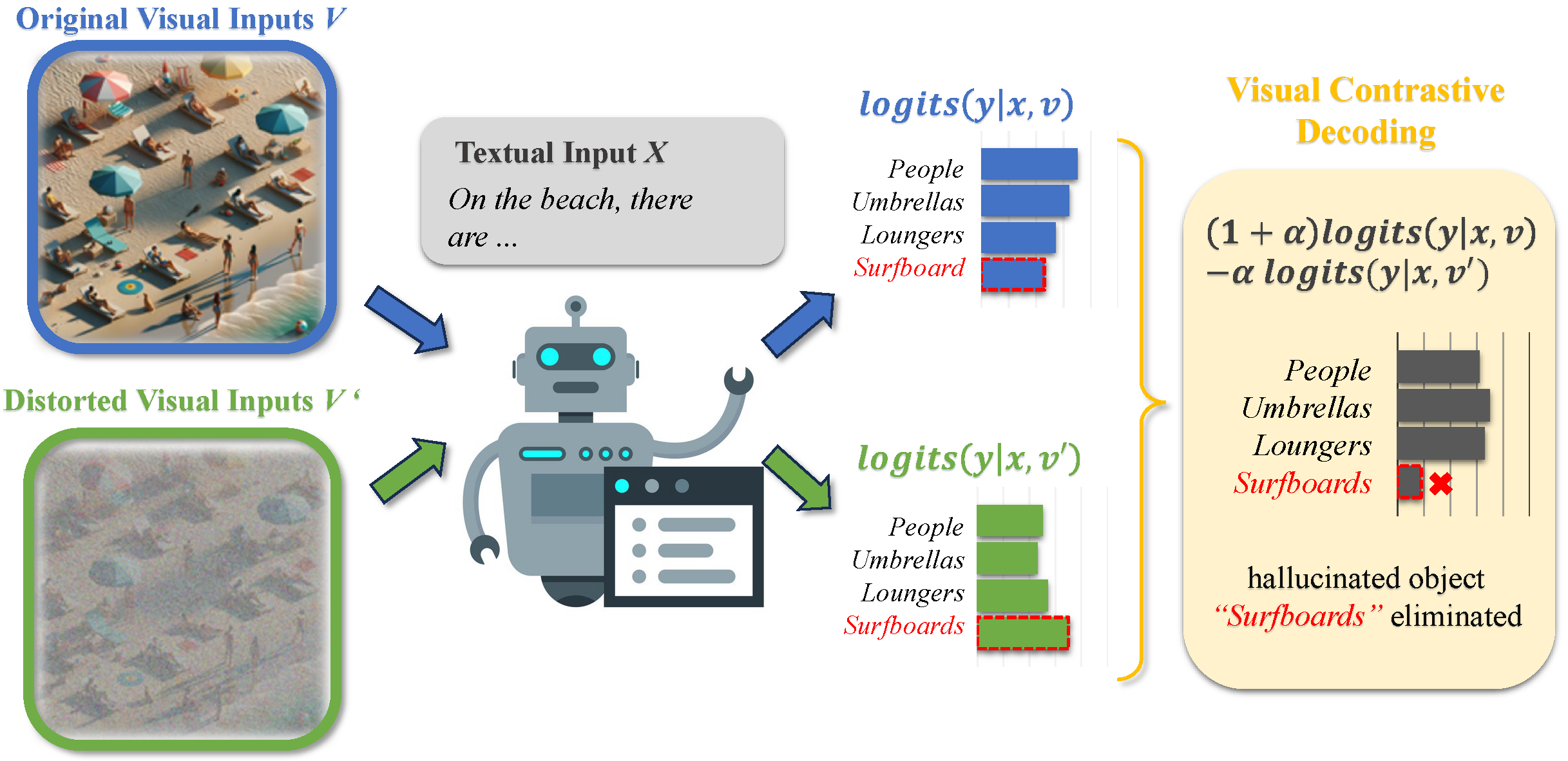
- We introduce Visual Contrastive Decoding (VCD), a simple and training-free method that contrasts output distributions derived from original and distorted visual inputs.
- The new contrastive probability distribution for decoding is formulated as follows:
p_{vcd}(y \mid v, v', x) = softmax[ (1+\alpha)\times logit_\theta (y \mid v, x) - \alpha \times logit_\theta(y \mid v', x)],
- The proposed VCD effectively reduces the over-reliance on statistical bias and unimodal priors, two essential causes of object hallucinations.
🕹️ Usage
Environment Setup
conda create -yn vcd python=3.9
conda activate vcd
cd VCD
pip install -r requirements.txt
How to Use VCD in LVLMs
The two core function of VCD, adding noise to images and generating text based on VCD sampling, are found in the vcd_utils folder. Scripts for using VCD sampling in LLaVA, InstructBLIP, and QwenVL are located in VCD/eval. We have annotated some key changes with ## cd_comment for easy location using ctrl+f.
To help you get started quickly, here's an example using LLaVA on how to replace the conventional sampling method with the VCD method during generation:
- Add the following at the beginning of the start-up script:
from vcd_utils.vcd_sample import evolve_vcd_sampling
evolve_vcd_sampling()
The evolve_vcd_sampling function replaces the sampling function in the transformers library. The modified sampling function includes an option for visual contrastive decoding, while keeping the rest unchanged.
-
Slightly modify
llava_llama.py:a. Add contrastive decoding parameters in the
LlavaLlamaForCausalLMclass'sforwardfunction to avoid exceptions inmodel.generate.b. Add the
prepare_inputs_for_generation_cdfunction. -
Add noise to the image:
from vcd_utils.vcd_add_noise import add_diffusion_noise
image_tensor_cd = add_diffusion_noise(image_tensor, args.noise_step)
set the hyperparameter in the generate function:
output_ids = model.generate(
    input_ids,
    images=image_tensor.unsqueeze(0).half().cuda(),
    images_cd=(image_tensor_cd.unsqueeze(0).half().cuda() if image_tensor_cd is not None else None),
    cd_alpha = args.cd_alpha,
    cd_beta = args.cd_beta,
    do_sample=True)
🏅 Experiments
-
VCD significantly mitigates the object hallucination issue across different LVLM families.
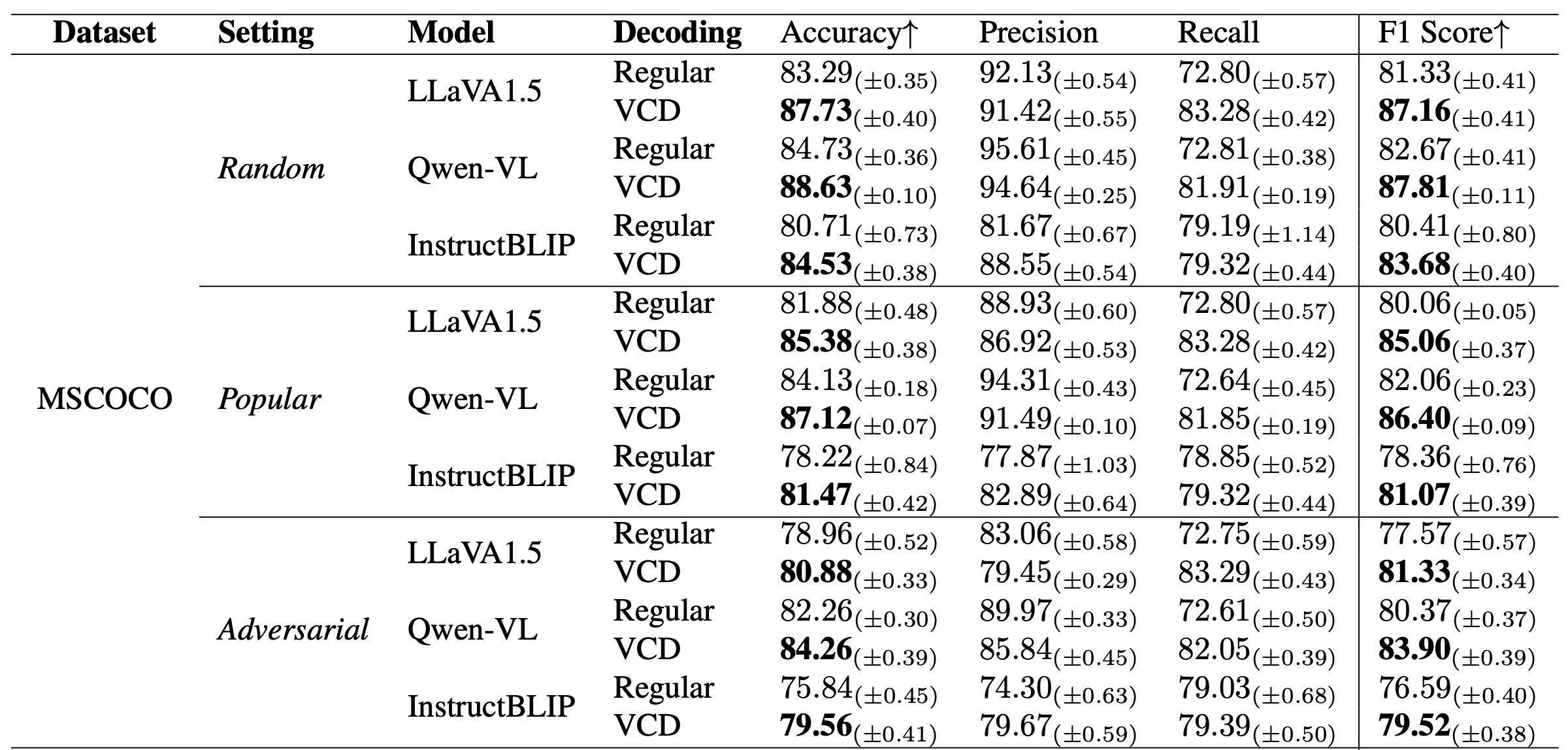 table 1(Part of). Results on POPE. Regular decoding denotes direct sampling, whereas VCD refers to sampling from our proposed contrastive distribution pvcd. The best performances within each setting are bolded.
 -
Beyond mitigating object hallucinations, VCD also excels in general LVLM benchmarks, highlighting its wide-ranging applicability.
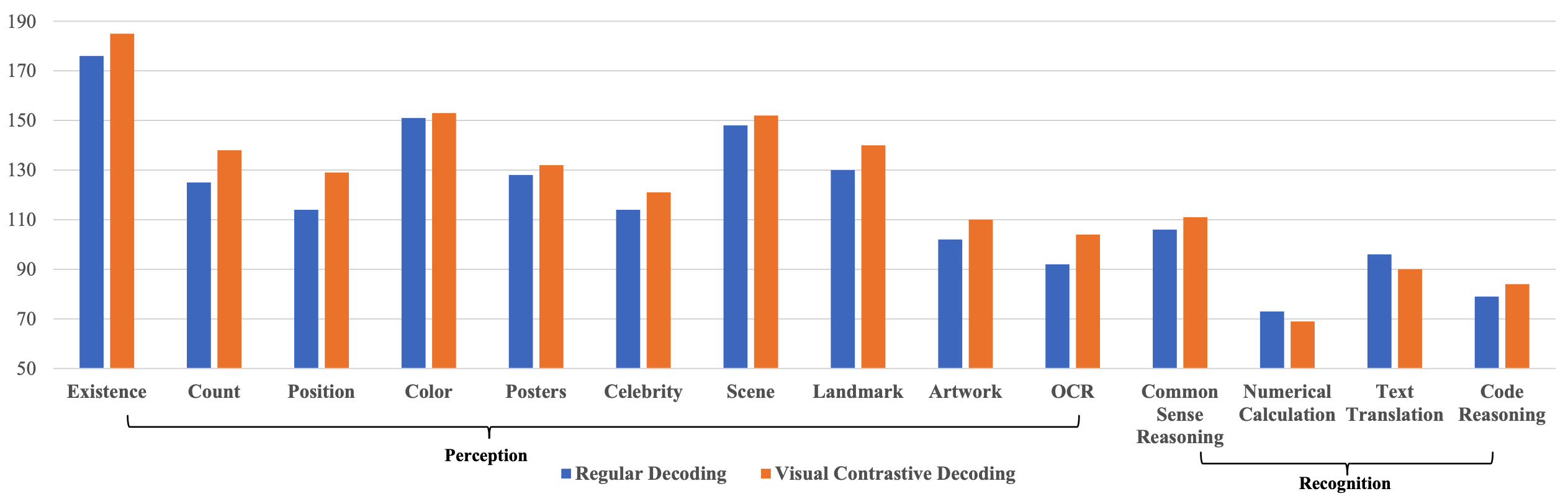 figure 4. MME full set results on LLaVA-1.5. VCD consistently enhances LVLMs’ perception capacities while preserving their recognition competencies.
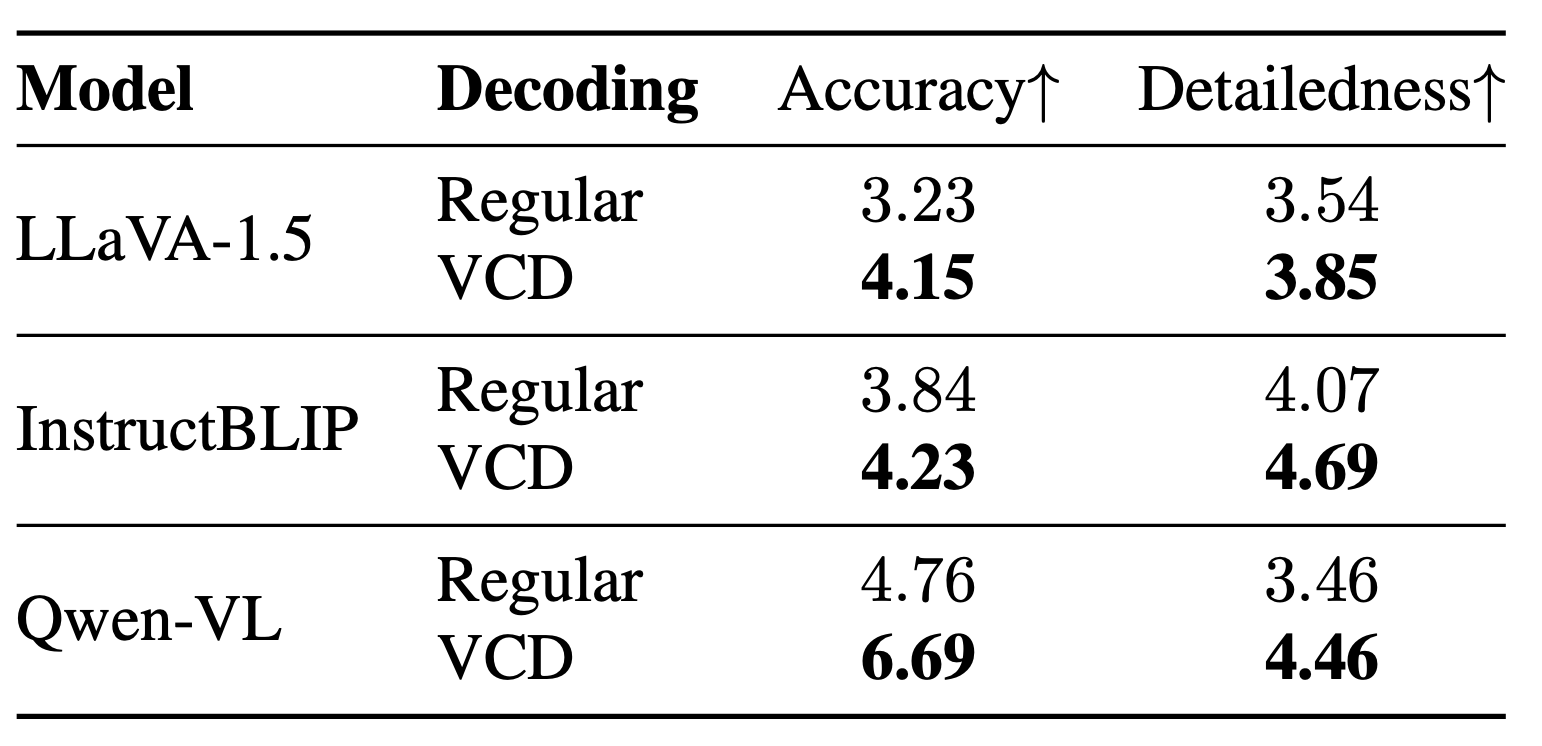
table 3. Results of GPT-4V-aided evaluation on open-ended generation. Accuracy measures the response’s alignment with the image content, and Detailedness gauges the richness of details in the response. Both metrics are on a scale of 10.
- Please refer to our paper for detailed experimental results.
📌 Examples
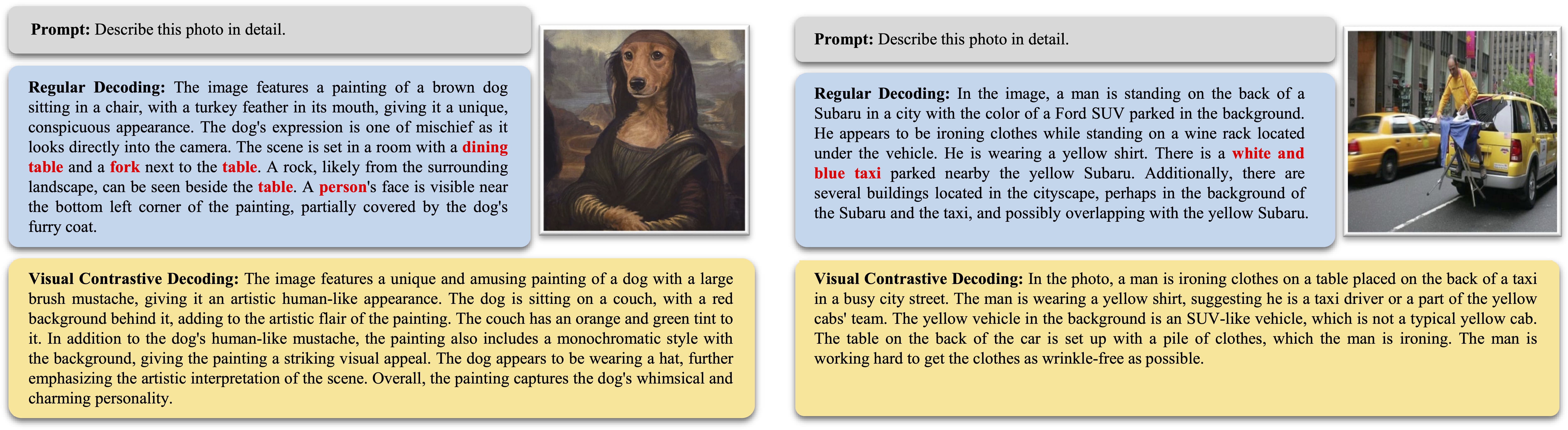 figure 5. Illustration of hallucination correction by our proposed VCD with two samples from LLaVA-Bench. Hallucinated objects from LVLM's regular decoding are highlighted in red.
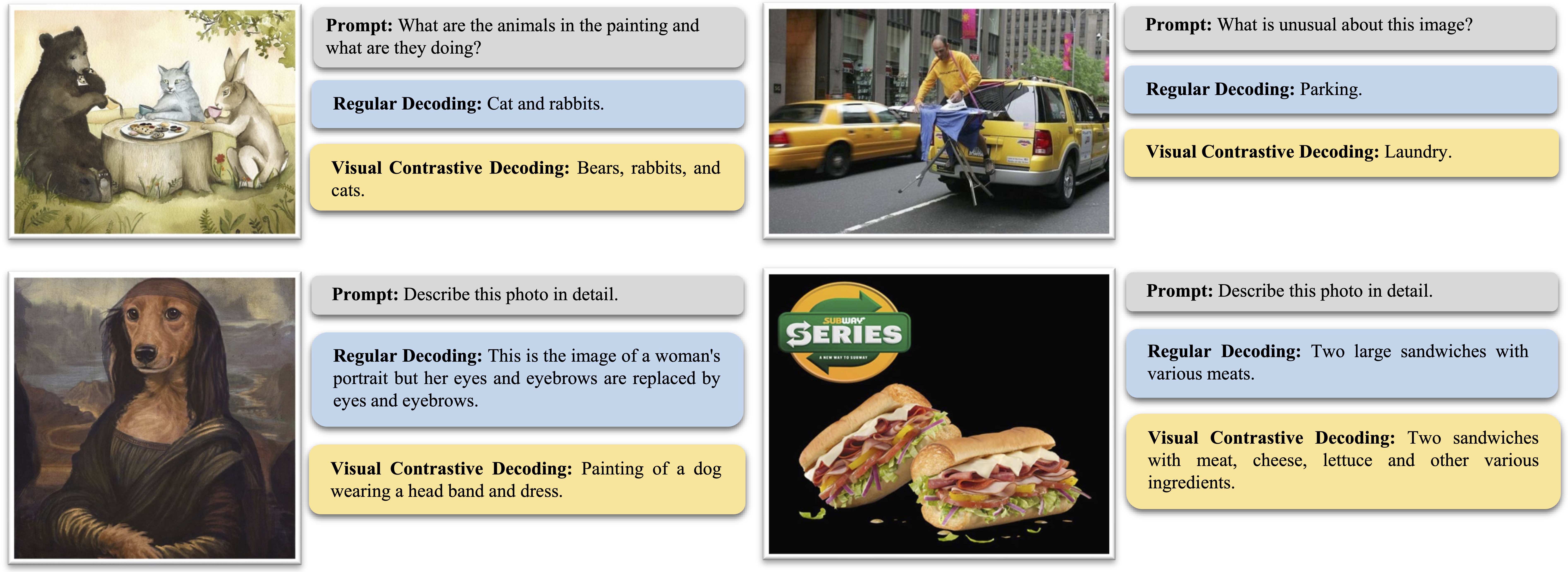 figure 8. More examples from LLaVA-Bench of our proposed VCD for enhanced general perception and recognition capacities.
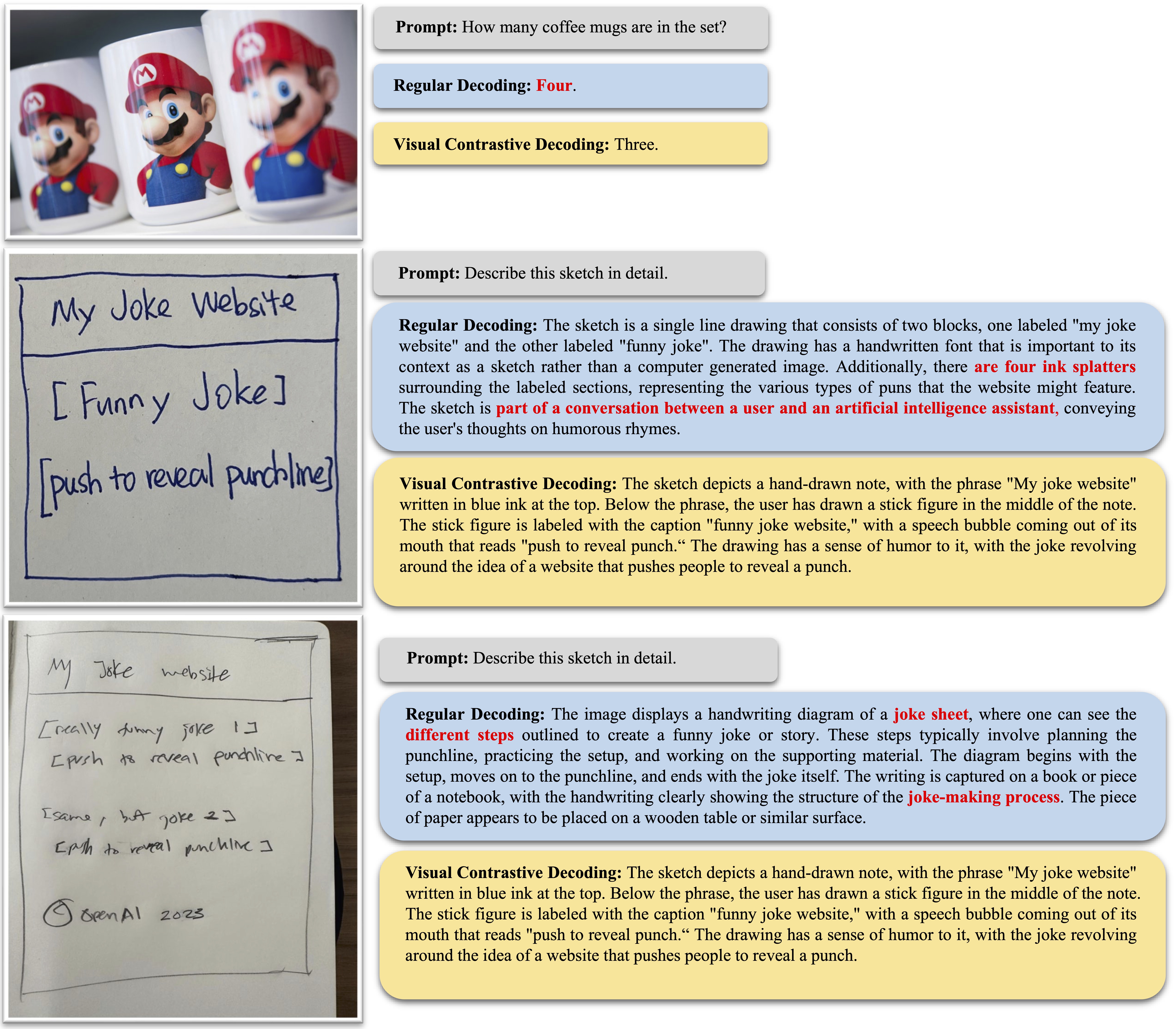 figure 7. More examples from LLaVA-Bench of our proposed VCD for hallucination corrections. Hallucinated objects from LVLM's regular decoding are highlighted in red.
📑 Citation
If you find our project useful, we hope you can star our repo and cite our paper as follows:
@article{damonlpsg2023vcd,
  author = {Sicong Leng, Hang Zhang, Guanzheng Chen, Xin Li, Shijian Lu, Chunyan Miao, Lidong Bing},
  title = {Mitigating Object Hallucinations in Large Vision-Language Models through Visual Contrastive Decoding},
  year = 2023,
  journal = {arXiv preprint arXiv:2311.16922},
  url = {https://arxiv.org/abs/2311.16922}
}
📝 Related Projects
- Contrastive Decoding: Open-ended Text Generation as Optimization
- InstructBLIP: Towards General-purpose Vision-Language Models with Instruction Tuning
- Qwen-VL: A Versatile Vision-Language Model for Understanding, Localization, Text Reading, and Beyond
- LLaVA 1.5: Improved Baselines with Visual Instruction Tuning
Similar repos


Languages
Python
99.6%
[CVPR 2024 Highlight] Mitigating Object Hallucinations in Large Vision-Language Models through Visual Contrastive Decoding
Python
421
34 commits
updated Oct 7, 2024
README
VCD: Mitigating Object Hallucinations in Large Vision-Language Models through Visual Contrastive Decoding
This is the official repo for Visual Contrastive Decoding, a simple, training-free method for mitigating hallucinations in LVLMs during decoding without utilizing external tools.
🔥 Update
- [2024-04-05]: ⭐️⭐️⭐️ VCD is selected as Poster Highlight in CVPR 2024! (Top 11.9% in accepted papers)
- [2023-11-29]: ⭐️ Paper of VCD online. Check out this link for details.
- [2023-11-28]: 🚀 Codes released.
🎯 Overview
- We introduce Visual Contrastive Decoding (VCD), a simple and training-free method that contrasts output distributions derived from original and distorted visual inputs.
- The new contrastive probability distribution for decoding is formulated as follows:
p_{vcd}(y \mid v, v', x) = softmax[ (1+\alpha)\times logit_\theta (y \mid v, x) - \alpha \times logit_\theta(y \mid v', x)],
- The proposed VCD effectively reduces the over-reliance on statistical bias and unimodal priors, two essential causes of object hallucinations.
🕹️ Usage
Environment Setup
conda create -yn vcd python=3.9
conda activate vcd
cd VCD
pip install -r requirements.txt
How to Use VCD in LVLMs
The two core function of VCD, adding noise to images and generating text based on VCD sampling, are found in the vcd_utils folder. Scripts for using VCD sampling in LLaVA, InstructBLIP, and QwenVL are located in VCD/eval. We have annotated some key changes with ## cd_comment for easy location using ctrl+f.
To help you get started quickly, here's an example using LLaVA on how to replace the conventional sampling method with the VCD method during generation:
- Add the following at the beginning of the start-up script:
from vcd_utils.vcd_sample import evolve_vcd_sampling
evolve_vcd_sampling()
The evolve_vcd_sampling function replaces the sampling function in the transformers library. The modified sampling function includes an option for visual contrastive decoding, while keeping the rest unchanged.
-
Slightly modify
llava_llama.py:a. Add contrastive decoding parameters in the
LlavaLlamaForCausalLMclass'sforwardfunction to avoid exceptions inmodel.generate.b. Add the
prepare_inputs_for_generation_cdfunction. -
Add noise to the image:
from vcd_utils.vcd_add_noise import add_diffusion_noise
image_tensor_cd = add_diffusion_noise(image_tensor, args.noise_step)
set the hyperparameter in the generate function:
output_ids = model.generate(
    input_ids,
    images=image_tensor.unsqueeze(0).half().cuda(),
    images_cd=(image_tensor_cd.unsqueeze(0).half().cuda() if image_tensor_cd is not None else None),
    cd_alpha = args.cd_alpha,
    cd_beta = args.cd_beta,
    do_sample=True)
🏅 Experiments
-
VCD significantly mitigates the object hallucination issue across different LVLM families.
table 1(Part of). Results on POPE. Regular decoding denotes direct sampling, whereas VCD refers to sampling from our proposed contrastive distribution pvcd. The best performances within each setting are bolded. -
Beyond mitigating object hallucinations, VCD also excels in general LVLM benchmarks, highlighting its wide-ranging applicability.
figure 4. MME full set results on LLaVA-1.5. VCD consistently enhances LVLMs’ perception capacities while preserving their recognition competencies.
table 3. Results of GPT-4V-aided evaluation on open-ended generation. Accuracy measures the response’s alignment with the image content, and Detailedness gauges the richness of details in the response. Both metrics are on a scale of 10.
- Please refer to our paper for detailed experimental results.
📌 Examples
figure 5. Illustration of hallucination correction by our proposed VCD with two samples from LLaVA-Bench. Hallucinated objects from LVLM's regular decoding are highlighted in red.
figure 8. More examples from LLaVA-Bench of our proposed VCD for enhanced general perception and recognition capacities.
figure 7. More examples from LLaVA-Bench of our proposed VCD for hallucination corrections. Hallucinated objects from LVLM's regular decoding are highlighted in red.
📑 Citation
If you find our project useful, we hope you can star our repo and cite our paper as follows:
@article{damonlpsg2023vcd,
  author = {Sicong Leng, Hang Zhang, Guanzheng Chen, Xin Li, Shijian Lu, Chunyan Miao, Lidong Bing},
  title = {Mitigating Object Hallucinations in Large Vision-Language Models through Visual Contrastive Decoding},
  year = 2023,
  journal = {arXiv preprint arXiv:2311.16922},
  url = {https://arxiv.org/abs/2311.16922}
}
📝 Related Projects
- Contrastive Decoding: Open-ended Text Generation as Optimization
- InstructBLIP: Towards General-purpose Vision-Language Models with Instruction Tuning
- Qwen-VL: A Versatile Vision-Language Model for Understanding, Localization, Text Reading, and Beyond
- LLaVA 1.5: Improved Baselines with Visual Instruction Tuning
Similar repos
Languages
Python
99.6%