
README

RDK Model Zoo
Out-of-the-Box AI Model Deployment Pipelines and Full-Link Conversion Tutorials Based on D-Robotics BPU
English | 简体中文




Introduction
Mission: Dedicated to providing D-Robotics developers with extreme performance, out-of-the-box, and full-scenario AI deployment validation experiences.
This repository is the official collection of BPU model examples and tools (Model Zoo) provided by D-Robotics. It is oriented towards AI model deployment and application development on BPU (Brain Processing Unit), helping developers to quickly get started with BPU and fast-track model inference workflows.
The repository includes BPU-ready models across multiple AI domains and provides complete reference implementations from Original Model (PyTorch/ONNX) -> Fixed-point Quantization -> Inference Execution -> Result Parsing -> Example Validation, helping users understand and utilize BPU capabilities at minimal cost.
Core Value
- 🚀 Quick BPU Adoption: Provides out-of-the-box inference pipelines to help users complete BPU inference validation and performance evaluation in the shortest time.
- 🧩 Complete End-to-End Examples: Covers the entire process from algorithm export and fixed-point quantization to efficient on-board execution (
.bin/.hbm). Includes model loading, preprocessing, BPU inference execution, post-processing, and result visualization. - 📐 Standardized Design & Documentation: Provides unified directory structures and sample code specifications, supporting Python (
hbm_runtime) and C/C++ interfaces for easy understanding, secondary development, and reduced integration/maintenance costs. - 🌐 Full Scenario Coverage: Covers classification, detection, segmentation, pose estimation, OCR, and multi-modal models.
Hardware & System Support
This repository uses hardware-specific branches to keep maintained samples, legacy demos, and board-specific documents clearly separated. The current rdk_x5 branch is the primary delivery branch for RDK X5. The previous main branch has been renamed to rdk_x5_legacy and is kept only as the historical archive branch.
| Target Hardware | Branch | Description |
|---|---|---|
| RDK X5 | rdk_x5 | Primary delivery branch for RDK X5. Recommended system version: RDK OS >= 3.5.0, based on Ubuntu 22.04 aarch64 and TROS-Humble. |
| RDK X5 legacy demos | rdk_x5_legacy | Historical archive branch for the previous RDK X5 demos. Use it only when you need to reference legacy demo content. |
| RDK X3 | rdk_x3 | Branch for RDK X3 devices. |
| RDK S series | rdk_s | Branch for RDK S series boards. Historical archived demos for RDK S series boards are kept in RDK Model Zoo S. |
Browse the online model catalog →
The online catalog presents released models as searchable cards with model assets, measured performance and accuracy results, and their documented test conditions.
Directory Structure
Click to expand project directory architecture
rdk_model_zoo/
|-- samples/
|   |-- robotics/
|   |   `-- himloco/              # Unitree Go2 locomotion policy
|   |-- vision/
|   |   |-- clip/                 # Image-text multimodal matching
|   |   |-- convnext/             # Image classification
|   |   |-- edgenext/             # Image classification
|   |   |-- efficientformer/      # Image classification
|   |   |-- efficientformerv2/    # Image classification
|   |   |-- efficient_sam/        # Promptable image segmentation
|   |   |-- mobile_sam/           # Promptable image segmentation
|   |   |-- efficientnet/         # Image classification
|   |   |-- efficientvit/         # Image classification
|   |   |-- fasternet/            # Image classification
|   |   |-- fastvit/              # Image classification
|   |   |-- fcos/                 # Object detection
|   |   |-- googlenet/            # Image classification
|   |   |-- hgnetv2/              # Image classification
|   |   |-- lprnet/               # License plate recognition
|   |   |-- mobilenetv1/          # Image classification
|   |   |-- mobilenetv2/          # Image classification
|   |   |-- mobilenetv3/          # Image classification
|   |   |-- mobilenetv4/          # Image classification
|   |   |-- mobileone/            # Image classification
|   |   |-- modnet/               # Image matting
|   |   |-- paddleocr/            # OCR text detection and recognition
|   |   |-- pp_liteseg/           # Semantic segmentation
|   |   |-- repghost/             # Image classification
|   |   |-- repvgg/               # Image classification
|   |   |-- repvit/               # Image classification
|   |   |-- resnet/               # Image classification
|   |   |-- resnext/              # Image classification
|   |   |-- unet/                 # Semantic segmentation
|   |   |-- ultralytics_yolo/     # Detection, segmentation, pose, classification
|   |   |-- ultralytics_yolo26/   # Detection, segmentation, pose, classification
|   |   |-- vargconvnet/          # Image classification
|   |   |-- yolo26_depth/         # Monocular depth estimation
|   |   |-- yolov5/               # Object detection
|   |   `-- yoloworld/           # Open-vocabulary object detection
|-- docs/                  # Project guidelines and reference documentation
|   `-- tros/              # TROS integration guides and examples
|-- datasets/              # Sample datasets and download scripts
|-- skills/                # RDK Model Zoo skills (placeholder)
|-- utils/                 # Shared C++ / Python utilities
Quick Start
- Check system version: Ensure the target board is running
RDK OS >= 3.5.0. - Connect hardware: Ensure your RDK board is powered and network-connected. SSH or VSCode Remote SSH is recommended.
- Read the model README first: Always open the target directory
README.mdbefore running commands. - Run the Ultralytics YOLO11x detection sample:
cd samples/vision/ultralytics_yolo/model
wget -nc https://archive.d-robotics.cc/downloads/rdk_model_zoo/rdk_x5/ultralytics_YOLO/yolo11x_detect_bayese_640x640_nv12.bin

cd ../runtime/python
python3 main.py \
  --task detect \
  --model-path ../../model/yolo11x_detect_bayese_640x640_nv12.bin \
  --test-img ../../../../../datasets/coco/assets/bus.jpg \
  --img-save-path ../../test_data/inference_yolo11x.jpg
Inference Result:
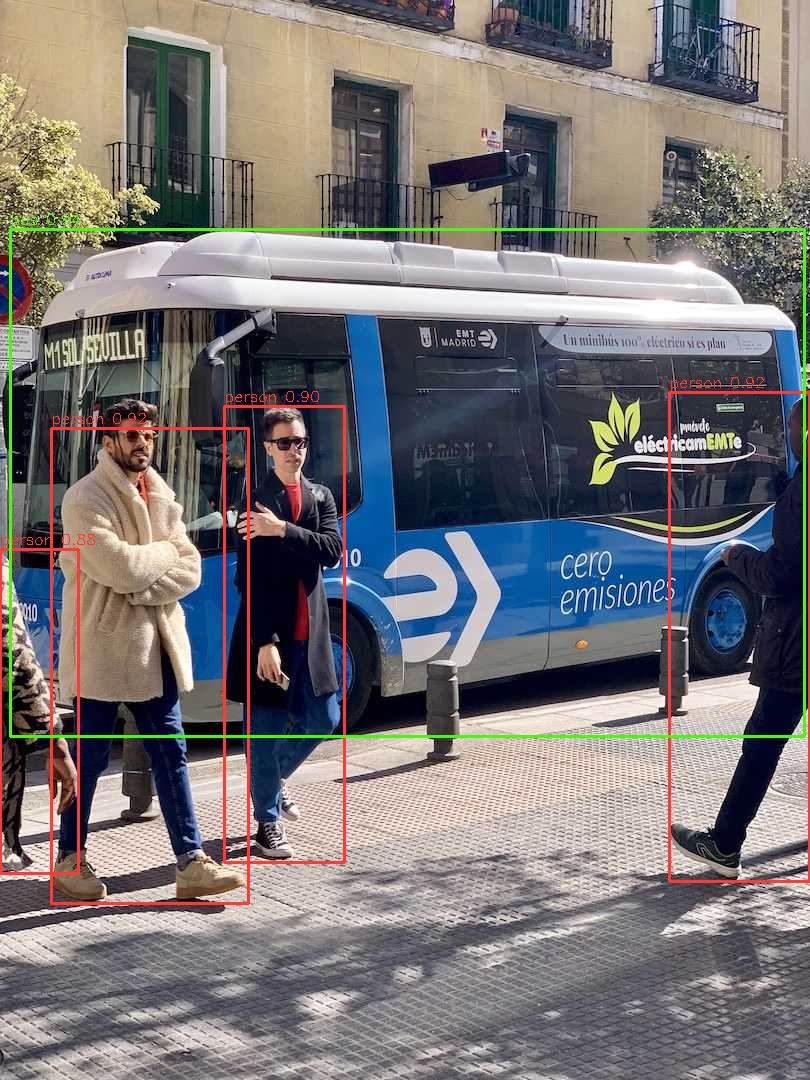
Model List
| Category | Model Name | Model Path | Supported Platform | Details |
|---|---|---|---|---|
| Image Classification | ConvNeXt | samples/vision/convnext | RDK X5 | Details |
| Image Classification | EdgeNeXt | samples/vision/edgenext | RDK X5 | Details |
| Image Classification | EfficientFormer | samples/vision/efficientformer | RDK X5 | Details |
| Image Classification | EfficientFormerV2 | samples/vision/efficientformerv2 | RDK X5 | Details |
| Image Classification | EfficientNet | samples/vision/efficientnet | RDK X5 | Details |
| Image Classification | EfficientViT | samples/vision/efficientvit | RDK X5 | Details |
| Image Classification | FasterNet | samples/vision/fasternet | RDK X5 | Details |
| Image Classification | FastViT | samples/vision/fastvit | RDK X5 | Details |
| Image Classification | GoogLeNet | samples/vision/googlenet | RDK X5 | Details |
| Image Classification | HGNetV2 | samples/vision/hgnetv2 | RDK X5 | Details |
| Image Classification | MobileNetV1 | samples/vision/mobilenetv1 | RDK X5 | Details |
| Image Classification | MobileNetV2 | samples/vision/mobilenetv2 | RDK X5 | Details |
| Image Classification | MobileNetV3 | samples/vision/mobilenetv3 | RDK X5 | Details |
| Image Classification | MobileNetV4 | samples/vision/mobilenetv4 | RDK X5 | Details |
| Image Classification | MobileOne | samples/vision/mobileone | RDK X5 | Details |
| Image Classification | RepGhost | samples/vision/repghost | RDK X5 | Details |
| Image Classification | RepVGG | samples/vision/repvgg | RDK X5 | Details |
| Image Classification | RepViT | samples/vision/repvit | RDK X5 | Details |
| Image Classification | ResNet | samples/vision/resnet | RDK X5 | Details |
| Image Classification | ResNeXt | samples/vision/resnext | RDK X5 | Details |
| Image Classification | VargConvNet | samples/vision/vargconvnet | RDK X5 | Details |
| Promptable Image Segmentation | EfficientSAM-Tiny | samples/vision/efficient_sam | RDK X5 | Details |
| Promptable Image Segmentation | MobileSAM | samples/vision/mobile_sam | RDK X5 | Details |
| Semantic Segmentation | PP-LiteSeg | samples/vision/pp_liteseg | RDK X5 | Details |
| Semantic Segmentation | UNet ResNet Family | samples/vision/unet | RDK X5 | Details |
| Object Detection | FCOS | samples/vision/fcos | RDK X5 | Details |
| Object Detection | YOLOv5 | samples/vision/yolov5 | RDK X5 | Details |
| Object Detection / Instance Segmentation / Pose Estimation / Image Classification | Ultralytics YOLO (YOLOv5u / YOLOv8 / YOLOv9 / YOLOv10 / YOLO11 / YOLO12 / YOLO13) | samples/vision/ultralytics_yolo | RDK X5 | Details |
| Object Detection / Instance Segmentation / Pose Estimation / Image Classification | Ultralytics YOLO26 | samples/vision/ultralytics_yolo26 | RDK X5 | Details |
| Monocular Depth Estimation | YOLO26 Depth | samples/vision/yolo26_depth | RDK X5 | Details |
| Image Matting | MODNet | samples/vision/modnet | RDK X5 | Details |
| OCR Text Detection and Recognition | PaddleOCR | samples/vision/paddleocr | RDK X5 | Details |
| License Plate Recognition | LPRNet | samples/vision/lprnet | RDK X5 | Details |
| Image-Text Multimodal Matching | CLIP | samples/vision/clip | RDK X5 | Details |
| Open-Vocabulary Object Detection | YOLOWorld | samples/vision/yoloworld | RDK X5 | Details |
| Legged Locomotion | HIMLoco (Unitree Go2) | samples/robotics/himloco | RDK X5 | Details |
Documentation & Resources
- Model Docs: Each model's top-level
README.mdprovides an overview and run guide. - Source Reference: For code-level interface details, see Source Documentation.
- Guidelines: To contribute or develop, please read the Model Zoo Repository Guidelines.
- Maintainer documentation: See the documentation index for release policy, manifests and website maintenance.
- Toolchain Manuals:
- Developer Forum: D-Robotics Developer Community
- User Manual: RDK User Manual
FAQ
1. Model accuracy doesn't meet expectations?
- Ensure OpenExplorer Docker and board-side
libdnn.soversions are up-to-date. - Check if model export followed the structure adjustments/operator replacements required in the model's README.
- Verify cosine similarity of each output node is >= 0.999 (minimum 0.99) during quantization validation.
2. Inference speed doesn't meet expectations?
- Python API performance is lower than C/C++. For maximum performance, use C/C++.
- Benchmark data (pure forward) excludes pre/post-processing. Models with NV12 input usually achieve peak BPU throughput.
- Ensure CPU/BPU frequency is locked to maximum.
- Check for other resource-heavy processes.
3. How to fix quantization precision loss?
- Refer to the PTQ accuracy debugging section in the platform documentation.
- If INT8 loss is severe due to model characteristics, consider Mixed Precision or QAT (Quantization-Aware Training).
4. Error "Can't reshape 1354752 in (1,3,640,640)"?
Update the resolution in preprocess.py to match your ONNX model's input size. Delete old calibration data and re-run the calibration script.
5. mAP accuracy is lower than official results (e.g., Ultralytics)?
- Deployment uses fixed shape and INT8 quantization, unlike dynamic shape/float official tests.
- Slight implementation differences in evaluation scripts (e.g.,
pycocotools). - NCHW-RGB to NV12 conversion adds minimal pixel-level loss.
6. Does the model use CPU during inference?
Yes. Non-quantizable or BPU-unsupported operators fallback to CPU. Even for pure BPU models, input/output quantization/dequantization nodes are executed by the CPU.
Community & Contribution
Star History
We warmly welcome contributions! Please raise an issue on GitHub Issues or discuss on the Developer Community.
License
This project is licensed under the Apache License 2.0 agreement.
Contributors


Similar repos


Languages
Python
99.3%
README
RDK Model Zoo
Out-of-the-Box AI Model Deployment Pipelines and Full-Link Conversion Tutorials Based on D-Robotics BPU
English | 简体中文
Introduction
Mission: Dedicated to providing D-Robotics developers with extreme performance, out-of-the-box, and full-scenario AI deployment validation experiences.
This repository is the official collection of BPU model examples and tools (Model Zoo) provided by D-Robotics. It is oriented towards AI model deployment and application development on BPU (Brain Processing Unit), helping developers to quickly get started with BPU and fast-track model inference workflows.
The repository includes BPU-ready models across multiple AI domains and provides complete reference implementations from Original Model (PyTorch/ONNX) -> Fixed-point Quantization -> Inference Execution -> Result Parsing -> Example Validation, helping users understand and utilize BPU capabilities at minimal cost.
Core Value
- 🚀 Quick BPU Adoption: Provides out-of-the-box inference pipelines to help users complete BPU inference validation and performance evaluation in the shortest time.
- 🧩 Complete End-to-End Examples: Covers the entire process from algorithm export and fixed-point quantization to efficient on-board execution (
.bin/.hbm). Includes model loading, preprocessing, BPU inference execution, post-processing, and result visualization. - 📐 Standardized Design & Documentation: Provides unified directory structures and sample code specifications, supporting Python (
hbm_runtime) and C/C++ interfaces for easy understanding, secondary development, and reduced integration/maintenance costs. - 🌐 Full Scenario Coverage: Covers classification, detection, segmentation, pose estimation, OCR, and multi-modal models.
Hardware & System Support
This repository uses hardware-specific branches to keep maintained samples, legacy demos, and board-specific documents clearly separated. The current rdk_x5 branch is the primary delivery branch for RDK X5. The previous main branch has been renamed to rdk_x5_legacy and is kept only as the historical archive branch.
| Target Hardware | Branch | Description |
|---|---|---|
| RDK X5 | rdk_x5 | Primary delivery branch for RDK X5. Recommended system version: RDK OS >= 3.5.0, based on Ubuntu 22.04 aarch64 and TROS-Humble. |
| RDK X5 legacy demos | rdk_x5_legacy | Historical archive branch for the previous RDK X5 demos. Use it only when you need to reference legacy demo content. |
| RDK X3 | rdk_x3 | Branch for RDK X3 devices. |
| RDK S series | rdk_s | Branch for RDK S series boards. Historical archived demos for RDK S series boards are kept in RDK Model Zoo S. |
Browse the online model catalog →
The online catalog presents released models as searchable cards with model assets, measured performance and accuracy results, and their documented test conditions.
Directory Structure
Click to expand project directory architecture
rdk_model_zoo/
|-- samples/
|   |-- robotics/
|   |   `-- himloco/              # Unitree Go2 locomotion policy
|   |-- vision/
|   |   |-- clip/                 # Image-text multimodal matching
|   |   |-- convnext/             # Image classification
|   |   |-- edgenext/             # Image classification
|   |   |-- efficientformer/      # Image classification
|   |   |-- efficientformerv2/    # Image classification
|   |   |-- efficient_sam/        # Promptable image segmentation
|   |   |-- mobile_sam/           # Promptable image segmentation
|   |   |-- efficientnet/         # Image classification
|   |   |-- efficientvit/         # Image classification
|   |   |-- fasternet/            # Image classification
|   |   |-- fastvit/              # Image classification
|   |   |-- fcos/                 # Object detection
|   |   |-- googlenet/            # Image classification
|   |   |-- hgnetv2/              # Image classification
|   |   |-- lprnet/               # License plate recognition
|   |   |-- mobilenetv1/          # Image classification
|   |   |-- mobilenetv2/          # Image classification
|   |   |-- mobilenetv3/          # Image classification
|   |   |-- mobilenetv4/          # Image classification
|   |   |-- mobileone/            # Image classification
|   |   |-- modnet/               # Image matting
|   |   |-- paddleocr/            # OCR text detection and recognition
|   |   |-- pp_liteseg/           # Semantic segmentation
|   |   |-- repghost/             # Image classification
|   |   |-- repvgg/               # Image classification
|   |   |-- repvit/               # Image classification
|   |   |-- resnet/               # Image classification
|   |   |-- resnext/              # Image classification
|   |   |-- unet/                 # Semantic segmentation
|   |   |-- ultralytics_yolo/     # Detection, segmentation, pose, classification
|   |   |-- ultralytics_yolo26/   # Detection, segmentation, pose, classification
|   |   |-- vargconvnet/          # Image classification
|   |   |-- yolo26_depth/         # Monocular depth estimation
|   |   |-- yolov5/               # Object detection
|   |   `-- yoloworld/           # Open-vocabulary object detection
|-- docs/                  # Project guidelines and reference documentation
|   `-- tros/              # TROS integration guides and examples
|-- datasets/              # Sample datasets and download scripts
|-- skills/                # RDK Model Zoo skills (placeholder)
|-- utils/                 # Shared C++ / Python utilities
Quick Start
- Check system version: Ensure the target board is running
RDK OS >= 3.5.0. - Connect hardware: Ensure your RDK board is powered and network-connected. SSH or VSCode Remote SSH is recommended.
- Read the model README first: Always open the target directory
README.mdbefore running commands. - Run the Ultralytics YOLO11x detection sample:
cd samples/vision/ultralytics_yolo/model
wget -nc https://archive.d-robotics.cc/downloads/rdk_model_zoo/rdk_x5/ultralytics_YOLO/yolo11x_detect_bayese_640x640_nv12.bin

cd ../runtime/python
python3 main.py \
  --task detect \
  --model-path ../../model/yolo11x_detect_bayese_640x640_nv12.bin \
  --test-img ../../../../../datasets/coco/assets/bus.jpg \
  --img-save-path ../../test_data/inference_yolo11x.jpg
Inference Result:
Model List
| Category | Model Name | Model Path | Supported Platform | Details |
|---|---|---|---|---|
| Image Classification | ConvNeXt | samples/vision/convnext | RDK X5 | Details |
| Image Classification | EdgeNeXt | samples/vision/edgenext | RDK X5 | Details |
| Image Classification | EfficientFormer | samples/vision/efficientformer | RDK X5 | Details |
| Image Classification | EfficientFormerV2 | samples/vision/efficientformerv2 | RDK X5 | Details |
| Image Classification | EfficientNet | samples/vision/efficientnet | RDK X5 | Details |
| Image Classification | EfficientViT | samples/vision/efficientvit | RDK X5 | Details |
| Image Classification | FasterNet | samples/vision/fasternet | RDK X5 | Details |
| Image Classification | FastViT | samples/vision/fastvit | RDK X5 | Details |
| Image Classification | GoogLeNet | samples/vision/googlenet | RDK X5 | Details |
| Image Classification | HGNetV2 | samples/vision/hgnetv2 | RDK X5 | Details |
| Image Classification | MobileNetV1 | samples/vision/mobilenetv1 | RDK X5 | Details |
| Image Classification | MobileNetV2 | samples/vision/mobilenetv2 | RDK X5 | Details |
| Image Classification | MobileNetV3 | samples/vision/mobilenetv3 | RDK X5 | Details |
| Image Classification | MobileNetV4 | samples/vision/mobilenetv4 | RDK X5 | Details |
| Image Classification | MobileOne | samples/vision/mobileone | RDK X5 | Details |
| Image Classification | RepGhost | samples/vision/repghost | RDK X5 | Details |
| Image Classification | RepVGG | samples/vision/repvgg | RDK X5 | Details |
| Image Classification | RepViT | samples/vision/repvit | RDK X5 | Details |
| Image Classification | ResNet | samples/vision/resnet | RDK X5 | Details |
| Image Classification | ResNeXt | samples/vision/resnext | RDK X5 | Details |
| Image Classification | VargConvNet | samples/vision/vargconvnet | RDK X5 | Details |
| Promptable Image Segmentation | EfficientSAM-Tiny | samples/vision/efficient_sam | RDK X5 | Details |
| Promptable Image Segmentation | MobileSAM | samples/vision/mobile_sam | RDK X5 | Details |
| Semantic Segmentation | PP-LiteSeg | samples/vision/pp_liteseg | RDK X5 | Details |
| Semantic Segmentation | UNet ResNet Family | samples/vision/unet | RDK X5 | Details |
| Object Detection | FCOS | samples/vision/fcos | RDK X5 | Details |
| Object Detection | YOLOv5 | samples/vision/yolov5 | RDK X5 | Details |
| Object Detection / Instance Segmentation / Pose Estimation / Image Classification | Ultralytics YOLO (YOLOv5u / YOLOv8 / YOLOv9 / YOLOv10 / YOLO11 / YOLO12 / YOLO13) | samples/vision/ultralytics_yolo | RDK X5 | Details |
| Object Detection / Instance Segmentation / Pose Estimation / Image Classification | Ultralytics YOLO26 | samples/vision/ultralytics_yolo26 | RDK X5 | Details |
| Monocular Depth Estimation | YOLO26 Depth | samples/vision/yolo26_depth | RDK X5 | Details |
| Image Matting | MODNet | samples/vision/modnet | RDK X5 | Details |
| OCR Text Detection and Recognition | PaddleOCR | samples/vision/paddleocr | RDK X5 | Details |
| License Plate Recognition | LPRNet | samples/vision/lprnet | RDK X5 | Details |
| Image-Text Multimodal Matching | CLIP | samples/vision/clip | RDK X5 | Details |
| Open-Vocabulary Object Detection | YOLOWorld | samples/vision/yoloworld | RDK X5 | Details |
| Legged Locomotion | HIMLoco (Unitree Go2) | samples/robotics/himloco | RDK X5 | Details |
Documentation & Resources
- Model Docs: Each model's top-level
README.mdprovides an overview and run guide. - Source Reference: For code-level interface details, see Source Documentation.
- Guidelines: To contribute or develop, please read the Model Zoo Repository Guidelines.
- Maintainer documentation: See the documentation index for release policy, manifests and website maintenance.
- Toolchain Manuals:
- Developer Forum: D-Robotics Developer Community
- User Manual: RDK User Manual
FAQ
1. Model accuracy doesn't meet expectations?
- Ensure OpenExplorer Docker and board-side
libdnn.soversions are up-to-date. - Check if model export followed the structure adjustments/operator replacements required in the model's README.
- Verify cosine similarity of each output node is >= 0.999 (minimum 0.99) during quantization validation.
2. Inference speed doesn't meet expectations?
- Python API performance is lower than C/C++. For maximum performance, use C/C++.
- Benchmark data (pure forward) excludes pre/post-processing. Models with NV12 input usually achieve peak BPU throughput.
- Ensure CPU/BPU frequency is locked to maximum.
- Check for other resource-heavy processes.
3. How to fix quantization precision loss?
- Refer to the PTQ accuracy debugging section in the platform documentation.
- If INT8 loss is severe due to model characteristics, consider Mixed Precision or QAT (Quantization-Aware Training).
4. Error "Can't reshape 1354752 in (1,3,640,640)"?
Update the resolution in preprocess.py to match your ONNX model's input size. Delete old calibration data and re-run the calibration script.
5. mAP accuracy is lower than official results (e.g., Ultralytics)?
- Deployment uses fixed shape and INT8 quantization, unlike dynamic shape/float official tests.
- Slight implementation differences in evaluation scripts (e.g.,
pycocotools). - NCHW-RGB to NV12 conversion adds minimal pixel-level loss.
6. Does the model use CPU during inference?
Yes. Non-quantizable or BPU-unsupported operators fallback to CPU. Even for pure BPU models, input/output quantization/dequantization nodes are executed by the CPU.
Community & Contribution
Star History
We warmly welcome contributions! Please raise an issue on GitHub Issues or discuss on the Developer Community.
License
This project is licensed under the Apache License 2.0 agreement.
Similar repos
Contributors
Languages
Python
99.3%