
README
MTLA: Multi-head Temporal Latent Attention
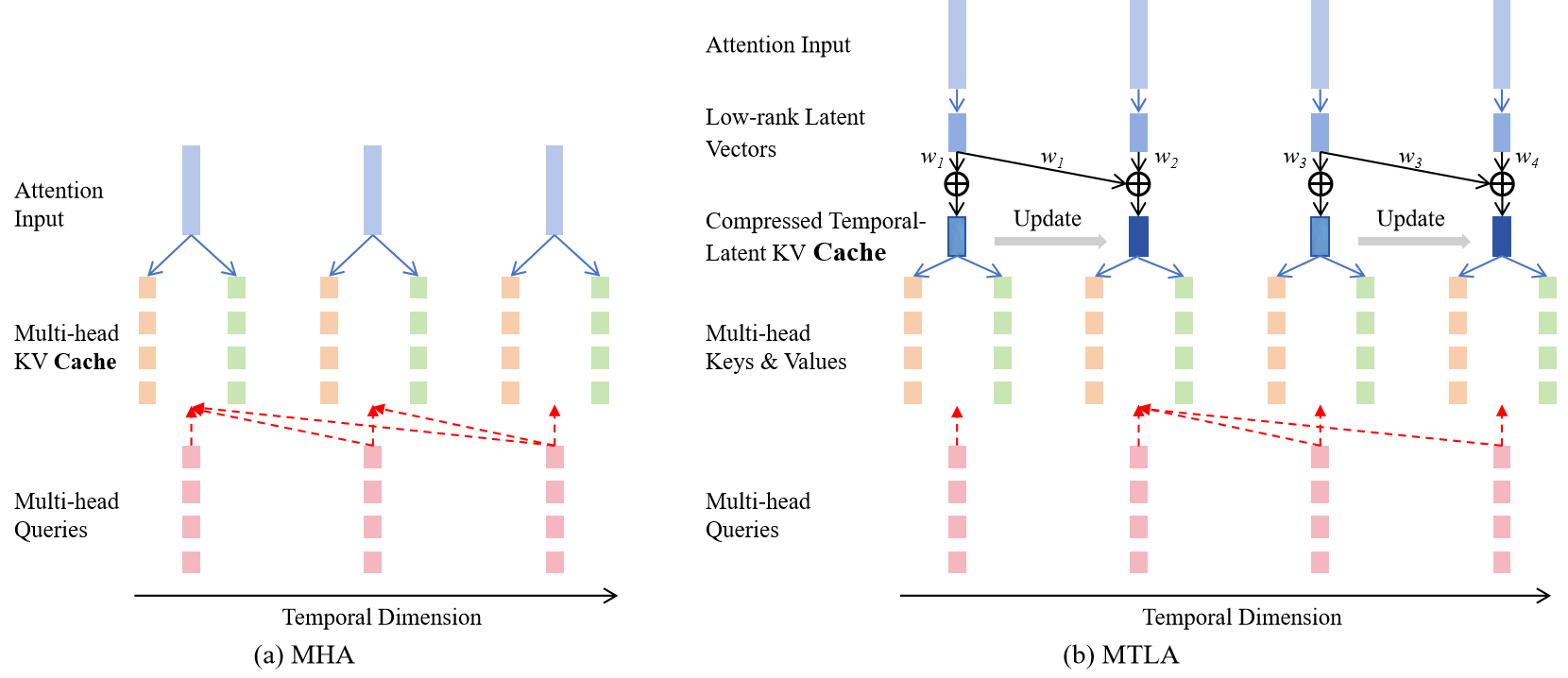
Multi-head Temporal Latent Attention
Keqi Deng, Philip C. Woodland
📄 Paper on arXiv
🎉 Accepted at NeurIPS 2025!
About
MTLA is a novel attention mechanism building on DeepSeek MLA, with a key innovation: temporal compression of the key-value cache. This enables more efficient self-attention and significantly reduces memory footprint during inference, making it particularly valuable for decoder-only architectures such as LLMs. Built on PyTorch, this project also serves as an open-source, decoder-only toolkit for end-to-end speech and language processing, covering tasks such as text summarisation, speech translation, speech recognition, spoken language understanding, and so on, with fully featured setup recipes.
Key Features
Supported Attention Mechanisms
- Attention: Multi-head Attention (MHA), Multi-Query Attention (MQA), Grouped-Query Attention (GQA), Multi-head Latent Attention (MLA), and Multi-head Temporal Latent Attention (MTLA)
- Positional Encoding: Rotary Position Embedding (RoPE), and Decoupled Rotary Position Embedding
- FlashAttention: Extended FlashAttention-2 for MTLA inference
- HuggingFace Transformers: Support HuggingFace Transformers toolkit usage to train LLMs based on MTLA
Complete Setup Recipes
- Tasks: speech translation (MuST-C), speech recognition (AMI), spoken language understanding (SLURP), and text summarisation (XSum)
- Data Processing: Fairseq-style Fbank feature extraction and compression into
zipfile, and ESPnet2-style speech data processing with raw audio saved inflacorarkformat - Feature Extraction: Fbank online/offline extraction, and self-supervised learning representations as features, using upstream models in S3PRL
- Notebook Demo:

Evaluation
- Parallel Inference: Fairseq-style parallel beam search over batches containing multiple data samples
- Quality Evaluation: BLEU, WER, classification accuracy, and ROUGE (ROUGE-1, ROUGE-2, and ROUGE-L)
- Efficiency Evaluation: inference time spent, and GPU memory (including activation memory and the storage of key-value cache) consumed on inference
Installation and Usage
-
If you only need the Python MTLA module, simply clone this repository or pip install:
pip install mtlaThen refer to the following example:
import torch
from mtla import MultiheadTemporalLatentAttention

batch, length, dim = 2, 64, 512
x = torch.randn(batch, length, dim)
pos = torch.arange(0, length).float().view(1, -1) # Position information
model = MultiheadTemporalLatentAttention(
    embed_dim=dim, # Model dimension
    num_heads=8,  # Attention heads of queries
)
y = model(query=x, key=x, value=x, position=pos)
assert y.shape == x.shape
A notebook demo of training with MTLA and performing beam search inference refers to
-
Optional: FlashAttention backend for MTLA inference. We provide an optional FlashAttention backend to accelerate MTLA inference. This feature is disabled by default. To enable it, please install our customised FlashAttention fork:
git clone https://github.com/D-Keqi/flash-attention.git cd flash-attention python setup.py install- FlashAttention requires a CUDA-capable GPU with PyTorch 2.7.0 and CUDA 12.6 (tested working versions).
- Only fp16 (
torch.float16) or bf16 (torch.bfloat16) dtypes are supported. - If FlashAttention is not installed, MTLA will automatically fall back to the standard PyTorch implementation.
Refer to the example below to use our extended FlashAttention for MTLA inference:
import torch from mtla import MultiheadTemporalLatentAttention batch, length, dim = 2, 16, 512 dtype = torch.float16 # or torch.bfloat16 device = "cuda" x = torch.randn(batch, length, dim, device=device, dtype=dtype) pos = torch.arange(0, length, device=device, dtype=torch.float32).view(1, -1) model = MultiheadTemporalLatentAttention( embed_dim=dim, num_heads=8, ).to(device, dtype=dtype) model.eval() # Incremental inference with FlashAttention-based MTLA incremental_state = {} outputs = [] for t in range(length): out = model( query=x[:, t:t+1], key=x[:, t:t+1], value=x[:, t:t+1], position=pos[:, t:t+1], incremental_state=incremental_state, use_flashattn_infer=True, # Enable FlashAttention ) outputs.append(out) y = torch.cat(outputs, dim=1) print("Output shape:", y.shape) # should be [batch, length, dim] -
If you want to use MTLA through HuggingFace Transformers or train an LLM based on MTLA, you just need to
import mtla, then you can load MTLA-based models as easily as you would load any other model in Transformers. See the example below for reference:# If you want to build a MTLA-based LLM from scratch from mtla import LlamaMTLAConfig, LlamaMTLAForCausalLM from transformers import AutoModelForCausalLM, AutoTokenizer base_model = AutoModelForCausalLM.from_pretrained("meta-llama/Meta-Llama-3-8B") # Just an example base_config = base_model.config config = LlamaMTLAConfig(**vars(base_config)) config.down_rate = 2 # You can play this and other MTLA-specific parameters model = LlamaMTLAForCausalLM(config) # If you want to load a MTLA-based pre-trained LLM import mtla from transformers import AutoModelForCausalLM, AutoTokenizer model = AutoModelForCausalLM.from_pretrained("mtla/model/path") tokenizer = AutoTokenizer.from_pretrained("mtla/model/path") # Then you can use e.g. model.generate() function just like other LLMs -
If you intend to run the full experiments, please install the project as described below before proceeding to the examples in the
experimentsdirectory.- PyTorch version >= 1.10.0
- Python version >= 3.8
cd experiments/tools/fairseq
pip install --editable ./
Citation
If you use this codebase, or otherwise find our work valuable, please cite MTLA:
@inproceedings{deng2025mtla,
  title={Multi-head Temporal Latent Attention},
  author={Deng, Keqi and Woodland, Philip C},
  booktitle={Proc. NeurIPS},
  address={San Diego, USA},
  year={2025}
}
Contributors

28 commits
Similar repos


Languages
Python
80.6%
Jupyter Notebook
11.4%
Shell
5.5%
Perl
1.5%
README
MTLA: Multi-head Temporal Latent Attention
Multi-head Temporal Latent Attention
Keqi Deng, Philip C. Woodland
📄 Paper on arXiv
🎉 Accepted at NeurIPS 2025!
About
MTLA is a novel attention mechanism building on DeepSeek MLA, with a key innovation: temporal compression of the key-value cache. This enables more efficient self-attention and significantly reduces memory footprint during inference, making it particularly valuable for decoder-only architectures such as LLMs. Built on PyTorch, this project also serves as an open-source, decoder-only toolkit for end-to-end speech and language processing, covering tasks such as text summarisation, speech translation, speech recognition, spoken language understanding, and so on, with fully featured setup recipes.
Key Features
Supported Attention Mechanisms
- Attention: Multi-head Attention (MHA), Multi-Query Attention (MQA), Grouped-Query Attention (GQA), Multi-head Latent Attention (MLA), and Multi-head Temporal Latent Attention (MTLA)
- Positional Encoding: Rotary Position Embedding (RoPE), and Decoupled Rotary Position Embedding
- FlashAttention: Extended FlashAttention-2 for MTLA inference
- HuggingFace Transformers: Support HuggingFace Transformers toolkit usage to train LLMs based on MTLA
Complete Setup Recipes
- Tasks: speech translation (MuST-C), speech recognition (AMI), spoken language understanding (SLURP), and text summarisation (XSum)
- Data Processing: Fairseq-style Fbank feature extraction and compression into
zipfile, and ESPnet2-style speech data processing with raw audio saved inflacorarkformat - Feature Extraction: Fbank online/offline extraction, and self-supervised learning representations as features, using upstream models in S3PRL
- Notebook Demo:
Evaluation
- Parallel Inference: Fairseq-style parallel beam search over batches containing multiple data samples
- Quality Evaluation: BLEU, WER, classification accuracy, and ROUGE (ROUGE-1, ROUGE-2, and ROUGE-L)
- Efficiency Evaluation: inference time spent, and GPU memory (including activation memory and the storage of key-value cache) consumed on inference
Installation and Usage
-
If you only need the Python MTLA module, simply clone this repository or pip install:
pip install mtlaThen refer to the following example:
import torch
from mtla import MultiheadTemporalLatentAttention

batch, length, dim = 2, 64, 512
x = torch.randn(batch, length, dim)
pos = torch.arange(0, length).float().view(1, -1) # Position information
model = MultiheadTemporalLatentAttention(
    embed_dim=dim, # Model dimension
    num_heads=8,  # Attention heads of queries
)
y = model(query=x, key=x, value=x, position=pos)
assert y.shape == x.shape
A notebook demo of training with MTLA and performing beam search inference refers to
-
Optional: FlashAttention backend for MTLA inference. We provide an optional FlashAttention backend to accelerate MTLA inference. This feature is disabled by default. To enable it, please install our customised FlashAttention fork:
git clone https://github.com/D-Keqi/flash-attention.git cd flash-attention python setup.py install- FlashAttention requires a CUDA-capable GPU with PyTorch 2.7.0 and CUDA 12.6 (tested working versions).
- Only fp16 (
torch.float16) or bf16 (torch.bfloat16) dtypes are supported. - If FlashAttention is not installed, MTLA will automatically fall back to the standard PyTorch implementation.
Refer to the example below to use our extended FlashAttention for MTLA inference:
import torch from mtla import MultiheadTemporalLatentAttention batch, length, dim = 2, 16, 512 dtype = torch.float16 # or torch.bfloat16 device = "cuda" x = torch.randn(batch, length, dim, device=device, dtype=dtype) pos = torch.arange(0, length, device=device, dtype=torch.float32).view(1, -1) model = MultiheadTemporalLatentAttention( embed_dim=dim, num_heads=8, ).to(device, dtype=dtype) model.eval() # Incremental inference with FlashAttention-based MTLA incremental_state = {} outputs = [] for t in range(length): out = model( query=x[:, t:t+1], key=x[:, t:t+1], value=x[:, t:t+1], position=pos[:, t:t+1], incremental_state=incremental_state, use_flashattn_infer=True, # Enable FlashAttention ) outputs.append(out) y = torch.cat(outputs, dim=1) print("Output shape:", y.shape) # should be [batch, length, dim] -
If you want to use MTLA through HuggingFace Transformers or train an LLM based on MTLA, you just need to
import mtla, then you can load MTLA-based models as easily as you would load any other model in Transformers. See the example below for reference:# If you want to build a MTLA-based LLM from scratch from mtla import LlamaMTLAConfig, LlamaMTLAForCausalLM from transformers import AutoModelForCausalLM, AutoTokenizer base_model = AutoModelForCausalLM.from_pretrained("meta-llama/Meta-Llama-3-8B") # Just an example base_config = base_model.config config = LlamaMTLAConfig(**vars(base_config)) config.down_rate = 2 # You can play this and other MTLA-specific parameters model = LlamaMTLAForCausalLM(config) # If you want to load a MTLA-based pre-trained LLM import mtla from transformers import AutoModelForCausalLM, AutoTokenizer model = AutoModelForCausalLM.from_pretrained("mtla/model/path") tokenizer = AutoTokenizer.from_pretrained("mtla/model/path") # Then you can use e.g. model.generate() function just like other LLMs -
If you intend to run the full experiments, please install the project as described below before proceeding to the examples in the
experimentsdirectory.- PyTorch version >= 1.10.0
- Python version >= 3.8
cd experiments/tools/fairseq
pip install --editable ./
Citation
If you use this codebase, or otherwise find our work valuable, please cite MTLA:
@inproceedings{deng2025mtla,
  title={Multi-head Temporal Latent Attention},
  author={Deng, Keqi and Woodland, Philip C},
  booktitle={Proc. NeurIPS},
  address={San Diego, USA},
  year={2025}
}
Similar repos
Contributors
28 commits
Languages
Python
80.6%
Jupyter Notebook
11.4%
Shell
5.5%
Perl
1.5%