Many agents and people changing one project at once, on Cloudflare Workers and Artifacts
See the code





CommonForge is a self-hosted workspace where an agency, its clients and their coding agents change a client's website together. Clients ask for changes as tasks. Agents work on each task in an isolated copy of the code. Every change is checked, previewed on a staging site and approved before it reaches production, and every accepted version can be restored.
For developers: it runs entirely on Cloudflare Workers and Cloudflare Artifacts. You
deploy it into your own Cloudflare account with one script, and agents work through a small CLI,
cforge.
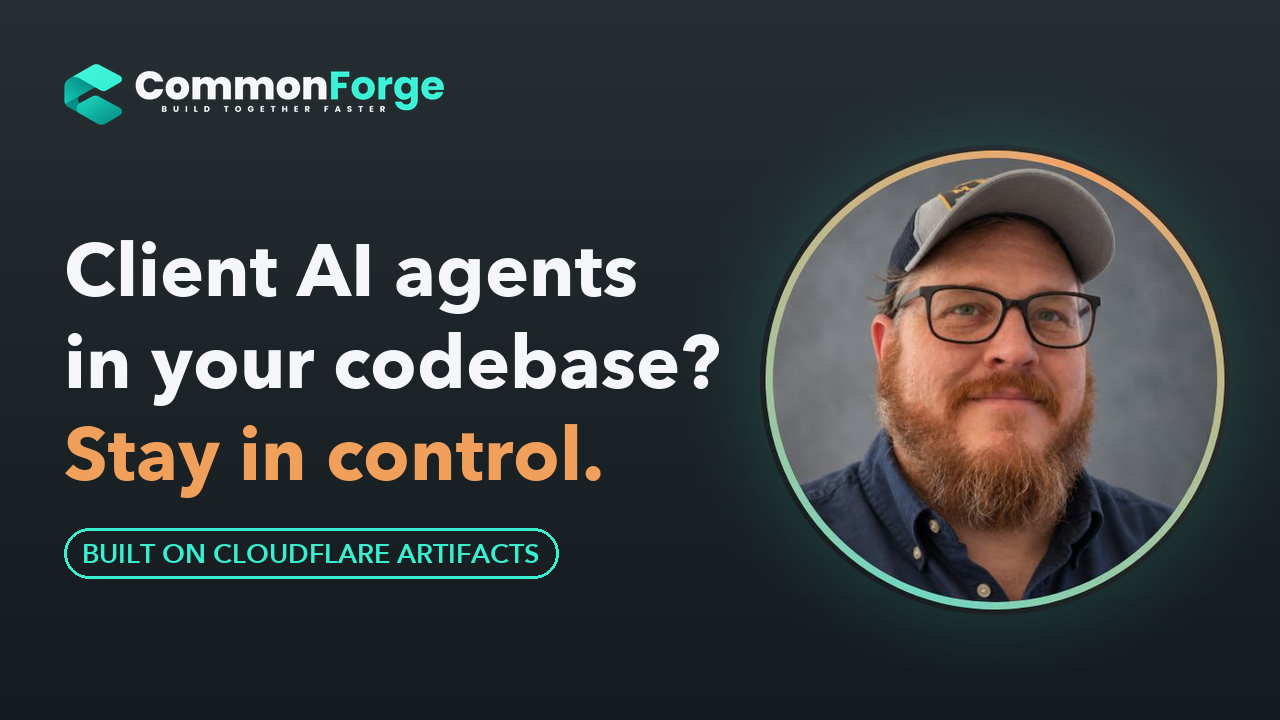
▶ Watch the 8-minute demo on YouTube
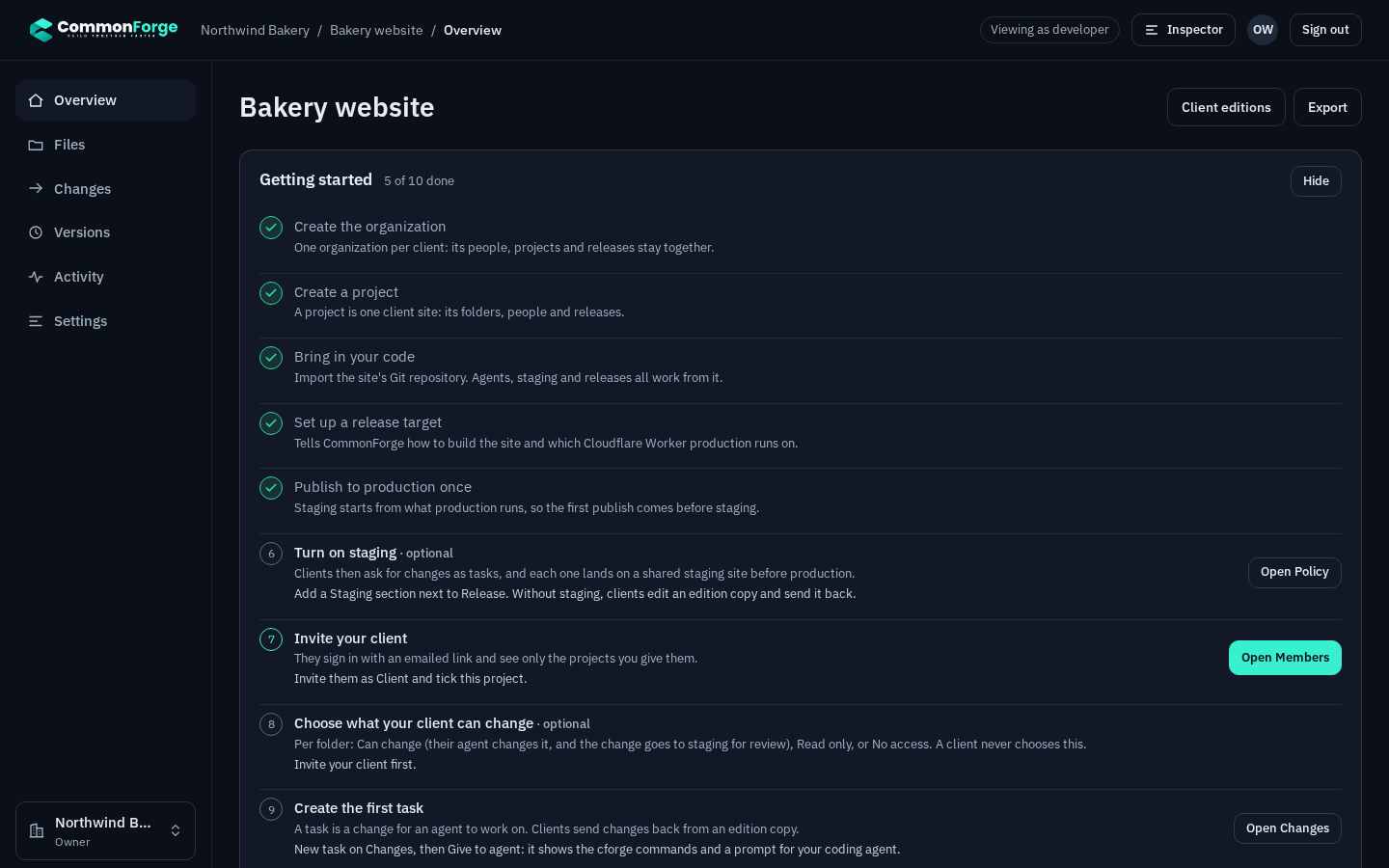 | 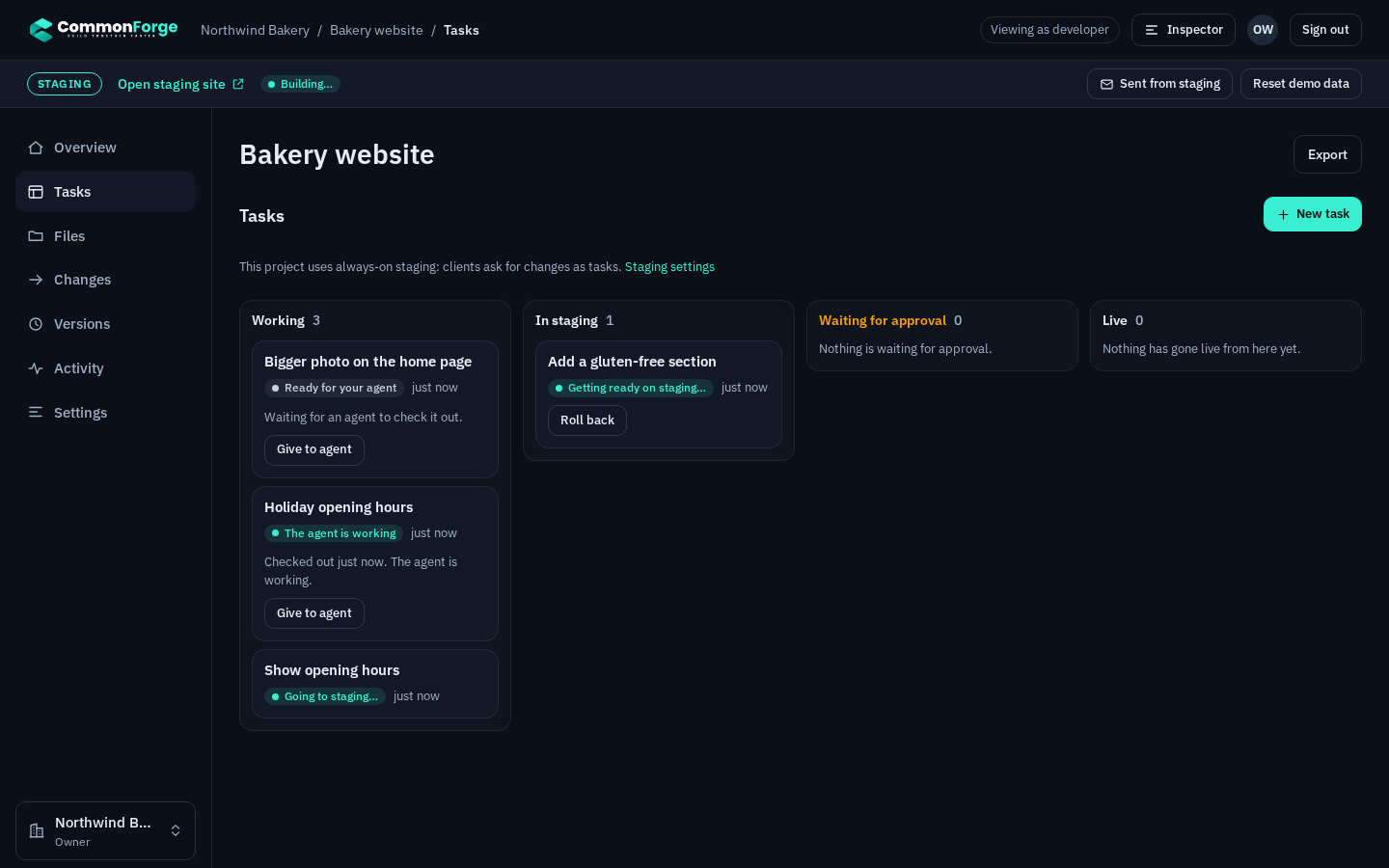 |
| Getting started walks a new owner from an empty organization to the first client task live. | Tasks (staging mode): client tasks move from Working to In staging, Waiting for approval and Live. |
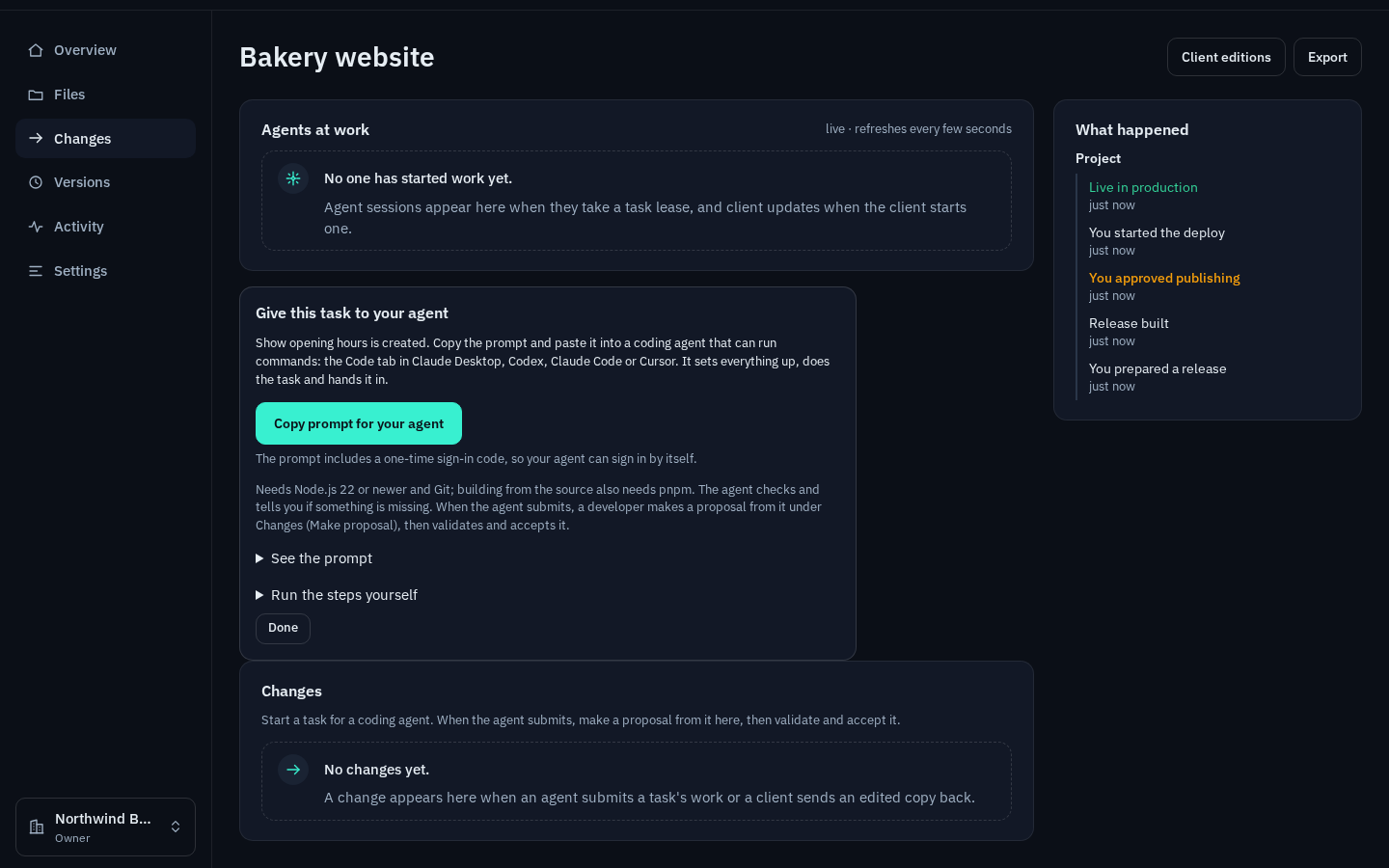 | 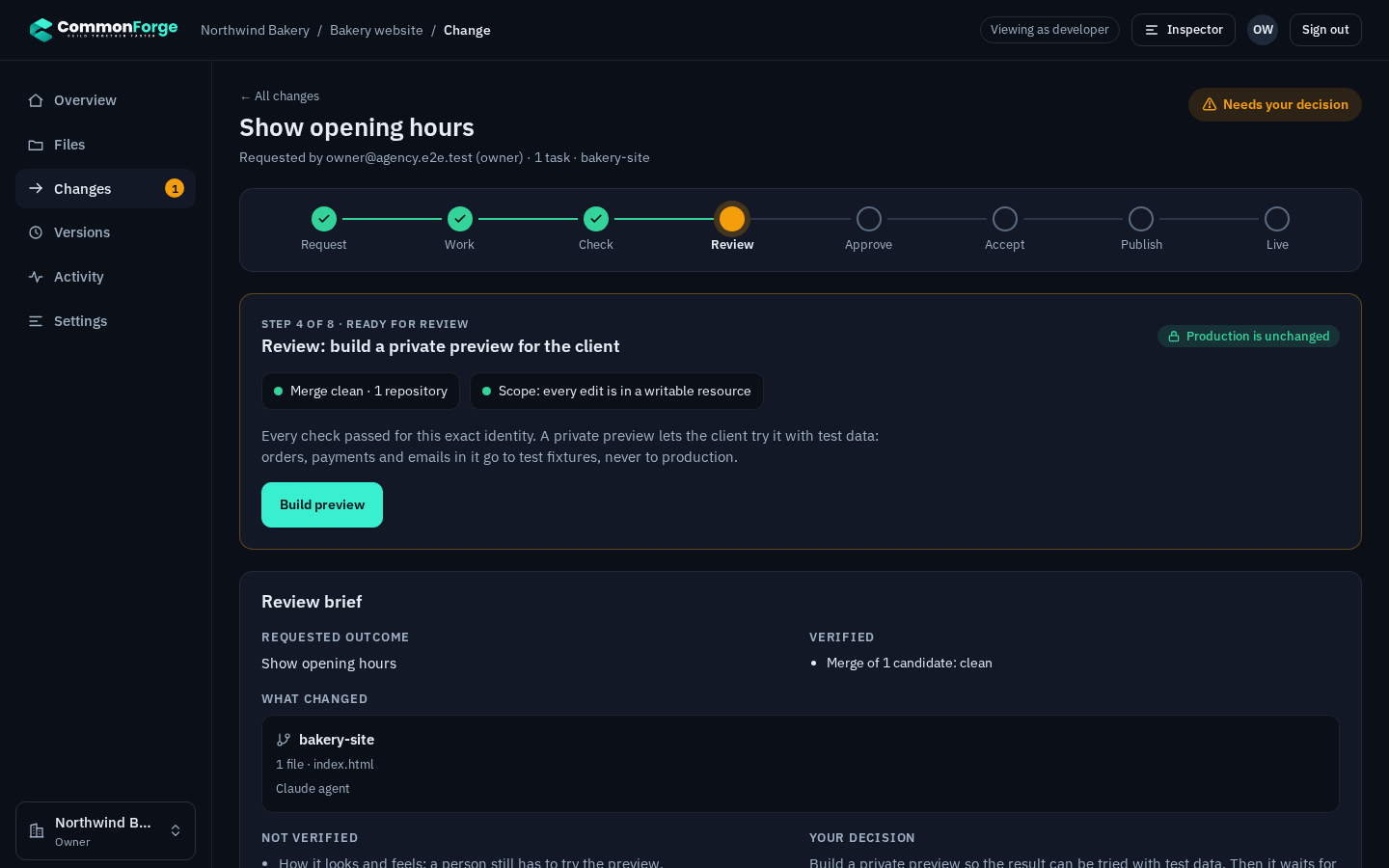 |
| Give to agent copies one prompt that a coding agent runs from start to finish: install, sign in, check out, submit. | The Change storyboard: what was asked, what changed, what was verified, and the next decision. |
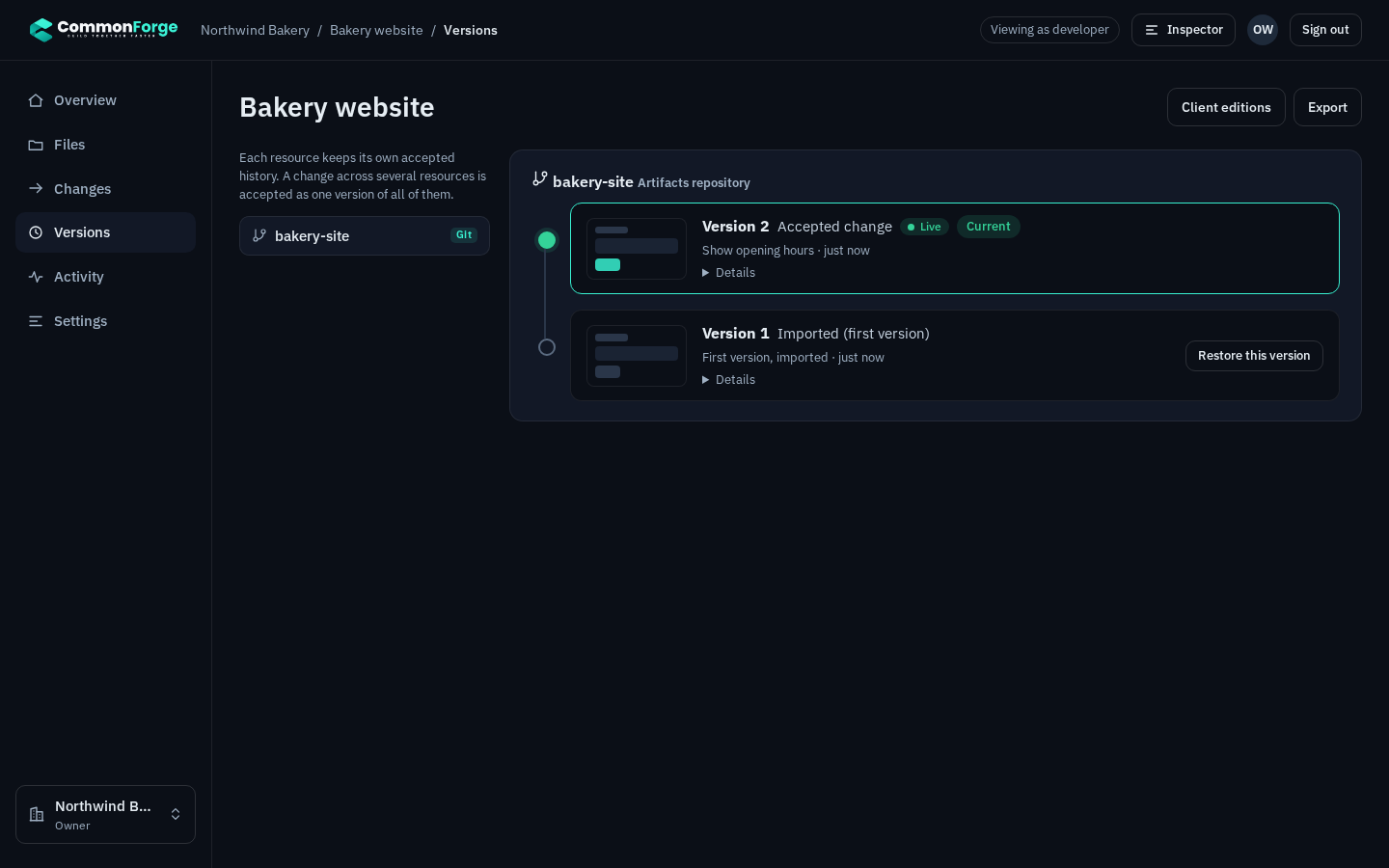 | |
| Versions: every accepted version, the one production runs, and restore. |
The screenshots come from the local stack (below), not from fixture data. To regenerate them, run
pnpm --filter @commonforge-org/web run screenshots
(apps/web/e2e/readme-screenshots.spec.ts).
The path from a new deployment to a client's change in production:
COMMONFORGE_ADMIN_EMAILS) may create an organization.cforge if it is missing, signs in
with a one-time code that the button puts in the prompt, checks the task out into its own copy
of the task's folders, does the work and finishes with cforge submit. The same steps, to run
by hand, are folded away under the button.Without staging, the same work goes through Changes instead: New task, Give to agent, then Make proposal once the agent submits. The proposal opens as a Change storyboard: validation runs the project's checks, then approve, accept as a new version, and publish are three separate records. Clients of such a project edit a filtered edition copy and send it back as a proposal.
Underneath:
git push from
the runner.The repository also hosts the reusable versioned-workspace engine (@commonforge-org/*: core,
ledger, providers, runner protocol, conformance suites) that other products can adopt.
 web app / cforge CLI / agents
            │  HTTPS (session cookie or bearer)
            ▼
 ┌─────────────────────────────┐   signed jobs (Queue)   ┌──────────────────────────────┐
 │ commonforge-worker          │ ──────────────────────▶ │ commonforge-runner           │
 │ Hono API, auth, broker      │ ◀────────────────────── │ Sandbox container per job:   │
 │ OrgLedger DO (SQLite)       │   results, credentials  │ git merge/check/push, builds │
 │ D1 directory, outbox, cron  │   (service binding)     └──────────────┬───────────────┘
 └──────┬───────────────┬──────┘                                        │ git push
        │ REST/binding  │                                               ▼
        ▼               ▼                               ┌──────────────────────────────┐
  R2 (assets,      Artifacts: <prefix>-<org>-canonical │ -tasks │ -editions repos      │
  manifests,       └────────────────────────────────────────────────────────────────────┘
  exports)         commonforge-preview: token-gated previews from R2 + a container per preview
The Worker names are the demo instance's; a bootstrap deployment calls them <name>-worker,
<name>-runner and <name>-preview. The HTTP API, deploy prerequisites and known deviations are
in apps/worker/API.md.
Code comments and docs sometimes refer to "plan §…", "PRD §…", "AT-NN" (acceptance tests) or "Task N". These point to internal planning documents that are not published; the code, the tests and the docs in this repository are the source of truth.
| Path | Package | What |
|---|---|---|
packages/core | @commonforge-org/core | Identities, schemas, hashing, path policy, provider contracts |
packages/ledger | @commonforge-org/ledger | Acceptance invariants (pure planCommit) over a LedgerStore port |
packages/provider-cloudflare | @commonforge-org/provider-cloudflare | Artifacts and R2 providers |
packages/provider-local-git | @commonforge-org/provider-local-git | Local bare-git provider (tests, offline, exit path) |
packages/runner-protocol | @commonforge-org/runner-protocol | Signed runner jobs, materialization plans |
packages/conformance | @commonforge-org/conformance | Provider and ledger conformance suites |
apps/worker | @commonforge-org/worker | Control-plane Worker + OrgLedger/OpsGate Durable Objects; also the preview and runner Workers (src/preview, src/sandbox) |
apps/runner | @commonforge-org/runner | Integration runner (Sandbox container image, or a Node process) |
apps/web | @commonforge-org/web | Web UI (React + Vite), served by the control-plane Worker |
apps/cli | @commonforge-org/cli | Developer CLI, binary cforge |
apps/demo-agents | @commonforge-org/demo-agents | Orchestrates three real agent sessions working concurrently |
fixtures/ | The demo client project ("Customer Portal") | |
scripts/ | Bootstrap, teardown, deploy, the live CI harness, demo helpers |
Requires Node.js 22 or newer, pnpm (the version pinned in package.json; corepack enable) and git.
Run the whole product on your machine without a Cloudflare account:
pnpm install
scripts/dev-local.sh          # or: pnpm dev:local; PORT=8813 scripts/dev-local.sh for another port
Open http://127.0.0.1:8799 and sign in as [email protected] (the only address allowed to
create an organization; set [email protected] to change it). No email is sent: the
sign-in link is printed in the terminal as
[commonforge dev] magic link for <email>: <link> (and kept in
apps/worker/.wrangler/dev-local.log). Open it in the same browser. To use the CLI against it:
pnpm exec turbo run build --filter=@commonforge-org/cli      # bundles apps/cli/dist/index.js
node apps/cli/dist/index.js login --api-url http://127.0.0.1:8799 --email [email protected]
The CLI's sign-in link (…/auth/cli?code=…) is printed in the server's terminal too; paste it
when cforge asks, or run cforge login --code <code>.
This is the stack the local-stack e2e suite runs: the real control-plane Worker under
wrangler dev -c apps/worker/wrangler.e2e.jsonc, with local D1, Durable Objects, R2 and queues,
serving the real web app. Cloudflare Artifacts, the integration runner and the Cloudflare API are
in-memory fakes, so git pushes, merges, checks and deploys are simulated, previews do not run, and
everything starts empty on each run. apps/worker/.dev.vars is never read.
scripts/bootstrap.sh deploys a complete CommonForge into your own Cloudflare account. It is
idempotent: rerun it to update.
You need Workers Paid, Cloudflare Artifacts and Containers (Sandbox) on the account, Docker on your machine (the runner and preview images are built locally), Node.js 22+, pnpm and an API token. The token needs Workers Scripts, Workers R2 Storage, D1, Queues, Workers KV Storage, Containers and Artifacts: Edit, and Account Settings: Read. The Worker gets its own Artifacts-only token.
export CLOUDFLARE_API_TOKEN=… CLOUDFLARE_ACCOUNT_ID=…   # wrangler + account API (never echoed)
export CF_API_TOKEN=…                                   # the Worker's Artifacts token (Artifacts: Edit)
export COMMONFORGE_DEPLOY_API_TOKEN=…                   # optional: release deploys (Workers Scripts + KV: Edit)

scripts/bootstrap.sh --name acme --email-mode log --admin-emails [email protected] --smoke   # a test deployment
scripts/bootstrap.sh --name acme --admin-emails [email protected],@acme.com \
  --email-from [email protected] --app-domain forge.acme.com --preview-domain preview.acme.net
scripts/teardown.sh  --name acme                         # list what it created
scripts/teardown.sh  --name acme --yes                   # delete it and verify nothing is left
Custom domains and the email sender's domain must be zones on the same Cloudflare account as the deployment. The app and preview domains must differ: previews run site code and never share the app's origin. Onboarding the sending domain to Cloudflare Email Service is a manual step that the script prints.
Prerequisites, every flag, the token scopes, state and ownership rules, and teardown are in
docs/SELF-HOSTING.md. It also covers local development against real
Cloudflare resources, and the maintainers' scripts for the project's own demo and CI instances
(scripts/deploy-live.sh, scripts/deploy-ci.sh, scripts/ci-live/).
npm install -g @commonforge-org/cli
It needs Node.js 22+ and Git. To run a CLI you changed yourself, build it from the source instead (Node.js 22+, Git and pnpm):
git clone https://github.com/CommonForge-org/commonforge.git
cd commonforge
pnpm install
pnpm --filter "@commonforge-org/cli..." build
npm install -g ./apps/cli
Then cforge login --api-url <your app URL> --email <you>. Give to agent in the app shows the
rest, filled in for the task, and its Copy prompt for your agent lets the agent do all of this
by itself. (The app's hand-off panel shows the same commands; a self-hosted copy that changes the
CLI without publishing it can set CLI_PUBLISHED to false in
apps/web/src/lib/handoff.ts to show the source build instead.)
cforge mcp gives an AI app tools to sign in, list projects and tasks, create a task, check it
out and submit it. The app's Account page shows the setup for each app and makes the one-time
sign-in code:
commonforge.mcpb extension from the latest release. Open the file and click Install./plugin install commonforge --marketplace CommonForge-org/commonforge[mcp_servers.commonforge] entry in ~/.codex/config.toml (see
apps/cli/README.md).The plugin and the Codex entry start the server with npx -y @commonforge-org/cli mcp, so they
need Node.js 22+ but no separate install.
The tools can do only what the signed-in person can; see docs/LIMITATIONS.md for what is tested.
pnpm install
pnpm build          # turbo: every package, the web app, the Worker bundles
pnpm typecheck
pnpm test           # unit and integration tests (miniflare, real git, fakes for Artifacts/runner)

pnpm --filter @commonforge-org/web exec playwright install chromium   # once
pnpm test:e2e        # Playwright: fixture-mode UI + the local stack (no credentials)
pnpm test:fault      # fault injection via COMMONFORGE_CHAOS flags + provider fault conformance
pnpm test:security   # the security acceptance tests across worker, runner, core, runner-protocol, conformance
pnpm test:live       # live-provider tests; need CF_API_TOKEN (CI runs them only when the secret is set)
docs/LIMITATIONS.md §8 lists, per suite, what is real and what is faked. CONTRIBUTING.md has the rest.
Watch the demo on YouTube (8:28, with chapters and captions): a client's agents and the agency's agents build one feature in parallel, a conflict is caught before it ships, the change goes through staging to production, and then a fresh deployment is set up from this repository and a client hands a task to Claude Code.
The project runs its own demo instance of CommonForge on its Cloudflare account. The original script, beat by beat, is docs/DEMO-SCRIPT.md.
Before anything depended on Artifacts and Sandbox behavior, each assumption the design rests on
was measured on a live Cloudflare account (evidence in spikes/*/RESULTS.md).
| Assumption | Verdict | Consequence | |
|---|---|---|---|
| A1 | Stale pushes are refused | PARTIAL: the server accepts --force, but never silently last-writer-wins | Every runner push uses --force-with-lease against the ledger's sha, one ref per push (--atomic is now refused) |
| A2 | Forks are fast and survive parent deletion | PARTIAL: they survive; 2.5 s at 1 MB, ~50 s at 500 MB | Forks and creates run in queue steps. Forks cannot cross namespaces, so task repos are fresh repos seeded by the runner |
| A3 | git runs in a Sandbox container and pushes to Artifacts | VERIFIED | Runner = Sandbox container, token injected on egress, internet off |
| A4 | Token revocation stops in-flight pushes | VERIFIED: effective on the next request (~170 ms) | Candidate freeze = token revocation |
| A5 | Custom refs and notes work | PARTIAL: over git yes; REST cannot resolve full ref names | The ledger stores shas; ref listing happens in the runner |
| A6 | pushed events arrive within ~5 s | VERIFIED (p95 1.1 s); repo.forked/imported never arrive | Events are wakeups only, with a periodic sweep as the backstop |
| A7 | Per-candidate preview hostnames | PARTIAL: needs a zone with wildcard DNS | Path-based, token-gated, expiring previews on one dedicated origin |
| A8 | Wrangler ≥ 4.145 with a remote Artifacts binding | VERIFIED | wrangler dev always uses real credentials |
| A9 | Rate-limit headroom for 100 task lifecycles | VERIFIED: 0 × 429 over 700 lifecycles | Cap of 25 concurrent fork/token operations per namespace |
Nothing in the core path is simulated on a Cloudflare deployment (yours, or the demo
instance): real Artifacts repositories, real git push from a real Sandbox container, the real
Durable Object ledger, R2, Queues, Email Service and real wrangler deploy releases. The local
quickstart is the exception: it fakes Artifacts, the runner and the Cloudflare API, and says so.
Also labelled as not live:
VITE_COMMONFORGE_FIXTURE=1) runs the UI on in-memory sample
data, always under a "Fixture mode" banner. Only the fixture-mode e2e suite uses it.The main shortcuts of this build:
The full, honest list is in docs/LIMITATIONS.md.
Contributing: CONTRIBUTING.md and the code of conduct. Reporting a vulnerability: SECURITY.md (not a public issue).
The code is MIT © 2026 CommonForge contributors. Third-party licences: THIRD_PARTY_NOTICES.md.
The CommonForge name and the logos in brand/ are trademarks and are not covered by the MIT
licence; see brand/README.md.
Many agents and people changing one project at once, on Cloudflare Workers and Artifacts
See the code
CommonForge is a self-hosted workspace where an agency, its clients and their coding agents change a client's website together. Clients ask for changes as tasks. Agents work on each task in an isolated copy of the code. Every change is checked, previewed on a staging site and approved before it reaches production, and every accepted version can be restored.
For developers: it runs entirely on Cloudflare Workers and Cloudflare Artifacts. You
deploy it into your own Cloudflare account with one script, and agents work through a small CLI,
cforge.
▶ Watch the 8-minute demo on YouTube
| |
| Getting started walks a new owner from an empty organization to the first client task live. | Tasks (staging mode): client tasks move from Working to In staging, Waiting for approval and Live. |
| |
| Give to agent copies one prompt that a coding agent runs from start to finish: install, sign in, check out, submit. | The Change storyboard: what was asked, what changed, what was verified, and the next decision. |
| |
| Versions: every accepted version, the one production runs, and restore. |
The screenshots come from the local stack (below), not from fixture data. To regenerate them, run
pnpm --filter @commonforge-org/web run screenshots
(apps/web/e2e/readme-screenshots.spec.ts).
The path from a new deployment to a client's change in production:
COMMONFORGE_ADMIN_EMAILS) may create an organization.cforge if it is missing, signs in
with a one-time code that the button puts in the prompt, checks the task out into its own copy
of the task's folders, does the work and finishes with cforge submit. The same steps, to run
by hand, are folded away under the button.Without staging, the same work goes through Changes instead: New task, Give to agent, then Make proposal once the agent submits. The proposal opens as a Change storyboard: validation runs the project's checks, then approve, accept as a new version, and publish are three separate records. Clients of such a project edit a filtered edition copy and send it back as a proposal.
Underneath:
git push from
the runner.The repository also hosts the reusable versioned-workspace engine (@commonforge-org/*: core,
ledger, providers, runner protocol, conformance suites) that other products can adopt.
 web app / cforge CLI / agents
            │  HTTPS (session cookie or bearer)
            ▼
 ┌─────────────────────────────┐   signed jobs (Queue)   ┌──────────────────────────────┐
 │ commonforge-worker          │ ──────────────────────▶ │ commonforge-runner           │
 │ Hono API, auth, broker      │ ◀────────────────────── │ Sandbox container per job:   │
 │ OrgLedger DO (SQLite)       │   results, credentials  │ git merge/check/push, builds │
 │ D1 directory, outbox, cron  │   (service binding)     └──────────────┬───────────────┘
 └──────┬───────────────┬──────┘                                        │ git push
        │ REST/binding  │                                               ▼
        ▼               ▼                               ┌──────────────────────────────┐
  R2 (assets,      Artifacts: <prefix>-<org>-canonical │ -tasks │ -editions repos      │
  manifests,       └────────────────────────────────────────────────────────────────────┘
  exports)         commonforge-preview: token-gated previews from R2 + a container per preview
The Worker names are the demo instance's; a bootstrap deployment calls them <name>-worker,
<name>-runner and <name>-preview. The HTTP API, deploy prerequisites and known deviations are
in apps/worker/API.md.
Code comments and docs sometimes refer to "plan §…", "PRD §…", "AT-NN" (acceptance tests) or "Task N". These point to internal planning documents that are not published; the code, the tests and the docs in this repository are the source of truth.
| Path | Package | What |
|---|---|---|
packages/core | @commonforge-org/core | Identities, schemas, hashing, path policy, provider contracts |
packages/ledger | @commonforge-org/ledger | Acceptance invariants (pure planCommit) over a LedgerStore port |
packages/provider-cloudflare | @commonforge-org/provider-cloudflare | Artifacts and R2 providers |
packages/provider-local-git | @commonforge-org/provider-local-git | Local bare-git provider (tests, offline, exit path) |
packages/runner-protocol | @commonforge-org/runner-protocol | Signed runner jobs, materialization plans |
packages/conformance | @commonforge-org/conformance | Provider and ledger conformance suites |
apps/worker | @commonforge-org/worker | Control-plane Worker + OrgLedger/OpsGate Durable Objects; also the preview and runner Workers (src/preview, src/sandbox) |
apps/runner | @commonforge-org/runner | Integration runner (Sandbox container image, or a Node process) |
apps/web | @commonforge-org/web | Web UI (React + Vite), served by the control-plane Worker |
apps/cli | @commonforge-org/cli | Developer CLI, binary cforge |
apps/demo-agents | @commonforge-org/demo-agents | Orchestrates three real agent sessions working concurrently |
fixtures/ | The demo client project ("Customer Portal") | |
scripts/ | Bootstrap, teardown, deploy, the live CI harness, demo helpers |
Requires Node.js 22 or newer, pnpm (the version pinned in package.json; corepack enable) and git.
Run the whole product on your machine without a Cloudflare account:
pnpm install
scripts/dev-local.sh          # or: pnpm dev:local; PORT=8813 scripts/dev-local.sh for another port
Open http://127.0.0.1:8799 and sign in as [email protected] (the only address allowed to
create an organization; set [email protected] to change it). No email is sent: the
sign-in link is printed in the terminal as
[commonforge dev] magic link for <email>: <link> (and kept in
apps/worker/.wrangler/dev-local.log). Open it in the same browser. To use the CLI against it:
pnpm exec turbo run build --filter=@commonforge-org/cli      # bundles apps/cli/dist/index.js
node apps/cli/dist/index.js login --api-url http://127.0.0.1:8799 --email [email protected]
The CLI's sign-in link (…/auth/cli?code=…) is printed in the server's terminal too; paste it
when cforge asks, or run cforge login --code <code>.
This is the stack the local-stack e2e suite runs: the real control-plane Worker under
wrangler dev -c apps/worker/wrangler.e2e.jsonc, with local D1, Durable Objects, R2 and queues,
serving the real web app. Cloudflare Artifacts, the integration runner and the Cloudflare API are
in-memory fakes, so git pushes, merges, checks and deploys are simulated, previews do not run, and
everything starts empty on each run. apps/worker/.dev.vars is never read.
scripts/bootstrap.sh deploys a complete CommonForge into your own Cloudflare account. It is
idempotent: rerun it to update.
You need Workers Paid, Cloudflare Artifacts and Containers (Sandbox) on the account, Docker on your machine (the runner and preview images are built locally), Node.js 22+, pnpm and an API token. The token needs Workers Scripts, Workers R2 Storage, D1, Queues, Workers KV Storage, Containers and Artifacts: Edit, and Account Settings: Read. The Worker gets its own Artifacts-only token.
export CLOUDFLARE_API_TOKEN=… CLOUDFLARE_ACCOUNT_ID=…   # wrangler + account API (never echoed)
export CF_API_TOKEN=…                                   # the Worker's Artifacts token (Artifacts: Edit)
export COMMONFORGE_DEPLOY_API_TOKEN=…                   # optional: release deploys (Workers Scripts + KV: Edit)

scripts/bootstrap.sh --name acme --email-mode log --admin-emails [email protected] --smoke   # a test deployment
scripts/bootstrap.sh --name acme --admin-emails [email protected],@acme.com \
  --email-from [email protected] --app-domain forge.acme.com --preview-domain preview.acme.net
scripts/teardown.sh  --name acme                         # list what it created
scripts/teardown.sh  --name acme --yes                   # delete it and verify nothing is left
Custom domains and the email sender's domain must be zones on the same Cloudflare account as the deployment. The app and preview domains must differ: previews run site code and never share the app's origin. Onboarding the sending domain to Cloudflare Email Service is a manual step that the script prints.
Prerequisites, every flag, the token scopes, state and ownership rules, and teardown are in
docs/SELF-HOSTING.md. It also covers local development against real
Cloudflare resources, and the maintainers' scripts for the project's own demo and CI instances
(scripts/deploy-live.sh, scripts/deploy-ci.sh, scripts/ci-live/).
npm install -g @commonforge-org/cli
It needs Node.js 22+ and Git. To run a CLI you changed yourself, build it from the source instead (Node.js 22+, Git and pnpm):
git clone https://github.com/CommonForge-org/commonforge.git
cd commonforge
pnpm install
pnpm --filter "@commonforge-org/cli..." build
npm install -g ./apps/cli
Then cforge login --api-url <your app URL> --email <you>. Give to agent in the app shows the
rest, filled in for the task, and its Copy prompt for your agent lets the agent do all of this
by itself. (The app's hand-off panel shows the same commands; a self-hosted copy that changes the
CLI without publishing it can set CLI_PUBLISHED to false in
apps/web/src/lib/handoff.ts to show the source build instead.)
cforge mcp gives an AI app tools to sign in, list projects and tasks, create a task, check it
out and submit it. The app's Account page shows the setup for each app and makes the one-time
sign-in code:
commonforge.mcpb extension from the latest release. Open the file and click Install./plugin install commonforge --marketplace CommonForge-org/commonforge[mcp_servers.commonforge] entry in ~/.codex/config.toml (see
apps/cli/README.md).The plugin and the Codex entry start the server with npx -y @commonforge-org/cli mcp, so they
need Node.js 22+ but no separate install.
The tools can do only what the signed-in person can; see docs/LIMITATIONS.md for what is tested.
pnpm install
pnpm build          # turbo: every package, the web app, the Worker bundles
pnpm typecheck
pnpm test           # unit and integration tests (miniflare, real git, fakes for Artifacts/runner)

pnpm --filter @commonforge-org/web exec playwright install chromium   # once
pnpm test:e2e        # Playwright: fixture-mode UI + the local stack (no credentials)
pnpm test:fault      # fault injection via COMMONFORGE_CHAOS flags + provider fault conformance
pnpm test:security   # the security acceptance tests across worker, runner, core, runner-protocol, conformance
pnpm test:live       # live-provider tests; need CF_API_TOKEN (CI runs them only when the secret is set)
docs/LIMITATIONS.md §8 lists, per suite, what is real and what is faked. CONTRIBUTING.md has the rest.
Watch the demo on YouTube (8:28, with chapters and captions): a client's agents and the agency's agents build one feature in parallel, a conflict is caught before it ships, the change goes through staging to production, and then a fresh deployment is set up from this repository and a client hands a task to Claude Code.
The project runs its own demo instance of CommonForge on its Cloudflare account. The original script, beat by beat, is docs/DEMO-SCRIPT.md.
Before anything depended on Artifacts and Sandbox behavior, each assumption the design rests on
was measured on a live Cloudflare account (evidence in spikes/*/RESULTS.md).
| Assumption | Verdict | Consequence | |
|---|---|---|---|
| A1 | Stale pushes are refused | PARTIAL: the server accepts --force, but never silently last-writer-wins | Every runner push uses --force-with-lease against the ledger's sha, one ref per push (--atomic is now refused) |
| A2 | Forks are fast and survive parent deletion | PARTIAL: they survive; 2.5 s at 1 MB, ~50 s at 500 MB | Forks and creates run in queue steps. Forks cannot cross namespaces, so task repos are fresh repos seeded by the runner |
| A3 | git runs in a Sandbox container and pushes to Artifacts | VERIFIED | Runner = Sandbox container, token injected on egress, internet off |
| A4 | Token revocation stops in-flight pushes | VERIFIED: effective on the next request (~170 ms) | Candidate freeze = token revocation |
| A5 | Custom refs and notes work | PARTIAL: over git yes; REST cannot resolve full ref names | The ledger stores shas; ref listing happens in the runner |
| A6 | pushed events arrive within ~5 s | VERIFIED (p95 1.1 s); repo.forked/imported never arrive | Events are wakeups only, with a periodic sweep as the backstop |
| A7 | Per-candidate preview hostnames | PARTIAL: needs a zone with wildcard DNS | Path-based, token-gated, expiring previews on one dedicated origin |
| A8 | Wrangler ≥ 4.145 with a remote Artifacts binding | VERIFIED | wrangler dev always uses real credentials |
| A9 | Rate-limit headroom for 100 task lifecycles | VERIFIED: 0 × 429 over 700 lifecycles | Cap of 25 concurrent fork/token operations per namespace |
Nothing in the core path is simulated on a Cloudflare deployment (yours, or the demo
instance): real Artifacts repositories, real git push from a real Sandbox container, the real
Durable Object ledger, R2, Queues, Email Service and real wrangler deploy releases. The local
quickstart is the exception: it fakes Artifacts, the runner and the Cloudflare API, and says so.
Also labelled as not live:
VITE_COMMONFORGE_FIXTURE=1) runs the UI on in-memory sample
data, always under a "Fixture mode" banner. Only the fixture-mode e2e suite uses it.The main shortcuts of this build:
The full, honest list is in docs/LIMITATIONS.md.
Contributing: CONTRIBUTING.md and the code of conduct. Reporting a vulnerability: SECURITY.md (not a public issue).
The code is MIT © 2026 CommonForge contributors. Third-party licences: THIRD_PARTY_NOTICES.md.
The CommonForge name and the logos in brand/ are trademarks and are not covered by the MIT
licence; see brand/README.md.



