
Official ClickHouse Agentic Data Stack - self-host with ClickHouse, LibreChat, Langfuse, and ClickHouse MCP.
Shell
110
65 commits
updated Sep 24, 2026
README
Agentic Data Stack
The open-source stack for ClickHouse's suite of agentic analytic tools — your chat, your models, your data.
Powered by ClickHouse, LibreChat, and Langfuse.
Learn more at clickhouse.ai and the Agentic Data Stack blog.
One Click Deploy
Want to skip the setup and jump straight into adding agentic analytics into your workflow? Choose a Railway template below to spin up a preconfigured instance of the Agentic Data Stack in the cloud.
Langfuse OSS | Langfuse Cloud |
|---|---|

|
|
More details available in the Deploy on Railway section.
Overview
This project runs a fully self-hosted agentic analytics environment with Docker Compose. It connects a chat UI (LibreChat) to your data (ClickHouse) via MCP, with full LLM observability (Langfuse) — all in a single docker compose up command.
What's included
| Component | Purpose | Port |
|---|---|---|
| LibreChat | Modern Chat UI with multi-model / provider support (OpenAI, Anthropic, Google) | 3080 |
| Admin Panel | Browser-based configuration UI for LibreChat | 3081 |
| ClickHouse MCP | MCP server that gives agents access to ClickHouse | 8000 |
| Langfuse | LLM observability — traces, evals, prompt management | 3000 |
| ClickHouse | World's fastest analytical database | 8123 |
| PostgreSQL | Transactional database for Langfuse | 5432 |
| MongoDB | Transactional database for LibreChat | 27017 |
| MinIO | S3-compatible object storage | 9090 |
| Redis | Caching and queue | 6379 |
| Meilisearch | Full-text search for LibreChat | 7700 |
| pgvector | Vector database for RAG | 5433 |
| RAG API | Retrieval-augmented generation service for LibreChat | 8001 |
Deploy on Railway
One-click deploy of two "Lite" variants of the stack:
- Langfuse OSS — Deploys LibreChat, the Admin Panel, Langfuse v3, and a ClickHouse MCP server pre-configured against the public ClickHouse demo cluster.
- Langfuse Cloud — Deploys LibreChat, the Admin Panel, and ClickHouse MCP, and is pre-configured to send traces to your existing Langfuse Cloud (or other remote Langfuse) project.
Both Railway templates skip Meilisearch, pgvector, and the RAG API for simplicity. The ClickHouse MCP server ships pointed at sql-clickhouse.clickhouse.com so you can chat with the public demo data immediately; the ClickHouse Cloud MCP is also wired up if you want to OAuth into your own Cloud account post-deploy. Prefer to self-host? See Quick Start below.
Quick Start
Prerequisites
- Docker and Docker Compose v2+
1. Prepare the environment
./scripts/prepare-demo.sh
This is your fastest way to get started with the Agentic Data Stack. It generates a .env file with random credentials for all services, then presents an interactive menu to optionally configure API keys for OpenAI, Anthropic, and/or Google. Any providers you skip will remain as user_provided, letting users enter their own keys in the LibreChat UI.
The script then asks whether LibreChat should send its Langfuse traces to the local Langfuse container (the default) or to a remote Langfuse project. Choose the cloud option to point LibreChat at Langfuse Cloud (or any self-hosted Langfuse) by entering the base URL, public key, and secret key for that project. Choosing local restores the local endpoint and initialized project keys even if a previous run configured a remote project. If LibreChat is already running, the script recreates that service when its Compose configuration changed and verifies the effective runtime target, so new settings take effect immediately. You can change this later by editing LANGFUSE_BASE_URL, LANGFUSE_PUBLIC_KEY, and LANGFUSE_SECRET_KEY in .env, then running scripts/reconcile-demo-runtime.sh.
You can also generate credentials separately and customize the initial administrator account credentials:
USER_EMAIL="you@example.com" USER_PASSWORD="supersecret" USER_NAME="YourName" ./scripts/generate-env.sh
Learn more about configuring your LibreChat instance at https://librechat.ai/docs.
Note: To use LibreChat's file search / RAG features, the RAG API needs a real API key for embeddings —
user_providedwon't work because the RAG API calls the embeddings endpoint directly. IfOPENAI_API_KEYis set touser_provided, setRAG_OPENAI_API_KEYto a valid OpenAI key (it overridesOPENAI_API_KEYfor RAG only). You can also switch embedding providers viaEMBEDDINGS_PROVIDER(openai,azure,huggingface,huggingfacetei,ollama). See the RAG API docs for details.
2. Start the stack
docker compose up -d
3. Access the services
- LibreChat — http://localhost:3080
- Admin Panel — http://localhost:3081
- Langfuse — http://localhost:3000
- MinIO Console — http://localhost:9091 (Find credentials in
.envunder MINIO_ROOT_* fields)
An admin user is created automatically on first startup using the credentials from your .env file.
Architecture
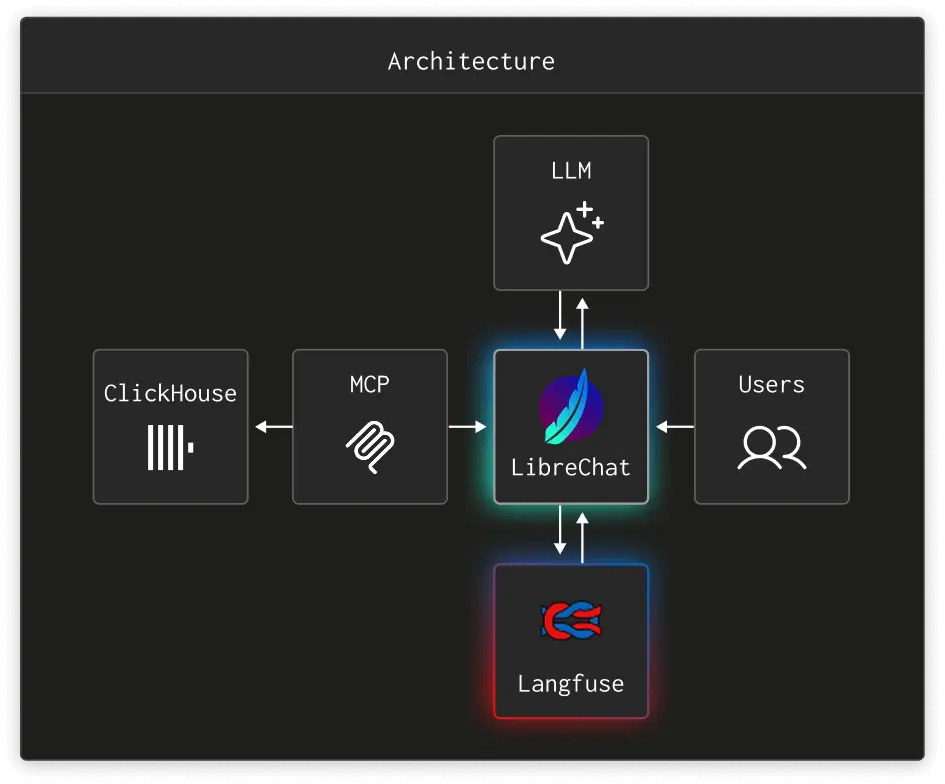
LibreChat connects to ClickHouse through the MCP server, allowing AI agents to query and analyze your data. All LLM interactions are traced in Langfuse for observability, evaluation, and prompt management. The Admin Panel provides a browser-based UI for LibreChat configuration without editing librechat.yaml by hand.
Scripts
| Script | Description |
|---|---|
scripts/prepare-demo.sh | Generate .env and interactively configure API keys |
scripts/generate-env.sh | Generate .env with random credentials |
scripts/reconcile-demo-runtime.sh | Apply .env changes to a running LibreChat container and verify its Langfuse target |
scripts/reset-all.sh | Stop all containers and wipe all data/volumes |
scripts/create-librechat-user.sh | Manually create a LibreChat admin user |
scripts/init-librechat-user.sh | Auto-init user on container startup (used internally) |
Configuration
- LibreChat —
librechat.yamlconfigures endpoints, MCP servers, and agent capabilities. The Admin Panel (http://localhost:3081) offers a browser-based alternative for most of these settings. - Environment —
.envholds all credentials and service configuration (see.env.examplefor reference). - Admin Panel authentication — Local HTTP uses password login with SSO disabled and non-Secure session cookies. Set
ADMIN_SSO_ENABLED=trueafter configuring LibreChat OpenID, and setADMIN_SESSION_COOKIE_SECURE=truewhenever the Admin Panel is served over HTTPS. - Docker —
docker-compose.ymlincludes the four compose files:langfuse-compose.yml— Langfuse, ClickHouse, PostgreSQL, Redis, MinIOclickhouse-mcp-compose.yml— ClickHouse MCP serverlibrechat-compose.yml— LibreChat, MongoDB, Meilisearch, pgvector, RAG APIadmin-panel-compose.yml— LibreChat Admin Panel
Reset Everything
To tear down all containers and delete all data:
./scripts/reset-all.sh
Then set up again and start fresh:
./scripts/prepare-demo.sh
docker compose up -d
Links
- clickhouse.ai — Project homepage
- Documentation — Full setup guide for adding ClickHouse MCP to LibreChat
- ClickHouse MCP — MCP server for ClickHouse
- LibreChat — Chat UI
- LibreChat Admin Panel — Browser-based configuration UI for LibreChat
- Langfuse — LLM observability
Significant stargazers

50 followers · starred Feb 2026

164 followers · starred May 2026

25 followers · starred Mar 2026

44 followers · starred Feb 2026
Similar repos


Languages
Shell
45.0%
TypeScript
42.7%
JavaScript
12.3%
Official ClickHouse Agentic Data Stack - self-host with ClickHouse, LibreChat, Langfuse, and ClickHouse MCP.
Shell
110
65 commits
updated Sep 24, 2026
README
Agentic Data Stack
The open-source stack for ClickHouse's suite of agentic analytic tools — your chat, your models, your data.
Powered by ClickHouse, LibreChat, and Langfuse.
Learn more at clickhouse.ai and the Agentic Data Stack blog.
One Click Deploy
Want to skip the setup and jump straight into adding agentic analytics into your workflow? Choose a Railway template below to spin up a preconfigured instance of the Agentic Data Stack in the cloud.
Langfuse OSS | Langfuse Cloud |
|---|---|
|
|
|
More details available in the Deploy on Railway section.
Overview
This project runs a fully self-hosted agentic analytics environment with Docker Compose. It connects a chat UI (LibreChat) to your data (ClickHouse) via MCP, with full LLM observability (Langfuse) — all in a single docker compose up command.
What's included
| Component | Purpose | Port |
|---|---|---|
| LibreChat | Modern Chat UI with multi-model / provider support (OpenAI, Anthropic, Google) | 3080 |
| Admin Panel | Browser-based configuration UI for LibreChat | 3081 |
| ClickHouse MCP | MCP server that gives agents access to ClickHouse | 8000 |
| Langfuse | LLM observability — traces, evals, prompt management | 3000 |
| ClickHouse | World's fastest analytical database | 8123 |
| PostgreSQL | Transactional database for Langfuse | 5432 |
| MongoDB | Transactional database for LibreChat | 27017 |
| MinIO | S3-compatible object storage | 9090 |
| Redis | Caching and queue | 6379 |
| Meilisearch | Full-text search for LibreChat | 7700 |
| pgvector | Vector database for RAG | 5433 |
| RAG API | Retrieval-augmented generation service for LibreChat | 8001 |
Deploy on Railway
One-click deploy of two "Lite" variants of the stack:
- Langfuse OSS — Deploys LibreChat, the Admin Panel, Langfuse v3, and a ClickHouse MCP server pre-configured against the public ClickHouse demo cluster.
- Langfuse Cloud — Deploys LibreChat, the Admin Panel, and ClickHouse MCP, and is pre-configured to send traces to your existing Langfuse Cloud (or other remote Langfuse) project.
Both Railway templates skip Meilisearch, pgvector, and the RAG API for simplicity. The ClickHouse MCP server ships pointed at sql-clickhouse.clickhouse.com so you can chat with the public demo data immediately; the ClickHouse Cloud MCP is also wired up if you want to OAuth into your own Cloud account post-deploy. Prefer to self-host? See Quick Start below.
Quick Start
Prerequisites
- Docker and Docker Compose v2+
1. Prepare the environment
./scripts/prepare-demo.sh
This is your fastest way to get started with the Agentic Data Stack. It generates a .env file with random credentials for all services, then presents an interactive menu to optionally configure API keys for OpenAI, Anthropic, and/or Google. Any providers you skip will remain as user_provided, letting users enter their own keys in the LibreChat UI.
The script then asks whether LibreChat should send its Langfuse traces to the local Langfuse container (the default) or to a remote Langfuse project. Choose the cloud option to point LibreChat at Langfuse Cloud (or any self-hosted Langfuse) by entering the base URL, public key, and secret key for that project. Choosing local restores the local endpoint and initialized project keys even if a previous run configured a remote project. If LibreChat is already running, the script recreates that service when its Compose configuration changed and verifies the effective runtime target, so new settings take effect immediately. You can change this later by editing LANGFUSE_BASE_URL, LANGFUSE_PUBLIC_KEY, and LANGFUSE_SECRET_KEY in .env, then running scripts/reconcile-demo-runtime.sh.
You can also generate credentials separately and customize the initial administrator account credentials:
USER_EMAIL="you@example.com" USER_PASSWORD="supersecret" USER_NAME="YourName" ./scripts/generate-env.sh
Learn more about configuring your LibreChat instance at https://librechat.ai/docs.
Note: To use LibreChat's file search / RAG features, the RAG API needs a real API key for embeddings —
user_providedwon't work because the RAG API calls the embeddings endpoint directly. IfOPENAI_API_KEYis set touser_provided, setRAG_OPENAI_API_KEYto a valid OpenAI key (it overridesOPENAI_API_KEYfor RAG only). You can also switch embedding providers viaEMBEDDINGS_PROVIDER(openai,azure,huggingface,huggingfacetei,ollama). See the RAG API docs for details.
2. Start the stack
docker compose up -d
3. Access the services
- LibreChat — http://localhost:3080
- Admin Panel — http://localhost:3081
- Langfuse — http://localhost:3000
- MinIO Console — http://localhost:9091 (Find credentials in
.envunder MINIO_ROOT_* fields)
An admin user is created automatically on first startup using the credentials from your .env file.
Architecture
LibreChat connects to ClickHouse through the MCP server, allowing AI agents to query and analyze your data. All LLM interactions are traced in Langfuse for observability, evaluation, and prompt management. The Admin Panel provides a browser-based UI for LibreChat configuration without editing librechat.yaml by hand.
Scripts
| Script | Description |
|---|---|
scripts/prepare-demo.sh | Generate .env and interactively configure API keys |
scripts/generate-env.sh | Generate .env with random credentials |
scripts/reconcile-demo-runtime.sh | Apply .env changes to a running LibreChat container and verify its Langfuse target |
scripts/reset-all.sh | Stop all containers and wipe all data/volumes |
scripts/create-librechat-user.sh | Manually create a LibreChat admin user |
scripts/init-librechat-user.sh | Auto-init user on container startup (used internally) |
Configuration
- LibreChat —
librechat.yamlconfigures endpoints, MCP servers, and agent capabilities. The Admin Panel (http://localhost:3081) offers a browser-based alternative for most of these settings. - Environment —
.envholds all credentials and service configuration (see.env.examplefor reference). - Admin Panel authentication — Local HTTP uses password login with SSO disabled and non-Secure session cookies. Set
ADMIN_SSO_ENABLED=trueafter configuring LibreChat OpenID, and setADMIN_SESSION_COOKIE_SECURE=truewhenever the Admin Panel is served over HTTPS. - Docker —
docker-compose.ymlincludes the four compose files:langfuse-compose.yml— Langfuse, ClickHouse, PostgreSQL, Redis, MinIOclickhouse-mcp-compose.yml— ClickHouse MCP serverlibrechat-compose.yml— LibreChat, MongoDB, Meilisearch, pgvector, RAG APIadmin-panel-compose.yml— LibreChat Admin Panel
Reset Everything
To tear down all containers and delete all data:
./scripts/reset-all.sh
Then set up again and start fresh:
./scripts/prepare-demo.sh
docker compose up -d
Links
- clickhouse.ai — Project homepage
- Documentation — Full setup guide for adding ClickHouse MCP to LibreChat
- ClickHouse MCP — MCP server for ClickHouse
- LibreChat — Chat UI
- LibreChat Admin Panel — Browser-based configuration UI for LibreChat
- Langfuse — LLM observability
Similar repos
Significant stargazers
50 followers · starred Feb 2026
164 followers · starred May 2026
25 followers · starred Mar 2026
44 followers · starred Feb 2026
Languages
Shell
45.0%
TypeScript
42.7%
JavaScript
12.3%