
README
Calyx
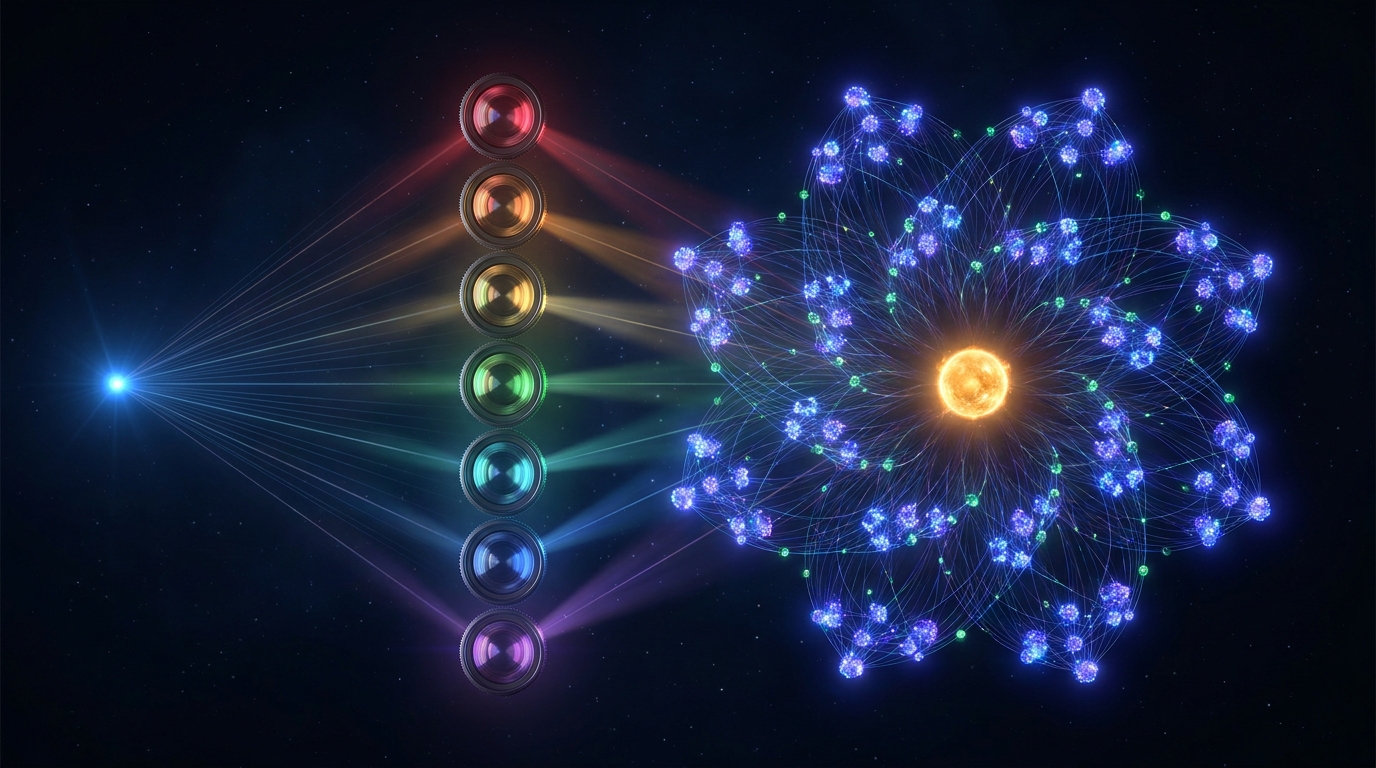
Calyx is an association-native database. Instead of storing rows and matching them, or storing one vector and finding its neighbors, Calyx stores constellations — one input measured through many frozen lenses — then fuses, grounds, and guards every answer. Built in Rust, with GPU linear algebra baked in.




Why Calyx · Concepts · Build · Architecture · Roadmap
📄 Start here — the Calyx white paper
Calyx: An Association-Native Database & Its Path to Planetary-Scale Grounded Intelligence
A Technical White Paper — Illustrated Formal Edition · Chris Royse, 2026
The whole vision, end to end: the calculus of association, the grounding kernel, the fail-closed guard, and Calyx's path from a single workstation to a neuromorphic, planetary-scale substrate for grounded intelligence — where every answer is measured, grounded, and traceable to its sources.
📖 Read on the web · ⬇️ Download the PDF · 🔬 ResearchGate
🎥 Watch: Calyx is AGI — the intelligent database, demoed · I Solved the Math Behind AGI — the theory
Calyx is a database whose native record is the association-constellation: one input measured through many frozen embedders ("lenses"), fused, differentiated by the information each one adds, and anchored to real outcomes. It finds the small grounding kernel that explains a whole dataset, guards generated content against drift and out-of-distribution answers, keeps a tamper-evident ledger of how every answer was produced, and gets faster the more you use it.
A calyx is the whorl of sepals that holds a flower together at its base — the grounded structure from which a constellation of petals opens. That is exactly what this database is: a grounded base (kernel + provenance) that holds a constellation of vectors and lets it bloom into search, naming, and answers.
🧩 Calyx is a base, not a finished product
Calyx is a template. It computes associations — it measures one input through many lenses, fuses them, finds the grounding kernel, guards every answer, and records provenance. But the moment an association means something specific — something you can infer, recognize, or act on — that recognition-and-trigger logic is code you write for your data. Every Calyx database holds different data, forms different associations, and unlocks different meanings; what happens the instant a meaning is recognized is custom to each project.
That is by design, and it is why Calyx will always be a base rather than a shrink-wrapped product. You don't ship the template — you refactor it into your specific use case, exactly like starting a product from a frontend template instead of a blank page. Beginning from the Calyx base, you are already very far along: the hard, reusable machinery (constellations, kernel, guard, ledger) is built and grounded for you. What remains is the part only you can write — the meaning your data unlocks, and what your system does when it sees it.
✨ Why Calyx
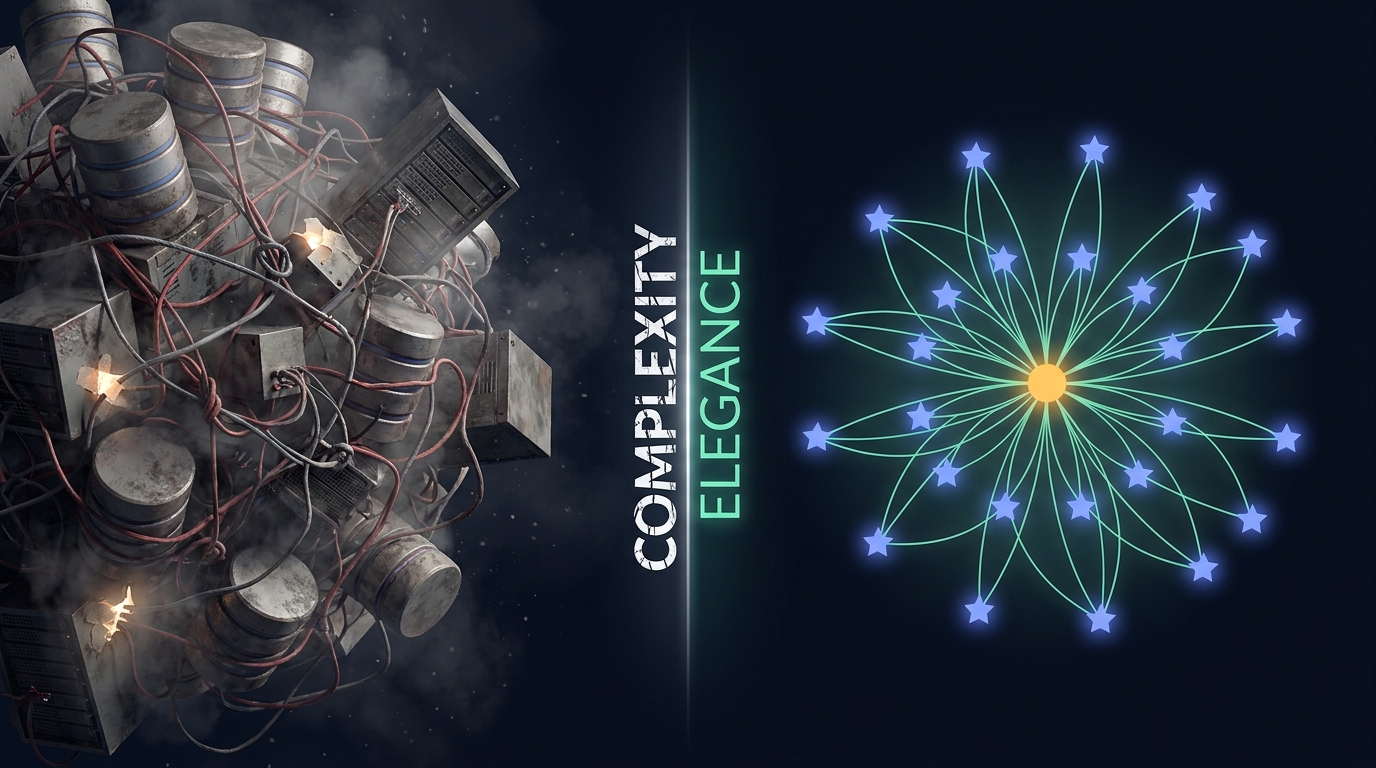
Every time you build a serious retrieval or intelligence system, you end up gluing the same machinery together by hand: a vector store for semantics, a keyword index for lexical match, a graph database for relationships, a pile of bespoke code to combine embedders, more code to measure whether a new embedder actually helps, and still nothing that tells you when your AI's answer has wandered outside what your data can support.
Calyx bakes that machinery once, into the storage engine.
| What a multi-signal system needs | Vector DB / pgvector / Elastic / Neo4j | Calyx bakes in |
|---|---|---|
| Many embedders, each versioned & frozen | You build the lifecycle yourself | Registry — add/retire lenses; each is content-addressed and immutable |
| Combine signals into one ranking | Hand-tuned fusion across systems | Sextant — dense + sparse + multi-vector fusion in one query |
| Know which signals actually help | You measure mutual information by hand | Assay — measures the bits each lens adds; prunes redundant ones |
| Relationships between records | A separate graph database | Loom + Lodestar — associations are native; the explanatory kernel is discoverable |
| Stop the AI from answering off-distribution | Nothing | Ward — a calibrated, fail-closed guard on every answer |
| Prove how an answer was produced | Metadata columns, best effort | Ledger — hash-chained, tamper-evident provenance |
| Get faster with use | Manual index / quantization tuning | Anneal — safe, reversible self-optimization |
[!NOTE] A vector database is a one-lens Calyx: a single embedder plus nearest-neighbor search. Calyx is built for the case where one signal is never enough.
🌟 The core idea: constellations
A traditional database stores a row. A vector database stores a point. Calyx stores a constellation: one input, measured through many independent lenses (embedders and feature extractors), each producing its own typed slot-vector — kept separate, never flattened into one opaque blob.
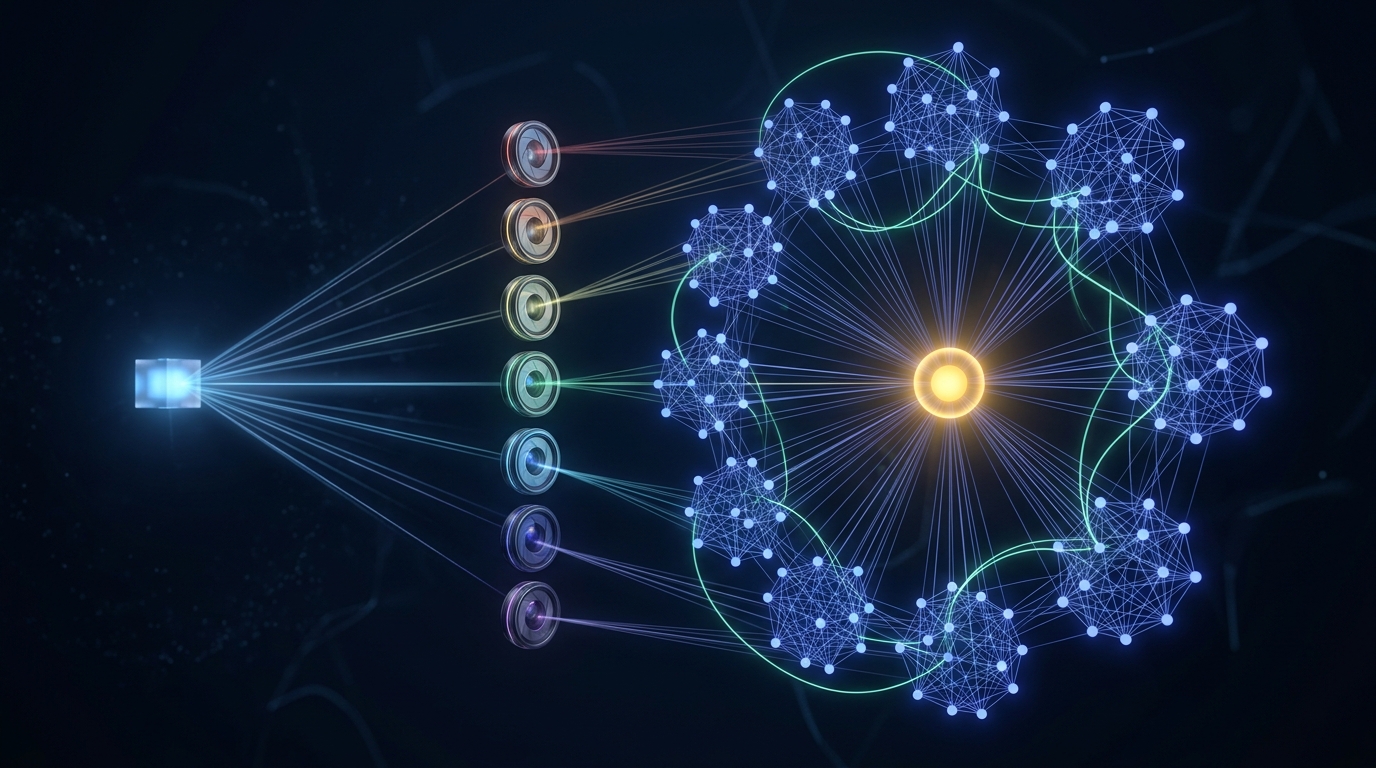
Calyx is organized around four verbs — the calculus of association:
| Verb | What it means | Subsystem |
|---|---|---|
| Measure | Assemble a constellation by viewing one input through every lens in a panel | Registry, Aster |
| Count | Derive the associations between slots (agreement, delta, interaction) | Loom |
| Differentiate | Quantify the unique information each lens contributes about real outcomes | Assay |
| Compose | Find the explanatory kernel, guard generation, and answer with provenance | Lodestar, Ward, Ledger |
Three principles make the results trustworthy:
- Grounding is mandatory. Every claim is measured against real, anchored outcomes. Ungrounded results are explicitly tagged provisional rather than presented as fact.
- Keep slots separate (no-flatten). Signals stay typed and independent end-to-end, so you can always see which lens drove a result.
- Fail closed. Unknown lens, shape mismatch, uncalibrated guard, missing data → a structured error, never a silent wrong answer.
🚀 Build from source
[!IMPORTANT] Calyx is a Rust workspace (
edition 2024, toolchain1.95). It builds CPU-only by default; the GPU backend is an opt-in feature.
Prerequisites
- Rust
1.95(viarustup; the pinned toolchain is inrust-toolchain.toml) - A C toolchain (required by native numeric/runtime dependencies)
- Optional, for GPU acceleration: an NVIDIA
sm_120-class GPU and CUDA13.3
Build & test
git clone https://github.com/ChrisRoyse/Calyx.git
cd Calyx

# CPU build (portable, uses SIMD math)
cargo build --release --workspace

# Run the test suite
cargo test --workspace

# Optional: build with the CUDA backend
cargo build --release --workspace --features cuda
[!NOTE] The polished public CLI and the agent-facing MCP server are in active development. A dedicated usage guide will ship alongside them — see Project status.
🧭 Architecture
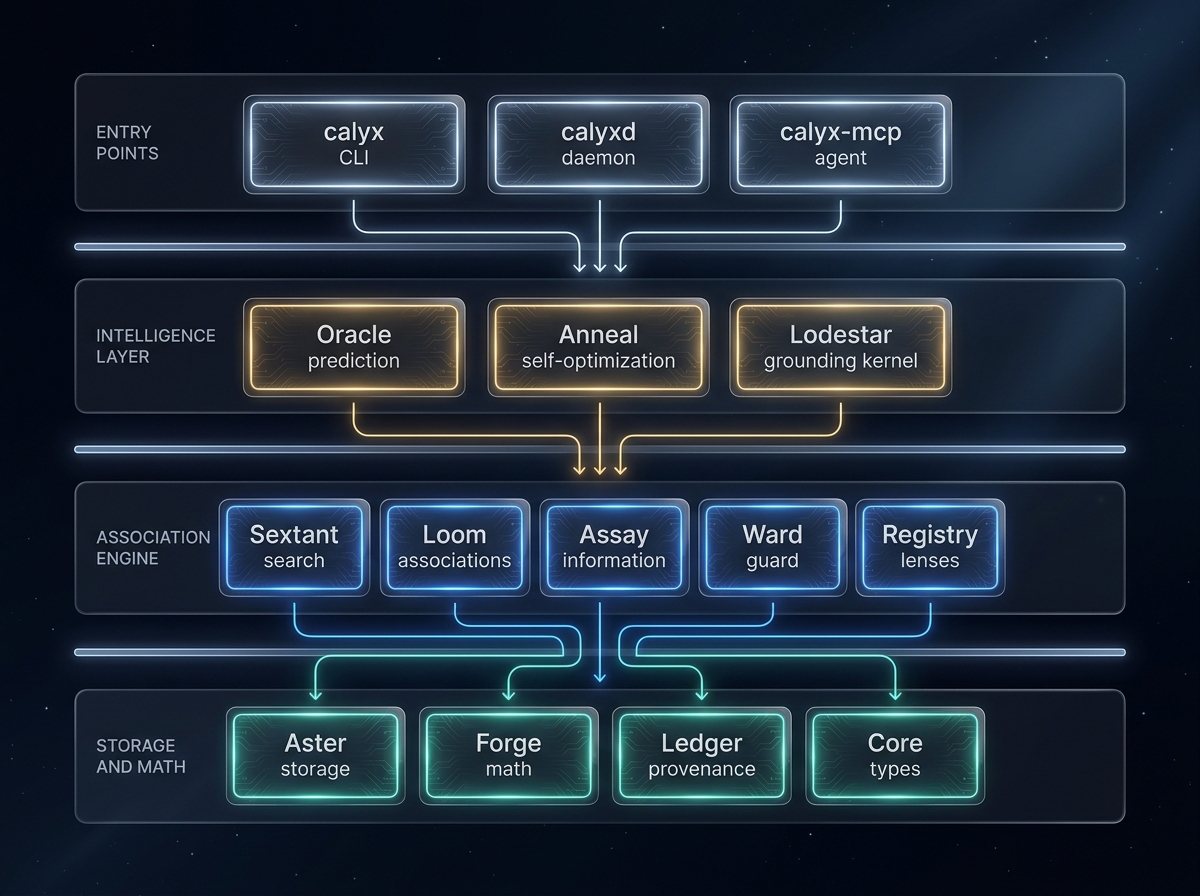
Calyx is not a service mesh. It is an embedded engine — a stack of focused Rust crates — with three thin entry points on top: a CLI (calyx), a daemon (calyxd), and an MCP server (calyx-mcp).
Every subsystem is named for an instrument of celestial navigation: a lens is a sighting instrument, the kernel is the guiding star, and search is navigation.
| Subsystem | Crate | What it is |
|---|---|---|
| 🗃️ Turso relational | calyx-turso | Pure-Rust, in-process relational source of truth for datasets, original records, multi-lens slots, revisions, and cross-store projection state. Uses bounded transactions, MVCC, and independently verified Aster projection. |
| 🪐 Aster | calyx-aster | Embedded LSM storage: write-ahead log, group-commit, MVCC snapshots, memory-mapped tables, crash recovery, hot/cold tiering. The "schema" layer. |
| 🔥 Forge | calyx-forge | The numeric runtime: one math backend implemented twice — CPU SIMD and CUDA — engineered for bit-near parity. Quantization from full precision down to 1-bit. |
| 🔭 Registry | calyx-registry | The lens registry: seven embedder runtimes (local, server, ONNX, algorithmic, multimodal…), each frozen and content-addressed. Hot-swap and lazy backfill. |
| 🧭 Sextant | calyx-sextant | Search & navigation: in-RAM and on-disk vector indexes, keyword (BM25) index, late-interaction, and multi-signal fusion with a query planner. |
| 🕸️ Loom | calyx-loom | Derives the associations between slots (agreement, delta, interaction) and weaves them into a queryable association graph. |
| ⚖️ Assay | calyx-assay | Measures the information (in bits) each lens contributes about real outcomes, enforces a redundancy contract, and reports panel sufficiency. |
| ⭐ Lodestar | calyx-lodestar | Discovers the small grounding kernel that explains a corpus, and turns it into both an index and an answer path. |
| 🛡️ Ward | calyx-ward | The fail-closed guard: scores every required slot independently against a calibrated threshold and refuses out-of-distribution or ungrounded content. |
| 📜 Ledger | calyx-ledger | Append-only, hash-chained provenance with periodic signed checkpoints and tamper-evident verification. |
| ♨️ Anneal | calyx-anneal | Reversible self-optimization: tunes the engine within safety tripwires and rolls back anything that regresses quality. |
| 🔮 Oracle | calyx-oracle | Consequence prediction over grounded constellations, with an honesty gate that refuses to answer when the data can't support it. |
| 🧩 Core | calyx-core | The dependency-free foundation: identifiers, the closed error catalog, the data model, and the engine traits everything else implements. |
🧠 The intelligence layer
What makes Calyx more than a fast multi-index search engine is the layer that turns retrieval into grounded intelligence.
⭐ Lodestar — the grounding kernel
Most datasets are mostly redundant. Lodestar discovers the small set of records — the kernel — that actually carries the structure of the whole corpus, scoring candidates by how central and how grounded they are. The kernel then doubles as a fast index and as an answer path: route a query through the kernel first, then walk its edges to an answer.
🛡️ Ward — the no-hallucination guard
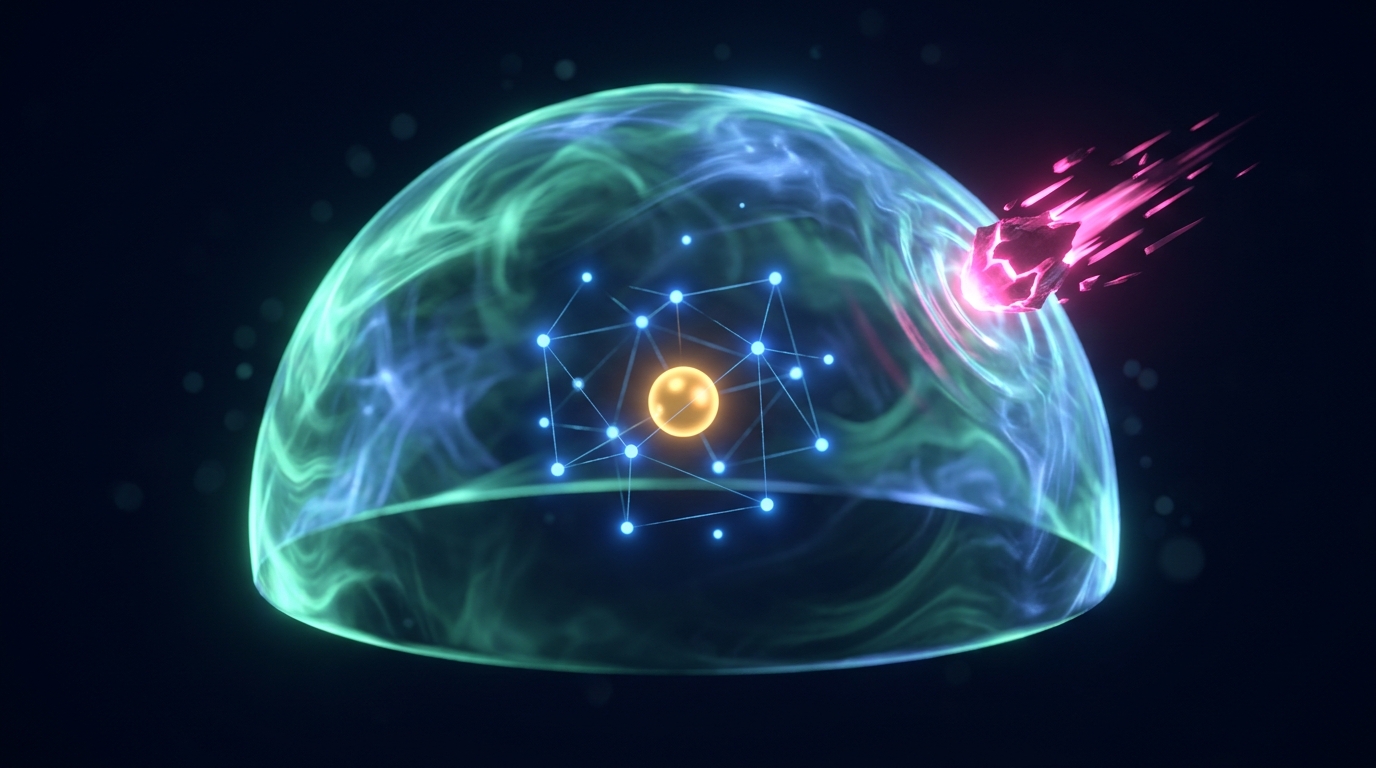
Ward is a fail-closed boundary around what your data can support. Each required slot is scored independently against a calibrated threshold — there is no single averaged gate that a strong score on one slot can sneak past. Anything outside the trusted region is refused, quarantined, or recorded as a new region to learn — never waved through. Thresholds are set by conformal calibration to a target false-accept rate, so the guard's strictness is a number you choose, not a guess.
📜 Ledger — provenance you can verify
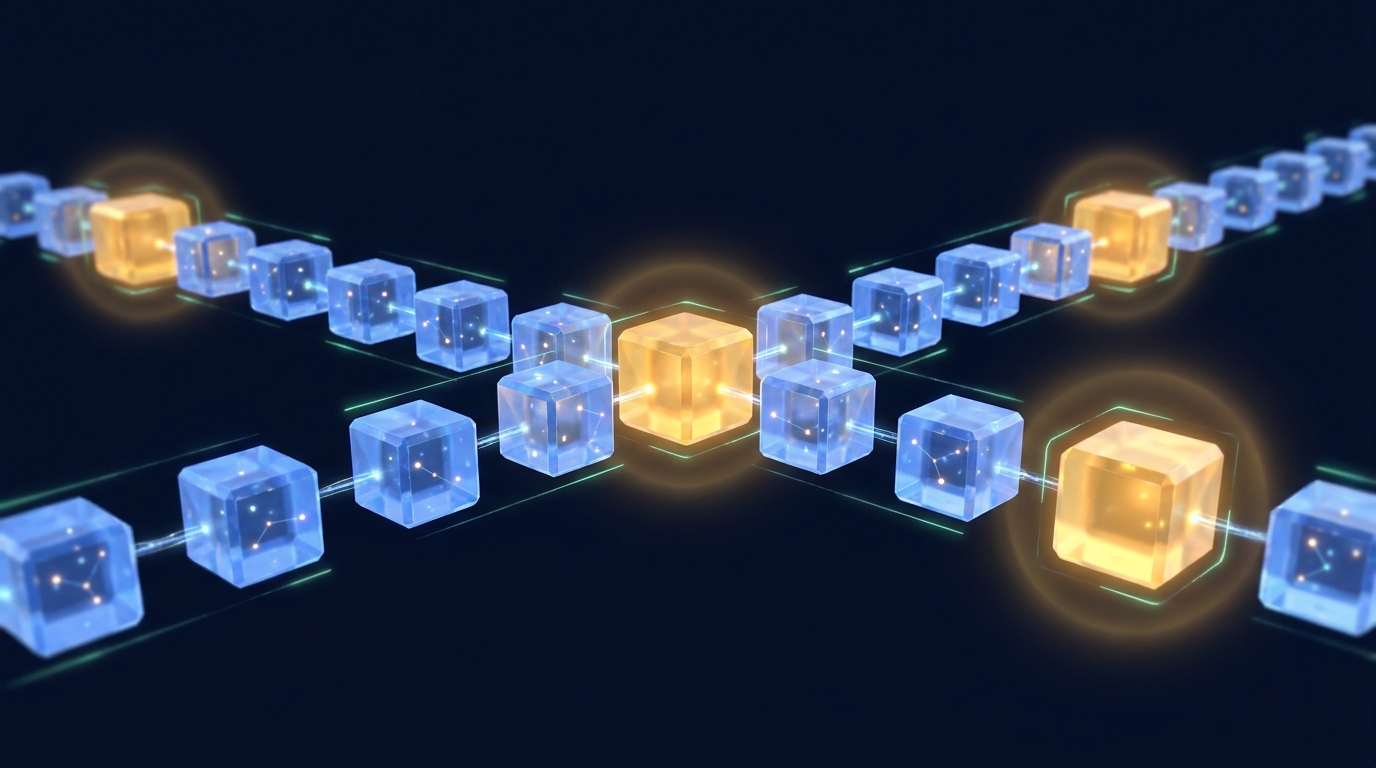
Every measurement, kernel, guard verdict, and answer is appended to a hash-chained ledger. Each entry seals the one before it, so any tampering is detectable; periodic checkpoints can be cryptographically signed; and a single command can re-verify the entire chain. You can always answer the question "how was this produced, and has anything changed since?"
♨️ Anneal — a database that improves with use
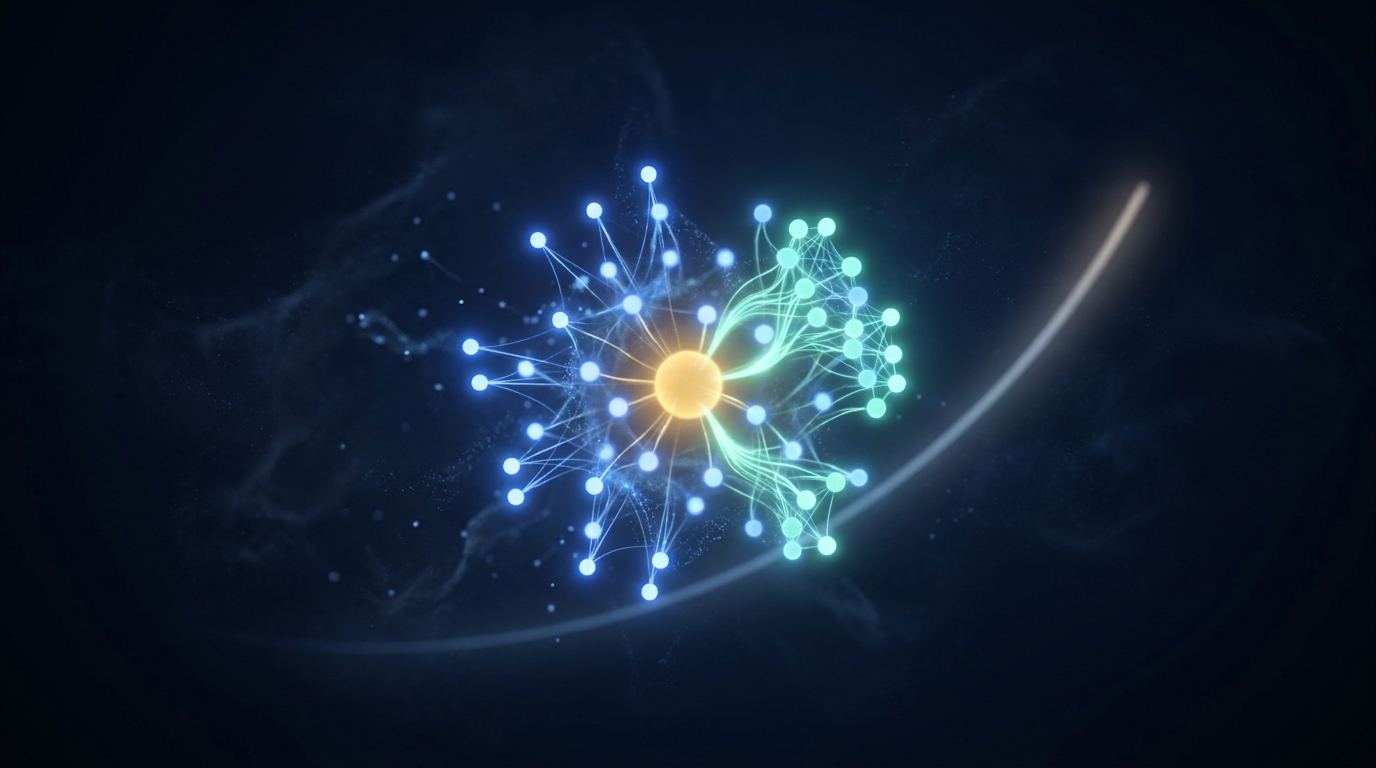
Anneal continuously tunes the engine — index parameters, quantization levels, fusion weights — but safely: every change is gated against quality tripwires and shadow-tested before it goes live, and anything that regresses recall, latency, or guard accuracy is automatically reverted. Optimization that can only make things better, and is always reversible.
🔮 Oracle — grounded consequence prediction
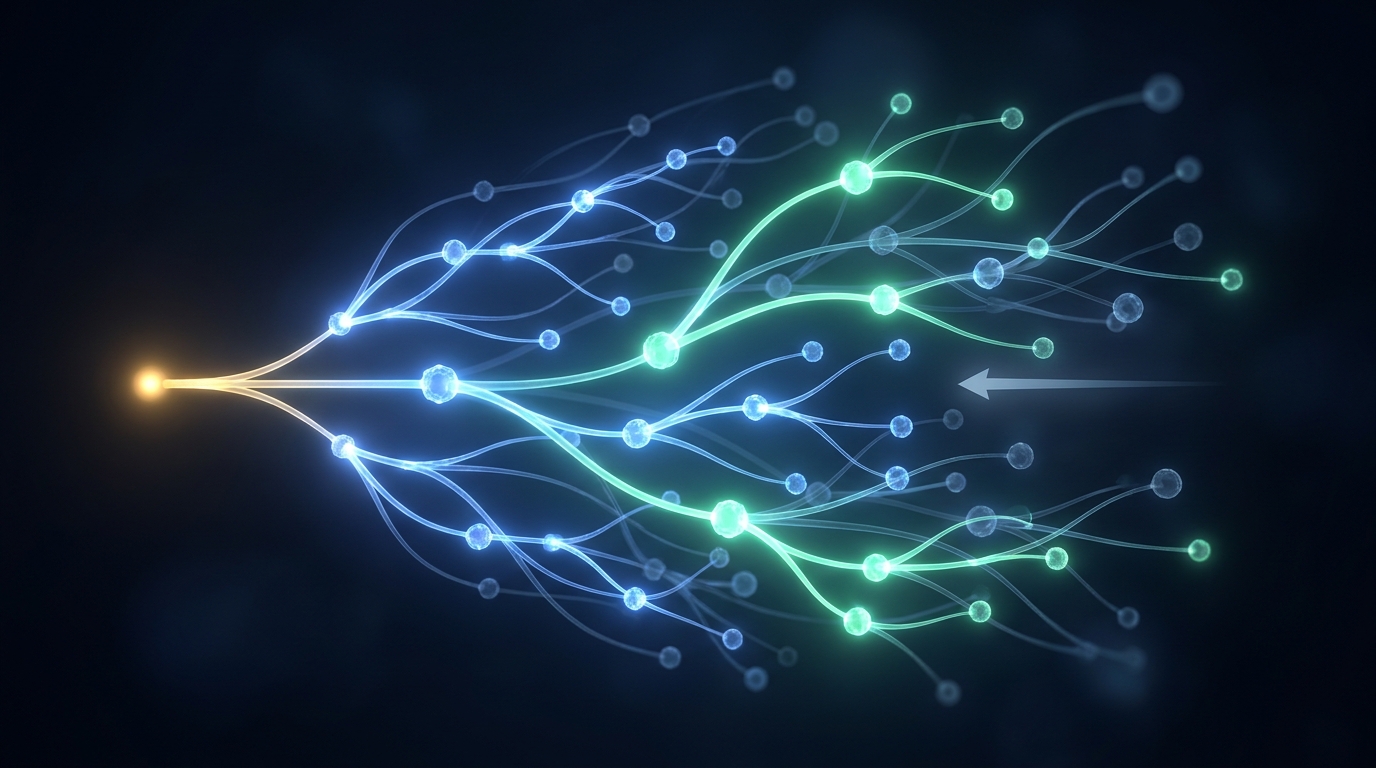
Oracle predicts the grounded consequences of an action by mining recurrence patterns in your data, builds a branching "butterfly" tree of likely downstream effects, and can even walk backward from an outcome to its likely causes. Crucially, it has an honesty gate: when the available signals can't support a confident prediction, Oracle returns insufficient with the specific deficits — instead of fabricating an answer.
🗄️ One core, every paradigm
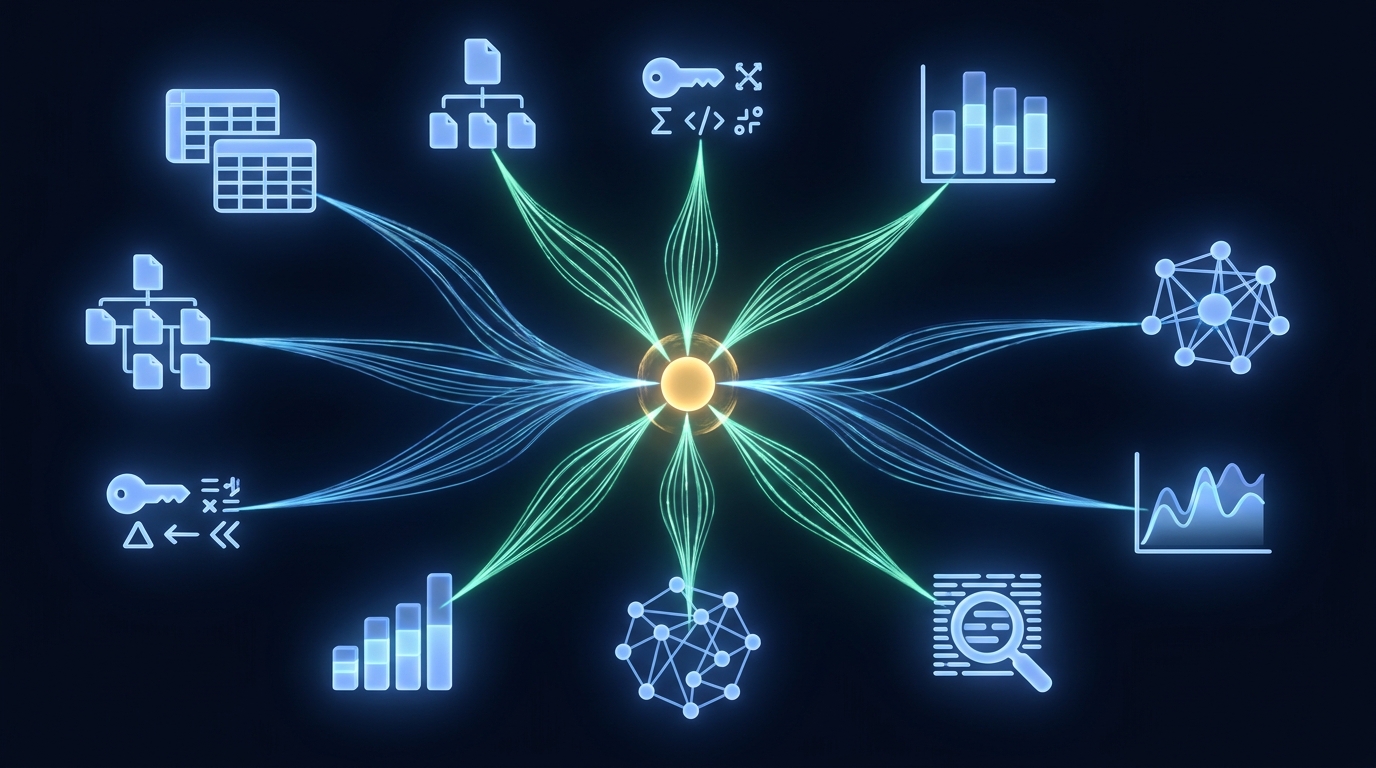
Because everything is built on one ordered, transactional storage core, Calyx can serve the role of many database shapes at once:
| Paradigm | How Calyx serves it |
|---|---|
| Vector | A dense lens + per-slot ANN search — a vector DB is a one-lens Calyx |
| Full-text | A sparse lexical lens with a BM25 inverted index |
| Graph | Associations are native; cross-terms are edges and the kernel is a path |
| Time-series | Range keys + temporal lenses, with time scoring that is additive and never dominant |
| Key-value / Document / Relational | Typed records and keyed state on the same transactional core |
The search-shaped paradigms collapse into the association engine; the storage-shaped ones are the general data layer beneath it. One engine, one transaction, one source of truth.
🗺️ Project status
[!WARNING] Calyx is pre-1.0 software under active development. The on-disk format and public interfaces may change before a stable release.
The core engine — storage, math, the lens registry, multi-signal search, the association and information layers, the grounding kernel, the guard, the ledger, self-optimization, and the first oracle capabilities — is built and working.
Actively expanding toward 1.0:
- A richer public CLI and a populated MCP toolset so agents can drive the full engine directly.
- Scale-out vector indexing (on-disk graph and centroid-partitioned indexes) for very large vaults.
- Server & deployment polish for running
calyxdas a managed service. - Broader validation of the oracle and guard against public benchmark corpora.
[!NOTE] The dream. Calyx's north star is a grounded substrate for planetary-scale intelligence: hold the world's data un-flattened, measure it through many diverse lenses, derive the associations between distant domains, and surface ranked, provenance-backed, validatable hypotheses — never ungrounded answers. Two levers maximize what it can discover: corpus breadth and lens diversity. In a world where any answer is cheap to generate, the scarce resource is grounded verification — knowing what is true and being able to trace it to its sources — and that is exactly what Calyx is built to provide. The white paper lays out the full path, including why this workload's natural long-term home is neuromorphic, in-memory hardware. That vision is aspirational and Calyx is pre-1.0; the honesty gate that underpins it is already built.
📄 License
Calyx is source-available under the Business Source License 1.1 (BSL) — the same model used by databases like CockroachDB, MariaDB, and Couchbase.
| Use | Allowed under BSL? |
|---|---|
| Development, testing, evaluation, research, education | ✅ Free |
| Personal & non-commercial projects | ✅ Free |
| Reading, modifying, and redistributing the source | ✅ Free |
| Production or commercial use — embedding in a product/service, or running in a business | 💼 Requires a commercial license |
Each released version automatically converts to the open-source Apache License 2.0 four years after its release. For a commercial license, please open an issue. See LICENSE for the binding terms.

Calyx — Intelligence is the calculus of association. Calyx is its engine.
White paper · calyxaimemory.com · Watch the demo · The theory
Built in Rust 🦀 · GPU math baked in · Grounded by design
Contributors

225 commits

125 commits
Similar repos


Languages
Rust
95.7%
Python
2.7%
README
Calyx
Calyx is an association-native database. Instead of storing rows and matching them, or storing one vector and finding its neighbors, Calyx stores constellations — one input measured through many frozen lenses — then fuses, grounds, and guards every answer. Built in Rust, with GPU linear algebra baked in.
Why Calyx · Concepts · Build · Architecture · Roadmap
📄 Start here — the Calyx white paper
Calyx: An Association-Native Database & Its Path to Planetary-Scale Grounded Intelligence
A Technical White Paper — Illustrated Formal Edition · Chris Royse, 2026
The whole vision, end to end: the calculus of association, the grounding kernel, the fail-closed guard, and Calyx's path from a single workstation to a neuromorphic, planetary-scale substrate for grounded intelligence — where every answer is measured, grounded, and traceable to its sources.
📖 Read on the web · ⬇️ Download the PDF · 🔬 ResearchGate
🎥 Watch: Calyx is AGI — the intelligent database, demoed · I Solved the Math Behind AGI — the theory
Calyx is a database whose native record is the association-constellation: one input measured through many frozen embedders ("lenses"), fused, differentiated by the information each one adds, and anchored to real outcomes. It finds the small grounding kernel that explains a whole dataset, guards generated content against drift and out-of-distribution answers, keeps a tamper-evident ledger of how every answer was produced, and gets faster the more you use it.
A calyx is the whorl of sepals that holds a flower together at its base — the grounded structure from which a constellation of petals opens. That is exactly what this database is: a grounded base (kernel + provenance) that holds a constellation of vectors and lets it bloom into search, naming, and answers.
🧩 Calyx is a base, not a finished product
Calyx is a template. It computes associations — it measures one input through many lenses, fuses them, finds the grounding kernel, guards every answer, and records provenance. But the moment an association means something specific — something you can infer, recognize, or act on — that recognition-and-trigger logic is code you write for your data. Every Calyx database holds different data, forms different associations, and unlocks different meanings; what happens the instant a meaning is recognized is custom to each project.
That is by design, and it is why Calyx will always be a base rather than a shrink-wrapped product. You don't ship the template — you refactor it into your specific use case, exactly like starting a product from a frontend template instead of a blank page. Beginning from the Calyx base, you are already very far along: the hard, reusable machinery (constellations, kernel, guard, ledger) is built and grounded for you. What remains is the part only you can write — the meaning your data unlocks, and what your system does when it sees it.
✨ Why Calyx
Every time you build a serious retrieval or intelligence system, you end up gluing the same machinery together by hand: a vector store for semantics, a keyword index for lexical match, a graph database for relationships, a pile of bespoke code to combine embedders, more code to measure whether a new embedder actually helps, and still nothing that tells you when your AI's answer has wandered outside what your data can support.
Calyx bakes that machinery once, into the storage engine.
| What a multi-signal system needs | Vector DB / pgvector / Elastic / Neo4j | Calyx bakes in |
|---|---|---|
| Many embedders, each versioned & frozen | You build the lifecycle yourself | Registry — add/retire lenses; each is content-addressed and immutable |
| Combine signals into one ranking | Hand-tuned fusion across systems | Sextant — dense + sparse + multi-vector fusion in one query |
| Know which signals actually help | You measure mutual information by hand | Assay — measures the bits each lens adds; prunes redundant ones |
| Relationships between records | A separate graph database | Loom + Lodestar — associations are native; the explanatory kernel is discoverable |
| Stop the AI from answering off-distribution | Nothing | Ward — a calibrated, fail-closed guard on every answer |
| Prove how an answer was produced | Metadata columns, best effort | Ledger — hash-chained, tamper-evident provenance |
| Get faster with use | Manual index / quantization tuning | Anneal — safe, reversible self-optimization |
[!NOTE] A vector database is a one-lens Calyx: a single embedder plus nearest-neighbor search. Calyx is built for the case where one signal is never enough.
🌟 The core idea: constellations
A traditional database stores a row. A vector database stores a point. Calyx stores a constellation: one input, measured through many independent lenses (embedders and feature extractors), each producing its own typed slot-vector — kept separate, never flattened into one opaque blob.
Calyx is organized around four verbs — the calculus of association:
| Verb | What it means | Subsystem |
|---|---|---|
| Measure | Assemble a constellation by viewing one input through every lens in a panel | Registry, Aster |
| Count | Derive the associations between slots (agreement, delta, interaction) | Loom |
| Differentiate | Quantify the unique information each lens contributes about real outcomes | Assay |
| Compose | Find the explanatory kernel, guard generation, and answer with provenance | Lodestar, Ward, Ledger |
Three principles make the results trustworthy:
- Grounding is mandatory. Every claim is measured against real, anchored outcomes. Ungrounded results are explicitly tagged provisional rather than presented as fact.
- Keep slots separate (no-flatten). Signals stay typed and independent end-to-end, so you can always see which lens drove a result.
- Fail closed. Unknown lens, shape mismatch, uncalibrated guard, missing data → a structured error, never a silent wrong answer.
🚀 Build from source
[!IMPORTANT] Calyx is a Rust workspace (
edition 2024, toolchain1.95). It builds CPU-only by default; the GPU backend is an opt-in feature.
Prerequisites
- Rust
1.95(viarustup; the pinned toolchain is inrust-toolchain.toml) - A C toolchain (required by native numeric/runtime dependencies)
- Optional, for GPU acceleration: an NVIDIA
sm_120-class GPU and CUDA13.3
Build & test
git clone https://github.com/ChrisRoyse/Calyx.git
cd Calyx

# CPU build (portable, uses SIMD math)
cargo build --release --workspace

# Run the test suite
cargo test --workspace

# Optional: build with the CUDA backend
cargo build --release --workspace --features cuda
[!NOTE] The polished public CLI and the agent-facing MCP server are in active development. A dedicated usage guide will ship alongside them — see Project status.
🧭 Architecture
Calyx is not a service mesh. It is an embedded engine — a stack of focused Rust crates — with three thin entry points on top: a CLI (calyx), a daemon (calyxd), and an MCP server (calyx-mcp).
Every subsystem is named for an instrument of celestial navigation: a lens is a sighting instrument, the kernel is the guiding star, and search is navigation.
| Subsystem | Crate | What it is |
|---|---|---|
| 🗃️ Turso relational | calyx-turso | Pure-Rust, in-process relational source of truth for datasets, original records, multi-lens slots, revisions, and cross-store projection state. Uses bounded transactions, MVCC, and independently verified Aster projection. |
| 🪐 Aster | calyx-aster | Embedded LSM storage: write-ahead log, group-commit, MVCC snapshots, memory-mapped tables, crash recovery, hot/cold tiering. The "schema" layer. |
| 🔥 Forge | calyx-forge | The numeric runtime: one math backend implemented twice — CPU SIMD and CUDA — engineered for bit-near parity. Quantization from full precision down to 1-bit. |
| 🔭 Registry | calyx-registry | The lens registry: seven embedder runtimes (local, server, ONNX, algorithmic, multimodal…), each frozen and content-addressed. Hot-swap and lazy backfill. |
| 🧭 Sextant | calyx-sextant | Search & navigation: in-RAM and on-disk vector indexes, keyword (BM25) index, late-interaction, and multi-signal fusion with a query planner. |
| 🕸️ Loom | calyx-loom | Derives the associations between slots (agreement, delta, interaction) and weaves them into a queryable association graph. |
| ⚖️ Assay | calyx-assay | Measures the information (in bits) each lens contributes about real outcomes, enforces a redundancy contract, and reports panel sufficiency. |
| ⭐ Lodestar | calyx-lodestar | Discovers the small grounding kernel that explains a corpus, and turns it into both an index and an answer path. |
| 🛡️ Ward | calyx-ward | The fail-closed guard: scores every required slot independently against a calibrated threshold and refuses out-of-distribution or ungrounded content. |
| 📜 Ledger | calyx-ledger | Append-only, hash-chained provenance with periodic signed checkpoints and tamper-evident verification. |
| ♨️ Anneal | calyx-anneal | Reversible self-optimization: tunes the engine within safety tripwires and rolls back anything that regresses quality. |
| 🔮 Oracle | calyx-oracle | Consequence prediction over grounded constellations, with an honesty gate that refuses to answer when the data can't support it. |
| 🧩 Core | calyx-core | The dependency-free foundation: identifiers, the closed error catalog, the data model, and the engine traits everything else implements. |
🧠 The intelligence layer
What makes Calyx more than a fast multi-index search engine is the layer that turns retrieval into grounded intelligence.
⭐ Lodestar — the grounding kernel
Most datasets are mostly redundant. Lodestar discovers the small set of records — the kernel — that actually carries the structure of the whole corpus, scoring candidates by how central and how grounded they are. The kernel then doubles as a fast index and as an answer path: route a query through the kernel first, then walk its edges to an answer.
🛡️ Ward — the no-hallucination guard
Ward is a fail-closed boundary around what your data can support. Each required slot is scored independently against a calibrated threshold — there is no single averaged gate that a strong score on one slot can sneak past. Anything outside the trusted region is refused, quarantined, or recorded as a new region to learn — never waved through. Thresholds are set by conformal calibration to a target false-accept rate, so the guard's strictness is a number you choose, not a guess.
📜 Ledger — provenance you can verify
Every measurement, kernel, guard verdict, and answer is appended to a hash-chained ledger. Each entry seals the one before it, so any tampering is detectable; periodic checkpoints can be cryptographically signed; and a single command can re-verify the entire chain. You can always answer the question "how was this produced, and has anything changed since?"
♨️ Anneal — a database that improves with use
Anneal continuously tunes the engine — index parameters, quantization levels, fusion weights — but safely: every change is gated against quality tripwires and shadow-tested before it goes live, and anything that regresses recall, latency, or guard accuracy is automatically reverted. Optimization that can only make things better, and is always reversible.
🔮 Oracle — grounded consequence prediction
Oracle predicts the grounded consequences of an action by mining recurrence patterns in your data, builds a branching "butterfly" tree of likely downstream effects, and can even walk backward from an outcome to its likely causes. Crucially, it has an honesty gate: when the available signals can't support a confident prediction, Oracle returns insufficient with the specific deficits — instead of fabricating an answer.
🗄️ One core, every paradigm
Because everything is built on one ordered, transactional storage core, Calyx can serve the role of many database shapes at once:
| Paradigm | How Calyx serves it |
|---|---|
| Vector | A dense lens + per-slot ANN search — a vector DB is a one-lens Calyx |
| Full-text | A sparse lexical lens with a BM25 inverted index |
| Graph | Associations are native; cross-terms are edges and the kernel is a path |
| Time-series | Range keys + temporal lenses, with time scoring that is additive and never dominant |
| Key-value / Document / Relational | Typed records and keyed state on the same transactional core |
The search-shaped paradigms collapse into the association engine; the storage-shaped ones are the general data layer beneath it. One engine, one transaction, one source of truth.
🗺️ Project status
[!WARNING] Calyx is pre-1.0 software under active development. The on-disk format and public interfaces may change before a stable release.
The core engine — storage, math, the lens registry, multi-signal search, the association and information layers, the grounding kernel, the guard, the ledger, self-optimization, and the first oracle capabilities — is built and working.
Actively expanding toward 1.0:
- A richer public CLI and a populated MCP toolset so agents can drive the full engine directly.
- Scale-out vector indexing (on-disk graph and centroid-partitioned indexes) for very large vaults.
- Server & deployment polish for running
calyxdas a managed service. - Broader validation of the oracle and guard against public benchmark corpora.
[!NOTE] The dream. Calyx's north star is a grounded substrate for planetary-scale intelligence: hold the world's data un-flattened, measure it through many diverse lenses, derive the associations between distant domains, and surface ranked, provenance-backed, validatable hypotheses — never ungrounded answers. Two levers maximize what it can discover: corpus breadth and lens diversity. In a world where any answer is cheap to generate, the scarce resource is grounded verification — knowing what is true and being able to trace it to its sources — and that is exactly what Calyx is built to provide. The white paper lays out the full path, including why this workload's natural long-term home is neuromorphic, in-memory hardware. That vision is aspirational and Calyx is pre-1.0; the honesty gate that underpins it is already built.
📄 License
Calyx is source-available under the Business Source License 1.1 (BSL) — the same model used by databases like CockroachDB, MariaDB, and Couchbase.
| Use | Allowed under BSL? |
|---|---|
| Development, testing, evaluation, research, education | ✅ Free |
| Personal & non-commercial projects | ✅ Free |
| Reading, modifying, and redistributing the source | ✅ Free |
| Production or commercial use — embedding in a product/service, or running in a business | 💼 Requires a commercial license |
Each released version automatically converts to the open-source Apache License 2.0 four years after its release. For a commercial license, please open an issue. See LICENSE for the binding terms.
Calyx — Intelligence is the calculus of association. Calyx is its engine.
White paper · calyxaimemory.com · Watch the demo · The theory
Built in Rust 🦀 · GPU math baked in · Grounded by design
Similar repos
Contributors
225 commits
125 commits
Languages
Rust
95.7%
Python
2.7%