Official PyTorch implementation for the paper: "VitaGlyph: Vitalizing Artistic Typography with Flexible Dual-branch Diffusion Models"
Python
24
15 commits
updated Sep 30, 2026
Vitalizing Artistic Typography with Flexible Dual-branch Diffusion Models
Kailai Feng, Yabo Zhang, Haodong Yu, Zhilong Ji, Jinfeng Bai, Hongzhi Zhang, Wangmeng Zuo
PyTorch implementation of VitaGlyph. Generate artistic typography from a glyph image and manually supplied subject and surrounding prompts.
Tested with Python 3.9 and PyTorch 2.5.1. CUDA, Apple MPS and CPU are supported; GPU inference is recommended. Model weights are downloaded from Hugging Face on first use.
git clone https://github.com/Carlofkl/VitaGlyph.git
cd VitaGlyph
python -m venv .venv
source .venv/bin/activate
python -m pip install -r requirements-preprocessing.txt
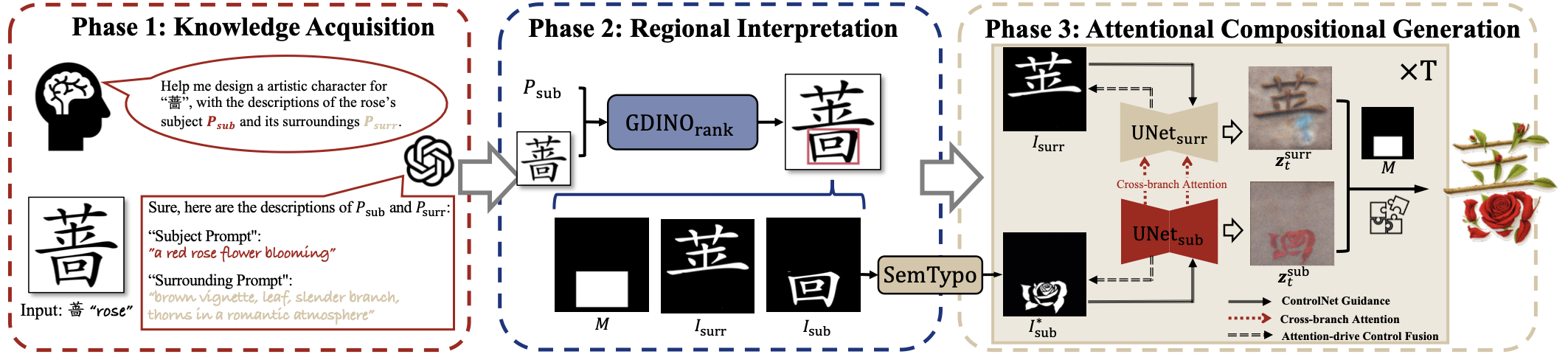
The pipeline runs Grounding DINO → subject deformation → HED surrounding control → dual-ControlNet rendering. Knowledge Acquisition is omitted; supply both prompts yourself.
python VitaGlyph.py \
  --image examples/rose_glyph.jpg \
  --detection-prompt 'a rose flower' \
  --subject-prompt 'a red rose flower blooming' \
  --surrounding-prompt 'green leaves, slender branches and thorns, botanical illustration' \
  --positive-prompt 'botanical watercolor illustration, only flowers and leaves, Chinese calligraphy, plain white background' \
  --negative-prompt 'people, person, human, skin, nudity, body, portrait, blurry, low quality, cluttered background' \
  --output results/my_rose --seed 42 --generation-seed 45 --steps 20 \
  --gamma 1 --guidance-scale 5 --subject-scale 0.8 --surrounding-scale 0.8 \
  --no-attention-control
On Apple Silicon, append --device mps --precision fp16 --deform-precision fp32 --variant fp16.
The command above uses the tested fixed-control configuration: cross-branch attention is enabled,
while attention-driven control fusion is disabled. Remove --no-attention-control to enable that module.
This example demonstrates execution; visual quality and concept fidelity still need tuning.
Outputs are written to results/my_rose/artistic.png, with intermediate images and JSON metadata
in the same directory. Generated outputs are excluded from Git. examples/rose_glyph.jpg is an input,
not a generated result.
Useful options:
--text '蔷' --font /path/to/font.ttf: render a glyph instead of supplying an image.--deformation sds --sds-iterations 100: use SDS-guided raster deformation instead of Depth2Img.--resume: reuse completed stages when commands and input/output hashes match.--dry-run: validate inputs and print commands without loading models.--local-files-only: use cached weights or explicit local model directories.Detection retains boxes with confidence ≥ 0.4 and area ratio 5%–60%, then selects the highest-confidence box. The SDS option is a raster displacement-field adaptation inspired by Word-As-Image, not its original vector optimizer.
| Entry point | Purpose |
|---|---|
VitaGlyph.py | Complete pipeline with manual prompts |
RegionDecomp.py | Detect one region and export sub, surr and mask |
SemTypo.py | Depth2Img subject deformation and HED preparation |
SDSDeform.py | Optional SDS raster deformation |
ConComGen.py | Final artistic rendering from prepared controls |
Use python <entry_point>.py --help for arguments.
See pipeline usage, preprocessing, and
generation details for model paths, conventions and implementation limitations.
python -m pip install -r requirements-dev.txt
python -m pytest tests -q
Tests cover region filtering, aligned controls, diffusion components, SDS gradients and pipeline continuation. They do not measure artistic quality or establish exact reproduction of the paper.
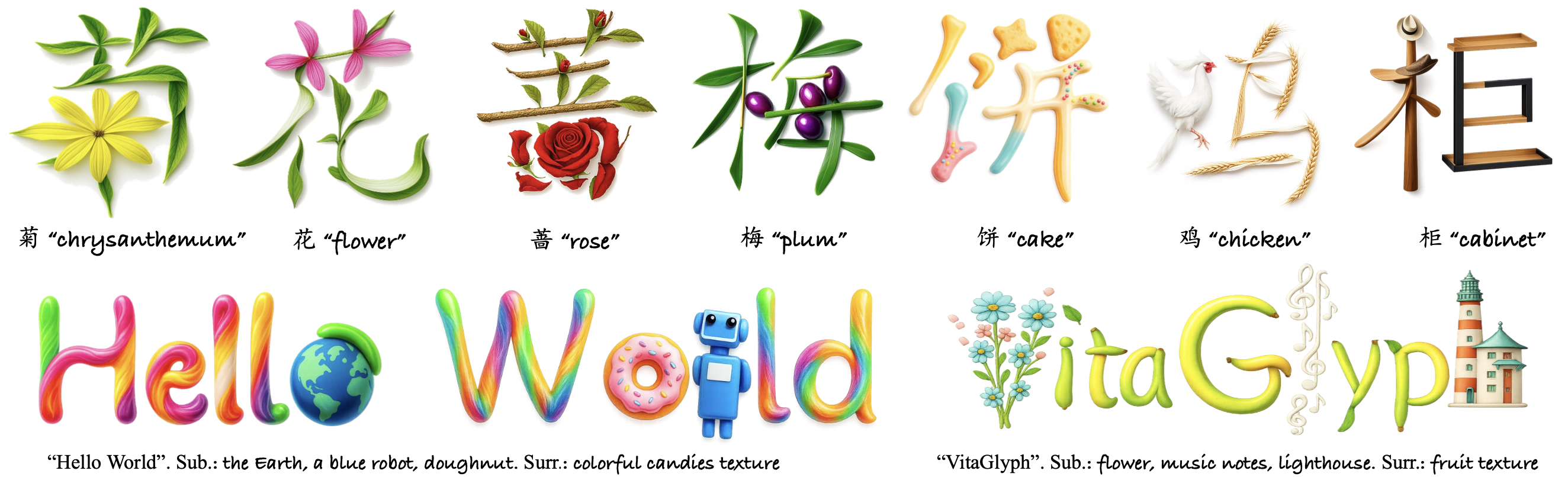
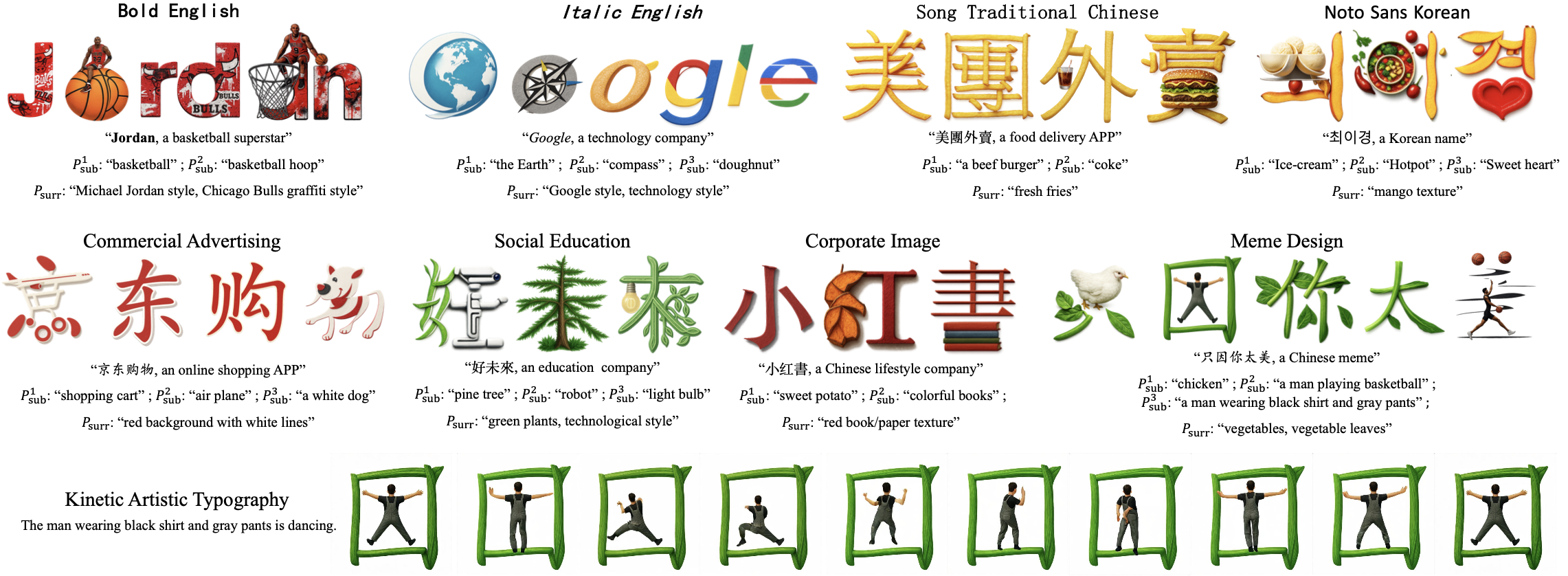
These are the repository's existing examples, not outputs from the quick-start run.
Built with Diffusers, Grounding DINO, and ControlNet.
This project is unrelated to the Vitaglyph evolution/spacetime project at vitaglyph.com.
Official PyTorch implementation for the paper: "VitaGlyph: Vitalizing Artistic Typography with Flexible Dual-branch Diffusion Models"
Python
24
15 commits
updated Sep 30, 2026
Vitalizing Artistic Typography with Flexible Dual-branch Diffusion Models
Kailai Feng, Yabo Zhang, Haodong Yu, Zhilong Ji, Jinfeng Bai, Hongzhi Zhang, Wangmeng Zuo
PyTorch implementation of VitaGlyph. Generate artistic typography from a glyph image and manually supplied subject and surrounding prompts.
Tested with Python 3.9 and PyTorch 2.5.1. CUDA, Apple MPS and CPU are supported; GPU inference is recommended. Model weights are downloaded from Hugging Face on first use.
git clone https://github.com/Carlofkl/VitaGlyph.git
cd VitaGlyph
python -m venv .venv
source .venv/bin/activate
python -m pip install -r requirements-preprocessing.txt
The pipeline runs Grounding DINO → subject deformation → HED surrounding control → dual-ControlNet rendering. Knowledge Acquisition is omitted; supply both prompts yourself.
python VitaGlyph.py \
  --image examples/rose_glyph.jpg \
  --detection-prompt 'a rose flower' \
  --subject-prompt 'a red rose flower blooming' \
  --surrounding-prompt 'green leaves, slender branches and thorns, botanical illustration' \
  --positive-prompt 'botanical watercolor illustration, only flowers and leaves, Chinese calligraphy, plain white background' \
  --negative-prompt 'people, person, human, skin, nudity, body, portrait, blurry, low quality, cluttered background' \
  --output results/my_rose --seed 42 --generation-seed 45 --steps 20 \
  --gamma 1 --guidance-scale 5 --subject-scale 0.8 --surrounding-scale 0.8 \
  --no-attention-control
On Apple Silicon, append --device mps --precision fp16 --deform-precision fp32 --variant fp16.
The command above uses the tested fixed-control configuration: cross-branch attention is enabled,
while attention-driven control fusion is disabled. Remove --no-attention-control to enable that module.
This example demonstrates execution; visual quality and concept fidelity still need tuning.
Outputs are written to results/my_rose/artistic.png, with intermediate images and JSON metadata
in the same directory. Generated outputs are excluded from Git. examples/rose_glyph.jpg is an input,
not a generated result.
Useful options:
--text '蔷' --font /path/to/font.ttf: render a glyph instead of supplying an image.--deformation sds --sds-iterations 100: use SDS-guided raster deformation instead of Depth2Img.--resume: reuse completed stages when commands and input/output hashes match.--dry-run: validate inputs and print commands without loading models.--local-files-only: use cached weights or explicit local model directories.Detection retains boxes with confidence ≥ 0.4 and area ratio 5%–60%, then selects the highest-confidence box. The SDS option is a raster displacement-field adaptation inspired by Word-As-Image, not its original vector optimizer.
| Entry point | Purpose |
|---|---|
VitaGlyph.py | Complete pipeline with manual prompts |
RegionDecomp.py | Detect one region and export sub, surr and mask |
SemTypo.py | Depth2Img subject deformation and HED preparation |
SDSDeform.py | Optional SDS raster deformation |
ConComGen.py | Final artistic rendering from prepared controls |
Use python <entry_point>.py --help for arguments.
See pipeline usage, preprocessing, and
generation details for model paths, conventions and implementation limitations.
python -m pip install -r requirements-dev.txt
python -m pytest tests -q
Tests cover region filtering, aligned controls, diffusion components, SDS gradients and pipeline continuation. They do not measure artistic quality or establish exact reproduction of the paper.
These are the repository's existing examples, not outputs from the quick-start run.
Built with Diffusers, Grounding DINO, and ControlNet.
This project is unrelated to the Vitaglyph evolution/spacetime project at vitaglyph.com.



