
See what people are saying (1)
README

Maki






Maki is a Python framework for building multi-agent LLM applications. It supports multiple LLM backends (Ollama, OpenAI, Anthropic, HuggingFace), a plugin system with 16 built-in tools, a workflow engine with dependency resolution and parallel execution, and a distributed layer for serving agents over HTTP.
Architecture
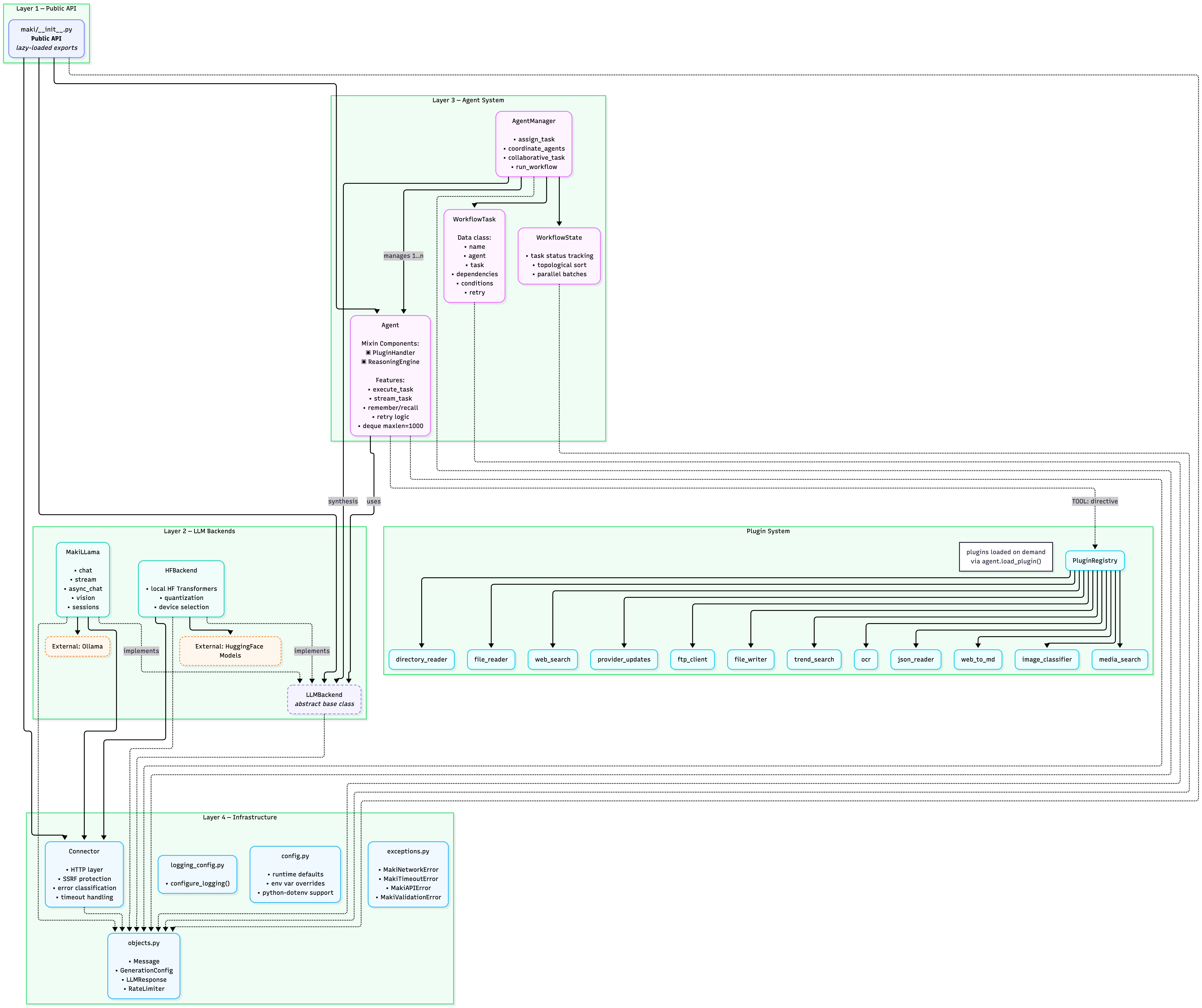
The framework is organized into four layers:
- Public API —
maki/__init__.pylazy-loads all exports on first access - LLM Backends —
MakiLLama,MakiOpenAI,MakiAnthropic, andHFBackendall implement the abstractLLMBackendcontract - Agent System —
AgentcomposesPluginHandlerandReasoningEnginemixins;AgentManagerorchestrates agents viaWorkflowTaskandWorkflowState - Distributed Layer —
AgentServer(FastAPI) exposes agents over HTTP;AgentProxyprovides a remote-agent client with circuit-breaking;DistributedAgentManagermixes local and remote agents - Infrastructure —
Connector(SSRF-protected HTTP with connect-time IP pinning), shared data classes, typed exceptions, runtime config, and structured logging
The Plugin System sits alongside the Agent layer: plugins are loaded on demand and invoked automatically when the LLM emits a TOOL: directive or via native tool-calling APIs (Ollama, OpenAI, Anthropic).
Features
MakiLLama— Ollama chat API with synchronous, streaming, async, and vision-capable workflowsMakiOpenAI— OpenAI chat completions, including reasoning models (o3/o4)MakiAnthropic— Anthropic messages API (Claude Sonnet, Haiku, Opus)HFBackend— direct HuggingFace Transformers integration with quantization and device selectionAgent— role-based agents with task execution, memory, reasoning, and plugin support; per-agent execution lock for concurrent safetyAgentManager— multi-agent orchestration: sequential pipelines, collaborative tasks, and dependency-aware workflows with parallel batching and checkpoint/resumeConversationMemory— token-budgeted, pair-based conversation history shared byAgent(stateful mode) andChatSession- Native tool-calling for all backends (Ollama
tools=, OpenAI, Anthropic tool use) with multi-round execution and self-correction - 16 built-in plugins covering files, web content, search, trading, and memory
- Distributed agent serving:
maki serveexposes any agent over HTTP;AgentProxyconsumes remote agents transparently - SSRF-protected HTTP connector with DNS pinning, error classification, and configurable timeouts
- Fail-closed plugin security: every plugin declares
ALLOWED_METHODS; destructive methods require explicit opt-in - Explicit logging setup and a typed exception hierarchy
Installation
curl -fsSL https://raw.githubusercontent.com/BowlOfData/maki/main/install.sh | bash
This clones the repo into ~/.maki, installs it into an isolated virtual environment, and symlinks the maki command into ~/.local/bin (override with the MAKI_INSTALL_DIR / MAKI_BIN_DIR env vars). Re-run it any time to update to the latest main.
From source
pip install -e .
For development tools:
pip install -e ".[dev]"
Some built-in plugins and backends rely on optional extras (defined in pyproject.toml):
maki-framework[web]—feedparser,readability-lxml,html2text(web search / web-to-Markdown)maki-framework[trends]—pytrends(Google Trends)maki-framework[alpaca]—alpaca-py(market data, news, trading, streaming)maki-framework[ftp]—paramiko(FTP/SFTP)maki-framework[gui]—PySide6(desktop GUI)maki-framework[openai]—openai(OpenAI backend)maki-framework[anthropic]—anthropic(Anthropic backend)maki-framework[distributed]—fastapi,uvicorn,pyyaml(agent server and proxies)maki-framework[distributed-redis]—redis(Redis workflow checkpoints)
Install everything with pip install -e ".[all]".
Configuration
Shared runtime defaults live in maki/config.py. All values are overridable via environment variables or a .env file (python-dotenv is supported).
| Variable | Description |
|---|---|
MAKI_OLLAMA_BASE_URL | Full Ollama base URL |
MAKI_OLLAMA_HOST | Ollama hostname |
MAKI_OLLAMA_PORT | Ollama port |
MAKI_DEFAULT_MODEL | Default model name |
MAKI_DEFAULT_TEMPERATURE | Sampling temperature |
MAKI_REQUEST_TIMEOUT | Per-request timeout (seconds) |
MAKI_HTTP_TIMEOUT | Low-level HTTP timeout |
MAKI_LOG_LEVEL | Logging level |
MAKI_WEB_USER_AGENT | User-agent string for web plugins |
Quick Start
Basic request
from maki import MakiLLama

llm = MakiLLama(model="gemma4:26b")
response = llm.chat("Explain recursion in one sentence.")
print(response.content)
Chat, streaming, and async
import asyncio
from maki import MakiLLama
from maki.objects import GenerationConfig

config = GenerationConfig(temperature=0.7, max_tokens=512)
llm = MakiLLama(model="gemma4:26b", config=config)

reply = llm.chat("Give me three project naming ideas.")
print(reply.content)

for chunk in llm.stream("Write a short haiku about testing"):
    print(chunk, end="", flush=True)

async def main():
    response = await llm.async_chat("Summarize the benefits of type hints.")
    print(response.content)

asyncio.run(main())
Stateful session
from maki import MakiLLama

llm = MakiLLama(model="gemma4:26b")
session = llm.session(system="You are a concise engineering assistant.")

session.say("We are building a release checklist.")
response = session.say("What should we verify before publishing a Python package?")
print(response.content)
Hosted backends
from maki import MakiOpenAI, MakiAnthropic

# OpenAI
llm = MakiOpenAI(model="gpt-4o")
response = llm.chat("What is the capital of France?")

# Anthropic
llm = MakiAnthropic(model="claude-sonnet-4-5")
response = llm.chat("Summarize this code in one sentence.")
Agents
Basic agent
from maki import MakiLLama
from maki.agents import Agent

llm = MakiLLama(model="gemma4:26b")
agent = Agent(
    name="Reviewer",
    maki_instance=llm,
    role="code reviewer",
    instructions="Focus on bugs, regressions, and missing validation.",
    stateful=True,
)

result = agent.execute_task("Review this design: a plugin system with file access.")
print(result)
Memory and reasoning helpers
agent.remember("repo", "maki")
print(agent.recall("repo"))

steps = agent.think_step_by_step("How should we structure plugin validation?")
subtasks = agent.decompose_task("Prepare this repository for a public release")
Streaming task execution
for chunk in agent.stream_task("Draft a short changelog entry."):
    print(chunk, end="", flush=True)
Long-running tasks with use_streaming
By default, execute_task sends one blocking HTTP request. For tasks that exceed the configured timeout (default 120 s), set use_streaming=True — the timeout then applies per chunk rather than to the whole response.
agent = Agent(
    name="Ranker",
    maki_instance=llm,
    role="content ranker",
    use_streaming=True,
)

result = agent.execute_task("Rank these 50 articles by relevance: ...")
print(result)
Agent Manager and Workflows
AgentManager coordinates multiple agents and can run collaborative or dependency-aware workflows.
from maki import MakiLLama
from maki.agents import AgentManager, WorkflowTask

llm = MakiLLama(model="gemma4:26b")
manager = AgentManager(llm)

manager.add_agent("Researcher", role="researcher")
manager.add_agent("Writer", role="writer")

workflow = [
    WorkflowTask(
        name="research",
        agent="Researcher",
        task="Find the main public-release risks for this repository.",
    ),
    WorkflowTask(
        name="summary",
        agent="Writer",
        task="Summarize the research into a release checklist.",
        dependencies=["research"],
    ),
]

results = manager.run_workflow(workflow)
print(results["summary"]["result"])
Supported manager patterns:
| Method | Behaviour |
|---|---|
assign_task() | Route a single task to one named agent |
coordinate_agents() | Sequential multi-agent pipeline with optional synthesis step |
collaborative_task() | All agents work on the same task independently |
run_workflow() | Dependency-aware execution with retries and optional parallel batches |
Distributed Layer
Serve any agent over HTTP with maki serve:
maki serve --config agent.yaml --host 127.0.0.1 --port 8100
# agent.yaml
name: MyAgent
model: gemma4:27b
role: assistant
plugins:
  - web_search
  - file_reader
Connect to a remote agent from another process:
from maki.distributed.proxy import AgentProxy

agent = AgentProxy(name="MyAgent", base_url="http://127.0.0.1:8100")
result = agent.execute_task("Summarize the latest AI news.")
DistributedAgentManager lets you mix local and remote agents in the same workflow.
Plugins
Built-in plugins are registered in maki/plugins/__init__.py:
| Plugin | Description | Extra |
|---|---|---|
directory_reader | List and inspect directory contents | — |
file_reader | Read files from disk | — |
file_writer | Write files to disk | — |
json_reader | Parse and query JSON files | — |
image_classifier | Classify images via a local model | — |
ocr | Extract text from images | — |
web_search | RSS, HackerNews, Reddit, GitHub Trending, Lobste.rs | web |
web_to_md | Fetch a URL and convert to Markdown | web |
provider_updates | Fetch LLM provider release notes | web |
trend_search | Google Trends queries | trends |
ftp_client | FTP/SFTP file transfers | ftp |
alpaca_data | Crypto bar and quote data | alpaca |
alpaca_news | Financial news from Alpaca and RSS | alpaca |
alpaca_trading | Submit and manage Alpaca trades | alpaca |
alpaca_stream | Live crypto data stream | alpaca |
obsidian_memory | Persistent note-based memory (Obsidian vault) | — |
rag_memory | Retrieval-augmented memory with pluggable vector backends | — |
Loading a plugin in an agent
from maki import MakiLLama
from maki.agents import Agent

llm = MakiLLama(model="gemma4:26b")
agent = Agent(name="ToolUser", maki_instance=llm, role="assistant")
agent.load_plugin("file_reader")

result = agent.execute_task(
    "Read the first lines of README.md and summarize them.",
    use_plugins=True,
)
print(result)
When use_plugins=True (or the backend supports native tool-calling), available plugin methods are advertised to the model and executed automatically. Destructive methods (file writes, trades, FTP deletes) require Agent(allow_dangerous_tools=True).
HuggingFace Backend
HFBackend runs models directly via HuggingFace Transformers — no Ollama required.
from maki import HFBackend

llm = HFBackend(model="mistralai/Mistral-7B-Instruct-v0.2", device="cuda")
response = llm.chat("Explain attention mechanisms.")
print(response.content)
Supports quantization and device selection (cpu, cuda, mps).
Public API
Top-level imports exposed by maki:
MakiLLama,MakiOpenAI,MakiAnthropic,HFBackendLLMBackend,BackendTypeAgent,AgentManagerGenerationConfig,LLMResponse,Message,ToolCallConversationMemory,RateLimiterConnector,Utilsconfig
All exports are lazy-loaded on first access.
Desktop App
The repository includes a PySide6/QML desktop shell (requires maki-framework[gui]):
maki-gui
Testing
pytest
888 tests covering backends, agents, workflows, plugins, connectors, distributed layer, and security-related behaviour. Tests marked @pytest.mark.network (requiring live external services) are excluded by default; run them explicitly with pytest -m network.
Contributing
Contributions are welcome: bug fixes, documentation improvements, new plugins, and feature suggestions all help move the project forward. Open an issue or submit a pull request on GitHub.
If you are interested in this line of research, consider joining Bowl of Data, an open-source AI research community.
License
Contributors

237 commits

2 commits
Similar repos


Languages
Python
98.2%
HTML
1.5%
See what people are saying (1)
README
Maki
Maki is a Python framework for building multi-agent LLM applications. It supports multiple LLM backends (Ollama, OpenAI, Anthropic, HuggingFace), a plugin system with 16 built-in tools, a workflow engine with dependency resolution and parallel execution, and a distributed layer for serving agents over HTTP.
Architecture
The framework is organized into four layers:
- Public API —
maki/__init__.pylazy-loads all exports on first access - LLM Backends —
MakiLLama,MakiOpenAI,MakiAnthropic, andHFBackendall implement the abstractLLMBackendcontract - Agent System —
AgentcomposesPluginHandlerandReasoningEnginemixins;AgentManagerorchestrates agents viaWorkflowTaskandWorkflowState - Distributed Layer —
AgentServer(FastAPI) exposes agents over HTTP;AgentProxyprovides a remote-agent client with circuit-breaking;DistributedAgentManagermixes local and remote agents - Infrastructure —
Connector(SSRF-protected HTTP with connect-time IP pinning), shared data classes, typed exceptions, runtime config, and structured logging
The Plugin System sits alongside the Agent layer: plugins are loaded on demand and invoked automatically when the LLM emits a TOOL: directive or via native tool-calling APIs (Ollama, OpenAI, Anthropic).
Features
MakiLLama— Ollama chat API with synchronous, streaming, async, and vision-capable workflowsMakiOpenAI— OpenAI chat completions, including reasoning models (o3/o4)MakiAnthropic— Anthropic messages API (Claude Sonnet, Haiku, Opus)HFBackend— direct HuggingFace Transformers integration with quantization and device selectionAgent— role-based agents with task execution, memory, reasoning, and plugin support; per-agent execution lock for concurrent safetyAgentManager— multi-agent orchestration: sequential pipelines, collaborative tasks, and dependency-aware workflows with parallel batching and checkpoint/resumeConversationMemory— token-budgeted, pair-based conversation history shared byAgent(stateful mode) andChatSession- Native tool-calling for all backends (Ollama
tools=, OpenAI, Anthropic tool use) with multi-round execution and self-correction - 16 built-in plugins covering files, web content, search, trading, and memory
- Distributed agent serving:
maki serveexposes any agent over HTTP;AgentProxyconsumes remote agents transparently - SSRF-protected HTTP connector with DNS pinning, error classification, and configurable timeouts
- Fail-closed plugin security: every plugin declares
ALLOWED_METHODS; destructive methods require explicit opt-in - Explicit logging setup and a typed exception hierarchy
Installation
curl -fsSL https://raw.githubusercontent.com/BowlOfData/maki/main/install.sh | bash
This clones the repo into ~/.maki, installs it into an isolated virtual environment, and symlinks the maki command into ~/.local/bin (override with the MAKI_INSTALL_DIR / MAKI_BIN_DIR env vars). Re-run it any time to update to the latest main.
From source
pip install -e .
For development tools:
pip install -e ".[dev]"
Some built-in plugins and backends rely on optional extras (defined in pyproject.toml):
maki-framework[web]—feedparser,readability-lxml,html2text(web search / web-to-Markdown)maki-framework[trends]—pytrends(Google Trends)maki-framework[alpaca]—alpaca-py(market data, news, trading, streaming)maki-framework[ftp]—paramiko(FTP/SFTP)maki-framework[gui]—PySide6(desktop GUI)maki-framework[openai]—openai(OpenAI backend)maki-framework[anthropic]—anthropic(Anthropic backend)maki-framework[distributed]—fastapi,uvicorn,pyyaml(agent server and proxies)maki-framework[distributed-redis]—redis(Redis workflow checkpoints)
Install everything with pip install -e ".[all]".
Configuration
Shared runtime defaults live in maki/config.py. All values are overridable via environment variables or a .env file (python-dotenv is supported).
| Variable | Description |
|---|---|
MAKI_OLLAMA_BASE_URL | Full Ollama base URL |
MAKI_OLLAMA_HOST | Ollama hostname |
MAKI_OLLAMA_PORT | Ollama port |
MAKI_DEFAULT_MODEL | Default model name |
MAKI_DEFAULT_TEMPERATURE | Sampling temperature |
MAKI_REQUEST_TIMEOUT | Per-request timeout (seconds) |
MAKI_HTTP_TIMEOUT | Low-level HTTP timeout |
MAKI_LOG_LEVEL | Logging level |
MAKI_WEB_USER_AGENT | User-agent string for web plugins |
Quick Start
Basic request
from maki import MakiLLama

llm = MakiLLama(model="gemma4:26b")
response = llm.chat("Explain recursion in one sentence.")
print(response.content)
Chat, streaming, and async
import asyncio
from maki import MakiLLama
from maki.objects import GenerationConfig

config = GenerationConfig(temperature=0.7, max_tokens=512)
llm = MakiLLama(model="gemma4:26b", config=config)

reply = llm.chat("Give me three project naming ideas.")
print(reply.content)

for chunk in llm.stream("Write a short haiku about testing"):
    print(chunk, end="", flush=True)

async def main():
    response = await llm.async_chat("Summarize the benefits of type hints.")
    print(response.content)

asyncio.run(main())
Stateful session
from maki import MakiLLama

llm = MakiLLama(model="gemma4:26b")
session = llm.session(system="You are a concise engineering assistant.")

session.say("We are building a release checklist.")
response = session.say("What should we verify before publishing a Python package?")
print(response.content)
Hosted backends
from maki import MakiOpenAI, MakiAnthropic

# OpenAI
llm = MakiOpenAI(model="gpt-4o")
response = llm.chat("What is the capital of France?")

# Anthropic
llm = MakiAnthropic(model="claude-sonnet-4-5")
response = llm.chat("Summarize this code in one sentence.")
Agents
Basic agent
from maki import MakiLLama
from maki.agents import Agent

llm = MakiLLama(model="gemma4:26b")
agent = Agent(
    name="Reviewer",
    maki_instance=llm,
    role="code reviewer",
    instructions="Focus on bugs, regressions, and missing validation.",
    stateful=True,
)

result = agent.execute_task("Review this design: a plugin system with file access.")
print(result)
Memory and reasoning helpers
agent.remember("repo", "maki")
print(agent.recall("repo"))

steps = agent.think_step_by_step("How should we structure plugin validation?")
subtasks = agent.decompose_task("Prepare this repository for a public release")
Streaming task execution
for chunk in agent.stream_task("Draft a short changelog entry."):
    print(chunk, end="", flush=True)
Long-running tasks with use_streaming
By default, execute_task sends one blocking HTTP request. For tasks that exceed the configured timeout (default 120 s), set use_streaming=True — the timeout then applies per chunk rather than to the whole response.
agent = Agent(
    name="Ranker",
    maki_instance=llm,
    role="content ranker",
    use_streaming=True,
)

result = agent.execute_task("Rank these 50 articles by relevance: ...")
print(result)
Agent Manager and Workflows
AgentManager coordinates multiple agents and can run collaborative or dependency-aware workflows.
from maki import MakiLLama
from maki.agents import AgentManager, WorkflowTask

llm = MakiLLama(model="gemma4:26b")
manager = AgentManager(llm)

manager.add_agent("Researcher", role="researcher")
manager.add_agent("Writer", role="writer")

workflow = [
    WorkflowTask(
        name="research",
        agent="Researcher",
        task="Find the main public-release risks for this repository.",
    ),
    WorkflowTask(
        name="summary",
        agent="Writer",
        task="Summarize the research into a release checklist.",
        dependencies=["research"],
    ),
]

results = manager.run_workflow(workflow)
print(results["summary"]["result"])
Supported manager patterns:
| Method | Behaviour |
|---|---|
assign_task() | Route a single task to one named agent |
coordinate_agents() | Sequential multi-agent pipeline with optional synthesis step |
collaborative_task() | All agents work on the same task independently |
run_workflow() | Dependency-aware execution with retries and optional parallel batches |
Distributed Layer
Serve any agent over HTTP with maki serve:
maki serve --config agent.yaml --host 127.0.0.1 --port 8100
# agent.yaml
name: MyAgent
model: gemma4:27b
role: assistant
plugins:
  - web_search
  - file_reader
Connect to a remote agent from another process:
from maki.distributed.proxy import AgentProxy

agent = AgentProxy(name="MyAgent", base_url="http://127.0.0.1:8100")
result = agent.execute_task("Summarize the latest AI news.")
DistributedAgentManager lets you mix local and remote agents in the same workflow.
Plugins
Built-in plugins are registered in maki/plugins/__init__.py:
| Plugin | Description | Extra |
|---|---|---|
directory_reader | List and inspect directory contents | — |
file_reader | Read files from disk | — |
file_writer | Write files to disk | — |
json_reader | Parse and query JSON files | — |
image_classifier | Classify images via a local model | — |
ocr | Extract text from images | — |
web_search | RSS, HackerNews, Reddit, GitHub Trending, Lobste.rs | web |
web_to_md | Fetch a URL and convert to Markdown | web |
provider_updates | Fetch LLM provider release notes | web |
trend_search | Google Trends queries | trends |
ftp_client | FTP/SFTP file transfers | ftp |
alpaca_data | Crypto bar and quote data | alpaca |
alpaca_news | Financial news from Alpaca and RSS | alpaca |
alpaca_trading | Submit and manage Alpaca trades | alpaca |
alpaca_stream | Live crypto data stream | alpaca |
obsidian_memory | Persistent note-based memory (Obsidian vault) | — |
rag_memory | Retrieval-augmented memory with pluggable vector backends | — |
Loading a plugin in an agent
from maki import MakiLLama
from maki.agents import Agent

llm = MakiLLama(model="gemma4:26b")
agent = Agent(name="ToolUser", maki_instance=llm, role="assistant")
agent.load_plugin("file_reader")

result = agent.execute_task(
    "Read the first lines of README.md and summarize them.",
    use_plugins=True,
)
print(result)
When use_plugins=True (or the backend supports native tool-calling), available plugin methods are advertised to the model and executed automatically. Destructive methods (file writes, trades, FTP deletes) require Agent(allow_dangerous_tools=True).
HuggingFace Backend
HFBackend runs models directly via HuggingFace Transformers — no Ollama required.
from maki import HFBackend

llm = HFBackend(model="mistralai/Mistral-7B-Instruct-v0.2", device="cuda")
response = llm.chat("Explain attention mechanisms.")
print(response.content)
Supports quantization and device selection (cpu, cuda, mps).
Public API
Top-level imports exposed by maki:
MakiLLama,MakiOpenAI,MakiAnthropic,HFBackendLLMBackend,BackendTypeAgent,AgentManagerGenerationConfig,LLMResponse,Message,ToolCallConversationMemory,RateLimiterConnector,Utilsconfig
All exports are lazy-loaded on first access.
Desktop App
The repository includes a PySide6/QML desktop shell (requires maki-framework[gui]):
maki-gui
Testing
pytest
888 tests covering backends, agents, workflows, plugins, connectors, distributed layer, and security-related behaviour. Tests marked @pytest.mark.network (requiring live external services) are excluded by default; run them explicitly with pytest -m network.
Contributing
Contributions are welcome: bug fixes, documentation improvements, new plugins, and feature suggestions all help move the project forward. Open an issue or submit a pull request on GitHub.
If you are interested in this line of research, consider joining Bowl of Data, an open-source AI research community.
License
Similar repos
Contributors
237 commits
2 commits
Languages
Python
98.2%
HTML
1.5%