Smoothly deprecate and redirect Python functions/classes with smart warnings and auto-routing—keep your codebase clean while maintaining backward compatibility
See the code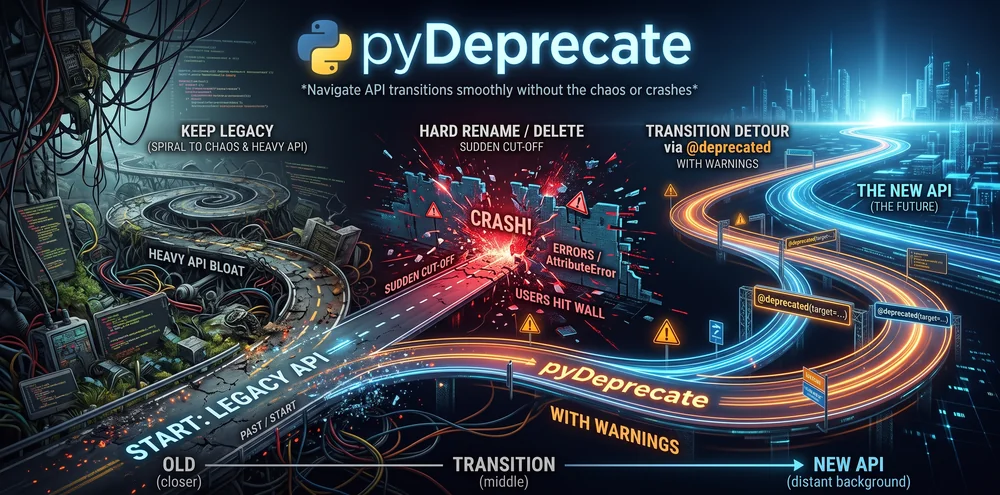
Deprecate Python APIs without breaking existing callers.
Use pyDeprecate when you renamed a function, moved a class, or retired an argument but still need old user code to work during the migration window. A single decorator can emit a clear warning, forward the call to the new implementation, remap old argument names, and expose metadata that CI audit tools can enforce when the removal deadline arrives.
Core capabilities:
Author: Jiri Borovec · License: Apache 2.0 · Python: 3.9+ · Import:
from deprecate import deprecated, deprecated_class· Docs: https://borda.github.io/pyDeprecate/
The common case is moving functionality across modules, packages, or public API names without breaking callers immediately. You keep the old entry point temporarily, show users what changed, and forward them to the replacement until the old name can be removed.
pyDeprecate also avoids warning spam: each deprecated function or class warns once by default, and you can route messages through Python warnings, logging, or any custom stream.
pip install pyDeprecate


Read: Mastering API Deprecation in Python — the pain points and how pyDeprecate can help — CodeX / Medium
targetdef gen(): yield — warning fires eagerly at call time, before iteration begins), and async def coroutine functions (wrapper is async def, inspect.iscoroutinefunction(wrapper) returns True; warning fires when the coroutine is awaited)@property — all three accessors (fget, fset, fdel) fire FutureWarning; chain-style .setter() / .deleter() rebinding preserved via _DeprecatedProperty subclass. Also supports @cached_property (getter-only — no fset/fdel).deprecated_class for types; deprecated_instance for objects, with optional read-only enforcement — blocks standard collection mutators: append, pop, update, clear, etc.; custom mutator names bypass this guard)args_extra for injecting fixed forwarded kwargs, and conditional skip_if behaviorassert_no_warnings, formerly no_warning_call) for deterministic testsRequires Python 3.9 or later.
Choose the install that matches the workflow you need:
| Workflow | Command | Includes |
|---|---|---|
| Runtime deprecation wrappers | pip install pyDeprecate | @deprecated, @deprecated_class, deprecated_instance, docstring helpers, and most audit metadata helpers |
| CI deadline checks | pip install 'pyDeprecate[audit]' | Adds packaging for PEP 440 version comparison in validate_deprecation_expiry() and validate_deprecation_policy() |
| Command-line audit workflows | pip install 'pyDeprecate[audit,cli]' | Adds CLI dependencies (fire, rich) plus version support for pydeprecate expiry, pydeprecate policy, and pydeprecate all |
Base installation from PyPI:
pip install pyDeprecate
Simply install with pip from source:
pip install https://github.com/Borda/pyDeprecate/archive/main.zip
This repository includes a pydeprecate plugin for Codex and Claude Code, available from the repository's default branch (early, pre-1.0). It is a separate artifact from the pyDeprecate library and is not installed by pip.
Install it from GitHub:
# Codex
codex plugin marketplace add Borda/pyDeprecate
codex plugin add pydeprecate@pydeprecate

# Claude Code
claude plugin marketplace add Borda/pyDeprecate
claude plugin install pydeprecate@pydeprecate
For local development or unpublished changes, run these commands from the repository root with . instead of Borda/pyDeprecate in the marketplace-add command. The plugin-install command stays the same.
Use $pydeprecate:sunset / $pydeprecate:prune in Codex, or /pydeprecate:sunset / /pydeprecate:prune in Claude Code, to implement or retire a deprecation — see the coding-agent recipes for invocation examples, host commands, and workflow boundaries.
Here's the simplest way to get started with deprecating a function:
from deprecate import deprecated


# NEW/FUTURE API — renamed to be more explicit about what it computes
def compute_sum(a: int = 0, b: int = 3) -> int:
    return a + b


# DEPRECATED API — `addition` was the original name before the rename
@deprecated(target=compute_sum, deprecated_in="1.0", remove_in="2.0")
def addition(a: int, b: int = 5) -> int:
    pass  # body is not needed — calls are forwarded to compute_sum


# Using the original name still works but shows a warning
result = addition(1, 2)  # Returns 3
# Warning: The `addition` was deprecated since v1.0 in favor of `__main__.compute_sum`.
#          It will be removed in v2.0.
print(result)
addition(1, 2)3
That's it! All calls to addition() are automatically forwarded to compute_sum() with a deprecation warning.
[!IMPORTANT]
When
target=<callable>is set, pyDeprecate intercepts the call before the body executes — the body is dead code under normal forwarding. Exception: ifskip_ifevaluatesTrueat call time, the source body runs as the fallback, so keep a working implementation when combiningtarget=<callable>withskip_if.
Not sure which API to reach for? Start here.
Pick the right decorator:
| Scenario | API to use |
|---|---|
| Renaming a function or method | @deprecated(target=new_func) |
| Renaming an argument within the same function | @deprecated(target=TargetMode.ARGS_REMAP, args_mapping={"old": "new"}) |
| Warn only — original body still runs | @deprecated(deprecated_in="1.0", remove_in="2.0") |
| Deprecating a class, Enum, or dataclass name | @deprecated_class(target=NewClass) |
| Deprecating a module-level constant or object | deprecated_instance(obj, ...) |
| Retiring an entire module | deprecated_module(__name__, ...) |
| Refusing a class up front (strict callables) | @deprecated_callable(target=new_func) |
| Annotating the proxy the two proxy forms return | DeprecationProxy |
Note: Legacy
target=Noneandtarget=TrueemitFutureWarningat decoration time in v0.8 and becomeTypeErrorin v1.0. UseTargetMode.NOTIFYandTargetMode.ARGS_REMAPrespectively.
| Param | Default | Purpose |
|---|---|---|
target | TargetMode.AUTO | Callable to forward to · TargetMode.ARGS_REMAP to remap args · TargetMode.NOTIFY warn-only · TargetMode.AUTO (default) infers the mode from the other arguments |
deprecated_in | "" | Version when deprecated (e.g. "1.0") |
remove_in | "" | Version when removed (e.g. "2.0") |
| Advanced: ~10% of cases | ||
stream | deprecation_warning | Warning sink callable (set None to silence warnings) |
num_warns | 1 | 0 never · 1 once · -1 always · N exactly N times |
args_mapping | None | {"old": "new"} rename · {"old": None} drop |
message_template | None | Custom warning message template (%-style placeholders) |
args_extra | None | Fixed kwargs injected into the target call |
skip_if | False | bool or Callable → bool; deactivate the deprecation machinery when true |
as_exception | None | Raise DeprecatedError instead of warning; None follows the global deprecate.AS_EXCEPTIONS |
update_docstring | False | Append Sphinx .. deprecated:: notice to docstring |
docstring_style | "auto" | Docstring notice format: auto · rst · mkdocs/markdown |
[!TIP]
All three decorators share every parameter above. The only differences:
deprecated_class()adds the class-onlyattrs_mapping(attribute-name remapping —TypeErroron the other two), and a class source is dispatched todeprecated_classby@deprecatedbut rejected withTypeErrorbydeprecated_callable().TargetMode.AUTOis front-door-only:deprecated_callable()defaultstargettoTargetMode.NOTIFY,deprecated_class()leaves it unset, and both raiseTypeErrorwhen handedTargetMode.AUTOexplicitly.deprecated_instance()sharesdeprecated_in,remove_in,num_warns,stream,args_extra,message_template,skip_if, andas_exception; it requiresobjand addsname(display name) andread_only.
💬 How does pyDeprecate compare to other Python deprecation solutions?
Most alternatives emit a deprecation notice. pyDeprecate is for migrations where the old API must keep working: it can forward calls, remap arguments, wrap class/object aliases, and audit removal deadlines.
warnings.warn (stdlib): the lowest-friction option for simple internal warnings.deprecation (Lib): a widely used library by Brian Curtin with version-based deprecation helpers.Deprecated (wrapt): a decorator-based library by Laurent Laporte with wrapt integration.def fn(): yield), async def coroutines, and async generators (async def fn(): yield) — the deprecation warning fires at call time regardless of callable type, and the wrapper preserves the correct introspection flags (iscoroutinefunction, etc.).deprecated_in and remove_in versions for better lifecycle management.logging, standard warnings, or any custom callable to fit your monitoring stack.assert_no_warnings() ensure your deprecations are testable and deterministic.deprecated_class, deprecated_instance).pyDeprecate[audit] extra — enforce removal deadlines (PEP 440) and detect deprecated-to-deprecated chains.warnings.deprecated — type checkers recognise that decorator by name only. For both static-checker hints and runtime call-forwarding, stack @warnings.deprecated("literal message", category=None) directly above pyDeprecate's @deprecated(...); category=None keeps the runtime warning pyDeprecate-only. The package ships py.typed and keeps decorated signatures intact for type checkers, and find_deprecation_wrappers(..., include_pep702=True) also lists symbols deprecated with the PEP 702 decorator alone.@deprecated decorators for multi-version migrations — rename arguments across releases (ARGS_REMAP + ARGS_REMAP), then deprecate the whole function when a complete replacement arrives (ARGS_REMAP + NOTIFY). Unsupported combinations warn at decoration time.deprecate.docstring.sphinx_ext) so _DeprecatedProxy objects are documented with their injected deprecation notice instead of rendering as opaque aliases.deprecate.docstring.griffe_ext) for mkdocstrings so runtime-injected !!! warning admonitions are visible in MkDocs-generated API docs.When to prefer
warnings.deprecated(PEP 702): If your project targets Python 3.13+ and you only need simple call-site warnings visible to static type-checkers (mypy, pyright, IDEs), the stdlib decorator is the right choice — zero extra dependency.warnings.warntells users what is deprecated; pyDeprecate tells users what to use instead and does the forwarding for them. ChoosepyDeprecatewhen you need call-forwarding, argument remapping, proxy wrapping of module-level constants, or CI audit tools — none of those exist in PEP 702. On Python < 3.13,typing_extensions.deprecatedrequirestyping_extensions(marked ✍️ for that reason).
| Feature | pyDeprecate | warnings.warn (stdlib) | deprecation (Lib) | Deprecated (wrapt) | warnings.deprecated† (py3.13+) |
|---|---|---|---|---|---|
| Simple Warnings | ✅ | ✅ | ✅ | ✅ | ✅ |
| Auto-Forward Calls | ✅ | ❌ | ❌ | ❌ | ❌ |
| Generator / Async | ✅ | ❌ | ❌ | ❌ | ❌ |
| Argument Mapping | ✅ | ❌ | ❌ | ❌ | ❌ |
| Argument Deprecation | ✅ | ✍️ | ❌ | ❌ | ❌ |
| Class/Instance Proxy | ✅ | ❌ | ❌ | ❌ | ❌ |
| Docstring Updates | ✅ | ❌ | ✅ | ✅ | ❌ |
| Version Tracking | ✅ | ✍️ | ✅ | ✅ | ❌ |
| Prevent Log Spam | ✅ | ✍️ | ❌ | ❌ | ❌ |
| Zero Extra Depend. | ✅ | ✅ | ❌ | ❌ | † |
| Custom Streams | ✅ | ✍️ | ❌ | ❌ | ❌ |
| Testing Helpers | ✅ | ❌ | ❌ | ❌ | ❌ |
| CI/Audit Tools | ✅ | ❌ | ❌ | ❌ | ❌ |
| Static Checker Signal | ✍️ | ❌ | ❌ | ❌ | ✅ |
| Decorator Stacking | ✅ | ❌ | ❌ | ❌ | ❌ |
| Sphinx Plugin | ✅ | ❌ | ❌ | ❌ | ❌ |
| MkDocs Plugin | ✅ | ❌ | ❌ | ❌ | ❌ |
✍️ = possible but requires manual implementation
† warnings.deprecated in the stdlib on Python 3.13+ (PEP 702); also available as typing_extensions.deprecated for Python < 3.13
This positioning guide is not a full cell-by-cell external audit and may drift from upstream tools over time; open an issue if you spot an inaccuracy.
Fair strengths in alternative tools worth considering:
warnings.deprecated is the best option when your top priority is IDE/type-checker diagnostics with no runtime behavior changes; it also adds no per-call runtime overhead when the warning category is suppressed.deprecation includes @fail_if_not_removed, a focused test helper for direct test-failure enforcement when removal deadlines are reached.Deprecated — deprecated.sphinx includes @versionadded and @versionchanged decorators that inject Sphinx directives into docstrings for lifecycle annotation in Sphinx-built API docs.warnings.warn stays the lowest-friction option for one-off internal warnings where compatibility shims are unnecessary.[!NOTE]
This comparison is compiled to the best of our knowledge and we're happy to make any justified corrections. If you spot an inaccuracy, please open an issue or submit a PR.
[!TIP]
Every deprecation variant writes the same
DeprecationConfig—@deprecated,deprecated_class,deprecated_instance, and the audit tools all read from a single source of truth. This means your CI pipeline (pydeprecate check src/) catches misconfigured wrappers across all three variants with one scan.
The functionality is kept simple and all defaults should be reasonable, but you can still do extra customization such as:
In particular the target values (cases):
target value | Use case | args_mapping | Warning trigger |
|---|---|---|---|
TargetMode.NOTIFY | Whole callable going away; no replacement yet | Ignored (warns; TypeError in v1.0) | Every call |
TargetMode.ARGS_REMAP | Callable stays; argument names are renamed | Required | Only when old arg names are passed |
<callable> | Callable replaced by another; calls forwarded | Optional | Every call |
TargetMode.AUTO (default) | Fallback for an omitted target — mode inferred at decoration time | Presence resolves ARGS_REMAP; absence resolves NOTIFY | Follows the resolved mode |
[!TIP]
Prefer passing an explicit
target— one of the first three rows — so the intent is visible at the call site.TargetMode.AUTOis only the default that resolves an omittedtarget. The front door does accept it explicitly — it behaves exactly as omittingtarget— but writing it says nothing an omittedtargetdoes not, so prefer the concrete mode; the strictdeprecated_callable()/deprecated_class()forms reject it outright withTypeError.TargetMode.NOTIFYreplaces the oldtarget=Nonesentinel andTargetMode.ARGS_REMAPreplaces the oldtarget=Truesentinel; the old forms still work but emit aFutureWarningat decoration time.
[!NOTE]
@deprecatedis primarily for functions and methods. Applied to a class it also works — it dispatches to@deprecated_class()(a permanent, supported path) and emits a one-time informationalUserWarning(only this notice is removed, in v1.0; suppressed bystream=None) — but prefer@deprecated_class()directly for classes, Enums, and dataclasses (see Deprecating Enums and dataclasses): same result, no notice, and it exposes class-only options such asattrs_mapping. If you want a strict callable-only form that refuses a class up front instead, use@deprecated_callable()— it shares every parameter with@deprecatedand raisesTypeErrorat decoration time when applied to a class.
It is very straightforward: you forward your function call to a new function and all arguments are mapped:
# NEW/FUTURE API — renamed to be more explicit about what it computes
def compute(a: int = 0, b: int = 3) -> int:
    """New function anywhere in the codebase or even other package."""
    return a + b


# ---------------------------

from deprecate import deprecated


# What this module looked like before the rename:
# def calculate(a: int, b: int = 5) -> int:
#     return a + b


# DEPRECATED API — `calculate` was the original name before the rename
@deprecated(target=compute, deprecated_in="0.1", remove_in="0.5")
def calculate(a: int, b: int = 5) -> int:
    """
    My deprecated function which now has an empty body
     as all calls are routed to the new function.
    """
    pass  # or you can just place docstring as one above


# calling this function will raise a deprecation warning:
#   The `calculate` was deprecated since v0.1 in favor of `__main__.compute`.
#   It will be removed in v0.5.
print(calculate(1, 2))
calculate(1, 2)3
@deprecated without the decorator syntaxWhen the deprecated name already exists as a callable (for example, imported from another package), you can apply deprecated() directly without redefining the function:
from deprecate import deprecated


# NEW/FUTURE API — in real usage this would be imported from another module
def compute_sum(a: int, b: int = 0) -> int:
    return a + b


# LEGACY — already-existing callable that is being deprecated
def addition(a: int, b: int = 0) -> int:
    return a + b


# DEPRECATED API — `calculate` was the original name in this package;
# wrap it without redefining a function body
calculate = deprecated(
    target=compute_sum,
    deprecated_in="0.5",
    remove_in="1.0",
)(addition)
print(calculate(1, 2))
calculate(1, 2)3
This is an equivalent to the @deprecated(...) decorator form but applied to an already-existing callable — useful when the deprecated function lives in a dependency you don't control.
Use argument mapping when the replacement function keeps the same meaning but uses different parameter names:
sklearn.metrics.accuracy_scoreimport logging
from sklearn.metrics import accuracy_score
from deprecate import deprecated, void
@deprecated(
# use standard sklearn accuracy implementation
target=accuracy_score,
# custom warning stream
stream=logging.warning,
# number of warnings per lifetime (with -1 for always)
num_warns=5,
# lifecycle metadata shown in the deprecation notice and audit output
deprecated_in="0.6",
remove_in="1.0",
# custom message template
message_template="`%(source_name)s` was deprecated, use `%(target_path)s`",
# as target args are different, define mapping from source to target func
args_mapping={"preds": "y_pred", "target": "y_true", "blabla": None},
)
def depr_accuracy(preds: list, target: list, blabla: float) -> float:
"""My deprecated function which is mapping to sklearn accuracy."""
# to stop complain your IDE about unused argument you can use void/empty function
return void(preds, target, blabla)
# calling this function will raise a deprecation warning:
# WARNING:root:`depr_accuracy` was deprecated, use `sklearn.metrics.accuracy_score`
print(depr_accuracy([1, 0, 1, 2], [0, 1, 1, 2], 1.23))
sample output:
0.5
Base use-case with no forwarding and just raising a warning:
from deprecate import deprecated


@deprecated(deprecated_in="0.1", remove_in="0.5")
def my_sum(a: int, b: int = 5) -> int:
    """My deprecated function which still has to have implementation."""
    return a + b


# calling this function will raise a deprecation warning:
#   The `my_sum` was deprecated since v0.1. It will be removed in v0.5.
print(my_sum(1, 2))
my_sum(1, 2)3
[!NOTE]
When using
TargetMode.NOTIFY, the deprecated function's implementation must be preserved and will be executed. The deprecation decorator only adds a warning without forwarding.
Use TargetMode.ARGS_REMAP when the function stays in place but one of its arguments has been renamed or removed:
from deprecate import TargetMode, deprecated


@deprecated(
    # rename an argument within the same function
    target=TargetMode.ARGS_REMAP,
    args_mapping={"coef": "new_coef"},
    # common version info
    deprecated_in="0.2",
    remove_in="0.4",
)
def any_pow(base: float, coef: float = 0, new_coef: float = 0) -> float:
    """My function with deprecated argument `coef` mapped to `new_coef`."""
    return base**new_coef


# calling this function will raise a deprecation warning:
#   The `any_pow` uses deprecated arguments: `coef` -> `new_coef`.
#   They were deprecated since v0.2 and will be removed in v0.4.
print(any_pow(2, 3))
any_pow(2, 3)8
To drop an argument entirely (warn when it's passed, then discard it), map it to None:
from deprecate import TargetMode, deprecated
from typing import Optional


@deprecated(
    target=TargetMode.ARGS_REMAP,
    args_mapping={"legacy_param": None},
    deprecated_in="1.8",
    remove_in="1.9",
)
def my_func(value: int, legacy_param: Optional[str] = None) -> int:
    """legacy_param is no longer used; pass None or omit it."""
    return value * 2


# Passing the removed argument triggers a warning and the argument is silently discarded:
#   The `my_func` uses deprecated arguments: `legacy_param` -> `None`.
#   They were deprecated since v1.8 and will be removed in v1.9.
print(my_func(value=42, legacy_param="old"))
my_func(value=42, legacy_param="old")84
[!WARNING]
TargetMode.ARGS_REMAPwithoutargs_mappingis a misconfiguration; using it emits a construction-timeUserWarning. This will become aTypeErrorin v1.0. If you only want to warn callers with no forwarding or remapping, useTargetMode.NOTIFYinstead.
Stack @deprecated decorators to handle multi-version deprecation migrations. Each layer tracks its own version range and warning count independently.
from deprecate import TargetMode, deprecated


@deprecated(
    target=TargetMode.ARGS_REMAP,
    deprecated_in="0.3",
    remove_in="0.6",
    args_mapping=dict(c1="nc1"),
    message_template="Depr: v%(deprecated_in)s rm v%(remove_in)s for args: %(argument_map)s.",
)
@deprecated(
    target=TargetMode.ARGS_REMAP,
    deprecated_in="0.4",
    remove_in="0.7",
    args_mapping=dict(nc1="nc2"),
    message_template="Depr: v%(deprecated_in)s rm v%(remove_in)s for args: %(argument_map)s.",
)
def any_pow(base, c1: float = 0, nc1: float = 0, nc2: float = 2) -> float:
    return base**nc2


# calling this function will raise deprecation warnings:
#   FutureWarning('Depr: v0.3 rm v0.6 for args: `c1` -> `nc1`.')
#   FutureWarning('Depr: v0.4 rm v0.7 for args: `nc1` -> `nc2`.')
print(any_pow(2, 3))
code output:
8
Rename an argument in v1.0, then deprecate the whole function in v2.0 when a complete replacement exists. ARGS_REMAP must be the outermost (top) decorator; NOTIFY goes below it.
from deprecate import TargetMode, deprecated


@deprecated(TargetMode.ARGS_REMAP, deprecated_in="1.0", remove_in="2.0", args_mapping={"factor": "scale"})
@deprecated(TargetMode.NOTIFY, deprecated_in="2.0", remove_in="3.0")
def compute_power(base: float, factor: float = 1, scale: float = 1) -> float:
    return base**scale


print(compute_power(2, factor=3))  # → 2 warnings (arg rename + function deprecated)
print(compute_power(2, scale=3))  # → 1 warning  (function deprecated only)
compute_power(2, factor=3); compute_power(2, scale=3)8
8
| Outer (top) | Inner (bottom) | Status | Notes |
|---|---|---|---|
ARGS_REMAP | ARGS_REMAP | ✓ Supported | Multi-step argument renames across versions |
ARGS_REMAP | NOTIFY | ✓ Supported | Lifecycle: rename args first, then deprecate the whole function |
NOTIFY | callable | ✓ Supported | Outer NOTIFY warns callers; inner callable handles forwarding |
callable | callable | ✗ UserWarning at decoration time | Use a single @deprecated(target=<callable>) instead |
callable | ARGS_REMAP | ✗ UserWarning at decoration time | Collapse to @deprecated(target=fn, args_mapping={...}) |
callable | NOTIFY | ✗ UserWarning at decoration time | Collapse to a single @deprecated(target=<callable>) |
ARGS_REMAP | callable | ✗ UserWarning at decoration time | Update the inner decorator to include target= and args_mapping= |
NOTIFY | NOTIFY | ✗ UserWarning at decoration time | Update the existing decorator's versions instead of adding a second one |
NOTIFY | ARGS_REMAP | ✗ UserWarning at decoration time | Wrong order — swap: ARGS_REMAP on top, NOTIFY below |
Use skip_if when the deprecation notice should depend on runtime state such as an installed package version. It is available on @deprecated, deprecated_callable(), deprecated_class(), and deprecated_instance(); on a class or instance proxy an active skip serves the wrapped source silently — no warning, no mapping, no target forwarding:
skip_if based on a runtime conditionfrom deprecate import TargetMode, deprecated_callable
FAKE_VERSION = 1
def version_greater_1():
return FAKE_VERSION > 1
@deprecated_callable(
target=TargetMode.ARGS_REMAP,
deprecated_in="0.3",
remove_in="0.6",
args_mapping=dict(c1="nc1"),
skip_if=version_greater_1,
)
def skip_pow(base, c1: float = 1, nc1: float = 1) -> float:
return base ** (c1 - nc1)
# calling this function will raise a deprecation warning
print(skip_pow(2, 3))
# change the fake versions
FAKE_VERSION = 2
# will not raise any warning
print(skip_pow(2, 3))
skip_pow(2, 3); skip_pow(2, 3)0.25
4
This pattern is useful when a migration is only active for some environments or dependency versions.
A warning is a request; sometimes you need a refusal. as_exception=True raises DeprecatedError instead of emitting the warning — the same rendered message, but the call stops: the replacement target is never invoked and the source body never runs (so TargetMode.NOTIFY and TargetMode.ARGS_REMAP stop instead of falling through). It is the middle step of the warn → raise → delete lifecycle, available on @deprecated, deprecated_callable(), deprecated_class(), deprecated_instance(), and deprecated_module().
For proxies, fatal mode applies only to operations that would warn. Ordinary attribute writes and attributes outside attrs_mapping remain silent. Without attrs_mapping, a successful attribute lookup can execute a property getter or another descriptor before DeprecatedError is raised; getter side effects may already have occurred. Fatal deprecation is a migration control, not an authorization boundary. See class and object fatal deprecations for the access rules.
Two behaviours differ from the warning path and are deliberate: a fatal deprecation ignores num_warns and raises on every call (a budget that stopped raising after the first call would be a gate with a hole in it), and stream=None silences only the message, never the raise. skip_if still suppresses everything, fatal included.
as_exception on a single wrapperfrom deprecate import DeprecatedError, TargetMode, deprecated
@deprecated(target=TargetMode.NOTIFY, deprecated_in="1.0", remove_in="2.0", as_exception=True)
def legacy_encode(text: str) -> str:
return text.upper()
# the body never runs — the call is refused, not merely flagged
try:
legacy_encode("ship it")
except DeprecatedError as err:
print(err)
# and it refuses again: the `num_warns` budget does not apply to a fatal deprecation
try:
legacy_encode("again")
except DeprecatedError as err:
print(type(err).__name__)
legacy_encode("ship it"); legacy_encode("again")The `legacy_encode` was deprecated since v1.0. It will be removed in v2.0.
DeprecatedError
With a forwarding target=new_encode the raised message names the replacement exactly as the warning would (… in favor of `mypkg.new_encode`), but the target is still never called.
Flip every deprecation at once with the process-wide switch — deprecate.AS_EXCEPTIONS, seeded at import from the DEPRECATE_AS_EXCEPTIONS environment variable (1, true, yes, or on):
DEPRECATE_AS_EXCEPTIONS=1 pytest # every pyDeprecate deprecation your code triggers now fails the run
Precedence is monotonic: an explicit as_exception=True is always fatal, while as_exception=False means "not fatal by default" and still yields to a True global — so a consumer's strict run cannot be opted out of by the library that declared the deprecation.
[!TIP]
Python already offers
-W error::FutureWarningandPYTHONWARNINGS=error::FutureWarning, and those are the right tool when you want every library'sFutureWarningto raise. Reach foras_exceptionwhen you need something they cannot do: fail only on pyDeprecate's own deprecations (not on NumPy's or pandas'), fail when the wrapper routes through a non-warningsstreamsuch aslogging.warning, or ship one symbol as fatal ahead of the rest.
[!WARNING]
A fatal module deprecation raises on every public attribute access, which includes attribute-walking tools — pytest collection, Sphinx autodoc,
pickle,copy. That is the contract working as intended, but expect such tools to stop at the module rather than skip it. pyDeprecate's own audit is the exception:find_deprecation_wrappers()and thepydeprecateCLI read the module's__dict__, so a fatal module still shows up in discovery and reports.
@deprecated is a crossroad: hand it a function and it wraps the callable, hand it a class and it dispatches to @deprecated_class(). That convenience is not always what you want. @deprecated_callable() is the strict form — it shares every @deprecated parameter but raises TypeError at decoration time when applied to a class, so a mistaken class decoration fails on import rather than silently becoming a proxy.
Reach for it when a codebase should never take the class path implicitly: shared library code, a lint-adjacent internal helper, or any module where the reviewer wants the class case to be an error rather than a dispatch.
from deprecate import deprecated_callable


# NEW/FUTURE API — renamed to say what it measures
def elapsed_seconds(start: float, end: float) -> float:
    return end - start


# DEPRECATED API — `duration` was the original name before the rename
@deprecated_callable(target=elapsed_seconds, deprecated_in="1.4", remove_in="2.0")
def duration(start: float, end: float) -> float: ...


# calling this function will raise a deprecation warning:
#   The `duration` was deprecated since v1.4 in favor of `__main__.elapsed_seconds`.
#   It will be removed in v2.0.
print(duration(10.0, 12.5))
duration(10.0, 12.5)2.5
Applied to a class it refuses immediately, naming the decorator you should have used:
from deprecate import deprecated_callable


class HttpClient:
    """The replacement class."""


try:

    @deprecated_callable(target=HttpClient, deprecated_in="1.4", remove_in="2.0")
    class Client:
        """A class handed to the strict callable-only decorator."""

except TypeError as err:
    print(type(err).__name__)
type(err).__name__TypeError
The error names both alternatives — @deprecated_class() for the class itself, or @deprecated if you did want automatic dispatch. Note that the two forms differ in one default: @deprecated defaults target to TargetMode.AUTO (inferred at decoration time), while deprecated_callable() defaults to TargetMode.NOTIFY and rejects an explicit TargetMode.AUTO with TypeError.
Two common patterns: deprecating a single method (rename within the same class) or deprecating the whole class by forwarding __init__ to a successor.
from deprecate import deprecated, void


class MyService:
    # NEW/FUTURE API — renamed from run() for clarity
    def execute(self, x: int) -> int:
        """Current method."""
        return x * 2

    # DEPRECATED API — `run` was the original name before the rename
    @deprecated(target=execute, deprecated_in="1.0", remove_in="2.0")
    def run(self, x: int) -> int:
        """Deprecated — renamed to execute()."""
        return void(x)


svc = MyService()
# calling this method will raise a deprecation warning:
#   The `run` was deprecated since v1.0 in favor of `__main__.execute`.
#   It will be removed in v2.0.
print(svc.run(5))
svc.run(5)10
__init__ to a successor class# NEW/FUTURE API — renamed to be more descriptive
class HttpClient:
"""My new class anywhere in the codebase or other package."""
def __init__(self, c: float, d: str = "abc"):
self.my_c = c
self.my_d = d
# ---------------------------
from deprecate import deprecated, void
# DEPRECATED API — `Client` was the original name before it was renamed to HttpClient
class Client(HttpClient):
"""
The deprecated class should be inherited from the successor class
to hold all methods and properties.
"""
@deprecated(target=HttpClient, deprecated_in="0.2", remove_in="0.4")
def __init__(self, c: int, d: str = "efg"):
"""
You place the decorator around __init__ as you want
to warn user just at the time of creating object.
Decorating __init__ warns at instantiation time and optionally
forwards to another class. For deprecating the class itself
(name change, Enum, dataclass), use @deprecated_class() instead.
"""
void(c, d)
# calling this function will raise a deprecation warning:
# The `Client` was deprecated since v0.2 in favor of `__main__.HttpClient`.
# It will be removed in v0.4.
inst = Client(7)
print(inst.my_c) # returns: 7
print(inst.my_d) # returns: "efg"
inst.my_c; inst.my_d7
efg
Use deprecated_instance to wrap module-level objects such as dicts, lists, constants, or custom objects with transparent deprecation warnings. Attribute, item, call, and common data-use operations forward to the wrapped object, while isinstance checks and structural introspection stay silent so type guards keep working.
The name parameter is optional; when omitted it defaults to the wrapped object's type name. Use read_only=True for shared constants or config objects that callers should not mutate through the deprecated alias. For operator, copy, pickle, and introspection edge cases, see Classes → Constants and instances and Troubleshooting.
from deprecate import deprecated_instance

# NEW/FUTURE API — renamed to be more explicit about its scope
TRAINING_CONFIG = {"lr": 0.001, "batch_size": 32, "epochs": 10}

# What it looked like before the rename:
# DEFAULTS = {"lr": 0.001, "batch_size": 32, "epochs": 10}

# DEPRECATED API — `DEFAULTS` was the original name; read-only so
# callers cannot mutate shared state through the deprecated alias
DEFAULTS = deprecated_instance(
    TRAINING_CONFIG,
    deprecated_in="1.2",
    remove_in="2.0",
    read_only=True,
)

# Reading still works but emits a FutureWarning once:
#   The `dict` was deprecated since v1.2. It will be removed in v2.0.
print(DEFAULTS["lr"])  # 0.001
DEFAULTS["lr"]0.001
deprecated_class() for Enum and dataclassdeprecated_class() wraps an entire Enum or dataclass in a transparent proxy that warns on every access and forwards attribute, item, and call operations to the replacement class. Use args_mapping to rename or drop kwargs when the deprecated class is called.
[!NOTE]
Type checks with
isinstance()andissubclass()work transparently withdeprecated_class()proxies and do not emit deprecation warnings, as these are structural checks rather than actual usage of the deprecated API.
from enum import Enum
from dataclasses import dataclass
from deprecate import deprecated_class

# mypackage/theme.py — what it looked like before the rename:
#
# class Color(Enum):
#     RED = 1
#     BLUE = 2


# NEW/FUTURE API — renamed to be more descriptive
class ThemeColor(Enum):
    RED = 1
    BLUE = 2


# DEPRECATED API — `Color` was the original name; no class body needed,
# the proxy forwards all access to ThemeColor
Color = deprecated_class(target=ThemeColor, deprecated_in="1.0", remove_in="2.0")(ThemeColor)

# All access is forwarded to ThemeColor — a FutureWarning is emitted once:
#   The `Color` was deprecated since v1.0. It will be removed in v2.0.
print(Color.RED is ThemeColor.RED)  # True
print(Color(1) is ThemeColor.RED)  # True
print(Color["RED"] is ThemeColor.RED)  # True


# Precision migration story:
# - PointV1 used integer pixel coordinates.
# - PointV2 supports float coordinates for sub-pixel precision and smoother transforms.


# NEW/FUTURE API — extended to float precision
@dataclass
class PointV2:
    x: float
    y: float


# DEPRECATED API — PointV1 was the original integer-coordinate implementation
@deprecated_class(target=PointV2, deprecated_in="1.8", remove_in="2.0")
@dataclass
class PointV1:
    x: int
    y: int


# Existing callers using integer coordinates still work and are forwarded to PointV2:
p_old = PointV1(3, 4)
print(isinstance(p_old, PointV2))
print((p_old.x, p_old.y))

# New callers can use higher precision directly:
p_new = PointV2(3.25, 4.75)
print((p_new.x, p_new.y))
Color.RED is ThemeColor.RED; Color(1) is ThemeColor.RED; (p_new.x, p_new.y)True
True
True
True
(3, 4)
(3.25, 4.75)
DeprecationProxy and reading proxy breadcrumbsdeprecated_instance() returns a proxy. Annotate it with the public DeprecationProxy protocol instead of reaching for a private name.
deprecated_class types a call-form alias as the class it forwards to: Old = deprecated_class(target=NewCls, deprecated_in="1.0", remove_in="2.0")(OldCls) is type[NewCls] whichever class it wraps, so isinstance/issubclass, construction and attribute access type-check against the replacement; with no class target (args_mapping / attrs_mapping only) it keeps the wrapped class's own type, and the decorator form is read as the class statement by mypy (pyright applies the decorator's return type, type[NewCls] with a class target). DeprecationProxy[T] annotates deprecated_instance proxies; for a class alias use get_deprecation_config(Old) or cast(DeprecationProxy[Any], Old) to reach proxy-only attributes.
Every proxy also carries __wrapped__ (the source object) and __signature__ (the source's signature), so inspect.unwrap, inspect.signature, Sphinx autodoc, and IDEs resolve through the proxy to the real thing. Reading either attribute emits no warning.
[!NOTE]
DeprecationProxyis a data protocol —isinstance(obj, DeprecationProxy)works, butissubclass()raisesTypeError.
import inspect
from dataclasses import dataclass
from deprecate import DeprecationProxy, deprecated_class


# NEW/FUTURE API — renamed for clarity
@dataclass
class RetryPolicy:
    attempts: int
    backoff: float = 1.0


# DEPRECATED API — `RetryConfig` was the original name
@deprecated_class(target=RetryPolicy, deprecated_in="1.4", remove_in="2.0")
@dataclass
class RetryConfig:
    attempts: int
    backoff: float = 1.0


print(isinstance(RetryConfig, DeprecationProxy))
# Breadcrumbs read straight off the proxy — no deprecation warning
print(inspect.unwrap(RetryConfig).__name__)
print(str(inspect.signature(RetryConfig)))
isinstance(RetryConfig, DeprecationProxy); inspect.unwrap(RetryConfig).__name__; str(inspect.signature(RetryConfig))True
RetryConfig
(attempts: int, backoff: float = 1.0) -> None
attrs_mappingUse attrs_mapping to deprecate only specific attribute names — other attributes pass through silently. Covers renames, misspelling corrections, warn-only notices, and Enum member aliases. Non-None mapping values must exist on the target class when target= is provided, or on the wrapped class otherwise. Entries mapped to None keep the same attribute name but still resolve on the active class, so target=NewClass with attrs_mapping={"size": None} warns and then reads, writes, or deletes NewClass.size. Non-cyclic chains are allowed at decoration time and reported by audit; cycles raise immediately.
Decorator syntax — apply @deprecated_class(attrs_mapping=...) at class definition time:
from deprecate import deprecated_class


@deprecated_class(
    attrs_mapping={"color": "colour"},  # "color" is the deprecated spelling
    deprecated_in="2.0",
    remove_in="3.0",
)
class Palette:
    colour: str = "red"  # canonical name
    size: int = 10  # unlisted — passes through silently


print(Palette.color)  # warns: FutureWarning — redirected to colour → "red"
print(Palette.colour)  # silent
print(Palette.size)  # silent
Palette.color; Palette.colour; Palette.sizered
red
10
Wrapper form — equivalent, useful when wrapping an existing class:
from deprecate import deprecated_class


class Config:
    colour: str = "red"
    size: int = 42
    timeout: int = 30


# "color" → "colour" rename; "size" warn-only (None = no rename, just warn)
DeprecatedConfig = deprecated_class(
    attrs_mapping={"color": "colour", "size": None},
    deprecated_in="1.0",
    remove_in="2.0",
)(Config)

print(DeprecatedConfig.color)  # warns: FutureWarning — redirected to colour → "red"
print(DeprecatedConfig.colour)  # silent
print(DeprecatedConfig.timeout)  # silent
DeprecatedConfig.color; DeprecatedConfig.colour; DeprecatedConfig.timeoutred
red
30
Each deprecated attribute name has its own independent warning counter — with num_warns=1, both color and size each emit one warning, not one shared across all entries. See Selective attribute deprecation in the docs for write/delete redirect and Enum member alias examples.
Dataclass auto-expand — when the wrapped class is a @dataclass, a single deprecated_class(attrs_mapping={"old": "new"}) call automatically warns on both attribute access (obj.old) and constructor kwargs (DC(old=5)). No need to set args_mapping separately for a field rename. For non-@dataclass targets, attrs_mapping covers attribute access only — also set args_mapping to cover constructor kwargs.
Explicit TargetMode.ATTRS_REMAP form — passing attrs_mapping alone auto-resolves to TargetMode.ATTRS_REMAP. The equivalent self-documenting form is to pass target=TargetMode.ATTRS_REMAP together with attrs_mapping; both forms are behaviourally identical. Three misconfigurations emit UserWarning at decoration time (planned TypeError in v1.0): target=TargetMode.ATTRS_REMAP without attrs_mapping (no selective effect), attrs_mapping={} (empty dict), and explicit target=TargetMode.NOTIFY together with attrs_mapping — they contradict, so the proxy keeps NOTIFY, leaves the mapping inert at runtime, and records it in audit metadata with misconfigured=True; explicit configuration is never silently rewritten. Auto-resolve applies only when target is omitted. Using @deprecated(target=TargetMode.ATTRS_REMAP) raises TypeError for any source — function, property, or class — because the front door does not expose attrs_mapping; the mode is proxy-only, so reach for deprecated_class(attrs_mapping=...) directly.
To deprecate attributes at different library versions, stack two @deprecated_class() decorators — each layer carries its own version pair and isinstance()/issubclass() resolve correctly through the proxy chain.
You can automatically inject deprecation information into your function's docstring:
update_docstring=True inserts a Sphinx deprecation notice before Args:/Parameters# NEW/FUTURE API — renamed to be more explicit about what it does
def transform(x: int) -> int:
"""New implementation of the function."""
return x * 2
# ---------------------------
from deprecate import deprecated
# DEPRECATED API — `process` was the original name before the rename
@deprecated(
target=transform,
deprecated_in="1.0",
remove_in="2.0",
update_docstring=True, # Enable automatic docstring updates
)
def process(x: int) -> int:
"""Transforms the input value.
Args:
x: Input value
Returns:
Result of computation
"""
pass
# The docstring now includes deprecation information (inserted before "Args:")
print(process.__doc__)
# Output includes:
# .. deprecated:: 1.0
# Will be removed in 2.0.
# Use `__main__.transform` instead.
If you build docs with MkDocs/Markdown, you can switch to admonition output:
from deprecate import deprecated


def transform(x: int) -> int:
    return x * 2


@deprecated(
    target=transform,
    deprecated_in="1.0",
    remove_in="2.0",
    update_docstring=True,
    docstring_style="mkdocs",  # alias: "markdown"
)
def process(x: int) -> int:
    """Transforms the input value."""
    pass


print(process.__doc__)
# !!! warning "Deprecated in 1.0"
#     Will be removed in 2.0.
#     Use `__main__.transform` instead.
This is useful for generating API docs with Sphinx, MkDocs, and strict Google/NumPy docstring parsers.
MkDocs (via mkdocstrings + Griffe extension):
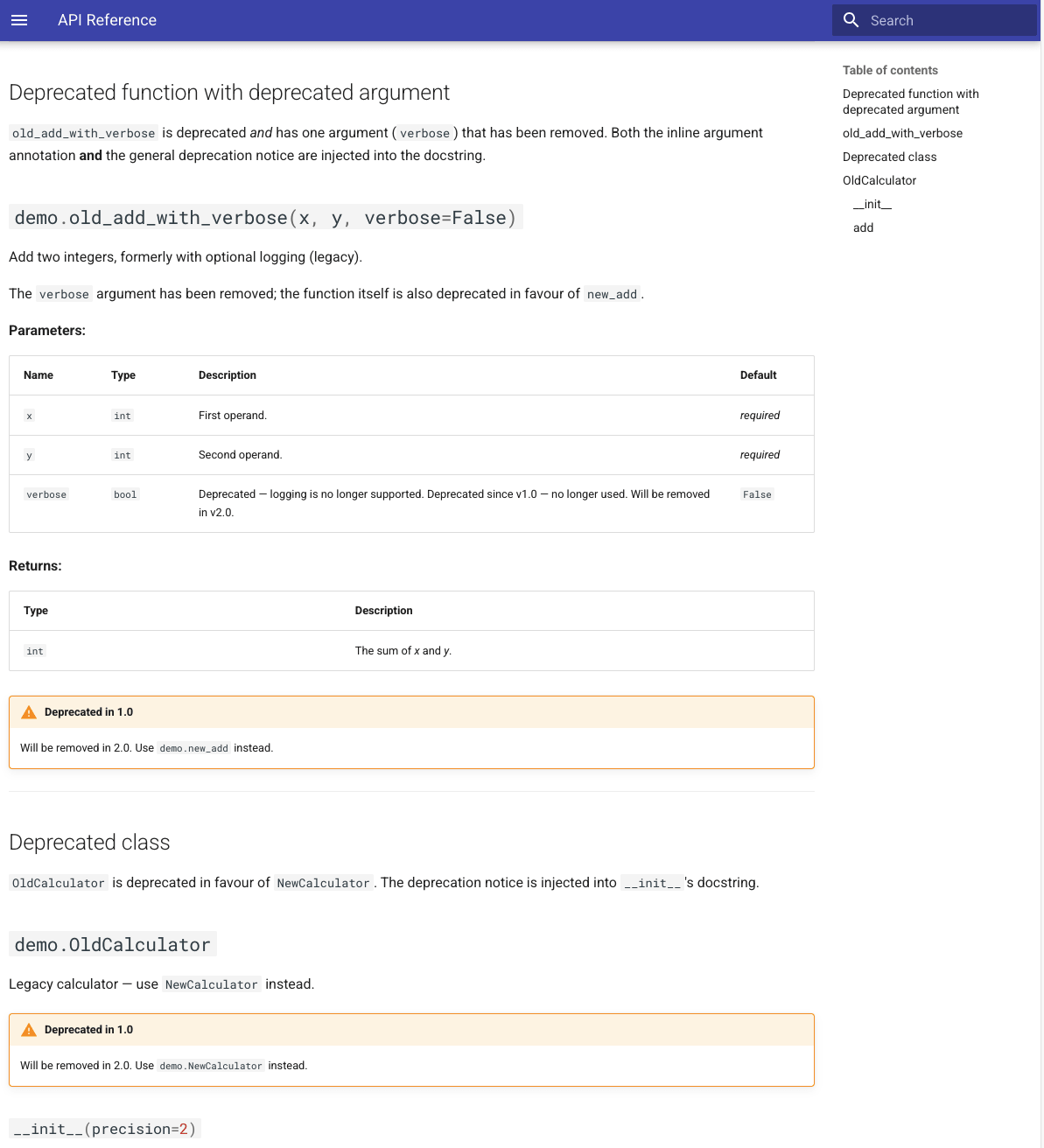
Sphinx (via autodoc + Sphinx extension):
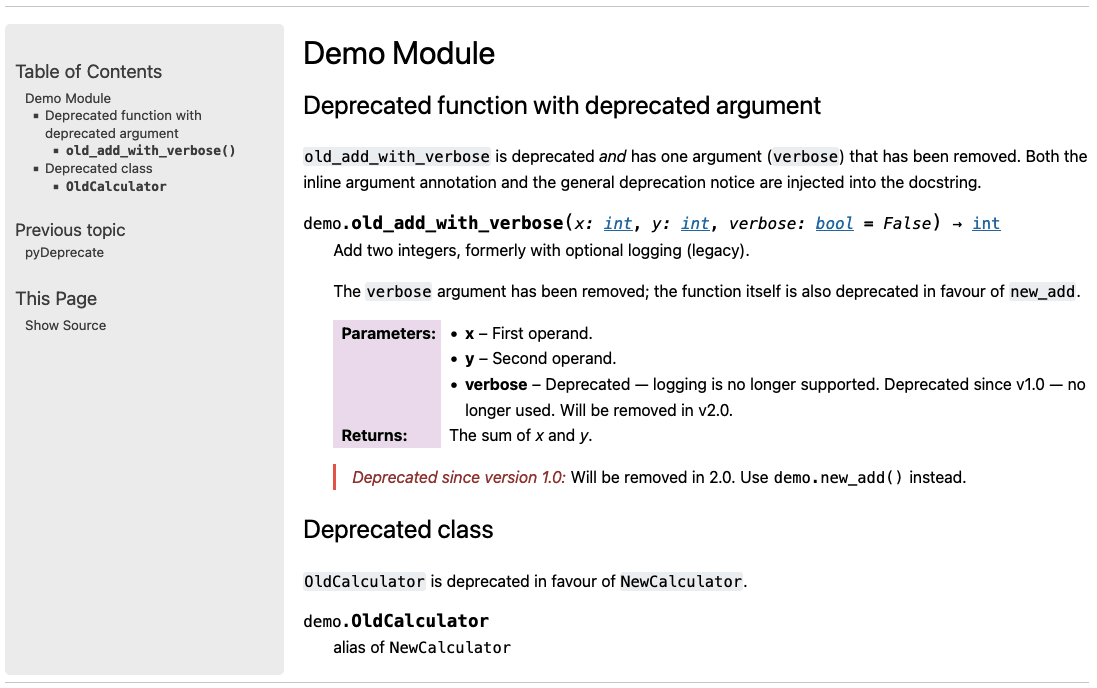
See the live rendered output in the online demos: Sphinx demo · MkDocs demo.
mkdocstrings@deprecated(update_docstring=True) modifies fn.__doc__ at import time. mkdocstrings uses Griffe to read docstrings from the source AST, so it never sees that runtime change. To bridge the gap, pyDeprecate ships a Griffe extension:
# mkdocs.yml
plugins:
  - mkdocstrings:
      handlers:
        python:
          extensions:
            - deprecate.docstring.griffe_ext:RuntimeDocstrings
With the extension registered, mkdocstrings will render the injected !!! warning admonition for every @deprecated function in your docs. No extra dependencies are required — griffe is already a dependency of mkdocstrings[python].
When the target function gains a new parameter that callers of the old API never passed, use args_extra to inject a fixed value at the wrapper level:
from deprecate import deprecated, void


# NEW/FUTURE API — `send_email` adds an explicit `priority` field
def send_email(to: str, subject: str, priority: str) -> str:
    return f"Sent to {to!r}: {subject!r} [{priority}]"


# DEPRECATED API — `notify` was the original name; it had no `priority` concept
@deprecated(
    target=send_email,
    deprecated_in="1.5",
    remove_in="2.0",
    # callers of `notify` never passed `priority`, so inject a sensible default
    args_extra={"priority": "normal"},
)
def notify(to: str, subject: str) -> str:
    """Deprecated — use send_email() with an explicit priority instead."""
    return void(to, subject)


# calling this function will raise a deprecation warning:
#   The `notify` was deprecated since v1.5 in favor of `__main__.send_email`.
#   It will be removed in v2.0.
print(notify("[email protected]", "Hello"))
notify("[email protected]", "Hello")Sent to '[email protected]': 'Hello' [normal]
[!NOTE]
args_extrais merged into kwargs afterargs_mappingis applied, so extra values can override mapped ones. It is used whentargetis a Callable orTargetMode.ARGS_REMAP(withargs_mapping). ForTargetMode.NOTIFY, it is ignored and a construction-timeUserWarningis emitted by validation.
Use deprecated_module() at the bottom of a module you are retiring. Three modes are supported.
Mode 1 — in-place warning path (keep the module and invoke its warning path on every public attribute access; filters can suppress repeated display):
# phmdoctest:skip — CI template: replace old_calculator with your actual module
# old_calculator.py
from deprecate import deprecated_module


def add(a: float, b: float) -> float:
    return a + b


# Call once at the bottom — invokes the warning path for every public attribute access, including real ones.
# `__name__` is passed explicitly here; it is optional (auto-detected from the caller frame when omitted),
# but passing it is the robust idiom — auto-detection relies on `sys._getframe` and only works when the
# call sits directly in the module body, not when routed through a helper.
deprecated_module(__name__, deprecated_in="2.0", remove_in="3.0", message_template="Use `new_calculator` instead.")
# old_calculator.add(1, 2)  # warns: FutureWarning; returns 3
Mode 2 — redirect (forward missing-attr lookups to a replacement module, useful when renaming):
# phmdoctest:skip — CI template: replace new_calculator with your actual module
# old_calculator.py
import new_calculator as _new_calculator
from deprecate import deprecated_module

deprecated_module(
    __name__,  # optional — auto-detected when omitted; see Mode 1 note above
    target=_new_calculator,  # all unknown attr access forwarded here
    deprecated_in="2.0",
    remove_in="3.0",
    message_template="Use `new_calculator` instead.",
)
# old_calculator.add(1, 2)  # warns: FutureWarning, returns new_calculator.add(1, 2)
Mode 3 — parent alias (expose old sub-module name on the parent package via deprecated_instance):
# phmdoctest:skip — CI template: replace my_package with your actual package
# my_package/__init__.py
import my_package.new_calculator as _new_calculator
from deprecate import deprecated_instance

old_utils = deprecated_instance(
    _new_calculator,
    name="old_utils",
    deprecated_in="2.0",
    remove_in="3.0",
    message_template="Use `my_package.new_calculator` instead.",
)
# my_package.old_utils.add(1, 2)  # warns: FutureWarning
Use num_warns to cap warning delivery across every public attribute access on the module. -1 is the default and delivers a warning for each access; 0 delivers none; a positive N delivers exactly N. The standard warnings filter can still suppress repeated display at a location. -1 skips budget locking, but each access still performs normal module lookup and warning handling.
[!NOTE]
Star imports invoke the warning path:
from old_calculator import *calls the path for every public name CPython pulls in; standard warning filters can suppress repeated visibleFutureWarningoutput. CPython'sIMPORT_STARbytecode callsgetattr(module, name)for each public name, so it routes through the same__getattribute__interception as any other attribute access. This closes a gap a PEP 562__getattr__hook would otherwise leave open.
@deprecated works natively on async def functions. The resulting wrapper is itself async def, so inspect.iscoroutinefunction(wrapper) returns True and asyncio frameworks (FastAPI, asyncio.run, asyncio.gather) recognise it. All three TargetMode variants work; the deprecation warning fires when the coroutine is awaited, not when the wrapper is called.
import asyncio
from deprecate import TargetMode, deprecated, void


# NEW/FUTURE API
async def download(url: str) -> bytes:
    return url.encode()


# 1) target=<callable> — forward to a replacement async function
@deprecated(target=download, deprecated_in="0.9", remove_in="1.0")
async def fetch(url: str) -> bytes:
    """Deprecated — use download() instead."""
    return void(url)


# 2) TargetMode.NOTIFY — warn callers; the async body still runs
@deprecated(deprecated_in="0.9", remove_in="1.0")
async def ping() -> str:
    """Deprecated — going away; remove call sites."""
    return "pong"


# 3) TargetMode.ARGS_REMAP — rename an argument within the same async function
@deprecated(
    target=TargetMode.ARGS_REMAP,
    args_mapping={"endpoint": "url"},
    deprecated_in="0.9",
    remove_in="1.0",
)
async def fetch_data(endpoint: str = "", url: str = "") -> bytes:
    """Deprecated argument `endpoint` renamed to `url`."""
    return url.encode()


asyncio.run(fetch("https://example.com"))
asyncio.run(ping())
print(asyncio.run(fetch_data(endpoint="https://example.com")))
asyncio.run(fetch_data(endpoint="https://example.com"))b'https://example.com'
[!NOTE]
@deprecatedalso supports async generator functions (async def+yield). The warning fires when the wrapper is called and callers keep iterating withasync for. For framework introspection and exact async warning-count caveats, see Async functions and Troubleshooting.
void() HelperWhen using @deprecated with a target function, the deprecated function's body is never executed—all calls are automatically forwarded. However, your IDE might complain about "unused parameters". The void() helper function silences these warnings:
# NEW API — adds two integers and returns the sum
def add_values(a: int, b: int) -> int:
    return a + b


# ---------------------------

from deprecate import deprecated, void


# DEPRECATED API — `add` replaced by `add_values`
@deprecated(target=add_values, deprecated_in="1.0", remove_in="2.0")
def add(a: int, b: int) -> int:
    return void(a, b)  # Tells IDE: "Yes, I know these parameters aren't used"
    # call is forwarded to add_values


# Alternative: You can also use pass or just a docstring
@deprecated(target=add_values, deprecated_in="1.0", remove_in="2.0")
def add_v1(a: int, b: int) -> int:
    """Just a docstring works too."""
    pass  # This also works


print(add_v1(2, 3))
add_v1(2, 3)5
[!TIP]
void()is purely for IDE convenience and has no runtime effect. It simply returnsNoneafter accepting any arguments.
Deprecations are only as good as the hygiene around them. The deprecate.audit module provides utilities for verifying that deprecated wrappers are correctly configured, that removal deadlines are actually enforced, that every deprecation was scheduled the way your release policy promises, and that chains of deprecated-to-deprecated calls don't silently pile up. These tools are designed to run in CI pipelines and test suites, catching problems before they reach users.
[!NOTE]
Renamed in v0.6:
find_deprecated_callables→find_deprecation_wrappers,validate_deprecated_callable→validate_deprecation_wrapper,DeprecatedCallableInfo→DeprecationWrapperInfo. The old names are still exported for backwards compatibility but will be removed in v1.0.
During development, you may want to verify that your deprecated wrappers are configured correctly. pyDeprecate provides two utilities for this: validate_deprecation_wrapper() for inspecting a single function, and find_deprecation_wrappers() for scanning an entire package.
The DeprecationWrapperInfo dataclass contains:
module: Module name where the function is defined (empty for direct validation)function: Function namedeprecated_info: The DeprecationConfig from the decorator's __deprecation_config__ attribute (read it via get_deprecation_config(obj) rather than the raw attribute — __deprecated__ itself is a plain PEP 702-conformant message string, not a dict)invalid_args: List of args_mapping keys that don't exist in the function signatureempty_args_mapping: True if args_mapping is None or empty (no argument remapping)identity_args_mapping: List of args where key equals value (e.g., {'arg': 'arg'} - no effect)self_reference: True if target points to the same function (self-reference)no_effect: True if wrapper has zero impact (self-reference, empty mapping, or all identity)empty_deprecated_in: True if deprecated_in is absent (CI misconfiguration signal — missing introductory version metadata)pep702_message: None for pyDeprecate wrappers; on a row found with find_deprecation_wrappers(..., include_pep702=True) for a symbol deprecated only with warnings.deprecated, the decorator's message (a string, possibly empty) — such a row keeps a shape api_type (callable, class, class method, ...) and has no versionsThe validate_deprecation_wrapper() utility extracts the configuration from the function's __deprecation_config__ attribute and returns a DeprecationWrapperInfo dataclass that helps you identify configurations that would make your deprecation wrapper have zero impact:
from deprecate import DeprecationWrapperInfo, TargetMode, deprecated, validate_deprecation_wrapper


# Define your deprecated function
@deprecated(target=TargetMode.ARGS_REMAP, args_mapping={"old_arg": "new_arg"}, deprecated_in="1.0")
def my_func(old_arg: int = 0, new_arg: int = 0) -> int:
    return new_arg


# Validate the configuration - automatically extracts `args_mapping` and target from the decorator
result = validate_deprecation_wrapper(my_func)


# DeprecationWrapperInfo(
#   function='my_func',
#   invalid_args=[],
#   empty_args_mapping=False,
#   identity_args_mapping=[],
#   self_reference=False,
#   no_effect=False
# )


# Example: Function with invalid args_mapping
@deprecated(target=TargetMode.ARGS_REMAP, args_mapping={"nonexistent": "new_arg"}, deprecated_in="1.0")
def bad_func(real_arg: int = 0) -> int:
    return real_arg


result = validate_deprecation_wrapper(bad_func)
# result.invalid_args == ['nonexistent']
print(result)


# Example: Function with empty mapping (no effect)
@deprecated(target=TargetMode.ARGS_REMAP, args_mapping={}, deprecated_in="1.0")
def empty_func(arg: int = 0) -> int:
    return arg


result = validate_deprecation_wrapper(empty_func)
# result.empty_args_mapping == True, result.no_effect == True
print(result)

# Quick check if wrapper has any effect
if result.no_effect:
    print("Warning: This wrapper configuration has zero impact!")
The find_deprecation_wrappers() utility scans an entire package or module and returns a list of DeprecationWrapperInfo dataclasses:
from deprecate import find_deprecation_wrappers

# For testing purposes, we use the test module; normally you would import your own package
from tests import collection_deprecate as my_package

# Scan an entire package for deprecated wrappers
results = find_deprecation_wrappers(my_package)

# Or scan using a string module path
results = find_deprecation_wrappers("tests.collection_deprecate")

# Check results - each item is a DeprecationWrapperInfo dataclass
for r in results:
    print(f"{r.module}.{r.function}: no_effect={r.no_effect}")
    if r.no_effect:
        print(f"  Warning: This wrapper has zero impact!")
        print(f"  invalid_args: {r.invalid_args}, identity_args_mapping: {r.identity_args_mapping}")

# Filter to only ineffective wrappers
ineffective = [r for r in results if r.no_effect]
if ineffective:
    print(f"Found {len(ineffective)} deprecated wrappers with zero impact!")
Group validation results by issue type for better reporting:
from deprecate import find_deprecation_wrappers

# For testing purposes, we use the test module; normally you would import your own package
from tests import collection_deprecate as my_package

results = find_deprecation_wrappers(my_package)

# Group by issue type (using dataclass attribute access)
wrong_args = [r for r in results if r.invalid_args]
identity_mappings = [r for r in results if r.identity_args_mapping]
self_refs = [r for r in results if r.self_reference]

print(f"=== Deprecation Validation Report ===")
print(f"Wrong arguments: {len(wrong_args)}")
print(f"Identity mappings: {len(identity_mappings)}")
print(f"Self-references: {len(self_refs)}")
If you want docs-friendly summaries, generate_deprecation_table() renders the discovered wrapper metadata as Markdown tables. The report includes deprecated class members such as methods and constructors, so wrapper metadata remains the single source of truth.
It supports two styles via style=:
compact (default): Original API | API Type | New API | Deprecated | Remove | Current Statusmatrix: Original API | API Type | New API | <all versions ...> with lifecycle markers:
D = deprecated in this versionR = remove in this versionargs variants stay grouped togetherThe Current Status column uses these labels:
| Status | Meaning |
|---|---|
| 🕒 Scheduled Deprecation | Current version is before deprecated_in — not yet active |
| ℹ️ No Removal Target | No remove_in set — no scheduled removal |
| ⚪ Status Unknown | packaging not installed or current_version not resolvable |
| ⚪ Invalid Removal Target | remove_in cannot be parsed as a PEP 440 version |
| 📢 Deprecation Active | Between deprecated_in and remove_in — still in the deprecation window |
| ⏰ Removal Imminent | Dev/alpha/beta pre-release of the remove_in base version |
| 🔔 Remove Before Release | RC pre-release of the remove_in base version |
| 💥 Past Removal Date | Current version ≥ remove_in — zombie code that should be deleted |
from tests import collection_deprecate as my_package
from deprecate import generate_deprecation_table

report = generate_deprecation_table(my_package, current_version="1.5", recursive=False)
Current version: 1.5
Original API API Type New API Deprecated Remove Current Status my_package.depr_func_same_versioncallable —v2.0 v3.0 🕒 Scheduled Deprecation my_package.ServiceCls.old_redirect_methodclass method my_package.ServiceCls.computev1.0 v2.0 📢 Deprecation Active my_package.depr_pow_argscallable my_package.base_pow_argsv1.0 v1.3 💥 Past Removal Date my_package.depr_func_no_remove_incallable —v1.0 — ℹ️ No Removal Target
You can also use the CLI to validate your deprecations directly from the command line.
The CLI requires the cli extra (includes fire and rich). Install it with:
pip install 'pyDeprecate[audit,cli]'
The CLI has six subcommands.
# check — wrapper config + deprecated-to-deprecated chains (default)
pydeprecate check path/to/your/package
pydeprecate path/to/your/package          # equivalent shorthand

# expiry — wrappers past their remove_in deadline
# requires: pip install 'pyDeprecate[audit]'
pydeprecate expiry path/to/your/package --version 2.0.0
pydeprecate expiry path/to/your/package   # auto-detects version from the package

# policy — deprecations scheduled against your governance rules
# requires: pip install 'pyDeprecate[audit]'
pydeprecate policy path/to/your/package
pydeprecate policy path/to/your/package --min-grace=1.0 --message-required=False
# rules can also live in pyproject.toml under [tool.pydeprecate.policy]; a typed flag beats the file

# chains — deprecated-to-deprecated forwarding chains only
pydeprecate chains path/to/your/package

# all — single scan running check + expiry + policy + chains, then appends a deprecation table
# policy violations are printed here but never change the exit code — gate on them with `policy`
pydeprecate all path/to/your/package --version 2.0.0

# status — print a markdown deprecation status table (standalone, no checks)
pydeprecate status path/to/your/package
pydeprecate status path/to/your/package --style matrix
pydeprecate status path/to/your/package --version 2.0.0 --output DEPRECATIONS.md
Common flags (all subcommands): --norecursive scans the top-level module only. --exclude takes glob patterns over full dotted module names (one, comma-separated, or a list) the scan itself never imports nor descends into; its default is the exclude list of [tool.pydeprecate] in the nearest pyproject.toml. check, expiry, policy, chains, and all also accept --exit-zero to always exit 0 even when issues are found. expiry, all, and status also accept --version VERSION to set the current version explicitly. policy additionally accepts one flag per rule — --min-grace, --message-required — resolved as flag → [tool.pydeprecate.policy] in the nearest pyproject.toml → built-in default (min-grace = "0.3", message-required = true; false switches min-grace off), and exits 2 when a rule value is malformed, or when the pyproject.toml itself cannot be read or parsed (Cannot read <path>: <err>) — this file-read exit 2 is checked before chains runs even inside pydeprecate all, though policy violation counts stay advisory there. The Policy: header line names the source of each value. status additionally accepts --style compact|matrix (default compact) and --output FILE to also save the markdown to that file.
Quick demo using pyDeprecate's own test fixtures (no package setup needed):
# Run all checks + deprecation table on the bundled test fixtures
pydeprecate all tests --version 1.2
# Standalone deprecation table only
pydeprecate status tests --version 1.2
tests/ contains pyDeprecate's own deprecation fixtures — useful as a live demo without needing your own package. Note: expiry and chains (run as part of all) require an importable package name rather than a plain directory path.
Example: catching a deprecated-to-deprecated chain
$ pydeprecate chains src/mypackage
⚠  Deprecated chain detected: old_fn → legacy_fn → new_fn
   old_fn is deprecated and forwards to legacy_fn, which is also deprecated.
   Update old_fn to forward directly to new_fn.
Example: combined one-liner scan across all checks
The ✓/⚠ one-line-per-check layout below is illustrative — condensed for readability, not the CLI's actual Rich-table output — but the policy line reflects the real [WARNING]-style advisory trailer:
$ pydeprecate all src/mypackage
✓ check:    12 wrappers validated, 0 misconfigured
⚠ expiry:   2 wrappers past remove_in deadline
[WARNING] policy: 1 violation (advisory here — run `pydeprecate policy` to gate on it)
✓ chains:   no deprecated→deprecated chains detected
Use in pytest to validate your package's deprecation wrappers:
import warnings

import pytest
from deprecate import find_deprecation_wrappers

# For testing purposes, we use the test module; normally you would import your own package
from tests import collection_deprecate as my_package


def test_deprecated_wrappers_are_valid():
    """Validate all deprecated wrappers have proper configuration."""
    results = find_deprecation_wrappers(my_package)

    # Collect issues — wrong arg names are errors, identity mappings are worth a warning
    wrong_args = [r for r in results if r.invalid_args]
    identity_mappings = [r for r in results if r.identity_args_mapping]

    # Raise errors for wrong arguments (critical issues)
    if wrong_args:
        for r in wrong_args:
            print(f"ERROR: {r.module}.{r.function} has invalid args: {r.invalid_args}")
        pytest.fail(f"Found {len(wrong_args)} deprecated wrappers with invalid arguments")

    # Warn for identity mappings (less severe)
    for r in identity_mappings:
        warnings.warn(f"{r.function} has identity mapping", UserWarning)
When you deprecate code with a remove_in version, you're making a commitment to remove that code when that version is reached. However, it's easy to forget to actually remove the code—leading to "zombie code" that lingers past its scheduled removal.
pyDeprecate provides enforcement utilities to detect and prevent zombie code in your CI/CD pipeline:
The validate_deprecation_expiry() utility scans an entire module or package for expired deprecations:
from deprecate import validate_deprecation_expiry

# For testing purposes, we use the test module; normally you would import your own package
from tests import collection_deprecate as my_package

# Scan your package for expired deprecations - using early-version that won't have expirations
expired = validate_deprecation_expiry(my_package, "0.2")
print(f"Found {len(expired)} expired")  # Returns a list of error messages (empty list = no expired)

# Example with expired deprecations found (using later-version)
expired = validate_deprecation_expiry(my_package, "0.5")
print(f"Found {len(expired)} expired")

# Auto-detect version from package metadata (mocked for demo)
from unittest.mock import patch

with patch("importlib.metadata.version", return_value="0.3"):
    expired = validate_deprecation_expiry(my_package)  # Automatically detects version
    print(f"Found {len(expired)} expired")

# Control recursion
expired = validate_deprecation_expiry(my_package, "0.1", recursive=False)  # Only scan top-level module
print(f"Found {len(expired)} expired")
Found 14 expired
Found 31 expired
Found 17 expired
Found 0 expired
Integrate expiry checks into your test suite to catch zombie code automatically:
import pytest
from deprecate import validate_deprecation_expiry

# For testing purposes, we use the test module; normally you would import your own package
from tests import collection_deprecate as my_package


def test_no_zombie_deprecations():
    """Ensure all deprecated code is removed when it reaches its deadline."""
    # Use your package's actual version - for this example we use a test version
    current_version = "0.5"  # Replace with: from mypackage import __version__

    expired = validate_deprecation_expiry(my_package, current_version)

    if expired:
        error_msg = "Found deprecated code past its removal deadline:\n"
        for msg in expired:
            error_msg += f"  - {msg}\n"
        pytest.fail(error_msg)


# Alternative: Use a fixture to run on every test session
# For testing purposes, we use the test module; normally you would import your own package
@pytest.fixture(scope="session", autouse=True)
def enforce_deprecation_deadlines():
    """Automatically check for zombie code before running any tests."""
    from tests import collection_deprecate as my_package

    current_version = "0.5"  # Replace with: from mypackage import __version__
    expired = validate_deprecation_expiry(my_package, current_version)
    if expired:
        raise AssertionError(
            f"Cannot run tests: {len(expired)} deprecated callables past removal deadline. "
            f"Remove these functions first: {expired}"
        )
[!TIP]
- Callables without
remove_inare skipped (warnings-only deprecations are allowed)- Callables with an unparsable
remove_inversion string emit aUserWarningnaming the callable; the scan continues for the rest- PEP 440 versioning is used for comparison (e.g., "2.0.0" > "1.9.5")
- Pre-release versions are handled correctly (e.g., "1.5.0a1" < "1.5.0")
validate_deprecation_expiry() asks whether deprecated code was removed on time. validate_deprecation_policy() asks the earlier question — whether it was scheduled responsibly in the first place: a removal deadline that gives callers too short an upgrade window or lands off a release boundary, or a warning that never names a replacement.
Two rules exist and each can be switched off independently:
| Rule slug | What it checks | Default | Disable with |
|---|---|---|---|
min-grace | remove_in is one clean version bump beyond deprecated_in, at least this far | min_grace="0.3" | min_grace=None |
message-required | The wrapper names a replacement callers can migrate to | message_required=True | message_required=False |
Every violation message is prefixed with its rule slug in square brackets, so a CI log can be grouped or filtered per rule. Like the expiry gate this one compares PEP 440 versions, so it needs pip install 'pyDeprecate[audit]'.
Declare the rules once in pyproject.toml and run the gate as its own CI step — no test code needed:
[tool.pydeprecate.policy]
min-grace = "1.0"          # removals only at the next major; "0.3" (three minors) is the built-in default
message-required = true    # every warning must name a replacement
pydeprecate policy src/mypackage # exit 1 on a violation, 2 on a malformed rule or unreadable pyproject.toml
Run against pyDeprecate's own fixtures (tests/collection_policy.py, one broken rule per wrapper) with the built-in defaults spelled out as flags:
pydeprecate policy tests.collection_policy --norecursive --min-grace=0.3 --message-required=True
Scanning: tests.collection_policy
Package: tests.collection_policy
Policy: min-grace=0.3 (flag)  message-required=True (flag)
                         Deprecation Policy Violations
╭──────────────────────────────────────────────────────────────────────────────╮
│ Message                                                                      │
├──────────────────────────────────────────────────────────────────────────────┤
│ [min-grace] Callable `tests.collection_policy.no_grace_window` is deprecated │
│ in `2.0` and scheduled for removal in `2.0`; the policy requires a grace     │
│ window of at least 3 minor releases, landing on a clean major or minor       │
│ boundary.                                                                    │
│ [message-required] Callable                                                  │
│ `tests.collection_policy.warns_without_replacement` warns without naming a   │
│ replacement; configure a `target`, an `args_mapping`/`attrs_mapping`, or a   │
│ custom `message_template` so callers learn what to migrate to.               │
│ …                                                                            │
╰──────────────────────────────────────────────────────────────────────────────╯

6 policy violation(s) found.
The same check is available in Python as validate_deprecation_policy(my_package, min_grace="1.0", message_required=True) — it returns the violation strings and never reads pyproject.toml; see the audit guide.
[!TIP]
- Wrappers missing
deprecated_inorremove_inare not violations — the version-distance rules skip them, since a deprecation without a scheduled removal is a valid choice- An unparsable version string emits a
UserWarningnaming the wrapper and the offending field, then the scan continues for the restmin_graceis a version-shaped delta with two or three components and one non-zero —"1.0"one major,"0.3"three minors,"0.0.2"two patches; a bare"1"is rejected as ambiguous and so is a mixed spelling such as"1.2"(ValueError). The removal must be one clean bump of a single component (1.2→1.5or2.0, never2.3); a coarser bump always clears a finer window, so1.2→2.0satisfies"0.3"- A
0.xproject needs no special setting — a bump to1.0is a major step and clears any window, and removals inside the0.xline are counted in minors as usualpydeprecate allprints policy violations but never fails on them — runpydeprecate policyas its own CI step to gate on them- A typed
--min-grace/--message-requiredflag beats thepyproject.tomltable for that run; thePolicy:header names where each value came from- Every scanning function takes a keyword-only
excludelist of module-name globs (exclude=["my_package.tests"]); the scan never imports a matching package itself, and its wrappers are never reported
When refactoring code, it's easy to create "lazy" deprecated wrappers that call other deprecated functions instead of calling the new target directly. This creates deprecation chains that defeat the purpose of deprecation.
The validate_deprecation_chains() utility scans a module or package for deprecated functions whose target is itself a deprecated callable. Such chains are wasteful: the outer wrapper should point directly to the final (non-deprecated) implementation. Detection is purely metadata-based — no source-code inspection.
from deprecate import TargetMode, deprecated, validate_deprecation_wrapper, void


def new_power(base: float, exponent: float = 2) -> float:
    return base**exponent


# deprecated forwarder — targets new_power directly
@deprecated(target=new_power, deprecated_in="1.0", remove_in="2.0")
def power_v2(base: float, exponent: float = 2) -> float:
    void(base, exponent)


# self-deprecation — renames old arg "exp" -> "exponent" within the same function
@deprecated(TargetMode.ARGS_REMAP, deprecated_in="1.0", remove_in="2.0", args_mapping={"exp": "exponent"})
def legacy_power(base: float, exp: float = 2, exponent: float = 2) -> float:
    return base**exponent


# BAD: targets power_v2 (another deprecated forwarder) — ChainType.TARGET
# SOLUTION: point directly to new_power
@deprecated(target=power_v2, deprecated_in="1.5", remove_in="2.5")
def caller_target_chain(base: float, exponent: float = 2) -> float:  # ❌
    return void(base, exponent)


# BAD: targets legacy_power (target=TargetMode.ARGS_REMAP with arg renaming) — ChainType.STACKED
# Mappings chain: "power" -> "exp" -> "exponent" — must be composed.
# SOLUTION: target=new_power, args_mapping={"power": "exponent"}
@deprecated(target=legacy_power, deprecated_in="1.5", remove_in="2.5", args_mapping={"power": "exp"})
def caller_stacked_chain(base: float, power: float = 2) -> float:  # ❌
    return void(base, power)


# GOOD: targets final implementation directly with composed mapping
@deprecated(target=new_power, deprecated_in="1.5", remove_in="2.5", args_mapping={"power": "exponent"})
def caller_direct(base: float, power: float = 2) -> float:  # ✅
    return void(base, power)


for func in (caller_target_chain, caller_stacked_chain, caller_direct):
    info = validate_deprecation_wrapper(func)
    print(f"{func.__name__}: {info.chain_type}")
caller_target_chain: ChainType.TARGET
caller_stacked_chain: ChainType.STACKED
caller_direct: None
Integrate chain detection into your test suite to prevent deprecated-to-deprecated forwarding:
import pytest
from deprecate import validate_deprecation_chains

# normally you would import your own package
from tests import collection_chains as my_package


def test_no_deprecation_chains():
    """Ensure no deprecated function targets another deprecated function."""
    issues = validate_deprecation_chains(my_package)

    if issues:
        lines = [
            f"  - {i.function}: target '{getattr(i.deprecated_info['target'], '__name__', repr(i.deprecated_info['target']))}' is deprecated"
            for i in issues
        ]
        pytest.fail("Found deprecation chains:\n" + "\n".join(lines))


# Alternative: session-scoped auto-use fixture
@pytest.fixture(scope="session", autouse=True)
def enforce_no_deprecation_chains():
    from tests import collection_chains as my_package

    issues = validate_deprecation_chains(my_package)
    if issues:
        raise AssertionError(f"Found {len(issues)} deprecation chain(s). Fix before running tests.")
[!TIP]
- The function scans all deprecated functions found by
find_deprecation_wrappers()- Returns
list[DeprecationWrapperInfo]— each entry haschain_typeset to aChainTypeenum valueChainType.TARGET— target is a deprecated callable that forwards to another function; fix by pointing directly to the final targetChainType.STACKED— mappings chain through multiple hops and must be composed; includes:
- Callable target is itself
@deprecated(TargetMode.ARGS_REMAP, args_mapping=...)(self-renaming) — mappings compose across hops- Stacked
@deprecated(TargetMode.ARGS_REMAP, args_mapping=...)on the same function — merge into one decorator with combinedargs_mappingdeprecated_class(attrs_mapping=...)where one deprecated attribute redirects to another deprecated attribute alias- Use
recursive=Falseto scan only the top-level module
The check subcommand surfaces deprecated_class proxies whose args_mapping remaps a deprecated kwarg to a POSITIONAL_ONLY constructor parameter. The proxy forwards those remapped values positionally to the constructor, so the mapping works even for required positional-only parameters, frozen dataclasses, and classes with __post_init__ logic — the finding is an advisory visibility signal, not a failure.
pydeprecate check my_package
# or as part of a full scan:
pydeprecate all my_package
[!TIP]
- The proxy forwards remapped values positionally to the constructor at call time;
pydeprecate checksurfaces the pattern at CI time as an advisory signal- To silence the decoration-time
UserWarning: useattrs_mappinginstead ofargs_mappingforPOSITIONAL_ONLYparameters, or restructure the target constructor to accept keyword arguments- For programmatic use:
validate_mapping_compatibility(module)returnslist[DeprecationWrapperInfo]whereargs_mapping_positional_onlyis non-empty
pyDeprecate provides utilities to help you test deprecated code properly:
from deprecate import deprecated, assert_no_warnings, void
import pytest


# NEW API — doubles the input value
def score_predictions(x: int) -> int:
    return x * 2


# DEPRECATED API — `score` replaced by `score_predictions`
@deprecated(target=score_predictions, deprecated_in="1.0", remove_in="2.0")
def score(x: int) -> int:
    pass


# DEPRECATED API — `score_v2` replaced by `score_predictions`
@deprecated(target=score_predictions, deprecated_in="1.0", remove_in="2.0")
def score_v2(x: int) -> int:
    return void(x)


def test_deprecated_function_shows_warning():
    """Verify the deprecation warning is shown."""
    with pytest.warns(FutureWarning, match="score.*deprecated"):
        result = score(42)
    assert result == 84


def test_new_function_no_warning():
    """Verify new function doesn't trigger warnings."""
    with assert_no_warnings(FutureWarning):
        result = score_predictions(42)
    assert result == 84


def test_no_warning_after_first_call():
    """By default, warnings are shown only once per function."""
    # First call shows warning
    with pytest.warns(FutureWarning):
        score_v2(1)

    # Subsequent calls don't show warning (by default num_warns=1)
    with assert_no_warnings(FutureWarning):
        score_v2(2)


# call the tests for CI demonstration/validation
test_deprecated_function_shows_warning()
test_new_function_no_warning()
test_no_warning_after_first_call()
# Minimal replacement implementation used in examples
def score_predictions(x: int) -> int:
    return x * 2


# ---------------------------

from deprecate import deprecated


# Show warning every time (useful for critical deprecations)
@deprecated(target=score_predictions, deprecated_in="1.0", remove_in="2.0", num_warns=-1)
def predict(x: int) -> int:
    pass


# Show warning N times total
@deprecated(target=score_predictions, deprecated_in="1.0", remove_in="2.0", num_warns=5)
def predict_batch(x: int) -> int:
    pass


print(predict_batch(1))
predict_batch(1)2
`@deprecated` on class … now dispatches to `@deprecated_class`Not a problem — since v0.12, @deprecated on a class is first-class supported and permanent: it dispatches to @deprecated_class() and produces an identical _DeprecatedProxy. The UserWarning is a one-time informational notice, fired at most once per class (keyed by module + qualified name — same-named classes in different modules each warn) per process, telling you that the dispatch happened. Only this notice — not the dispatch support — is removed entirely, in v1.0.
To quiet it: apply @deprecated_class() directly (same result, no notice, and required to reach class-only options such as attrs_mapping), or pass stream=None.
from deprecate import TargetMode, deprecated, deprecated_class
from enum import Enum


# Preferred: use @deprecated_class directly for classes — identical result, no notice
@deprecated_class(target=TargetMode.NOTIFY, deprecated_in="1.0", remove_in="2.0")
class MyClass:
    pass


@deprecated_class(target=TargetMode.NOTIFY, deprecated_in="1.0", remove_in="2.0")
class MyEnum(Enum):
    A = 1
    B = 2


# Alternative: decorate __init__ to warn at instantiation while keeping the class name
from deprecate import deprecated


class MyOtherClass:
    @deprecated(target=TargetMode.NOTIFY, deprecated_in="1.0", remove_in="2.0")
    def __init__(self, x: int) -> None:
        self.x = x  # body still executes; warning fires on every new MyOtherClass(...)


print(MyOtherClass(42).x)
MyOtherClass(42).x42
Failed mappingProblem: TypeError: Failed mapping of 'my_func', arguments not accepted by target: ['old_arg']
Cause: Your deprecated function has arguments that the target function doesn't accept.
Skip the argument (if it's no longer needed):
# define a target that ignores the extra arg
def new_func(required_arg: int, **kwargs) -> int:
    return required_arg * 2


# ---------------------------

from deprecate import deprecated


# None means skip this argument
@deprecated(target=new_func, args_mapping={"old_arg": None}, deprecated_in="1.0", remove_in="2.0")
def old_func(old_arg: int, new_arg: int) -> int:
    pass
Rename the argument (if target uses different name):
def new_func(new_name: int) -> int:
    return new_name * 2


# ---------------------------

from deprecate import deprecated


# Map old to new
@deprecated(target=new_func, args_mapping={"old_name": "new_name"}, deprecated_in="1.0", remove_in="2.0")
def old_func(old_name: int) -> int:
    pass
Use TargetMode.ARGS_REMAP for self-deprecation (deprecate argument of same function):
from deprecate import TargetMode, deprecated


# Deprecate within same function
@deprecated(target=TargetMode.ARGS_REMAP, args_mapping={"old_arg": "new_arg"}, deprecated_in="1.0", remove_in="2.0")
def my_func(old_arg: int = 0, new_arg: int = 0) -> int:
    return new_arg * 2
User function 'should_ship' shall return boolProblem: TypeError: User function 'should_ship' shall return bool, but got: <type>
Cause: When using skip_if with a callable, the function must return a boolean value.
# Minimal replacement function for examples
def get_status() -> str:
    return "Hi!"


# ---------------------------

from deprecate import deprecated_callable


# Correct: function returns bool
def should_skip() -> bool:
    return False  # replace with your condition


@deprecated_callable(target=get_status, skip_if=should_skip, deprecated_in="1.0", remove_in="2.0")
def infer():
    pass


# Also correct: use a lambda
@deprecated_callable(target=get_status, skip_if=lambda: False, deprecated_in="1.0", remove_in="2.0")
def infer_v2():
    pass


print(infer_v2())
infer_v2()Hi!
Problem: You don't see the deprecation warning.
Cause: By default, warnings are shown only once per function (num_warns=1) to prevent log spam. For per-argument deprecation (when using args_mapping with TargetMode.ARGS_REMAP), each deprecated argument has its own warning counter, meaning warnings for different arguments are tracked independently.
# Minimal replacement function for examples
def score_predictions(x: int) -> int:
    return x * 2


# ---------------------------

from deprecate import deprecated


# Show warning every time
@deprecated(target=score_predictions, deprecated_in="1.0", remove_in="2.0", num_warns=-1)  # -1 means unlimited
def predict():
    pass


# Show warning N times total
@deprecated(target=score_predictions, deprecated_in="1.0", remove_in="2.0", num_warns=5)  # Show 5 times
def predict_batch():
    pass


print(callable(predict_batch))
callable(predict_batch)True
Problem: The deprecation notice shows an unexpected path when a function is moved to a different module.
Cause: pyDeprecate resolves the target path from target.__module__ and target.__qualname__ at decoration time — not at call time. If the target is imported via an alias or re-export at the point where @deprecated is applied, the stored path reflects the alias, not the canonical location.
Solution: Import the target from its canonical module location before applying @deprecated. The deprecation notice will then show the fully-qualified path where the function actually lives.
Have you faced this issue in the past or are you facing it now? Do you have good ideas for improvement? All contributions are welcome!
Please read our Contributing Guide for details on how to contribute, and our Code of Conduct for community guidelines.
Overall
Maintained
Code review
PyPI
Latest release
Releases this year
2,500 followers · starred Apr 2021
Smoothly deprecate and redirect Python functions/classes with smart warnings and auto-routing—keep your codebase clean while maintaining backward compatibility
See the code
Deprecate Python APIs without breaking existing callers.
Use pyDeprecate when you renamed a function, moved a class, or retired an argument but still need old user code to work during the migration window. A single decorator can emit a clear warning, forward the call to the new implementation, remap old argument names, and expose metadata that CI audit tools can enforce when the removal deadline arrives.
Core capabilities:
Author: Jiri Borovec · License: Apache 2.0 · Python: 3.9+ · Import:
from deprecate import deprecated, deprecated_class· Docs: https://borda.github.io/pyDeprecate/
The common case is moving functionality across modules, packages, or public API names without breaking callers immediately. You keep the old entry point temporarily, show users what changed, and forward them to the replacement until the old name can be removed.
pyDeprecate also avoids warning spam: each deprecated function or class warns once by default, and you can route messages through Python warnings, logging, or any custom stream.
pip install pyDeprecate
Read: Mastering API Deprecation in Python — the pain points and how pyDeprecate can help — CodeX / Medium
targetdef gen(): yield — warning fires eagerly at call time, before iteration begins), and async def coroutine functions (wrapper is async def, inspect.iscoroutinefunction(wrapper) returns True; warning fires when the coroutine is awaited)@property — all three accessors (fget, fset, fdel) fire FutureWarning; chain-style .setter() / .deleter() rebinding preserved via _DeprecatedProperty subclass. Also supports @cached_property (getter-only — no fset/fdel).deprecated_class for types; deprecated_instance for objects, with optional read-only enforcement — blocks standard collection mutators: append, pop, update, clear, etc.; custom mutator names bypass this guard)args_extra for injecting fixed forwarded kwargs, and conditional skip_if behaviorassert_no_warnings, formerly no_warning_call) for deterministic testsRequires Python 3.9 or later.
Choose the install that matches the workflow you need:
| Workflow | Command | Includes |
|---|---|---|
| Runtime deprecation wrappers | pip install pyDeprecate | @deprecated, @deprecated_class, deprecated_instance, docstring helpers, and most audit metadata helpers |
| CI deadline checks | pip install 'pyDeprecate[audit]' | Adds packaging for PEP 440 version comparison in validate_deprecation_expiry() and validate_deprecation_policy() |
| Command-line audit workflows | pip install 'pyDeprecate[audit,cli]' | Adds CLI dependencies (fire, rich) plus version support for pydeprecate expiry, pydeprecate policy, and pydeprecate all |
Base installation from PyPI:
pip install pyDeprecate
Simply install with pip from source:
pip install https://github.com/Borda/pyDeprecate/archive/main.zip
This repository includes a pydeprecate plugin for Codex and Claude Code, available from the repository's default branch (early, pre-1.0). It is a separate artifact from the pyDeprecate library and is not installed by pip.
Install it from GitHub:
# Codex
codex plugin marketplace add Borda/pyDeprecate
codex plugin add pydeprecate@pydeprecate

# Claude Code
claude plugin marketplace add Borda/pyDeprecate
claude plugin install pydeprecate@pydeprecate
For local development or unpublished changes, run these commands from the repository root with . instead of Borda/pyDeprecate in the marketplace-add command. The plugin-install command stays the same.
Use $pydeprecate:sunset / $pydeprecate:prune in Codex, or /pydeprecate:sunset / /pydeprecate:prune in Claude Code, to implement or retire a deprecation — see the coding-agent recipes for invocation examples, host commands, and workflow boundaries.
Here's the simplest way to get started with deprecating a function:
from deprecate import deprecated


# NEW/FUTURE API — renamed to be more explicit about what it computes
def compute_sum(a: int = 0, b: int = 3) -> int:
    return a + b


# DEPRECATED API — `addition` was the original name before the rename
@deprecated(target=compute_sum, deprecated_in="1.0", remove_in="2.0")
def addition(a: int, b: int = 5) -> int:
    pass  # body is not needed — calls are forwarded to compute_sum


# Using the original name still works but shows a warning
result = addition(1, 2)  # Returns 3
# Warning: The `addition` was deprecated since v1.0 in favor of `__main__.compute_sum`.
#          It will be removed in v2.0.
print(result)
addition(1, 2)3
That's it! All calls to addition() are automatically forwarded to compute_sum() with a deprecation warning.
[!IMPORTANT]
When
target=<callable>is set, pyDeprecate intercepts the call before the body executes — the body is dead code under normal forwarding. Exception: ifskip_ifevaluatesTrueat call time, the source body runs as the fallback, so keep a working implementation when combiningtarget=<callable>withskip_if.
Not sure which API to reach for? Start here.
Pick the right decorator:
| Scenario | API to use |
|---|---|
| Renaming a function or method | @deprecated(target=new_func) |
| Renaming an argument within the same function | @deprecated(target=TargetMode.ARGS_REMAP, args_mapping={"old": "new"}) |
| Warn only — original body still runs | @deprecated(deprecated_in="1.0", remove_in="2.0") |
| Deprecating a class, Enum, or dataclass name | @deprecated_class(target=NewClass) |
| Deprecating a module-level constant or object | deprecated_instance(obj, ...) |
| Retiring an entire module | deprecated_module(__name__, ...) |
| Refusing a class up front (strict callables) | @deprecated_callable(target=new_func) |
| Annotating the proxy the two proxy forms return | DeprecationProxy |
Note: Legacy
target=Noneandtarget=TrueemitFutureWarningat decoration time in v0.8 and becomeTypeErrorin v1.0. UseTargetMode.NOTIFYandTargetMode.ARGS_REMAPrespectively.
| Param | Default | Purpose |
|---|---|---|
target | TargetMode.AUTO | Callable to forward to · TargetMode.ARGS_REMAP to remap args · TargetMode.NOTIFY warn-only · TargetMode.AUTO (default) infers the mode from the other arguments |
deprecated_in | "" | Version when deprecated (e.g. "1.0") |
remove_in | "" | Version when removed (e.g. "2.0") |
| Advanced: ~10% of cases | ||
stream | deprecation_warning | Warning sink callable (set None to silence warnings) |
num_warns | 1 | 0 never · 1 once · -1 always · N exactly N times |
args_mapping | None | {"old": "new"} rename · {"old": None} drop |
message_template | None | Custom warning message template (%-style placeholders) |
args_extra | None | Fixed kwargs injected into the target call |
skip_if | False | bool or Callable → bool; deactivate the deprecation machinery when true |
as_exception | None | Raise DeprecatedError instead of warning; None follows the global deprecate.AS_EXCEPTIONS |
update_docstring | False | Append Sphinx .. deprecated:: notice to docstring |
docstring_style | "auto" | Docstring notice format: auto · rst · mkdocs/markdown |
[!TIP]
All three decorators share every parameter above. The only differences:
deprecated_class()adds the class-onlyattrs_mapping(attribute-name remapping —TypeErroron the other two), and a class source is dispatched todeprecated_classby@deprecatedbut rejected withTypeErrorbydeprecated_callable().TargetMode.AUTOis front-door-only:deprecated_callable()defaultstargettoTargetMode.NOTIFY,deprecated_class()leaves it unset, and both raiseTypeErrorwhen handedTargetMode.AUTOexplicitly.deprecated_instance()sharesdeprecated_in,remove_in,num_warns,stream,args_extra,message_template,skip_if, andas_exception; it requiresobjand addsname(display name) andread_only.
💬 How does pyDeprecate compare to other Python deprecation solutions?
Most alternatives emit a deprecation notice. pyDeprecate is for migrations where the old API must keep working: it can forward calls, remap arguments, wrap class/object aliases, and audit removal deadlines.
warnings.warn (stdlib): the lowest-friction option for simple internal warnings.deprecation (Lib): a widely used library by Brian Curtin with version-based deprecation helpers.Deprecated (wrapt): a decorator-based library by Laurent Laporte with wrapt integration.def fn(): yield), async def coroutines, and async generators (async def fn(): yield) — the deprecation warning fires at call time regardless of callable type, and the wrapper preserves the correct introspection flags (iscoroutinefunction, etc.).deprecated_in and remove_in versions for better lifecycle management.logging, standard warnings, or any custom callable to fit your monitoring stack.assert_no_warnings() ensure your deprecations are testable and deterministic.deprecated_class, deprecated_instance).pyDeprecate[audit] extra — enforce removal deadlines (PEP 440) and detect deprecated-to-deprecated chains.warnings.deprecated — type checkers recognise that decorator by name only. For both static-checker hints and runtime call-forwarding, stack @warnings.deprecated("literal message", category=None) directly above pyDeprecate's @deprecated(...); category=None keeps the runtime warning pyDeprecate-only. The package ships py.typed and keeps decorated signatures intact for type checkers, and find_deprecation_wrappers(..., include_pep702=True) also lists symbols deprecated with the PEP 702 decorator alone.@deprecated decorators for multi-version migrations — rename arguments across releases (ARGS_REMAP + ARGS_REMAP), then deprecate the whole function when a complete replacement arrives (ARGS_REMAP + NOTIFY). Unsupported combinations warn at decoration time.deprecate.docstring.sphinx_ext) so _DeprecatedProxy objects are documented with their injected deprecation notice instead of rendering as opaque aliases.deprecate.docstring.griffe_ext) for mkdocstrings so runtime-injected !!! warning admonitions are visible in MkDocs-generated API docs.When to prefer
warnings.deprecated(PEP 702): If your project targets Python 3.13+ and you only need simple call-site warnings visible to static type-checkers (mypy, pyright, IDEs), the stdlib decorator is the right choice — zero extra dependency.warnings.warntells users what is deprecated; pyDeprecate tells users what to use instead and does the forwarding for them. ChoosepyDeprecatewhen you need call-forwarding, argument remapping, proxy wrapping of module-level constants, or CI audit tools — none of those exist in PEP 702. On Python < 3.13,typing_extensions.deprecatedrequirestyping_extensions(marked ✍️ for that reason).
| Feature | pyDeprecate | warnings.warn (stdlib) | deprecation (Lib) | Deprecated (wrapt) | warnings.deprecated† (py3.13+) |
|---|---|---|---|---|---|
| Simple Warnings | ✅ | ✅ | ✅ | ✅ | ✅ |
| Auto-Forward Calls | ✅ | ❌ | ❌ | ❌ | ❌ |
| Generator / Async | ✅ | ❌ | ❌ | ❌ | ❌ |
| Argument Mapping | ✅ | ❌ | ❌ | ❌ | ❌ |
| Argument Deprecation | ✅ | ✍️ | ❌ | ❌ | ❌ |
| Class/Instance Proxy | ✅ | ❌ | ❌ | ❌ | ❌ |
| Docstring Updates | ✅ | ❌ | ✅ | ✅ | ❌ |
| Version Tracking | ✅ | ✍️ | ✅ | ✅ | ❌ |
| Prevent Log Spam | ✅ | ✍️ | ❌ | ❌ | ❌ |
| Zero Extra Depend. | ✅ | ✅ | ❌ | ❌ | † |
| Custom Streams | ✅ | ✍️ | ❌ | ❌ | ❌ |
| Testing Helpers | ✅ | ❌ | ❌ | ❌ | ❌ |
| CI/Audit Tools | ✅ | ❌ | ❌ | ❌ | ❌ |
| Static Checker Signal | ✍️ | ❌ | ❌ | ❌ | ✅ |
| Decorator Stacking | ✅ | ❌ | ❌ | ❌ | ❌ |
| Sphinx Plugin | ✅ | ❌ | ❌ | ❌ | ❌ |
| MkDocs Plugin | ✅ | ❌ | ❌ | ❌ | ❌ |
✍️ = possible but requires manual implementation
† warnings.deprecated in the stdlib on Python 3.13+ (PEP 702); also available as typing_extensions.deprecated for Python < 3.13
This positioning guide is not a full cell-by-cell external audit and may drift from upstream tools over time; open an issue if you spot an inaccuracy.
Fair strengths in alternative tools worth considering:
warnings.deprecated is the best option when your top priority is IDE/type-checker diagnostics with no runtime behavior changes; it also adds no per-call runtime overhead when the warning category is suppressed.deprecation includes @fail_if_not_removed, a focused test helper for direct test-failure enforcement when removal deadlines are reached.Deprecated — deprecated.sphinx includes @versionadded and @versionchanged decorators that inject Sphinx directives into docstrings for lifecycle annotation in Sphinx-built API docs.warnings.warn stays the lowest-friction option for one-off internal warnings where compatibility shims are unnecessary.[!NOTE]
This comparison is compiled to the best of our knowledge and we're happy to make any justified corrections. If you spot an inaccuracy, please open an issue or submit a PR.
[!TIP]
Every deprecation variant writes the same
DeprecationConfig—@deprecated,deprecated_class,deprecated_instance, and the audit tools all read from a single source of truth. This means your CI pipeline (pydeprecate check src/) catches misconfigured wrappers across all three variants with one scan.
The functionality is kept simple and all defaults should be reasonable, but you can still do extra customization such as:
In particular the target values (cases):
target value | Use case | args_mapping | Warning trigger |
|---|---|---|---|
TargetMode.NOTIFY | Whole callable going away; no replacement yet | Ignored (warns; TypeError in v1.0) | Every call |
TargetMode.ARGS_REMAP | Callable stays; argument names are renamed | Required | Only when old arg names are passed |
<callable> | Callable replaced by another; calls forwarded | Optional | Every call |
TargetMode.AUTO (default) | Fallback for an omitted target — mode inferred at decoration time | Presence resolves ARGS_REMAP; absence resolves NOTIFY | Follows the resolved mode |
[!TIP]
Prefer passing an explicit
target— one of the first three rows — so the intent is visible at the call site.TargetMode.AUTOis only the default that resolves an omittedtarget. The front door does accept it explicitly — it behaves exactly as omittingtarget— but writing it says nothing an omittedtargetdoes not, so prefer the concrete mode; the strictdeprecated_callable()/deprecated_class()forms reject it outright withTypeError.TargetMode.NOTIFYreplaces the oldtarget=Nonesentinel andTargetMode.ARGS_REMAPreplaces the oldtarget=Truesentinel; the old forms still work but emit aFutureWarningat decoration time.
[!NOTE]
@deprecatedis primarily for functions and methods. Applied to a class it also works — it dispatches to@deprecated_class()(a permanent, supported path) and emits a one-time informationalUserWarning(only this notice is removed, in v1.0; suppressed bystream=None) — but prefer@deprecated_class()directly for classes, Enums, and dataclasses (see Deprecating Enums and dataclasses): same result, no notice, and it exposes class-only options such asattrs_mapping. If you want a strict callable-only form that refuses a class up front instead, use@deprecated_callable()— it shares every parameter with@deprecatedand raisesTypeErrorat decoration time when applied to a class.
It is very straightforward: you forward your function call to a new function and all arguments are mapped:
# NEW/FUTURE API — renamed to be more explicit about what it computes
def compute(a: int = 0, b: int = 3) -> int:
    """New function anywhere in the codebase or even other package."""
    return a + b


# ---------------------------

from deprecate import deprecated


# What this module looked like before the rename:
# def calculate(a: int, b: int = 5) -> int:
#     return a + b


# DEPRECATED API — `calculate` was the original name before the rename
@deprecated(target=compute, deprecated_in="0.1", remove_in="0.5")
def calculate(a: int, b: int = 5) -> int:
    """
    My deprecated function which now has an empty body
     as all calls are routed to the new function.
    """
    pass  # or you can just place docstring as one above


# calling this function will raise a deprecation warning:
#   The `calculate` was deprecated since v0.1 in favor of `__main__.compute`.
#   It will be removed in v0.5.
print(calculate(1, 2))
calculate(1, 2)3
@deprecated without the decorator syntaxWhen the deprecated name already exists as a callable (for example, imported from another package), you can apply deprecated() directly without redefining the function:
from deprecate import deprecated


# NEW/FUTURE API — in real usage this would be imported from another module
def compute_sum(a: int, b: int = 0) -> int:
    return a + b


# LEGACY — already-existing callable that is being deprecated
def addition(a: int, b: int = 0) -> int:
    return a + b


# DEPRECATED API — `calculate` was the original name in this package;
# wrap it without redefining a function body
calculate = deprecated(
    target=compute_sum,
    deprecated_in="0.5",
    remove_in="1.0",
)(addition)
print(calculate(1, 2))
calculate(1, 2)3
This is an equivalent to the @deprecated(...) decorator form but applied to an already-existing callable — useful when the deprecated function lives in a dependency you don't control.
Use argument mapping when the replacement function keeps the same meaning but uses different parameter names:
sklearn.metrics.accuracy_scoreimport logging
from sklearn.metrics import accuracy_score
from deprecate import deprecated, void
@deprecated(
# use standard sklearn accuracy implementation
target=accuracy_score,
# custom warning stream
stream=logging.warning,
# number of warnings per lifetime (with -1 for always)
num_warns=5,
# lifecycle metadata shown in the deprecation notice and audit output
deprecated_in="0.6",
remove_in="1.0",
# custom message template
message_template="`%(source_name)s` was deprecated, use `%(target_path)s`",
# as target args are different, define mapping from source to target func
args_mapping={"preds": "y_pred", "target": "y_true", "blabla": None},
)
def depr_accuracy(preds: list, target: list, blabla: float) -> float:
"""My deprecated function which is mapping to sklearn accuracy."""
# to stop complain your IDE about unused argument you can use void/empty function
return void(preds, target, blabla)
# calling this function will raise a deprecation warning:
# WARNING:root:`depr_accuracy` was deprecated, use `sklearn.metrics.accuracy_score`
print(depr_accuracy([1, 0, 1, 2], [0, 1, 1, 2], 1.23))
sample output:
0.5
Base use-case with no forwarding and just raising a warning:
from deprecate import deprecated


@deprecated(deprecated_in="0.1", remove_in="0.5")
def my_sum(a: int, b: int = 5) -> int:
    """My deprecated function which still has to have implementation."""
    return a + b


# calling this function will raise a deprecation warning:
#   The `my_sum` was deprecated since v0.1. It will be removed in v0.5.
print(my_sum(1, 2))
my_sum(1, 2)3
[!NOTE]
When using
TargetMode.NOTIFY, the deprecated function's implementation must be preserved and will be executed. The deprecation decorator only adds a warning without forwarding.
Use TargetMode.ARGS_REMAP when the function stays in place but one of its arguments has been renamed or removed:
from deprecate import TargetMode, deprecated


@deprecated(
    # rename an argument within the same function
    target=TargetMode.ARGS_REMAP,
    args_mapping={"coef": "new_coef"},
    # common version info
    deprecated_in="0.2",
    remove_in="0.4",
)
def any_pow(base: float, coef: float = 0, new_coef: float = 0) -> float:
    """My function with deprecated argument `coef` mapped to `new_coef`."""
    return base**new_coef


# calling this function will raise a deprecation warning:
#   The `any_pow` uses deprecated arguments: `coef` -> `new_coef`.
#   They were deprecated since v0.2 and will be removed in v0.4.
print(any_pow(2, 3))
any_pow(2, 3)8
To drop an argument entirely (warn when it's passed, then discard it), map it to None:
from deprecate import TargetMode, deprecated
from typing import Optional


@deprecated(
    target=TargetMode.ARGS_REMAP,
    args_mapping={"legacy_param": None},
    deprecated_in="1.8",
    remove_in="1.9",
)
def my_func(value: int, legacy_param: Optional[str] = None) -> int:
    """legacy_param is no longer used; pass None or omit it."""
    return value * 2


# Passing the removed argument triggers a warning and the argument is silently discarded:
#   The `my_func` uses deprecated arguments: `legacy_param` -> `None`.
#   They were deprecated since v1.8 and will be removed in v1.9.
print(my_func(value=42, legacy_param="old"))
my_func(value=42, legacy_param="old")84
[!WARNING]
TargetMode.ARGS_REMAPwithoutargs_mappingis a misconfiguration; using it emits a construction-timeUserWarning. This will become aTypeErrorin v1.0. If you only want to warn callers with no forwarding or remapping, useTargetMode.NOTIFYinstead.
Stack @deprecated decorators to handle multi-version deprecation migrations. Each layer tracks its own version range and warning count independently.
from deprecate import TargetMode, deprecated


@deprecated(
    target=TargetMode.ARGS_REMAP,
    deprecated_in="0.3",
    remove_in="0.6",
    args_mapping=dict(c1="nc1"),
    message_template="Depr: v%(deprecated_in)s rm v%(remove_in)s for args: %(argument_map)s.",
)
@deprecated(
    target=TargetMode.ARGS_REMAP,
    deprecated_in="0.4",
    remove_in="0.7",
    args_mapping=dict(nc1="nc2"),
    message_template="Depr: v%(deprecated_in)s rm v%(remove_in)s for args: %(argument_map)s.",
)
def any_pow(base, c1: float = 0, nc1: float = 0, nc2: float = 2) -> float:
    return base**nc2


# calling this function will raise deprecation warnings:
#   FutureWarning('Depr: v0.3 rm v0.6 for args: `c1` -> `nc1`.')
#   FutureWarning('Depr: v0.4 rm v0.7 for args: `nc1` -> `nc2`.')
print(any_pow(2, 3))
code output:
8
Rename an argument in v1.0, then deprecate the whole function in v2.0 when a complete replacement exists. ARGS_REMAP must be the outermost (top) decorator; NOTIFY goes below it.
from deprecate import TargetMode, deprecated


@deprecated(TargetMode.ARGS_REMAP, deprecated_in="1.0", remove_in="2.0", args_mapping={"factor": "scale"})
@deprecated(TargetMode.NOTIFY, deprecated_in="2.0", remove_in="3.0")
def compute_power(base: float, factor: float = 1, scale: float = 1) -> float:
    return base**scale


print(compute_power(2, factor=3))  # → 2 warnings (arg rename + function deprecated)
print(compute_power(2, scale=3))  # → 1 warning  (function deprecated only)
compute_power(2, factor=3); compute_power(2, scale=3)8
8
| Outer (top) | Inner (bottom) | Status | Notes |
|---|---|---|---|
ARGS_REMAP | ARGS_REMAP | ✓ Supported | Multi-step argument renames across versions |
ARGS_REMAP | NOTIFY | ✓ Supported | Lifecycle: rename args first, then deprecate the whole function |
NOTIFY | callable | ✓ Supported | Outer NOTIFY warns callers; inner callable handles forwarding |
callable | callable | ✗ UserWarning at decoration time | Use a single @deprecated(target=<callable>) instead |
callable | ARGS_REMAP | ✗ UserWarning at decoration time | Collapse to @deprecated(target=fn, args_mapping={...}) |
callable | NOTIFY | ✗ UserWarning at decoration time | Collapse to a single @deprecated(target=<callable>) |
ARGS_REMAP | callable | ✗ UserWarning at decoration time | Update the inner decorator to include target= and args_mapping= |
NOTIFY | NOTIFY | ✗ UserWarning at decoration time | Update the existing decorator's versions instead of adding a second one |
NOTIFY | ARGS_REMAP | ✗ UserWarning at decoration time | Wrong order — swap: ARGS_REMAP on top, NOTIFY below |
Use skip_if when the deprecation notice should depend on runtime state such as an installed package version. It is available on @deprecated, deprecated_callable(), deprecated_class(), and deprecated_instance(); on a class or instance proxy an active skip serves the wrapped source silently — no warning, no mapping, no target forwarding:
skip_if based on a runtime conditionfrom deprecate import TargetMode, deprecated_callable
FAKE_VERSION = 1
def version_greater_1():
return FAKE_VERSION > 1
@deprecated_callable(
target=TargetMode.ARGS_REMAP,
deprecated_in="0.3",
remove_in="0.6",
args_mapping=dict(c1="nc1"),
skip_if=version_greater_1,
)
def skip_pow(base, c1: float = 1, nc1: float = 1) -> float:
return base ** (c1 - nc1)
# calling this function will raise a deprecation warning
print(skip_pow(2, 3))
# change the fake versions
FAKE_VERSION = 2
# will not raise any warning
print(skip_pow(2, 3))
skip_pow(2, 3); skip_pow(2, 3)0.25
4
This pattern is useful when a migration is only active for some environments or dependency versions.
A warning is a request; sometimes you need a refusal. as_exception=True raises DeprecatedError instead of emitting the warning — the same rendered message, but the call stops: the replacement target is never invoked and the source body never runs (so TargetMode.NOTIFY and TargetMode.ARGS_REMAP stop instead of falling through). It is the middle step of the warn → raise → delete lifecycle, available on @deprecated, deprecated_callable(), deprecated_class(), deprecated_instance(), and deprecated_module().
For proxies, fatal mode applies only to operations that would warn. Ordinary attribute writes and attributes outside attrs_mapping remain silent. Without attrs_mapping, a successful attribute lookup can execute a property getter or another descriptor before DeprecatedError is raised; getter side effects may already have occurred. Fatal deprecation is a migration control, not an authorization boundary. See class and object fatal deprecations for the access rules.
Two behaviours differ from the warning path and are deliberate: a fatal deprecation ignores num_warns and raises on every call (a budget that stopped raising after the first call would be a gate with a hole in it), and stream=None silences only the message, never the raise. skip_if still suppresses everything, fatal included.
as_exception on a single wrapperfrom deprecate import DeprecatedError, TargetMode, deprecated
@deprecated(target=TargetMode.NOTIFY, deprecated_in="1.0", remove_in="2.0", as_exception=True)
def legacy_encode(text: str) -> str:
return text.upper()
# the body never runs — the call is refused, not merely flagged
try:
legacy_encode("ship it")
except DeprecatedError as err:
print(err)
# and it refuses again: the `num_warns` budget does not apply to a fatal deprecation
try:
legacy_encode("again")
except DeprecatedError as err:
print(type(err).__name__)
legacy_encode("ship it"); legacy_encode("again")The `legacy_encode` was deprecated since v1.0. It will be removed in v2.0.
DeprecatedError
With a forwarding target=new_encode the raised message names the replacement exactly as the warning would (… in favor of `mypkg.new_encode`), but the target is still never called.
Flip every deprecation at once with the process-wide switch — deprecate.AS_EXCEPTIONS, seeded at import from the DEPRECATE_AS_EXCEPTIONS environment variable (1, true, yes, or on):
DEPRECATE_AS_EXCEPTIONS=1 pytest # every pyDeprecate deprecation your code triggers now fails the run
Precedence is monotonic: an explicit as_exception=True is always fatal, while as_exception=False means "not fatal by default" and still yields to a True global — so a consumer's strict run cannot be opted out of by the library that declared the deprecation.
[!TIP]
Python already offers
-W error::FutureWarningandPYTHONWARNINGS=error::FutureWarning, and those are the right tool when you want every library'sFutureWarningto raise. Reach foras_exceptionwhen you need something they cannot do: fail only on pyDeprecate's own deprecations (not on NumPy's or pandas'), fail when the wrapper routes through a non-warningsstreamsuch aslogging.warning, or ship one symbol as fatal ahead of the rest.
[!WARNING]
A fatal module deprecation raises on every public attribute access, which includes attribute-walking tools — pytest collection, Sphinx autodoc,
pickle,copy. That is the contract working as intended, but expect such tools to stop at the module rather than skip it. pyDeprecate's own audit is the exception:find_deprecation_wrappers()and thepydeprecateCLI read the module's__dict__, so a fatal module still shows up in discovery and reports.
@deprecated is a crossroad: hand it a function and it wraps the callable, hand it a class and it dispatches to @deprecated_class(). That convenience is not always what you want. @deprecated_callable() is the strict form — it shares every @deprecated parameter but raises TypeError at decoration time when applied to a class, so a mistaken class decoration fails on import rather than silently becoming a proxy.
Reach for it when a codebase should never take the class path implicitly: shared library code, a lint-adjacent internal helper, or any module where the reviewer wants the class case to be an error rather than a dispatch.
from deprecate import deprecated_callable


# NEW/FUTURE API — renamed to say what it measures
def elapsed_seconds(start: float, end: float) -> float:
    return end - start


# DEPRECATED API — `duration` was the original name before the rename
@deprecated_callable(target=elapsed_seconds, deprecated_in="1.4", remove_in="2.0")
def duration(start: float, end: float) -> float: ...


# calling this function will raise a deprecation warning:
#   The `duration` was deprecated since v1.4 in favor of `__main__.elapsed_seconds`.
#   It will be removed in v2.0.
print(duration(10.0, 12.5))
duration(10.0, 12.5)2.5
Applied to a class it refuses immediately, naming the decorator you should have used:
from deprecate import deprecated_callable


class HttpClient:
    """The replacement class."""


try:

    @deprecated_callable(target=HttpClient, deprecated_in="1.4", remove_in="2.0")
    class Client:
        """A class handed to the strict callable-only decorator."""

except TypeError as err:
    print(type(err).__name__)
type(err).__name__TypeError
The error names both alternatives — @deprecated_class() for the class itself, or @deprecated if you did want automatic dispatch. Note that the two forms differ in one default: @deprecated defaults target to TargetMode.AUTO (inferred at decoration time), while deprecated_callable() defaults to TargetMode.NOTIFY and rejects an explicit TargetMode.AUTO with TypeError.
Two common patterns: deprecating a single method (rename within the same class) or deprecating the whole class by forwarding __init__ to a successor.
from deprecate import deprecated, void


class MyService:
    # NEW/FUTURE API — renamed from run() for clarity
    def execute(self, x: int) -> int:
        """Current method."""
        return x * 2

    # DEPRECATED API — `run` was the original name before the rename
    @deprecated(target=execute, deprecated_in="1.0", remove_in="2.0")
    def run(self, x: int) -> int:
        """Deprecated — renamed to execute()."""
        return void(x)


svc = MyService()
# calling this method will raise a deprecation warning:
#   The `run` was deprecated since v1.0 in favor of `__main__.execute`.
#   It will be removed in v2.0.
print(svc.run(5))
svc.run(5)10
__init__ to a successor class# NEW/FUTURE API — renamed to be more descriptive
class HttpClient:
"""My new class anywhere in the codebase or other package."""
def __init__(self, c: float, d: str = "abc"):
self.my_c = c
self.my_d = d
# ---------------------------
from deprecate import deprecated, void
# DEPRECATED API — `Client` was the original name before it was renamed to HttpClient
class Client(HttpClient):
"""
The deprecated class should be inherited from the successor class
to hold all methods and properties.
"""
@deprecated(target=HttpClient, deprecated_in="0.2", remove_in="0.4")
def __init__(self, c: int, d: str = "efg"):
"""
You place the decorator around __init__ as you want
to warn user just at the time of creating object.
Decorating __init__ warns at instantiation time and optionally
forwards to another class. For deprecating the class itself
(name change, Enum, dataclass), use @deprecated_class() instead.
"""
void(c, d)
# calling this function will raise a deprecation warning:
# The `Client` was deprecated since v0.2 in favor of `__main__.HttpClient`.
# It will be removed in v0.4.
inst = Client(7)
print(inst.my_c) # returns: 7
print(inst.my_d) # returns: "efg"
inst.my_c; inst.my_d7
efg
Use deprecated_instance to wrap module-level objects such as dicts, lists, constants, or custom objects with transparent deprecation warnings. Attribute, item, call, and common data-use operations forward to the wrapped object, while isinstance checks and structural introspection stay silent so type guards keep working.
The name parameter is optional; when omitted it defaults to the wrapped object's type name. Use read_only=True for shared constants or config objects that callers should not mutate through the deprecated alias. For operator, copy, pickle, and introspection edge cases, see Classes → Constants and instances and Troubleshooting.
from deprecate import deprecated_instance

# NEW/FUTURE API — renamed to be more explicit about its scope
TRAINING_CONFIG = {"lr": 0.001, "batch_size": 32, "epochs": 10}

# What it looked like before the rename:
# DEFAULTS = {"lr": 0.001, "batch_size": 32, "epochs": 10}

# DEPRECATED API — `DEFAULTS` was the original name; read-only so
# callers cannot mutate shared state through the deprecated alias
DEFAULTS = deprecated_instance(
    TRAINING_CONFIG,
    deprecated_in="1.2",
    remove_in="2.0",
    read_only=True,
)

# Reading still works but emits a FutureWarning once:
#   The `dict` was deprecated since v1.2. It will be removed in v2.0.
print(DEFAULTS["lr"])  # 0.001
DEFAULTS["lr"]0.001
deprecated_class() for Enum and dataclassdeprecated_class() wraps an entire Enum or dataclass in a transparent proxy that warns on every access and forwards attribute, item, and call operations to the replacement class. Use args_mapping to rename or drop kwargs when the deprecated class is called.
[!NOTE]
Type checks with
isinstance()andissubclass()work transparently withdeprecated_class()proxies and do not emit deprecation warnings, as these are structural checks rather than actual usage of the deprecated API.
from enum import Enum
from dataclasses import dataclass
from deprecate import deprecated_class

# mypackage/theme.py — what it looked like before the rename:
#
# class Color(Enum):
#     RED = 1
#     BLUE = 2


# NEW/FUTURE API — renamed to be more descriptive
class ThemeColor(Enum):
    RED = 1
    BLUE = 2


# DEPRECATED API — `Color` was the original name; no class body needed,
# the proxy forwards all access to ThemeColor
Color = deprecated_class(target=ThemeColor, deprecated_in="1.0", remove_in="2.0")(ThemeColor)

# All access is forwarded to ThemeColor — a FutureWarning is emitted once:
#   The `Color` was deprecated since v1.0. It will be removed in v2.0.
print(Color.RED is ThemeColor.RED)  # True
print(Color(1) is ThemeColor.RED)  # True
print(Color["RED"] is ThemeColor.RED)  # True


# Precision migration story:
# - PointV1 used integer pixel coordinates.
# - PointV2 supports float coordinates for sub-pixel precision and smoother transforms.


# NEW/FUTURE API — extended to float precision
@dataclass
class PointV2:
    x: float
    y: float


# DEPRECATED API — PointV1 was the original integer-coordinate implementation
@deprecated_class(target=PointV2, deprecated_in="1.8", remove_in="2.0")
@dataclass
class PointV1:
    x: int
    y: int


# Existing callers using integer coordinates still work and are forwarded to PointV2:
p_old = PointV1(3, 4)
print(isinstance(p_old, PointV2))
print((p_old.x, p_old.y))

# New callers can use higher precision directly:
p_new = PointV2(3.25, 4.75)
print((p_new.x, p_new.y))
Color.RED is ThemeColor.RED; Color(1) is ThemeColor.RED; (p_new.x, p_new.y)True
True
True
True
(3, 4)
(3.25, 4.75)
DeprecationProxy and reading proxy breadcrumbsdeprecated_instance() returns a proxy. Annotate it with the public DeprecationProxy protocol instead of reaching for a private name.
deprecated_class types a call-form alias as the class it forwards to: Old = deprecated_class(target=NewCls, deprecated_in="1.0", remove_in="2.0")(OldCls) is type[NewCls] whichever class it wraps, so isinstance/issubclass, construction and attribute access type-check against the replacement; with no class target (args_mapping / attrs_mapping only) it keeps the wrapped class's own type, and the decorator form is read as the class statement by mypy (pyright applies the decorator's return type, type[NewCls] with a class target). DeprecationProxy[T] annotates deprecated_instance proxies; for a class alias use get_deprecation_config(Old) or cast(DeprecationProxy[Any], Old) to reach proxy-only attributes.
Every proxy also carries __wrapped__ (the source object) and __signature__ (the source's signature), so inspect.unwrap, inspect.signature, Sphinx autodoc, and IDEs resolve through the proxy to the real thing. Reading either attribute emits no warning.
[!NOTE]
DeprecationProxyis a data protocol —isinstance(obj, DeprecationProxy)works, butissubclass()raisesTypeError.
import inspect
from dataclasses import dataclass
from deprecate import DeprecationProxy, deprecated_class


# NEW/FUTURE API — renamed for clarity
@dataclass
class RetryPolicy:
    attempts: int
    backoff: float = 1.0


# DEPRECATED API — `RetryConfig` was the original name
@deprecated_class(target=RetryPolicy, deprecated_in="1.4", remove_in="2.0")
@dataclass
class RetryConfig:
    attempts: int
    backoff: float = 1.0


print(isinstance(RetryConfig, DeprecationProxy))
# Breadcrumbs read straight off the proxy — no deprecation warning
print(inspect.unwrap(RetryConfig).__name__)
print(str(inspect.signature(RetryConfig)))
isinstance(RetryConfig, DeprecationProxy); inspect.unwrap(RetryConfig).__name__; str(inspect.signature(RetryConfig))True
RetryConfig
(attempts: int, backoff: float = 1.0) -> None
attrs_mappingUse attrs_mapping to deprecate only specific attribute names — other attributes pass through silently. Covers renames, misspelling corrections, warn-only notices, and Enum member aliases. Non-None mapping values must exist on the target class when target= is provided, or on the wrapped class otherwise. Entries mapped to None keep the same attribute name but still resolve on the active class, so target=NewClass with attrs_mapping={"size": None} warns and then reads, writes, or deletes NewClass.size. Non-cyclic chains are allowed at decoration time and reported by audit; cycles raise immediately.
Decorator syntax — apply @deprecated_class(attrs_mapping=...) at class definition time:
from deprecate import deprecated_class


@deprecated_class(
    attrs_mapping={"color": "colour"},  # "color" is the deprecated spelling
    deprecated_in="2.0",
    remove_in="3.0",
)
class Palette:
    colour: str = "red"  # canonical name
    size: int = 10  # unlisted — passes through silently


print(Palette.color)  # warns: FutureWarning — redirected to colour → "red"
print(Palette.colour)  # silent
print(Palette.size)  # silent
Palette.color; Palette.colour; Palette.sizered
red
10
Wrapper form — equivalent, useful when wrapping an existing class:
from deprecate import deprecated_class


class Config:
    colour: str = "red"
    size: int = 42
    timeout: int = 30


# "color" → "colour" rename; "size" warn-only (None = no rename, just warn)
DeprecatedConfig = deprecated_class(
    attrs_mapping={"color": "colour", "size": None},
    deprecated_in="1.0",
    remove_in="2.0",
)(Config)

print(DeprecatedConfig.color)  # warns: FutureWarning — redirected to colour → "red"
print(DeprecatedConfig.colour)  # silent
print(DeprecatedConfig.timeout)  # silent
DeprecatedConfig.color; DeprecatedConfig.colour; DeprecatedConfig.timeoutred
red
30
Each deprecated attribute name has its own independent warning counter — with num_warns=1, both color and size each emit one warning, not one shared across all entries. See Selective attribute deprecation in the docs for write/delete redirect and Enum member alias examples.
Dataclass auto-expand — when the wrapped class is a @dataclass, a single deprecated_class(attrs_mapping={"old": "new"}) call automatically warns on both attribute access (obj.old) and constructor kwargs (DC(old=5)). No need to set args_mapping separately for a field rename. For non-@dataclass targets, attrs_mapping covers attribute access only — also set args_mapping to cover constructor kwargs.
Explicit TargetMode.ATTRS_REMAP form — passing attrs_mapping alone auto-resolves to TargetMode.ATTRS_REMAP. The equivalent self-documenting form is to pass target=TargetMode.ATTRS_REMAP together with attrs_mapping; both forms are behaviourally identical. Three misconfigurations emit UserWarning at decoration time (planned TypeError in v1.0): target=TargetMode.ATTRS_REMAP without attrs_mapping (no selective effect), attrs_mapping={} (empty dict), and explicit target=TargetMode.NOTIFY together with attrs_mapping — they contradict, so the proxy keeps NOTIFY, leaves the mapping inert at runtime, and records it in audit metadata with misconfigured=True; explicit configuration is never silently rewritten. Auto-resolve applies only when target is omitted. Using @deprecated(target=TargetMode.ATTRS_REMAP) raises TypeError for any source — function, property, or class — because the front door does not expose attrs_mapping; the mode is proxy-only, so reach for deprecated_class(attrs_mapping=...) directly.
To deprecate attributes at different library versions, stack two @deprecated_class() decorators — each layer carries its own version pair and isinstance()/issubclass() resolve correctly through the proxy chain.
You can automatically inject deprecation information into your function's docstring:
update_docstring=True inserts a Sphinx deprecation notice before Args:/Parameters# NEW/FUTURE API — renamed to be more explicit about what it does
def transform(x: int) -> int:
"""New implementation of the function."""
return x * 2
# ---------------------------
from deprecate import deprecated
# DEPRECATED API — `process` was the original name before the rename
@deprecated(
target=transform,
deprecated_in="1.0",
remove_in="2.0",
update_docstring=True, # Enable automatic docstring updates
)
def process(x: int) -> int:
"""Transforms the input value.
Args:
x: Input value
Returns:
Result of computation
"""
pass
# The docstring now includes deprecation information (inserted before "Args:")
print(process.__doc__)
# Output includes:
# .. deprecated:: 1.0
# Will be removed in 2.0.
# Use `__main__.transform` instead.
If you build docs with MkDocs/Markdown, you can switch to admonition output:
from deprecate import deprecated


def transform(x: int) -> int:
    return x * 2


@deprecated(
    target=transform,
    deprecated_in="1.0",
    remove_in="2.0",
    update_docstring=True,
    docstring_style="mkdocs",  # alias: "markdown"
)
def process(x: int) -> int:
    """Transforms the input value."""
    pass


print(process.__doc__)
# !!! warning "Deprecated in 1.0"
#     Will be removed in 2.0.
#     Use `__main__.transform` instead.
This is useful for generating API docs with Sphinx, MkDocs, and strict Google/NumPy docstring parsers.
MkDocs (via mkdocstrings + Griffe extension):
Sphinx (via autodoc + Sphinx extension):
See the live rendered output in the online demos: Sphinx demo · MkDocs demo.
mkdocstrings@deprecated(update_docstring=True) modifies fn.__doc__ at import time. mkdocstrings uses Griffe to read docstrings from the source AST, so it never sees that runtime change. To bridge the gap, pyDeprecate ships a Griffe extension:
# mkdocs.yml
plugins:
  - mkdocstrings:
      handlers:
        python:
          extensions:
            - deprecate.docstring.griffe_ext:RuntimeDocstrings
With the extension registered, mkdocstrings will render the injected !!! warning admonition for every @deprecated function in your docs. No extra dependencies are required — griffe is already a dependency of mkdocstrings[python].
When the target function gains a new parameter that callers of the old API never passed, use args_extra to inject a fixed value at the wrapper level:
from deprecate import deprecated, void


# NEW/FUTURE API — `send_email` adds an explicit `priority` field
def send_email(to: str, subject: str, priority: str) -> str:
    return f"Sent to {to!r}: {subject!r} [{priority}]"


# DEPRECATED API — `notify` was the original name; it had no `priority` concept
@deprecated(
    target=send_email,
    deprecated_in="1.5",
    remove_in="2.0",
    # callers of `notify` never passed `priority`, so inject a sensible default
    args_extra={"priority": "normal"},
)
def notify(to: str, subject: str) -> str:
    """Deprecated — use send_email() with an explicit priority instead."""
    return void(to, subject)


# calling this function will raise a deprecation warning:
#   The `notify` was deprecated since v1.5 in favor of `__main__.send_email`.
#   It will be removed in v2.0.
print(notify("[email protected]", "Hello"))
notify("[email protected]", "Hello")Sent to '[email protected]': 'Hello' [normal]
[!NOTE]
args_extrais merged into kwargs afterargs_mappingis applied, so extra values can override mapped ones. It is used whentargetis a Callable orTargetMode.ARGS_REMAP(withargs_mapping). ForTargetMode.NOTIFY, it is ignored and a construction-timeUserWarningis emitted by validation.
Use deprecated_module() at the bottom of a module you are retiring. Three modes are supported.
Mode 1 — in-place warning path (keep the module and invoke its warning path on every public attribute access; filters can suppress repeated display):
# phmdoctest:skip — CI template: replace old_calculator with your actual module
# old_calculator.py
from deprecate import deprecated_module


def add(a: float, b: float) -> float:
    return a + b


# Call once at the bottom — invokes the warning path for every public attribute access, including real ones.
# `__name__` is passed explicitly here; it is optional (auto-detected from the caller frame when omitted),
# but passing it is the robust idiom — auto-detection relies on `sys._getframe` and only works when the
# call sits directly in the module body, not when routed through a helper.
deprecated_module(__name__, deprecated_in="2.0", remove_in="3.0", message_template="Use `new_calculator` instead.")
# old_calculator.add(1, 2)  # warns: FutureWarning; returns 3
Mode 2 — redirect (forward missing-attr lookups to a replacement module, useful when renaming):
# phmdoctest:skip — CI template: replace new_calculator with your actual module
# old_calculator.py
import new_calculator as _new_calculator
from deprecate import deprecated_module

deprecated_module(
    __name__,  # optional — auto-detected when omitted; see Mode 1 note above
    target=_new_calculator,  # all unknown attr access forwarded here
    deprecated_in="2.0",
    remove_in="3.0",
    message_template="Use `new_calculator` instead.",
)
# old_calculator.add(1, 2)  # warns: FutureWarning, returns new_calculator.add(1, 2)
Mode 3 — parent alias (expose old sub-module name on the parent package via deprecated_instance):
# phmdoctest:skip — CI template: replace my_package with your actual package
# my_package/__init__.py
import my_package.new_calculator as _new_calculator
from deprecate import deprecated_instance

old_utils = deprecated_instance(
    _new_calculator,
    name="old_utils",
    deprecated_in="2.0",
    remove_in="3.0",
    message_template="Use `my_package.new_calculator` instead.",
)
# my_package.old_utils.add(1, 2)  # warns: FutureWarning
Use num_warns to cap warning delivery across every public attribute access on the module. -1 is the default and delivers a warning for each access; 0 delivers none; a positive N delivers exactly N. The standard warnings filter can still suppress repeated display at a location. -1 skips budget locking, but each access still performs normal module lookup and warning handling.
[!NOTE]
Star imports invoke the warning path:
from old_calculator import *calls the path for every public name CPython pulls in; standard warning filters can suppress repeated visibleFutureWarningoutput. CPython'sIMPORT_STARbytecode callsgetattr(module, name)for each public name, so it routes through the same__getattribute__interception as any other attribute access. This closes a gap a PEP 562__getattr__hook would otherwise leave open.
@deprecated works natively on async def functions. The resulting wrapper is itself async def, so inspect.iscoroutinefunction(wrapper) returns True and asyncio frameworks (FastAPI, asyncio.run, asyncio.gather) recognise it. All three TargetMode variants work; the deprecation warning fires when the coroutine is awaited, not when the wrapper is called.
import asyncio
from deprecate import TargetMode, deprecated, void


# NEW/FUTURE API
async def download(url: str) -> bytes:
    return url.encode()


# 1) target=<callable> — forward to a replacement async function
@deprecated(target=download, deprecated_in="0.9", remove_in="1.0")
async def fetch(url: str) -> bytes:
    """Deprecated — use download() instead."""
    return void(url)


# 2) TargetMode.NOTIFY — warn callers; the async body still runs
@deprecated(deprecated_in="0.9", remove_in="1.0")
async def ping() -> str:
    """Deprecated — going away; remove call sites."""
    return "pong"


# 3) TargetMode.ARGS_REMAP — rename an argument within the same async function
@deprecated(
    target=TargetMode.ARGS_REMAP,
    args_mapping={"endpoint": "url"},
    deprecated_in="0.9",
    remove_in="1.0",
)
async def fetch_data(endpoint: str = "", url: str = "") -> bytes:
    """Deprecated argument `endpoint` renamed to `url`."""
    return url.encode()


asyncio.run(fetch("https://example.com"))
asyncio.run(ping())
print(asyncio.run(fetch_data(endpoint="https://example.com")))
asyncio.run(fetch_data(endpoint="https://example.com"))b'https://example.com'
[!NOTE]
@deprecatedalso supports async generator functions (async def+yield). The warning fires when the wrapper is called and callers keep iterating withasync for. For framework introspection and exact async warning-count caveats, see Async functions and Troubleshooting.
void() HelperWhen using @deprecated with a target function, the deprecated function's body is never executed—all calls are automatically forwarded. However, your IDE might complain about "unused parameters". The void() helper function silences these warnings:
# NEW API — adds two integers and returns the sum
def add_values(a: int, b: int) -> int:
    return a + b


# ---------------------------

from deprecate import deprecated, void


# DEPRECATED API — `add` replaced by `add_values`
@deprecated(target=add_values, deprecated_in="1.0", remove_in="2.0")
def add(a: int, b: int) -> int:
    return void(a, b)  # Tells IDE: "Yes, I know these parameters aren't used"
    # call is forwarded to add_values


# Alternative: You can also use pass or just a docstring
@deprecated(target=add_values, deprecated_in="1.0", remove_in="2.0")
def add_v1(a: int, b: int) -> int:
    """Just a docstring works too."""
    pass  # This also works


print(add_v1(2, 3))
add_v1(2, 3)5
[!TIP]
void()is purely for IDE convenience and has no runtime effect. It simply returnsNoneafter accepting any arguments.
Deprecations are only as good as the hygiene around them. The deprecate.audit module provides utilities for verifying that deprecated wrappers are correctly configured, that removal deadlines are actually enforced, that every deprecation was scheduled the way your release policy promises, and that chains of deprecated-to-deprecated calls don't silently pile up. These tools are designed to run in CI pipelines and test suites, catching problems before they reach users.
[!NOTE]
Renamed in v0.6:
find_deprecated_callables→find_deprecation_wrappers,validate_deprecated_callable→validate_deprecation_wrapper,DeprecatedCallableInfo→DeprecationWrapperInfo. The old names are still exported for backwards compatibility but will be removed in v1.0.
During development, you may want to verify that your deprecated wrappers are configured correctly. pyDeprecate provides two utilities for this: validate_deprecation_wrapper() for inspecting a single function, and find_deprecation_wrappers() for scanning an entire package.
The DeprecationWrapperInfo dataclass contains:
module: Module name where the function is defined (empty for direct validation)function: Function namedeprecated_info: The DeprecationConfig from the decorator's __deprecation_config__ attribute (read it via get_deprecation_config(obj) rather than the raw attribute — __deprecated__ itself is a plain PEP 702-conformant message string, not a dict)invalid_args: List of args_mapping keys that don't exist in the function signatureempty_args_mapping: True if args_mapping is None or empty (no argument remapping)identity_args_mapping: List of args where key equals value (e.g., {'arg': 'arg'} - no effect)self_reference: True if target points to the same function (self-reference)no_effect: True if wrapper has zero impact (self-reference, empty mapping, or all identity)empty_deprecated_in: True if deprecated_in is absent (CI misconfiguration signal — missing introductory version metadata)pep702_message: None for pyDeprecate wrappers; on a row found with find_deprecation_wrappers(..., include_pep702=True) for a symbol deprecated only with warnings.deprecated, the decorator's message (a string, possibly empty) — such a row keeps a shape api_type (callable, class, class method, ...) and has no versionsThe validate_deprecation_wrapper() utility extracts the configuration from the function's __deprecation_config__ attribute and returns a DeprecationWrapperInfo dataclass that helps you identify configurations that would make your deprecation wrapper have zero impact:
from deprecate import DeprecationWrapperInfo, TargetMode, deprecated, validate_deprecation_wrapper


# Define your deprecated function
@deprecated(target=TargetMode.ARGS_REMAP, args_mapping={"old_arg": "new_arg"}, deprecated_in="1.0")
def my_func(old_arg: int = 0, new_arg: int = 0) -> int:
    return new_arg


# Validate the configuration - automatically extracts `args_mapping` and target from the decorator
result = validate_deprecation_wrapper(my_func)


# DeprecationWrapperInfo(
#   function='my_func',
#   invalid_args=[],
#   empty_args_mapping=False,
#   identity_args_mapping=[],
#   self_reference=False,
#   no_effect=False
# )


# Example: Function with invalid args_mapping
@deprecated(target=TargetMode.ARGS_REMAP, args_mapping={"nonexistent": "new_arg"}, deprecated_in="1.0")
def bad_func(real_arg: int = 0) -> int:
    return real_arg


result = validate_deprecation_wrapper(bad_func)
# result.invalid_args == ['nonexistent']
print(result)


# Example: Function with empty mapping (no effect)
@deprecated(target=TargetMode.ARGS_REMAP, args_mapping={}, deprecated_in="1.0")
def empty_func(arg: int = 0) -> int:
    return arg


result = validate_deprecation_wrapper(empty_func)
# result.empty_args_mapping == True, result.no_effect == True
print(result)

# Quick check if wrapper has any effect
if result.no_effect:
    print("Warning: This wrapper configuration has zero impact!")
The find_deprecation_wrappers() utility scans an entire package or module and returns a list of DeprecationWrapperInfo dataclasses:
from deprecate import find_deprecation_wrappers

# For testing purposes, we use the test module; normally you would import your own package
from tests import collection_deprecate as my_package

# Scan an entire package for deprecated wrappers
results = find_deprecation_wrappers(my_package)

# Or scan using a string module path
results = find_deprecation_wrappers("tests.collection_deprecate")

# Check results - each item is a DeprecationWrapperInfo dataclass
for r in results:
    print(f"{r.module}.{r.function}: no_effect={r.no_effect}")
    if r.no_effect:
        print(f"  Warning: This wrapper has zero impact!")
        print(f"  invalid_args: {r.invalid_args}, identity_args_mapping: {r.identity_args_mapping}")

# Filter to only ineffective wrappers
ineffective = [r for r in results if r.no_effect]
if ineffective:
    print(f"Found {len(ineffective)} deprecated wrappers with zero impact!")
Group validation results by issue type for better reporting:
from deprecate import find_deprecation_wrappers

# For testing purposes, we use the test module; normally you would import your own package
from tests import collection_deprecate as my_package

results = find_deprecation_wrappers(my_package)

# Group by issue type (using dataclass attribute access)
wrong_args = [r for r in results if r.invalid_args]
identity_mappings = [r for r in results if r.identity_args_mapping]
self_refs = [r for r in results if r.self_reference]

print(f"=== Deprecation Validation Report ===")
print(f"Wrong arguments: {len(wrong_args)}")
print(f"Identity mappings: {len(identity_mappings)}")
print(f"Self-references: {len(self_refs)}")
If you want docs-friendly summaries, generate_deprecation_table() renders the discovered wrapper metadata as Markdown tables. The report includes deprecated class members such as methods and constructors, so wrapper metadata remains the single source of truth.
It supports two styles via style=:
compact (default): Original API | API Type | New API | Deprecated | Remove | Current Statusmatrix: Original API | API Type | New API | <all versions ...> with lifecycle markers:
D = deprecated in this versionR = remove in this versionargs variants stay grouped togetherThe Current Status column uses these labels:
| Status | Meaning |
|---|---|
| 🕒 Scheduled Deprecation | Current version is before deprecated_in — not yet active |
| ℹ️ No Removal Target | No remove_in set — no scheduled removal |
| ⚪ Status Unknown | packaging not installed or current_version not resolvable |
| ⚪ Invalid Removal Target | remove_in cannot be parsed as a PEP 440 version |
| 📢 Deprecation Active | Between deprecated_in and remove_in — still in the deprecation window |
| ⏰ Removal Imminent | Dev/alpha/beta pre-release of the remove_in base version |
| 🔔 Remove Before Release | RC pre-release of the remove_in base version |
| 💥 Past Removal Date | Current version ≥ remove_in — zombie code that should be deleted |
from tests import collection_deprecate as my_package
from deprecate import generate_deprecation_table

report = generate_deprecation_table(my_package, current_version="1.5", recursive=False)
Current version: 1.5
Original API API Type New API Deprecated Remove Current Status my_package.depr_func_same_versioncallable —v2.0 v3.0 🕒 Scheduled Deprecation my_package.ServiceCls.old_redirect_methodclass method my_package.ServiceCls.computev1.0 v2.0 📢 Deprecation Active my_package.depr_pow_argscallable my_package.base_pow_argsv1.0 v1.3 💥 Past Removal Date my_package.depr_func_no_remove_incallable —v1.0 — ℹ️ No Removal Target
You can also use the CLI to validate your deprecations directly from the command line.
The CLI requires the cli extra (includes fire and rich). Install it with:
pip install 'pyDeprecate[audit,cli]'
The CLI has six subcommands.
# check — wrapper config + deprecated-to-deprecated chains (default)
pydeprecate check path/to/your/package
pydeprecate path/to/your/package          # equivalent shorthand

# expiry — wrappers past their remove_in deadline
# requires: pip install 'pyDeprecate[audit]'
pydeprecate expiry path/to/your/package --version 2.0.0
pydeprecate expiry path/to/your/package   # auto-detects version from the package

# policy — deprecations scheduled against your governance rules
# requires: pip install 'pyDeprecate[audit]'
pydeprecate policy path/to/your/package
pydeprecate policy path/to/your/package --min-grace=1.0 --message-required=False
# rules can also live in pyproject.toml under [tool.pydeprecate.policy]; a typed flag beats the file

# chains — deprecated-to-deprecated forwarding chains only
pydeprecate chains path/to/your/package

# all — single scan running check + expiry + policy + chains, then appends a deprecation table
# policy violations are printed here but never change the exit code — gate on them with `policy`
pydeprecate all path/to/your/package --version 2.0.0

# status — print a markdown deprecation status table (standalone, no checks)
pydeprecate status path/to/your/package
pydeprecate status path/to/your/package --style matrix
pydeprecate status path/to/your/package --version 2.0.0 --output DEPRECATIONS.md
Common flags (all subcommands): --norecursive scans the top-level module only. --exclude takes glob patterns over full dotted module names (one, comma-separated, or a list) the scan itself never imports nor descends into; its default is the exclude list of [tool.pydeprecate] in the nearest pyproject.toml. check, expiry, policy, chains, and all also accept --exit-zero to always exit 0 even when issues are found. expiry, all, and status also accept --version VERSION to set the current version explicitly. policy additionally accepts one flag per rule — --min-grace, --message-required — resolved as flag → [tool.pydeprecate.policy] in the nearest pyproject.toml → built-in default (min-grace = "0.3", message-required = true; false switches min-grace off), and exits 2 when a rule value is malformed, or when the pyproject.toml itself cannot be read or parsed (Cannot read <path>: <err>) — this file-read exit 2 is checked before chains runs even inside pydeprecate all, though policy violation counts stay advisory there. The Policy: header line names the source of each value. status additionally accepts --style compact|matrix (default compact) and --output FILE to also save the markdown to that file.
Quick demo using pyDeprecate's own test fixtures (no package setup needed):
# Run all checks + deprecation table on the bundled test fixtures
pydeprecate all tests --version 1.2
# Standalone deprecation table only
pydeprecate status tests --version 1.2
tests/ contains pyDeprecate's own deprecation fixtures — useful as a live demo without needing your own package. Note: expiry and chains (run as part of all) require an importable package name rather than a plain directory path.
Example: catching a deprecated-to-deprecated chain
$ pydeprecate chains src/mypackage
⚠  Deprecated chain detected: old_fn → legacy_fn → new_fn
   old_fn is deprecated and forwards to legacy_fn, which is also deprecated.
   Update old_fn to forward directly to new_fn.
Example: combined one-liner scan across all checks
The ✓/⚠ one-line-per-check layout below is illustrative — condensed for readability, not the CLI's actual Rich-table output — but the policy line reflects the real [WARNING]-style advisory trailer:
$ pydeprecate all src/mypackage
✓ check:    12 wrappers validated, 0 misconfigured
⚠ expiry:   2 wrappers past remove_in deadline
[WARNING] policy: 1 violation (advisory here — run `pydeprecate policy` to gate on it)
✓ chains:   no deprecated→deprecated chains detected
Use in pytest to validate your package's deprecation wrappers:
import warnings

import pytest
from deprecate import find_deprecation_wrappers

# For testing purposes, we use the test module; normally you would import your own package
from tests import collection_deprecate as my_package


def test_deprecated_wrappers_are_valid():
    """Validate all deprecated wrappers have proper configuration."""
    results = find_deprecation_wrappers(my_package)

    # Collect issues — wrong arg names are errors, identity mappings are worth a warning
    wrong_args = [r for r in results if r.invalid_args]
    identity_mappings = [r for r in results if r.identity_args_mapping]

    # Raise errors for wrong arguments (critical issues)
    if wrong_args:
        for r in wrong_args:
            print(f"ERROR: {r.module}.{r.function} has invalid args: {r.invalid_args}")
        pytest.fail(f"Found {len(wrong_args)} deprecated wrappers with invalid arguments")

    # Warn for identity mappings (less severe)
    for r in identity_mappings:
        warnings.warn(f"{r.function} has identity mapping", UserWarning)
When you deprecate code with a remove_in version, you're making a commitment to remove that code when that version is reached. However, it's easy to forget to actually remove the code—leading to "zombie code" that lingers past its scheduled removal.
pyDeprecate provides enforcement utilities to detect and prevent zombie code in your CI/CD pipeline:
The validate_deprecation_expiry() utility scans an entire module or package for expired deprecations:
from deprecate import validate_deprecation_expiry

# For testing purposes, we use the test module; normally you would import your own package
from tests import collection_deprecate as my_package

# Scan your package for expired deprecations - using early-version that won't have expirations
expired = validate_deprecation_expiry(my_package, "0.2")
print(f"Found {len(expired)} expired")  # Returns a list of error messages (empty list = no expired)

# Example with expired deprecations found (using later-version)
expired = validate_deprecation_expiry(my_package, "0.5")
print(f"Found {len(expired)} expired")

# Auto-detect version from package metadata (mocked for demo)
from unittest.mock import patch

with patch("importlib.metadata.version", return_value="0.3"):
    expired = validate_deprecation_expiry(my_package)  # Automatically detects version
    print(f"Found {len(expired)} expired")

# Control recursion
expired = validate_deprecation_expiry(my_package, "0.1", recursive=False)  # Only scan top-level module
print(f"Found {len(expired)} expired")
Found 14 expired
Found 31 expired
Found 17 expired
Found 0 expired
Integrate expiry checks into your test suite to catch zombie code automatically:
import pytest
from deprecate import validate_deprecation_expiry

# For testing purposes, we use the test module; normally you would import your own package
from tests import collection_deprecate as my_package


def test_no_zombie_deprecations():
    """Ensure all deprecated code is removed when it reaches its deadline."""
    # Use your package's actual version - for this example we use a test version
    current_version = "0.5"  # Replace with: from mypackage import __version__

    expired = validate_deprecation_expiry(my_package, current_version)

    if expired:
        error_msg = "Found deprecated code past its removal deadline:\n"
        for msg in expired:
            error_msg += f"  - {msg}\n"
        pytest.fail(error_msg)


# Alternative: Use a fixture to run on every test session
# For testing purposes, we use the test module; normally you would import your own package
@pytest.fixture(scope="session", autouse=True)
def enforce_deprecation_deadlines():
    """Automatically check for zombie code before running any tests."""
    from tests import collection_deprecate as my_package

    current_version = "0.5"  # Replace with: from mypackage import __version__
    expired = validate_deprecation_expiry(my_package, current_version)
    if expired:
        raise AssertionError(
            f"Cannot run tests: {len(expired)} deprecated callables past removal deadline. "
            f"Remove these functions first: {expired}"
        )
[!TIP]
- Callables without
remove_inare skipped (warnings-only deprecations are allowed)- Callables with an unparsable
remove_inversion string emit aUserWarningnaming the callable; the scan continues for the rest- PEP 440 versioning is used for comparison (e.g., "2.0.0" > "1.9.5")
- Pre-release versions are handled correctly (e.g., "1.5.0a1" < "1.5.0")
validate_deprecation_expiry() asks whether deprecated code was removed on time. validate_deprecation_policy() asks the earlier question — whether it was scheduled responsibly in the first place: a removal deadline that gives callers too short an upgrade window or lands off a release boundary, or a warning that never names a replacement.
Two rules exist and each can be switched off independently:
| Rule slug | What it checks | Default | Disable with |
|---|---|---|---|
min-grace | remove_in is one clean version bump beyond deprecated_in, at least this far | min_grace="0.3" | min_grace=None |
message-required | The wrapper names a replacement callers can migrate to | message_required=True | message_required=False |
Every violation message is prefixed with its rule slug in square brackets, so a CI log can be grouped or filtered per rule. Like the expiry gate this one compares PEP 440 versions, so it needs pip install 'pyDeprecate[audit]'.
Declare the rules once in pyproject.toml and run the gate as its own CI step — no test code needed:
[tool.pydeprecate.policy]
min-grace = "1.0"          # removals only at the next major; "0.3" (three minors) is the built-in default
message-required = true    # every warning must name a replacement
pydeprecate policy src/mypackage # exit 1 on a violation, 2 on a malformed rule or unreadable pyproject.toml
Run against pyDeprecate's own fixtures (tests/collection_policy.py, one broken rule per wrapper) with the built-in defaults spelled out as flags:
pydeprecate policy tests.collection_policy --norecursive --min-grace=0.3 --message-required=True
Scanning: tests.collection_policy
Package: tests.collection_policy
Policy: min-grace=0.3 (flag)  message-required=True (flag)
                         Deprecation Policy Violations
╭──────────────────────────────────────────────────────────────────────────────╮
│ Message                                                                      │
├──────────────────────────────────────────────────────────────────────────────┤
│ [min-grace] Callable `tests.collection_policy.no_grace_window` is deprecated │
│ in `2.0` and scheduled for removal in `2.0`; the policy requires a grace     │
│ window of at least 3 minor releases, landing on a clean major or minor       │
│ boundary.                                                                    │
│ [message-required] Callable                                                  │
│ `tests.collection_policy.warns_without_replacement` warns without naming a   │
│ replacement; configure a `target`, an `args_mapping`/`attrs_mapping`, or a   │
│ custom `message_template` so callers learn what to migrate to.               │
│ …                                                                            │
╰──────────────────────────────────────────────────────────────────────────────╯

6 policy violation(s) found.
The same check is available in Python as validate_deprecation_policy(my_package, min_grace="1.0", message_required=True) — it returns the violation strings and never reads pyproject.toml; see the audit guide.
[!TIP]
- Wrappers missing
deprecated_inorremove_inare not violations — the version-distance rules skip them, since a deprecation without a scheduled removal is a valid choice- An unparsable version string emits a
UserWarningnaming the wrapper and the offending field, then the scan continues for the restmin_graceis a version-shaped delta with two or three components and one non-zero —"1.0"one major,"0.3"three minors,"0.0.2"two patches; a bare"1"is rejected as ambiguous and so is a mixed spelling such as"1.2"(ValueError). The removal must be one clean bump of a single component (1.2→1.5or2.0, never2.3); a coarser bump always clears a finer window, so1.2→2.0satisfies"0.3"- A
0.xproject needs no special setting — a bump to1.0is a major step and clears any window, and removals inside the0.xline are counted in minors as usualpydeprecate allprints policy violations but never fails on them — runpydeprecate policyas its own CI step to gate on them- A typed
--min-grace/--message-requiredflag beats thepyproject.tomltable for that run; thePolicy:header names where each value came from- Every scanning function takes a keyword-only
excludelist of module-name globs (exclude=["my_package.tests"]); the scan never imports a matching package itself, and its wrappers are never reported
When refactoring code, it's easy to create "lazy" deprecated wrappers that call other deprecated functions instead of calling the new target directly. This creates deprecation chains that defeat the purpose of deprecation.
The validate_deprecation_chains() utility scans a module or package for deprecated functions whose target is itself a deprecated callable. Such chains are wasteful: the outer wrapper should point directly to the final (non-deprecated) implementation. Detection is purely metadata-based — no source-code inspection.
from deprecate import TargetMode, deprecated, validate_deprecation_wrapper, void


def new_power(base: float, exponent: float = 2) -> float:
    return base**exponent


# deprecated forwarder — targets new_power directly
@deprecated(target=new_power, deprecated_in="1.0", remove_in="2.0")
def power_v2(base: float, exponent: float = 2) -> float:
    void(base, exponent)


# self-deprecation — renames old arg "exp" -> "exponent" within the same function
@deprecated(TargetMode.ARGS_REMAP, deprecated_in="1.0", remove_in="2.0", args_mapping={"exp": "exponent"})
def legacy_power(base: float, exp: float = 2, exponent: float = 2) -> float:
    return base**exponent


# BAD: targets power_v2 (another deprecated forwarder) — ChainType.TARGET
# SOLUTION: point directly to new_power
@deprecated(target=power_v2, deprecated_in="1.5", remove_in="2.5")
def caller_target_chain(base: float, exponent: float = 2) -> float:  # ❌
    return void(base, exponent)


# BAD: targets legacy_power (target=TargetMode.ARGS_REMAP with arg renaming) — ChainType.STACKED
# Mappings chain: "power" -> "exp" -> "exponent" — must be composed.
# SOLUTION: target=new_power, args_mapping={"power": "exponent"}
@deprecated(target=legacy_power, deprecated_in="1.5", remove_in="2.5", args_mapping={"power": "exp"})
def caller_stacked_chain(base: float, power: float = 2) -> float:  # ❌
    return void(base, power)


# GOOD: targets final implementation directly with composed mapping
@deprecated(target=new_power, deprecated_in="1.5", remove_in="2.5", args_mapping={"power": "exponent"})
def caller_direct(base: float, power: float = 2) -> float:  # ✅
    return void(base, power)


for func in (caller_target_chain, caller_stacked_chain, caller_direct):
    info = validate_deprecation_wrapper(func)
    print(f"{func.__name__}: {info.chain_type}")
caller_target_chain: ChainType.TARGET
caller_stacked_chain: ChainType.STACKED
caller_direct: None
Integrate chain detection into your test suite to prevent deprecated-to-deprecated forwarding:
import pytest
from deprecate import validate_deprecation_chains

# normally you would import your own package
from tests import collection_chains as my_package


def test_no_deprecation_chains():
    """Ensure no deprecated function targets another deprecated function."""
    issues = validate_deprecation_chains(my_package)

    if issues:
        lines = [
            f"  - {i.function}: target '{getattr(i.deprecated_info['target'], '__name__', repr(i.deprecated_info['target']))}' is deprecated"
            for i in issues
        ]
        pytest.fail("Found deprecation chains:\n" + "\n".join(lines))


# Alternative: session-scoped auto-use fixture
@pytest.fixture(scope="session", autouse=True)
def enforce_no_deprecation_chains():
    from tests import collection_chains as my_package

    issues = validate_deprecation_chains(my_package)
    if issues:
        raise AssertionError(f"Found {len(issues)} deprecation chain(s). Fix before running tests.")
[!TIP]
- The function scans all deprecated functions found by
find_deprecation_wrappers()- Returns
list[DeprecationWrapperInfo]— each entry haschain_typeset to aChainTypeenum valueChainType.TARGET— target is a deprecated callable that forwards to another function; fix by pointing directly to the final targetChainType.STACKED— mappings chain through multiple hops and must be composed; includes:
- Callable target is itself
@deprecated(TargetMode.ARGS_REMAP, args_mapping=...)(self-renaming) — mappings compose across hops- Stacked
@deprecated(TargetMode.ARGS_REMAP, args_mapping=...)on the same function — merge into one decorator with combinedargs_mappingdeprecated_class(attrs_mapping=...)where one deprecated attribute redirects to another deprecated attribute alias- Use
recursive=Falseto scan only the top-level module
The check subcommand surfaces deprecated_class proxies whose args_mapping remaps a deprecated kwarg to a POSITIONAL_ONLY constructor parameter. The proxy forwards those remapped values positionally to the constructor, so the mapping works even for required positional-only parameters, frozen dataclasses, and classes with __post_init__ logic — the finding is an advisory visibility signal, not a failure.
pydeprecate check my_package
# or as part of a full scan:
pydeprecate all my_package
[!TIP]
- The proxy forwards remapped values positionally to the constructor at call time;
pydeprecate checksurfaces the pattern at CI time as an advisory signal- To silence the decoration-time
UserWarning: useattrs_mappinginstead ofargs_mappingforPOSITIONAL_ONLYparameters, or restructure the target constructor to accept keyword arguments- For programmatic use:
validate_mapping_compatibility(module)returnslist[DeprecationWrapperInfo]whereargs_mapping_positional_onlyis non-empty
pyDeprecate provides utilities to help you test deprecated code properly:
from deprecate import deprecated, assert_no_warnings, void
import pytest


# NEW API — doubles the input value
def score_predictions(x: int) -> int:
    return x * 2


# DEPRECATED API — `score` replaced by `score_predictions`
@deprecated(target=score_predictions, deprecated_in="1.0", remove_in="2.0")
def score(x: int) -> int:
    pass


# DEPRECATED API — `score_v2` replaced by `score_predictions`
@deprecated(target=score_predictions, deprecated_in="1.0", remove_in="2.0")
def score_v2(x: int) -> int:
    return void(x)


def test_deprecated_function_shows_warning():
    """Verify the deprecation warning is shown."""
    with pytest.warns(FutureWarning, match="score.*deprecated"):
        result = score(42)
    assert result == 84


def test_new_function_no_warning():
    """Verify new function doesn't trigger warnings."""
    with assert_no_warnings(FutureWarning):
        result = score_predictions(42)
    assert result == 84


def test_no_warning_after_first_call():
    """By default, warnings are shown only once per function."""
    # First call shows warning
    with pytest.warns(FutureWarning):
        score_v2(1)

    # Subsequent calls don't show warning (by default num_warns=1)
    with assert_no_warnings(FutureWarning):
        score_v2(2)


# call the tests for CI demonstration/validation
test_deprecated_function_shows_warning()
test_new_function_no_warning()
test_no_warning_after_first_call()
# Minimal replacement implementation used in examples
def score_predictions(x: int) -> int:
    return x * 2


# ---------------------------

from deprecate import deprecated


# Show warning every time (useful for critical deprecations)
@deprecated(target=score_predictions, deprecated_in="1.0", remove_in="2.0", num_warns=-1)
def predict(x: int) -> int:
    pass


# Show warning N times total
@deprecated(target=score_predictions, deprecated_in="1.0", remove_in="2.0", num_warns=5)
def predict_batch(x: int) -> int:
    pass


print(predict_batch(1))
predict_batch(1)2
`@deprecated` on class … now dispatches to `@deprecated_class`Not a problem — since v0.12, @deprecated on a class is first-class supported and permanent: it dispatches to @deprecated_class() and produces an identical _DeprecatedProxy. The UserWarning is a one-time informational notice, fired at most once per class (keyed by module + qualified name — same-named classes in different modules each warn) per process, telling you that the dispatch happened. Only this notice — not the dispatch support — is removed entirely, in v1.0.
To quiet it: apply @deprecated_class() directly (same result, no notice, and required to reach class-only options such as attrs_mapping), or pass stream=None.
from deprecate import TargetMode, deprecated, deprecated_class
from enum import Enum


# Preferred: use @deprecated_class directly for classes — identical result, no notice
@deprecated_class(target=TargetMode.NOTIFY, deprecated_in="1.0", remove_in="2.0")
class MyClass:
    pass


@deprecated_class(target=TargetMode.NOTIFY, deprecated_in="1.0", remove_in="2.0")
class MyEnum(Enum):
    A = 1
    B = 2


# Alternative: decorate __init__ to warn at instantiation while keeping the class name
from deprecate import deprecated


class MyOtherClass:
    @deprecated(target=TargetMode.NOTIFY, deprecated_in="1.0", remove_in="2.0")
    def __init__(self, x: int) -> None:
        self.x = x  # body still executes; warning fires on every new MyOtherClass(...)


print(MyOtherClass(42).x)
MyOtherClass(42).x42
Failed mappingProblem: TypeError: Failed mapping of 'my_func', arguments not accepted by target: ['old_arg']
Cause: Your deprecated function has arguments that the target function doesn't accept.
Skip the argument (if it's no longer needed):
# define a target that ignores the extra arg
def new_func(required_arg: int, **kwargs) -> int:
    return required_arg * 2


# ---------------------------

from deprecate import deprecated


# None means skip this argument
@deprecated(target=new_func, args_mapping={"old_arg": None}, deprecated_in="1.0", remove_in="2.0")
def old_func(old_arg: int, new_arg: int) -> int:
    pass
Rename the argument (if target uses different name):
def new_func(new_name: int) -> int:
    return new_name * 2


# ---------------------------

from deprecate import deprecated


# Map old to new
@deprecated(target=new_func, args_mapping={"old_name": "new_name"}, deprecated_in="1.0", remove_in="2.0")
def old_func(old_name: int) -> int:
    pass
Use TargetMode.ARGS_REMAP for self-deprecation (deprecate argument of same function):
from deprecate import TargetMode, deprecated


# Deprecate within same function
@deprecated(target=TargetMode.ARGS_REMAP, args_mapping={"old_arg": "new_arg"}, deprecated_in="1.0", remove_in="2.0")
def my_func(old_arg: int = 0, new_arg: int = 0) -> int:
    return new_arg * 2
User function 'should_ship' shall return boolProblem: TypeError: User function 'should_ship' shall return bool, but got: <type>
Cause: When using skip_if with a callable, the function must return a boolean value.
# Minimal replacement function for examples
def get_status() -> str:
    return "Hi!"


# ---------------------------

from deprecate import deprecated_callable


# Correct: function returns bool
def should_skip() -> bool:
    return False  # replace with your condition


@deprecated_callable(target=get_status, skip_if=should_skip, deprecated_in="1.0", remove_in="2.0")
def infer():
    pass


# Also correct: use a lambda
@deprecated_callable(target=get_status, skip_if=lambda: False, deprecated_in="1.0", remove_in="2.0")
def infer_v2():
    pass


print(infer_v2())
infer_v2()Hi!
Problem: You don't see the deprecation warning.
Cause: By default, warnings are shown only once per function (num_warns=1) to prevent log spam. For per-argument deprecation (when using args_mapping with TargetMode.ARGS_REMAP), each deprecated argument has its own warning counter, meaning warnings for different arguments are tracked independently.
# Minimal replacement function for examples
def score_predictions(x: int) -> int:
    return x * 2


# ---------------------------

from deprecate import deprecated


# Show warning every time
@deprecated(target=score_predictions, deprecated_in="1.0", remove_in="2.0", num_warns=-1)  # -1 means unlimited
def predict():
    pass


# Show warning N times total
@deprecated(target=score_predictions, deprecated_in="1.0", remove_in="2.0", num_warns=5)  # Show 5 times
def predict_batch():
    pass


print(callable(predict_batch))
callable(predict_batch)True
Problem: The deprecation notice shows an unexpected path when a function is moved to a different module.
Cause: pyDeprecate resolves the target path from target.__module__ and target.__qualname__ at decoration time — not at call time. If the target is imported via an alias or re-export at the point where @deprecated is applied, the stored path reflects the alias, not the canonical location.
Solution: Import the target from its canonical module location before applying @deprecated. The deprecation notice will then show the fully-qualified path where the function actually lives.
Have you faced this issue in the past or are you facing it now? Do you have good ideas for improvement? All contributions are welcome!
Please read our Contributing Guide for details on how to contribute, and our Code of Conduct for community guidelines.
Overall
Maintained
Code review
PyPI
Latest release
Releases this year
2,500 followers · starred Apr 2021



