



Spatial Amsan is a benchmark for evaluating state-based spatial reasoning and action assessment in egocentric manipulation videos. The term amsan (Korean for mental arithmetic) reflects the core challenge: constructing and continuously updating an internal spatial state to judge whether each manipulation advances toward a goal.
The benchmark comprises two block-manipulation tasks of increasing complexity — a Tangram task (7 colored blocks) and a Wooden Puzzle task (16 blocks) — yielding 282 scenarios and 1,801 evaluation turns. Models are evaluated through a multi-turn protocol that diagnostically isolates four capabilities: visual perception, temporal state tracking, spatial contact reasoning, and goal-directed action evaluation, with a conditional follow-up probing reversibility reasoning.
If you use this benchmark, please cite our paper (see Citation). The data and annotations are released under the Apache-2.0 license.
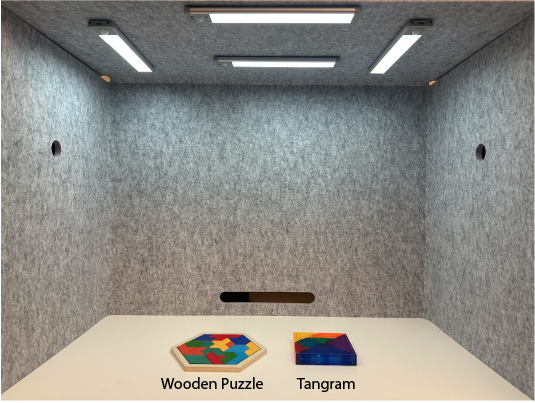
Egocentric video is captured in a controlled environment with both puzzles on a shared workspace.
A 2D task: blocks cannot be stacked vertically but may be flipped in any orientation. Scenarios span Easy → Medium → Challenging difficulty, and additionally introduce occlusion conditions to test spatial-state maintenance under missing visual information. The figure below shows goal states (top) with their abstract silhouette targets (bottom).
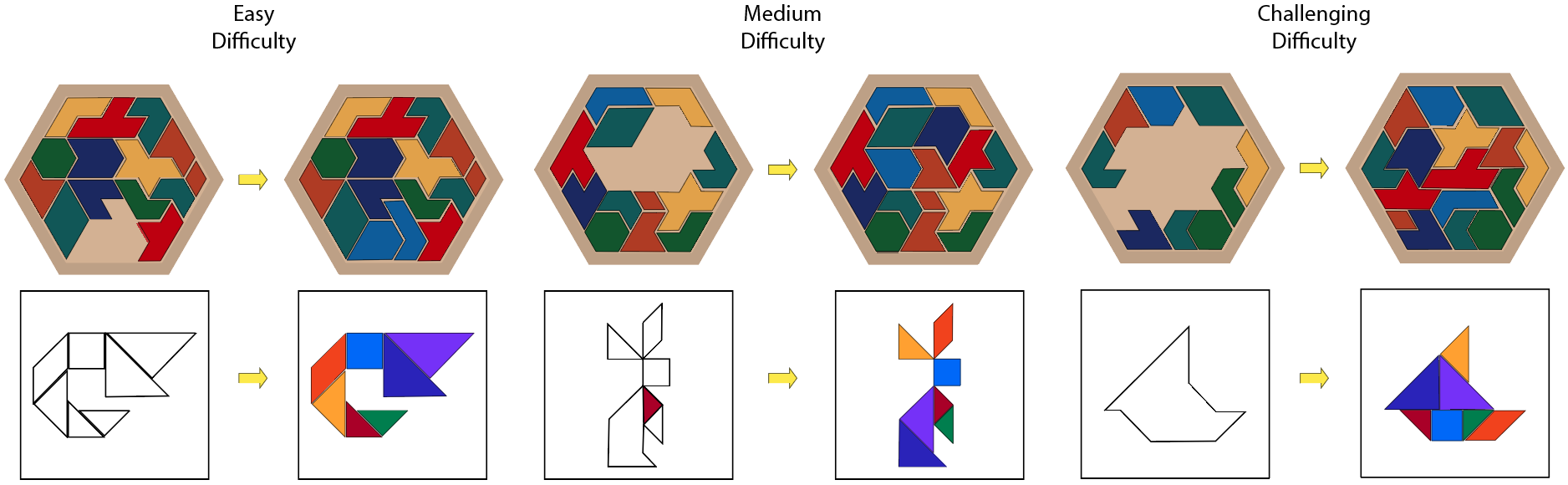
A harder packing task with 16 distinct blocks. Some blocks may already be correctly placed; the rest must be manipulated into place. Blocks may be flipped, temporarily occluded, or disappear due to manipulation mistakes.
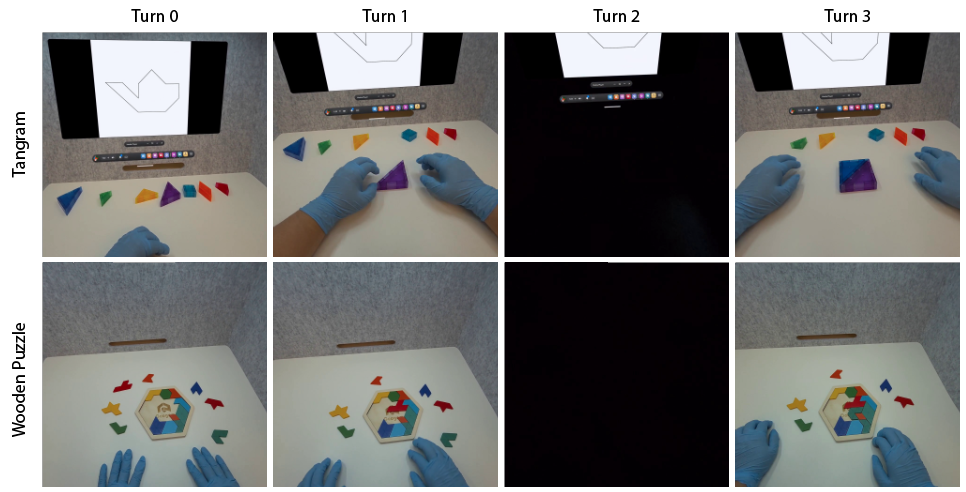
For each scenario, the model observes the goal state and then a sequence of per-turn frames. At every turn exactly one manipulation has occurred relative to the previous turn, and the model answers a fixed battery of questions (Q1–Q4).
| Question | Capability probed | Type |
|---|---|---|
| Q1. Manipulated Block | Visual perception | single-choice |
| Q2. Previously Manipulated Block | Temporal state tracking | single-choice |
| Q3. Contact Blocks | Fine-grained spatial contact reasoning | multi-choice |
| Q4. Manipulation Evaluation | Goal-directed action evaluation (error taxonomy) | multi-choice |
| Q4-1. Reasoning | Explanation for Q4 | free text |
| Q4-2. Undo Feasibility | Reversibility reasoning (conditional) | binary |
| Q4-2-1. Reasoning | Explanation for Q4-2 | free text |
| Tangram | Wooden Puzzle | Total | |
|---|---|---|---|
| Blocks | 7 (colored) | 16 (B1–B16) | — |
| Scenarios | 150 | 132 | 282 |
| Evaluation turns | — | — | 1,801 |
| Modality | egocentric, monocular frames | egocentric, monocular frames | — |
We evaluate nine VLMs zero-shot — three hosted-API models (GPT-5.2, Gemini 3 Flash Preview, Claude Sonnet 4.6) and six open-weight local models. The full analysis is in the paper; the headline results are below.
Key findings
Q2 is excluded from Turn 1; Q4-2 is scored only on turns with error ground truth.
Task 1: Tangram (7 blocks, 2D)
| Model | Type | Q1 | Q2 | Q3 | Q4 | Q4-2 | Overall |
|---|---|---|---|---|---|---|---|
| GPT-5.2 | API | 94.8 | 89.7 | 74.9 | 50.5 | 63.6 | 77.0 |
| Gemini 3 Flash Preview | API | 95.6 | 92.7 | 69.5 | 42.2 | 68.2 | 74.3 |
| Claude Sonnet 4.6 | API | 86.8 | 83.8 | 49.7 | 29.9 | 71.4 | 62.0 |
| InternVL3-8B | Local | 35.6 | 17.8 | 13.2 | 42.8 | 75.2 | 29.3 |
| Qwen3-VL-8B | Local | 36.0 | 11.3 | 7.9 | 49.6 | 79.2 | 28.1 |
| VideoChat-R1-7B | Local | 34.1 | 20.4 | 11.8 | 0.7 | 55.7 | 18.0 |
| InternVL3.5-8B | Local | 23.9 | 9.1 | 24.5 | 6.8 | 56.6 | 17.6 |
| Qwen2.5-VL-7B | Local | 34.8 | 18.5 | 11.7 | 0.7 | 27.6 | 16.8 |
| LLaVA-OV-7B | Local | 20.0 | 16.5 | 0.0 | 0.0 | 40.3 | 10.0 |
Task 2: Wooden Puzzle (16 blocks)
| Model | Type | Q1 | Q2 | Q3 | Q4 | Q4-2 | Overall |
|---|---|---|---|---|---|---|---|
| Claude Sonnet 4.6 | API | 65.6 | 56.3 | 13.6 | 36.1 | 63.0 | 42.8 |
| GPT-5.2 | API | 58.7 | 49.6 | 15.9 | 34.4 | 47.1 | 39.3 |
| Gemini 3 Flash Preview | API | 52.9 | 45.1 | 12.2 | 28.6 | 56.9 | 34.7 |
| InternVL3-8B | Local | 6.1 | 7.6 | 1.3 | 41.9 | 65.6 | 17.5 |
| Qwen3-VL-8B | Local | 13.5 | 1.1 | 0.1 | 22.1 | 58.2 | 11.1 |
| LLaVA-OV-7B | Local | 6.1 | 7.9 | 0.0 | 0.0 | 65.6 | 6.9 |
| VideoChat-R1-7B | Local | 9.2 | 1.1 | 5.3 | 4.6 | 33.8 | 6.8 |
| InternVL3.5-8B | Local | 4.0 | 0.9 | 0.4 | 10.7 | 63.0 | 5.8 |
| Qwen2.5-VL-7B | Local | 10.7 | 0.7 | 0.1 | 1.9 | 42.9 | 5.0 |
Q1 (perception) stays stable across turns while Q4 (action evaluation) collapses — the benchmark's central finding.
| Model | Q | T1 | T2 | T3 | T4 | T5 | T6 | T7 | T8 |
|---|---|---|---|---|---|---|---|---|---|
| GPT-5.2 | Q1 | 90.7 | 94.0 | 92.0 | 100.0 | 97.3 | 96.7 | 95.3 | 90.8 |
| GPT-5.2 | Q4 | 81.3 | 79.3 | 58.0 | 56.0 | 47.3 | 36.0 | 19.3 | 3.9 |
| Gemini 3 Flash Preview | Q1 | 93.3 | 94.7 | 94.7 | 99.3 | 96.7 | 96.0 | 94.0 | 96.1 |
| Gemini 3 Flash Preview | Q4 | 81.3 | 66.0 | 43.3 | 40.7 | 33.3 | 28.0 | 16.0 | 15.8 |
| Claude Sonnet 4.6 | Q1 | 89.3 | 85.3 | 81.3 | 92.0 | 89.3 | 84.0 | 89.3 | 80.3 |
| Claude Sonnet 4.6 | Q4 | 79.3 | 35.3 | 28.7 | 22.7 | 24.0 | 20.7 | 8.7 | 10.5 |
SpatialAmsan/
├── problems/
│   ├── tangram.json                 # Task 1 problem spec: setup, options, Q1–Q4 schema
│   ├── wooden_puzzle.json           # Task 2 problem spec
│   └── problem_images/
│       ├── tangram/                 # Task1-pNN.png (+ -ans.png answer keys)
│       └── wooden_puzzle/           # Task2-pNN.png
├── frames/
│   ├── Tangram_mono/
│   │   ├── blocks.jpg               # reference image of the 7 blocks
│   │   ├── _frame_indices.json      # source-video frame indices per scenario
│   │   └── pNN_sMM/                 # per-scenario frames: <scenario>_subK.jpg
│   └── WoodenPuzzle_mono/
│       ├── blocks.jpg               # reference image of the 16 blocks
│       ├── _frame_indices.json
│       └── pNN_sMM/
├── task1_eval/                      # Tangram evaluation engines
│   ├── apis/evaluate_task1.py       #   hosted API models (OpenAI/Claude/Gemini)
│   └── local/evaluate_local_task1.py#   local open-weight models (transformers)
├── task2_eval/                      # Wooden Puzzle evaluation engines
│   ├── apis/evaluate_task2.py
│   └── local/evaluate_local_task2.py
├── scripts/                         # launchers & helpers
│   ├── load_env.sh                  #   loads API keys from .env
│   ├── run_task{1,2}_{api,local}.sh #   run a task against API / local models
│   ├── verify_task{1,2}_{api,local}_sample.sh  # quick smoke tests
│   └── merge_shards.py              #   merge sharded result files
├── requirements.txt
├── .env.example                     # API-key template (copy to .env)
├── assets/                          # figures used in this README
└── LICENSE
pNN_sMM — p = problem (goal configuration), s = scenario/sequence.<scenario>_subK.jpg. sub01 is always the goal state; subsequent subK are the per-turn observations.blocks.jpg in each task folder is the canonical reference image of all blocks, referenced by the problem JSON (question_header.blocks_reference_image).The problem sets (
problems/tangram.json,problems/wooden_puzzle.json) are pure, standard JSON — strictly parseable, with no comments or trailing commas. The format is documented here in the README rather than inline in the files.
Each file has the following top-level keys:
| Key | Description |
|---|---|
dataset_name | e.g. "SpatialAmsan-Tangram" |
version | dataset version string (e.g. "v1") |
task | human-readable task name |
question_header | shared problem setup, the block reference image, and the answer-option lists (block_options, q1_options, … q4_options) |
questions | the question schema q1–q4_2_1 (prompt text, answer type, and which option list each uses) |
paths | { "frames_dir": "./frames/<Task>_mono" } |
problems | array of scenarios (150 for Tangram, 132 for Wooden Puzzle) |
Each entry in problems is one scenario:
{
  "problem_id": "tangram_p01_s01",
  "scenario":   "p01_s01",
  "goal_image": "./frames/Tangram_mono/p01_s01/p01_s01_sub01.jpg",
  "blocks_reference": "./frames/Tangram_mono/blocks.jpg",
  "num_turns": 7,
  "turns": [
    {
      "turn": 1,
      "image": "./frames/Tangram_mono/p01_s01/p01_s01_sub02.jpg",
      "q1": 7,          // single-choice: option id (see q1_options)
      "q2": null,       // single-choice or null (no prior manipulation)
      "q3": [8],        // multi-choice: list of option ids
      "q4": [2],        // multi-choice: error-taxonomy option ids
      "q4_1": "",       // free-text rationale for q4
      "q4_2": null,     // binary undo-feasibility (conditional), else null
      "q4_2_1": ""      // free-text rationale for q4_2
    }
    // ... one object per turn, up to num_turns
  ]
}
Answer encoding. q1/q2 are integer option ids; q3/q4 are lists of integer option ids; q4_2 is a binary ("Yes"/"No") gated on q4; the q*_1/q*_2_1 fields are free-text rationales. Resolve every id against the matching *_options list in question_header (the option text is the ground truth label). Image paths are repo-root-relative.
Note: the
// ...markers above are explanatory only — the actual.jsonfiles contain no comments.
The benchmark data (
frames/,problems/) needs no keys. API keys are only required to run the hosted-API evaluation (*_api.sh); local open-weight models run without any key.
Provide keys via a local .env file at the repo root — never commit real keys. A template is provided:
cp .env.example .env # then edit .env and paste your keys
.env:
OPENAI_API_KEY=sk-...          # OpenAI (GPT family)
ANTHROPIC_API_KEY=sk-ant-...   # Anthropic (Claude family)
GOOGLE_API_KEY=...             # Google (Gemini family)
Security notes:
.env is git-ignored in this repo, so your keys are never staged. Verify with git status before committing.pip install -r requirements.txt
If you only run hosted API models you can skip the local (torch/transformers) block in requirements.txt, and vice versa.
All scripts use repo-relative paths and must be launched from the repo root. Results are written to ./results/.
Requires a configured .env (see above). The launchers run all three API models in sequence:
./scripts/run_task1_api.sh        # Task 1 (Tangram)
./scripts/run_task2_api.sh        # Task 2 (Wooden Puzzle)
Override the model ids per provider with environment variables:
OPENAI_MODEL=gpt-5.2 \
CLAUDE_MODEL=claude-sonnet-4-6 \
GEMINI_MODEL=gemini-3-flash-preview \
  ./scripts/run_task1_api.sh
Run a single API model, or only a slice of scenarios, by calling the engine directly:
# Claude only, Task 1, scenarios 0–4 (the --end bound is exclusive)
python task1_eval/apis/evaluate_task1.py \
  --api claude \
  --problems ./problems/tangram.json \
  --frames_dir ./frames \
  --output ./results/task1_claude.json \
  --claude_model claude-sonnet-4-6 \
  --start 0 --end 5 \
  --max_new_tokens 2048 \
  --delay 0.5
The launchers default to three models — Qwen2.5-VL-7B, InternVL3-8B, and LLaVA-OneVision-7B:
./scripts/run_task1_local.sh      # Task 1, all default local models
./scripts/run_task2_local.sh      # Task 2
Select specific models with MODELS (comma-separated):
MODELS="qwen2p5_vl_7b" ./scripts/run_task1_local.sh                  # single model
MODELS="qwen2p5_vl_7b,internvl3_8b_hf" ./scripts/run_task2_local.sh  # subset
Available model ids: qwen2p5_vl_7b, internvl3_8b_hf, llava_onevision_qwen2_7b_ov_hf. The large llama4_scout_17b16e is excluded by default (very slow); enable it with MODELS="all" or ./scripts/run_task1_local.sh --llama4-only.
Call the engine directly for full control over device and precision:
python task1_eval/local/evaluate_local_task1.py \
  --problems ./problems/tangram.json \
  --frames_dir ./frames \
  --output_dir ./results/local \
  --models qwen2p5_vl_7b \
  --start 0 --end 5 \
  --max_new_tokens 512 \
  --device_map auto \
  --dtype bf16
Each verify script runs a single scenario and prints per-turn scores side by side — a fast way to confirm keys, model ids, and GPU setup:
./scripts/verify_task1_api_sample.sh                  # 1 scenario, all 3 API models
SAMPLE_IDX=3 ./scripts/verify_task1_local_sample.sh   # pick a scenario, local models
MODELS="qwen2p5_vl_7b" ./scripts/verify_task2_local_sample.sh
| Variable | Applies to | Default | Purpose |
|---|---|---|---|
PROBLEMS | all | ./problems/<task>.json | problem-set file |
FRAMES_DIR | all | ./frames | frames root |
START / END | all | 0 / end | evaluate a scenario slice (END exclusive; used for sharding) |
MAX_TOKENS | all | 2048 (API) / 512 (local) | max new tokens per turn |
DELAY | API | 0.5 | seconds between API calls (rate-limit safety) |
MODELS | local | all except llama4 | comma-separated local model ids |
DEVICE_MAP / DTYPE | local | auto / bf16 | device placement and precision |
OPENAI_MODEL / CLAUDE_MODEL / GEMINI_MODEL | API | paper defaults | override API model ids |
SAMPLE_IDX | verify | 0 | which scenario the smoke test runs |
Each engine writes per-model JSON to ./results/ containing every turn's parsed model answer, the ground truth, and per-question correctness for scoring. Sharded runs (split via START/END) can be recombined with scripts/merge_shards.py.
The frames/ here are sampled from the original recordings. We additionally release the source videos (minimum-cut) for both monocular and stereo captures:
| Task | Monocular | Stereo |
|---|---|---|
| Tangram | Google Drive | Google Drive |
| Wooden Puzzle | Google Drive | Google Drive |
Each linked video contains the minimum cut only.
If you use Spatial Amsan in your research, please cite:
@inproceedings{spatialamsan2026,
  title     = {Spatial Amsan: A Benchmark for Perception-Grounded Spatial
               Reasoning and Action Evaluation in Egocentric Manipulation},
  author    = {Anonymous},
  booktitle = {European Conference on Computer Vision (ECCV)},
  year      = {2026}
}
Author and venue details will be finalized upon publication.
This benchmark — data, annotations, and accompanying materials — is released under the Apache License 2.0. You are free to use, modify, and distribute it, including for commercial purposes, provided you retain attribution and cite our paper.
Spatial Amsan is a benchmark for evaluating state-based spatial reasoning and action assessment in egocentric manipulation videos. The term amsan (Korean for mental arithmetic) reflects the core challenge: constructing and continuously updating an internal spatial state to judge whether each manipulation advances toward a goal.
The benchmark comprises two block-manipulation tasks of increasing complexity — a Tangram task (7 colored blocks) and a Wooden Puzzle task (16 blocks) — yielding 282 scenarios and 1,801 evaluation turns. Models are evaluated through a multi-turn protocol that diagnostically isolates four capabilities: visual perception, temporal state tracking, spatial contact reasoning, and goal-directed action evaluation, with a conditional follow-up probing reversibility reasoning.
If you use this benchmark, please cite our paper (see Citation). The data and annotations are released under the Apache-2.0 license.
Egocentric video is captured in a controlled environment with both puzzles on a shared workspace.
A 2D task: blocks cannot be stacked vertically but may be flipped in any orientation. Scenarios span Easy → Medium → Challenging difficulty, and additionally introduce occlusion conditions to test spatial-state maintenance under missing visual information. The figure below shows goal states (top) with their abstract silhouette targets (bottom).
A harder packing task with 16 distinct blocks. Some blocks may already be correctly placed; the rest must be manipulated into place. Blocks may be flipped, temporarily occluded, or disappear due to manipulation mistakes.
For each scenario, the model observes the goal state and then a sequence of per-turn frames. At every turn exactly one manipulation has occurred relative to the previous turn, and the model answers a fixed battery of questions (Q1–Q4).
| Question | Capability probed | Type |
|---|---|---|
| Q1. Manipulated Block | Visual perception | single-choice |
| Q2. Previously Manipulated Block | Temporal state tracking | single-choice |
| Q3. Contact Blocks | Fine-grained spatial contact reasoning | multi-choice |
| Q4. Manipulation Evaluation | Goal-directed action evaluation (error taxonomy) | multi-choice |
| Q4-1. Reasoning | Explanation for Q4 | free text |
| Q4-2. Undo Feasibility | Reversibility reasoning (conditional) | binary |
| Q4-2-1. Reasoning | Explanation for Q4-2 | free text |
| Tangram | Wooden Puzzle | Total | |
|---|---|---|---|
| Blocks | 7 (colored) | 16 (B1–B16) | — |
| Scenarios | 150 | 132 | 282 |
| Evaluation turns | — | — | 1,801 |
| Modality | egocentric, monocular frames | egocentric, monocular frames | — |
We evaluate nine VLMs zero-shot — three hosted-API models (GPT-5.2, Gemini 3 Flash Preview, Claude Sonnet 4.6) and six open-weight local models. The full analysis is in the paper; the headline results are below.
Key findings
Q2 is excluded from Turn 1; Q4-2 is scored only on turns with error ground truth.
Task 1: Tangram (7 blocks, 2D)
| Model | Type | Q1 | Q2 | Q3 | Q4 | Q4-2 | Overall |
|---|---|---|---|---|---|---|---|
| GPT-5.2 | API | 94.8 | 89.7 | 74.9 | 50.5 | 63.6 | 77.0 |
| Gemini 3 Flash Preview | API | 95.6 | 92.7 | 69.5 | 42.2 | 68.2 | 74.3 |
| Claude Sonnet 4.6 | API | 86.8 | 83.8 | 49.7 | 29.9 | 71.4 | 62.0 |
| InternVL3-8B | Local | 35.6 | 17.8 | 13.2 | 42.8 | 75.2 | 29.3 |
| Qwen3-VL-8B | Local | 36.0 | 11.3 | 7.9 | 49.6 | 79.2 | 28.1 |
| VideoChat-R1-7B | Local | 34.1 | 20.4 | 11.8 | 0.7 | 55.7 | 18.0 |
| InternVL3.5-8B | Local | 23.9 | 9.1 | 24.5 | 6.8 | 56.6 | 17.6 |
| Qwen2.5-VL-7B | Local | 34.8 | 18.5 | 11.7 | 0.7 | 27.6 | 16.8 |
| LLaVA-OV-7B | Local | 20.0 | 16.5 | 0.0 | 0.0 | 40.3 | 10.0 |
Task 2: Wooden Puzzle (16 blocks)
| Model | Type | Q1 | Q2 | Q3 | Q4 | Q4-2 | Overall |
|---|---|---|---|---|---|---|---|
| Claude Sonnet 4.6 | API | 65.6 | 56.3 | 13.6 | 36.1 | 63.0 | 42.8 |
| GPT-5.2 | API | 58.7 | 49.6 | 15.9 | 34.4 | 47.1 | 39.3 |
| Gemini 3 Flash Preview | API | 52.9 | 45.1 | 12.2 | 28.6 | 56.9 | 34.7 |
| InternVL3-8B | Local | 6.1 | 7.6 | 1.3 | 41.9 | 65.6 | 17.5 |
| Qwen3-VL-8B | Local | 13.5 | 1.1 | 0.1 | 22.1 | 58.2 | 11.1 |
| LLaVA-OV-7B | Local | 6.1 | 7.9 | 0.0 | 0.0 | 65.6 | 6.9 |
| VideoChat-R1-7B | Local | 9.2 | 1.1 | 5.3 | 4.6 | 33.8 | 6.8 |
| InternVL3.5-8B | Local | 4.0 | 0.9 | 0.4 | 10.7 | 63.0 | 5.8 |
| Qwen2.5-VL-7B | Local | 10.7 | 0.7 | 0.1 | 1.9 | 42.9 | 5.0 |
Q1 (perception) stays stable across turns while Q4 (action evaluation) collapses — the benchmark's central finding.
| Model | Q | T1 | T2 | T3 | T4 | T5 | T6 | T7 | T8 |
|---|---|---|---|---|---|---|---|---|---|
| GPT-5.2 | Q1 | 90.7 | 94.0 | 92.0 | 100.0 | 97.3 | 96.7 | 95.3 | 90.8 |
| GPT-5.2 | Q4 | 81.3 | 79.3 | 58.0 | 56.0 | 47.3 | 36.0 | 19.3 | 3.9 |
| Gemini 3 Flash Preview | Q1 | 93.3 | 94.7 | 94.7 | 99.3 | 96.7 | 96.0 | 94.0 | 96.1 |
| Gemini 3 Flash Preview | Q4 | 81.3 | 66.0 | 43.3 | 40.7 | 33.3 | 28.0 | 16.0 | 15.8 |
| Claude Sonnet 4.6 | Q1 | 89.3 | 85.3 | 81.3 | 92.0 | 89.3 | 84.0 | 89.3 | 80.3 |
| Claude Sonnet 4.6 | Q4 | 79.3 | 35.3 | 28.7 | 22.7 | 24.0 | 20.7 | 8.7 | 10.5 |
SpatialAmsan/
├── problems/
│   ├── tangram.json                 # Task 1 problem spec: setup, options, Q1–Q4 schema
│   ├── wooden_puzzle.json           # Task 2 problem spec
│   └── problem_images/
│       ├── tangram/                 # Task1-pNN.png (+ -ans.png answer keys)
│       └── wooden_puzzle/           # Task2-pNN.png
├── frames/
│   ├── Tangram_mono/
│   │   ├── blocks.jpg               # reference image of the 7 blocks
│   │   ├── _frame_indices.json      # source-video frame indices per scenario
│   │   └── pNN_sMM/                 # per-scenario frames: <scenario>_subK.jpg
│   └── WoodenPuzzle_mono/
│       ├── blocks.jpg               # reference image of the 16 blocks
│       ├── _frame_indices.json
│       └── pNN_sMM/
├── task1_eval/                      # Tangram evaluation engines
│   ├── apis/evaluate_task1.py       #   hosted API models (OpenAI/Claude/Gemini)
│   └── local/evaluate_local_task1.py#   local open-weight models (transformers)
├── task2_eval/                      # Wooden Puzzle evaluation engines
│   ├── apis/evaluate_task2.py
│   └── local/evaluate_local_task2.py
├── scripts/                         # launchers & helpers
│   ├── load_env.sh                  #   loads API keys from .env
│   ├── run_task{1,2}_{api,local}.sh #   run a task against API / local models
│   ├── verify_task{1,2}_{api,local}_sample.sh  # quick smoke tests
│   └── merge_shards.py              #   merge sharded result files
├── requirements.txt
├── .env.example                     # API-key template (copy to .env)
├── assets/                          # figures used in this README
└── LICENSE
pNN_sMM — p = problem (goal configuration), s = scenario/sequence.<scenario>_subK.jpg. sub01 is always the goal state; subsequent subK are the per-turn observations.blocks.jpg in each task folder is the canonical reference image of all blocks, referenced by the problem JSON (question_header.blocks_reference_image).The problem sets (
problems/tangram.json,problems/wooden_puzzle.json) are pure, standard JSON — strictly parseable, with no comments or trailing commas. The format is documented here in the README rather than inline in the files.
Each file has the following top-level keys:
| Key | Description |
|---|---|
dataset_name | e.g. "SpatialAmsan-Tangram" |
version | dataset version string (e.g. "v1") |
task | human-readable task name |
question_header | shared problem setup, the block reference image, and the answer-option lists (block_options, q1_options, … q4_options) |
questions | the question schema q1–q4_2_1 (prompt text, answer type, and which option list each uses) |
paths | { "frames_dir": "./frames/<Task>_mono" } |
problems | array of scenarios (150 for Tangram, 132 for Wooden Puzzle) |
Each entry in problems is one scenario:
{
  "problem_id": "tangram_p01_s01",
  "scenario":   "p01_s01",
  "goal_image": "./frames/Tangram_mono/p01_s01/p01_s01_sub01.jpg",
  "blocks_reference": "./frames/Tangram_mono/blocks.jpg",
  "num_turns": 7,
  "turns": [
    {
      "turn": 1,
      "image": "./frames/Tangram_mono/p01_s01/p01_s01_sub02.jpg",
      "q1": 7,          // single-choice: option id (see q1_options)
      "q2": null,       // single-choice or null (no prior manipulation)
      "q3": [8],        // multi-choice: list of option ids
      "q4": [2],        // multi-choice: error-taxonomy option ids
      "q4_1": "",       // free-text rationale for q4
      "q4_2": null,     // binary undo-feasibility (conditional), else null
      "q4_2_1": ""      // free-text rationale for q4_2
    }
    // ... one object per turn, up to num_turns
  ]
}
Answer encoding. q1/q2 are integer option ids; q3/q4 are lists of integer option ids; q4_2 is a binary ("Yes"/"No") gated on q4; the q*_1/q*_2_1 fields are free-text rationales. Resolve every id against the matching *_options list in question_header (the option text is the ground truth label). Image paths are repo-root-relative.
Note: the
// ...markers above are explanatory only — the actual.jsonfiles contain no comments.
The benchmark data (
frames/,problems/) needs no keys. API keys are only required to run the hosted-API evaluation (*_api.sh); local open-weight models run without any key.
Provide keys via a local .env file at the repo root — never commit real keys. A template is provided:
cp .env.example .env # then edit .env and paste your keys
.env:
OPENAI_API_KEY=sk-...          # OpenAI (GPT family)
ANTHROPIC_API_KEY=sk-ant-...   # Anthropic (Claude family)
GOOGLE_API_KEY=...             # Google (Gemini family)
Security notes:
.env is git-ignored in this repo, so your keys are never staged. Verify with git status before committing.pip install -r requirements.txt
If you only run hosted API models you can skip the local (torch/transformers) block in requirements.txt, and vice versa.
All scripts use repo-relative paths and must be launched from the repo root. Results are written to ./results/.
Requires a configured .env (see above). The launchers run all three API models in sequence:
./scripts/run_task1_api.sh        # Task 1 (Tangram)
./scripts/run_task2_api.sh        # Task 2 (Wooden Puzzle)
Override the model ids per provider with environment variables:
OPENAI_MODEL=gpt-5.2 \
CLAUDE_MODEL=claude-sonnet-4-6 \
GEMINI_MODEL=gemini-3-flash-preview \
  ./scripts/run_task1_api.sh
Run a single API model, or only a slice of scenarios, by calling the engine directly:
# Claude only, Task 1, scenarios 0–4 (the --end bound is exclusive)
python task1_eval/apis/evaluate_task1.py \
  --api claude \
  --problems ./problems/tangram.json \
  --frames_dir ./frames \
  --output ./results/task1_claude.json \
  --claude_model claude-sonnet-4-6 \
  --start 0 --end 5 \
  --max_new_tokens 2048 \
  --delay 0.5
The launchers default to three models — Qwen2.5-VL-7B, InternVL3-8B, and LLaVA-OneVision-7B:
./scripts/run_task1_local.sh      # Task 1, all default local models
./scripts/run_task2_local.sh      # Task 2
Select specific models with MODELS (comma-separated):
MODELS="qwen2p5_vl_7b" ./scripts/run_task1_local.sh                  # single model
MODELS="qwen2p5_vl_7b,internvl3_8b_hf" ./scripts/run_task2_local.sh  # subset
Available model ids: qwen2p5_vl_7b, internvl3_8b_hf, llava_onevision_qwen2_7b_ov_hf. The large llama4_scout_17b16e is excluded by default (very slow); enable it with MODELS="all" or ./scripts/run_task1_local.sh --llama4-only.
Call the engine directly for full control over device and precision:
python task1_eval/local/evaluate_local_task1.py \
  --problems ./problems/tangram.json \
  --frames_dir ./frames \
  --output_dir ./results/local \
  --models qwen2p5_vl_7b \
  --start 0 --end 5 \
  --max_new_tokens 512 \
  --device_map auto \
  --dtype bf16
Each verify script runs a single scenario and prints per-turn scores side by side — a fast way to confirm keys, model ids, and GPU setup:
./scripts/verify_task1_api_sample.sh                  # 1 scenario, all 3 API models
SAMPLE_IDX=3 ./scripts/verify_task1_local_sample.sh   # pick a scenario, local models
MODELS="qwen2p5_vl_7b" ./scripts/verify_task2_local_sample.sh
| Variable | Applies to | Default | Purpose |
|---|---|---|---|
PROBLEMS | all | ./problems/<task>.json | problem-set file |
FRAMES_DIR | all | ./frames | frames root |
START / END | all | 0 / end | evaluate a scenario slice (END exclusive; used for sharding) |
MAX_TOKENS | all | 2048 (API) / 512 (local) | max new tokens per turn |
DELAY | API | 0.5 | seconds between API calls (rate-limit safety) |
MODELS | local | all except llama4 | comma-separated local model ids |
DEVICE_MAP / DTYPE | local | auto / bf16 | device placement and precision |
OPENAI_MODEL / CLAUDE_MODEL / GEMINI_MODEL | API | paper defaults | override API model ids |
SAMPLE_IDX | verify | 0 | which scenario the smoke test runs |
Each engine writes per-model JSON to ./results/ containing every turn's parsed model answer, the ground truth, and per-question correctness for scoring. Sharded runs (split via START/END) can be recombined with scripts/merge_shards.py.
The frames/ here are sampled from the original recordings. We additionally release the source videos (minimum-cut) for both monocular and stereo captures:
| Task | Monocular | Stereo |
|---|---|---|
| Tangram | Google Drive | Google Drive |
| Wooden Puzzle | Google Drive | Google Drive |
Each linked video contains the minimum cut only.
If you use Spatial Amsan in your research, please cite:
@inproceedings{spatialamsan2026,
  title     = {Spatial Amsan: A Benchmark for Perception-Grounded Spatial
               Reasoning and Action Evaluation in Egocentric Manipulation},
  author    = {Anonymous},
  booktitle = {European Conference on Computer Vision (ECCV)},
  year      = {2026}
}
Author and venue details will be finalized upon publication.
This benchmark — data, annotations, and accompanying materials — is released under the Apache License 2.0. You are free to use, modify, and distribute it, including for commercial purposes, provided you retain attribution and cite our paper.



