[ICLR26] Exposing Weakness of Large Reasoning Models through Graph Algorithm Problems
Python
6
22 commits
updated Jan 27, 2026
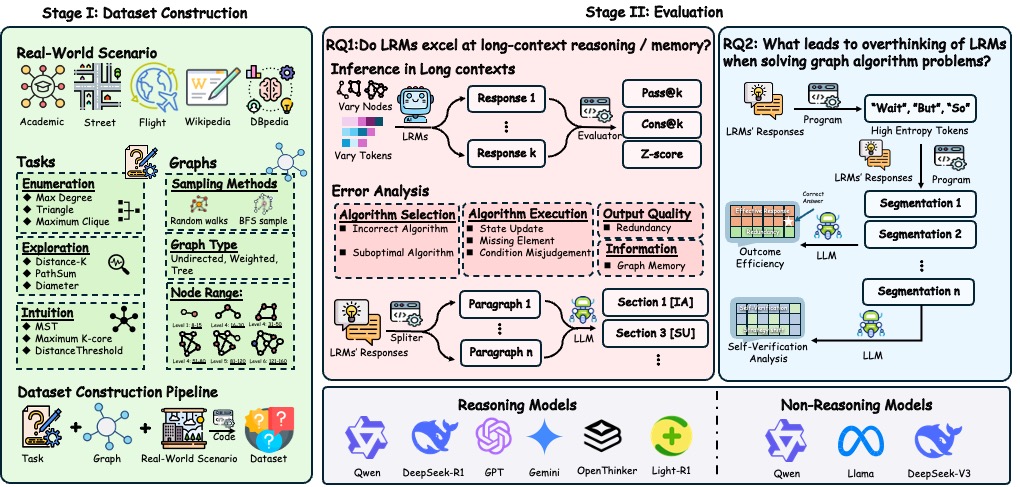
Large Reasoning Models (LRMs) have achieved rapid progress, yet existing benchmarks—focused on mathematics, programming, or common-sense reasoning—suffer from poor long-context evaluation, weak difficulty control, ambiguous answers, and narrow coverage of reasoning paradigms.
GrAlgoBench introduces a benchmark of graph algorithm problems to evaluate LRMs. Graph tasks naturally provide:
Experiments on nine tasks across three categories uncover two major weaknesses of current LRMs:
By addressing the shortcomings of prior benchmarks, GrAlgoBench establishes graph algorithm problems as a rigorous, multidimensional, and application-relevant testbed for advancing the study of reasoning in LRMs.
GrAlgoBench/
├── data_generation/        # Scripts for dataset construction
├── Inference/              # Model inference scripts and configs
├── error_analysis/         # Scripts for analyzing model errors
├── overthinking/           # Overthinking analysis module
├── label/                  # Response labeling and segmentation
├── judge/                  # Segment effectiveness judgment
├── entropy_analysis/       # Token entropy analysis and wordclouds
├── logs/                   # Default log directory
├── results/                # Saved inference results
├── scripts/                # Helper bash scripts for batch running
├── common_utils.py         # Shared utilities and configurations
└── README.md               # Documentation
conda create -n gralgobench python=3.10
conda activate gralgobench
pip install -r requirements.txt
python ./data_generation/build_dataset.py
Datasets are organized as:
dataset/
├── MKC_easy.pkl
├── MKC_medium.pkl
├── MST_hard.pkl
└── ...
Single-task example:
python Inference/infer_open.py \
    --LLM Qwen3-8B \
    --task MST \
    --difficulty medium \
    --batch_size 32 \
    --gpu_num 4
Batch execution via script:
bash scripts/infer_open.sh
To analyze model errors, follow these steps:
Reformat raw responses
This step parses and normalizes model outputs into a consistent structure:
python error_analysis/reformat.py
Run the error analysis script
Specify the task, evaluation model, and the model that generated the responses:
python error_analysis/error_analysis.py \
    --task MST \
    --llm gpt5_mini \
    --response_generated_from_what_model Qwen3-8B
GrAlgoBench provides comprehensive analysis tools to understand model behavior and reasoning patterns across multiple dimensions:
Analyze model self-verification and reasoning redundancy patterns:
./overthinking/run_overthinking.sh 0,1 \
    --LLM Qwen3-32B \
    --task_type graph \
    --batch_size 32

./overthinking/run_overthinking.sh 0,1 \
    --LLM Qwen3-32B \
    --task_type math_competition \
    --batch_size 16
Segment and label model reasoning steps for fine-grained analysis:
./label/run_label.sh 0,1 \
    --LLM Qwen3-32B \
    --task_type graph \
    --batch_size 32

./label/run_label.sh 0,1 \
    --LLM Qwen3-32B \
    --task_type math_competition \
    --batch_size 16
Evaluate the effectiveness of individual reasoning segments:
./judge/run_judge.sh 0,1 \
    --LLM Qwen3-32B \
    --task_type graph \
    --batch_size 32

./judge/run_judge.sh 0,1 \
    --LLM Qwen3-32B \
    --task_type math \
    --batch_size 16
Analyze token-level uncertainty and model confidence patterns:
./entropy_analysis/run_entropy_analysis.sh infer 0,1 \
    --LLM Qwen3-32B --task MaxDegree --difficulty easy

./entropy_analysis/run_entropy_analysis.sh analyze 0,1 \
    --min_freq 40000 --top_k 100

./entropy_analysis/run_entropy_analysis.sh wordcloud 0,1
[ICLR26] Exposing Weakness of Large Reasoning Models through Graph Algorithm Problems
Python
6
22 commits
updated Jan 27, 2026
Large Reasoning Models (LRMs) have achieved rapid progress, yet existing benchmarks—focused on mathematics, programming, or common-sense reasoning—suffer from poor long-context evaluation, weak difficulty control, ambiguous answers, and narrow coverage of reasoning paradigms.
GrAlgoBench introduces a benchmark of graph algorithm problems to evaluate LRMs. Graph tasks naturally provide:
Experiments on nine tasks across three categories uncover two major weaknesses of current LRMs:
By addressing the shortcomings of prior benchmarks, GrAlgoBench establishes graph algorithm problems as a rigorous, multidimensional, and application-relevant testbed for advancing the study of reasoning in LRMs.
GrAlgoBench/
├── data_generation/        # Scripts for dataset construction
├── Inference/              # Model inference scripts and configs
├── error_analysis/         # Scripts for analyzing model errors
├── overthinking/           # Overthinking analysis module
├── label/                  # Response labeling and segmentation
├── judge/                  # Segment effectiveness judgment
├── entropy_analysis/       # Token entropy analysis and wordclouds
├── logs/                   # Default log directory
├── results/                # Saved inference results
├── scripts/                # Helper bash scripts for batch running
├── common_utils.py         # Shared utilities and configurations
└── README.md               # Documentation
conda create -n gralgobench python=3.10
conda activate gralgobench
pip install -r requirements.txt
python ./data_generation/build_dataset.py
Datasets are organized as:
dataset/
├── MKC_easy.pkl
├── MKC_medium.pkl
├── MST_hard.pkl
└── ...
Single-task example:
python Inference/infer_open.py \
    --LLM Qwen3-8B \
    --task MST \
    --difficulty medium \
    --batch_size 32 \
    --gpu_num 4
Batch execution via script:
bash scripts/infer_open.sh
To analyze model errors, follow these steps:
Reformat raw responses
This step parses and normalizes model outputs into a consistent structure:
python error_analysis/reformat.py
Run the error analysis script
Specify the task, evaluation model, and the model that generated the responses:
python error_analysis/error_analysis.py \
    --task MST \
    --llm gpt5_mini \
    --response_generated_from_what_model Qwen3-8B
GrAlgoBench provides comprehensive analysis tools to understand model behavior and reasoning patterns across multiple dimensions:
Analyze model self-verification and reasoning redundancy patterns:
./overthinking/run_overthinking.sh 0,1 \
    --LLM Qwen3-32B \
    --task_type graph \
    --batch_size 32

./overthinking/run_overthinking.sh 0,1 \
    --LLM Qwen3-32B \
    --task_type math_competition \
    --batch_size 16
Segment and label model reasoning steps for fine-grained analysis:
./label/run_label.sh 0,1 \
    --LLM Qwen3-32B \
    --task_type graph \
    --batch_size 32

./label/run_label.sh 0,1 \
    --LLM Qwen3-32B \
    --task_type math_competition \
    --batch_size 16
Evaluate the effectiveness of individual reasoning segments:
./judge/run_judge.sh 0,1 \
    --LLM Qwen3-32B \
    --task_type graph \
    --batch_size 32

./judge/run_judge.sh 0,1 \
    --LLM Qwen3-32B \
    --task_type math \
    --batch_size 16
Analyze token-level uncertainty and model confidence patterns:
./entropy_analysis/run_entropy_analysis.sh infer 0,1 \
    --LLM Qwen3-32B --task MaxDegree --difficulty easy

./entropy_analysis/run_entropy_analysis.sh analyze 0,1 \
    --min_freq 40000 --top_k 100

./entropy_analysis/run_entropy_analysis.sh wordcloud 0,1



