A lightweight library for generating synthetic instruction tuning datasets for your data without GPT.
Python
829
35 commits
updated Jul 15, 2025
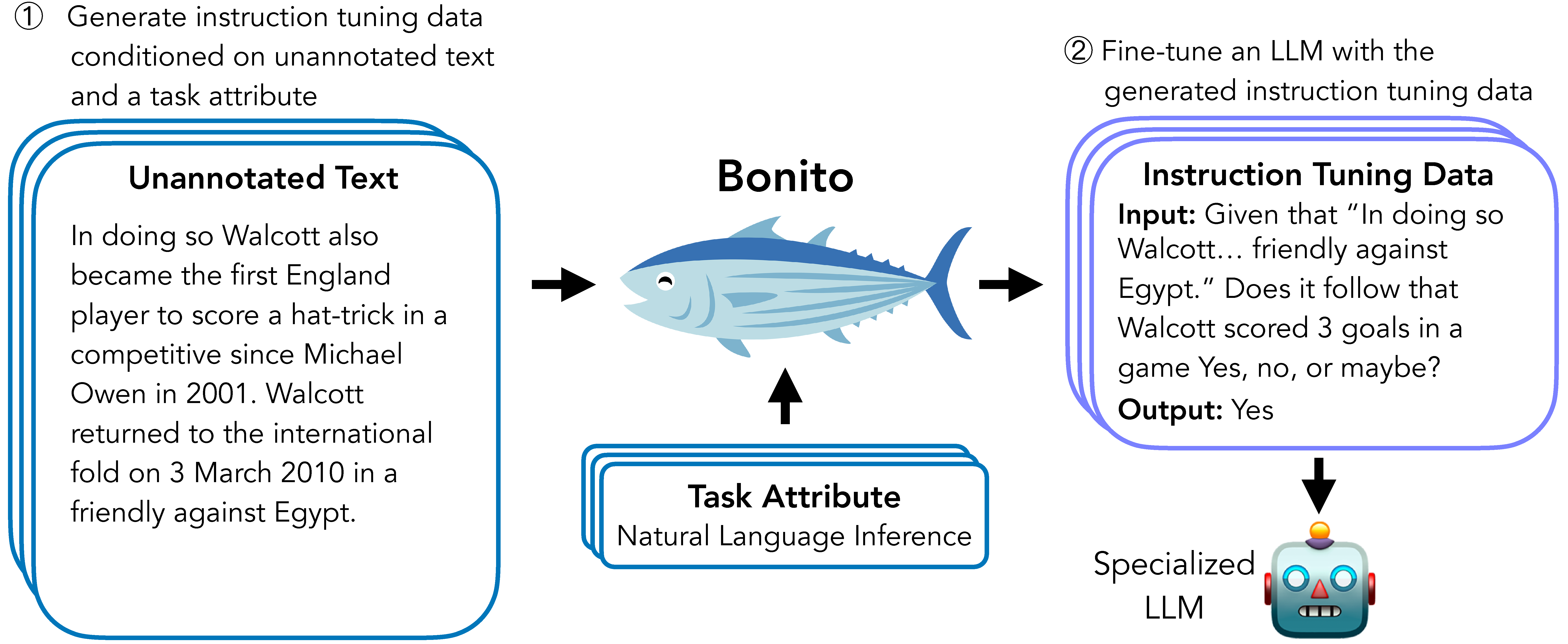
Bonito is an open-source model for conditional task generation: the task of converting unannotated text into task-specific training datasets for instruction tuning. This repo is a lightweight library for Bonito to easily create synthetic datasets built on top of the Hugging Face transformers and vllm libraries.
bonito-llm to PyPI.Create an environment and install the package using the following command:
pip3 install bonito-llm
To generate synthetic instruction tuning dataset using Bonito, you can use the following code:
from bonito import Bonito
from vllm import SamplingParams
from datasets import load_dataset

# Initialize the Bonito model
bonito = Bonito("BatsResearch/bonito-v1")

# load dataset with unannotated text
unannotated_text = load_dataset(
    "BatsResearch/bonito-experiment",
    "unannotated_contract_nli"
)["train"].select(range(10))

# Generate synthetic instruction tuning dataset
sampling_params = SamplingParams(max_tokens=256, top_p=0.95, temperature=0.5, n=1)
synthetic_dataset = bonito.generate_tasks(
    unannotated_text,
    context_col="input",
    task_type="nli",
    sampling_params=sampling_params
)
Here we include the supported task types [full name (short form)]: extractive question answering (exqa), multiple-choice question answering (mcqa), question generation (qg), question answering without choices (qa), yes-no question answering (ynqa), coreference resolution (coref), paraphrase generation (paraphrase), paraphrase identification (paraphrase_id), sentence completion (sent_comp), sentiment (sentiment), summarization (summarization), text generation (text_gen), topic classification (topic_class), word sense disambiguation (wsd), textual entailment (te), natural language inference (nli)
You can use either the full name or the short form to specify the task_type in generate_tasks.
We have created a tutorial here for how to use a quantized version of the model in a Google Colab T4 instance. The quantized version was graciously contributed by user alexandreteles. We have an additional tutorial to try out the Bonito model on A100 GPU on Google Colab here.
If you use Bonito in your research, please cite the following paper:
@inproceedings{bonito:aclfindings24,
  title = {Learning to Generate Instruction Tuning Datasets for Zero-Shot Task Adaptation},
  author = {Nayak, Nihal V. and Nan, Yiyang and Trost, Avi and Bach, Stephen H.},
  booktitle = {Findings of the Association for Computational Linguistics: ACL 2024},
  year = {2024}}
392 followers · starred Jun 2024
1,113 followers · starred Mar 2024
7,319 followers · starred Mar 2024
183 followers · starred Mar 2024
A lightweight library for generating synthetic instruction tuning datasets for your data without GPT.
Python
829
35 commits
updated Jul 15, 2025
Bonito is an open-source model for conditional task generation: the task of converting unannotated text into task-specific training datasets for instruction tuning. This repo is a lightweight library for Bonito to easily create synthetic datasets built on top of the Hugging Face transformers and vllm libraries.
bonito-llm to PyPI.Create an environment and install the package using the following command:
pip3 install bonito-llm
To generate synthetic instruction tuning dataset using Bonito, you can use the following code:
from bonito import Bonito
from vllm import SamplingParams
from datasets import load_dataset

# Initialize the Bonito model
bonito = Bonito("BatsResearch/bonito-v1")

# load dataset with unannotated text
unannotated_text = load_dataset(
    "BatsResearch/bonito-experiment",
    "unannotated_contract_nli"
)["train"].select(range(10))

# Generate synthetic instruction tuning dataset
sampling_params = SamplingParams(max_tokens=256, top_p=0.95, temperature=0.5, n=1)
synthetic_dataset = bonito.generate_tasks(
    unannotated_text,
    context_col="input",
    task_type="nli",
    sampling_params=sampling_params
)
Here we include the supported task types [full name (short form)]: extractive question answering (exqa), multiple-choice question answering (mcqa), question generation (qg), question answering without choices (qa), yes-no question answering (ynqa), coreference resolution (coref), paraphrase generation (paraphrase), paraphrase identification (paraphrase_id), sentence completion (sent_comp), sentiment (sentiment), summarization (summarization), text generation (text_gen), topic classification (topic_class), word sense disambiguation (wsd), textual entailment (te), natural language inference (nli)
You can use either the full name or the short form to specify the task_type in generate_tasks.
We have created a tutorial here for how to use a quantized version of the model in a Google Colab T4 instance. The quantized version was graciously contributed by user alexandreteles. We have an additional tutorial to try out the Bonito model on A100 GPU on Google Colab here.
If you use Bonito in your research, please cite the following paper:
@inproceedings{bonito:aclfindings24,
  title = {Learning to Generate Instruction Tuning Datasets for Zero-Shot Task Adaptation},
  author = {Nayak, Nihal V. and Nan, Yiyang and Trost, Avi and Bach, Stephen H.},
  booktitle = {Findings of the Association for Computational Linguistics: ACL 2024},
  year = {2024}}
392 followers · starred Jun 2024
1,113 followers · starred Mar 2024
7,319 followers · starred Mar 2024
183 followers · starred Mar 2024






