Jupyter Notebook
0
54 commits
updated Oct 18, 2026
SHAWAF is a Stage 1 benchmark for text-to-tracklet retrieval. A frozen vision-language model embeds a text description and each video tracklet; cosine similarity ranks the gallery.
text description ──► text encoder ──► text embedding
                                      │ cosine similarity
tracklet ──────────► video/image encoder ──► tracklet embedding ──► ranked gallery
This repository does not fuse VLM and Re-ID features or train a projection
into the VLM space (later SHAWAF stages). Optional Qdrant + Gradio demo
support interactive text→tracklet search with multiple pooling modes; the core
benchmark remains embedding-only. The identity encoder remains in the sibling
Person-ReID-BenchMark project.
All results below are frozen, zero-shot evaluations: no model was fine-tuned on the target benchmark. Values are Rank-1 / mAP unless stated otherwise.
| Question | Best result | Interpretation |
|---|---|---|
| Person descriptions on video tracklets (TVPReid) | IRRA: 66.55 / 76.09 on PRID | Task-specific text-to-person training transfers best to identity descriptions. |
| Person descriptions on still images (RSTPReid) | IRRA: 53.30 / 39.71 | The same task-specific advantage survives without temporal information. |
| Clothing-based street-track retrieval (GroOT appearance) | SigLIP 2: 25.58 | Appearance is discriminative; broad image-language pretraining is competitive. |
| Long-video event retrieval (ActivityNet paragraph) | InternVideo2 CLIP-S: 69.80 / 80.24 | Video-language pretraining and temporal coverage matter for whole events. |
| Long-video event retrieval (ActivityNet sentence) | Perception Encoder: 41.91 / 54.83 | Frame-level semantic alignment is strongest for short event descriptions. |
| Best extended model on TVPReid | Qwen3-VL-Embedding-2B: 24.65 / 37.00 on PRID | Newer general embeddings help, but still do not beat task-specific IRRA. |
Each cell is the best Rank-1 / mAP for that model on the indicated test subset. The gallery sizes are PRID 185, iLIDS 75, and Duke 603 tracklets.
| Model | PRID | iLIDS | Duke |
|---|---|---|---|
| IRRA | 66.55 / 76.09 | 30.00 / 41.29 | 38.06 / 50.79 |
| SigLIP 2 So400m | 35.56 / 50.84 | 18.67 / 28.88 | 21.97 / 33.03 |
| Perception Encoder L/14 | 38.38 / 52.04 | 19.33 / 32.55 | 17.66 / 28.12 |
| InternVideo2 CLIP-S | 32.39 / 43.77 | 13.33 / 24.14 | 18.49 / 28.36 |
| Qwen3-VL-Embedding-2B | 24.65 / 37.00 | 11.33 / 21.37 | 13.18 / 22.73 |
| LanguageBind | 16.20 / 24.82 | 12.67 / 22.09 | 7.30 / 14.46 |
| GME-Qwen2-VL-2B | 11.62 / 22.96 | 10.67 / 20.14 | 9.45 / 17.70 |
| OpenAI CLIP ViT-L/14 | 10.92 / 20.05 | 9.33 / 17.48 | 5.14 / 10.10 |
| Jina CLIP v2 | 7.75 / 14.41 | 11.33 / 19.47 | 4.15 / 9.80 |
| X-CLIP | 4.93 / 10.05 | 5.33 / 10.52 | 1.41 / 3.95 |
| InternVideo2-1B-s2 | 4.23 / 10.78 | 4.00 / 10.26 | 1.82 / 4.15 |
Why the gap? IRRA was trained for text-to-person retrieval, so its embedding space is aligned with clothing, body, and identity descriptions. General video-language models learn events and actions rather than fine-grained person identity. Qwen3 is the strongest of the newer general encoders, but specialization still matters more than parameter count.
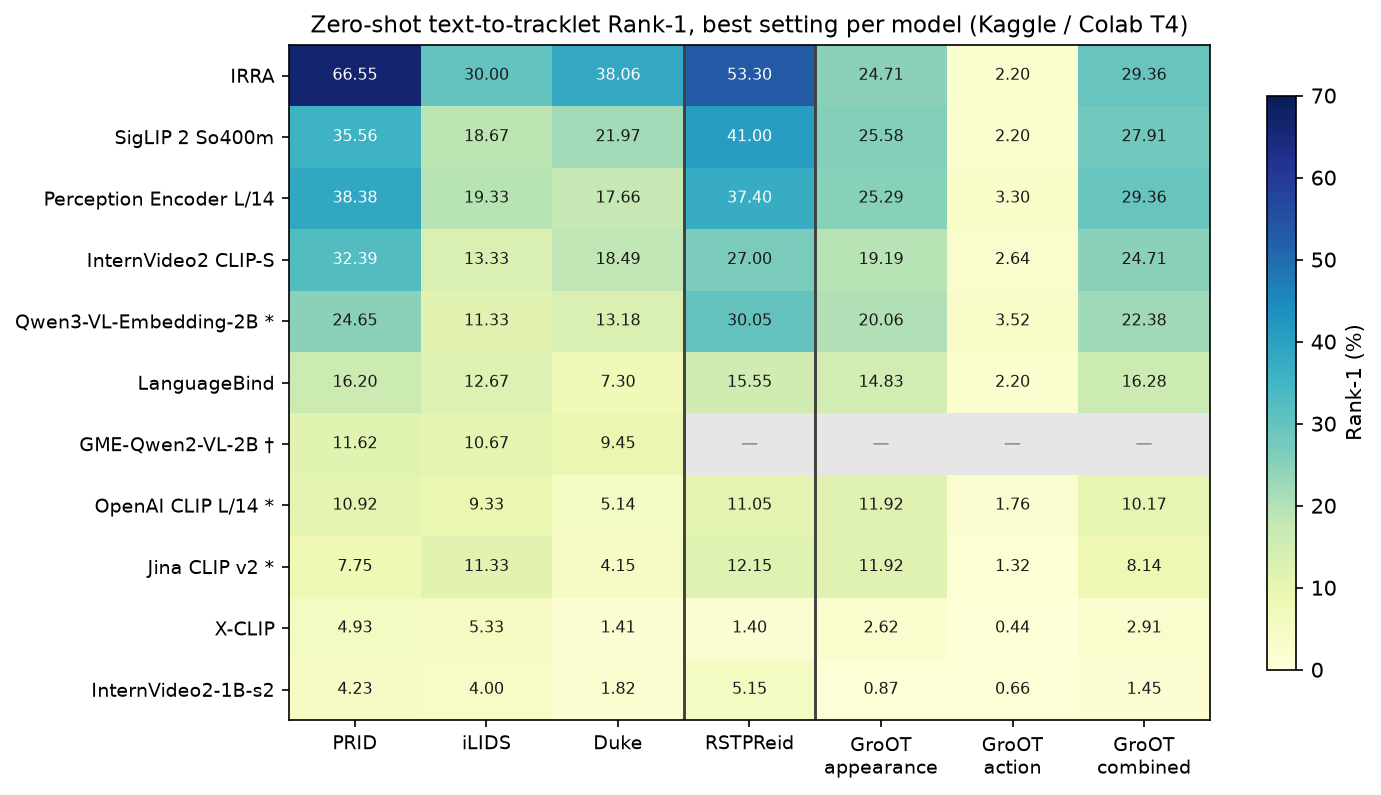
This is an image-only check: 2,000 descriptions query 1,000 images from 200 identities.
| Model | Rank-1 / mAP |
|---|---|
| IRRA | 53.30 / 39.71 |
| SigLIP 2 So400m | 41.00 / 29.34 |
| Perception Encoder L/14 | 37.40 / 29.09 |
| Qwen3-VL-Embedding-2B | 30.05 / 21.72 |
| InternVideo2 CLIP-S | 27.00 / 21.34 |
| LanguageBind | 15.55 / 11.36 |
| Jina CLIP v2 | 12.15 / 9.64 |
| OpenAI CLIP ViT-L/14 | 11.05 / 8.21 |
| InternVideo2-1B-s2 | 5.15 / 4.53 |
| X-CLIP | 1.40 / 2.26 |
The ordering supports the TVPReid conclusion: image-language pretraining helps more than video pretraining when there is no temporal signal, but task-specific person retrieval remains the strongest prior.
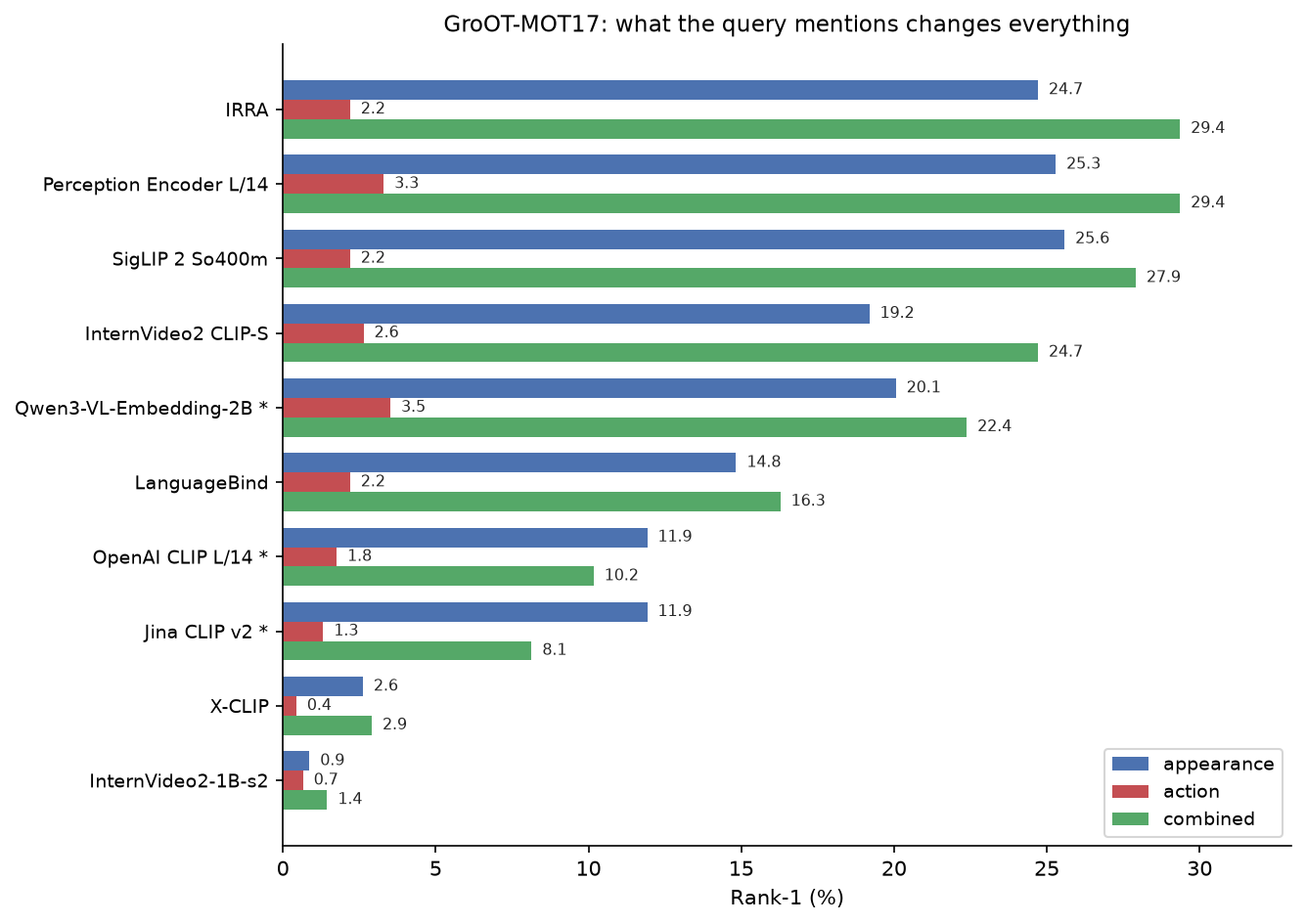
The same 454 street tracks are queried using appearance descriptions, action descriptions, and a cleaned sentence containing both.
| Model | Appearance | Action | Combined |
|---|---|---|---|
| Perception Encoder L/14 | 25.29 | 3.30 | 29.36 |
| IRRA | 24.71 | 2.20 | 29.36 |
| SigLIP 2 So400m | 25.58 | 2.20 | 27.91 |
| InternVideo2 CLIP-S | 19.19 | 2.64 | 24.71 |
| Qwen3-VL-Embedding-2B | 20.06 | 3.52 | 22.38 |
| LanguageBind | 14.83 | 2.20 | 16.28 |
| OpenAI CLIP ViT-L/14 | 11.92 | 1.76 | 10.17 |
| Jina CLIP v2 | 11.92 | 1.32 | 8.14 |
| X-CLIP | 2.62 | 0.44 | 2.91 |
| InternVideo2-1B-s2 | 0.87 | 0.66 | 1.45 |
Action Rank-1 is only 0.44–3.52 because the action captions are highly
repetitive: only 112 of 454 are unique, and “a person walking on the street”
alone matches 78 tracks. This is primarily a dataset/caption ceiling, not a
model failure. Appearance is discriminative; combining appearance and action
improves both leading models. The reviewed combined captions are stored in
shawaf_vlm/data/groot_mot17_combined.json.
This out-of-domain check uses a seeded sample of 1,000 val1 videos
(ANET_SEED=0, about 180 seconds per video). paragraph joins a video's event
sentences; sentence queries individual events. Only the seven base models
were evaluated.
| Model | Paragraph | Sentence | Mean Rank-1 |
|---|---|---|---|
| Perception Encoder L/14 | 68.10 / 78.87 | 41.91 / 54.83 | 55.01 |
| InternVideo2 CLIP-S | 69.80 / 80.24 | 39.73 / 52.87 | 54.76 |
| LanguageBind | 64.10 / 75.18 | 36.96 / 49.82 | 50.53 |
| SigLIP 2 So400m | 57.10 / 70.18 | 35.11 / 48.51 | 46.11 |
| InternVideo2-1B-s2 | 37.70 / 48.77 | 10.62 / 15.48 | 24.16 |
| X-CLIP | 28.60 / 41.53 | 14.04 / 23.59 | 21.32 |
| IRRA | 16.40 / 27.20 | 8.29 / 15.40 | 12.35 |
The ranking reverses relative to person retrieval: video-pretrained encoders transfer better to general events, while IRRA's person-specific training does not. Dense temporal sampling helps sentence queries because one window can match the queried event; mean pooling is safer for paragraphs.
These are not published ActivityNet numbers. They use a 1,000-video sample and frozen encoders rather than an ActivityNet-trained retrieval model.
uniform8, vt_1fps_n12, vt_2fps_n32, and
reid_8fps_n64.mean, mean_s8, max, and query_max.query_max is this repository's late-interaction diagnostic; it is not the
official X-Pool implementation.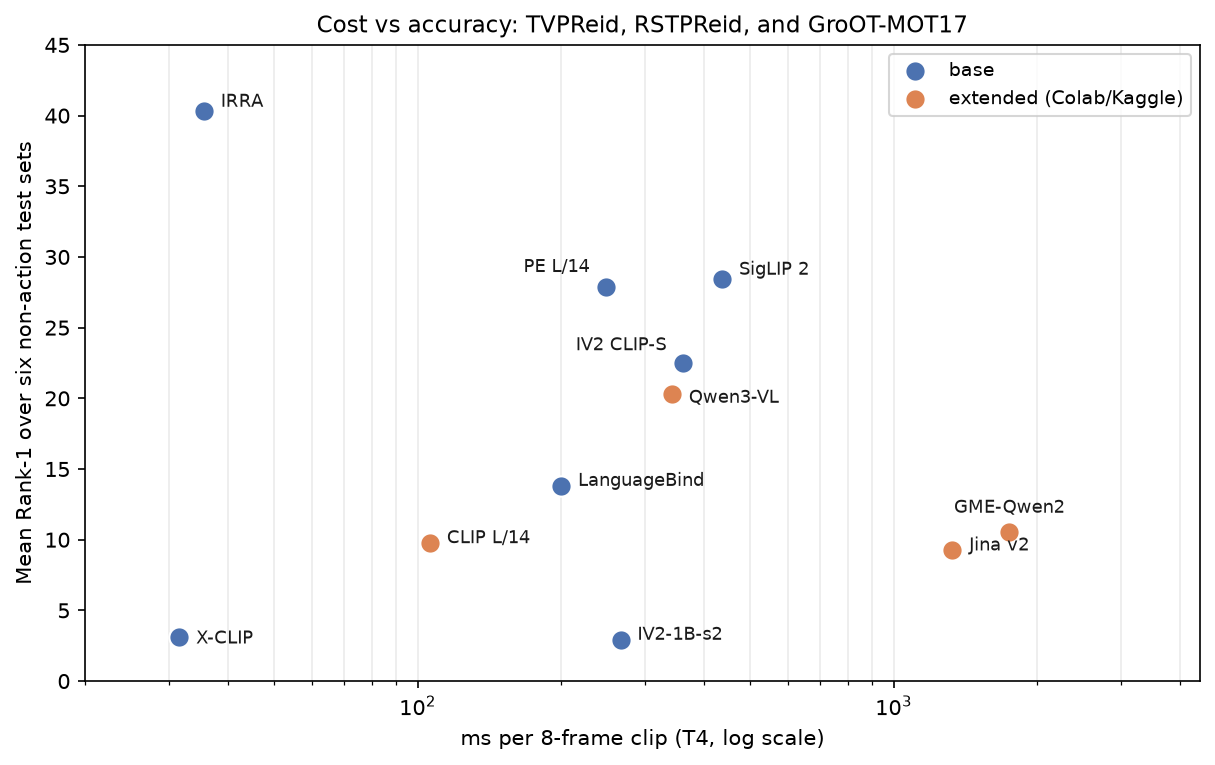
This figure belongs to the TVPReid + RSTPReid + GroOT-MOT17 experiments, not ActivityNet. Each point is one frozen model. The x-axis is the measured time to encode one 8-frame clip on a T4; the y-axis is mean Rank-1 across the six available non-action test sets: TVPReid PRID, iLIDS, and Duke; RSTPReid; and GroOT-MOT17 appearance and combined queries. GroOT action is excluded because its highly repetitive captions create a dataset ceiling rather than a meaningful model comparison. Timings were collected in the benchmark runs and are hardware/runtime-specific, so the chart is a practical trade-off view, not a universal speed ranking.
The extended checkpoint contains all 156 completed configurations for
OpenAI CLIP ViT-L/14, Jina CLIP v2, GME-Qwen2-VL-2B, and
Qwen3-VL-Embedding-2B across PRID, iLIDS, and Duke:
results/checkpoints/extended_zero_shot_4models_3datasets_v1.csv.
| Path | Purpose |
|---|---|
shawaf_vlm/ | Core library: data/, models/, retrieval/, eval loop |
scripts/ | CLI: download, index, eval, figures (see scripts README) |
demo/ | Gradio UI (search only; data via download_tier_a.py) |
docs/ | Architecture, environments, datasets |
notebooks/ | Kaggle/Colab experiment notebooks |
tests/ | Pytest suite (pytest from repo root) |
assets/ | Report figures |
papers/ | Reference papers |
Large datasets, model caches, generated frames, checkpoints, build/,
results/ outputs, and notebook checkpoint folders are intentionally ignored
by Git. The tracked extended CSV is the exception: it is the compact,
reviewable experiment checkpoint.
Python 3.10+ is required. Install the common environment or a model-specific extra:
pip install -e ".[all]"
# or: pip install -e ".[xclip]"
# or: pip install -e ".[extended_modern]"
# or: pip install -e ".[extended_gme]"
extended_modern uses Transformers 4.57.3 for OpenAI CLIP, Jina CLIP v2, and
Qwen3-VL-Embedding. extended_gme uses Transformers 4.51.3 and is kept
separate because the two profiles are not mutually compatible.
python scripts/eval_encoder.py --model xclip --data-root "../Person-ReID-BenchMark/datasets/MARS" --ann-root "/path/to/tv-mars-captions" --device cuda
For sliding windows and pooling (including Method C / global_local):
| Mode | CLI pool | Scoring |
|---|---|---|
| Average (global) | mean | Mean of clip embeddings per tracklet; cos(q, g) |
| Max (local) | query_max | max_i cos(q, c_i) per tracklet |
| Type C (hybrid) | global_local | α·cos(q,g) + (1−α)·max_i cos(q,c_i) (--hybrid-alpha, default 0.5) |
python scripts/eval_encoder.py --model languagebind --windows --stride 4 --sample-fps 2 --max-frames 32 --pools mean,query_max,global_local --hybrid-alpha 0.5
Re-run the same command on TVPReid, RSTPReid, and GroOT (via dataset loaders in
the Kaggle notebook or shawaf-vlm-eval) to compare pooling strategies on Tier A
benchmarks.
pip install -e ".[demo]"
# If transformers breaks after demo install: scripts/env/repair_crowd_gpu_deps.ps1

python scripts/download_tier_a.py   # TVPReid + GroOT (HF) + RSTPReid (Drive)
docker compose up -d qdrant         # optional; demo falls back to on-disk numpy index
python scripts/index_qdrant.py --model siglip2 --dataset tvpreid:prid
python demo/app.py
python scripts/smoke_demo_stack.py   # smoke checks (no server)
Set SHAWAF_MODEL_GROUP to base, extended_modern, or extended_gme when
switching encoder families (restart the app). Downloads use
HF_TOKEN / HUGGING_FACE_HUB_TOKEN from the environment (CLI only, not Gradio).
See docs/datasets_catalog.md for integrated and planned text-to-person datasets.
The loaders also support the public dataset mirrors used by the notebooks: TVPReid, GroOT-MOT17, and ActivityNet Captions. MSMT17/RSTPReid data is not redistributed here.
notebooks/kaggle-zero-shot.ipynb:
multi-dataset zero-shot benchmark.notebooks/colab_extended_zero_shot.ipynb:
extended-model TVPReid checkpoint.notebooks/activity-net-siglip-irra-xclip-perception.ipynb:
ActivityNet base models, first group.notebooks/activity-net-languagebind-internvideo.ipynb:
ActivityNet base models, second group.notebooks/kaggle_finetuning.ipynb:
exploratory InternVideo2 fine-tuning; it is not part of the frozen tables.Dataset-specific paths can be overridden with
SHAWAF_TVPREID_ROOT, SHAWAF_RSTPREID_ROOT, SHAWAF_GROOT_ROOT,
SHAWAF_MARS_ROOT, and SHAWAF_TV_MARS_ANN.
See LICENSE. Dataset and checkpoint licenses remain those of their
original providers.
Jupyter Notebook
0
54 commits
updated Oct 18, 2026
SHAWAF is a Stage 1 benchmark for text-to-tracklet retrieval. A frozen vision-language model embeds a text description and each video tracklet; cosine similarity ranks the gallery.
text description ──► text encoder ──► text embedding
                                      │ cosine similarity
tracklet ──────────► video/image encoder ──► tracklet embedding ──► ranked gallery
This repository does not fuse VLM and Re-ID features or train a projection
into the VLM space (later SHAWAF stages). Optional Qdrant + Gradio demo
support interactive text→tracklet search with multiple pooling modes; the core
benchmark remains embedding-only. The identity encoder remains in the sibling
Person-ReID-BenchMark project.
All results below are frozen, zero-shot evaluations: no model was fine-tuned on the target benchmark. Values are Rank-1 / mAP unless stated otherwise.
| Question | Best result | Interpretation |
|---|---|---|
| Person descriptions on video tracklets (TVPReid) | IRRA: 66.55 / 76.09 on PRID | Task-specific text-to-person training transfers best to identity descriptions. |
| Person descriptions on still images (RSTPReid) | IRRA: 53.30 / 39.71 | The same task-specific advantage survives without temporal information. |
| Clothing-based street-track retrieval (GroOT appearance) | SigLIP 2: 25.58 | Appearance is discriminative; broad image-language pretraining is competitive. |
| Long-video event retrieval (ActivityNet paragraph) | InternVideo2 CLIP-S: 69.80 / 80.24 | Video-language pretraining and temporal coverage matter for whole events. |
| Long-video event retrieval (ActivityNet sentence) | Perception Encoder: 41.91 / 54.83 | Frame-level semantic alignment is strongest for short event descriptions. |
| Best extended model on TVPReid | Qwen3-VL-Embedding-2B: 24.65 / 37.00 on PRID | Newer general embeddings help, but still do not beat task-specific IRRA. |
Each cell is the best Rank-1 / mAP for that model on the indicated test subset. The gallery sizes are PRID 185, iLIDS 75, and Duke 603 tracklets.
| Model | PRID | iLIDS | Duke |
|---|---|---|---|
| IRRA | 66.55 / 76.09 | 30.00 / 41.29 | 38.06 / 50.79 |
| SigLIP 2 So400m | 35.56 / 50.84 | 18.67 / 28.88 | 21.97 / 33.03 |
| Perception Encoder L/14 | 38.38 / 52.04 | 19.33 / 32.55 | 17.66 / 28.12 |
| InternVideo2 CLIP-S | 32.39 / 43.77 | 13.33 / 24.14 | 18.49 / 28.36 |
| Qwen3-VL-Embedding-2B | 24.65 / 37.00 | 11.33 / 21.37 | 13.18 / 22.73 |
| LanguageBind | 16.20 / 24.82 | 12.67 / 22.09 | 7.30 / 14.46 |
| GME-Qwen2-VL-2B | 11.62 / 22.96 | 10.67 / 20.14 | 9.45 / 17.70 |
| OpenAI CLIP ViT-L/14 | 10.92 / 20.05 | 9.33 / 17.48 | 5.14 / 10.10 |
| Jina CLIP v2 | 7.75 / 14.41 | 11.33 / 19.47 | 4.15 / 9.80 |
| X-CLIP | 4.93 / 10.05 | 5.33 / 10.52 | 1.41 / 3.95 |
| InternVideo2-1B-s2 | 4.23 / 10.78 | 4.00 / 10.26 | 1.82 / 4.15 |
Why the gap? IRRA was trained for text-to-person retrieval, so its embedding space is aligned with clothing, body, and identity descriptions. General video-language models learn events and actions rather than fine-grained person identity. Qwen3 is the strongest of the newer general encoders, but specialization still matters more than parameter count.
This is an image-only check: 2,000 descriptions query 1,000 images from 200 identities.
| Model | Rank-1 / mAP |
|---|---|
| IRRA | 53.30 / 39.71 |
| SigLIP 2 So400m | 41.00 / 29.34 |
| Perception Encoder L/14 | 37.40 / 29.09 |
| Qwen3-VL-Embedding-2B | 30.05 / 21.72 |
| InternVideo2 CLIP-S | 27.00 / 21.34 |
| LanguageBind | 15.55 / 11.36 |
| Jina CLIP v2 | 12.15 / 9.64 |
| OpenAI CLIP ViT-L/14 | 11.05 / 8.21 |
| InternVideo2-1B-s2 | 5.15 / 4.53 |
| X-CLIP | 1.40 / 2.26 |
The ordering supports the TVPReid conclusion: image-language pretraining helps more than video pretraining when there is no temporal signal, but task-specific person retrieval remains the strongest prior.
The same 454 street tracks are queried using appearance descriptions, action descriptions, and a cleaned sentence containing both.
| Model | Appearance | Action | Combined |
|---|---|---|---|
| Perception Encoder L/14 | 25.29 | 3.30 | 29.36 |
| IRRA | 24.71 | 2.20 | 29.36 |
| SigLIP 2 So400m | 25.58 | 2.20 | 27.91 |
| InternVideo2 CLIP-S | 19.19 | 2.64 | 24.71 |
| Qwen3-VL-Embedding-2B | 20.06 | 3.52 | 22.38 |
| LanguageBind | 14.83 | 2.20 | 16.28 |
| OpenAI CLIP ViT-L/14 | 11.92 | 1.76 | 10.17 |
| Jina CLIP v2 | 11.92 | 1.32 | 8.14 |
| X-CLIP | 2.62 | 0.44 | 2.91 |
| InternVideo2-1B-s2 | 0.87 | 0.66 | 1.45 |
Action Rank-1 is only 0.44–3.52 because the action captions are highly
repetitive: only 112 of 454 are unique, and “a person walking on the street”
alone matches 78 tracks. This is primarily a dataset/caption ceiling, not a
model failure. Appearance is discriminative; combining appearance and action
improves both leading models. The reviewed combined captions are stored in
shawaf_vlm/data/groot_mot17_combined.json.
This out-of-domain check uses a seeded sample of 1,000 val1 videos
(ANET_SEED=0, about 180 seconds per video). paragraph joins a video's event
sentences; sentence queries individual events. Only the seven base models
were evaluated.
| Model | Paragraph | Sentence | Mean Rank-1 |
|---|---|---|---|
| Perception Encoder L/14 | 68.10 / 78.87 | 41.91 / 54.83 | 55.01 |
| InternVideo2 CLIP-S | 69.80 / 80.24 | 39.73 / 52.87 | 54.76 |
| LanguageBind | 64.10 / 75.18 | 36.96 / 49.82 | 50.53 |
| SigLIP 2 So400m | 57.10 / 70.18 | 35.11 / 48.51 | 46.11 |
| InternVideo2-1B-s2 | 37.70 / 48.77 | 10.62 / 15.48 | 24.16 |
| X-CLIP | 28.60 / 41.53 | 14.04 / 23.59 | 21.32 |
| IRRA | 16.40 / 27.20 | 8.29 / 15.40 | 12.35 |
The ranking reverses relative to person retrieval: video-pretrained encoders transfer better to general events, while IRRA's person-specific training does not. Dense temporal sampling helps sentence queries because one window can match the queried event; mean pooling is safer for paragraphs.
These are not published ActivityNet numbers. They use a 1,000-video sample and frozen encoders rather than an ActivityNet-trained retrieval model.
uniform8, vt_1fps_n12, vt_2fps_n32, and
reid_8fps_n64.mean, mean_s8, max, and query_max.query_max is this repository's late-interaction diagnostic; it is not the
official X-Pool implementation.
This figure belongs to the TVPReid + RSTPReid + GroOT-MOT17 experiments, not ActivityNet. Each point is one frozen model. The x-axis is the measured time to encode one 8-frame clip on a T4; the y-axis is mean Rank-1 across the six available non-action test sets: TVPReid PRID, iLIDS, and Duke; RSTPReid; and GroOT-MOT17 appearance and combined queries. GroOT action is excluded because its highly repetitive captions create a dataset ceiling rather than a meaningful model comparison. Timings were collected in the benchmark runs and are hardware/runtime-specific, so the chart is a practical trade-off view, not a universal speed ranking.
The extended checkpoint contains all 156 completed configurations for
OpenAI CLIP ViT-L/14, Jina CLIP v2, GME-Qwen2-VL-2B, and
Qwen3-VL-Embedding-2B across PRID, iLIDS, and Duke:
results/checkpoints/extended_zero_shot_4models_3datasets_v1.csv.
| Path | Purpose |
|---|---|
shawaf_vlm/ | Core library: data/, models/, retrieval/, eval loop |
scripts/ | CLI: download, index, eval, figures (see scripts README) |
demo/ | Gradio UI (search only; data via download_tier_a.py) |
docs/ | Architecture, environments, datasets |
notebooks/ | Kaggle/Colab experiment notebooks |
tests/ | Pytest suite (pytest from repo root) |
assets/ | Report figures |
papers/ | Reference papers |
Large datasets, model caches, generated frames, checkpoints, build/,
results/ outputs, and notebook checkpoint folders are intentionally ignored
by Git. The tracked extended CSV is the exception: it is the compact,
reviewable experiment checkpoint.
Python 3.10+ is required. Install the common environment or a model-specific extra:
pip install -e ".[all]"
# or: pip install -e ".[xclip]"
# or: pip install -e ".[extended_modern]"
# or: pip install -e ".[extended_gme]"
extended_modern uses Transformers 4.57.3 for OpenAI CLIP, Jina CLIP v2, and
Qwen3-VL-Embedding. extended_gme uses Transformers 4.51.3 and is kept
separate because the two profiles are not mutually compatible.
python scripts/eval_encoder.py --model xclip --data-root "../Person-ReID-BenchMark/datasets/MARS" --ann-root "/path/to/tv-mars-captions" --device cuda
For sliding windows and pooling (including Method C / global_local):
| Mode | CLI pool | Scoring |
|---|---|---|
| Average (global) | mean | Mean of clip embeddings per tracklet; cos(q, g) |
| Max (local) | query_max | max_i cos(q, c_i) per tracklet |
| Type C (hybrid) | global_local | α·cos(q,g) + (1−α)·max_i cos(q,c_i) (--hybrid-alpha, default 0.5) |
python scripts/eval_encoder.py --model languagebind --windows --stride 4 --sample-fps 2 --max-frames 32 --pools mean,query_max,global_local --hybrid-alpha 0.5
Re-run the same command on TVPReid, RSTPReid, and GroOT (via dataset loaders in
the Kaggle notebook or shawaf-vlm-eval) to compare pooling strategies on Tier A
benchmarks.
pip install -e ".[demo]"
# If transformers breaks after demo install: scripts/env/repair_crowd_gpu_deps.ps1

python scripts/download_tier_a.py   # TVPReid + GroOT (HF) + RSTPReid (Drive)
docker compose up -d qdrant         # optional; demo falls back to on-disk numpy index
python scripts/index_qdrant.py --model siglip2 --dataset tvpreid:prid
python demo/app.py
python scripts/smoke_demo_stack.py   # smoke checks (no server)
Set SHAWAF_MODEL_GROUP to base, extended_modern, or extended_gme when
switching encoder families (restart the app). Downloads use
HF_TOKEN / HUGGING_FACE_HUB_TOKEN from the environment (CLI only, not Gradio).
See docs/datasets_catalog.md for integrated and planned text-to-person datasets.
The loaders also support the public dataset mirrors used by the notebooks: TVPReid, GroOT-MOT17, and ActivityNet Captions. MSMT17/RSTPReid data is not redistributed here.
notebooks/kaggle-zero-shot.ipynb:
multi-dataset zero-shot benchmark.notebooks/colab_extended_zero_shot.ipynb:
extended-model TVPReid checkpoint.notebooks/activity-net-siglip-irra-xclip-perception.ipynb:
ActivityNet base models, first group.notebooks/activity-net-languagebind-internvideo.ipynb:
ActivityNet base models, second group.notebooks/kaggle_finetuning.ipynb:
exploratory InternVideo2 fine-tuning; it is not part of the frozen tables.Dataset-specific paths can be overridden with
SHAWAF_TVPREID_ROOT, SHAWAF_RSTPREID_ROOT, SHAWAF_GROOT_ROOT,
SHAWAF_MARS_ROOT, and SHAWAF_TV_MARS_ANN.
See LICENSE. Dataset and checkpoint licenses remain those of their
original providers.



